Year: 2006
-
Forget Skippy – Who’s The Duck?
My eye was caught by an article in The Telegraph today about some newly discovered fossils in Australia. The story centred around the remains found of a flesh-eating kangaroo – Ekaltadeta – but what really got my attention was the reference to a prehistoric bird known affectionately to scientists as the Demon Duck of Doom.Intrigued, I did a quick Google, and here, ladies, gentlemen, and small furry animals, I give you: Bullockornis planei. Ain’t Nature amazing? -
Candlelight Vigil on 19 July
Almost one year ago on 19 July 2005, Mahmoud Asgari and Ayaz Marhoni, ages 16 and 18, were executed in the city of Mashhad, Iran. Their crime? They were gay.There will be a candlelight vigil on 19 July at the Homomonument in Amsterdam from 22:00. The sun sets at 21:30. It will be a simple affair. People should bring a candle and show up. No political speeches or anything like that — just like-minded people.Update: the starting time has been changed to 22:00 as now shown above. -
Lifebeat Loses The Plot
Raising awareness and providing support to communities affected by AIDS is one thing. Organising a concert with the likes of Beenie Man and TOK is clearly so incredibly unthinking that it takes my breath away.Update: Lifebeat have apparently backed down, and cancelled the concert. Ironically, they blame a "select group of activists" for "inciting the firestorm that makes canceling the concert the only responsible action". What a bunch of wankers. It’s called "refusing to accept responsibility" in my book. Terrance has more. -
Safety First
Rare Exports Inc of Finland has found it necessary to issue its Official Safety Instructions. Warning, not for the faint-hearted or those who do not like their humour to be of the deepest shade of black. -
Bush Pilot
This explains a lot. There’s a theme here. President Clinton also seems to have been a puppet…(hat tip to PZ Myers…) -
Why?
I liked this. Schmaltzty, American humo(u)r – but still… Not bad, and more life affirming than the troll. -
For He Is The Kwisatz Haderach…
…or the Giant Flatulent Raccoon – take your pick. I am sometimes grateful for being in a backwater as far as the US mainstream is concerned. It means that I don’t have to be confronted with the evident idiocy that is known as Ann Coulter on a regular basis. I am far enough away that I can stare into a glass darkly and wonder at the hot gases that she emits.Still, it helps when a rational being delves into the noxious depths and retrieves pearls of wisdom, casting illumination where formerly there was only a troll. -
A Sunday Afternoon…
…on the island of La Grande Jatte. Well, perhaps not, but it does have echoes of Seurat’s masterpiece. I’ve been fortunate enough to have seen the original, and it’s one of the few paintings that I have sat and contemplated for more than 20 minutes. -
Count Me Out…
This is probably one dinner date that I won’t be wanting to go on. Don’t forget to go to the loo before you sit down for dinner…Update: BLDBLOG has the video.Just don’t drop your fork, OK? -
Bread and Circuses
I’m sorry, but I find this news story particularly depressing. Mbeki denies the impact of AIDS on his country, but he puffs up football? Sometimes I think we are all doomed. -
Hot Weather and Hot Spots
We took our labrador, Kai, to the vet earlier this week for his annual vaccines. While he was there, I pointed out to the vet that I had found a rough patch of skin under his left ear. The vet felt it and said that it might have been where a tick had been, but that the tick had either fallen off or been removed (I find myself removing ticks on a fairly regular basis when Kai walks through the woods).We didn’t think anything more of it, but the following day, I looked at the spot, and to my alarm saw that it was wet, bloody and spreading. We went back post-haste to the vet who diagnosed it as a hot-spot and prescribed treatment. While the treatment seems to be having an effect, I must say that I was taken aback at how quickly a small, dry patch of skin had erupted into a festering wound. It would seem that we humans don’t get affected in quite the same way. We (or at least the more affluent amongst us) seem more prone to brown rashes on the chin and chest. I should point out that I have not experienced this particular rash, just in case you were drawing conclusions… -
Hassan Writes Another Letter
Rachel publishes another letter from Hassan. He writes powerfully. Go and read it. -
The Doctor’s Finale
Well, that was simply superb. Forget about the battle between the Daleks and the Cybermen – the heart and soul was the human/inhuman pulling on the heartstrings. Brilliantly written, brilliantly played by all concerned. It brought a tear to my eye. -
Book Fair in Bredevoort
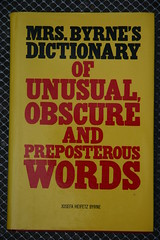
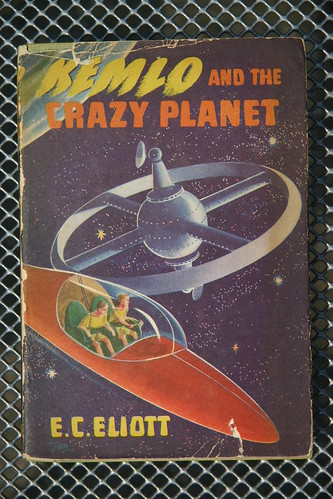
Bredevoort is a small village in our neighbourhood. It’s the Dutch equivalent to Hay-on-Wye, being filled with more bookshops than you can shake a stick at. In addition, it has regular open-air book markets. There was one today, and it being a pleasant day, I cycled along to have a look.I struck lucky with two books. The first was a hardcover edition of Mrs. Byrne’s Dictionary of Unusual, Obscure and Preposterous Words. I’ve long had a paperback edition in my library, but it’s been well thumbed and showing the signs of being the worse for wear. To find a pristine hardcover edition was a joy. The longest word in it contains 1,913 letters (the chemical name for tryptophan synthetase A protein).The second was a children’s book: Kemlo and the Crazy Planet. I had several books from the Kemlo series as a child, but, alas, lost track of them during the course of the years. When I saw this book (still with its dustjacket) lying on a stall, I knew that I had to buy it instantly.The books were written by Reginald Alec Martin (alias E. C. Eliott) and were probably one of the factors that got me hooked on science and science fiction when still a very small boy. I’m very pleased with this find… -
Happy Birthday, Gustav!
It’s the birthday today of one of my favourite composers. I was reminded of this by The Ridger, over at the Greenbelt blog, who also mentions Alma Maria Mahler. She led a very colourful life, which prompted Tom Lehrer to pen one of his witty ditties. The introduction and lyrics can be found in The Ridger’s entry.I love the photograph of Alma in the Wikipedia entry. The person shines through, and you can tell she has depth to her character. -
“A Religious Experience For Atheists”
That’s how Joe Clark describes 2001: A Space Odyssey. I can buy that. I’ve seen the film, oh, dozens of times, but it still manages to give me goosebumps. But where I would disagree with Joe is where he claims that it is "an index of a generation gap among cinéastes, since the group that considers 2001 the finest motion picture of the 20th century simply will never get along with the group that recapitulates tired arguments for the consensus choice, Citizen Kane".Tosh. They are both brilliant works of art. I would find it difficult to have to choose between them. I am reminded of the old joke about the Jewish mother who presents her beloved son with two ties for his birthday. He dutifully appears at his birthday party wearing one of them. "So", she says, "you didn’t like the other one, then?" -
What I Did Wrong
That’s the title of a new book by John Weir. Well, actually, it’s only his second book since the publication of The Irreversible Decline of Eddie Socket back in 1989. Eddie Socket was a brilliant debut by Weir – so good that I wound up having two copies of it in the library – having first bought the paperback edition, I tracked down a hardcover edition so that it would last longer.And how did I find out that Weir has published his second novel after a gap of 17 years? That’s the beauty of serendipity on the internet… The Mumpsimus blog had a chance mention of an article in The Village Voice by Edmund White on the "new gay fiction". Following the link and reading the article (because White usually has something interesting to say) unearthed the fact that Weir has a new book out on the streets. As a result, What I Did Wrong has gone onto my want list. -
Dutch Cities On The March
The Dutch Central Bureau of Statistics quantifies what most of us have long suspected: cities are expanding around their edges, at the expense of green buffer zones. -
Like a Fish Without a Bicycle
Inayat Bunglawala, over in the Guardian’s Comment Is Free blog, asks the question: Darwin and God: Can They Co-exist?
A believer himself, he feels that they can, but is clearly made uncomfortable by those who see god as an irrelevant fairytale. Bunglawala, for example found the “militant atheism” of Richard Dawkins “quite off-putting”. Much more to his taste are Kenneth Miller and Stephen Gould’s attempt to soften the blow of the implications of evolution on religion.
The trouble is that the arguments of Miller and Gould that try to reconcile evolution and religion are far from strong.
By chance, this week I’ve been reading Follies of the Wise, a selection of essays by Frederick Crews. Chapters 14 and 15 (The New Creationists And Their Friends and Darwin Goes To Sunday School) were originally published as a two-part essay “Saving Us From Darwin” in The New York Review of Books, October 4 and 18, 2001. The essay Darwin Goes To Sunday School is a damning critique of the arguments of Miller and Gould. While Crews applauds much of Miller’s book Finding Darwin’s God for its ”most trenchant refutation of the newer creationism to be found anywhere”, when Miller tries to drag God and Darwin to the bargaining table, “his sense of proportion and probability abandons him, and he himself proves to be just another ‘God of the Gaps’ creationist". Crews points out a number of flaws in Miller’s arguments, and wryly observes that: “As the fruit of a keen scientific mind, Finding Darwin’s God appears to offer the strongest corroboration yet of William Provine’s infamous rule: if you want to marry Christian doctrine with modern evolutionary biology, ‘you have to check your brains at the church-house door’”.
Stephen Gould, with his book Rocks of Ages: Science and Religion in the Fullness of Life, does not emerge with any honours either from under Crews’ withering glance. Gould’s central idea is that there are two “magisteria” or domains of authority, which will enjoy mutual respect if their adherents refrain from any attempted synthesis. That is, scientists can investigate nature, while religionists can pursue spiritual values and ethical rules.
As a side issue, this idea that religionists can pursue spiritual values and ethical rules often seems to be taken as only religionists can speak with any authority in matters of morality and ethics (and perhaps that is what Gould himself meant). It is hinted at in Bunglawala’s piece: “[Gould] also gently chided those scientists who made similarly unsupported atheistic claims about what evolution had to say regarding questions of meaning and purpose – questions that have traditionally been the domain of religion”. As Ophelia Benson, over at ButterfliesAndWheels.com, says:
Religion does not (whatever it might like to think) get to put up "Keep Out" signs on questions of meaning and purpose. Anybody can address those questions, anybody at all, and that emphatically includes atheists. In fact, of course, atheists are better people to turn to for such discussions, since their versions of purpose and meaning don’t rely on belief in a fictitious being who watches the sparrow and makes babies and animals suffer torments of pain because it’s good for them.
But I digress; back to Crews on Gould… Crews finds that “Gould delivers gratuitous restraining orders to both factions. In exchange for abandoning their immanent God and settling for a watery deism, the religionists get the realm of ethics largely to themselves, while scientists are admonished to eschew ‘invalid forays into the magisterium of moral argument’ (Rocks of Ages, p. 176)”. But as Crews points out, the supreme irony of that statement is that “Rocks of Ages is itself a moral argument proffered by a scientist and an infidel – and why not?” Gould is clearly trying to have his cake and eat it.
The last two paragraphs from Darwin Goes to Sunday School are, I think, worth quoting in full:
The evasions practiced by Pollack, Haught, Ruse, Miller and Gould, in concert with those of the intelligent design crew, remind us that Darwinism, despite its radical effect on science, has yet to temper the self-centered way in which we assess our place and actions in the world. Think of the shadows now falling across our planet: overpopulation, pollution, dwindling and maldistributed resources, climatic disruption, new and resurgent plagues, ethnic and religious hatred, the ravaging of forests and jungles, and the consequent loss of thousands of species per year – the greatest mass extinction, it has been said, since the age of the dinosaurs. So long as we regard ourselves as creatures apart who need only repent of our personal sins to retain heaven’s blessing, we won’t take the full measure of our species-wide responsibility for these calamities.
An evolutionary perspective, by contrast, can trace our present woes to the dawn of agriculture ten thousand years ago, when, as Niles Eldredge observes, we became “the first species in the entire 3.8 billion-year history of life to stop living inside local ecosystems”. Today, when we have burst from six million to six billion exploiters of a biosphere whose resilience can no longer be assumed, the time has run out for telling ourselves that we are the darlings of a deity who placed nature here for our convenience. We are the most resourceful, but also the most dangerous and disruptive, animals in this corner of the universe. A Darwinian understanding of how we got that way could be the first step toward a wider ethics commensurate with our real transgressions, not against God, but against Earth itself and its myriad forms of life.
Follies of the Wise is worth reading. I thoroughly recommend it.