Year: 2008
-
A Victory for Common Sense
I see that a group of retired Gurkhas have won their court battle for the right to stay in Britain. As their lawyer says, it is a victory for common sense. It just strikes me as a slap in the face for them that the UK Home Office would let this come to having to be judged in a court of law.Even now, the statement by Home Secretary Jacqui Smith as reported in the story hardly rings true as accepting that the men are owed a "moral debt of honour" (the judge’s words) and that the "Home Office rules are unlawful. She still hedges with weasel words and phrases: "where there is a compelling case" and "honouring our commitment… by reviewing all cases…". Distasteful, Ms. Smith, distasteful. -
The Astrobiology Rap
Rap music is not usually my cup of tea, but every once in a while a piece comes along that makes me sit up and listen. It happened with the Dawkins Rap a little while back. And now, here’s the Astrobiology Rap by Oort Kuiper, a.k.a. Jonathan Chase, a postgraduate student.(hat tip to SciencePunk) -
Precisely
In today’s Guardian, Philip Pullman reacts with some glee to the news that his book The Golden Compass (aka as The Northern Lights) is in the top five of the American Library Association’s list of most-challenged books in 2007. In passing he makes what strikes me as a pretty profound and true statement about organised religion:Religion, uncontaminated by power, can be the source of a great deal of private solace, artistic inspiration, and moral wisdom. But when it gets its hands on the levers of political or social authority, it goes rotten very quickly indeed. The rank stench of oppression wafts from every authoritarian church, chapel, temple, mosque, or synagogue – from every place of worship where the priests have the power to meddle in the social and intellectual lives of their flocks, from every presidential palace or prime ministerial office where civil leaders have to pander to religious ones.My basic objection to religion is not that it isn’t true; I like plenty of things that aren’t true. It’s that religion grants its adherents malign, intoxicating and morally corrosive sensations. Destroying intellectual freedom is always evil, but only religion makes doing evil feel quite so good.There’s something in what he says… Whether it’s the Catholic church stoking the AIDS epidemic in Africa, or the Taleban gunning down policewomen in Afghanistan, organised religion and the levers of political power are a dangerous combination. Malalai Kakar has been killed by this potent cocktail. She won’t be the last. -
Round the Hurin
Henry Gee, over at his blog, The End of the Pier Show, pens a pastiche that views Tolkien’s The Lord of the Rings through the lens of Round the Horne. British people of a certain age and sensibility (e.g. me) will find it irresistably funny. I can hear all the characters speaking the script as clear as a bell. -
Segregation
The author and cartoonist Alison Bechdel blogs about the strange phenomenon of segregated drinking fountains in Indianapolis airport… -
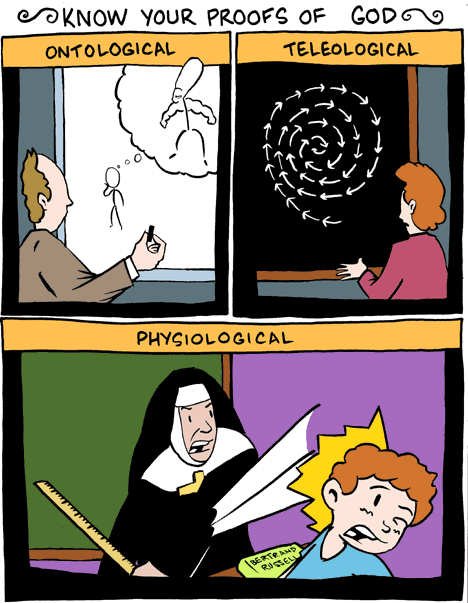
Proofs of God
Ontological, Teleological, Physiological… I can’t help feeling that we need to add in Psychological in there somewhere as well… -
Stampede
We had a bit of excitement this morning. First of all, we were woken up at 7 am by a maize harvester working the field that is ten yards away from the bedroom window. Then, while I was letting the dog out for his morning constitutional at 8, I became aware of a lot of shouting going on at the front of the house. The dog ran there barking, and I followed as quickly as I could. I was met by the sight of our neighbour’s cows galloping back and forth in the garden and José, his partner, trying to round them up without too much success. She was trying to put them in the field next to us, but they had got away from her at the road crossing, and decided to make a dash for freedom.She yelled at me to ring Herman, the farmer, to come and help, so I went inside and rang him, while watching the herd thunder past on the front lawn in the direction of the maize field. He arrived after a couple of minutes, and between us, and with the help of the men harvesting the maize, we managed to get the herd under control and into the field where it should have been.There’s a couple of fence posts damaged, and some of the borders look a bit the worse for wear, but it could have been a lot worse. The lawns are in a bit of a state, but they’ll recover. The stampede has hopefully scared away the moles with a bit of luck. Never a dull moment… -
Two Analyses of a Disaster
My understanding of economics is pretty basic. I can understand, and try to follow, the financial principles espoused by Mr. Micawber in Dickens’ David Copperfield:
"Annual income twenty pounds, annual expenditure nineteen pounds nineteen and six, result happiness. Annual income twenty pounds, annual expenditure twenty pounds ought and six, result misery."
I really think that that is all one needs to know, anything more, it seems to me, gets closer to religion and blind faith. So I can’t say that I’m much surprised by the current crisis in the financial markets.
In an attempt to understand the causes, I’ve been reading two analyses of the events. The first is an article in Edge written by Nassim Nicholas Taleb called The Fourth Quadrant. I will forgive him the air of "I told you so" that permeates the article, he’s somewhat justified in having it. After all, it was he who wrote back in 2006:
The government-sponsored institution Fannie Mae, when I look at its risks, seems to be sitting on a barrel of dynamite, vulnerable to the slightest hiccup. But not to worry: their large staff of scientists deemed these events "unlikely."
However, his analysis goes into dizzying detail about statistical theory and how people misinterpret statistics and probabilities. I’ll probably need to read the article several times before I can come closer to understanding what he is saying. But even after all that, I can’t help feeling that he’s shining the light of reason in the wrong place. That was brought home to me when I read John Carter Wood’s article over at Obscene Desserts. Like me, John finds the workings of high finance rather mysterious. He quotes from an article in the New York Times:
The mortgages, with an average size of about $450,000, were Alt-A loans — the kind often referred to as liar loans, because lenders made them without the usual documentation to verify borrowers’ incomes or savings.
And then, without the benefit of graphs or statistics, John gets to the root of the matter:
Let’s just pause here for a brief moment. Just for a measly few seconds.
Please just consider that last sentence, the one in which it is pointed out that lenders gave people mortgages worth an average of nearly a half-million dollars without even checking how much they earned or how much money they had?
Is this for real?
Because if it is, I can only say: What–please pardon my French (you know, I’ve been spending some time there)–the fuck?!
It seems to me to be all too easy to label the shenanigans on Wall Street and in other financial centres as “a crisis too complex for easy fixes”. John’s put his finger on it, the world’s economy is seemingly run by a bunch of greedy wankers. Micawber’s principles should never have been forgotten.
-
Q.E.D.
Jesus and Mo explain the difference between a cult and a religion. I thought the difference was at least 1,400 years… -
The Ghost of Miguel Servetus
An excellent and eloquent statement by Austin Dacey in yesterday’s meeting of the Human Rights Council being held in Geneva. -
The Human Odyssey
I see that the cartoonist Martin Rowson has a new book coming out entitled Fuck: The Human Odyssey. It consists of a series of images tracing the human journey from its beginnings. The majority of the images have a speech bubble containing the single eponymous expletive. You can see (and buy!) the original images at the Chris Beetles Gallery. I particularly like the one illustrating the High Renaissance.Rowson is a good writer as well as cartoonist. His book The Dog Allusion is both witty and true. -
The Chronophage
I’m a bit late coming to the party, but I do want to draw your attention to the marvellous work of engineering art that is the new Corpus Christi clock: the Chronophage. It was unveiled last week by Stephen Hawking. The clock is a gift to the college from John Taylor, a fellow Manxman and inventor. He sounds a most interesting and unassuming individual; I’m sorry that I have never met him in person.Martin Kleppmann has an excellent entry on his blog about the clock and John Taylor, including a video of Taylor himself explaining some of the workings of the clock. Well worth looking at. -
Hippisch Festijn 2008
This weekend saw the Hippisch Festijn 2008 – an annual international horse eventing spectacle – taking place in our neighbourhood. I went out this morning to take photos of the cross-country event. -
Merlin
Dear god, but I cannot believe how bad the new BBC series Merlin is. What a waste of some good actorly talents (John Hurt, for example) on a pile of utter crap.Update: Mark Pickavance’s review puts into words the reasons why I was so irritated with Merlin. Not content with driving SUVs through the mythology, the writers also brought in flat modern dialogue (example: "don’t be such a prat…"). While I’m not looking for Chaucerian English, I think we deserved better than this… -
Moral Quandary
Abstruse Goose poses a moral quandary at the family reunion… -
A Plea for Reason
A promotional video from the Center for Inquiry. It’s a worthy effort, but I couldn’t help but think that during the opening minute, when the "once we believed in superstition" trope was being laid out: don’t look now folks, but most of us on this sorry little excuse for a planet still do…More’s the pity, and more power to the elbow of the folks in the Center for Inquiry. Hmm, perhaps I should be putting my money where my mouth is… -
Managing Photo Libraries – Part 6
Time for another episode in my saga of trying to manage my library of photos. This has been prompted by the release this week of the beta of what will be the next major release of Microsoft’s Windows Live Photo Gallery.
While there’s a lot to like about Photo Gallery, it continues to have shortcomings that stop me from making much use of it. Some of them are down to bugs that Microsoft really should address, while others are limitations in its capabilities. But even here, at least one of the limitations could be removed by Microsoft as I’ll illustrate.
First, the bugs. One that I find particularly irritating, because it’s been known about by Microsoft for nearly a year, but still has not been fixed in this new beta, is the “Publish to Flickr” bug. It’s probably even a very simple fix – a change to a single line of code would probably do it – so I fail to understand why this has not been done. Update: this bug was finally fixed by a release of WLPG on 16 December 2008.
Another long-standing bug, but one that may be more tricky to fix, is that Windows Live Photo Gallery (WLPG) is aware of IPTC/XMP metadata tags that images may have, but seems to deal with them on a hit or miss basis. Sometimes WLPG will correctly read in the IPTC/XMP tags from an image file and add them to its own tag list, and sometimes it won’t. Here’s an illustration of this. The following image is a WLPG screenshot of twelve photos that have been tagged with IPTC/XMP metadata. I happen to have used IDimager, which is my current tool of choice at the heart of my digital workflow, but I could also have used Microsoft’s own Pro Photo Tools 2 to add IPTC/XMP metadata. (Note: IDimager is no longer available. Its successor is Photo Supreme, which I am now using)
In this screenshot of WLPG, I have selected the first of the twelve images, and in the information panel on the right are the description tags associated with the image. I’ve highlighted the tags with a red box for clarity. Now, I did not use WLPG to add the tags to the image, they were automatically read in from the image by WLPG itself and added to WLPG’s list of tags.
That’s how it should work – WLPG should check images for IPTC/XMP metadata and use this to maintain its own tag hierarchy. But now look at this next screenshot. Here, I’ve selected the second image in the sequence of twelve. Remember that all twelve images have had IPTC/XMP metadata added to them, in fact they all have exactly the same metadata. But here, in this screenshot, WLPG is showing that there are no tags associated with this image, so it seems to have failed to read in the metadata from the image.
In fact, in this set of twelve images, all of which have the same metadata, WLPG failed on nine images, and only correctly read in the metadata on three (numbers 1, 10 and 12). While WLPG has a “Refresh” command, this doesn’t seem to have any effect on reading in metadata. It still stubbornly claims that nine of the images have no descriptive tags associated with them.
This is a showstopper of a bug as far as I’m concerned. For me, the “truth is in the file” – in other words, the metadata describing an image file must be preserved in the file itself. That means that the IPTC/XMP and EXIF metadata is central for management of my photo library. Having metadata held outside the image files (as WLPG is doing in its own database) may be necessary for performance reasons, but the content must always reflect the metadata in the files themselves.
A rather good analogy that I came across is this… Imagine that you have an album of family photos. It’s full of photos of members of your family stretching back several generations. Underneath each photo is a handwritten description of who is in the photo – that is the metadata for the photo. It’s a marvellous resource for you and your family – a record of your family history. But over time, the glue degrades, and the photos become loose. Worse, many of them become unstuck. What do you have then? A pile of loose photos, and an album with blanks where the photos should be – and no way of knowing which photo should go where. The metadata has become separated from the photos.
What’s the solution? Well, what should have been done in the first place is to write on the back of every photo who is in the photo before sticking the photos in the album. In other words, the metadata should be directly associated with the photos themselves. Then it doesn’t matter if the photos fall out, the album can always be reconstructed. Indeed, a new album can be made when the old one falls apart.
Anyway, back to WLPG. I mentioned limitations. One is in the photo import process (when you transfer off a batch of photos from a camera or memory card into the PC). While WLPG gives some options for creating folders and renaming the files as part of the process, they are nowhere near flexible enough to meet my requirements. I spelt out what I was looking for in part 5 of this series of posts. I also mentioned that Microsoft had claimed that the underlying import engine was flexible enough to do what I wanted. It’s a pity then that in this latest beta, the claimed flexibility has not been exposed. We still have the same old limited options that we had a year ago.
There are a couple of new features in this beta of WLPG. The first is one that has long been asked for: the ability to select photos based on rating. I’m a little surprised that it’s taken so long to be included, given that it has always been in Vista’s Photo Gallery. Still, I suppose I shouldn’t be churlish.
The second is a totally new feature: face recognition. You can tag faces in your photos with people tags. Interestingly, if you are using Windows Live Contacts, then your people tags are automatically populated with your contact list to start with, and changes to this list are reflected in WLPG. I still need to investigate this feature a bit more carefully. Unless these tags are written back to the individual image files as XMP metadata, so that they can be used in other applications, then I would not want to make much use of this feature. It would be too much like simply writing names underneath photos in an album. No guaranteed longevity there, then…
So, all in all, one cheer for WLPG. But until the metadata bug in particular is addressed, I’m not going to be making much use of this application.
Update 24 September 2008: I’ve done some more testing on the metadata bug, and I think what is happening is that WLPG is confused by hierarchical keyword metadata. In WLPG, you can have a long list of keywords/tags, or you can start to group them in a hierarchy. So, for example, my keyword cows is actually part of a hierarchy that starts Nature/Animals/livestock/cattle/dairy cattle/cows. That way, when I search for photos with the keyword cows, it will just show me those with cows in them. But if I search for photos with the keyword livestock, it will show me photos of cows, horses, pigs, sheep, and so on.
It looks as though WLPG will recognise a hierarchy of IPTC/XMP keywords in new files, and uses it to add to its own hierarchy. However, thereafter it refuses to recognise any changes to the metadata of image files containing hierarchical metadata, and so ignores them. Not very useful, and what I consider to be a showstopper bug.
Update 4 December 2008: here’s the blog entry where I track down this issue of hierarchical keywords causing a problem in WLPG…
Other entries in this saga:
- Managing Photo Libraries – Part 1
- Managing Photo Libraries – Part 2
- Managing Photo Libraries – Part 3
- Managing Photo Libraries – Part 4
- Managing Photo Libraries – Part 5
- Tagging Digital Photos
- Tagging Digital Photos – Part II
- Tagging Digital Photos – Part III
- All You Wanted To Know About Photo Metadata
- Windows Photo Gallery on Vista Beta 2
- Metadata Woes
- Metadata Woes – Part II
- More Metadata Woes
- Photo Metadata (link to IPTC whitepaper)
-
Lindsay Anderson
A good article in today’s Guardian about the film director Lindsay Anderson. By coincidence, earlier this week I watched if…. again. While I’ve seen it more than once, I suspect that the last time I saw it was probably thirty years ago. I was struck by how well it has stood the test of time. It remains a brilliant, brilliant film.The DVD that I now have of it also has an audio commentary by Malcolm McDowell, which is an excellent bonus. Plus, there is one of Anderson’s early B&W film shorts: Thursday’s Children, which is a tremendously moving (and Oscar-winning) look at the education of deaf children in a special school. -
Depressing
While this news story is depressing enough, what is even more depressing is reading the comments on it that follow. Barking doesn’t even begin to describe them. I’m sorry, I now need to go for a quiet walk in the woods.