Reflections on life at “De Witte Wand”…

Year: 2009

  • Fun With Technology – Part II

    Last month, I wrote about some of the ways in which consumer technology doesn’t always work as promised. Today I’ll continue with the saga of the SNAFUs I’m encountering in my quest to have a media network in the house. I should start off by pointing out that today’s episode deals with cutting-edge features of products that are not in their final state, so it’s hardly surprising that not everything works as it should. Still, I post this as a counter-balance to some of the rah-rah blog posts that I’ve seen to illustrate that things aren’t always as wonderful as they seem.

    Today’s topic is the “Play to” feature that will be in the upcoming version of Windows Media Player that will ship with Windows 7. That means that when browsing my music library, instead of choosing a track (or an album) and having it play on my computer, I can send it to be played on the Denon AVR-3808 that sits at the heart of our home’s audio-visual system. What I see on the PC is something like this:
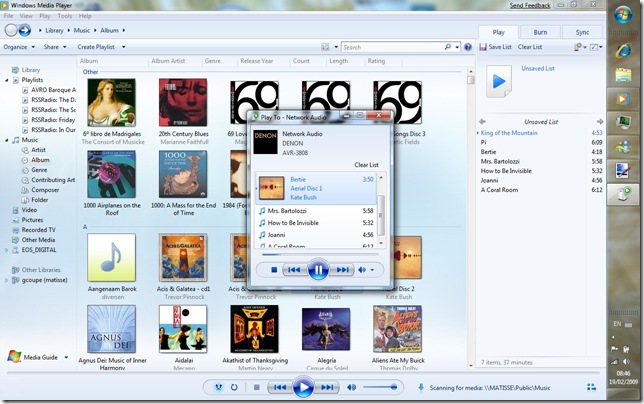
    WMP12

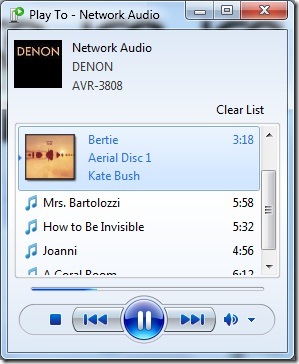
    Let’s take a closer look at the “Play to” window:
    WMP12 - Play To 1

    Here you can see that a track from a Kate Bush album is being played through the Denon AVR-3808. At the bottom of the window are the playback controls. The “Play”, “Pause”, “Stop” and “Track skip” buttons work correctly. In theory, I should also be able to set the volume level on the Denon via the volume control here, but this currently has no effect. This is probably because it’s an attribute in the new version 1.5 of the DLNA specification. The Denon is currently only certified to version 1.0, but a future firmware upgrade should be able to take care of this.

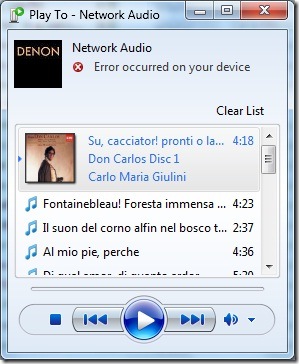
    Well, this was all very nice, thought I, I’ll be able to assemble Playlists on my Tablet PC and use them on my Denon. But there’s many a slip ‘twixt cup and lip… I found that many tracks simply would not play on the Denon. When I tried, the “Play to” window would report that an error had occurred on the Denon, like this:
    WMP12 - Play To 2 

    As you can see, it’s not a particularly informative error message, and looking through the error logs on the PC using Event Viewer didn’t reveal any more information that I could see.

    What was going on? Further experimentation revealed that some tracks worked while other tracks didn’t – and it was consistent. Those that worked, always worked; and those that didn’t, always failed. And just to be clear – all of the tracks worked when I called them up off the Media servers using the Denon directly. But when I sent them to the Denon via the “Play to” feature, some of the tracks would always fail.

    Finally, I found the correlation. The tracks that work were encoded using the default Windows Media Audio codec, encoding at a bit rate of 192 kbps. Tracks encoded using the Windows Media Audio Pro codec (also at a bit rate of 192 kbps) and those encoded using the Windows Media Audio Lossless codec (which uses higher bit rates) always fail with the “Play to” feature. This is a bit of a bugger, since these days I always use the WMA Lossless codec to rip my CDs to my Music Library.

    So, to summarise:

    Codec

    Streamed to Denon via “Play to” Feature

    Streamed to Denon Direct from Media Server

    WMA

    Works

    Works

    WMA Pro

    Fails

    Works

    WMA Lossless

    Fails

    Works


    As I said at the beginning, Windows 7 is still in Beta, and the Denon has not yet been certified to the new 1.5 version of the DNLA specification. So the problems could lie in either of them or both. But I do find it interesting that the Denon has no problem with all forms of WMA codecs when the files are streamed directly to it, which leads me to suspect that the issue may well lie with the current Beta of Windows 7. Whatever the cause, I hope that it gets resolved soon.

    Important Update, 13 March 2009: I’ve discovered that I am in error in believing that the Denon works directly with WMA Pro and WMA Lossless streams – it doesn’t. The reason why I thought that these were working when streamed directly to the Denon (as shown in the table above) is that the streams were actually being transcoded into PCM format on the fly by the Media Servers I was using. Clearly, the servers were negotiating with the Denon over a supportable format when talking directly with the Denon. When using WMP12’s “Play to” feature, there are three devices in the chain, and a proper negotiation is not taking place. So, the server sends WMA Pro or WMA Lossless to the Denon, which can’t dealt with the formats, and the process fails.

    Second Update, 14 May 2009: Using the Windows 7 Release Candidate, I’ve found that there is are scenarios where the format negotiation will fail, and ones where the negotiation will succeed. It’s all down to how you access your music files in Windows Media Player, and what the media server is. I’ll document all this and add it as a fresh entry into my blog… It’s now posted see Fun with Technology – Part IV.

  • The Fall

    Almost a year ago, I wrote about a film that I wanted to see: The Fall, a film directed by Tarsem Singh that was originally released back in 2006. It’s now finally been released on Blu-ray, so I invested in a copy and sat down to watch it with Martin and a friend.

    Well, we were all entranced and stunned by the film. Visually, it’s one of the most beautiful films I’ve ever seen. Shot after shot were jaw-dropping. And the central performances of Lee Pace as the injured stuntman (and the bandit) and Catinca Untaru as the little girl were heart-stopping. Untaru’s performance, in particular, was not a performance at all – she was the little girl.

    The film moves constantly between scenes set in a Los Angeles hospital in the 1920s, where the stuntman is weaving his fantastical tale for the little girl, and into the tale itself, which is being visualised by her.

    The settings of the tale are, as I said, stunning. The interesting thing is that they are all real locations – there was no CGI trickery used to construct virtual reality here.

    The film is, in effect, a love letter from Tarsem to the power of cinema and its abilities to spark the human imagination. It’s a masterpiece. See it.

  • Wine

    BBC Four has started a new series on the wine industry, centred around the venerable firm of Berry Brothers and Rudd. It is clearly going to be absolutely spellbinding, mainly because the contrast between the mystique that is being sold and the bunch of tossers, poseurs and wide boys that pass in front of us could hardly be greater.

    Wonderful stuff.

  • A Way With Words

    I’ve mentioned the writings of Charlie Brooker before. His jaundiced view of the world strikes a chord with me when I’m in full misanthropic cynic mode. Which is most of the time, these days.
     
    His current article takes a relatively unimportant topic – the new flavours being introduced by a crisp manufacturer. However, some of the writing reaches sublime levels. For example:
    The flavour itself is truly vile: if they’d called it Squirrel’s Blood, everyone would’ve believed them. They taste precisely like a tiny cat piping hot farts through a pot-pourri pouch into your mouth.  
    Now, that’s class.
  • Yet More New Age Crap

    I know that I’ve often referred to presentations from TED before as being stimulating and illuminating. Well, a lot of them are. But TED being TED, they also have their share of absolute clinkers in there. Here’s Elizabeth Gilbert demonstrating what happens when you switch your brain off. Dreadful new age woo of the worst kind. And she gets a standing ovation? I despair of our ability to advance. Clearly, the ability to pay $6,000 for a seat at TED is in no way related to rational intelligence.
     
    Black Sun Journal thinks so too, and dissects it better than I.
  • Happy Birthday, Miep!

    Miep Gies will celebrate her 100th birthday tomorrow. Happy birthday, Miep!
  • Fold Along Dotted Line

    By way of light relief, and because I’m an old geezer who remembers both the originals and this wonderful parody by Peter Cook and Dudley Moore, here’s Superthunderstingcar Is Go!


    (hat tip to Raymond Chen)
  • The Balancing Act

    Yes, I know that I said that I wouldn’t give Wilders the air of publicity, but I do think it’s worthwhile to look at the wider issues around the right to free expression. As I’ve said before, I loathe and detest all that Wilders represents, but we’ve now had two governments (the Dutch and the UK) respond to him in ways that strike me as being completely counter-productive. Russell Blackford and Udo Schuklenk both sum up the reasons why far better than I can. I suggest that you go and read what they have to say.
  • Upsetting Harmony

    Rather than give the air of publicity to Geert Wilders’ circus, I want to draw your attention instead to recent events in Calcutta (or Kolkata, as we are supposed to call it these days). Johann Hari recently wrote what I thought was an excellent article on the defense of free speech. The editors of the Indian newspaper, The Statesman, thought so too. So much so that they reprinted it. Result, four thousand Islamic fundamentalists rioted outside the newspaper’s offices in Calcutta, and the editor and publisher have now been arrested on the charge of "deliberately acting with malicious intent to outrage religious feelings". Go and read about it. Also, Ophelia has some thoughts about the situation, and the need to defend human rights.
  • Kurzweil Kookery

    And while I’m pointing at the clay feet of people who pretend otherwise, I can’t help saying that when I read PZ Myer’s views on Ray Kurweil’s posturings, I punched the air and said "yes!" I’ve never really understood how Kurzweil’s pontifications receive anything other than a Bronx cheer. As a commentator stated, Kurzweil puts me in mind of Madame Blavatsky. Are both Blavatsky and Kurzweil deluded, cynical or merely mistaken? I don’t know, but I’m pretty sure that Kurzweil will be proven as erroneous as Blavatsky by history.
     
    Oh, and perhaps I should point out that my main beef with Kurzweil is over his timescales. They seem to be ludicrously on the optimistic side. My bet is that we as the human race will have long since been extinguished, or died at our own hands, before our technologies will have evolved sufficiently to act as perfect substitutions for our current carbon-based substrates of consciousness.
  • Nothing Behind The Eyes

    Over in Britain, there’s a spat broken out between a journalist (George Monbiot) and a politician (Hazel Blears). The latter, it seems to me, sums up all that is wrong with Nu-Labour politics. As one commenter wrote: "there’s nothing behind the eyes". I think it’s worse that that – I detect the stirring of pod people.
  • A Life With Bells On

    Morris Dancing has always struck me as being funny, charming and slightly sinister by turns. Now it looks as though there’s a new film to examine all three aspects.

    I’m not sure what they did to the Cerne Abbas Giant for the trailer – looks as though they made him bashful for the American audience…

    (hat tip to Francis Sedgemore)

  • Talking Tosh

    I see Tony Blair’s been talking tosh again. Frankly, I’m amazed that after what we’ve seen from the man that people continue to give him the time of day. As usual, Ophelia sums up my feelings about the wrongness of it all.
  • Hack Your Brain

    The Boston Globe has a terrific "how-to" article on five simple ways to fool your brain.
     
    (hat tip to Neurophilosophy for the link)
  • God Is A Spandrel – Part II

    The last time I read an article by Michael Brooks, I found it rather odd. I’ve just read another article by him, and this one I found to be rather interesting – perhaps because he is fully in science journalism mode, rather than offering up his own speculations.
     
    It’s an article in New Scientist entitled Born Believers: How Your Brain Creates God. Like an article in the NYT, which I pointed out a couple of years back, it explores the scientific debate on whether religious beliefs are the result of an evolutionary adaptation or arise as a by-product of some other adaptation. Now, just as then, it seems to me that the evidence points to religious belief being a spandrel – a by-product of other evolutionary adaptations.
     
    (hat tip to Epiphenom for the link to the NS article)
  • Literary Pastiches

    Last night I dreamed of literary pastiches. I think what got me started was, curiously, not a pastiche, but the real copper-bottomed article. An article, in fact from the World’s Pictorial News, published 12th February 1928, and quoted by John over at Obscene Desserts. It’s a real hoot, and definitely worth your time. As John says, the whole tone of the article is very much of its time, and reminiscent of the plot device of Dennis Wheatley’s 1934 novel, The Devil Rides Out.

    I’ve just finished reading the three “Lucifer Box” novels (The Vesuvius Club, The Devil in Amber and Black Butterfly) by the multi-talented Mark Gatiss and enjoyed them very much. The Devil in Amber is set in the late 1920s, and is a pitch-perfect pastiche of the style of the newspaper article and Wheatley’s novel. All three novels are pastiches – the first (The Vesuvius Club) has an Edwardian setting, and is a pastiche of Oscar Wilde crossed with Conan Doyle, while Black Butterfly, set in the 1950s is a pastiche of Ian Fleming.

    Gatiss has great fun with all three novels, in particular with his characters’ names; starting with Lucifer Box himself, and taking in such luminaries as Bella Pok, Kitty Backlash, Whitley Bey, Melissa ffawthawte, Percy Flage, Victoria Wine and her deadly manservant Oddbins. For those not familiar with the high streets of Britain, the last two names are wine shop chains.

    Anyway, I’d obviously got to thinking about literary pastiches when I fell asleep last night, because I dreamt of a Bond-like adventure. I awoke this morning with the name of my Bond Girl on my lips. Not a bad effort, even if I do say so myself. It was Ms. Clementine Tonguewood.

  • Unified Messaging

    This is another post about computers and the Internet, so if they don’t make your heart beat a little faster, then best turn away now.
     
    I was interested to see a case study recently published by Microsoft that concerned my old employer, Shell. When I worked there, our communications infrastructure was a horrendous patchwork of multiple technologies and vendors covering the channels of telephony, video, and computing (email and web). The dream was to try and bring some order to this chaos, but at the time it would have been very difficult for two reasons: immature technology and organisational politics, to put it politely.
     
    Still, times change and things move on. I was pleased to see an old colleague of mine, Johan Krebbers (Shell’s Group IT Architect), put forward the vision to provide a single user interface for all Shell’s 150,000 users of real-time communications. It’s a big challenge to consolidate about 200 PBX systems, multiple audio and video conferencing systems into a single service. I wish him and his colleagues the best of luck. Mind you, if anyone can make this work, it will be Johan – the man’s a phenomenon.
  • My Snake Here Likes To Pick Out His Own Cookies

    In life’s great game of Snakes and Ladders, whenever I feel that there is a faint chance that the human race might learn from its mistakes, a visit to Not Always Right almost invariably sends me sliding back down a snake to the starting point. Literally, in this case.
  • Manipulative, Cynical Nonsense

    That’s the title of a thorough fisking of the latest tripe from Theos – a "theological think-tank". Mmmn, I just lurv the smell of oxymorons in the morning.
  • Web Forms Gone Wild

    Mr. Eugenides discovers that the Royal Opera House is rather particular on making sure that you choose the correct title for yourself on their web form.