Reflections on life at “De Witte Wand”…

Year: 2009

  • Bibliophiles ‘R Us

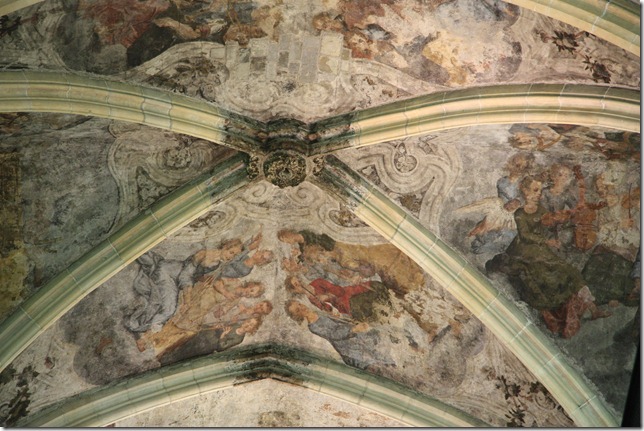
    This last week, I’ve been making a couple of pilgrimages to bookshops and bookmarkets. First up was a day trip down to Maastricht, to the Dominicanen bookshop. This is notable for being in a converted church, and is probably the most beautiful bookshop in the Netherlands.

    20090727-1205-27

    20090727-1206-25

    20090727-1207-16

    I confess that I didn’t actually buy anything there this time around, but it was worth it for the sightseeing, and the opportunity on the train journey to get stuck into Carlos Ruiz Zafon’s “The Angel’s Game”.

    Next up was the trip last Sunday to the Hanseatic city of Deventer for the annual Bookmarket – the biggest one in Europe with 6 kilometers of bookstalls. Despite the pouring rain, I came away with some success: an armful of books including a first edition hardcover of Spider Robinson’s “Callahan’s Lady” and Anton Radevsky’s pop-up book on Spacecraft.

    I have a small collection of pop-up books – I’m fascinated by paper engineering. But it’s nothing when compared to the collection of someone like Kees Keijzer. He was mentioned in the Volkskrant’s report on the bookmarket. Apparently, he has a collection of 2,500 pop-up books. That’s more than my complete library, for heaven’s sake.

  • A Hit And A Miss

    Somewhere (I can’t remember where), I came across a review of Jedediah Berry’s "A Manual of Detection". The review sounded interesting, so I got the book. There were other positive reviews as well, so I started the book with high hopes. Alas, my hopes have been dashed. I found the novel trying too hard, and eventually, simply trying. I’ve given up about halfway through, with a sour expression on my face. It just didn’t work for me.
     
    So I turned to the latest from Malcolm Pryce: "From Aberystwyth with Love". From the very first page, a smile was back on my face, and I can’t wait to immerse myself in this book.
     
    Both books are ostensibly about detectives and are detective novels set in bizarre fantastical worlds. But the difference, as far as I am concerned is like day and night. Give me Pryce over Berry any day.
  • Bang Goes The Theory

    That’s the title of the BBC’s new science show. Tomorrow’s World, it ain’t, but I have to admit to liking it more than I thought I would. It’s clearly aimed at a young audience. not an old fogey like me. And on that level it probably succeeds quite well; hopefully it will get children interested in science.

    The interview with Craig Venter came across well, despite the rather idiotic questions, and the "King of the World" visual reference the director obviously couldn’t resist throwing in.

  • Beware The Spinal Trap

    Simon Singh wrote an article on Chiropractic therapy for the Guardian a couple of months back, with the result that the British Chiropractic Association sued for libel in the British courts. In response, the Sense About Science organisation has started a campaign to keep libel laws out of the subject of science. As part of that campaign, Sense About Science has asked for bloggers around the world to repost the article. So here’s where I do my bit. By the way, do also check out my comment at the end of the reposted article.
    You might be surprised to know that the founder of chiropractic therapy, Daniel David Palmer, wrote that ‘99% of all diseases are caused by displaced vertebrae’. In the 1860s, Palmer began to develop his theory that the spine was involved in almost every illness because the spinal cord connects the brain to the rest of the body. Therefore any misalignment could cause a problem in distant parts of the body.
    In fact, Palmer’s first chiropractic intervention supposedly cured a man who had been profoundly deaf for 17 years. His second treatment was equally strange, because he claimed that he treated a patient with heart trouble by correcting a displaced vertebra.
    You might think that modern chiropractors restrict themselves to treating back problems, but in fact some still possess quite wacky ideas. The fundamentalists argue that they can cure anything, including helping treat children with colic, sleeping and feeding problems, frequent ear infections, asthma and prolonged crying – even though there is not a jot of evidence.
    I can confidently label these assertions as utter nonsense because I have co-authored a book about alternative medicine with the world’s first professor of complementary medicine, Edzard Ernst. He learned chiropractic techniques himself and used them as a doctor. This is when he began to see the need for some critical evaluation. Among other projects, he examined the evidence from 70 trials exploring the benefits of chiropractic therapy in conditions unrelated to the back. He found no evidence to suggest that chiropractors could treat any such conditions.
    But what about chiropractic in the context of treating back problems? Manipulating the spine can cure some problems, but results are mixed. To be fair, conventional approaches, such as physiotherapy, also struggle to treat back problems with any consistency. Nevertheless, conventional therapy is still preferable because of the serious dangers associated with chiropractic.
    In 2001, a systematic review of five studies revealed that roughly half of all chiropractic patients experience temporary adverse effects, such as pain, numbness, stiffness, dizziness and headaches. These are relatively minor effects, but the frequency is very high, and this has to be weighed against the limited benefit offered by chiropractors.
    More worryingly, the hallmark technique of the chiropractor, known as high-velocity, low-amplitude thrust, carries much more significant risks. This involves pushing joints beyond their natural range of motion by applying a short, sharp force. Although this is a safe procedure for most patients, others can suffer dislocations and fractures.
    Worse still, manipulation of the neck can damage the vertebral arteries, which supply blood to the brain. So-called vertebral dissection can ultimately cut off the blood supply, which in turn can lead to a stroke and even death. Because there is usually a delay between the vertebral dissection and the blockage of blood to the brain, the link between chiropractic and strokes went unnoticed for many years. Recently, however, it has been possible to identify cases where spinal manipulation has certainly been the cause of vertebral dissection.
    Laurie Mathiason was a 20-year-old Canadian waitress who visited a chiropractor 21 times between 1997 and 1998 to relieve her low-back pain. On her penultimate visit she complained of stiffness in her neck. That evening she began dropping plates at the restaurant, so she returned to the chiropractor. As the chiropractor manipulated her neck, Mathiason began to cry, her eyes started to roll, she foamed at the mouth and her body began to convulse. She was rushed to hospital, slipped into a coma and died three days later. At the inquest, the coroner declared: ‘Laurie died of a ruptured vertebral artery, which occurred in association with a chiropractic manipulation of the neck.’
    This case is not unique. In Canada alone there have been several other women who have died after receiving chiropractic therapy, and Edzard Ernst has identified about 700 cases of serious complications among the medical literature. This should be a major concern for health officials, particularly as under-reporting will mean that the actual number of cases is much higher.
    If spinal manipulation were a drug with such serious adverse effects and so little demonstrable benefit, then it would almost certainly have been taken off the market.

    Simon Singh is a science writer in London and the co-author, with Edzard Ernst, of Trick or Treatment? Alternative Medicine on Trial. This is an edited version of an article published in The Guardian for which Singh is being personally sued for libel by the British Chiropractic Association.


    Now, you will note the words: "edited version" in the sentence above. Head on over to Jack of Kent’s blog to read the two sentences that have been excised from the article above, and which are the ones that all the fuss is about…
  • Cheeta Makes The Booker

    A couple of weeks back, I mentioned how much I had enjoyed reading James Lever’s cod autobiography Me Cheeta – supposedly the autobiography of the chimp who starred in the Tarzan films. I’m pleased to see, therefore, that Me Cheeta has been put on the longlist of this year’s Booker Prize. I’ll be cheering it on.
  • Moving In Mysterious Ways

    Last week, I ordered a new monitor from Dell. Yesterday, I received an email from Dell telling me that the monitor had been despatched from the warehouse, and was on its way via UPS. The email also gave a link to a UPS web page that tracks the progress of the package.
     
    I confess I am confused. So far, the package seems to have come into the Netherlands at Eindhoven airport yesterday, from where it was promptly despatched to Brussels in Belgium. Hello? This seems to be a case of one step forward, two steps back. Brussels is twice as far away from here than Eindhoven is, and it’s in another country. UPS seem convinced that the package will be delivered today. We’ll see.
     
    This is not the first time that I’ve had experience of UPS moving stuff around in mysterious ways. A few years back, a Dell system was despatched to me from Ireland. It first travelled to Rotterdam, then was sent to France, where it languished for a few days, and eventually was returned to Rotterdam for delivery to me a few kilometers away in Gouda.
     
    Update: …Their wonders to perform… Well, it arrived shortly before 1PM today. I still think that sending it further away to Brussels seems a bit bizarre, but there you go…
  • The Game Cookbook

    Apparently, the appalling Norman Tebbit has written a cookery book. I don’t think I’ll bother buying it – I don’t wish to put even a few coppers in his purse. I suspect John Crace’s digested read of the contents is not a million miles from the impression that I would have, were I to crack open its covers.
  • A New Word

    I learnt a new word today: Lithopedion. It’s both horrifying and amazing at the same time.
  • Pot, Kettle, Black…

    A richly ironical story in today’s Guardian about the British Ex-Pats in Spain who are now feeling the crunch:

    Television shows such as Channel 4’s A Place in the Sun promised adventure, swimming pools and the good life. A collapsing pound and the credit crunch have brought a harsher reality: homesickness, financial hardship and something those who call themselves "expats" rarely take into account, that they are immigrants – often with all the problems of not understanding the language or the rules. Interestingly, a surprising number of them list immigration as one of the things they dislike about Britain. Few, indeed, come from Britain’s own ethnic minorities.

    I find it difficult to raise much sympathy with the plight of such as these. As one commenter puts it:

    Am I supposed to feel sorry for British expats in Spain? They invade by the hundreds of thousands, not making a single effort to learn the language or the culture. They turn their villages into Little Croydons and Little Sheffields. And – we learn – one of the things they dont like in Britain is immigration??? Seriously…

    Indeed, pot, kettle, black… At least I’ve made an effort to learn Dutch, and become a Dutch citizen in my adopted country…

  • Carl Sagan on God

    The premature death of Carl Sagan robbed us of a voice worth listening to. However, I recently picked up a copy of one of his books, published from beyond the grave, as it were: The Varieties of Scientific Experience: A Personal View of the Search for God. I cannot recommend it highly enough.
     
    The book is composed of rediscovered transcripts of a series of lectures that he gave back in 1985. They are as relevant today, perhaps even more so, than as when he first delivered them. The wit, compassion, curiosity, and intellectual integrity of the man shines through on every page. Absolutely stunning.  
  • Tim Burton’s “Alice in Wonderland”

    I see that the first trailer for Tim Burton’s forthcoming film "Alice in Wonderland" has surfaced. Despite the condescension dripping from many of the comments here, I want to see how Burton reinvents Alice. We’ve had Disney, we’ve had Miller (which I adored), we’ve had Svankmajer (which I admired), and now we’ll get Burton – I can’t wait.


  • False Witness

    I see that the philosopher Alain de Botton has now weighed in with his  review of Karen Armstrong’s The Case For God. What I find so exasperating about people such as de Botton and Armstrong is the way they make assertions that patently are simply not true. For example, de Botton explains Armstrong’s point as:

    Both atheists and fundamentalists take God to be an essentially human sort of figure, a giant Father in the sky who watches over us, punishes the guilty, intervenes directly in our affairs and is entirely comprehensible to our minds. "We regularly ask God to bless our nation, save our queen, cure our sickness or give us a fine day for a picnic."

    Er, just a minute, guv – this atheist certainly doesn’t. In fact, I thought I was operating under the assumption that the very definition of an atheist was someone who lacked the belief in any form of gods, beardy interventionist in the sky included… So having erected a strawman, Armstrong and de Botton continue blithely on:

    Her sympathy is with the great Jewish, Christian and Muslim theologians who have denied that any human attempt to put the divine into words will be accurate. We are simply too limited to be able to know God; our apprehension must hence be suffused with an awareness of our provisional and potentially faulty natures. She writes: "He is not good, divine, powerful or intelligent in any way that we can understand. We could not even say that God ‘exists’, because our concept of existence is too limited."

    Right, so having disposed of any attempt at a definition of a god, Armstrong then plays what she sees as her trump card: the whole point of religion is that it’s a mystery, one that helps us deal with our feelings of fear, aggression and guilt. She also defends religion as a source of compassion. This seems to me to be a case of mistaken identity – compassion seems to me to be powered by our human sense of empathy; no religion required. It may find expression through religiosity, but that is not the only channel. Indeed, the problem seems to be organised religion’s tendency to display anything but compassion; the recent statements by the Catholic Church once again appear to underscore the importance of doctrinal faith over compassion. Armstrong seems to acknowledge this:

    The concluding part of Armstrong’s book traces the growth of modern atheism and attributes it largely to religions’ failure to argue for what is most compelling about them. Fatally, religions tried to defend themselves against science by arguing that they knew the truth better than the geologists, rather than presenting themselves (as one feels Armstrong would have wished) as the guardians of mystery and therapeutic manoeuvres of the mind.

    The problem with this view, it seems to me, is that, taken to its logical conclusion, it completely undercuts all the tenets and dogma of practically all organised religion. It seems to point towards something like Zen or Confucianism. So away with the Nicene creed, the Catechism and the Koran. They are false and a distraction. Instead we have a set of mind exercises and stories (often myths) designed to help us deal with our feelings of fear, aggression and guilt, and to improve our feelings of compassion. But that sounds like the sort of thing that I do when I listen to music, look at a piece of art, go for a walk in the woods, or read the Brothers Grimm or the Arabian Nights…

  • Showing Off

    Paul Morley has a terrific multimedia episode online at the moment. The interviews with Goldie and Sir Peter Maxwell Davies are paydirt in themselves. Marvellous.
  • What Kind of Humanist Are You?

    Another of those online quizzes to pass the time; this one asks the question: What Kind of Humanist Are You?
     
    Taking the quiz reveals that I’m a Hedonistic Humanist, which is probably pretty accurate; I note that the description ends up with:
    Sometimes you might be tempted to allow your own pleasures to take precedence over your ethics. But everyone is striving for that elusive balance between the good and the happy life. You’d probably better open another bottle and agree that for you there’s no contest. 
    Got it in one, I fear…
  • Making Physics Fun

    Bill Gates purchased the rights to a series of lectures that Richard Feynman gave in 1964 on the topic of physics. Now these are all available on the internet in Project Tuva. Feymann was a brilliant communicator. As Gates says, Feynman made physics fun. Like Gates, I hope that these lectures will continue to inspire youngsters to get interested in, and passionate about, science.
  • A Simian Tale

    If you like reading autobiographies and stories about the Golden Age of Hollywood, then I can thoroughly recommend Me Cheeta, ostensibly the autobiography of the chimpanzee who starred alongside Johnny Weissmuller in the Tarzan fims of the 1930s and 1940s.
     
    Mind you, this is a scabrous autobiography, as Cheeta lifts the lid on the sleaze behind the silver screen. I don’t think I’ve been as appalled, or laughed as loud, since I read Kenneth Anger’s Hollywood Babylon.
     
    Me Cheeta is a brilliant piece of writing by his handler, James Lever. A must-read. But don’t just take my word for it; here’s Nicholas Lezard in the Guardian Review.
  • Noooooooo!

    That’s it, if this comes to pass, we’ve lost all sense of morality and justice. I hang my head in shame.
     
    To be honest, I had expected better of Glenys Kinnock; but apparently she really did say:
    Blair is seen by many as someone who has the strength of character, the stature. People know who he is, and he would be someone who would have this role and step into it with a lot of respect and I think would be generally welcomed.  
    As John Palmer says, almost everything in those two sentences is wrong, even the punctuation. Frankly, the bad punctuation is the least of it. Clearly, Lady Kinnock is completely out of touch with those who once thought that she stood for something.
  • Are You Paying Attention?

    Danah Boyd, over at Apophenia, blogs about the increasing tendency of audiences at presentations to spend much of the time apparently engaged with their laptops instead of seeming to pay attention to the speaker. While there’s something in what she writes, I confess that when it has happened to me, I found it somewhat irritating, particularly if the people in question were reading their emails or playing a game.
     
    Perhaps I’m just one of the old dinosaurs that Mary Hodder is waiting for to die off
  • Pale Blue Dot

    Here’s a terrific film montage used to illustrate Carl Sagan’s reading a text from his book Pale Blue Dot”…

    I was watching 2001: A Space Odyssey (again!) the other night, and one of the extra features on the DVD included this quote from Stanley Kubrick:

    “The most terrifying fact about the universe is not that it is hostile, but that it is indifferent.

    If we can come to terms with this indifference and accept the challenges of life within the boundaries of death, our existence as a species can have genuine meaning and fulfilment.

    However vast the darkness, we must supply our own light.”

    Amen to that.