Reflections on life at “De Witte Wand”…

Year: 2009

  • “Vengeance Is Mine”, Saith the Lord

    A few weeks ago, I received a chain email from a distant relative. It was about the James Boulger case. As it happens, the email is one of these zombie emails that constantly circulates throughout the internet refusing to die. While I did not realise that at the time, I did respond to my relative telling her that I did not think that vengeance was a good emotion to exercise, and that I would not be passing the email on, or responding to its exhortations in any way.

    I was reminded of that example while reading the coverage of the publication of the report into child abuse within Catholic institutions in Ireland. The two things that leapt out at me were (a) the scale of the abuses against children in care and (b) the fact that the Catholic church cut a deal to limit the scale of the financial penalties against it and to prevent prosecution of the perpetrators of the abuse.

    My initial reaction was to think “prosecute the bastards!”, but then I wondered whether I was simply seeking vengeance – something that I said was a bad idea in the Jamie Boulger case. On reflection, I don’t think that the two cases can be compared, and I am, in fact, seeking justice, not vengeance. It seems to me that not to bring the perpetrators to account for their crimes is an evil in itself. As A Thinking Man says in this very excellent post:

    …the failure to name the perpetrators and bring them to justice, will do nothing but twist a brutal knife into a very painful wound.

    I agree, but I see no recognition from the Catholic church of that fact. Instead they are closing ranks and siding with the perpetrators. Shame on them.

  • Repairing the Cathedral

    From one point of view, this is nothing special – just a video of people doing their job. In this particular case, it’s repairing a telescope. A telescope that happens to be orbiting the earth. The Hubble telescope. Watching this gives me goosebumps. The same sort of goosebumps that I often feel when entering a cathedral. Except in this case, I feel that the sense of wonder is not tainted.


    (hat tip to Phil)
  • RIP, Pleo

    I’ve always had a soft spot for robotic simulacra of humans and animals. I went through a period of wondering whether to buy a Sony Aibo, until Sony announced that they were getting out of the robot dog business. The successor to Aibo, from a different manufacturer and from an earlier period in the earth’s evolutionary history was Pleo. Alas, I learned today that Pleo’s manufacturer has gone belly-up.

    Still, I’m sure that innovators and manufacturers around the world will keep striving to produce toys like Teddy that last the whole summer long. In the meantime, here’s a fascinating video of what happened when one Pleo’s owner took it on a visit to the local aquarium (skip forward to about 1 minute 46 seconds in…).

  • Passion or Greed?

    The scientific tale of Ida, a 57 million year-old primate fossil, is amazing enough, but what I found almost as striking was the light it also casts on the human passion for ownership. The tale of how the fossil passed from private hands into public ownership for the staggering sum of $1 million seems to me to illustrate that passion and greed are darkly interconnected.

  • Nightingales in the Orchard

    A wonderful article by Mary Warnock about self identity and ageing. Go and read it.
  • Five Minutes With Richard Dawkins

    A surprisingly good interview with Dawkins, considering the limited time available. I am envious of his bookshelves, and I’m sure I would be envious of the books were I to be able to examine them.
  • Why Am I Not Surprised?

    As expected, Russian police broke up today’s pro-gay demonstration in Moscow with excessive force. And I also note without surprise that Graham Norton and Andrew Lloyd-Webber are quoted as saying that they "knew little about" the tough line being taken by the Moscow authorities. Perhaps Messrs. Norton and Lloyd-Webber should open their eyes once in a while. 
  • Swine Flu and Tuberculosis

    Hans Rosling deserves to be not just a National Treasure, but a Global Treasure for his analyses of the wash of data that we are all swimming in (if not drowning in).
     
    Here, for example, is his comparison of the Media’s reporting of Swine Flu versus Tuberculosis. Please note that he is not saying that the health agencies are not right to sound a warning, but that the Media has over-reacted beyond all reasonable measure,
  • Fun With Technology – Part IV

    So, I blogged back in February about how I was having some problems with the “Play to” feature in the new Windows Media Player that will be part of Windows 7. Since getting the Release Candidate of Windows 7, I’ve been playing around with this feature, and I think I’m beginning to get to the bottom of why it will sometimes work and sometimes fail.

    First, a bit of background on the underlying technology specification, which hails from the industry consortium that goes by the pretentious moniker of the Digital Living Networking Alliance, or DLNA for short. As an aside, I note that their motto is “Connect and enjoy”. At this stage of the technology, it’s often felt more like “Connect and tear your hair out”, but I digress…

    Their specification defines how a variety of different types of digital devices can connect and share information. This I’ve summarised in the following table:

    Device Class What it does Examples
    Digital Media Server (DMS) Stores content and makes it available to networked digital media players (DMP) and digital media renderers (DMR). Some digital media servers can also help protect your content once stored. PCs and network attached storage (NAS) devices
    Digital Media Player (DMP)
    Finds content on digital media servers (DMS) and provides playback and rendering capabilities. TVs, stereos and home theaters, wireless monitors and game consoles
    Digital Media Renderer (DMR)
    These devices play content received from a digital media controller (DMC), which will find content from a digital media server (DMS). TVs, audio/video receivers, video displays and remote speakers for music.
    Digital Media Controller (DMC) These devices find content on digital media servers (DMS) and play it on digital media renderers (DMR). Internet tablets, Wi-Fi® enabled digital cameras and personal digital assistants (PDA).
    Digital Media Printer (DMPr) These devices provide printing services to the DLNA home network. Generally, digital media players (DMP) and digital media controllers (DMC) with print capability can print to DMPr. Networked photo printers and networked all-in-one printers.

    Table 1: Information drawn from the DLNA web site.

    Windows 7 implements a number of these classes as shown here:

    Device Class Windows Implementations
    Digital Media Server (DMS) When media streaming is enabled, Windows acts as a DMS.
    Digital Media Player (DMP)
    Windows Media Player and Windows Media Center act as a DMP when browsing shared media libraries
    Digital Media Renderer (DMR)
    Windows Media Player acts as a DMR when configured to allow remote control of the Player.
    Digital Media Controller (DMC) The “Play To” feature from Windows Media Player and Windows Explorer launches a DMC to control the media playback experience

    Table 2: Information drawn from the Engineering Windows 7 Blog.

    Note that in the above table, Microsoft had planned to have “Play to” added to Windows Explorer in Windows 7. This did not materialise.

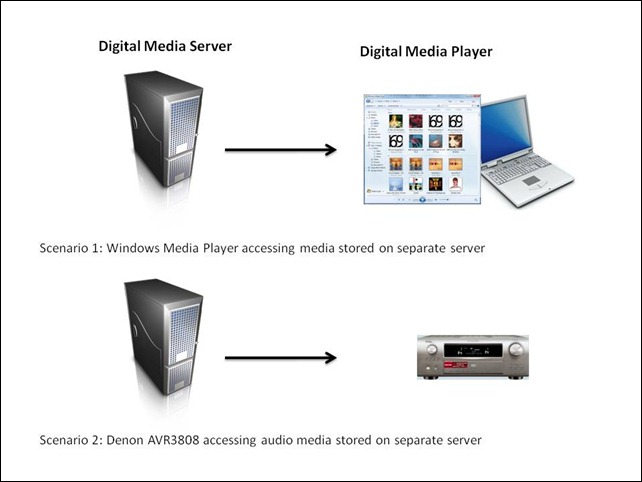
    At its simplest, just two devices can be involved: a Server and a Player. These can even be running on the same physical device, as in the case where your Windows Media Player on your Desktop PC is streaming music or video stored on the PC itself. The next step up is where the server and player are on separate physical devices. Two typical scenarios are shown in figure 1:
    WMP Scenarios
    Figure 1: Typical scenarios of simple case of DMP devices accessing DMS devices.

    I’ve used the Denon AVR3808 as an example, since this is what I have in my home network. My main DMS is an old headless (no monitor, keyboard or mouse) Dell PC running the Windows Home Server operating system. Actually, to be strictly accurate, the Dell is running two Digital Media Servers. The first is Microsoft’s Windows Media Connector version 2.0, which is built into WHS. The second is the Asset UPnP media server, which is a free piece of third party software installed onto WHS. The fact that I have two DMSes running will prove significant once I get into describing the next set of scenarios.

    In my particular case, all flavours of the two scenarios shown above will work, that is, both DMSes running on the Dell box will stream audio to other PCs in the home network, and to the Denon AVR3808. Under the covers, there’s actually some negotiation of streaming formats going on. This is because I have stored all my music files on the Dell server box in Windows Media Audio Lossless (WMAL) format. This presents no problems for the PCs, since the Windows Media Players installed on them can handle WMAL. But the Denon can only handle standard Windows Media Audio, not the Lossless variant. So when I use the Denon to browse my music library on the Dell and select a track to play, the DMS that I’m using sees that the Denon can’t handle WMAL and transcodes the stream into standard PCM (which the Denon can handle) on the fly. Both the Asset and the Windows Media Connect will do this. But this breaks down in the next set of scenarios.

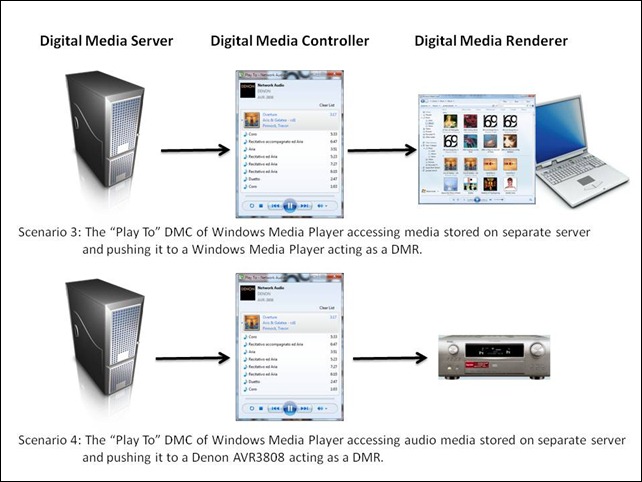
    So, the interesting scenarios are where there are three devices linked together: a Digital Media Server, a Digital Media Controller, and a Digital Media Renderer.
    WMP Scenarios 2
    Figure 2: Typical scenarios of a three device link (DMS-DMC-DMR).

    Once again, in my case, all flavours of scenario 3 will work. That is, I can stream from either DMS running on my Dell Windows Home Server using the “Play To” feature of Windows Media Player in Windows 7, and push the stream to either of my PCs that are currently running Windows 7.

    But scenario 4 has been giving me all sorts of problems. Sometimes it would seem to work, and other times it wouldn’t. I think I have finally got to the bottom of it.

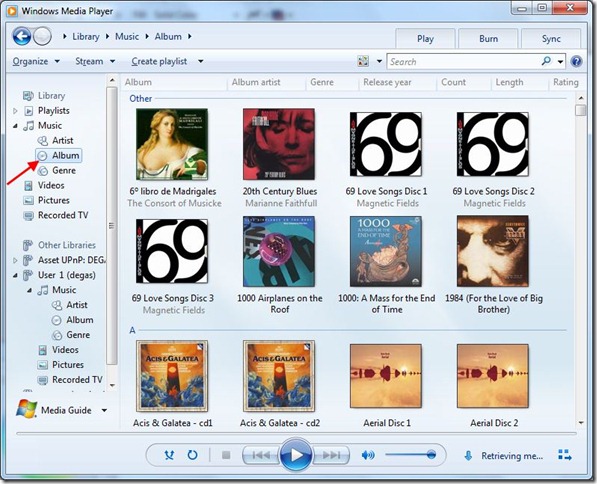
    The issue is that media libraries in Windows Media Player in Windows 7 can be built up in a number of ways. Take a look at this screenshot of the first few albums in my music library:
    WMP 12 3

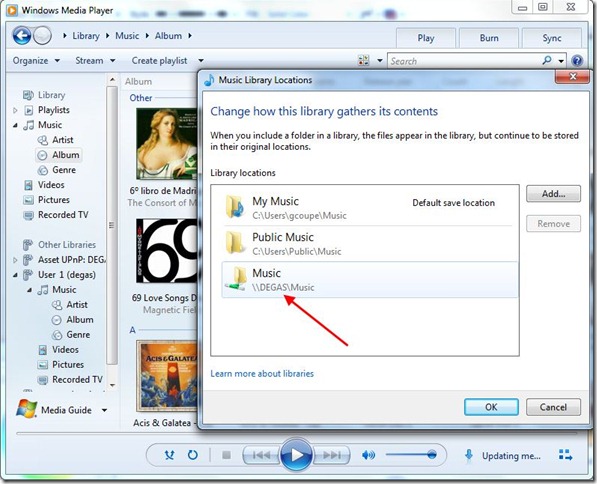
    I’ve highlighted the fact that you are looking at the content of my music library in “Album” view. That is shown as part of the “Library” tree (Library – Music – Album). This screenshot has been taken from my Tablet PC, which is running the Windows 7 Release Candidate. Now the interesting part is where these albums are physically stored. There is far more storage required than my Tablet PC can cope with, so in fact these album files are sitting on my Windows Home Server. This next screenshot shows that my music library is in fact being comprised of three storage locations: my own music folders on the Tablet PC, the “Public” music folders on the Tablet PC, and the music folders on Degas – which is my Windows Home Server:
    WMP 12 4

    But hang on a minute, Windows Media Player is showing two navigation trees on the left hand side of its window: the “Library” tree and another one called “Other Libraries”. The content of the “Other Libraries” tree is populated by other Digital Media Servers which Windows Media Player discovers on the network. Sure enough, it’s found the Windows Media Connect DMS running on the Dell Windows Home Server (Degas), and this next screenshot shows the same album files being seen in the Album view under the “Other Libraries” tree:
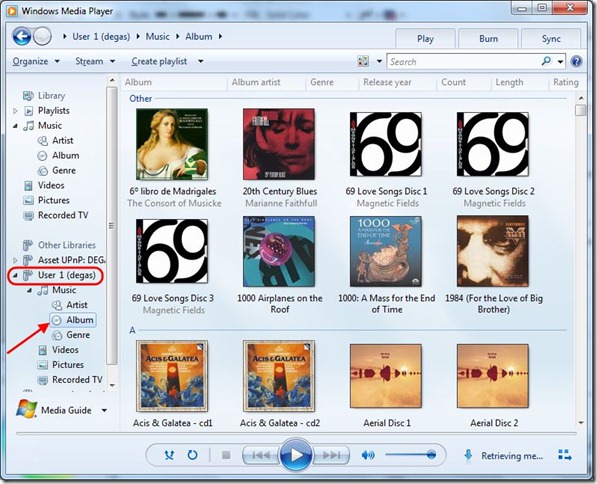
    WMP 12 6

    You’ll notice that just above “User 1 (degas)”, which is the Windows Media Connect DMS, is the Asset UPnP server entry, shown as “Asset UPnP: DEGAS”. So, under scenario 4, I can stream the same album in three different ways:

    1. Using “Play To” to pull from the Tablet PC’s Windows Media Player streaming server and push it out to the Denon.
    2. Using “Play To” to pull from the Windows Media Connect streaming server on the Dell and push it out to the Denon.
    3. Using “Play To” to pull from the Asset UPnP streaming server on the Dell and push it out to the Denon.

    What I’ve found is that method (1) and (3) will work, but that method (2) does not. These are illustrated in the following screenshots:

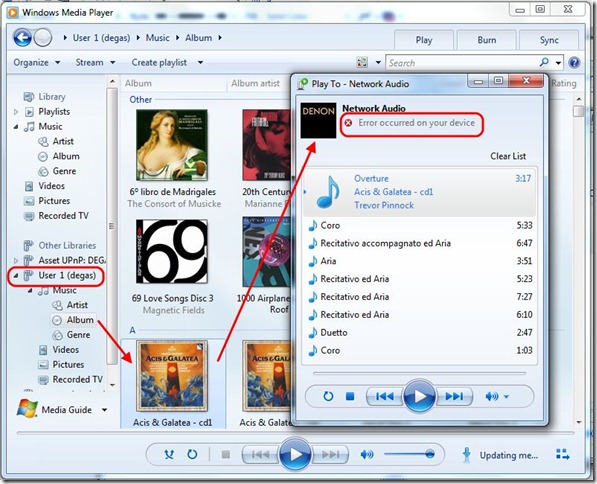
    WMP 12 7

    WMP 12 8

    WMP 12 9

    I should just point out that I’ve configured the Asset UPnP server to always stream in PCM format. If I didn’t do this, then while it would work in the simple case of scenario 2, in the case of scenario 4, it would fail just as the Windows Media Connect server does.

    The conclusion that I draw from all this is that in these “man-in-the-middle” scenarios, it looks as though end-to-end negotiation of the proper streaming format is not always being done correctly. I suspect that in scenario 4, method 2, the Windows Media Connect server is simply serving up WMAL format to the Denon, which causes it to fail. Now, I don’t know whether this is a shortcoming of the DLNA specification itself, or simply an outcome of how Microsoft have implemented it in the case where there are physically separate servers out on the network. Time will tell.

    At least I now know which scenarios work and which will fail. On to the next problem…

  • Eurovision Roundup

    Eurovision looms, and I can do no better than to point you to this roundup in the Guardian of some of the sillier entries. Included in them is the Dutch contender: Shine, performed by the Toppers. Alas, the Guardian’s scathing comments are fully justified. Sample:
    Of the punters who pay to watch this band, one can only assume they are high on life, and other substances. Men about to turn 50 should know better than to sing about how "Love will make us glow in the dark".
    Very true.
     
    Mind you, I have to hand it to Gordon, one of the members of the Toppers for taking a stand against Russia’s anti-gay attitudes. He says he will withdraw from the final if violence is used against a pro-gay protest in Moscow planned for the 16th May. Although, I somehow doubt whether Shine will make it to the final, so he’s probably on safe ground…
     
    Update: I have just watched and listened to the Dutch entry for the very first time in its awesome entirety. Omifeckinggawd – that is cringeworthy stuff. I felt the enamel being stripped from my teeth as I beheld it.
     
    Update II: Jaysus – Ukraine’s entry is mainlining if you’re a chocoholic with a taste for erotica… I must go and lie down for a while…
     
  • Windows 7 RC

    Well, it’s now a week since I downloaded the Release Candidate of Windows 7, so how is it shaping up for me? For the most part, I’m very impressed.

    I’ve installed it on both my Tablet PC and (gulp) my desktop PC – my main workhorse. Yes, I know that Microsoft issue dire warnings against using it on your main systems, but this is my way of living dangerously, since I have no interest in extreme sports. Anyway, I have a complete image backup of my previous Vista installation stored on my Windows Home Server, so if the worst comes to the worst, I can roll back my desktop to exactly as it was on the 4th May. New documents and mail being created in the Windows 7 installation are also being backed up onto Windows Home Server every night, so I can add these into a restored Vista installation if I ever need to go back to it. But at the moment, I don’t think I will need to go back to Vista ever again.

    What do I like so far about Windows 7? Well, I suppose the main thing is how snappy it is in comparison with Vista. There’s been a noticeable increase in speed on both my systems. Applications open and close faster, and are more responsive, while the performance of the GUI is definitely better. The second thing that I am liking a lot is the redesigned Taskbar. There are lots of subtle touches that improve the usability of the system. For example, while an operation is going on, such as Copy, Move, or Download, the progress bar window is also reflected in the degree of green shading on the application icon on the Taskbar, so even if the progress bar window is obscured, you can see at a glance how far the operation has got to. See this example of a file copy operation in the Windows Explorer icon:

    W7 5

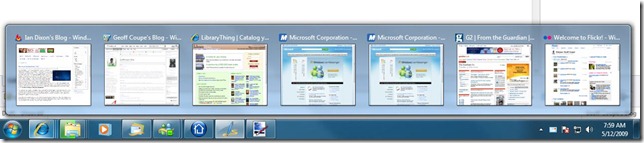
    The Taskbar indicates active applications by surrounding them with a highlighted window – applications with multiple active windows (e.g. Internet Explorer, Windows Explorer and Messenger in the example above) have a double window around them. Mousing over the icons of active applications instantly throws up miniature copies of the actual windows:

    W7 6

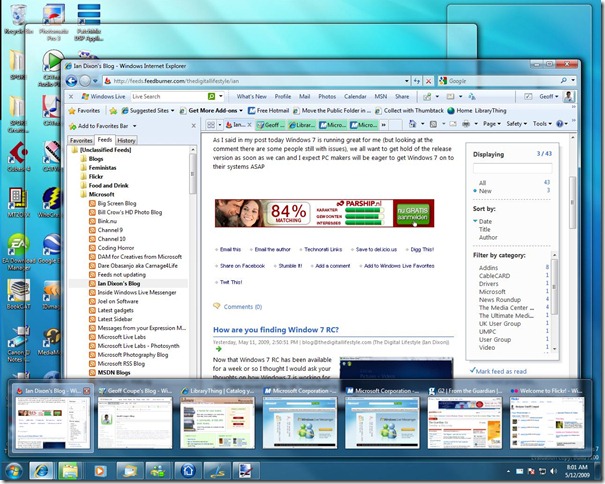
    Mousing over any of these miniature copies will instantly highlight that copy while simultaneously revealing that window on your desktop – all the other active windows become just outlines:

    W7 7

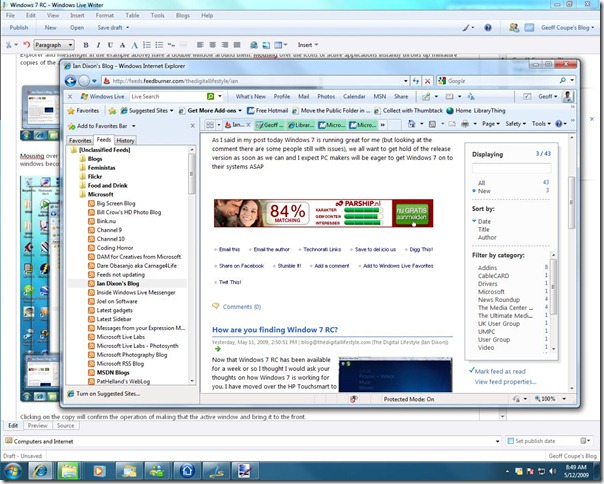
    Clicking on the copy will confirm the operation of making that the active window and bring it to the front:

    W7 8

    What issues have I come across? Well, none on the Tablet PC so far, but I have had some problems with the Desktop. It has two SATA disks installed, and I found that the D: drive seemed to vanish if I put the PC into sleep mode. Worse still, I got the dreaded BSOD occasionally. I had used the system BIOS to set the SATA drives into AHCI mode before doing a clean install of Windows 7. Even though Windows 7 has an AHCI driver, it seems as though this was the cause of the problems. After scouting around on the Windows 7 forums, I found advice that suggested that I should install software from Intel to replace the Microsoft AHCI driver. Since my desktop is a Dell system, I found an elderly copy of the Intel software (my Dell is equally elderly) on the Dell site and installed it. Touch wood, it seems to have done the trick. Interestingly, even though the Intel software was designed for Windows XP and earlier systems, Windows 7 was able to handle it perfectly in compatibility mode, and it installed without problem.

    The issue that I discovered back in February with the “Play to” feature in Window 7’s Media Player is still there, unfortunately. I don’t know whether the blame should be laid at the door of Microsoft or whether it’s a shortcoming in the DLNA specification. Either way, the result is that I can’t use the “Play to” feature to push music from my Windows Media servers to my Denon amplifier. Negotiation of setting up the correct streaming format for the player device (the Denon) isn’t being handled correctly when there are three devices in the playing chain (the server, the player and the controller). I have got a workaround though. I’ve installed the (free) Asset UPnP media server software onto my Windows Home Server. The Asset server can be set to automatically transcode the Windows Media Audio Lossless format (which the Denon can’t handle) into PCM (which the Denon is happy with). Then, when the Asset server is instructed to push an audio stream to the Denon by the “Play to” media controller of Windows 7, it will stream PCM by default. Result: music and bliss.

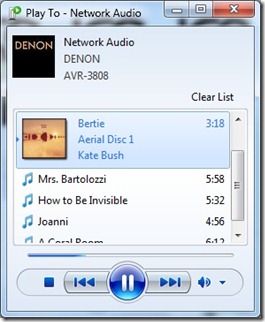
    I notice that the “Play to” media controller seems to have taken a step backwards from where it was in the Beta of Windows 7. Here’s screenshots of the “Play to” media controller window; on the left is a screenshot taken from the Beta, and on the right is a screenshot taken from the Release Candidate.

    WMP12 - Play To 1  W7 9

    Notice how the track indicator (the blue line) is operational in the Beta, but is not working in the Release Candidate? What is not obvious from the screenshots is that the track timing is also broken in the RC. In the Beta, the track timing display of the playing track counts down to zero as the track plays. In the RC, the track time remains unchanging. As usual in software development: fix a bug, introduce another one…

    However, overall, I’m pretty pleased with the Windows 7 RC. I think it will remain on both of my systems, only to be replaced by the final product when it comes out at the end of this year.

    Update: I have found that the track indicator and track timing work when the “Play to” control is being used against a library held as part of the main library hierarchy of Windows Media Player, but not when it it being used to control the content of a library held on a server and accessed via the “other libraries” hierarchy of Windows Media Player. Take a look at the following screenshots. The first shows albums in a library held on a separate server, but added into the main library of WMP running on my laptop:

    WMP 12 1

    The small window is the “Play to”media controller window – and it is showing a correctly working track indicator and track timing for the currently playing track. The track is being pulled from a remote server that is being accessed via “Library – Music – Album”.

    Now, this next shot is of exactly the same audio file, held on the same server, but this time it’s being accessed via the “Other libraries” section. And this time, the track indicator and track timing are not working…

    WMP 12 2

    The choice of using either the main Library tree or the “Other Libraries” tree in WMP also seems to have an influence on the “Play to” negotiation of formats. I found that when I navigate in the main Library tree and push audio files to my Denon they will play, but pushing the very same audio files to the Denon via navigation of the “Other Libraries” tree will fail. I surmise that in the first case, the negotiation and selection of the audio format to be pushed to the Denon works correctly, but not in the second case.

    Update: I’ve explored various “Play to” scenarios and documented the results in Fun with Technology – Part IV.

  • Windows 7 RC

    Today’s the day that the Release Candidate of Microsoft’s Windows 7 becomes available. Being a nerd, it’s downloading as I write this. But one thing already strikes me as being curious. Recently, on the Engineering Windows 7 blog, the Windows 7 team wrote that they wanted people to test the scenario of upgrading a Vista installation to a Windows 7 installation. Yet, the installation instructions make no mention of this scenario, the only option being recommended is a clean install (i.e. wiping out of the previous operating system and replacing it with a fresh installation of Windows 7).
     
    What gives?
  • RIP, Marilyn

    Marilyn French has died. I read "The Women’s Room" back in 1979, and it was clear that the quote on the front cover of the Sphere paperback: "This novel changes lives" was not simply hyperbole. I still have the book. I should re-read it and see whether things have changed much in the intervening years.
  • Condoleeza Rice

    The mask slips. I hope I live to see her in court.
  • The Politics of Torture

    Ophelia highlights a perceptive comment made on her blog, which paints a very persuasive case for the nature of the political game being played out by Obama in relation to the use of torture under the Bush administration. The game is simultaneously saddening – in that it exists as the alternative to actively pursuing war crime prosecutions – and probably the only way in which progress can be made to the point where such prosecutions are demanded by a substantial proportion of US citizens.
     
    Softly, softly, catchee monkey.
  • Damn

    This has probably put paid to the relaxed atmosphere that we all used to enjoy during Queen Beatrix’s walkabouts on Koninginnedag. And I don’t think there was anything "apparent", as the Guardian puts it, about Maxima’s look of horror. Damn, damn, damn.
  • Is Gay Marriage a Religious Issue?

    I see that the Guardian is running a series of opinion pieces this week centred around the question: “Is gay marriage a religious issue?

    So far, we’ve had four different people take four different stances. First, we had Candace Chellew-Hodge, an American gay Christian and associate pastor, arguing that marriage existed long before Christianity got its sticky fingers on it. Next up was Martin Prendergast, a British gay Catholic, arguing that the Catholic sacramental view of marriage could be applied to same-sex unions. While his heart is clearly in the right place, I can’t help feeling that he’s flogging a dead horse while the current Pope and his coterie are in power. Still, as he points out, the Catholic Church has itself recognised same-sex unions in the past, so it’s possible that once Benedict bites the bullet, reason, equality and doing the right thing might once again prevail.

    Then we got Theo Hobson, arguing that marriage should be opened up to gay people. Fine, except that, being Theo Hobson, his arguments are a pile of old codswallop. He gets off to an abysmal start in his opening two sentences:

    Is gay marriage a religious issue? Yes, in the sense that we can only really understand marriage with reference to religion.

    Er, sorry? The evidence for that assertion is, what, exactly? Theo attempts to explain:

    The event has a religious dimension, even if the couple are atheists, for they are affirming a tradition moulded by religious values.

    Ah, the “sticky fingers” argument. Well, sorry, Theo, but my civil marriage ceremony had no religious dimension to it whatsoever – God didn’t get an invite (how could she, when she doesn’t exist?).

    The ideal of total communion between two souls is religiously rooted.

    There you go again, Theo, I don’t have a soul either – that’s a concept that indeed is religiously rooted, but is total nonsense. However, two people can want to get married because of their love and commitment to each other – no souls required.

    And so is the discipline that this entails: confining sexuality to one relationship, for the sake of nurturing a new social entity, the family, involves an idea of social duty that has long been seen in religious terms.

    It may have “long been seen in religious terms”, but that doesn’t mean that that is the only way of seeing it. Discipline and the family are not the sole prerogatives of religion, no matter how much Hobson seems to need to believe it. He should try taking off his blinkers once in a while. But what really irritates me about Hobson’s piece is his final paragraph:

    Yes, this makes marriage a wider concept, but it doesn’t matter. Nor does it matter that many of us will still feel that there is something more real about heterosexual marriage, because of its union of gender opposites, and because of its reproductive potential.

    “More real”? Patronising, or what? Excuse me while I catch my breath.

    Today, Mark Simpson weighed in with his take on the subject, arguing that marriage is outdated, and that the existing civil partnership laws are all that is needed in 21st. Century Britain, and should be open to heterosexuals, not limited just to gays and lesbians. While there’s something to be said for this point of view, the fact of the matter is that in Britain, at present, straight people, religious or not, can get married, while gay people can only enter into a civil partnership. There’s the discrepancy and the discrimination right there.

    Britain is stuck in a halfway house at the moment. Perhaps the way out is indeed, as Simpson suggests, to open up civil partnerships to all.

    It’s interesting to reflect on the situation here in the Netherlands. We’ve got both civil marriage (open to all) and civil partnerships – known as registered partnerships (again, open to all). The point is that “marriage” is completely secular: two people must get married in a townhall for their marriage to be recognised as such. If they are religious, then they usually walk across the market square into the church to perform a church marriage, but that is a purely religious ceremonial, it has no standing in the eyes of the State. When Prince Willem-Alexander and his Maxima got married a few years back, that was the pattern they followed: civil marriage in the Townhall, followed by the religious marriage in the church.

    There are few real differences between civil marriage and civil partnerships here. If you want the nitty-gritty detail, then this paper by Kees Waaldijk will tell you all you need to know.

    I’m probably biased, but the Dutch model seems to be eminently pragmatic, sensible, and treats people equally. I wish more countries would adopt the model.

  • The Merchants of Light

    The Science Network has a series of videos up on the web that were made of the recent Origins Symposium held at Arizona State University earlier this month. Worth watching.
  • The British Museum

    I visited the British Museum last Sunday. It was the first time that I had seen the remodelled Courtyard. Very impressive. I took lots of shots, and here is the resulting Photosynth.
     
    (tip: when viewing the Photosynth, switch to Grid View to select another set of photos shot from a different point in the Courtyard)

    Addendum: And of course Microsoft has now scrapped the Photosynth product and technology, so none of these links work anymore. It’s dead, Jim.

  • London Bound

    I’m off to London for the weekend, hopefully to meet up with a couple of friends that I haven’t seen for many years. It’ll be my first visit to London in nearly five years. I expect that I will find some changes. Back next week.