Reflections on life at “De Witte Wand”…

Year: 2011

  • My Windows Phone Apps

    I mentioned yesterday that I’d taken the plunge and acquired a Windows Phone – a Nokia Lumia 800. One of the things about moving from a dumbphone (my old Nokia 6310i) to a smartphone is that a world of applications opens up to you. For the Windows Phone ecosystem, that means over 50,000 Apps, and counting…

    Now, while the quality of Windows Phone Apps, just like everything else, is subject to Sturgeon’s Law, it seems to me that there’s a reasonable chance of finding a portfolio of decent applications that will suit my needs. Here’s what I currently have on my phone (in addition to the standard Apps that ship with Windows Phone, and the Nokia Apps – Nokia Drive, Nokia Maps and Nokia Music – that come with the Nokia Lumia 800):

    buienradar Buienradar A realtime viewer of where rain is falling over the Benelux region.
    face swap Face Swap A bit of photographic fun from Microsoft Research
    Flickr Flickr The official Flickr app to upload photos taken on your Windows Phone and upload them to Flickr. You can also browse your Flickr account from your Windows Phone. Nicely done.
    Het Weer Het Weer Comprehensive Weather application for The Netherlands. Basic interface, but gets the job done.
    Imdb IMDb Very comprehensive interface to the IMDb movie database. Well implemented – shows off the Windows Phone user interface to advantage.
    iss Iss Locator A basic app that just shows the current position on the ISS (International Space Station) superimposed on a 2D map of the globe. Not bad, but I’m left wanting more.
    media center remote Media Center Remote A very good Remote Control App for Windows Media Center. Covers the full range of function, including Search and Keyboard support for your Media. The only negative point is that it on start up it reads in the content of your Media libraries, and if you have large libraries, this can take a minute or two.
    meteor Meteor Another Remote Control App for Windows Media Center. While startup is faster than Media Center Remote, and the display of the Music Library is clearer, it does not support Search and Keyboard functions, which I find surprising, and a negative point.
    metrotube Metrotube The best App for browsing YouTube that there is. Makes full use of the Windows Phone user interface. Unfortunately, the developers have announced it will be withdrawn from the Marketplace because Google have not documented the YouTube interfaces, and continual reverse engineering is not a sustainable approach.
    my home server My Home Server A basic App to interface with Windows Home Server 2011. It has some Dashboard functions, and some capability to stream media (music, pictures, video) to your Windows Phone, but it is very basic. For example, the Album or Artist lists are single level lists (no jumping to initial title letters) that load agonisingly slowly. It does have a Search function, but it breaks the user interface guidelines in the way it operates.

    When using the Media functions, error messages are a frequent occurrence. This App is from Microsoft’s own WHS 2011 team, and is yet more evidence of their poor performance in design and delivery of a product.

    satview SatView A nicely-done realtime satellite tracker and orbit predictor with 2D and 3D views of over 1,300 satellites.
    SkyDrive SkyDrive An App to enable you to browse documents, folders, photos and files that are held on your SkyDrive storage (every Windows Live user ID has 25GB of free online storage). Works fairly well, but not faultlessly – I have at least one Word document that I can’t open on my Windows Phone, but which I can open on my PC.
    SkyMap SkyMap Probably the best skymap available for the Windows Phone. Actually useful!

    The Guardian The Guardian The official App for the Guardian newspaper. It’s not particularly innovative; it feels a bit tired and lazy. For example, the Search screen is only available in Portrait mode – I actually like to rotate my phone into Landscape when typing – the keyboard is bigger… The search engine also seems to be different from the Web version – the results are less and also more dated. Frankly, it’s almost better to browse the Guardian’s web site than bother with this App.
    Treintijden Treintijden There are several train timetables and planners available for the Dutch railway network. This is the best one that I’ve found. Simple and effective.

    Doubtless this list will get refined over time, but it will do to get me started. I have to say that, so far, I really like the Metro interface of the Windows Phone; it’s a well-designed and well-executed piece of work.

  • I’ve Been Seduced By A Windows Phone

    OK, so a year ago, I wrote about the fact that I had not upgraded my trusty old Nokia 6310i to a Smartphone.

    I didn’t want to get an iPhone (I’ve never liked Apple’s walled garden infrastructure) and Google’s Android environment seemed to me to be too much of a free-for-all, where, rather than evolution, cancerous growth seems to be the result of letting too many cooks spoil the broth.

    The third way seemed to be Microsoft’s Windows Phone, where a firm grip was taken on the base specification, while allowing for innovation in hardware. I was underwhelmed by the first release of Windows Phone 7, but by last September, with the Windows Phone 7.5 (Mango) release, Microsoft seemed to me to have achieved critical mass. The operating system had good reviews and seemed to offer something of interest. Yes, in terms of market share, Microsoft languish well behind Android and iOS, but I think that this can reasonably said to be because of other factors.

    So, from September onwards, my interest has been piqued by the possibility of buying a Windows Phone. Since I have been using a Nokia mobile phone since 2002, my first thought was that it should be a Nokia Windows Phone.

    When Nokia announced the Nokia Lumia 800 and the Nokia Lumia 710, my mental crosshairs centred upon the Lumia 800, in the Cyan colour. That seemed to me to be the best possible merging of hardware and software design in a mobile phone.

    Since then, I’ve been tracking the availability of the Nokia Lumia 800 here in the Netherlands, and comparing the price plans that the suppliers have been advertising. A couple of weeks ago, there was an offer that I could not refuse from The Phone House. A Nokia Lumia 800 on a one-year’s contract from Vodafone totalling less than 400 Euros – this at a time when the phone itself retails at between 450 to 480 Euros, without any additional connection charges included.

    I admit I was seduced.

    And so it was, on the 23rd December, that I took possession of a Cyaan Nokia Lumia 800, and today, Vodafone have completed the porting of my mobile number from my old Nokia 6310i to the Lumia 800.

    I have to say that the basic experience of the combination of the Nokia Lumia 800 and Windows Phone 7.5 is a joy. The physical design of the phone feels absolutely right, and the user experience of Windows Phone 7.5 is beautifully done.

    I was worried about the shortcomings of the Windows Phone Marketplace infrastructure, but I have to say that while they are still there, I’ve been able to paper over the cracks. I now have a unified inbox for all my email accounts, and I’ve been able to bring in my Contact lists and Calendars from other places on the web. It’s not perfect, but I think I can live with it, which is what I never thought that I would say a few months ago.

    I’ll follow up this post with some thoughts about the applications that I have installed on my Windows Phone. Some are brilliant, and some are so-so. The fact remains that I think I can now bid farewell to my trusty Nokia 6310i and hail my Nokia Lumia 800.

    Le Roi est mort – vive le Roi!

  • Seasons Greetings

    A Merry Christmas and a Happy New Year…

    Xmas 2011

  • Gay Rights Are Human Rights

    I missed hearing or reading about this speech that the US Secretary of State, Hilary Clinton, gave to an audience of diplomats at the United Nations in Geneva on the 6th December. It is quite remarkable. I’ve put some extracts below. The full transcript is here, and it is well worth reading.

    “It is violation of human rights when people are beaten or killed because of their sexual orientation or because they do not conform to cultural norms about how men and women should look or behave. It is a violation of human rights when governments declare it illegal to be gay or allow those who harm gay people to go unpunished. It is a violation of human rights when lesbian or transgendered women are subjected to so-called corrective rape or forcibly subjected to hormone treatments, or when people are murdered after public calls for violence toward gays, or when they are forced to flee their nations and seek asylum in other lands to save their lives. And it is a violation of human rights when life-saving care is withheld from people because they are gay, or equal access to justice is denied to people because they are gay, or public spaces are out of bounds to people because they are gay. No matter what we look like, where we come from, or who we are, we are all equally entitled to our human rights and dignity.

    “The second issue is a question of whether homosexuality arises from a particular part of the world. Some seem to believe it is a Western phenomenon, and therefore people outside the West have grounds to reject it. Well, in reality, gay people are born into and belong to every society in the world. They are all ages, all races, all faiths; they are doctors and teachers, farmers and bankers, soldiers and athletes; and whether we know it, or whether we acknowledge it, they are our family, our friends, and our neighbors.

    “Being gay is not a Western invention; it is a human reality. And protecting the human rights of all people, gay or straight, is not something that only Western governments do. South Africa’s constitution, written in the aftermath of Apartheid, protects the equality of all citizens, including gay people. In Colombia and Argentina, the rights of gays are also legally protected. In Nepal, the supreme court has ruled that equal rights apply to LGBT citizens. The government of Mongolia has committed to pursue new legislation that will tackle anti-gay discrimination.

    “The third, and perhaps most challenging, issue arises when people cite religious or cultural values as a reason to violate or not to protect the human rights of LGBT citizens. This is not unlike the justification offered for violent practices towards women like honor killings, widow burning or female genital mutilation. Some people still defend those practices as part of a cultural tradition. But violence toward women isn’t cultural; it’s criminal. Likewise with slavery, what was once justified as sanctioned by God is now properly reviled as an unconscionable violation of human rights.

    “The fourth issue is what history teaches us about how we make progress towards rights for all. Progress starts with honest discussion. Now, there are some who say and believe that all gay people are pedophiles, that homosexuality is a disease that can be caught or cured, or that gays recruit others to become gay. Well, these notions are simply not true. They are also unlikely to disappear if those who promote or accept them are dismissed out of hand rather than invited to share their fears and concerns. No one has ever abandoned a belief because he was forced to do so.

    “Universal human rights include freedom of expression and freedom of belief, even if our words or beliefs denigrate the humanity of others. Yet, while we are each free to believe whatever we choose, we cannot do whatever we choose, not in a world where we protect the human rights of all.

    “Reaching understanding of these issues takes more than speech. It does take a conversation. In fact, it takes a constellation of conversations in places big and small. And it takes a willingness to see stark differences in belief as a reason to begin the conversation, not to avoid it.

  • RIP, Hitch

    So, Christopher Hitchens is dead. He has left Tumortown and passed beyond the Land of Malady, after leaving us with some last words of advice on dealing with mortal illness.

    I’ll miss his voice and his writings. We now have all that we are going to have from him.

    I can’t resist adding his widely-quoted words of wisdom:

    “The four most over-rated things in life are champagne, lobster, anal sex and picnics.”

    Like Christopher Hitchens, I’ve enjoyed them all. Over-rated? Possibly. Enjoyable? Certainly.

    RIP, Hitch.

  • The Kindness of Strangers

    In today’s Observer, Henry Porter writes about a revelation that his friend, Gilbert Adair, had in the months before he died. It’s worth reading. And it’s a reminder that for some people, nursing remains a vocation, rather than a service from which profit must be wrung. Treasure them.

  • Picasa versus WLPG Redux

    Yesterday, I wrote up a comparison between the current versions of Picasa and Windows Live Photo Gallery. Lying awake in the small hours last night, I thought of additional things that I should have covered in the comparison. So if you read the entry yesterday, I suggest you take another look at it. It’s now been considerably reworked and expanded.

  • Picasa versus Windows Live Photo Gallery

    Google’s Picasa and Microsoft’s Windows Live Photo Gallery are free tools for organising, editing and sharing (via the web) collections of photos on your PC. They have both been around for some years, and have each gone through a number of iterations, adding features each time.

    I first blogged about Picasa back in 2005, when I compared it (favourably) with Microsoft’s Digital Image Library, a product that was subsequently discontinued by Microsoft, and replaced by Windows Live Photo Gallery, which was released in 2007. As each new version of Picasa or WLPG has been released, I’ve taken a look at them and blogged about my findings. Up until a couple of days ago, the latest versions meant version 3.8 of Picasa and build 15.4.3538.513 of WLPG. These are fairly evenly matched in features, but they both suffer from issues such that I do not make much use of them.

    Picasa version 3.8 would not display my geotags correctly, as you can see from the examples I show in this blog post. And once Microsoft had corrected a horrendous geotagging bug in WLPG, I was still left with the fact that WLPG will merrily corrupt Makernotes in Exif metadata if you use it to edit metadata or tag people’s faces. That Makernotes corruption bug was acknowledged by Microsoft a year ago, but it is still there in the latest build of WLPG.

    Now, Google have just released version 3.9 of Picasa, so I took a look at it to see what has changed.

    Geotagging and Geocoding

    Picasa and WLPG handle geographic metadata in completely different ways, and it’s as well to be aware of the distinction.

    There are two main approaches to handling geographic data: Geotagging and Geocoding. In short, geotagging is the process of adding coordinate data (i.e. Latitude and Longitude) to an image file’s metadata, while geocoding is the process of using other forms of geographic data (e.g. a street address) to derive the coordinate data for that location.

    Picasa has gone down the geotagging route, hence the use of the map interface. When you place a pin on the map displayed in Picasa and associate it with a particular photo, Picasa will write the GPS coordinates of the location’s Latitude and Longitude into the image file’s Exif metadata.

    WLPG, so far, does not have a mapping interface for handling geographic data. That’s because WLPG does not do geotagging: you can’t use it to add coordinate data into an image file’s metadata. However, and somewhat confusingly, you’ll see that WLPG has provision for what it calls “geotags” to add geographic metadata into an image file. This metadata is not coordinate data, but textual data, e.g. a street address, and when you add “geotags” to an image, it will store the information as XMP metadata in the image file.

    If a file contains GPS coordinates in the Exif metadata when it’s brought in to WLPG, then reverse geocoding will be triggered automatically and WLPG will assign a location address to the file based on the GPS values. It does this by sending the GPS values to an online Bing service, which then returns the location as text strings.

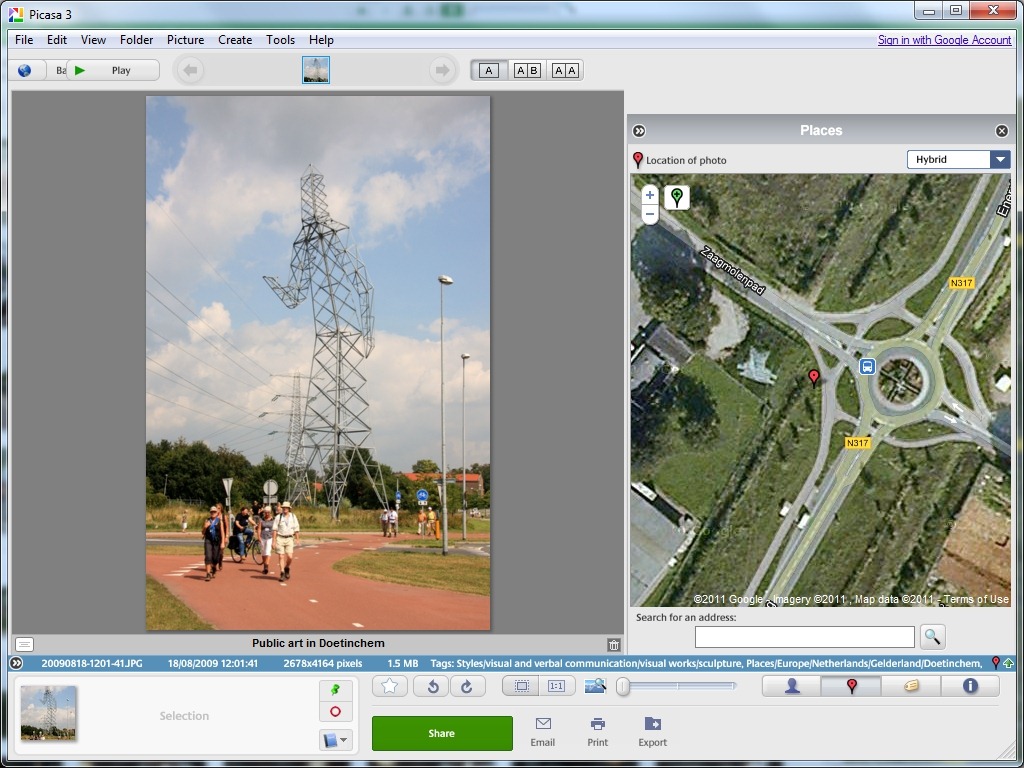
    Let me try and illustrate this. Here’s a screenshot of a photo being displayed in Picasa, and I’ve used Picasa to assign a set of GPS coordinates to the image file, by moving the red location pin to the correct location on the map:
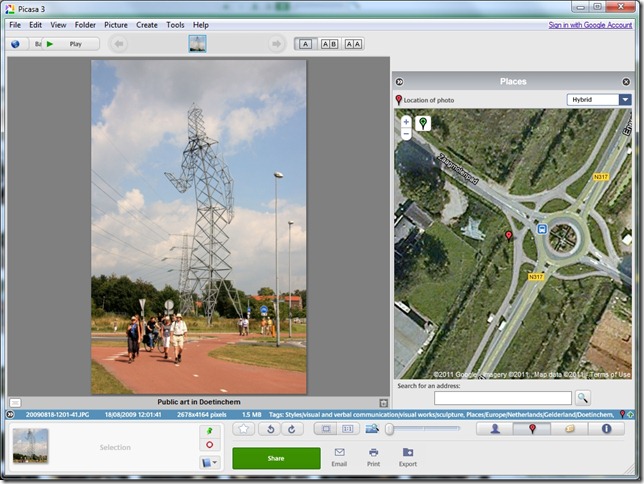
    Picasa Geotag 4

    When I save this location to the image file, Picasa uses the online Google Maps service to find out the GPS coordinates of the location and writes them into the image file as Exif metadata.

    Since the image file now contains GPS coordinates in its Exif metadata, when I look at the same file in WLPG, you can see from this screenshot that WLPG has performed reverse geocoding by using the GPS coordinates to derive the closest address for where the photo was taken, in this case, Energieweg, in Doetinchem, in The Netherlands:

    WLPG Geotag 2

    Under certain circumstances, WLPG can store this address information in the image file, using the IPTC Extension LocationCreated metadata fields. Since this is a cross-industry standard, other applications that support this standard should be able to work with the metadata. However, you cannot use WLPG to create GPS coordinates for an image. Perhaps in the next version?

    One point to be aware of is that although WLPG will automatically generate its “geotags” from GPS data that has been set by Picasa (or any other geotagging application), Picasa will not do geocoding; that is, it will not automatically generate GPS coordinates from the IPTC Extension LocationCreated metadata fields – it simply ignores them, and will not even display them in the information panel in Picasa. This means that if you use WLPG to set “geotags”, you need to go through the photos again with Picasa if you want to have proper geotag (i.e. coordinate) data in the photo metadata.

    I do wish that Microsoft hadn’t called this metadata “geotags”, because it is not, in the generally accepted sense of the term – it’s not coordinate data. It would have been better to name it “Location”, because that’s what it is, and it also refers back to the IPTC LocationCreated metadata standard.

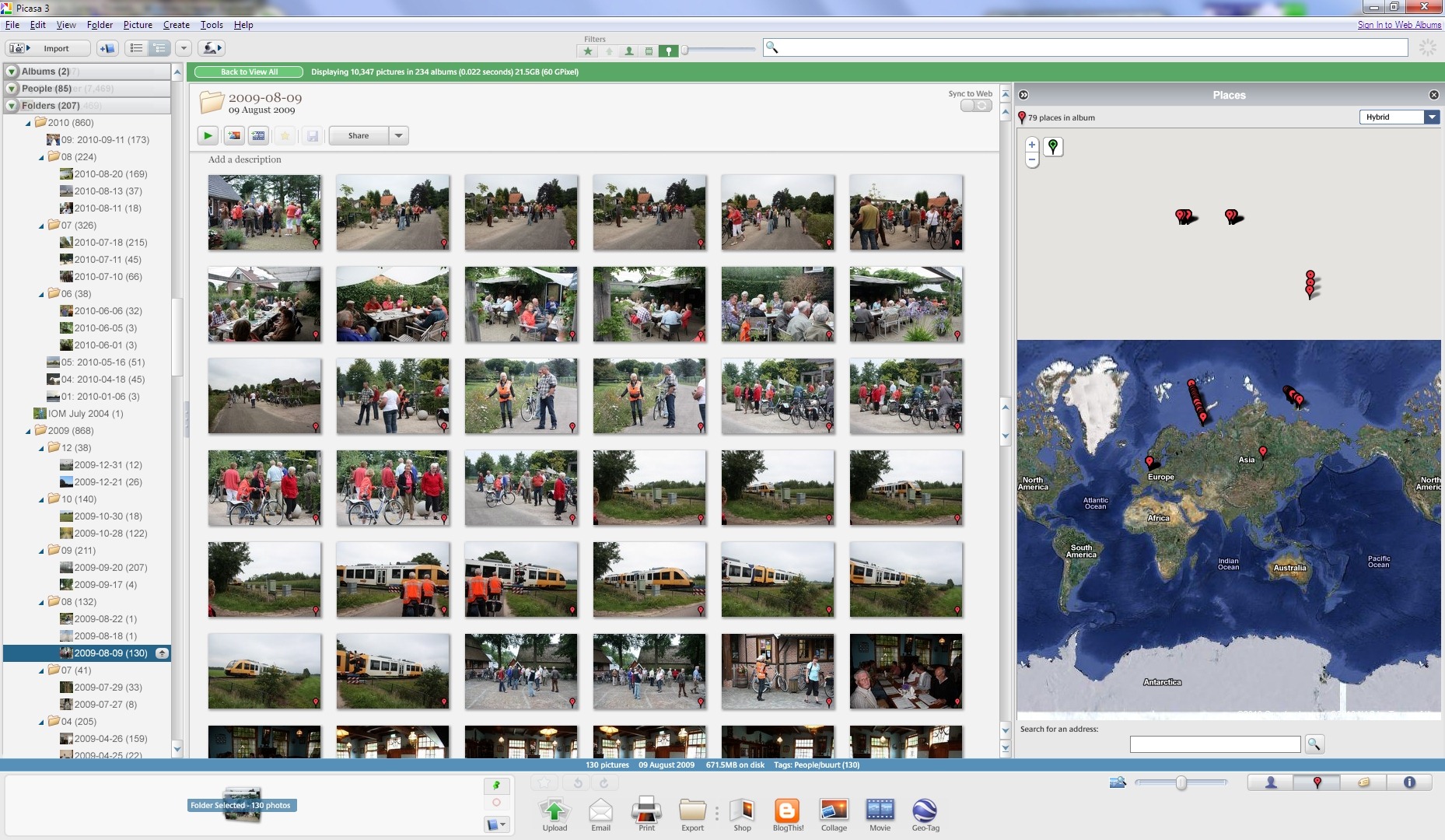
    On a more positive note, I’m very pleased to say that the geotag display problem of version 3.8 of Picasa has gone, and geotags are now displayed in their correct locations on the map. Here’s the screenshot I used to demonstrate the bug in my blog post of version 3.8 in September 2010 (click for the full-sized version):

    Picasa Geotag 2

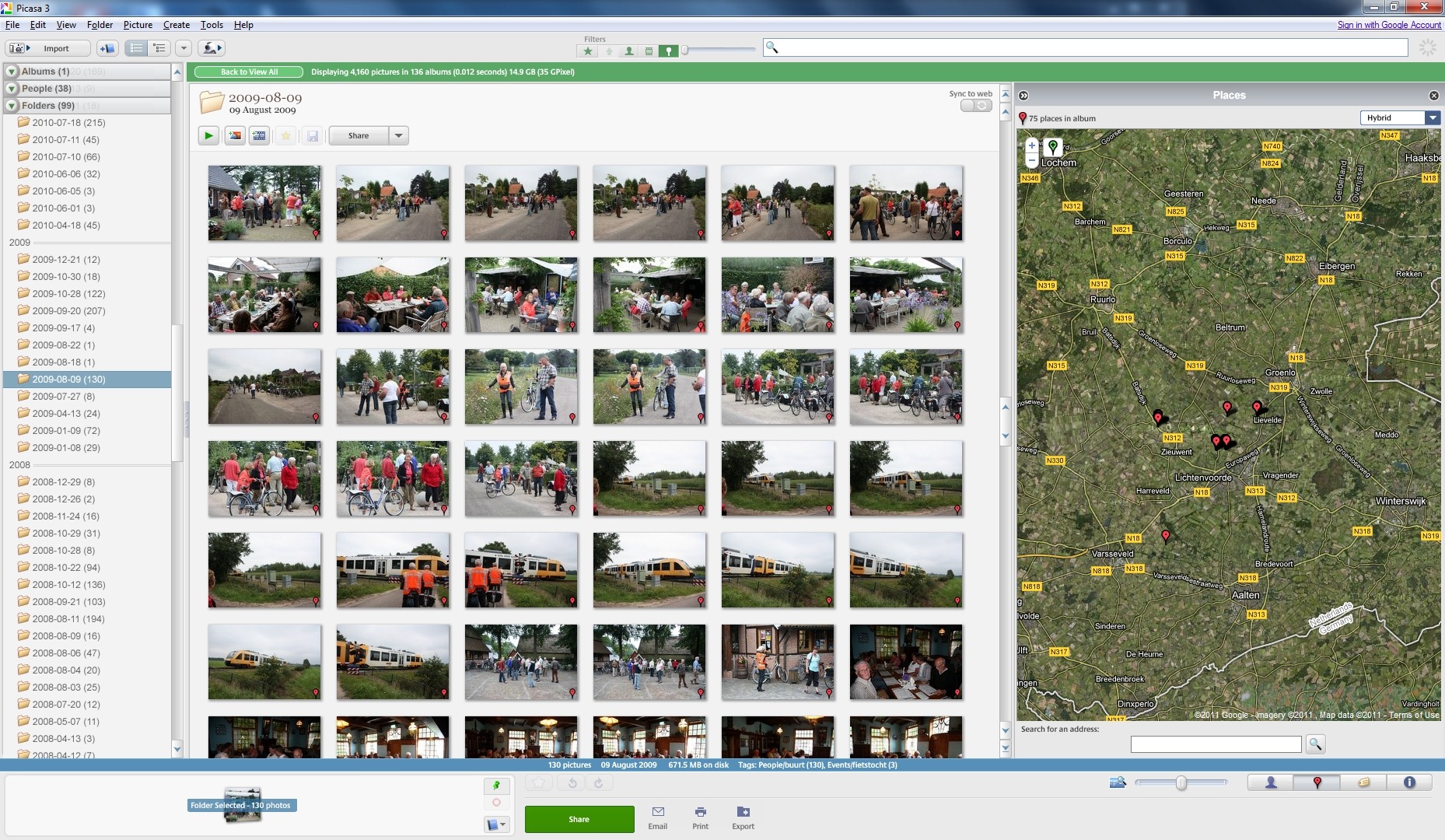
    And here’s the same folder of photos in version 3.9 displaying the correct locations of the geotags on the map:

    Picasa Geotag 3

    Captions

    As the old joke goes: the great thing about standards is that there are so many to choose from. I’ve noticed that Google and Microsoft have interpreted the IPTC Core standard slightly differently in at least one area, and that is in the captioning of photos.

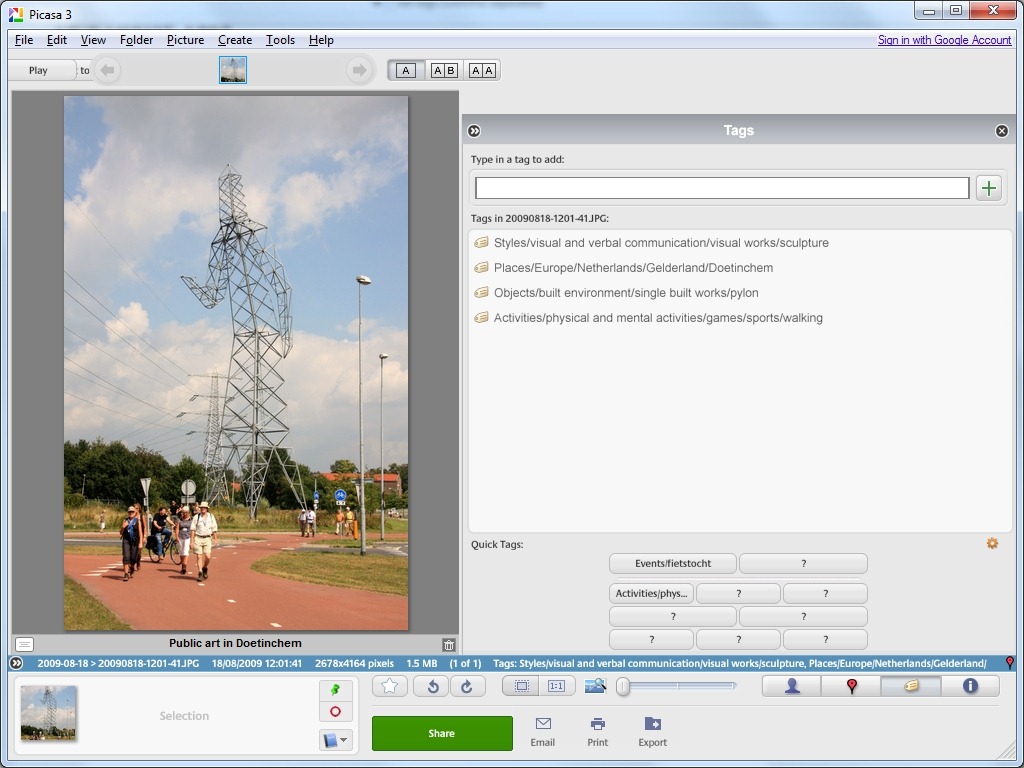
    Take another look at the single photo being displayed in Picasa. Notice that it has a caption (showing underneath the photo) that reads: Public art in Doetinchem.

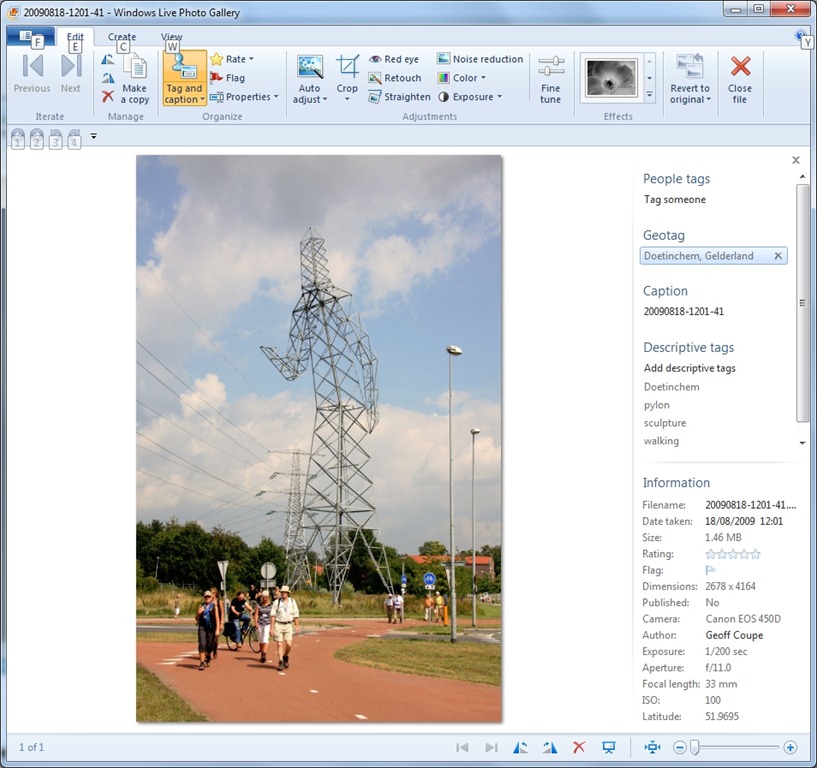
    Now take a look at the same photo being displayed in WLPG. I’ll show a new screenshot below, since in the first screenshot, the caption was being obscured by the “geotag” information:

    WLPG Geotag 1

    In the information panel to the right, you will see that the caption reads: 20090818-1201-41. In both cases, this is the same photo, so why are the captions different? The answer is that Picasa uses the “Description” metadata field from the IPTC Core standard to display the caption for a photo, while WLPG uses the “Title” metadata field from the IPTC Core standard to display the caption.

    Frankly, I think that Google have made the right choice and Microsoft the wrong choice. If I look at the IPTC definitions of the two fields, I read the following:

    Description A textual description, including captions, of the item’s content.
    Title A shorthand reference for the digital image. Title provides a short human readable name which can be a text and/or numeric reference

    I’ve followed these definitions for my own photos. I use the filename of the photo to set the Title field (it’s the date and time of when the photo was taken as a reference), and I use the Description field to hold a caption describing the content of the photo.

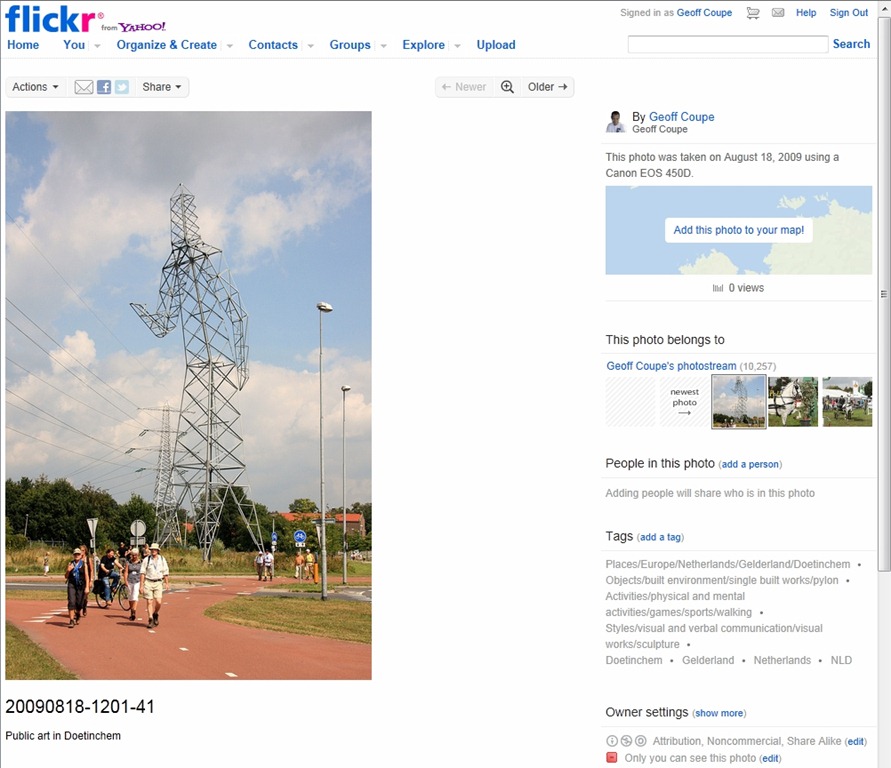
    Also, if I use Flickr to upload the same photo to my Photostream, you can clearly see from this screenshot that Flickr actually displays both the Title and the Description fields under the photo:
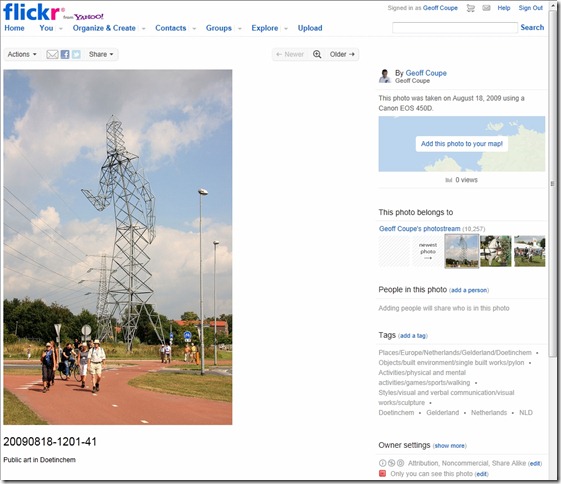
    Flickr 4

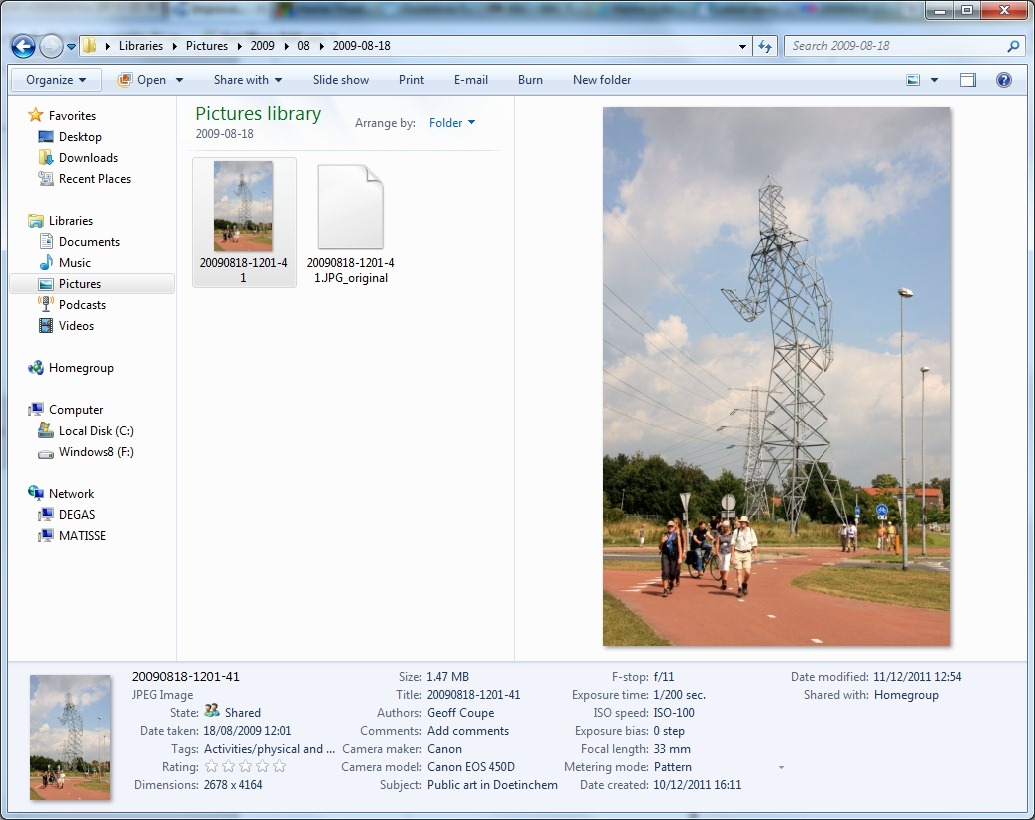
    Both Flickr and Google seem to me to have made the correct interpretation of the IPTC Core standard, while Microsoft’s WLPG team has got it wrong. However, I think that there’s little chance of them changing now. We’re probably stuck with it. Curiously enough, the WLPG team seem to have struck out on their own here, since they use different terms to those used in Windows itself. Here’s a screenshot of the photo being displayed in Windows Explorer:
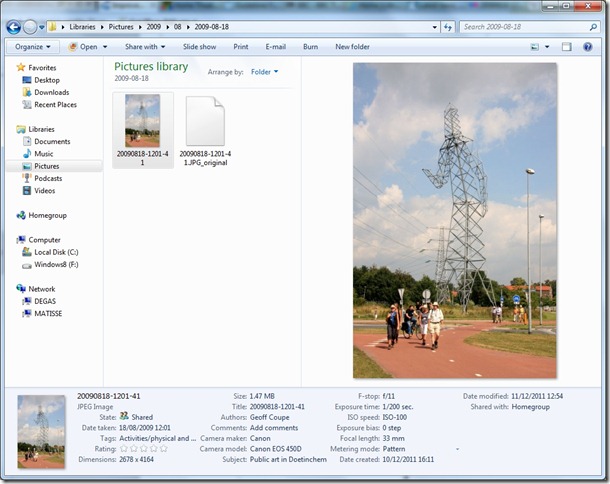
    Explorer 1

    Notice how Explorer does actually use “Title” according to the IPTC Core definition, and using “Subject” to align with the IPTC Core definition of “Description”. So Windows is better aligned with the IPTC standard for photo metadata than WLPG…

    Descriptive Tags

    Both Picasa and WLPG support the use of descriptive tags, and both use the “Keywords” metadata field from the IPTC Core standard to display the keywords, or descriptive tags for a photo. This means that the same photo should be displayed with the same set of descriptive tags in both Picasa and WLPG. And, subject to one slight quirk, that’s what they do.

    The quirk is caused by the fact that I use hierarchical tags with my photos. That’s to say that, for example, my tag cows is actually part of a hierarchy that starts Nature/Animals/livestock/cattle/dairy cattle/cows. That way, when I search for photos with the tag cows, it will just show me those with cows in them. But if I search for photos with the tag livestock, it will show me photos of cows, horses, pigs, sheep, and so on. I use a tag hierarchy because I find it more flexible than an enormously long list of single-level tags. See this blog post for more detail of how I tag my photos.

    The quirk shows itself by the fact that WLPG displays just the last term in a tag sequence; e.g. for a photo that is tagged with the tag Nature/Animals/livestock/cattle/dairy cattle/cows, WLPG will just display “cows”. For our photo taken in Doetinchem, WLPG displays this for the descriptive tags (see the screenshot above):

    Doetinchem
    pylon
    sculpture
    walking

    Picasa, on the other hand can’t deal with a tag hierarchy in a friendly fashion, and has to display the whole sequence:
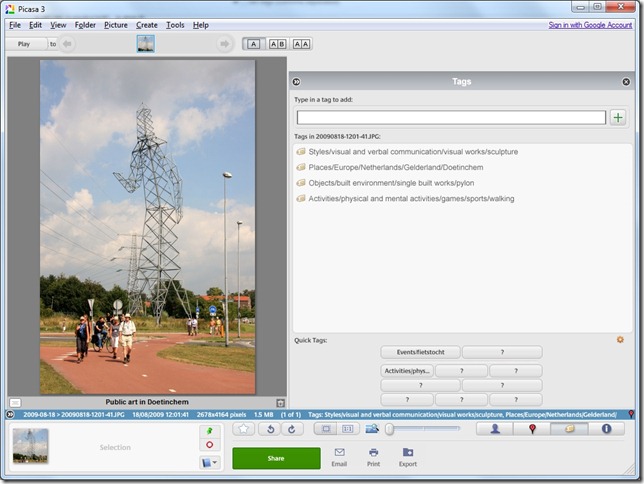
    Picasa Geotag 5

    As you can see, this gives rise to problems in handling long tag sequences: the Quick Tags buttons can only display the beginning of a tag sequence, rather than displaying the last term in the sequence.

    Mind you, WLPG is not perfect in this area, either. Both could do with improvements. For the moment, I’ll be carrying on doing tagging and other metadata work with my preferred tool: IDimager. (Note: IDimager is no longer available. Its successor is Photo Supreme, which I am now using)

    People Tags

    Both the current versions of Picasa and WLPG provide face recognition technology, so that you can easily tag people with their names. However, while WLPG used XMP to store the people tag metadata in the image files, version 3.8 of Picasa stored the tag information locally on the PC. This meant that it was very difficult to share tag information across multiple machines, since the tags did not travel with the file. I notice that in version 3.9 of Picasa, there is now an option to store the name tags in the image files themselves. Unfortunately, at the moment, there is no real information available from Google as to what this actually means. Are they using XMP? If so, is the schema documented? Microsoft have documented what they do for people tags, but so far I have not seen anything similar from Google.

    I’ll be prepared to bet that the two approaches for people tags are not compatible; that is, if I tag people in Picasa, those tags will not show up in WLPG, and vice versa. It’s been a year since the Metadata Working Group published their guidelines calling for standardisation in the area of people tagging. I doubt that we’ll see fast progress, or any progress at all, given the fact that Google and Microsoft have probably planted their flags in different places.

    Update 13 December 2011: Well, there’s a surprise: Picasa version 3.9 is using the XMP metadata fields proposed by the Metadata Working Group for people tags. See this thread on the Picasa Help Forums, where this is stated. I’ve just checked this, and I can confirm it. This is excellent news. It also means that Google has adopted the proposed industry standard ahead of Microsoft, who are still using their own XMP schema. That’s a bit ironic, considering that Microsoft are one of the founding members of the Metadata Working Group. It will be interesting to see whether Microsoft will adopt the same standard for people tags in a future version of WLPG. Then, like descriptive tags, people tags can also be shared by Picasa and WLPG. If Microsoft do adopt the standard, we’ll probably see at least one version of WLPG where both standards are used, in order to provide a transition period.

    And here’s a second surprise: it looks as though Picasa 3.9 can read WLPG people tags, so there is at least some degree of compatibility between WLPG and Picasa regarding people tags. I think I’ve lost my bet.

    I discovered this because Picasa started assigning names to some faces, without my having to do so. This could only mean that it was getting the names from somewhere, and that turned out to be from the Microsoft people tag metadata in some files – I had used the face tagging capability of WLPG on some files before I discovered that WLPG was corrupting Exif Makernotes.

    Unfortunately, Picasa doesn’t use this information to then write back the face tags into the file using the Metadata Working Group schema, but just holds the information in its local database. I’m going to have to find some way of wiping out all trace of the Microsoft people tags, and then apply them exclusively from within Picasa. Since for those files, the Exif Makernotes are already corrupted, I’ll try using WLPG to delete the face tags and see what Picasa does…

    Update 14 December 2011: Right, I’ve been playing around with the people tagging feature, and this is what I’ve come up with:

    • Picasa 3.9 will read WLPG people tags and create people tags in Picasa’s local database only (they are not written out as metadata to the image files).
    • Picasa 3.9 will read people tags created in earlier versions of Picasa that are held in the local database. It will not write pre-existing tags out as metadata to the image files.
    • Picasa 3.9 has an option to store people tags as metadata, in addition to holding them in the local database. This option is not retroactive; that is, once selected, Picasa will not write out pre-existing tags to the image files, but only write out metadata on newly-created people tags.
    • There seems to be no way to force Picasa 3.9 to write out pre-existing people tags as metadata to the image files.
    • The current version of WLPG will not read Picasa’s people tags, either from Picasa’s database, or from the people tag metadata in the image files.

    In the end, what I’ve had to do is:

    1. Ensure that all people tags were deleted from WLPG.
    2. Uninstall previous versions of Picasa, and delete the Picasa database.
    3. Search for all Picasa.ini files that Picasa strews through your picture folders, and delete them.
    4. Do a fresh install of Picasa 3.9, and ensure that the option to store people tags as metadata in the image files was enabled before starting to do any people tagging work.

    Clearly, this is a bit of a pain if you’ve already done extensive people tagging in either WLPG or Picasa, but I see no alternative at the moment. That is, if you want to prepare for the future and hold people tags as industry-standard metadata in your image files.

    Update 2, 14 December 2011: Sigh, it looks as though storing the people tags as XMP metadata into the image files with Picasa 3.9 is buggy. I’ve found that, even though the option is selected to write out the metadata, not all the image files have the people tags written out to them. Even though Picasa is showing people tags, the images themselves do not have the XMP metadata written to them. I’ve raised this as a potential bug in the Picasa Help forum.

    Update 3, 19 December 2011: I think the comments made by Ben below are worth including here in the main entry (for the benefit of people who read the entry, but not the comments). He has found a few more people tagging behaviours worth noting:

    1. WLPG does not read the Iptc4xmpExt:PersonInImage tag.
    2. Picasa does read the Iptc4xmpExt:PersonInImage tag, but this information is buried in the properties, labelled “Person Shown”. People tagged in this manner will not show up under the “People” pane or in the “People Manager”. Likewise, you cannot search for people that are tagged using this tag (as far as he knows).
    3. WLPG allows you to tag a person without specifying the area they are in. If you tag someone in WLPG without drawing a box to indicate where they are, they will not show up in Picasa. As already pointed out, people tagged in WLPG that DO indicate where they are in the photo will show up in Picasa as expected.

    Update 4, 20 December 2011: Another Picasa bug has crawled out of the woodwork. I’ve just discovered that of the 1,895 photos that Picasa has written name tag metadata into, seven of them have had their “Date Taken” and “Date Created” metadata overwritten by the date/timestamp of when the file was modified, i.e. had the name tag metadata written out to them.

    I think it’s time to stop using Picasa version 3.9. There are just too many bugs present in the current build (135.80,0).

    Synchronisation Between Online and Local Photos

    One area where I think Picasa is still ahead of WLPG is the ease of sharing photo albums online, and keeping them synchronised with the photo albums on your PC. With a single mouse click, any folder of images on your PC can be mirrored online and the two kept synchronised. And this is a two-way sync – changes made locally on your PC will be automatically reflected in your online web folders, and vice versa. Very nice.

    In the current version of WLPG, while you can publish images from your PC to a variety of online sites (e.g. SkyDrive, Flickr or Facebook), these can’t be automatically kept synchronised. This is a rather surprising omission, particularly since Microsoft have provided online synchronising technology for some years. However, the issue was that they had a couple of competing approaches. I suspect that there is a major technology revamp going on behind the scenes, and that the next versions of Windows Live Mesh and WLPG will provide at least the equivalent of what Picasa is already doing. We may have to wait for Windows 8 to see real results from Microsoft in this area.

    Conclusions

    Summing up, I think I would have to say that, at the moment, Picasa is clearly ahead of WLPG. This is for three reasons:

    • Picasa’s automatic synchronisation of local and online photo albums is a feature that WLPG simply does not yet have.
    • Picasa will not corrupt your Exif metadata. As far as I’m concerned, WLPG’s wanton corruption of the Exif Makernotes is a cardinal sin. I refuse to even countenance using WLPG for any metadata work until this is fixed.
    • Picasa version 3.9 has adopted the Metadata Working Group’s standard for face tagging.

    I’ve held off doing any serious face tagging work up until now; partly because WLPG will corrupt Exif Makernotes if I use it to apply face tags, partly because earlier versions of Picasa only stored face tags in its local database, and partly because IDimager (my main digital workflow tool) has its own standard for face tags. Now that Picasa has adopted the Metadata Working Group standard, I think can finally start tackling face tagging in earnest.

    Update 20 December 2011. As noted in the section on People Tags, since I reached the conclusion that I can finally start face tagging in earnest, I’ve discovered bugs in the current build (135.80,0) of Picasa 3.9. As a result, I’ve changed my mind – I’ll wait until Google gets rid of these bugs before I use Picasa for face-tagging work.

    Update 27 December 2011. Thomas, in the comments below, has pointed out another major failing of Picasa 3.9 – it will remove Makernotes from any file that it touches. Sigh. I had missed this, because I was just checking to see whether the Makernotes section was being corrupted (this is what WLPG will do). Because ExifTool was not reporting any errors, I thought everything was OK. I simply hadn’t realised that it was not reporting any Makernotes errors because Picasa had bloody well removed the whole damn Makernotes section

    Right, now I need to restore all the 1,895 image files that Picasa has touched (when writing out People tags) from a backup taken prior to unleashing Picasa on my photo collection. It’s at times like these that I really appreciate the backup capabilities of my Windows Home Server.

  • Gone Missing: Bowers & Wilkins Customer Service

    This is a tale of two British companies that supply Hi-Fi equipment, and my contrasting experiences of their after-sales service.

    The first is the Acoustical Manufacturing Company Limited (now called QUAD Electroacoustics), which was set up by Peter Walker in 1936. It began by manufacturing public address systems, but in the 1950s entered the emerging domestic Hi-Fi market. The second is Bowers & Wilkins (B&W) established in 1966 by John Bowers as a company manufacturing Hi-Fi loudspeakers.

    Back in the late 1960s, I became a Hi-Fi enthusiast, and my first system included a QUAD 33 pre-amp and QUAD 303 power amplifier paired with KEF loudspeakers – the cost of B&W or QUAD loudspeakers was beyond my budget at the time. Eventually, in 1976, I replaced the KEF speakers with a pair of QUAD ESL-57 electrostatic loudspeakers, which I still have and enjoy to this day. I upgraded the QUAD 33/303 combo to a QUAD 44/405 system in 1982, and once again, I still have and use them. Along the way, I also added a QUAD FM Radio tuner.

    In 2008, I branched out into setting up my first Home Cinema system. This time, for the loudspeakers, I went for the B&W M-1 series, which had got good reviews in the Hi-Fi and Home Cinema press.

    In the course of the years, I’ve had to use the after-sales service of QUAD just once. My FM tuner developed a fault in 2005. I emailed QUAD in the UK, and my service request was forwarded to their distributor in the Netherlands, who contacted me the very next day. They subsequently repaired my tuner; result – one happy customer.

    My experience with B&W has, so far, not been so satisfactory.

    Last month, on the night of the 15th November to be precise, a shelf collapsed in our living room. Unfortunately, one of the B&W M-1 speakers was sitting on it at the time. It fell to the floor, but the fall was broken by the speaker cable. However, these little speakers are surprisingly heavy, and the result was that a small circuit board in the table stand that connects the external cable connections to the speaker itself got ripped in two; one half remained attached to the cable, the other half remained in the stand:

    20111116-1415-00

    So, on the 16th November I contacted B&W, via their web site, to ask them if it would be possible to obtain a replacement. On submitting the request, the web site promised that I would have a reply from B&W within three working days, and an automated response, copying my request, was sent to my email address.

    Three working days went by, and nothing further was heard.

    On the 28th November, I submitted the request again. Once again, the web site promised a response within three working days, and once again an acknowledgement of the request arrived in my email inbox. That’s the only thing that arrived. Once again, I’ve heard nothing further from B&W. Er, hello? Is this supposed to be customer service? I think not.

    Bowers & Wilkins Customer Service – gone missing. Result: one very unhappy customer.

    I should have stuck to Quad.

    Update 7 December 2011

    Well, it seems as though blogging about my experience with B&W customer service has produced a result. I was contacted this morning, first by the Director of Export Sales, and subsequently by the Group Service Manager.

    It would appear that their web contact form misdirected my messages, so no action was taken. I just wonder how many other customers this may have affected, leaving a trail of bad feelings in its wake.

    However, in my case, the issue has been resolved, and I’ll be able to repair my speaker. B&W’s customer service has been found.

  • Hugo

    A few years back, I bought The Invention of Hugo Cabret by Brian Selznick. Although it’s ostensibly a children’s book, I was attracted to it because the book is a work of art in its own right. Even when the book is closed and sitting on the bookshelf, Hugo’s eye stares out at you and you feel yourself drawn to reach out and discover what lies within.

    Hugo spine

    The only bit of colour is the book’s cover, everything else is black or white or shades of grey.

    Hugo cover

    Selznick mixes pages of black and white drawings into his text, and, as befits a story that concerns Georges Méliès, the sequences of drawings, on pages edged with black, flow like an unfolding film, with pans, zooms, and cuts. Indeed, the very first page invites the reader to imagine sitting in a darkened room waiting for a film to start:

    Hugo0003

    And now, a film has been made of the book. Because this is a children’s film, the director, somewhat surprisingly, turns out to be Martin Scorsese. But it makes sense when you realise that he has a great knowledge of, and affection for, the history of film. The trailer looks good (although I detest, with a passion, the sound of the trailer narrator’s voice), and the film is garnering good reviews.

    It doesn’t open here in The Netherlands until next February, but, when it does, I’ll definitely make one of my rare trips to the cinema to see it.

  • The Scientific Method

    The scientific method is the process by which science is done. To quote from Wikipedia:

    Scientific method refers to a body of techniques for investigating phenomena, acquiring new knowledge, or correcting and integrating previous knowledge. To be termed scientific, a method of inquiry must be based on gathering empirical and measurable evidence subject to specific principles of reasoning. The Oxford English Dictionary says that scientific method is: “a method of procedure that has characterized natural science since the 17th century, consisting in systematic observation, measurement, and experiment, and the formulation, testing, and modification of hypotheses.”

    Equally important in the scientific method is the sharing of results and peer review:

    Scientific inquiry is generally intended to be as objective as possible, to reduce biased interpretations of results. Another basic expectation is to document, archive and share all data and methodology so they are available for careful scrutiny by other scientists, giving them the opportunity to verify results by attempting to reproduce them. This practice, called full disclosure, also allows statistical measures of the reliability of these data to be established.

    It’s therefore a bit odd when criticism of an experimental cancer treatment results in those voicing the criticisms being threatened with legal action.

    Enter the Burzynski Cancer Clinic and one Marc Stephens who may, or may not, be a lawyer, but who claims to be acting on their behalf.

    Mr Stephens has been very busy of late. He’s been sending blustering letters to Rhys Morgan, a 17 year-old schoolboy:

    Rhys,

    This is my THIRD AND FINAL WARNING to you.

    Please convey this message to your entire Skeptic Network, which includes but not limited to, Ratbags.com, thetwentyfirstfloor, quackwatch, etc. I represent Dr. Burzynski, the Burzynski Clinic, and the Burzynski Research Institute. I’ve attached Azad Rastegar, and Renee Trimble from the Burzynski Clinic for your confirmation.

    In the following weeks I will be giving authorization to local attorneys in multiple countries to pursue every defamation libel case online, including your online libelous statements. I suggest you shut down your entire online defamation campaign about Dr. Burzynski, and remove ALL recent or previous comments off the internet IMMEDIATELY. The minute you post any libelous comments online about my client I will pursue you and your parents/guardians To the Full Extent of the Law. I have no obligation to train you, or teach you, the meaning of defamation. Google it, or go to the library and research it.

    This is a very serious matter. Please confirm your mailing address, which I have on record as (my address). If you do not cooperate an official legal complaint requesting punitive damages will be mailed to that address. I will be contacting your school as well to inform them of your illegal acts.

    As Rhys says:

    Since the initial email, I have discovered others have received similar legal threats from Marc Stephens including Peter Bowditch of ratbags.com, who blogged about Burzynski eleven years ago, but is only now receiving this legal threat. Another blog threatened includes Quackometer.net from Andy Lewis, A.K.A Le Canard Noir. You can find a blog about his ordeal with Marc Stephens here:

    I posted the blog so that patients, their friends and families would be aware of the whole story about Burzynski and his unproven therapy. I want them to be aware that the treatment seems to be in a constant cycle of trials generating unpublished results. As Dr Howard Ozer, director of the Allegheny Cancer Center in Philadelphia, said – it is scientific nonsense.

    In fact, the actions of Mr. Stephens may have backfired a little. There is now a long list of posts popping up drawing attention to this interesting interpretation of what the scientific method entails.

  • Boris and Brazil

    I read this in the New Statesman today. It reminded me of the scene in Terry Gilliam’s Brazil where armoured police break into the flat of Archibald Buttle, terrorising his wife and children and ultimately bringing about the death of the innocent Buttle.

    I’ve never been a fan of Boris Johnson. This makes me like him even less. This is not how community policing should be.

  • It’s Time…

    Life, dating, love, tears – and a marriage proposal; all in a little film that lasts under two minutes. What on earth could be wrong with that?

    Well, judging from the comments on YouTube, and the fact that it was necessary to make the film in the first place, some people obviously do have problems with two people wanting to share their life together and having their friends and relations bear witness to their commitment.

    I’ve never understood their objections.

  • Ken, Meet Grim…

    I was saddened to read today that Ken Russell has died. He was 84. He once said that “the Grim Reaper is the only thing that will stop me making films”. Alas, introductions have now been made.

    It was Ken who, way back in the 1960s, introduced me to the music of Delius and Bartok through his films on their lives made for the BBC television programme “Monitor”. He also made short films on other aspects of art and culture for Monitor. Here’s one dating from 1960 that he did on the playwright Shelagh Delaney (who has also died very recently):

    His films were never less than interesting, and often courted controversy; most notoriously with The Devils. Apparently, the fully restored and uncut version of The Devils will be released in March next year to mark the centenary of the British Board of Film Classification. I’m sure that the irony did not go unmissed by the old devil Ken himself. He will be missed.

    Update: There’s a nice appreciation of Ken Russell written by Mark Kermode here. Worth reading.

  • Gameplay

    After an earlier failed attempt a few years back to run the Steam environment on my PC, I tried again a couple of months ago.

    I was enticed into it by a free offer to experience Portal – a game of which I had heard much, and was intrigued by.

    Steam ran much better this time around, and I very much enjoyed Portal. So much so, that I purchased Portal 2, and found it even better. The atmosphere, the humour, and the characterisation of the two protagonists, Wheatley and GLAADOS, are terrific (in all senses of the term) in Portal 2.

    Buoyed with my success of running Steam and Portal (1 and 2), I looked around for similar games. I found LIMBO, and I bought it.

    I have to say that while I can appreciate the craft that has gone into it, I find it almost impossible to play for any length of time. That’s not just because it is difficult (and it is for me, requiring lightning responses that I no longer possess), but also because my character dies – a lot. In fact, my character dies practically every step the poor bugger takes, and it’s just too much for me.

    Life can be depressing enough – I really don’t want to spend my spare time wallowing in the futility of traipsing through a representation of theology’s Limbo, where the powers that be derive a sadistic pleasure from the manifold ways in which pain and death can be brought about. Religion has brought enough suffering to the human condition, I really don’t need a video game to underline the misery, thank you very much. I think I will leave LIMBO uncompleted.

  • Little Shop of Horrors

    The Guardian is running a series on the theme of “My Favourite Film”, and this week, Jessica Hopkins pens a love letter to “Little Shop of Horrors”. Not the Roger Corman original, but Frank Oz’s Musical remake.

    I agree with her absolutely, it is a wonderful film: visually, musically, and a perfect cast. I’ve watched it more times than I can remember, and will keep coming back to savour it anew.

    One thing that the comments on her article have brought to the surface: the original ending of the film is to be seen on YouTube. I’ve known of the original ending for a while, but I’ve never seen it. Apparently, the test audience for the film found it too depressing. While it was available on a DVD release for a short while, it was pulled by David Geffen, the producer.

    All that remains is a working copy, in scratchy black and white, of what once was Frank Oz’s apocalyptic vision. The studio got cold feet, pulled it, and substituted a happy ending. Having now seen it, on the one hand, I can understand it – the original is very depressing (everybody dies), while the revised ending is a happy one (with a twist). But, on the other hand, the sight of multiple Audrey IIs rampaging through America causing chaos and destruction à la vegetable Godzillas has a demented majesty that demands to be seen.

    It is rumoured that Geffen possesses the only copy of the original final version in colour. Here’s hoping that it will one day see the light of day and thus show the full wizardry of Oz.

  • A Public Service Announcement

    If, like me, you have no idea how to react if someone has an epileptic fit, then help is at hand. The Epilepsy Action group has a web page and video to illustrate what you should do.

    If you are as clueless as I was, then watch it and learn.

    A tip of the hat to Vaughan Bell, over at Mind Hacks, for this.

  • The Pitfalls of Design

    I see that the Windows Live team has done another blog post on their efforts to redesign SkyDrive. While I appreciate their posts for documenting some of their approaches to design, I sometimes feel that their (often bland) statements can border on the disingenuous.

    Here, for example, is the very first bullet point from that post:

    In June we overhauled our website and used the latest browser standards to simplify our photos and documents experience, while also making it much faster.

    It sounds good, until I found out that what they meant by the verb “to simplify” is that they:

    • Removed the slideshow function. Now if you want to display the contents of a photo album on SkyDrive, you have to click through every damn photo manually.
    • Removed the display of Tag metadata. Previously, photos containing Tag metadata that were uploaded to SkyDrive would automatically have the Tags transferred and displayed in SkyDrive, now they don’t. Worse, you are invited by SkyDrive to “Add a Tag”, so that means that if you do, you now have two independent sets of Tags to maintain.
    • Removed the URLs to individual images; now you have to jump through hoops if you want to provide a link to an original photo or image in blog or forum entries.

    Let’s just look at these points in turn.

    Removal of the Slideshow Function

    According to Microsoft (in a comment from Omar Shahine on this blog post):

    In doing our research we found that users preferred controlling playback themselves, and the value of hitting play and sitting back to watch wasn’t all that important relative to other features.

    Sigh – this sounds to me like the pitfall of cherry-picking your data to fulfil your own agenda. Some of my online photo albums have over a thousand photos in them; there’s no way I’m going to sit there and click on the mouse a thousand times when I could have clicked once to start a slideshow. These albums will remain on Flickr, which sensibly has a slideshow function built in.

    Removal of the Display of Metadata

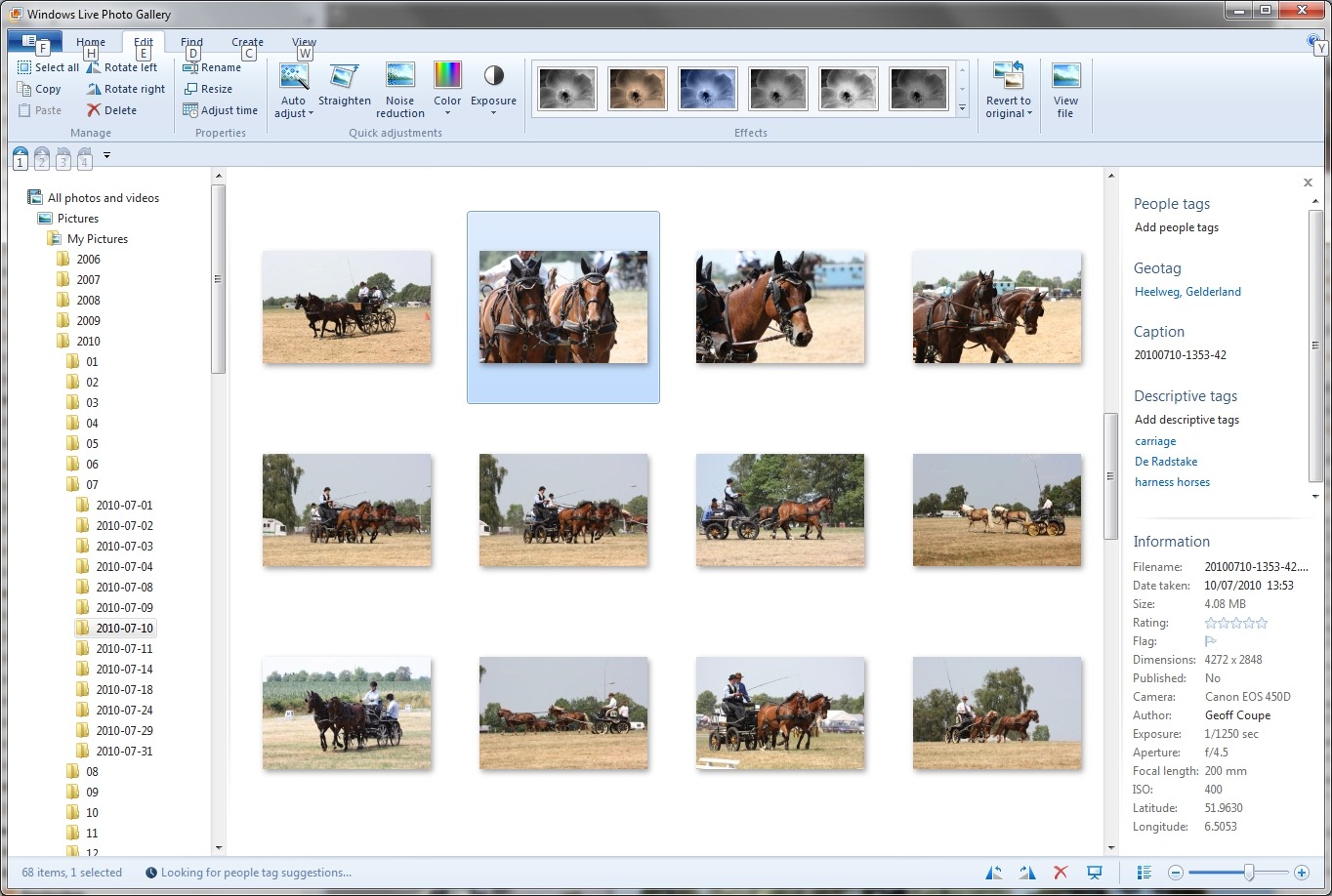
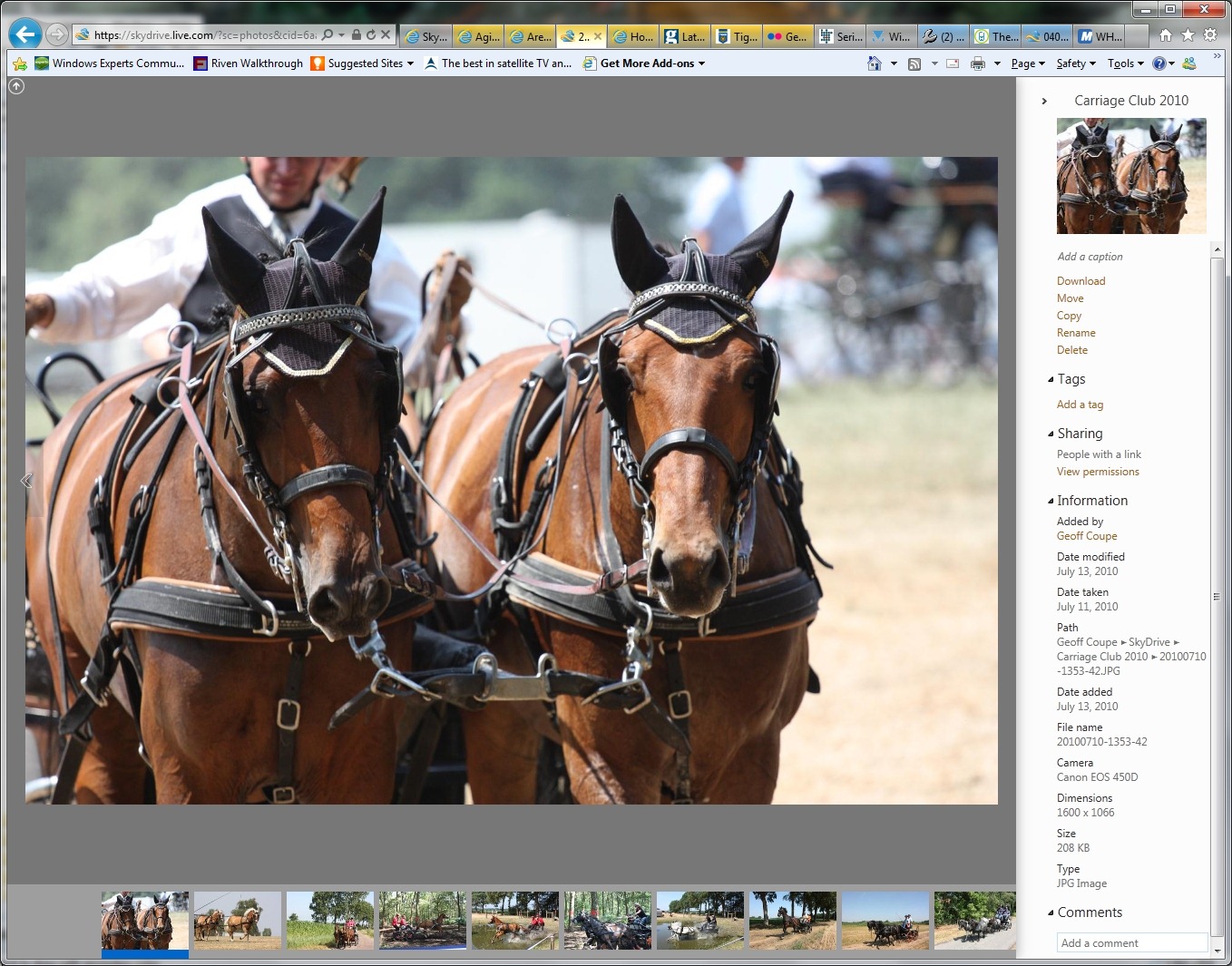
    Let me illustrate this. Here’s a screenshot of the thumbnails of some pictures being displayed in Microsoft’s Windows Live Photo Gallery, an application that is running on my PC. One thumbnail has been selected, and you can see the metadata embedded in the photo being displayed in the information panel on the right hand side of Windows Live Photo Gallery (click on the image to see the full-size screenshot).

    SkyDrive 1

    You can see that the metadata contains both descriptive tags (e.g. carriage and harness horses) as well as technical and copyright information (e.g. date taken, location, camera details, etc.).

    This picture was uploaded to a SkyDrive photo album here. When I look at the picture in SkyDrive, while I see some (but not all) of the technical information, none of the descriptive tags have been transferred. Indeed, I’m invited to add the tags again!

    SkyDrive 2 

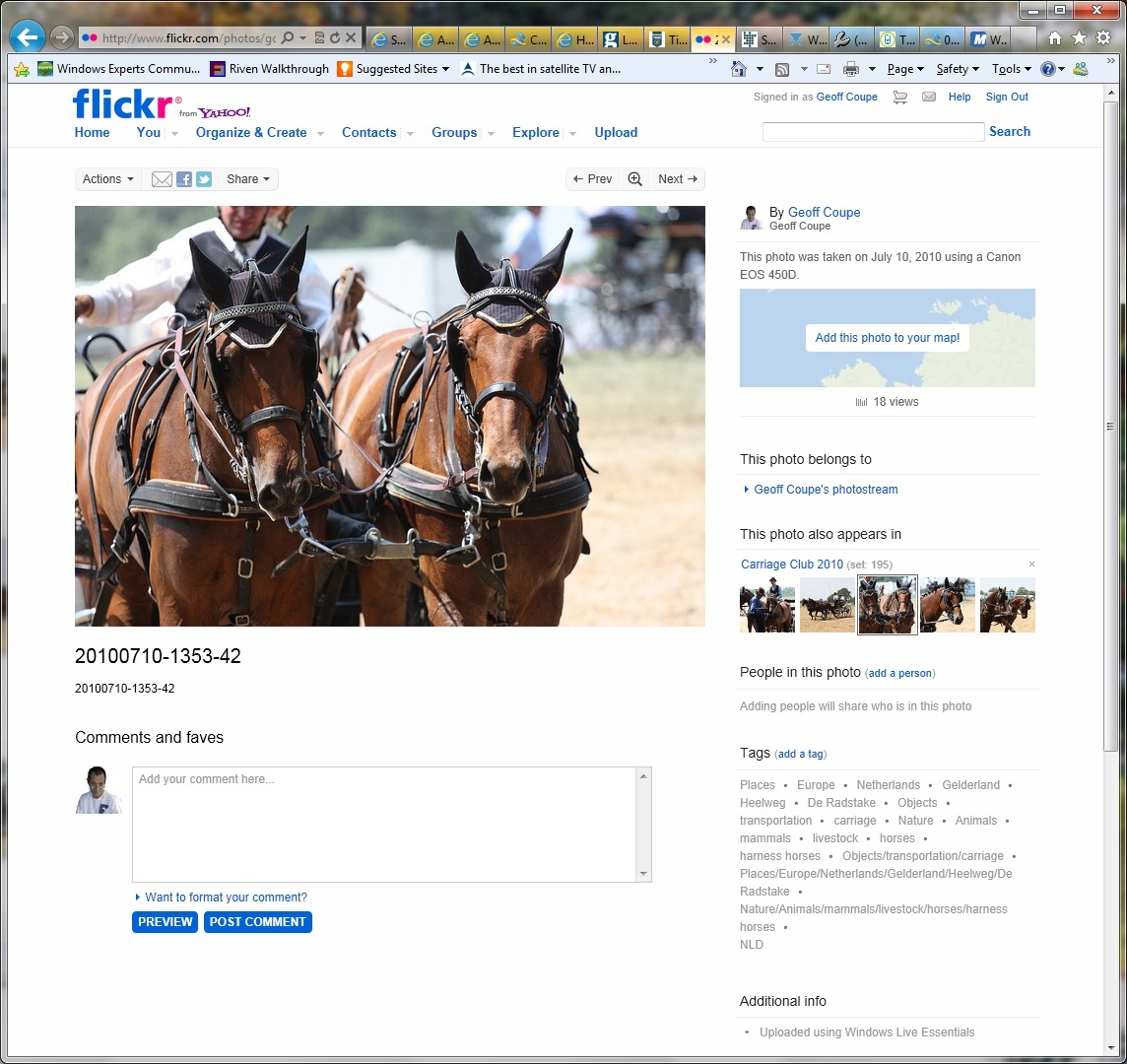
    Naturally, all the metadata is transferred and displayed if I upload my photo into Flickr:

    SkyDrive 3

    Removal of URLs to Individual Images

    There was a time when a simple right-click on an image in SkyDrive allowed you to copy the URL for that image, which could then be pasted into a blog or forum entry in order to embed the image in the entry. Alas, this is no longer possible. If you want to do that now, you have to download the image back to your PC once more, then persuade the Download Manager of IE9 to tell you the URL of where it came from. This strikes me, and others, as completely ridiculous.

    As you will have guessed by now, Flickr continues to provide a simple URL for images that can be used in blog and forum entries (together with URLs for other sizes of the same images)…

    And the Rest…

    The rest of that blog post from Microsoft goes on at length about the different groups of users that Microsoft needs to design for, and the challenges that this entails. All true enough, but it seems to me that in the current design of SkyDrive, Microsoft has actually made photographers take a step back rather than a step forward. And that is in contrast to the design of Flickr, which has certainly given me the impression that functionality has kept pace with my needs.

    Perhaps this is just a temporary hiccup. The authors of the blog post, Omar Shahine and Mike Torres, promise that they are working on improvements, without actually sharing any specifics. And that brings me to one last thought. I’ve been following the series of blog posts on Building Windows 8 with great interest. Each of those posts goes into detail, and at length, on the design choices and why particular ones are made. It’s a fascinating insight into the kitchen of the Windows 8 team. It’s a great pity that the Windows Live team have not taken a leaf out of the Windows 8 team’s book and given us more insight into what they are planning and doing. Issuing bland posts stating that there are challenges, whilst simultaneously delivering less functionality than previous versions of the SkyDrive service does not fill me with confidence.

    Update 30 November 3 December 2011

    Since writing the original post, there have been some changes to the SkyDrive service. Most have been in the area of being able to work with multiple files at once. However, one nice thing: the Slideshow function has been reintroduced.

    The other two issues I raised in the original post (no Descriptive Tags and a simple method for obtaining the URL for an image) are still there. Perhaps they will be removed in a future upgrade… Update: As Ludwig points out in a comment below, there is in fact now a method of obtaining the URL of an image. Just browse to the image required, click on “View original” and then you will be able to copy the URL from the Address bar.

    So, two down, one to go…

  • We Were Here

    A tip of the hat to Alistair Appleton over at Do Bhuddists Watch Telly for his post on the Documentary We Were Here by David Weissman. The film tells the history of the early 1980s when the AIDS epidemic grew and wiped out thousands. As Alistair says:

    More than 15,000 people died at the height of the epidemic in just the [San Francisco] Bay Area. All in the space of four or five years.

    Unlike the films And The Band Played On (which uses actors to portray the actual events of the time), or Longtime Companion (which is a fictionalised account of the rise of AIDS), We Were Here has real people telling their stories of that time and place (San Francisco).

    WE WERE HERE (trailer) from David Weissman on Vimeo.

    Martin and I are of the generation who faced the horror full on, and lost friends to AIDS. We will certainly watch the film (it’s being released next month on DVD) and remember. I also hope that some of the younger generation of gays will watch the film and get a sense of what we went through. The story is not all doom and gloom, however; as the plot summary on IMDB says:

    ‘We Were Here’ is the first film to take a deep and reflective look back at the arrival and impact of AIDS in San Francisco, and how the City’s inhabitants dealt with that unprecedented calamity. It explores what was not so easy to discern in the midst of it all – the parallel histories of suffering and loss, and of community coalescence and empowerment. Though this is a San Francisco based story, the issues it addresses extend not only beyond San Francisco but also beyond AIDS itself. ‘We Were Here’ speaks to our societal relationship to death and illness, our capacity as individuals to rise to the occasion, and the importance of community in addressing unimaginable crises.

  • A Short Tale of Two Alans

    Today’s Guardian has a short tale (less than a page) in the My Hero series. It’s by Alan Garner and reveals a connection between him and Alan Turing. Worth reading.