I must say, I felt frustrated by what they had to say. Van Zeil opened up the discussion by saying that “The Lady With an Ermine” was a better painting than the Mona Lisa. Her evidence appeared to be simply that she thought it was a better painting… Er, sorry, but that’s not really sufficient. Had she mentioned some of the pertinent facts about the painting, then I would have been nodding in agreement, but a bald “it’s a better painting” is simply not good enough, and she’s supposed to be the Art Editor of the Volkskrant, for heaven’s sake.
Well, OK, I thought, she’s only the Art Editor of the Volkskrant, she may have just a broad but shallow knowledge of Art. Let’s hear the real background from Ms. Gordenker. As Director of the Mauritshuis, she will obviously give us the facts on why this painting is so important.
But, blow me down, she didn’t. She also wittered on about the beauty of the painting and the brushstrokes…
Dammit, it’s not just about technique! It’s also about the fact that this painting is the first modern portrait in the history of art.
The woman in the painting, Cecilia Gallerani was the 16 year-old mistress of Da Vinci’s patron, Ludovico il Moro. She looks not at us, but away to someone else with a faint smile, which immediately raises the question of whom she was looking at. Da Vinci gives us a hint. She is holding an ermine, which symbolises purity. Da Vinci states this in his notebooks. Not only that, but the Greek name for ermine, γαλή, recalls the name Gallerani. Furthermore, the animal could also be a hint to Ludovico il Moro himself. Ludovico was called “Italico Morel” (white ermine), because he had become a member of the Order of the Ermine in 1488, when the King of Naples had conferred the title upon him.
There is more to this painting than simply brushstrokes and all of this was not mentioned in the interview. What a wasted opportunity!
The Dutch media is currently full of the case of Mauro Manuel, a refugee who arrived here from Angola when he was nine years old. Now that he is 18, the Dutch Government want to deport him back to Angola. The Dutch Immigration and Asylum Minister Gerd Leers has ruled that Mauro had no right to stay in the Netherlands.
Another victory for the baleful influence of Geert Wilders in his process of changing this once-tolerant country into an intolerant one. I don’t feel proud to be Dutch today.
Update: Abigail R. Esman (also living in the Netherlands) has an opinion piece in Forbes that sums up pretty well my feelings of shame and anger over this case.
I was very sorry to read today that Rose Robertson has died. Rose was the powerhouse behind Parents Enquiry, which, as the obituary says, was:
Britain’s first helpline to advise and support parents and their lesbian, gay and bisexual children, which she ran from her home in Catford, south-east London, for three decades.
I met Rose a number of times when I was working for a gay counselling organisation back in the 1970s, and I liked her very much. She was a warm, but no-nonsense sort of woman; a person whom you instinctively felt you could trust and depend upon. She did a lot of good work. Thank you, Rose.
Tablet PC Review is, as you might expect, a web site devoted to covering the field of Tablet PCs. It’s a useful place to go to for news and reviews of Tablets and Tablet PCs.
As well as the news and reviews section of the site, there’s also a large and extensive set of user forums with over 20,000 registered members. Since there’s a user forum devoted to discussion of Samsung’s Tablets, and since I am interested in learning more about people’s experience with the Samsung Series 7 Slate PC, I thought that I would get registered on the forums and get involved in the discussions.
So, a week ago, on the 18th October, I registered. I got the activation email from the forums to complete the registration process, and activated my membership account. I signed in, and browsed around.
Imagine my astonishment when, on Thursday, I attempted to sign in and instead of seeing the list of forums, I found myself staring at this:
It says:
You have been banned for the following reason: dumb spammer DID YOU THINK YOU WOULD GET AWAY???
Date the ban will be lifted: Never
Er, excuse me – I am not, and never have been, a Spammer. Indeed, I have not even posted one single message to your forums… Clearly there’s been some mistake. So I sent a polite message to forum support explaining that there’s been some sort of error, and my account has been flagged as spam.
No response.
Yesterday I sent another polite message to Forum support asking for the mistake to be corrected.
No response.
If I try to log on, I still get the Spam message, and I see that I am now no longer listed as a member. I suppose that I can still browse the forums of interest anonymously, but it is much more convenient to be registered, and to be able to raise questions.
I know I’m old-fashioned, but, even with the internet, I still do rather expect to receive the common courtesy of a reply, and I tend to get frustrated when I perceive that I’m simply talking to a brick wall.
Update 27 October 2011: I sent a direct email about this to Jamison Cush, site editor of TabletPCReview. He immediately forwarded it on to his community manager who manages the forums. I received a swift reply from him, apologising for the mistake – there was apparently a significant Spam attack when I registered, and I had got caught up in it – and I have now been reinstated. The brick wall may have been a failure of the “Contact us” channels. Sometimes it’s useful when you can walk around the wall and communicate directly with real people.
No, I’m not talking about Steve Jobs; I’m talking about Dennis Ritchie, inventor of the C programming language and co-developer of the Unix operating system. His influence, via C and Unix, has left its imprint through practically all of computing and modern technology.
Sobering to realise that he was only a few years older than me.
Update 16th October 2011: There’s a very good summary of Dennis Ritchie’s work in today’s Observer, written by John Naughton. Definitely worth a read if you’re interested in understanding the magnitude of what Ritchie achieved. Good opening too:
It’s funny how fickle fame can be. One week Steve Jobs dies and his death tops the news agendas in dozens of countries. Just over a week later, Dennis Ritchie dies and nobody – except for a few geeks – notices. And yet his work touched the lives of far more people than anything Steve Jobs ever did.
Over the past year, there have been a number of cases reported in the Dutch media of gay couples being harassed to such an extent that they have sold up and moved elsewhere in The Netherlands. Such cases usually occur in the housing areas of the large cities, such as Utrecht and The Hague, where you can get very different cultural and ethnic communities living cheek-by-jowl.
The latest case was reported last Friday, and I was somewhat surprised to learn that it happened just eleven km. down the road in Ulft, a little town of about 11,000 people. We live in the same municipality, and I was pleased to read in the local paper today (and on the council’s website) a statement on the case from the Mayor. It’s worth quoting in full:
Perhaps you too have seen this on TV or read it in the newspaper in the last week. A homosexual couple will be moving out of our community. They have been harassed for years. Last Friday I spoke with one of them. He stated that he had repeatedly called the police and had also tried to pass their complaints about harassment to me. Only after four calls to the municipality’s office was an appointment made. By that time, they had already decided to move. Because they were so upset that they felt compelled to leave their beloved Ulft, they made the media aware of their displeasure.
Apparently their complaint over harassment was not taken seriously enough for a meeting with me or the police. I want this to occur in the future. Meanwhile, I have made an agreement with the police that they are more alert over bullying, and over cases reported. In the Municipal Office, we will also be more alert. The Police have found no reports and the complaint is not known to the police on the beat. It is not an unwillingness of the police or municipalities, but bullying can be underestimated.
The lesson for me is: when people call with complaints about bullying, then it deserves more attention than this couple has received. We shall be more alert. I find it too crazy for words that people were bullied out of their village because they are ‘different’. Let’s be on our guard about this, so that respect and tolerance are important values and remain so in our communities. We are jointly responsible for ensuring that everyone has a place, regardless of origin, race, orientation or religion. Everyone needs a safe place to live in and to live. If that is not the case then we must, depending on the specific conditions, get around the table and look together at what can be done. I want to know how many bullying problems there are. Therefore I make this appeal to you.
Are you being bullied or know of situations where something like this is happening? I hope that you will report this to me. Naturally I will respect your confidentiality.
I like the fact that the Mayor has looked beyond the fact that the trigger here was a case of harassment of a gay couple, and used it to assert that harassment of anyone ‘different’ in the community is unacceptable. Quite right too.
Steve Jobs has died at the young age of 56. He had a massive influence on at least three industries: computing, film animation and music.
I thought that Dan Gillmor’s eulogy on Jobs probably came closest to a rounded portrait: “a man of contradiction and genius”. Gillmor also links to the commencement speech Jobs gave at Stanford University a few years ago and that is certainly worth reading; in particular, his thoughts on life and death:
No one wants to die. Even people who want to go to heaven don’t want to die to get there. And yet death is the destination we all share. No one has ever escaped it. And that is as it should be, because Death is very likely the single best invention of Life. It is Life’s change agent. It clears out the old to make way for the new. Right now the new is you, but someday not too long from now, you will gradually become the old and be cleared away. Sorry to be so dramatic, but it is quite true.
Over a year ago, I blogged about Peter Bright’s article in Ars Technica on why Steve Ballmer and Microsoft didn’t understand how Apple’s iPad has been so successful.
I wrote at the time that:
It’s odd that Ballmer appears to be insisting that Tablet and Slates are just another PC form factor – they are not, and they need something other than simply loading them up with bog-standard Windows 7. A way forward may be to adopt the approach of the forthcoming Windows Phone user interface, which is designed from the ground up to be driven by the human finger. After all, the iPad owes more to its roots in the iPhone than it does to the traditional Mac. If Ballmer can’t see that as an analogy for the next generation of Tablets and Slates, then it seems likely that sales will continue to languish.
Well, fast forward a year, and we have the Developer’s Preview of Windows 8, and we are beginning to see that Microsoft are indeed adopting the tenets of Metro – the interface used in Windows Phone.
I had intended to download and install the Developer’s Preview of Windows 8 onto my HP TX2000 Tablet PC, but unfortunately it chose this moment to die. However, I went ahead and installed it on my main PC, as the secondary operating system that can be chosen at boot-up.
I can see that Windows 8 is a gamble for Microsoft, and it’s one that I think that they might very well pull off. I think it’s because that they can have the same operating system running on a much broader range of devices (at different price points) than is possible currently, and all of these devices can be supported within the same ecosystem of backend (read: Cloud) services and applications.
By way of illustration: a couple of friends visited us this last weekend. One of them works in a Dutch government Ministry, so she was fully equipped with a Smartphone and an iPad. This was my first chance to get my hands on an iPad and try it out. And, while I marvelled at the form factor, I soon found that it seemed to be very good at consuming content, but not particularly good at creating content – an impression that my friend concurred with.
My old HP TX2000 – while it was larger and heavier than her iPad – ran a fully-fledged operating system (Windows 7) and was equipped with both a Touchscreen and pen interface, as well as a keyboard, so I could use it in ways that I simply could not accomplish with an iPad. Taking notes with my pen (using OneNote) or using the built-in handwriting recognition of Windows 7 (with its scary accuracy) is a task that is completely alien to the much more limited iPad. Then again, the iPad is designed from the bottom-up for fingers; Windows 7 needs a mouse or a pen. While it is possible to adjust Windows 7 to be more finger-friendly, this has its limits.
This is where it starts to get interesting with Windows 8.
Devices, with their operating systems and user interfaces are all about horses for courses. The iPad is a device designed for a much more limited purpose than a high-end notebook. And the newly-announced Kindle Fire is a device that aims at a purpose lower than both of them, but one which may well satisfy millions of people who simply want to read books or play games. The price points of the devices reflect their capabilities.
I think that we about to see an opportunity for devices that can span a wider range, yet even though they have a higher price point, will be attractive to people.
Samsung will introduce their Series 7 Slate PC (the XE700T1A) this month – well, hopefully this month, although I’m beginning to think that November might be nearer the mark.
It has the specs – and the price – of a high-end notebook, yet can be used as a finger-driven Slate PC. In price, it’s comparable with the Apple MacBook Air models, yet the Series 7 Slate comes with a built-in Wacom digitiser in the display and a pen. I’ve long been a fan of Wacom digitisers – I had one back in the days of Windows XP; so did the HP TX2000 – the pressure sensitive pens combined with accurate sensing are a joy. If I were an artist, then the Series 7 Slate would replace my sketchpad. The Series 7 Slate also comes with the accelerometer, compass, and GPS (see Update below) sensors that are expected these days in tablets. As someone comments on this review here:
The 11″ Air costs $999 for the base model, $1199 for the second tier model. This tablet costs $1099 for the base model, $1349 for the second tier model. That’s an extra 10-12%.
Unlike an iPad, Android tablet, etc., this tablet can perform as a laptop in most scenarios — if you give it a keyboard, you can use it to run the full Excel, Photoshop, a full desktop browser, development tools, and anything else a laptop can do.
If you want to be able to do some light reading and watch some video on your tablet sometimes, and you need to be able to run Photoshop sometimes, you have to buy a MacBook of some kind *and* an iPad. Buy one of these Samsungs, and you don’t have to choose. As an extra added bonus, you don’t have to sync anything between the two devices either. If that works for your, it’s a screaming deal.
But again, for me, this just isn’t a good enough tablet without real tablet software. So hurry up, Win 8.
Samsung have already said that the Series 7 Slate can be upgraded to Windows 8.
It’s possible that this is the first product that heralds the rebirth of Tablet PCs, and one that will be joined by lower-cost models running Windows 8. I’m sorely tempted.
Update 3 November 2011: It appears as though the first units that are being delivered to the market are not equipped with a compass and GPS sensors. These were available on the units that were given to developers at the Microsoft Build conference in September, so these sensors must be part of the optional 3G mobile telecommunications capability. However, since the 3G card is apparently fitted inside the sealed case, it is not going to be something that an end-user can fit after purchase.
Our younger dog, Watson, reacts to the sound of these sirens by howling in sympathy. Perhaps it’s some deep-seated instinct that he’s inherited from his wolf ancestors? Whatever the reason, he always reacts this way on the first Monday of every month.
I see from Youtube that many other dogs react this way, so perhaps there is some instinctive reaction at work here.
Almost a year after the first release of Windows Phone 7, the first major upgrade (“Mango”) of the phone operating system is being rolled out. Although it is a major upgrade, the official version number is 7.5, rather than 8. I suspect that’s because Microsoft want to reserve that for a future major upgrade – presumably to be rolled out at, or around, the time that Windows 8 hits the market.
WP7.5 apparently addresses most of the shortcomings of the original release. As usual, Peter Bright, over at Ars Technica, gives a very complete review of WP7.5.
His final summing-up:
With Mango, Microsoft has got the smartphone operating system right. It’s fast, it’s fun, it’s easy to use, it does everything you need, and it looks great. It takes the things that made the original release unique and makes them better, and it addresses nearly every criticism made of that version. As a piece of software, it’s a triumph, and it’s more than good enough to take on Android and iOS.
As a complete package, though, questions remain. Much is being demanded of the hardware companies, and much is staked on Nokia’s ability to make hot handsets. If they don’t deliver phones that people want, Windows Phone will continue to struggle. But it won’t be because of the operating system.
I find those last two sentences particularly telling. And in my view, it’s not just down to the hardware companies, it’s also down to Microsoft’s marketing, the phone application Marketplace, and to Microsoft’s infrastructure used in the Marketplace. That infrastructure has, I think, a pretty serious flaw, which I have pointed out before. And that is: it assumes that people stay in one country all their lives.
Microsoft have chosen to use the infrastructure used by their Zune music player as the basis to support the application Marketplace for Windows Phone. The problem being that once you create an account in the Marketplace, and define your country of residence, you cannot change that country, nor even delete your account. I find this last point almost incredible. I can close my Windows Live ID account, but I can’t close my Zune account? Which bright spark thought that one up?
This shortcoming has been in the Zune Marketplace since at least 2007, and people have been complaining about it ever since. When Windows Phone was released in October 2010, and the Zune Marketplace, running as a PC application, was used to access, purchase, and deliver applications to Windows Phones, a whole new group of people were suddenly confronted with the shortcoming and started complaining. There are many threads about it on the support forums, such as this one, which is currently running at 17 pages of pure frustration.
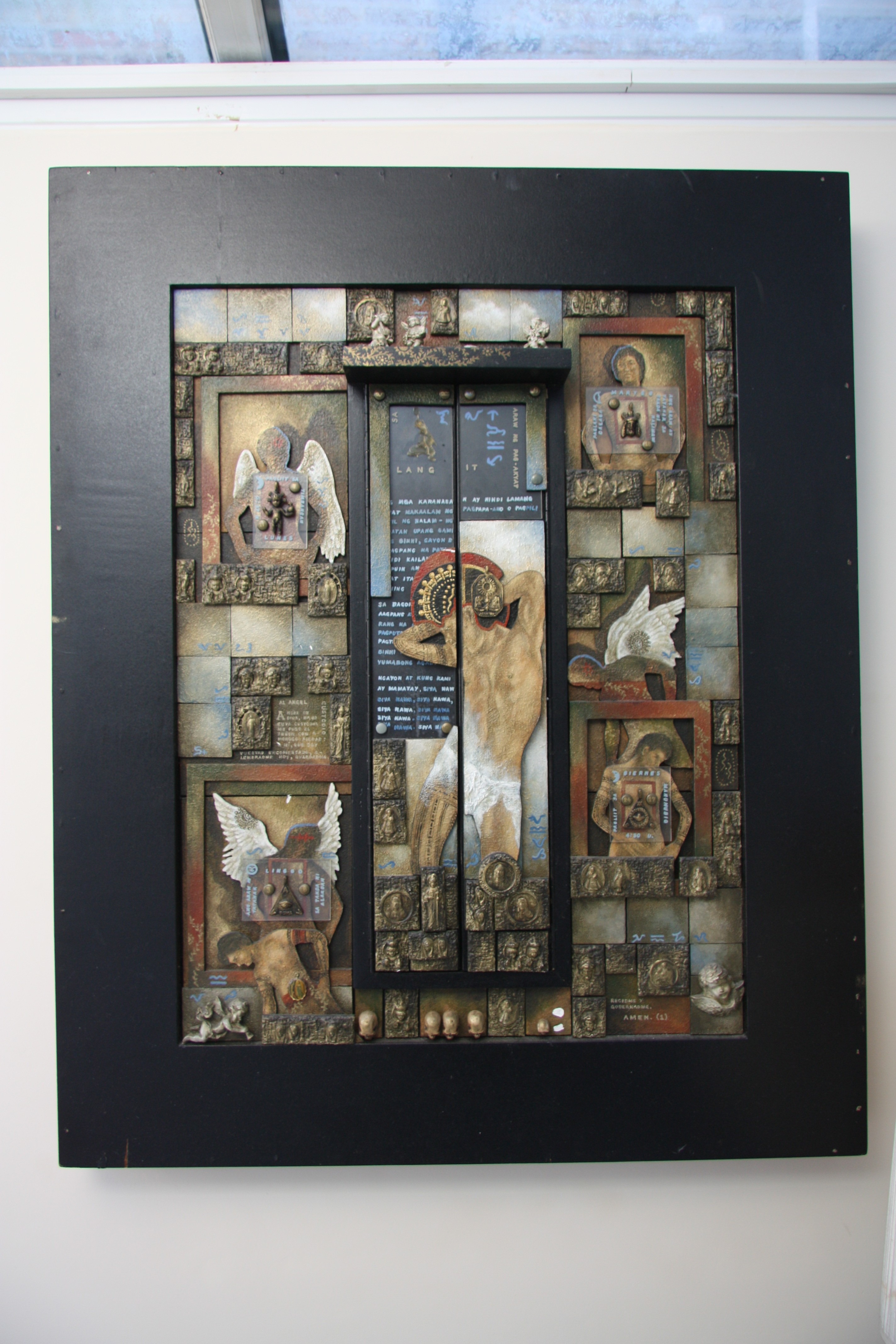
A large package was delivered yesterday morning. It turned out to be a work of art. My dearest friend, Len Curran, had, amongst his many other talents, an eye for Art. Many was the time during his travels abroad that he would struggle back with a sculpture, or a huge painting, and then argue with the airline about excess baggage.
The end result was that his house became ever more stuffed with his art collection. It was made even more acute as he downsized his accommodation space over the course of the years.
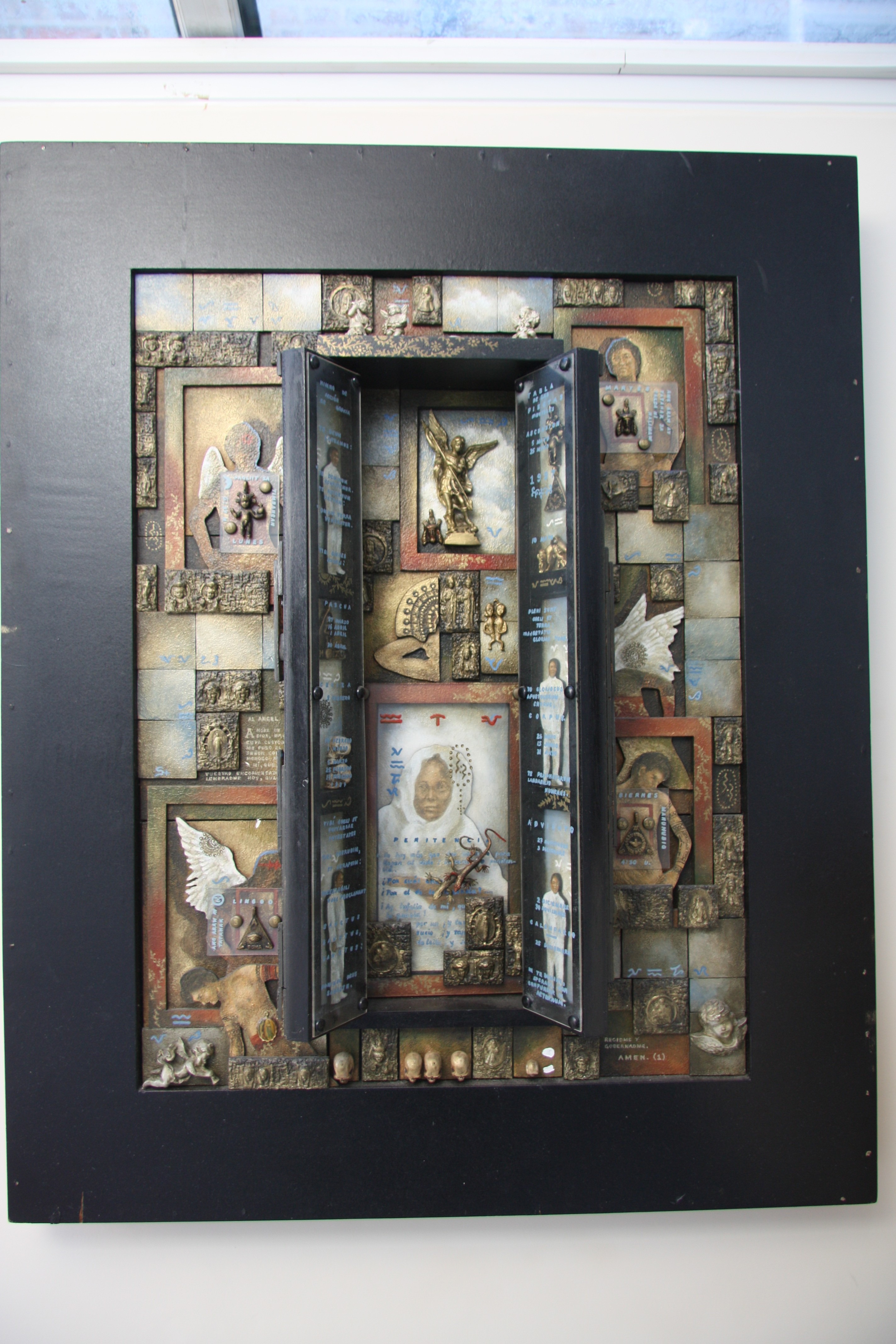
When Len died, his closest friend Mo asked me if I wanted anything from the collection as a memento, and I said that, if it were possible, I would like one particular piece. It’s by a Filipino artist, Noel Soler Cuizon, and is a mixed media piece with the title: Someday, I’ll Go Back To Heaven. That’s what arrived yesterday.
Unfortunately, it got a bit shaken up in transit, so I’m going to have to do a bit of restoration work (these photos were taken in Len’s last house), but it shouldn’t be too much of a problem. I’m looking forward to it hanging on the wall, and it will be a constant reminder of Len.
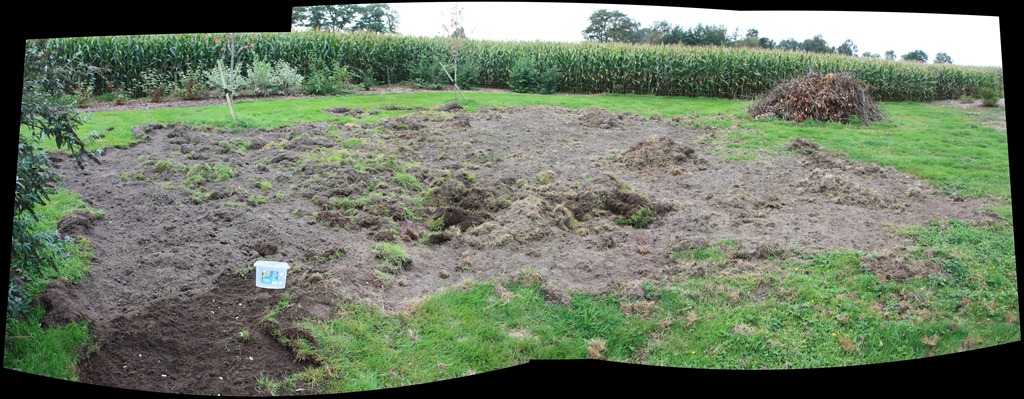
We noticed that the grass in our field was looking a bit scrubby, and the earth was being scraped over. At first, we suspected our dog, Watson, was looking for moles, but the damage was becoming too widespread.
One of our neighbours solved the mystery for us – we have a plague of Cockchafer larvae, known as Engerlingen in Dutch. Apparently, we’re not the only ones around here, it’s becoming a common problem in this area.
There are no pesticides approved to deal with it, so we’ve reverted to the Mediaeval method of dealing with the Cockchafer – killing the adult beetles or their larvae. I reckon that there are about 50 larvae per square meter, and most of the field seems to be affected.
We’ve been stripping off the turf to expose the larvae and collecting them in buckets for killing and disposal. It’s a very tedious job.
Last weekend was the annual horse festival held around here: the Varsseveld Hippisch Festijn. It’s a three-day event, but as usual, I only had time for going along to view a couple of hours of the cross-country event and the horse and carriage event on Sunday morning.
As is usual with these things, the three-year warranty that I had with the Tablet expired 6 months ago, so getting it repaired, even if it is possible, will not be cheap. It’s probably better to cut my losses by salvaging what I can from the Tablet (e.g. the hard disk) and dumping the rest.
I haven’t got another machine lying around that I can install the Developer Preview on, so I’m just going to have to curb my curiosity. Perhaps I should just wait until Windows 8 Tablets start appearing in the market (end 2012?). However, I must admit that I am sorely tempted by Samsung’s Series 7 Slate PC that is supposedly going to be available next month. But then again, I think that the Financial Controller (a.k.a. Martin) will probably be reluctant to authorise the expenditure…
So I was otherwise engaged last weekend when the latest episode of Doctor Who aired. I had travelled to Northern Ireland to say a final goodbye to my dearest friend. That’s another story, and I don’t feel ready to tell it, so instead I’ll turn to the artifice ofThe Girl Who Waited. I caught up with it today.
There’s something about a good story, well told. It can seize the heart and provoke a deep emotional reaction. The Girl Who Waited had that effect on me. Simply superb, developing from the basic setting up of the story, to the working out of the morality of how it affects the three protagonists, in particular the relationship of Rory and Amy, both balanced and unbalanced through time. As before, others can tell the story better than I.
“This is a kindness”. But, of course, it isn’t, and like the older Amy, one wants to rage against it. Arthur Darvill, and above all, Karen Gillan, as both the old and the young Amy, made this one of the best episodes of Doctor Who I’ve ever seen.
I’ve said it before, but I’ll say it again: I’m very lucky to be able to live in a country that has Civil Marriage for both same-sex and different sex couples. Some countries have only Civil Partnerships for same-sex couples, reserving Civil Marriage for different sex couples only.







 Geoff Coupe's Blog