Reflections on life at “De Witte Wand”…

Year: 2011

  • RIP, Santi Santamaria

    Damn, I see that the chef, Santi Santamaria has died of a heart attack – he was only 53. We have made three visits to his three-Michelin-star restaurant El Racó de Can Fabes in the sleepy town of San Celoni near Barcelona, and each time we really enjoyed it.

    I first heard about Can Fabes from my friend and food critic, Andy Hayler. Although Andy reported that the standard of cooking in Can Fabes was not what it once was, we were fortunate enough to be able to visit it when Santamaria and his staff were cooking at, or very near, the peak of their powers.

  • Windows Home Server 2011 Online Help

    While I’m deciding whether I should bother upgrading from my current Windows Home Server system to Microsoft’s brand spanking new Windows Home Server 2011, I thought that I should take a look at the online help system for WHS 2011. After all, when people get into difficulties, a well-designed online help system with relevant and accurate information should help them on their way, right?

    So, how does the online help for WHS 2011 measure up?

    Weeelll…

    • Could do better, I think is the diplomatic answer,
    • Could do an awful lot better, if we’re being more realistic.

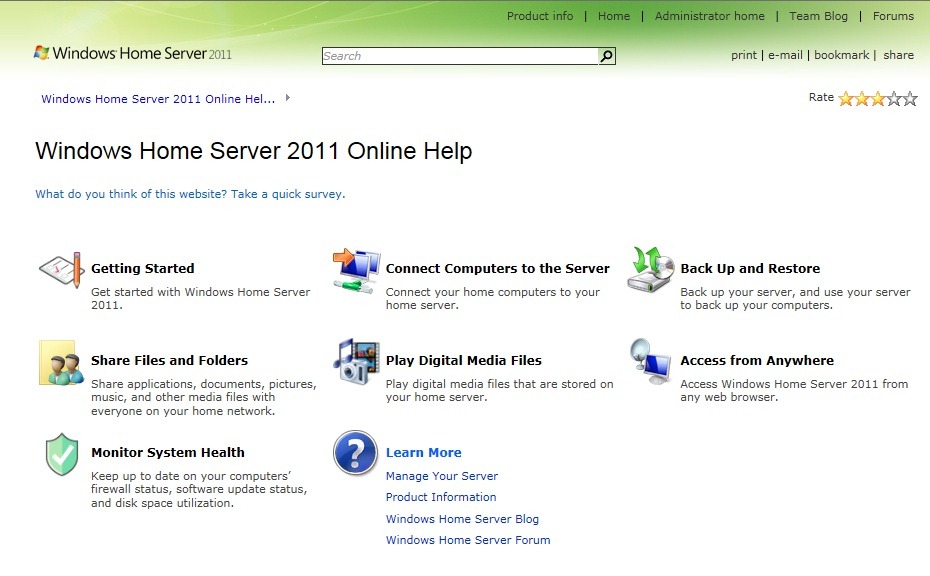
    Let’s start with the entry page of the help system:

    (Note: since writing this blog entry, Microsoft has dropped the original web pages, and moved all the help text into the TechNet Library. None of the typos/grammar/errors/text have been changed in the move, so my criticisms are still valid…)

    WHS help 1

    OK, let’s get started

    Oh, here’s a link about connecting computers to the Server

    Under the “Prepare to connect computers to the server” heading it says:

    The section provides information about the Connector software, the operated [sic] systems that are supported by Windows Home Server 2011, etc.

    The correct text would be operating systems.

    Further down the page, it has a section on how to “Connect computers to the server using the Connector software”. The first four subheadings are all to do with the concept of “How do I… (do a particular task)” . Three of the headings start with the phrase “How do I…”, yet for some reason the second item does not. It states baldly: “Install the Connector software?” when in fact what is implied is “How do I install the Connector software?”.

    There’s a minor omission on the last subheading  “Troubleshoot connecting computer to the server” – a missing indefinite article.

    So, back on the first subheading and link on the section “Connect computers to the server using the Connector software”, we arrive at the “How do I connect computers to the server page”…

    Here, there’s a minor typo in the third bullet point of the “Before you begin” section – a missing space between the words 2011 and when

    More importantly, in the text box labelled “Important”, there is reference to dynamic disks on client computers, without any further reference as to what, precisely, dynamic disks might be.

    Let’s just think about the target audience for WHS2011 for a moment. It is, I assume, the same as for the original version of WHS, that is, ordinary home consumers who have possibly a number of PCs, some or all of which will be holding digital media or documents, which need to be protected against loss.

    Using IT jargon (dynamic disks) without any further reference does not help – and this is supposed to be the online Help… This isn’t the last time this mistake will be made in the online Help…

    OK, let’s carry on… Under the “To connect your computer to the server” section, item 6, we read:

    a. From the Launchpad link, you can access the shared folders shortcut, configure computer backups, address alerts, and open the Remote Web Access site. For more information about the Launchpad, see Overview of the Dashboard

    Erm, I think that link should be “Overview of the Launchpad.”…

    After item 6 follows an extensive Important text box. There’s a typo at the end of the first bullet point: “For more information about user accounts see, see Manage User Accounts”.

    Back on the Connect Computers to the Server page, there’s a link promising help on Prerequisites for connecting a computer to the home server.

    Skating quickly over the reference to the fact that computer must be on the same IP subnet as the server that is running Windows Home Server 2011 – er, what’s an IP subnet? I’m just a home consumer… we come to the statement that:

    The boot partition—that is, the disk partition where the Windows operating system is installed—is formatted with the NTFS file system.

    Er, hang on – I thought that I could connect Macintosh computers to Windows Home Server 2011? What’s all this about Windows? Oh, don’t worry, the online Help system hasn’t got around to you yet…

    Just in case you thought that the online Help system was missing out crucial information, we come to a section where Microsoft has apparently thought it worthwhile to include irrelevant padding to further confuse the reader.

    Here’s the Install the Connector software? section (which as already noted, to be syntactically conformant and grammatically correct, should be titled How do I install the Connector software?). It reads:

    The Windows Home Server 2011 Connector software is installed when you connect your computer to the server using the Connect a Computer to the Server wizard. You can launch this wizard by typing http://<ServerName>/connect in the address bar of your web browser (where <ServerName> is the name of your server).

    • Connects your home computer to Windows Home Server 2011.
    • Automatically backs up your home computer nightly (if you configure the home server to backup your home computers).
    • Monitors the health of your home computer.
    • Enables you to configure and remotely administer Windows Home Server 2011 from your home computer.

    For step-by-step instructions about connecting your computer to the Windows Home Server 2011 server, see How do I connect computers to the server?. For additional information about connecting your home computer to the home server, see Connect Computers to the Server.

    Now, tell me – what do those four bullet points add in any way at all to the answer to the question “How do I install the Connector software?”? Answer: nothing whatsoever. They are pure fluff – and irrelevant fluff at that.

    OK, let’s skip now to one of the key areas of WHS2011 – Backup and Restore. We saw on the Home page of the online Help under the Backup and Restore heading the text:

    Back up your server, and use your server to back up your computers.

    So, clicking on the Backup and Restore link takes us to a page where there is information about backing up and restoring client computers, but not a single word about server backup and restore. A dead end. Oh well, never mind, after a bit of hunting, we find a page devoted to learning more about setting up server backup.

    After the throwaway line that “Server backup is not enabled during server setup” (why not? was this important? should I worry about it? – who knows…) we come to the first meat of the section under the heading Server backup schedule:

    You should protect your server and its data automatically by scheduling daily backups. It is recommended that you maintain a daily backup plan because most organizations cannot afford to lose the data that has been created over several days.

    Er, hello? I’m not an organization – I’m a home consumer. Who, exactly, are Microsoft talking to? I don’t think it’s me…

    Oh well, let’s continue… Under the section on considerations for the backup target drive, we read:

    Choose a drive that contains sufficient space to store your data. Your storage drives should contain at least 2.5 times the storage capacity of the data that you want to back up. The drives should also be large enough to accommodate the future growth of your server data. Because server backups are incremental, a backup drive of 300 GB in size or more can hold months of backup data.

    This advice is all very well, but nowhere does the help text spell out that (a ) your backup storage drives can not be bigger than 2TB in size and (b ) you can’t actually backup more than 2TB of server data in any case. And that “Because server backups are incremental, a backup drive of 300 GB in size or more can hold months of backup data” is possibly misleading if you’re a professional photographer doing daily shoots, or a TV addict recording lots of shows.

    Still, let’s skip to another help page: Move a server folder. Frankly, this whole page reads as though it has been written by someone to whom English is not their first language. Don’t Microsoft employ proofreaders any more?

    That same person appears to have been responsible for the Where should I add the Server folder? and the Where should I move the server folder? pages with:

    • their interesting sentence constructions (e.g. “If possible, avoid adding or moving a shared folder to the system (c:) hard drive as it make take away the necessary drive space that is required for operating system and its updates”.) and
    • their lack of clarity (e.g. “Also, avoid adding server or moving server folders to an external hard drive because you may not be able to access files in a folder on an external drive because they can be easily disconnected”. – using “they” when referring to “an external drive”).

    There’s another pile of help pages to wade through, but I’ve had enough for today. I’ll just leave you with another gem on the How do I remotely access my computer? page. Under the Home computer status: connection is disabled section, it says:

    The home computer connection is either blocked by a firewall, or the remote desktop is disabled at the computer or by Group Policy. It may take up to 6 hours for this status to be updated in the server if there is a change.

    Once again, I’m a home consumer – what in heaven’s name is “Group Policy”?

    Frankly, the majority of these help pages are written by IT people for IT people, not for ordinary people. This does not augur well for success in the supposed target market for WHS 2011.

  • Inching Closer?

    Back in January, I wrote about the fact that even though the Zune Marketplace was operational here in the Netherlands, it wasn’t offering any Apps for Windows Phone 7. The only thing that the Marketplace was offering here was videos to rent. Globally, Microsoft’s Marketplace is heavily fragmented or non-existent in most countries, in glaring contrast to the Android Market.

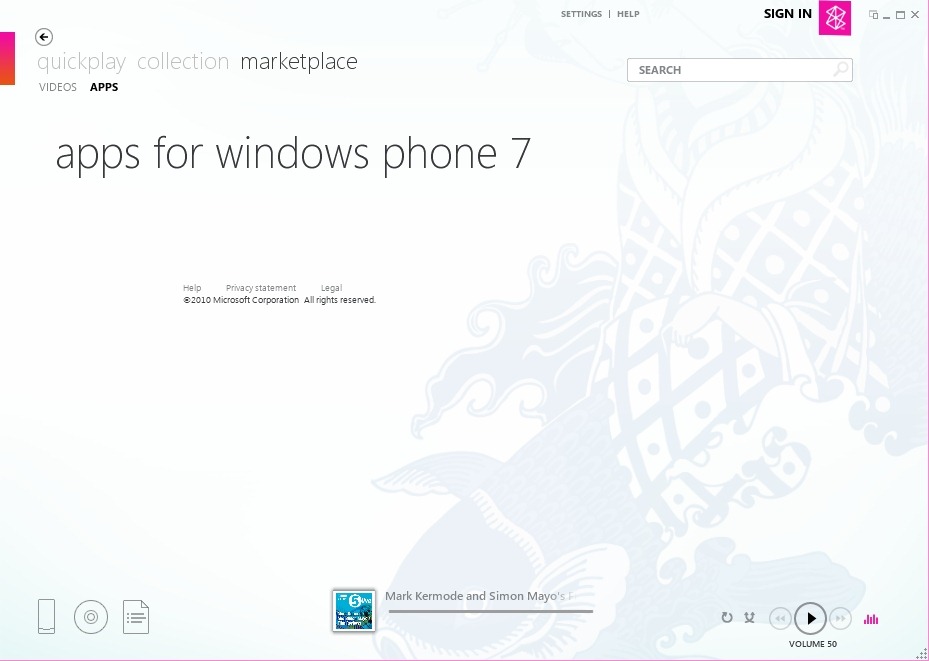
    However, it does look as though the log-jam is being tackled. I’m reading reports that the Windows Phone 7 Marketplace is now operational in India, and over the weekend, I noticed that the Zune client on my PC had an “Apps” entry in the Marketplace menu, which it didn’t before. However, there are as yet zero applications available…

    Zune 4

    While Microsoft management keep trumpeting about the thousands of applications available for WP7, it is somewhat irritating when they aren’t actually available to Windows Phones if you happen to live outside one of the few countries blessed with an operational marketplace…

    Addendum: sigh, it looks as though I spoke too soon. The “Apps” menu item has vanished again. Clearly, someone flipped a switch that they didn’t oughta and now it’s been turned off again. No Windows Phone Apps for the Netherlands, then…

  • Brooding

    A Blackbird has built a nest in our woodshed. The nest is perched on top of a wooden frame that is leaning against the wall, and is at eye-level. It’s just below the equipment that supplies the current to the electric fence (to keep the dogs in the garden and the cows out), so when I switch the fence on or off, the blackbird and I stare eyeball to eyeball. It doesn’t seem to bother her at all.

    20110402-1453-12

    20110402-1453-12

  • “Up-to-the-minute 17th Century Technology”

    I blogged a couple of weeks ago about the theatrical magic of Frankenstein. I regret that I haven’t made the effort to see earlier broadcasts of NT Live. And one production that I hope will be broadcast for NT Live would be War Horse.

    I, and you, can at least get a glimpse of the magic that the Handspring Puppet Company wove for that production from this TED talk

    Pure magic – and 17th Century technology.

  • A Damp Squib Splutters Into Life

    I see that Windows Home Server 2011 has been released to manufacturing. So it should be available on the market in April/May.

    I’m sorry, but I can only raise a faint cheer about this product. It doesn’t strike me as a major step forward from the original Windows Home Server, and in some respects – notably the removal of the Drive Extender technology – it is a step backwards.

    The comparison datasheet is long on marketing and short on actual comparison with WHSv1, and that’s not really surprising.

    What really gets to me is that Microsoft had the chance to build upon the base of WHSv1 as a server and media appliance that could be used by the average consumer, and they’ve thrown that chance away.

  • Goodies and Baddies

    The inestimable Adam Curtis has another blog entry that stops the heart, if not the tears. Such a steadfast view of humanity’s foibles is often more than I can bear. But bear witness, we must.

  • Dual Nationality to be Phased Out?

    I was born in the Isle of Man and, as a result, hold a British Passport. Having lived in the Netherlands since 1983, I also became a Dutch citizen in 2006 – so I currently have dual nationality.

    Today, the minister for home affairs, Piet Hein Donner, has introduced proposed legislation that will mean that anyone who wants to adopt Dutch nationality will soon have to give up their original nationality if that is legally possible.

    Obviously, the question in my mind is: will this also apply retroactively?

    Frankly, I see this move by Donner as a step backwards – a sop to the burgeoning nationalism fanned by the likes of Wilders and the PVV. I actually feel proud of the fact that I am able to hold dual nationality – I feel it gives me a broader horizon – a step towards being a citizen of the world. If Donner has his way, I’ll be forced to retreat to a narrower view of the world. I’m not happy about this.

    Addendum: a friend of mine who’s in much the same boat (born a Scot, lived in the Netherlands for years and now has dual nationality) wondered if he could add a new word to the English language:

    Wilderize
    – to change a tolerant country into an intolerant country.

    I think he has a point.

  • The Magic Washing Machine

    I’ve mentioned Hans Rosling and his artistry in showing statistics before. Here he is again, this time taking the humble washing machine as the springboard for an exploration on its impact on society and the environment. Great stuff.

  • “A Disturbing Trend”

    Today’s title is a quote from Archbishop Silvano Tomasi. Apparently, according to Reuters,

    People who criticise gay sexual relations for religious or moral reasons are increasingly being attacked and vilified for their views, a Vatican diplomat told the United Nations Human Rights Council on Tuesday.

    Archbishop Silvano Tomasi said the Roman Catholic Church deeply believed that human sexuality was a gift reserved for married heterosexual couples. But those who express these views are faced with “a disturbing trend,” he said.

    “People are being attacked for taking positions that do not support sexual behaviour between people of the same sex,” he told the current session of the Human Rights Council.

    “When they express their moral beliefs or beliefs about human nature … they are stigmatised, and worse — they are vilified, and prosecuted.

    “These attacks are violations of fundamental human rights and cannot be justified under any circumstances,” Tomasi said.

    Oh, dear god, where to begin?

    Well, perhaps with Russell Blackford:

    The most important thing about this is its one small grain of truth: you should not be prosecuted for expressing such evil views as that engaging in consensual homosexual conduct makes you a “sinnner”, or “emotionally disordered”, or whatever else these bastards want to say. Freedom of speech should enable you to say, quite legally, all sorts of ugly, vicious things.

    Freedom of speech also should enable others to point out that these are, in fact, ugly vicious things … and that only a vile person would say such things. When you say these things, it shows your true character.

    Silvano wants his cronies to have freedom of speech. Fine. I agree. But he doesn’t want the rest of us to have it. He’s not only vile – he’s a hypocrite, like the rest of his kind.

    And then, perhaps also Ophelia Benson has a point:

    Or to put it another way, gay people are increasingly being attacked and vilified by reactionary religious fanatics who think they should have the power to tell everyone everywhere what to do down to the smallest detail.

    But although I am disgusted by people such as Archbishop Silvano Tomani, I should perhaps take the line of Steve Zara, and laugh at Tomani:

    I’m rather enjoying this, I have to say. I’m a relatively mild-mannered fellow who sort of muddles through life in a vague way, and now I’m becoming a threat to human rights and a source of evil. It’s all rather exciting. I need to think of an evil look. Perhaps I could wear sunglasses indoors or something like that. I have not put as much effort into being evil in the past as I might have.

    Perhaps, when me and my partner had a civil partnership ceremony with our families and friends in attendance, we should have played the start of Bach’s Toccata and Fugue in D minor with evil laughter rather than Tales from Topographic Oceans as we signed the register. Our small house on the borders of Coventry looks rather meek and harmless. Perhaps we should attach some gargoyles and Satanic symbols. We have a gentle Labrador, when perhaps we should have got a white cat to stroke.

    Yes, I know what you mean, Steve. Our Labradors bounce around rather too much, instead of snarling and showing their fangs. But, I suppose when you get down to the heart of it, Russell nailed it: what Archbishop Tomasi said was ugly and vicious. It shows his true character. I see you, Archbishop.

    .

  • Dangerous Economics

    While I don’t pretend to be an economist, I do have this nagging doubt that the economic policy being pursued by the current UK government is not, shall we say, the wisest course.

    Johann Hari puts it rather more forcefully, and a good deal better. Example:

    I doubt there was a single person who woke up on Wednesday morning, looked out across Britain, and thought: “I know what’s wrong with this country. Vodafone pays too much tax.” But George Osborne has acted on this belief all the same – in part because he genuinely seems to have no idea what life in Britain is like. He said recently that his school, St. Paul’s (annual fees: £30,000 a year) was “incredibly liberal. It didn’t matter who your parents were. Your mother could be the head of a giant corporation – or a solicitor in Kew.” That’s his internal vision of the social spectrum in Britain, with those pauper solicitors in Kew begging at the bottom. No wonder he doesn’t understand that (say) slashing Housing Benefit will turn 200,000 poor people out of their homes in London alone. He thinks they can take it: the rich need more.

  • Frankenstein Redux

    After last week’s viewing of the NT’s production of Frankenstein, yesterday I saw it again. This time with Jonny Lee Miller in the role of the Creature and with Benedict Cumberbatch as Victor Frankenstein.

    I think this was the casting that worked best as far as I’m concerned. Good though last week’s combination of Cumberbatch/Creature and Miller/Frankenstein were, it seemed to me that last night’s role reversal played better to the actors’ strengths. Miller brought an extra vulnerability to the role of the Creature, while Cumberbatch was an icier Frankenstein.

    Unfortunately, unlike last week, there were a few problems with last night’s broadcast. The audio was slightly out of sync with the video, to the extent where it was noticeable and therefore somewhat irritating. At one point we heard a snatch of conversation between the technical crew. And finally, during the final scene, the sound cut out altogether for about ten seconds.

    Still, despite these technical disappointments, it was still a wonderful production to see again, and I’m glad I did.

    Addendum: I’ve had a reply to the email I sent to NT Live regarding the technical hitches I listed above. The sync issue was a fault at my local venue, and NT Live will follow that up with Cinemec to try and prevent it happening again in the future. The other two issues were problems in the Olivier theatre during the live performance, for which they apologise. I look forward to seeing future NT Live broadcasts – it’s a great way to see the work of the NT.

  • Spring Has Arrived

    It seems as though Spring has arrived. We’ve been having good weather for the past week, and the daffodils and crocuses are in full bloom.

    20110321-1122-55

    To celebrate, I’ve changed the blog header photo from Winter to Spring. From this:

    Witte Wand Winter 2

    to this (taken this morning):

    20110324-0818-54 Stitch - Copy (940 x 198)

    Mind you, the downside is that now the garden’s woken up, there will be lots of work to do…

  • Frankenstein

    The UK’s National Theatre in London has a new production: Frankenstein. It’s based on Mary Shelley’s book, and sticks more closely to the themes of the original work than Hollywood’s many films (wonderful though some of them are).

    The NT’s production has garnered rave reviews – it’s currently the hottest theatre ticket in town, and all performances are sold out. If you want to see it, then probably your best bet is to see one of the live relays of a performance to a cinema near you.

    That’s precisely what I did last night. I drove to Ede (45 minutes away) and watched yesterday’s performance of Frankenstein in the Olivier Theatre in London relayed live to a screen in Cinemec. I was worried whether this would work as an experience, but I needn’t have feared. The sound and vision were top-notch, and the use of multiple cameras allowed us to catch things that would be lost if you were sitting at the back of the Olivier. Yes, OK, it’s not like actually being there, but it is a very acceptable substitute, and for those of us who don’t live in London, it’s a great way to see the NT’s productions.

    The production and performance were every bit as good as the reviews are saying. Stunningly mounted, using the facilities of the Olivier stage with its giant revolve and lifts to great effect. During the two hour performance (no interval), the stage was transformed into a woodland, the lake at Geneva, the interiors of an elegant country house and a Scottish croft, and the Arctic wasteland. We saw a locomotive roar onto stage and stop at the footlights, and the destruction of a farmhouse by fire.

    The cast do not let all this theatre magic overwhelm them. The two central performances of the Creature and Victor Frankenstein are brilliantly handled by Benedict Cumberbatch and Jonny Lee Miller. Last night I saw the Creature played by Cumberbatch, and Frankenstein played by Miller. They switch roles on successive nights.

    The rest of the cast are strong as well. I particularly liked Karl Johnson as the blind De Lacey, Naomie Harris as Elizabeth, Victor’s fiancée, and Ella Smith as Clarice, Elizabeth’s maid. There are moments of broad comedy, notably between the Scottish crofter Rab and his uncle, and of course there are moments of high drama and tragedy. But underpinning the whole play is the exploration of the theme of what it means to be human. I think it’s safe to say that the Creature is more sympathetic than Victor, and he gives voice to both the pain and the glory of humanity. Victor seems to be the one who is less than human – a sociopath who lives only for seizing the secrets of life from Nature. And the one person who is portrayed as a fully rounded human being is Elizabeth, and she is ultimately betrayed by Victor and destroyed by Victor’s creation.

    All in all, this was a wonderful experience. I’m going again next week, this time to see Miller as the Creature and Cumberbatch as Frankenstein, and I’ll have downloaded the digital programme beforehand…

  • Out of the Frying Pan…

    A couple of years back, I blogged about a documentary made by Andrew Tait. It was Trouble in Amish Paradise, and followed the lives of two Amish families. Last night, the follow-up documentary, also made by Tait, was shown on BBC2: Leaving Amish Paradise. It was an equally extraordinary and revealing piece of work.

    It followed the fortunes of the same two Amish families: Ephraim and Amanda Stoltzfus and their children, and his brother Jesse Stoltzfus, his wife Elsie and their children. By the time of this second film, Ephraim and Amanda had already left their Amish church for an evangelical Christian church, and Jesse and Elsie were on the point of doing the same.

    By my lights, of course, leaving the Amish for evangelical Christianity strikes me as jumping out of the frying pan and into the fire, but Ephraim had no doubts whatever. Indeed his total, and unshakeable, belief that God would provide was either admirable or utterly foolhardy, depending on where you stand. That said, it was rather curious how money apparently turned up in envelopes to keep the family afloat, and the film opened with Ephraim and his family on a trip to Britain, which had been paid for by people who had seen the first documentary.

    As I wrote last time, both families were very personable, but every now and then, something would be said that brought one up short. Usually it would be Ephraim; as for example when he said (apropos his handing out of messages from the Bible to passers-by):

    People are more receptive here than in England. In England they’ve been taught Darwin for [pause] quite a few years more than we have here. The Bible says that in the beginning, God created the world in six days, and that’s what I… that’s what the truth… That’s the truth, that’s what happened in six days. Darwin doesn’t believe that way. Or he didn’t. He does believe that way now. Darwin now is saying “Yes Jesus was the Christ, and I didn’t acknowledge it in the past, but he is.  And I wish I would have, you know”. Darwin is in Hell, today, according to the scriptures.

    That’s his reality.

  • How Times Change

    I see that the Isle of Man will make civil partnerships available to gay couples living there as from next month.

    This is only five years after civil partnerships were introduced into UK law. I find that surprisingly speedy for the Isle of Man. After all, it took until 1992 before homosexuality was no longer illegal on the Island – a full 25 years after the UK decriminalised homosexuality.

    I was born and grew up on the Island, so bore witness to the anti-gay bigotry and prejudice that existed there. The atmosphere resulted in a number of suicides of gay people. It seems as though things have changed, although judging by the comments of Peter Murcott, a Methodist preacher, there are still some old style bigots knocking about there:

    “It will have a fundamental change in due course on how the next generation is brought up to conceive family life and ultimately it is going to introduce an anti-Christian attitude and it will be contrary to the beliefs of many other religions as well.”

    Of course, he’s right when he says that “It will have a fundamental change in due course on how the next generation is brought up to conceive family life” – people may come to realise that families come in all sorts of shapes and sizes, and that’s a good thing. But I rather think that Mr. Murcott sees the change only in negative terms.

    Addendum: I came across this video with Alan Bell who does a good job explaining the background to the change in the law. Bell is a Member of the House of Keys (MHK) – a member of the Manx Government.

  • Twixt Scylla and Charybdis

    Johann Hari has another thought-provoking article posted. This time it’s on our addiction to cheap oil. Worth a read.

  • Nothing “Pseudo” About It

    Following hard on the heels of the murder of Salman Taseer comes the murder of Shabaz Bhatti.

    I see that the Archbishop of Canterbury is reported as condemning the murder of Bhatti, and quite right too. But I did find one statement of his slightly jarring. He is reported as saying that there was a faction in Pakistan:

    “wholly uninterested in justice and due process of law, concerned only with promoting an inhuman pseudo-religious tyranny.”

    Er, excuse me, but what’s that word “pseudo” doing in that sentence? The sentence is just as true without it. I suspect that the good Dr. Williams just cannot face up to, or is not willing to state in public, the simple fact that there’s nothing pseudo about religious tyranny, and that Bhatti’s murderers sincerely believe that they were doing the right thing.

    On a related note, it’s worthwhile reading Eric MacDonald’s piece today. The key quote:

    It is simply foolish and foolhardy to dismiss these extremists as merely extreme, as marginal expressions of their respective believing communities. What they stand for is always at the centre of the religious systems they espouse. Most people, with lives to live, and other goals to pursue, pay little attention to the intrinsically extremist language of their faith communities. But the language is always there. That’s why there are faith communities, because religions are essentially tribal and divisive.

  • Did I Miss Something?

    Last night, I settled down to watch the opening episode of Professor Brian Cox’s new series on science: Wonders of the Universe. Unfortunately, I was very tired and promptly dozed off. Every few minutes I would almost wake up and catch sight of the prof standing proud in some gorgeous location and then promptly sink back down into oblivion.

    And I’m left with a nagging doubt that perhaps the programme wasn’t good enough to snag my attention and return me to full wakefulness. Reading today’s review of the programme in The Guardian only serves to strengthen the doubt. I really must try and stay awake next week.

  • I Don’t Believe It!

    I’m channelling Victor Meldrew again today. And the cause of my frustration is once again the forthcoming Windows Home Server 2011. I wasn’t too impressed with some of the backup features I found when I looked at them a few days ago. After digging a bit further, I’ve come across one “feature” that has flabbergasted me. It really should be called a bug, because it introduces an extraordinary limitation into WHS 2011.

    It turns out that the maximum size of a server backup that can be made is 2TB.

    OK, you say, but WHS 2011 recognises multiple backup discs. So suppose my WHS has 5 TB of data that needs to be backed up, then I just use three backup discs, right? Two discs of 2TB capacity and one disc of 1TB capacity (or three discs each of 2TB capacity; the third will only be half-used). Plug ‘em in, let the server backup processes run, and everything’s hunky-dory, right?

    Wrong.

    Even though WHS 2011 will recognise multiple backup discs, it won’t let you slice up the server storage across them. You can only backup the same files and folders to any of the multiple discs. So, in the example I used above, even though I have three backup discs, I can only ever backup a maximum of 2TB of the 5TB stored on my server.

    I ask you, what sort of design is that? The term brain-dead springs to mind.

    The WHS team at least do recognise the limitation. Over at the Microsoft Connect bug-reporting site, a member of the team has written:

    At this time we can only back up to 1 single 2 TB disk. We realize the limitation and are working with the Core Windows team to fix this. Hopefully it’s something we can provide in future releases. For now you have to pick your critical data.

    Er, “hopefully” you can fix it? Dear lord, is that the best that you can do?

    It turns out that there seems to be a workaround, but it’s not, I think, for the average home user – you know, the sort of person that WHS 2011 is targeted at.

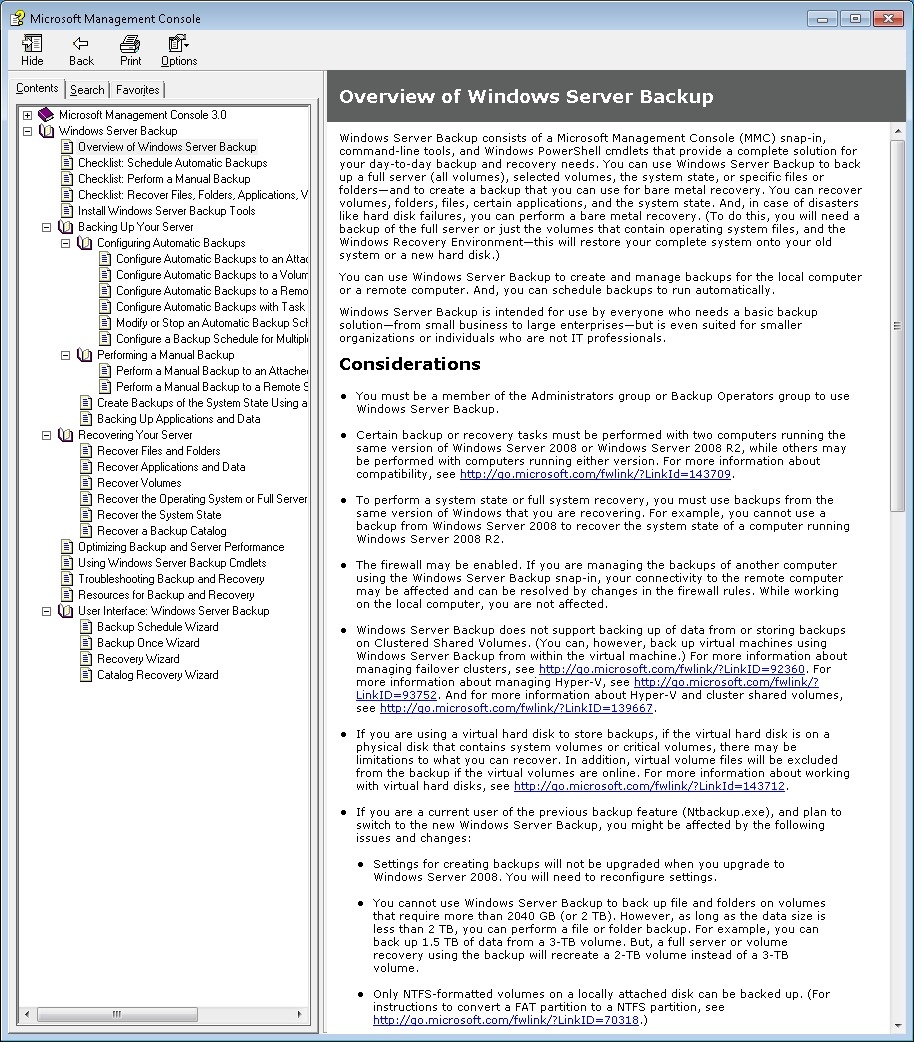
    WHS 2011 is built on top of Windows Server 2008 R2 – an extremely powerful server operating system. This has its own Backup and Restore mechanism, which is equally powerful. However, this mechanism is designed for IT people, not for the home user. Here, for example, is a screenshot of partof the Overview of Windows Server Backup, taken from the online help manual (click to see in its full gory glory). Full of jargon and certainly not for the faint of heart (or non-IT person)…

    WHS2011 19

    If you want to take a look at the full manual, then please, be my guest, and visit Microsoft’s online help web site.

    Now, it is certainly possible to use the Backup and Restore mechanism of Windows Server 2008 R2 to do what I want to do – slice the 5TB of storage on my WHS across three backup discs, but I’ll have to figure it out for myself, and start being an IT person again.

    The whole point is that I shouldn’t have to do this. WHS 2011 is supposed to be for the home user.

    The last irony about all of this is that in fact the backup features of WHS 2011 do seem to be using the underlying mechanisms of Windows Server 2008 R2, it’s just that their current design is extraordinarily limited, and, in my case with more than 2TB of data on my server, utterly useless.

    Update 20 October 2011: I see that Microsoft have now posted a TechNet article covering this 2TB limit in the TechNet Wiki. Since it’s a wiki, I’ve edited it to improve the language and the grammar. The original was clearly written by someone for whom English is not their first language.

    Update 31 March 2014: It appears as though there has been some improvement made to the Server Backup function in the Dashboard since I originally wrote this article. It remains the case that WHS 2011 continues to use the VHD format for backup, which has a maximum capacity of 2TB. However, it now appears (contrary to what Microsoft originally stated) as though the Server Backup function can now deal with multiple VHDs, providing the backup drive is big enough. So, if your backup drive is 4TB, that means you can have 2 VHDs of 2TB created on it. That, in turn, means that you can backup up to 4TB of data from your data storage drives (with a maximum of 2TB for any one drive). That’s a theoretical maximum, since Microsoft also recommend having some free space in the VHDs to handle incremental backups.