Reflections on life at “De Witte Wand”…

Year: 2011

  • Polling Day

    Today is polling day for the provincial elections here in The Netherlands. It appears that us oldsters may have an effect on the outcome and impact the position of the current coalition government.

    Meanwhile, the young appear to have swallowed the anti-Islam propaganda of the appalling Geert Wilders and his PVV party. You can guess who I won’t be voting for today.

  • Backups in Windows Home Server 2011

    I wrote yesterday that I’d decided to kick the tyres of the Release Candidate of Windows Home Server 2011. Today, I thought I’d take a look at how server backups are handled in WHS 2011.

    First, a bit of background. WHS Version 1 can make backups of its shared folders (e.g. the Pictures, Videos, Music and User folders held on the server) to external discs. This is a one-click manual process (see figure 1). That means, unlike the backups of client computers attached to the server, there’s no built-in function in WHS V1 to schedule the backups of shared folders. Also, WHS V1 does not have the option of backing up the client computer backups from the server itself onto external discs. There’s a third-party add-in to do this, but this function is not built into WHS V1 by Microsoft.

    whs Storage 3

    figure 1

    When it comes to WHS 2011, there are a number of changes in this area over WHS V1. First, server backups are always scheduled – you can’t actually initiate a server backup manually with one click of a button (NOTE: the final version of WHS 2011 does now contain a button to start a server backup manually. Microsoft added this in). Second, in WHS 2011, server backups can include both the contents of the shared folders and the backups of the client computers held on the server.

    I find these changes a bit of a mixed blessing. First the good news: it’s great that you can backup the client computer backups to external discs in addition to the shared folders (see figure 2).
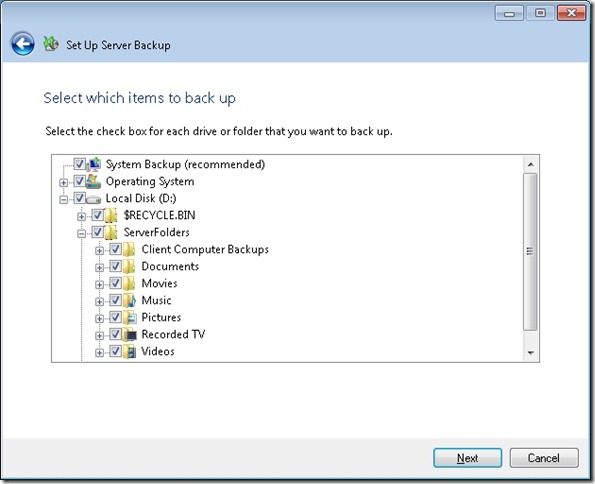
    WHS2011 9

    figure 2

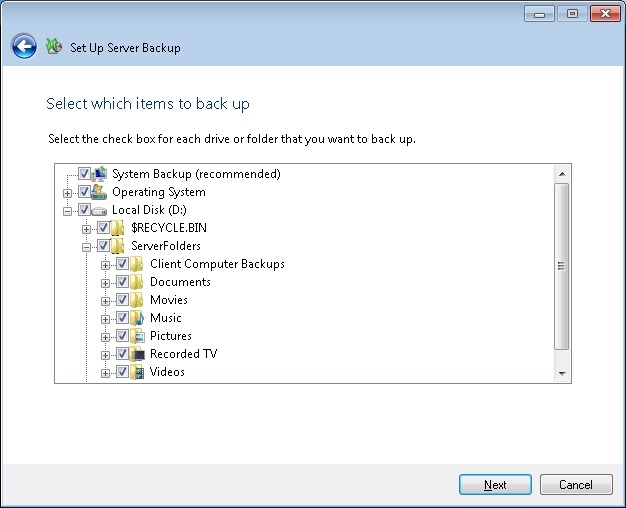
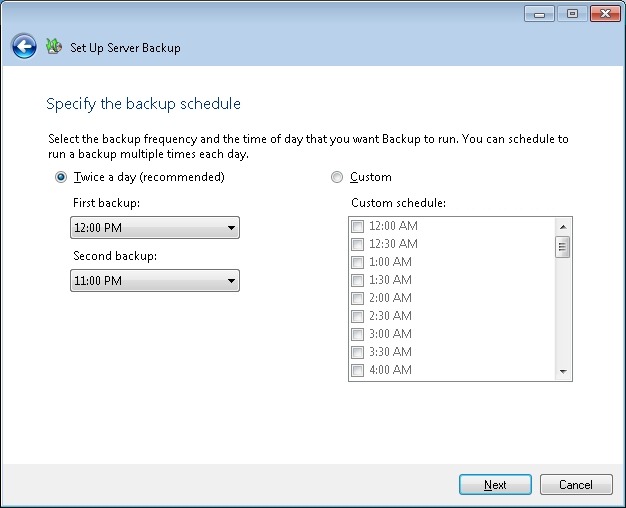
    However, I’m less enthusiastic about the fact that server backups are always scheduled, and that they run daily (see figure 3).
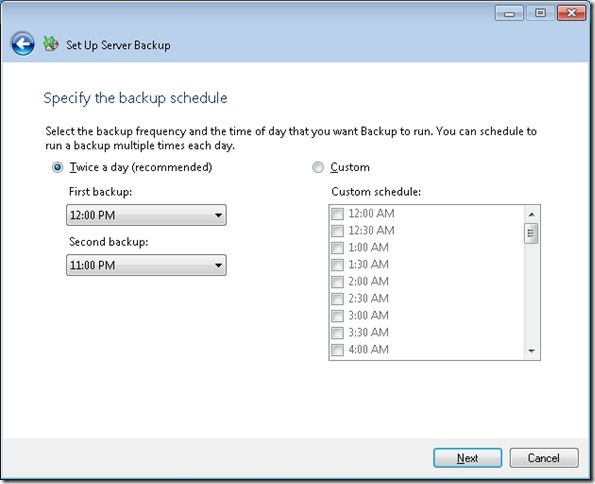
    WHS2011 8

    figure 3

    Let’s think a moment about the nature of these backups to external discs. As far as I’m concerned, they are for the purpose of making backups to be held offsite. That’s what I use them for, at any rate. If I were to have the external discs permanently connected to a WHS 2011 system, then, it seems to me, I’m only getting a slower version of the Shared Folder duplication that was built into WHS V1 and which was provided by the now-removed Drive Extender technology.

    And Microsoft’s own guidelines for Backup best practices for WHS 2011 state:

    You should backup server data to multiple external hard disks and rotate the hard disks between onsite and offsite storage locations. Doing so can improve your disaster preparedness planning by helping you recover your data if physical damage occurs to the hardware onsite.

    So if I’m going to be using the external discs for making server backups to be held offsite, then allowing the backups to be made only on a scheduled basis seems to be a bit counter-intuitive to me. I want to be able to fetch the discs from offsite, plug them in, push a button to initiate the server backups, and then return them offsite. I do this on a weekly basis. I can do this with WHS V1; I can’t do this with WHS 2011: (a ) there’s no manual server backup and (b ) the backups run on a daily schedule. At the time of originally writing this post, the Beta version of WHS 2011 did not have the capability to manually initiate a server backup. The final release version does. However, the backup task still continues to run on a daily basis…

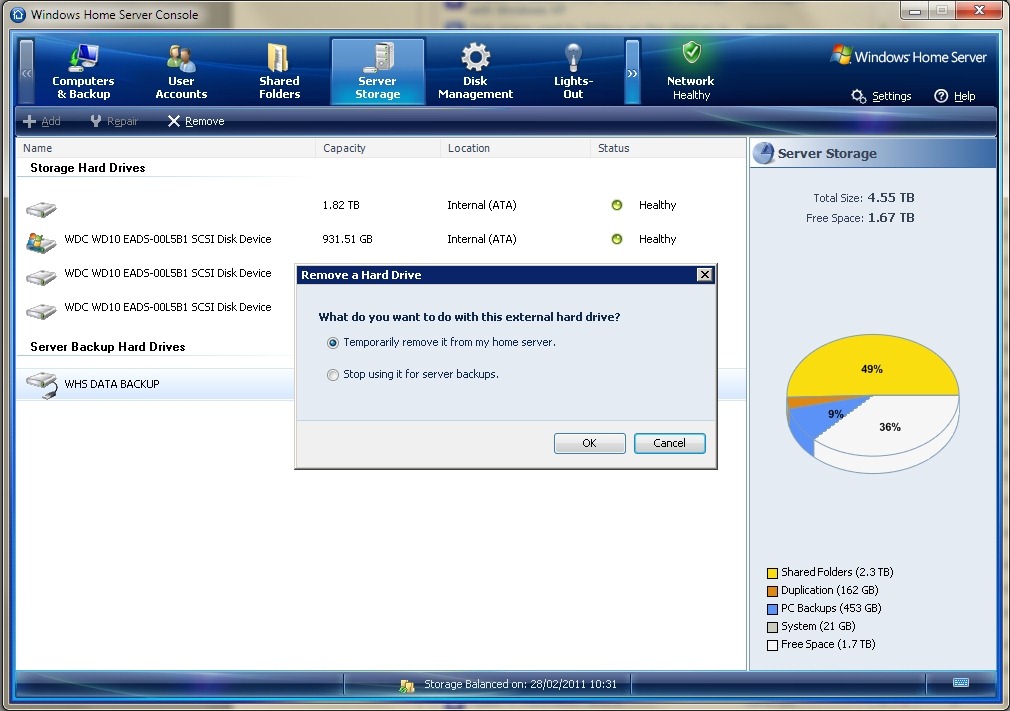
    In fact, even the act of removing external discs seems less clear in WHS 2011. In WHS v1, once the server backup is complete, then I simply select the external drive and click “Remove drive”. WHS V1 will ask if I want to remove the drive temporarily or permanently (see figure 4), and I select the “temporary” option. The disc is then safely dismounted from the system, and it can be returned to its offsite location.
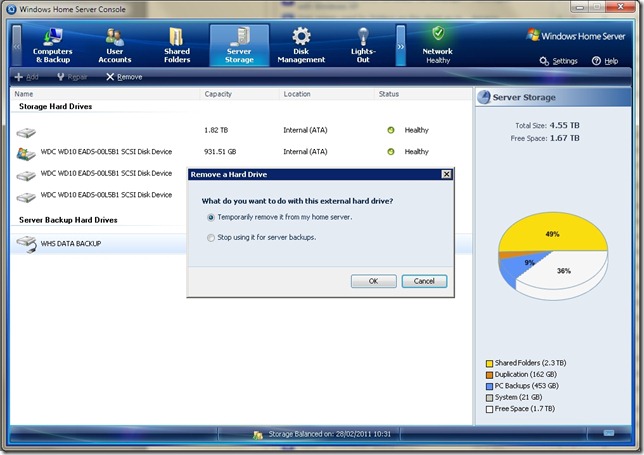
    WHS Storage 4

    figure 4

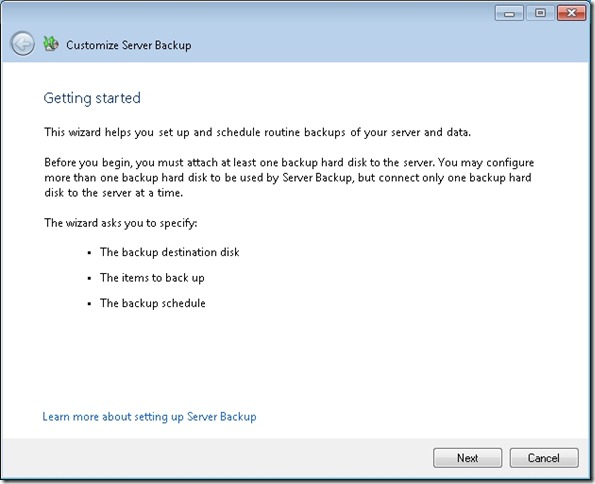
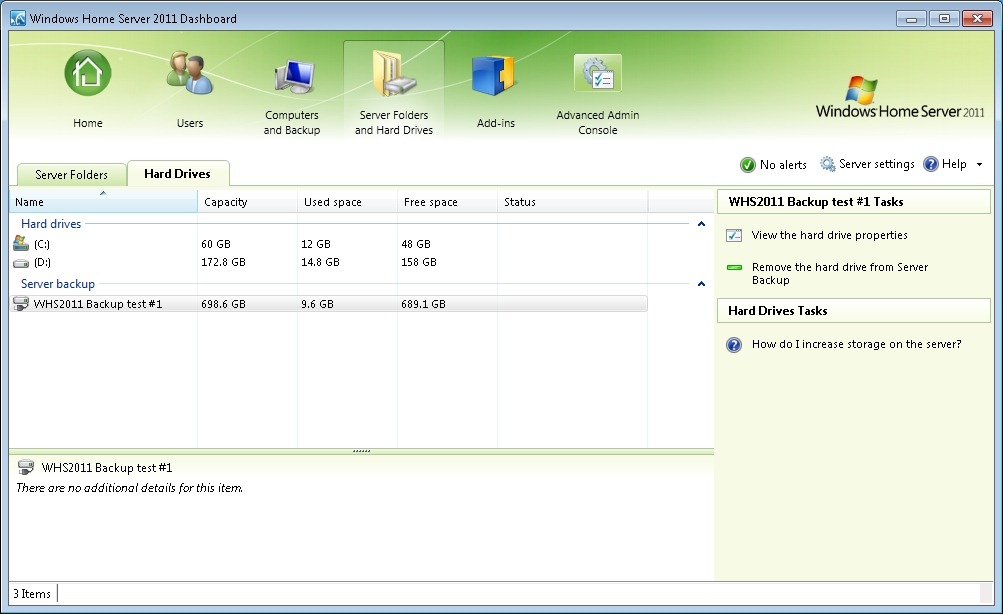
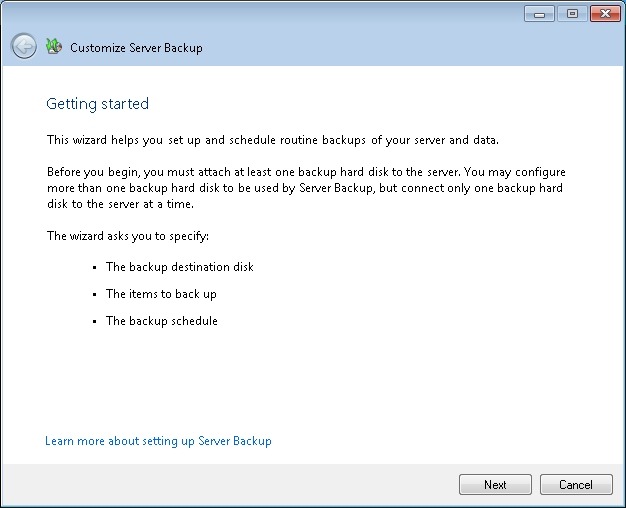
    In WHS 2011, if I select an external drive, I don’t get a choice to remove it temporarily, the only option shown is to remove it permanently from the server backup (see the tasks shown in figure 5). Choosing this starts the “Customise Server Backup” wizard (see figure 6), which I find somewhat confusing. I’m not trying to customise the server backup – I want to remove the drive… It turns out that the only way to temporarily remove a drive seems to be to yank out the cable. I suppose I’m set in my ways, but I always prefer to safely eject media (as WHS V1 allows me to do).
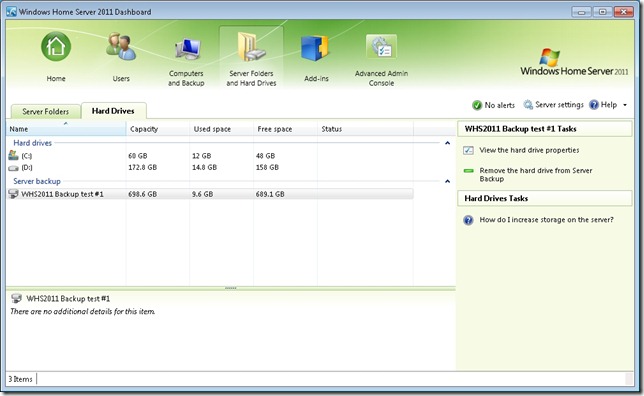
    WHS2011 14

    figure 5

    WHS2011 16

    figure 6

    The elephant in the room with server backups is that WHS 2011 can’t easily deal with discs bigger than 2TB. Now I know that even only a couple of years ago, this would have seemed an enormous capacity. However, with today’s high definition media, coupled with the ready availability of 3TB discs (with higher capacities on the horizon), then this limitation seems very surprising. The sad fact is that the backup method that Microsoft has chosen to go with in WHS 2011 has 2TB built-in as an upper limit. Never mind the fact that Windows 7 (even Windows Vista) and Windows Server 2008 (the operating system underneath WHS 2011) can support disks of more than 2TB capacity, WHS 2011 and its backup does not. If you install discs of more than 2TB into WHS 2011, then you must partition the disc into chunks, none of which can be more than 2TB in size. Even more frustrating, you can’t even backup a client computer that has a disc of more than 2TB assigned as one contiguous space. The Windows 7 client computer will be perfectly happy, but WHS 2011 will refuse to have anything to do with it (note: please see Addendum 2 at the bottom of this post for some clarification of this statement).

    I note that, on my WHS V1 server, my Movies shared folder is already at 1.86TB. Just a few more Blu-rays added to my library, and I won’t be able to use WHS 2011 without having to sit down and plan my storage, both for now, and in the future, very, very carefully.

    And this, to me, is the bottom line. WHS 2011 seems to force me to think like an IT support person; far, far more than WHS V1 ever did (or does!). That’s why I continue to think that the current WHS team don’t understand the home market sufficiently for WHS 2011 to succeed.

    Addendum 1: It just gets worse. It turns out that the 2TB limit doesn’t just apply to the size of a backup disc, but also to the maximum amount of server storage that you can backup for offsite storage. I don’t believe it!  Update 31 March 2014: It appears as though there has been some improvement made to the Server Backup function in the Dashboard since I originally wrote this article. It remains the case that WHS 2011 continues to use the VHD format for backup, which has a maximum capacity of 2TB. However, it now appears (contrary to what Microsoft originally stated) as though the Server Backup function can now deal with multiple VHDs, providing the backup drive is big enough. So, if your backup drive is 4TB, that means you can have 2 VHDs of 2TB created on it. That, in turn, means that you can backup up to 4TB of data from your data storage drives (with a maximum of 2TB for any one drive). That’s a theoretical maximum, since Microsoft also recommend having some free space in the VHDs to handle incremental backups.

    Addendum 2: Above, I wrote that: “you can’t even backup a client computer that has a disc of more than 2TB assigned as one contiguous space”. It turns out that’s too sweeping a statement. It was clarified by a discussion in the comments, and it’s worthwhile repeating the main points here in the blog entry itself.

    The issue is that you cannot Backup and then Restore a GPT OS drive with Windows Home Server. You can backup a GPT with v1 and perform the Restore but the disk will not boot. You can Restore individual files from a GPT backup but again not the OS into a bootable device.

    For WHS 2011, Microsoft’s release notes state:

    “If a client computer is running Windows Home Server 2011, and it has a hard disk that is configured to use the GUID Partition Table (GPT) format, you cannot use back up or restore data from the operating system, individual files, or folders on that computer. However, you can restore individual files or folders from other computers to a client computer that uses GPT formatting.

    In the event that a client computer is configured to use GPT hard disks, you must employ an alternative method to back up or restore that computer”.

    [Update 4th March 2013: Microsoft has at last issued a Hotfix to add backup support for UEFI-based computers to back up to servers that are running Windows Home Server 2011]

    Addendum 3: There are other issues with the Server Backup function in WHS 2011 that I explore in depth here. Sigh.

  • One Step Forward, Two Steps Back?

    Yes, this is yet another grumbling post about how the current Windows Home Server team just don’t seem to understand what the word “Home” means in the name of the product.

    I decided that I’d take a closer look at the Release Candidate for Windows Home Server 2011. So, I’ve wiped out the Windows 7 installation on my HP TX2000 laptop, and installed the WHS 2011 RC on it. On the plus side, I appreciated the way in which the installation process recognised hardware that had been developed since the days of Windows Server 2003 (that WHS V1 was based on). The installation process was painless.

    On the other hand, there are some losses if I compare what I would have with WHS 2011 versus what I had with the first version of WHS.

    The major difference is of course the removal of the Drive Extender technology. Now, this has been done to death (but that doesn’t mean that it’s not important), however, let’s look beyond that.

    I approach Windows Home Server from the perspective of a consumer who has computers in their home. I’m someone who wants to have two things:

    1. backup to a centralised server of all the data in the individual computers, such that, in the event of a failure of any individual computer, I can quickly restore that computer to a running state with the most recent data and,
    2. to have digital media (music, pictures, videos, movies) available throughout my home from the same centralised server, with connected devices sharing media as simply, and as directly, as possible.

    And I want that centralised server to be easy to manage, with regular offsite backups being made to ensure that the integrity of that server for both shared media and the data of client computers is preserved.

    All this must be done as simply as possible. I really don’t want to carry on being the IT guy in my household. If I fell under a bus tomorrow, I would want my nearest and dearest to be able to carry on without any special knowledge.

    And there’s the rub. While WHS V1 was certainly not perfect in this respect, it seems to me to be light-years ahead of the retrograde step of WHS 2011.

    As I said, let’s ignore the elephant in the room, the Drive Extender technology, for the moment. Let’s just look at managing storage on WHS 2011.

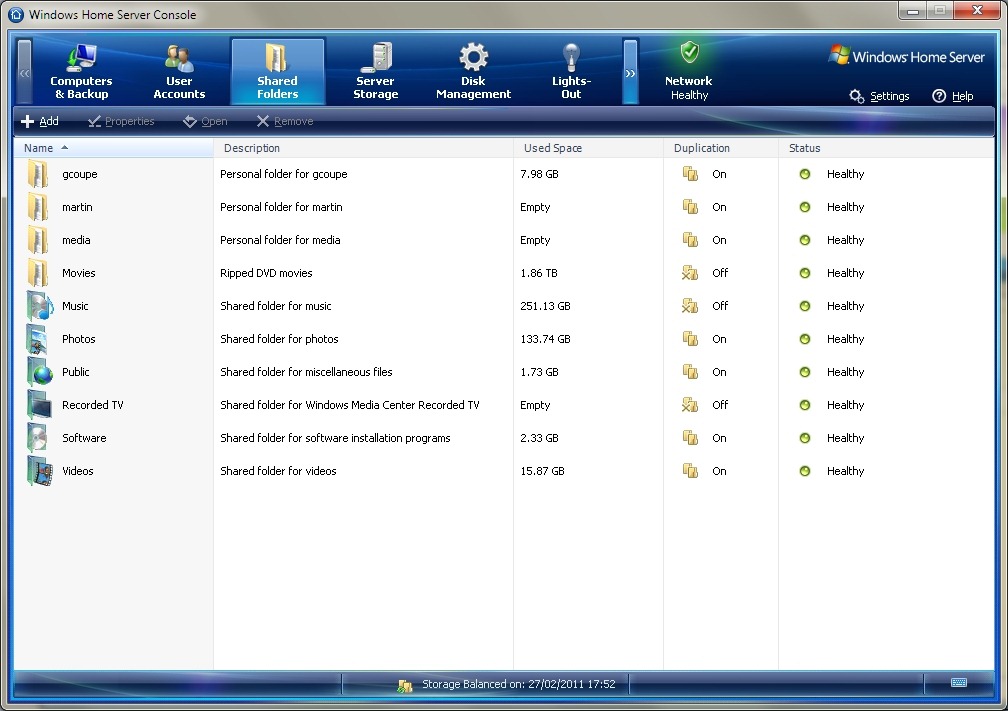
    In WHS V1, you could look at the shared folders to see how much space they currently took up. Here’s an example from my WHS V1 system:

    WHS Storage 2

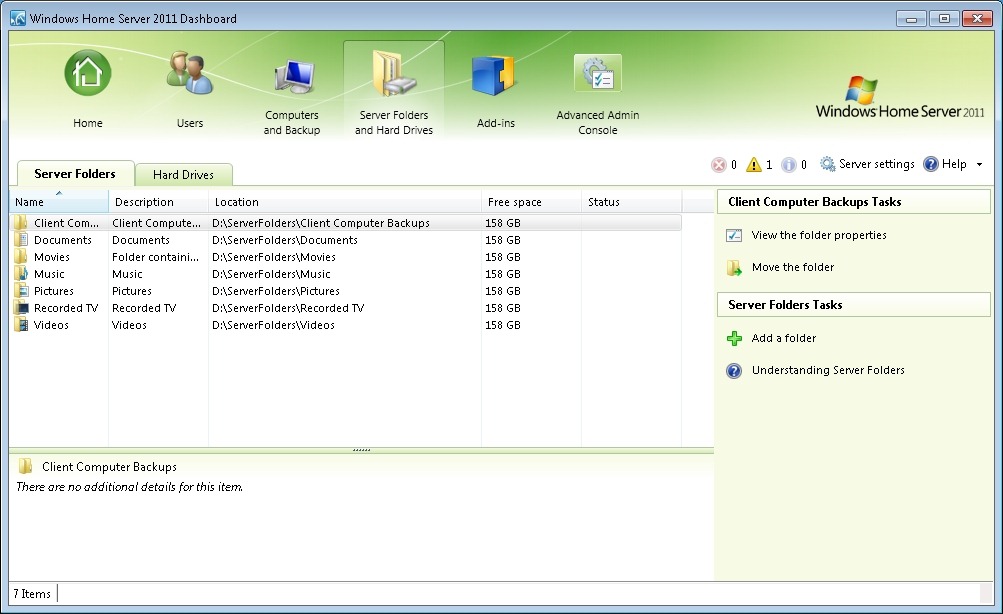
    And here’s the equivalent screenshot from WHS 2011:

    WHS2011 1

    Er, where’s the “used space” column? Well, surprise! It isn’t there. Instead, you have a “Free space” column that represents the space available on an individual drive. Nowhere near as useful. Because drive extender has been removed, the support person has to start thinking in terms of individual drives, not in terms of the total amount of storage as in WHS V1.

    This mode of thinking in terms of individual drives, instead of the total storage pool is also reflected when considering backups. WHS 2011 is unable to deal with backups (or discs) larger than 2TB.

    Frankly, if I were designing the follow-on product from WHS V1, then it would seem to me to be essential that I would handle the situation where discs and backups would be larger than 2TB. After all, if I’m going to claim that:

    Today large hard drives of over 1TB are reasonably priced, and freely available. We are also seeing further expansion of hard drive sizes at a fast rate, where 2Tb drives and more are becoming easy [sic] accessible. Since customers looking to buy Windows Home Server solutons [sic] from OEM’s will now have the ability to include larger drives, this will reduce the need for Drive Extender functionality.

    …then I would make sure that a 2TB limit did not exist in my product. Not so with WHS 2011.

    I really do wonder who the team are designing the product for. Certainly not home users.

  • Turing’s Papers Saved for the Nation

    For a while, it looked as though there was a real possibility that Alan Turing’s papers might disappear abroad, possibly to a private collector in Silicon Valley. However, news comes today that the UK’s National Heritage Memorial Fund has pledged £200,000 to make up the shortfall and meet the seller’s reserve price.

    So the papers should end up in the museum at Bletchley Park where they rightfully belong. Excellent.

  • Then and Now – II

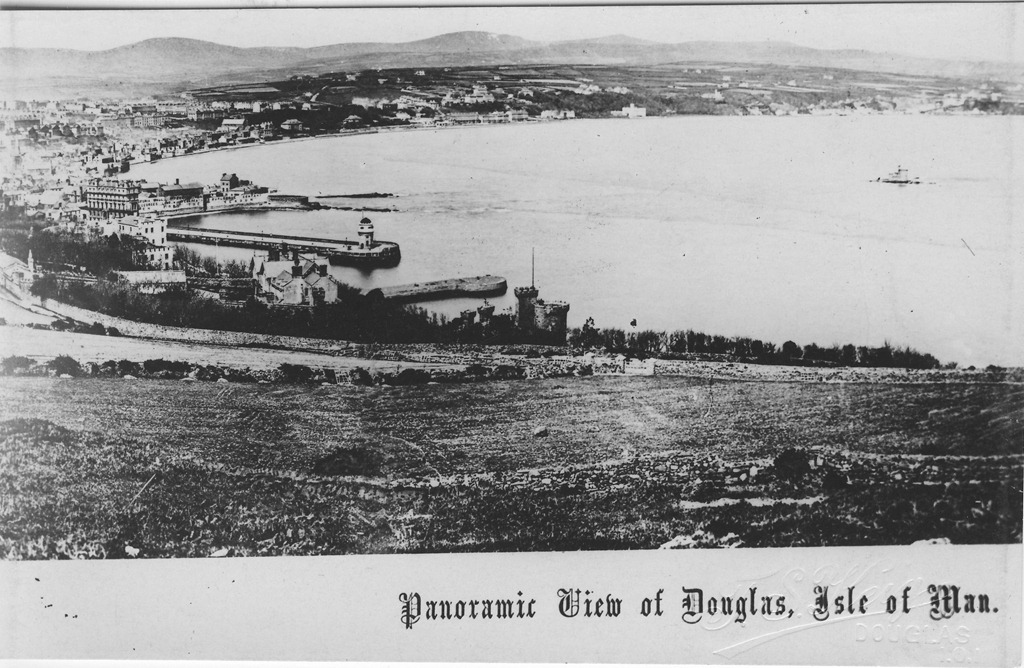
    Here’s another example of the changes that have occurred over time on the Isle of Man. This time it’s views of Douglas Bay. The first photo was taken in about 1860 (I think). It’s a bit difficult to see, but at that time the promenade on the seafront, with its frontage of boarding houses, did not exist.

    IOM0070

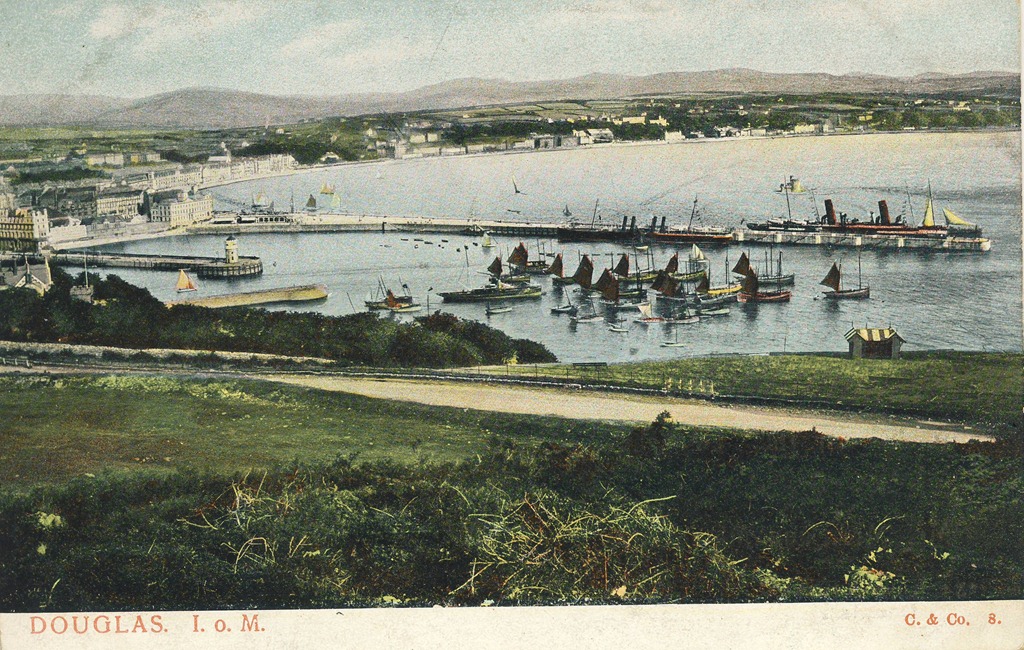
    This second (hand coloured) photo must have been taken after 1892, but before 1913, because by this time the promenade and boarding houses are visible (built in 1878), and the Victoria pier is in place (opened in 1892), while the Villa Marina (in the estate in the middle of the seafront, just to the right of the first row of boarding houses) looks to be the original private house. By 1913, the house had been demolished and the Villa Marina concert hall had been completed and opened to the public.

    IOM0115

    And here’s a photo that I took from a similar standpoint on Douglas Head in 2005.

    050713-1209-02

    Moving a little way along Douglas Head, and back in time to the early 1900s, this coloured postcard shows the funicular railway that used to run from near the base of the cliff up to the top.

    Scan10110

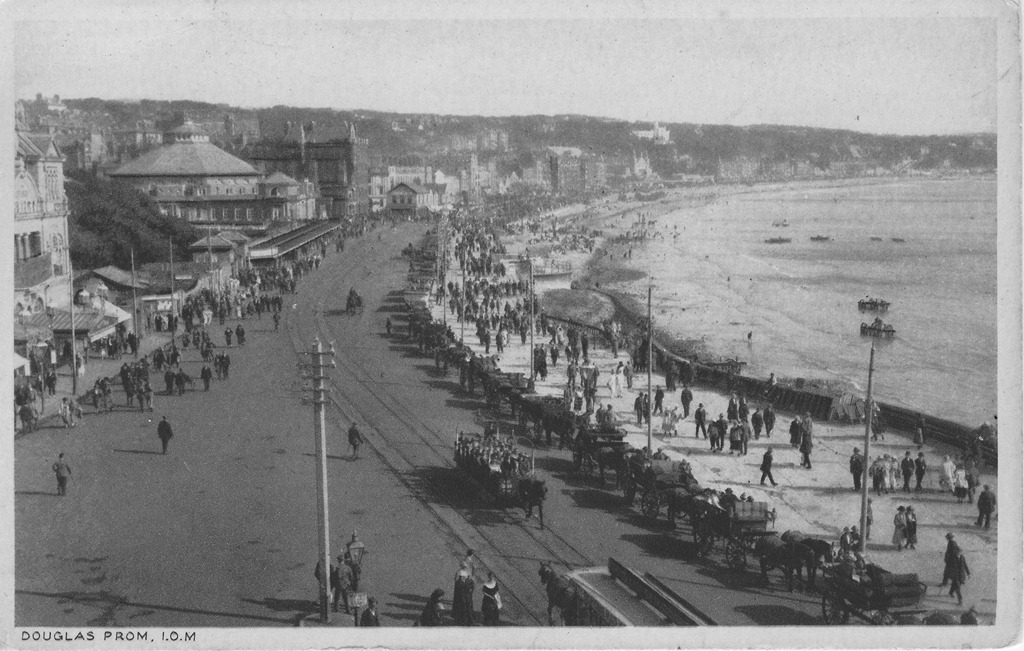
    Nothing remains of the railway now, as it was dismantled in 1954. By the way, you can see from the number of passenger steamers docked at the Victoria Pier just how popular the Island was as a tourist destination at that time, as these postcards illustrate:

    Oilette0004

    Oilette0005

    IOM0072

  • Then and Now

    Since I was looking through old photos of the Isle of Man for my last post, I thought that I might try and see if any of the locations corresponded with photos that I’ve taken.

    So here are a few examples of places showing the passage of time…

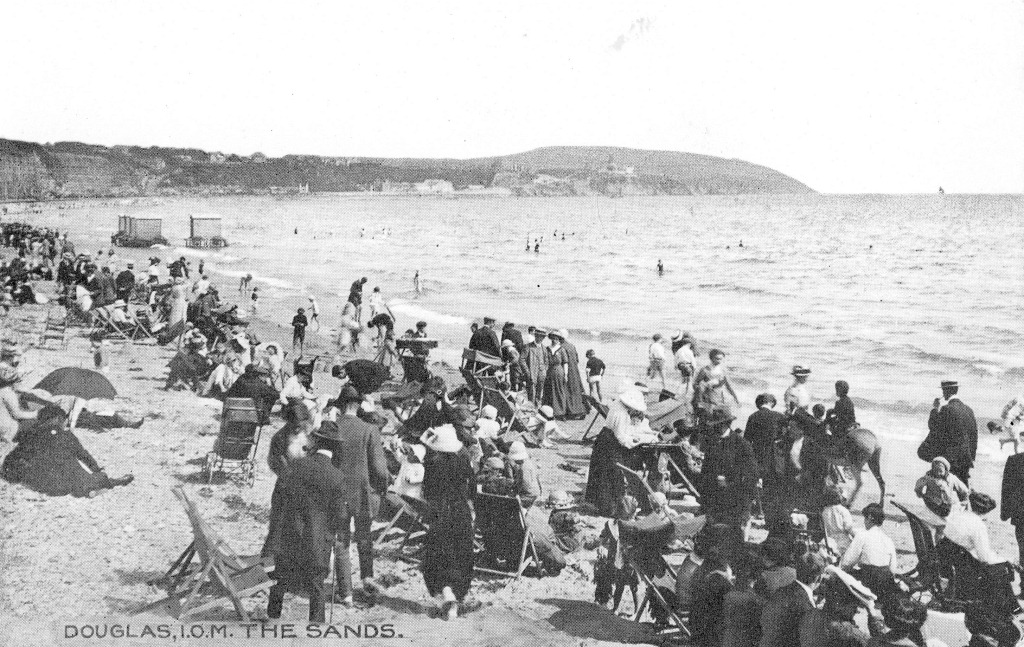
    For example, the Isle of Man was once a very popular holiday destination, but since the era of cheap air travel to guaranteed sunnier climes, the numbers of holidaymakers travelling to the island has plummeted. Here’s Douglas beach, then and now (2005):

    IOM0165

    050713-1143-00

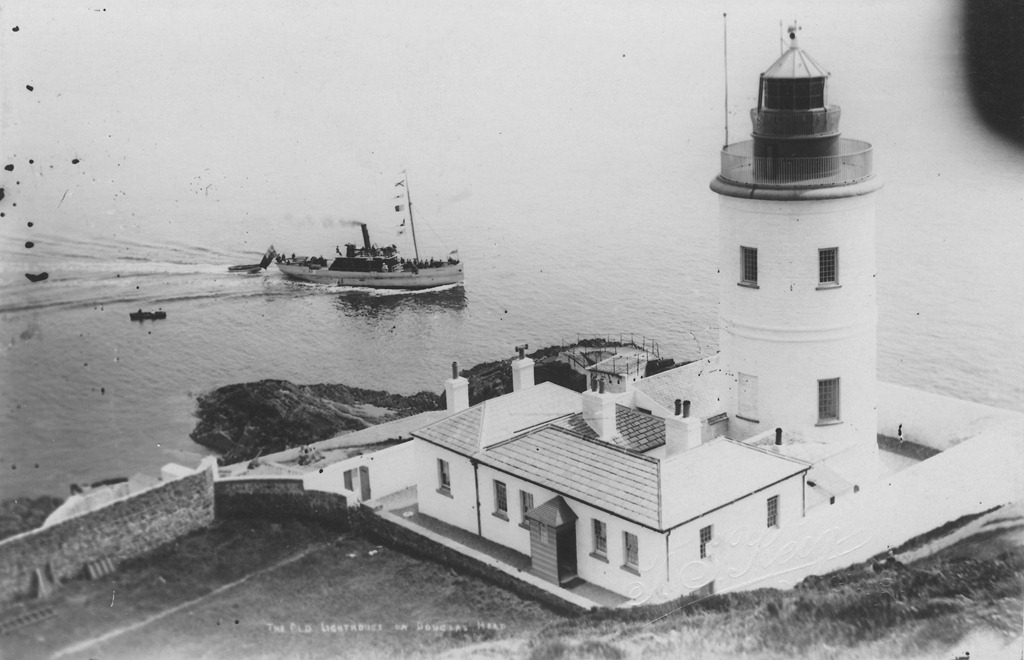
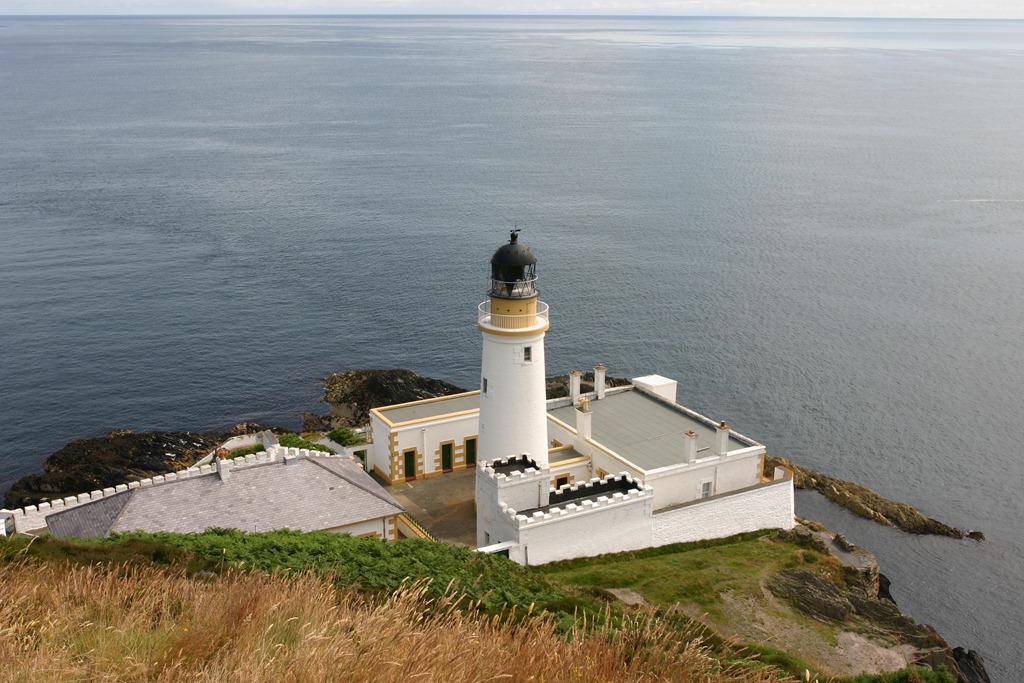
    The lighthouse on Douglas Head:

    IOM0073

    050713-1218-28

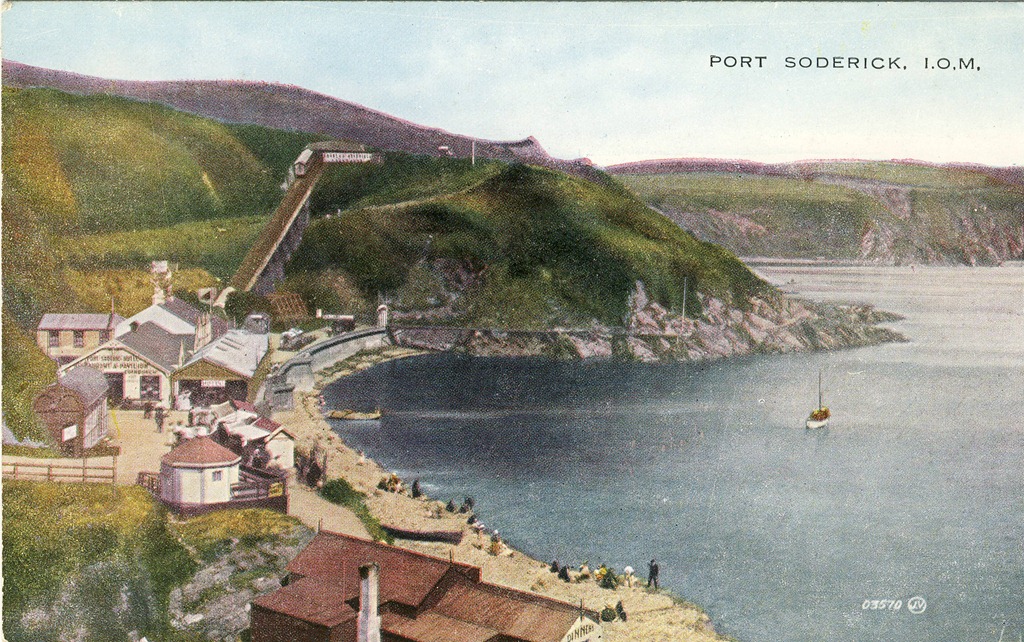
    That little boat steaming past the lighthouse in the picture above is almost certainly the ferry on its way to Port Soderick. Then, it was a little cove filled with cafes, shops, and other attractions. Now it is just a cove.

    Scan10111

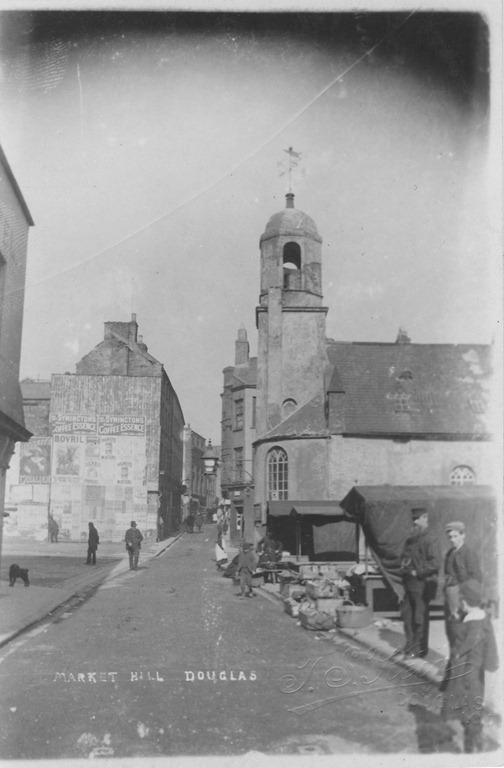
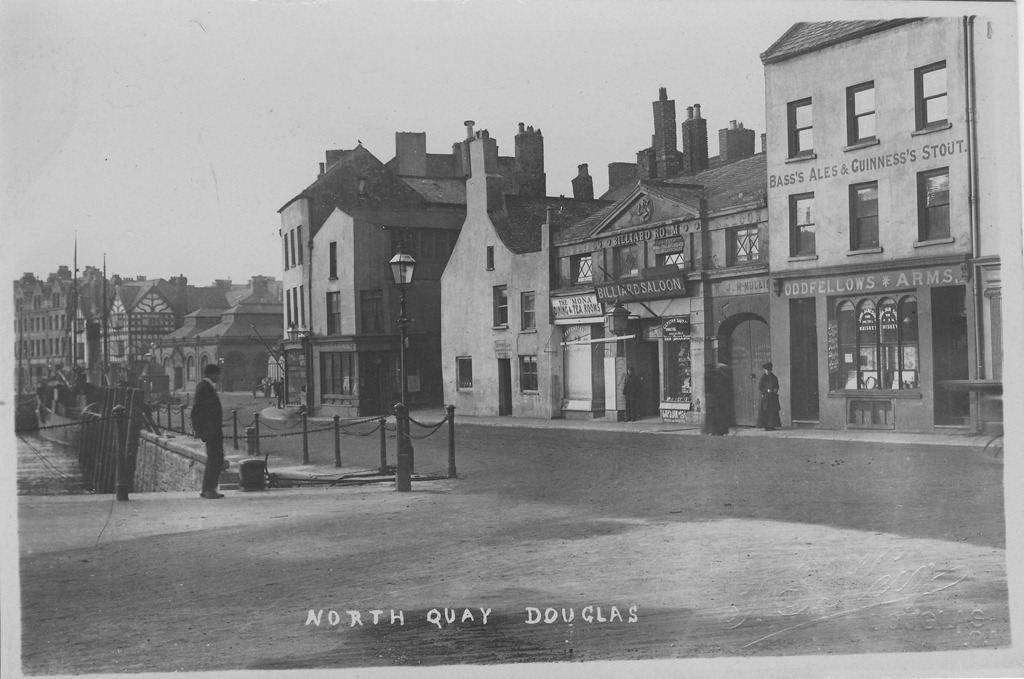
    Douglas harbour has seen great changes. I couldn’t find a series of photos taken from the same viewpoint, but here are some that illustrate something of what has gone on in the last 150 years. The first shows Market Hill, the street leading up from the quay. The old St. Matthew’s church is the focus of the picture, with the old open-air market just shown on the right.

    IOM0058

    Here’s a second view of the church and the open-air market:

    IOM0101

    Note the new commercial building behind the market and to the left of the church. The church itself was demolished in 1898 to make way for the building of a cast-iron market hall. A new church (the new St. Matthew’s) was built a short distance away on the quay itself. As well as the cast iron market hall, a brick-built market hall was also constructed at some point. Here’s a shot from 1912. On the left of the picture, you can seen the brick-built market hall (behind the standing man). All the buildings in the main part of the picture have been demolished.

    IOM0033

    And here is the brick-built market hall today, with the boarded-up cast-iron hall on the right. Note the commercial building behind, which is the same as the one (minus a chimney stack or two) from the earlier (second) photo in the series.

    050713-1255-11

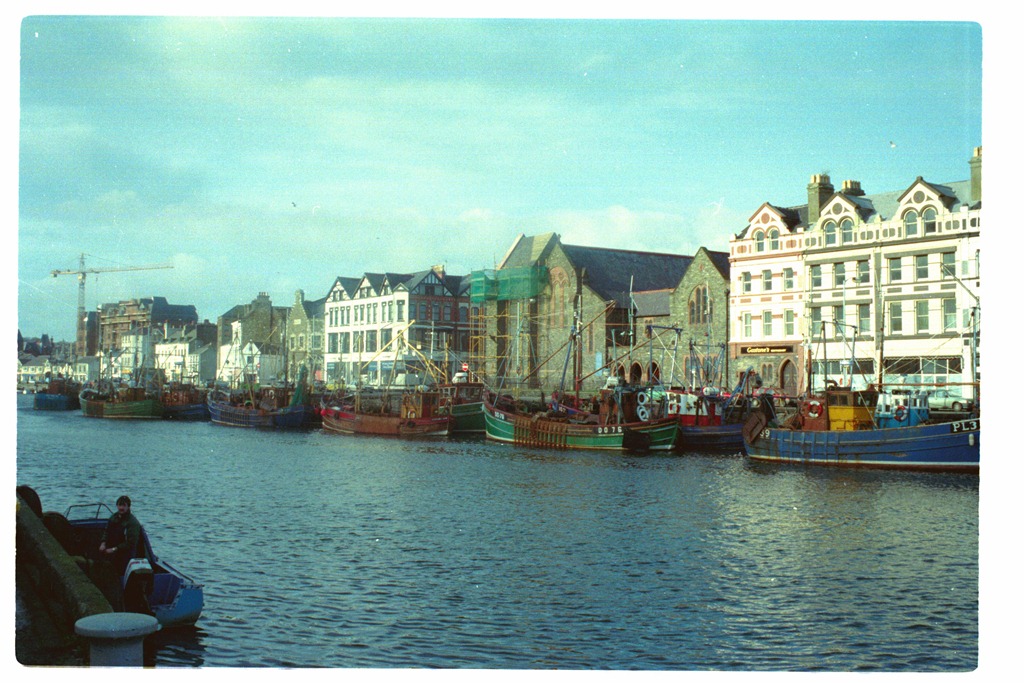
    And, pulling back, you can see the “new” St. Matthew’s church in shot. The harbour is filled with pleasure yachts. In my youth, it was filled with working fishing boats. All gone.

    050713-1154-14

    However, even as late as 1988, there was still something of the fishing fleet remaining:

    img060201-11

  • The Wedding Party–A Mystery Solved

    I’ve got a pile of postcards and old photos that I inherited from my father. Many of the postcards he collected from places that he visited around the world, when he was a merchant seaman in the 1920s and 1930s. There are also lots of postcards of places in the Isle of Man, where he and I were born. As well as reproductions of 18th century engravings, there are photos; the earliest of which date from 1860. Here’s an example of one of these, showing Douglas Bay:

    IOM0070

    But there is one photo that has always intrigued me. It shows a wedding party, in the grounds of what could be a rather grand house. Other than the fact that it certainly couldn’t be any of our family, I had no idea who these people were, or where the photo was taken. Until, that is, a couple of days ago…

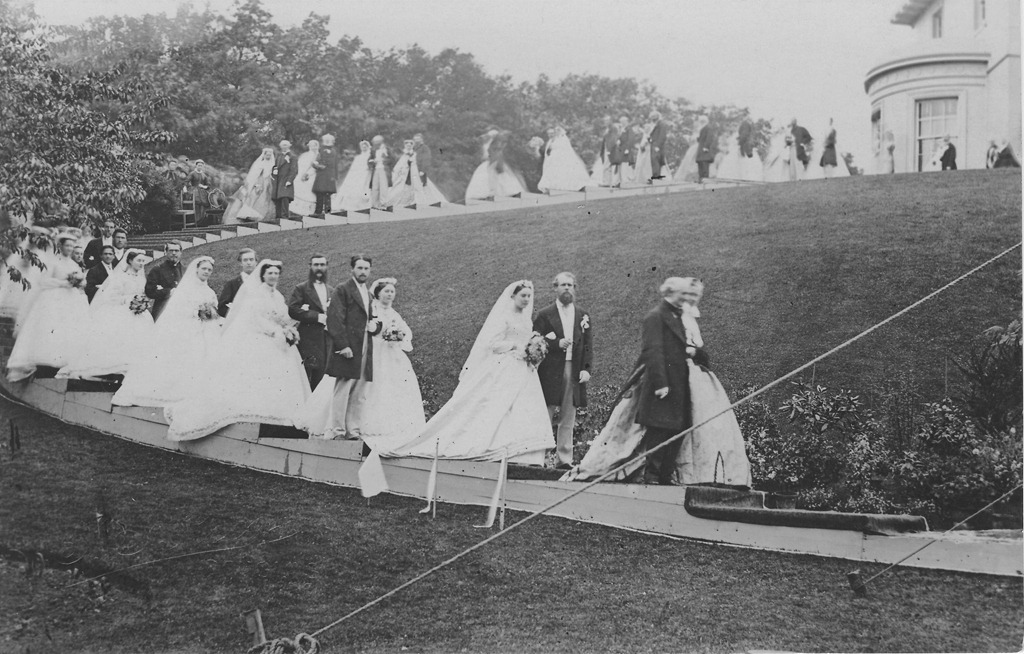
    Here’s the photo:

    IOM0036

    My brother has finally solved the mystery – he came across the same photo in a book. It is the wedding of Louisa Jane Dumbell and Alfred Charles Elliot on the 23rd June 1866. Louisa was the daughter of a prominent Manx figure of the time, George William Dumbell. He founded his own bank in 1853, and it had a fairly chequered history until its collapse in 1900. However, in 1866, George was riding high, and he made sure his daughter’s wedding was a lavish affair:

    In 1866, on the occasion of the marriage of his daughter, Louisa,to Mr Elliott, of the Indian Civil Service, the most lavish expenditure was indulged in. The SUN columns described the bride’s dress as being of “white satin, trimmed with three rolls of satinround the skirt, bodice trimmed with Bruxelles point lace, with crystal buttons, Bruxelles lace veil, wreath of orange and myrtle,pearl ornaments, etc. She was attended by eight bridesmaids, and the wedding party completely filled the church at Braddan. A troop of workmen had been for weeks employed in erecting a. monster marquee in the grounds at Belmont, which were illuminated and decorated with fairy-like grandeur.” The wedding festivities terminated on the fourth day with a great ball in the Castle Mona Hotel.

    The photo shows the wedding party in the six-acre grounds of “Belmont”, the house that George Dumbell had built in 1835. And now, with the benefit of knowledge, I realise that I should have recognised the house in the photograph, because I played in the house and grounds as a child. One of my schoolboy friends was Michael Crowe, and his family lived in Belmont (which by this time had been split into two semi-detached , but still very grand, houses). We spent many happy hours playing in the very Rhododendron bush that you can see on the left of the photo. By the 1950s, it had grown to gigantic size, and it was our jungle and climbing frame all rolled into one.

  • Soldiering On

    I see that Paul Thurrott, in an article published on his Supersite for Windows, has done a U-turn and is now betting on Windows Home Server 2011. Back in October 2010, when he was first told by the current WHS team that they would be removing the Drive Extender technology from WHS 2011, his first reaction was that:

    “Removing Drive Extender was the equivalent of driving a dagger right through the heart of the product”.

    Indeed, that was my first reaction on hearing the news when it became public a month later, and the reaction of many, if not most, of us who had bought the original version of Windows Home Server.

    Despite the outcry (for example, there are currently 5,581 votes in favour of retaining the DE technology in WHS 2011 versus 73 against over at the Microsoft Connect site – tagline: your feedback improving Microsoft products), the technology will not be put back into the final WHS 2011 product. (Addendum: on the 12 March 2011, Microsoft removed all the suggestions that had been posted by WHS 2011 beta testers in the connect forum, including this one. An act that reminded me of the Soviet’s airbrushing ex-politicos out of photographs. One way of removing embarrassing facts, I suppose)

    So now, Paul Thurrott has put his sense of disappointment behind him, and written that:

    So yes, I’m disappointed about Drive Extender, I really am. And yes, I’ve sweated this decision for months. But when the final version of Windows Home Server 2011 appears in the months ahead, I’m switching. And I’ll let you know how it goes, of course. But I can tell you now that Microsoft’s home server solution is still the best game in town, even with the removal of Drive Extender. And if you could stop crying into your beer, I think you’ll admit the same.

    Well, perhaps. But what I find most telling about this whole debacle has been the way that it has been (mis)handled by Microsoft. It seems clear, from Thurrott’s own account, that the current WHS team did not have a clue, at least in the beginning, that the decision to remove DE would have such a negative reaction.

    In effect, the team had just torn up the guiding principles for the product developed by Charlie Kindel and the original WHS V1 team – but they don’t seem to have appreciated that fact, or the likely reaction from customers who had bought V1 on the strength of those principles.

    The team then soldiered on with the decision – and I have to give them credit for their brass necks – and very probably have weathered the storm. But I really could have done without the disingenous posts on their blog telling us that they were only following feedback from their customers:

    “When weighing up the future direction of storage in the consumer and SMB market, the team felt the Drive Extender technology was not meeting our customer needs”.

    There are some good things remaining in WHS 2011, but the heart of WHS V1 – its provision of consumer-friendly storage – has been surgically removed.

    The die has been cast – we’ll see what happens.

  • PVV Absurdities

    I’ve written before that I worry about the popularity of Geert Wilders and his Freedom Party (the PVV) here in the Netherlands. While I find the demagoguery of Wilders extremely disturbing, I take some comfort from the fact that others in the PVV seem to be little more than political clowns.

    We’re about to enter into an election for seats in the provincial governments. So all the candidates are out there and using every opportunity for campaigning. No problem about that. But when one of the PVV candidates for the Gelderland province (where I live) calls for repatriation of Highland cattle back to Scotland and Polish ponies back to Poland, then I have to wonder why anyone should take clowns like this seriously?

    Since some people have commented that surely no-one could be that stupid; I give you PVV candidate Olov Wullink, in person, uttering his inanities (from 1:10 in the second video linked on this page here). Sorry, the full absurdity is only intelligible to those of us who understand Dutch.

    However, I think it’s worthwhile to remember that, while events like this have their humorous side, the politics, and subsequent impact on all of us, are deadly serious. The rise of Wilders continues to concern me. I don’t think it is good for us.

  • What’s Sauce for the Goose…

    The serious assault on a CBS journalist, Lara Logan, in Tahrir Square has rightfully drawn widespread condemnation from many quarters, including women’s rights activists and pro-change protesters in Eygpt.

    Of course, there were some commentators, such as Debbie Schlussel, who got into the “blame the victim” game, saying that the attack was partly Logan’s fault. That deserves the contempt that Schlussel got for her comments.

    However, there was a reaction from Heather Blake, of Reporters Without Borders, reported in the Guardian’s story that I found rather interesting. She said:

    “At the moment, female and male journalists have the same training. The truth is that female journalists need to be taught about different cultures and the ways in which men behave in those cultures. They need to know about gender-specific expectations in different countries, from what they wear to how they interact with those they met.”

    I’m not sure that I agree with that. I think that both men and women journalists need to be taught about different cultures and the ways in which men behave in those cultures. It seems to me that consciousness-raising is just as important, perhaps even more so, to members of the male gender, who are often blithely unaware of, or complicit in, the various forms that oppression of women can take.

  • Someone Like You

    I wrote a couple of months ago that I was looking forward to the release of Adele’s next album: 21. We got it a couple of weeks ago, and have been playing it frequently ever since. It’s very, very good.

    Here she is performing “Someone Like You” at the BRIT Awards recently; just her voice and a piano – but what a depth in that performance:

  • Being Economical with the Truth

    I know I’ve said it before, but I do loathe and detest marketing-speak. The last time my distaste was directed at Google; this time it’s Microsoft’s turn.

    This year’s Mobile World Congress is currently underway in Barcelona. So naturally, Microsoft is there publicising Windows Phone 7. The Marketing arm of Microsoft is running full tilt to supply the hungry maw of the news media, so we get this piece from Microsoft’s News Center. It includes the following quote attributed to Andy Lees, president of Microsoft’s Mobile Communications Business:

    Microsoft sold 2 million phone licenses in Windows Phone 7’s first two months, and the phone is now available from 60 mobile operators in 30 countries around the world, Lees said. As phone availability and sales grow, so too does the app marketplace – there are now more than 8,000 apps in the marketplace and 28,000 registered developers.

    Now, right there, is a prime example of why I loathe and detest marketing-speak. On the face of it, Mr. Lees’ statements are perfectly true. However, they are not the whole story. While Windows Phone 7 handsets are indeed available in 30 countries around the world, the applications marketplace is not. At my last reckoning, it was only available in 16 countries. So those “more than 8,000 apps in the marketplace” are not actually available to customers living in countries such as India, Norway, Sweden and the Netherlands.

    So customers buying phones in these, and similar countries, are then finding that instead of a smartphone they have little more than a premium-priced dumbphone.

    That does not make for happy customers.

    In that light, I find it very ironic that the Microsoft News Center puff piece ends with this quote from JP Wollersheim, a Windows Phone 7 product manager:

    “You don’t sell phones if people aren’t happy. That’s the leading indicator of where we’re at, and it’s predictive as to how many we’re going to eventually sell,” Wollersheim said. “We want it to sell, and we want customers to be super happy, and we want them to tell their friends and family. That’s the best recommendation you could have.”

    Be careful what you wish for.

  • The Story of Wind and Mr. Ug

    Vi Hart describes herself as a recreational mathematician. She’s also a pretty good storyteller, as evinced by this little tale set on a topologically challenging world.

  • In Praise of the Dumbphone

    The leaking of Stephen Elop’s memo to his troops at Nokia has certainly focused the attention of business and technical analysts on the company.

    However, in all the excitement, Francis Sedgemore has picked up on something that he thinks is in danger of being forgotten, and I think he is right to do so. He has written to Elop reminding him that not everyone is enamoured of Smartphones with touchscreens. Some of us still find that mobile phones, with real buttons, that just make and receive phone calls and SMS messages are sufficient. He has a point. And, as he says, some attention should be paid to the poor quality software that Nokia (like most mobile phone manufacturers) provide to synchronise contacts and content with the user’s PC or Mac.

  • The Survivor

    Good heavens, Jonathan Grimshaw is still alive and kicking. He contracted HIV way back in 1984, so must be one of the longest-surviving people with HIV in the UK.

    While I have never actually met him, for a time he was working closely with my best friend, who was a psychologist and epidemiologist working in the Home Office. Len was instrumental in the development of policy on HIV/AIDS in the UK’s prisons. By his account, Grimshaw was a charming and intelligent man, doing a lot of good work. So it’s good to hear that he’s still with us.

  • Michael Moorcock, At Home In Texas

    Somehow, the words “Michael Moorcock” and “Texas” seem strange bedfellows. But this interview, by Hari Kunzru of the author Michael Moorcock starts to make some sense of it.

    Moorcock is a brilliant author. Whether he’s producing pulp or great literature, or both simultaneously, doesn’t really matter. His voice is worth harking to. To me, his name is a bell that instantly starts my soul ringing to a certain time, place and ethos in my mind. A place that is dear to me, but one that causes frissons as well. It’s the shiver of fear that runs up your back mixed with eroticism at the same time.

  • Making a Silk Purse out of a Sow’s Ear – Not

    Oh dearie me, Microsoft has just unleashed the Release Candidate of Windows Home Server 2011 upon the world. And as they had promised, they have surgically removed the one unique selling point that WHS version 1 had – the drive extender technology.

    Frankly, this confirms to me that Microsoft has totally lost the plot when it comes to crafting consumer technology that ordinary people – as opposed to IT experts – actually feel comfortable about having.

    They are, of course, putting their spin on how WHS 2011 will be wonderful, but it all has the air of them trying to make a silk purse out of a sow’s ear, and failing miserably. Take, for example, this YouTube video that they put up to show us how to manage our storage in WHS 2011. With WHS version 1, when your storage was getting full, you could just add another drive and carry on. Now, as this video painfully points out, you have to worry about whether you need to move your folders around to rebalance your storage across your discs.

    Hello, Microsoft, wake up – Mr or Ms average consumer doesn’t want to think like an IT support person.

    I, for one, will be carrying on with WHS version 1 for as long as I possibly can. WHS 2011, with the removal of Drive Extender, has nothing to offer.

  • A Tale of Two Markets

    Following on from the previous post on Android 3.0 (Honeycomb), I see that Google also announced, and have opened, a web presence for Android applications: the Android Market.

    I found it quite instructive to compare using Google’s Android Market with the Microsoft equivalent, the Zune Marketplace.

    The first thing to note is that, in the Android Market, it is possible to browse and purchase applications for your Android devices directly via the web site. The Zune web site, on the other hand, does not allow you to browse applications for your Windows Phone directly. Instead, when you click on the “Browse Zune Marketplace” link, it fires up the Zune client application on your PC, which accesses the applications for Windows Phone 7 available in your location. And there’s the rub: the Android Market seems to be a single global marketplace, accessible to everyone, while the Zune Marketplace is heavily fragmented, and not open in all countries. I’ve written about this Microsoft Marketplace disaster before, but to see it laid bare by comparing the user experience with Android Market is very revealing.

    Microsoft really should open up a web site to allow global access to WP7 applications along the same lines as Google’s Android Market. If they don’t, then they will continue to be on the back foot in the Smartphone market.

  • Honeycomb Looks Sweet

    Google presented the latest version of their Android operating system yesterday, which is codenamed Honeycomb. The presentation has been posted on YouTube.

    I must admit that there were some nice touches in the User Interface of Android 3.0, particularly the use of hardware accelerated graphics. The UI is finger-driven, of course, and watching the demo really drives home the point that a Windows Tablet just isn’t designed for fingers. If Microsoft still haven’t grasped that fundamental point, and continue to insist that Windows Tablets, in their current form, can compete against Android and iPad tablets, then they will fail miserably.

    Watching the presentation also drove home another couple of points to me. First, how much I loathe and detest marketing-speak. I’m afraid watching people with false smiles saying how excited they are to be here today to tell you all about their “cool” and “awesome” products has never been one of my favourite pastimes. Secondly, I am so clearly not in the target markets. I might just as well be from another planet. I think that was exemplified by the gentleman from Disney Mobile gushing excitedly about something called Tap Tap Revenge, which has probably earned the Disney Corporation more money than the GDP of most small countries.

    And then there was the team from CNN showing their news application for the Android tablets. Quite apart from the fact that quality journalism is already a threatened species, CNN seem to be wanting to drive it further into extinction by introducing something called iReport. Essentially, CNN want to fool us into submitting news reports to them, for free, and my bet is that the rights subsequently belong to CNN, and not to the originator. I suspect that the quality of the majority of the stories will merely underline the veracity of Sturgeon’s Law. For example, on the page of news stories being demonstrated was one concerned with the fact that the iReporter’s miniature dachshund was caught in a recent snowfall. 

    I was left with the feeling that if Sturgeon were to redefine his Law today, he would probably revise the estimate of 90% (of everything being crud) to a number that would be considerably higher.

    Still, looking beyond the fact that I am an old curmudgeon, it will be interesting to see how the Tablet market develops. This challenge from Google with Android 3.0 looks to be a good one.

  • Cyclone Yasi

    I hadn’t quite grasped the huge size of cyclone Yasi until I read this story that shows the extent of Yasi overlaid on other parts of the world. It is simply vast.