Lawrence Krauss, articulating both the wonder and the insignificance of humanity. I agree.
No gods required.

Reflections on life at “De Witte Wand”…
Lawrence Krauss, articulating both the wonder and the insignificance of humanity. I agree.
No gods required.
I loved the Doctor Who Christmas Special.
Just typical of Steven Moffat’s writing that he inverts the time-worn trope of “It’s bigger on the inside” by having Clara Oswin Oswald exclaim the mirror opposite – which elicits a glance from the Doctor as if to say: buckle your seatbelts, we’re in for a bumpy ride…
I’ll be there, for every minute of the journey.
I admit that I am getting fed up with two things.
So it gives me some pleasure to be able to claim that someone, somewhere in Microsoft knows how to do proper marketing. Enter the (small) demonstrator.
I really like the punchline at the end. It punctures prejudices on a number of levels.
There is much to admire about the march of technology, but it has its dark side as well – a rate of obsolescence that takes my breath away.
A case in point.
I thought that I would upgrade our Home Theatre PC, which has been running Windows 7 and Windows Media Center quite happily for a couple of years, to Windows 8 Pro and the castrated Windows Media Center that comes with it. This was done just to see:
Well, I tried. I have given the new setup a month or two, but today I went back to my trusted Windows 7 + Windows Media Center combination.
What transpired was the fact that Microsoft really, really want to kill Windows Media Center stone dead, and Intel really, really, are just not interested in supporting older hardware with Windows 8 drivers.
I battled with the fact that Microsoft had taken functionality out of Windows Media Center for Windows 8 Pro, and wrote scripts to boot directly into Windows Media Center when the HTPC was turned on. That sort of worked, not always, mind. I had the feeling that it was a string and sealing wax sort of solution. But I could more or less live with it.
However, today I finally discovered something that had been lurking in the undergrowth all along. Our HTPC uses a motherboard that has the Intel 1156 socket and the H57 chipset. I was concerned that the software drivers for Windows 8 were not of the best, and today I discovered why. Intel don’t make Windows 8 drivers for the CPUs and chipsets for the products that use the 1156 socket. They date from 2010.
Er, hello, this is not yet three years old, and it is obsolete?
A plague on both your houses.
I’ve restored the system images of our Windows 7 + WMC software onto our HTPC (thank heavens at least for Windows Home Server 2011). We’ll struggle on somehow without the dubious benefits of Microsoft’s and Intel’s efforts to sell us newer technology.
Fuck ‘em.
I apologise about returning to the subject of same-sex marriage so soon, but I came across an example of an argument against same-sex marriage today that is just so, well, bizarre.
It is contained in an opinion piece in the Guardian, penned by one Timothy Radcliffe, who turns out to be, as I subsequently learned, a Roman Catholic priest and a Dominican friar. So I suppose I shouldn’t have been surprised.
Father Radcliffe starts out well:
It is heartening to see the wave of support for gay marriages. It shows a society that aspires to an open tolerance of all sorts of people, a desire for us to live together in mutual acceptance. It seems obviously fair and right that if straight people can get married, why not gay people?
But then comes:
But we must resist the easy seduction of the obvious. It once seemed obvious that the sun revolved around the Earth, and that women were inferior to men. Society only evolves when we have the mental liberty to challenge what seems to be common sense.
Followed by something that struck me as being simply mind-boggling:
Many Christians oppose gay marriage not because we are homophobic or reject the equal dignity of gay people, but because “gay marriage” ultimately, we believe, demeans gay people by forcing them to conform to the straight world.
As one of the commenters on the piece said, this is rather like saying:
Many Christians oppose the liberation of the slaves not because we are racist or reject the equal dignity of black people but because “freedom” ultimately, we believe, demeans black people by forcing them to conform to the white world.
Many Christians oppose equal rights for Jews not because we are antisemitic or reject the equal dignity of Jewish people but because “equality” ultimately, we believe, demeans Jewish people by forcing them to conform to the gentile world.
I felt neither demeaned nor forced to marry Martin. We got married because it seemed to us a positive step to take, and we didn’t take it lightly.
Here in the Netherlands, every couple who gets married does so in a civil ceremony. The option is then open to them, if they are religious, and if their religion supports it, to follow that up with a religious marriage ceremony. It’s very common here to see a newly-wedded couple emerge from the Town Hall, walk across the market square, and go into the church for their church wedding.
I confess to a fondness for schadenfreude. Never more so when an organisation, which expects power and recognition in the society in which it exists, resolutely opens its mouth only to change feet.
And so it is with the Anglican Church and same-sex marriage.
Having earnestly entreated the UK government to forbid the possibility of same-sex marriage, for a number of dubious reasons, it is now horrified when the UK government has responded by effectively saying: OK, you don’t want to have same-sex marriage, then we’ll bring in a law to make it forbidden for you to conduct same-sex marriage ceremonies within your premises.
Look, gentlemen (and, of course, it is men) you can’t have your cake and eat it. If you don’t want to conduct same-sex marriages, then don’t bleat when you are told that you can’t conduct same-sex marriages.
The Anglican Church: a cross between Marie Antoinette and Stan Laurel.
Few things are guaranteed to irritate me more than bad grammar. Yes, I know that my reaction is out of all proportion to the sin, but it is the way that I was brought up.
For example, yesterday I made a complaint to Microsoft about some applications in the Windows Store. Today, I received a polite response back from Microsoft Support to acknowledge my feedback. It was signed:
Isabelle L.
You’re Partner at Microsoft
Use what you know. Do what you’ve always imagine
My eyes were caught by that “You’re” – so much so that I completely missed the fact that “imagine” should be “imagined”. I decided that I could not let this affront to the Queen’s English slide, so I replied to Isabelle thus:
Dear Isabelle L.,
Thank you for your response to my feedback.
Could I just point out that you have a grammatical error in your signature?
It should, I think, be:
“Your Partner at Microsoft”
and not “You’re Partner at Microsoft”; “You’re” is the abbreviated form of “You are”.
Such grammatical mistakes do not give a positive feeling about the quality of Microsoft’s customer support.
Yours sincerely,
Geoff Coupe
I have just had a reply back from her. It reads:
Hi Geoff,
Thanks for your observation. Greatly appreciated. I modified that.
Isabelle L.
You are Partner at Microsoft
Use what you know. Do what you’ve always imagine
Sigh. I think that I should just count to ten in future.
So Sir Patrick Moore has died – at the age of 89. I can’t say I’m surprised, he has not looked at all well in his recent Sky at Night programmes, but it is still sad news.
I grew up watching the Sky at Night – it introduced me to Astronomy – and I still have my dog-eared copy of The Observer’s Book of Astronomy, authored by Patrick Moore F.R.A.S., F. R. S. A. He inspired generations of children to look up, wonder at, and, above all, observe the heavens. He was an amateur in the true sense of the word, and one whose meticulous work advanced our understanding of the moon in particular.
The next time I look up and see the moon in a clear night sky I shall remember him with affection and respect.
Today is World AIDS day. Wear your red ribbon, or better still, give a donation to an AIDS charity. It’s also a day to remember some lost friends: Kerry, Lance, Eric, Humphrey, Peter, John, Kingsley, Graham, and Neil. I’m sorry that you’re not around with the rest of us today.
OK, I admit it – I am frustrated by what seems to me to be the utter failure of a straightforward piece of design and marketing. What is it with the hardware manufacturers at the moment?
I’m in the market to acquire a tablet PC. Note, I said a tablet PC, not an iPad or an Android tablet, both of which, given my starting point in the Windows world, I consider to be pointless pieces of frippery.
I want something that recognises my handwriting, and that doesn’t get confused when I rest my palm on its screen as I write, as I do. Something that I can install and run some of my more idiosyncratic Windows applications without bleating that it does not compute. And although ultimately I might want something that can act as either a tablet or a full-blown desktop PC (what I term Origami computing), at this stage, I would be comfortable with something that acts simply as a tablet – something that I can relax on the sofa with, and dash out the odd blog post or email, but yet can rise to the occasion of dealing with my handwriting or to do something more than simply ponce about. It doesn’t have to have enormous reserves of computing power, just something that runs a good slew of my current applications without too much fuss.
And, since I’m firmly in the Windows world, that rules out all of the Apple, Android, and Linux ecosystems.
And in the Windows world, I am currently disappointed by the choices on offer. It may well simply be down to a timing issue – the hardware (Intel) and software (Microsoft) just not coming together at the right time.
In an ideal world, at the launch of Microsoft’s Windows 8, there would have been a plethora of Windows 8 tablets to choose from. Instead, we’ve essentially had just two: Microsoft’s Surface RT and Samsung’s ATIV Smart PC.
The problem with the Surface RT, for me, is threefold:
So, the Surface RT is out of the running.
Enter Intel’s latest generation of the Atom chip – the Z2760. This actually has a lot going for it. It’s apparently a better performer than the older Atom processors, with less thirst for electrical power. It will also run traditional Windows applications.
The trouble is that it’s in short supply at the moment. Samsung seems to have been first in line, delivering the Samsung ATIV Smart PC. I was very tempted, by this hardware, but the first wave of supplies seem to have been snapped up, and, more worryingly, reports are emerging of a hardware problem of the tablet not making a good connection with the keyboard dock.
Behind Samsung, both HP and Lenovo are reportedly introducing models based on the Intel Z2760 during December: The HP Envy X2 and the Lenovo Thinkpad 2.
Both models have much to commend them, but currently I’m more inclined to the Lenovo, simply because I can purchase it as a pure tablet, and it reportedly comes with GPS capability, which neither the Samsung, HP nor the Microsoft Surface tablets possess.
Yesterday, Microsoft announced the pricing of the second model in their Surface range, the Surface Pro. I must confess that I really don’t understand what Microsoft are playing at here. It’s based on the Intel Core i5 processor. Yes, it’s a more powerful processor than the Intel Atom Z2760, but it’s also more power-hungry, and it requires a fan to keep it cool. Battery life with the Surface Pro is likely to be half that of the Surface RT and equivalent Atom Z2760 devices, and I really want a tablet that is a sealed unit, not a hand-warmer. It does come with an active digitiser and pen (probably Microsoft’s own, rather than the Samsung’s S-Pen, a Wacom design, or the HP’s Atmel pen Latest buzz is that it is using Wacom technology, which is good).
Still, at this stage, I’m not ready to switch over to Origami computing, and commit to one device that can act as a tablet and a full desktop PC. I’m also not convinced that this first generation Surface Pro is the device to do that with. I think that I should wait a year or two for the Intel Haswell or Broadwell processors to become available. That is the time when I think Origami Computing comes of age.
The New Statesman has an excellent interview with Sir Terry Pratchett. It is well worth reading. He’s not going gently into that Good Night; but instead with his head held up high and fearlessly facing the final curtain. I wonder if I could do the same.
Here’s Terry Pratchett’s award-winning documentary “Choosing to Die”
Please watch it.
Yes, it’s been fifty years since I believed in Christianity, but even so, I had hoped that the Anglican Church would see sense and vote for women bishops.
Er, nope, they are still stuck in the dark ages, and want to treat 50% of the human race as lesser creatures.
Still swirling around in a cesspit of their own making. Bless.
Back in March, I wrote a post called “Microsoft’s Marmite”, which likened the reactions of people to Marmite to their reactions to Windows 8 – they either love it or hate it.
Now that Windows 8 has been released, I continue to be amazed at the amount of vitriol being poured upon it. I really can’t see what all the fuss is about. Yes, there are some radical changes in the user interface, but I certainly don’t find them a problem at all.
In that light, I was somewhat amused to read Jakob Nielsen’s condemnation of the design of Windows 8. After all, he’s the design guru who jointly set up the Nielsen Norman Group along with Don Norman, another design guru, who has written:
Windows 8 is brilliant, and its principles have been extended to phones, tablets, laptops, and desktop machines (and larger — for example, Surface), whether operated by gesture, mouse and keyboard, or stylus, but with appropriately changed interaction styles for the different sizes of devices and different input devices.
(note: the Surface device that Norman refers to is Microsoft’s table top device, now renamed as Microsoft PixelSense – he wrote this piece before Microsoft announced their Surface tablets)
As well as being amused, I confess to also being more than a little irritated by Nielsen’s review, because it seemed to me that he was often deliberately misrepresenting what Windows 8 is, and how it behaves in practice.
For example, he writes:
“Windows” no longer supports multiple windows on the screen. Win8 does have an option to temporarily show a second area in a small part of the screen, but none of our test users were able to make this work. Also, the main UI restricts users to a single window, so the product ought to be renamed “Microsoft Window.”
Er, sorry, the Windows desktop is just as it always has been, supporting multiple overlapping windows. The Modern UI view, designed for tablets and similar devices, does indeed show only two Modern UI apps simultaneously, but the traditional desktop hasn’t gone away, it’s still there. I find it hilarious that Nielsen states that “none of our test users were able to make this [the Modern UI view] work”, when he has just proudly stated
we invited 12 experienced PC users to test Windows 8 on both regular computers and Microsoft’s new Surface RT tablets
“Experienced”? They don’t seem particularly savvy to me. I cottoned on to this facility very early on, and use it to share my Desktop with Modern UI Apps.
The other example that I’ll give where it seems to me that Nielsen is not playing fair is the section where he claims that Windows 8’s “Flat style Reduces Discoverability”. He uses the example of the Settings Charm to illustrate this:
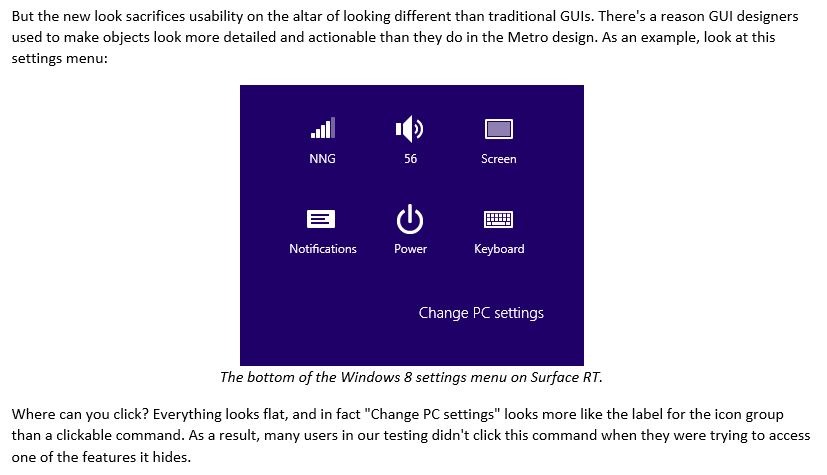
I find it odd that none of his “experienced PC users” noticed that as they moused over the icons and text in this panel, they would be highlighted to indicate that they were buttons, e.g.:
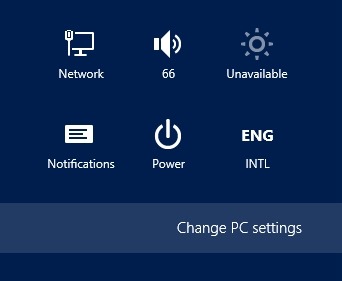 or
or 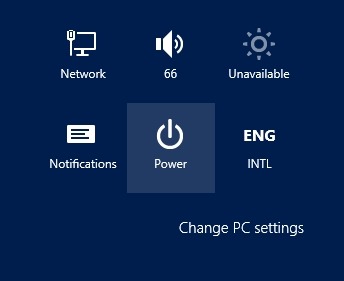
Frankly, I think Mr. Nielsen has not done a very good job in reviewing Windows 8 here. Scott Barnes also thinks that, and goes into far more detail. His critique of the Nielsen review is worth reading.
I find it difficult not to get both depressed and angry when reading about some of the things inflicted on the group that comprises 50% of the human race. Last week it was reading about the case of Savita Halappanavar. Today it is reading about the barbaric practice of female genital mutilation in Indonesia, a supposedly modern Muslim country.
It is well established that female genital mutilation (FGM) is not required in Muslim law. It is an ancient cultural practice that existed before Islam, Christianity and Judaism. It is also agreed across large swathes of the world that it is barbaric. At the mass ceremony, I ask the foundation’s social welfare secretary, Lukman Hakim, why they do it. His answer not only predates the dawn of religion, it predates human evolution: “It is necessary to control women’s sexual urges,” says Hakim, a stern, bespectacled man in a fez. “They must be chaste to preserve their beauty.”
Oh God, ah Allah, what evil we do in thy names…
Well, I certainly didn’t see that coming… Steven Sinofsky, the head of the Windows division, has left Microsoft, and the question that everyone is asking is: “did he fall, or was he pushed?” There’s clearly an inside story here, and it may come out one day. What it definitely is not, despite the many blog and forum commentators saying it, is that he was fired “because Windows 8 and Microsoft Surface are disasters”.
Much more likely is that he either left or was pushed because, under his leadership, the Windows division remained a fiefdom that refused to play nicely with the other product divisions in Microsoft. I’ve mentioned before how, during my time in Shell when I had frequent contacts with Microsoft, I was struck by the silo-like nature of the product divisions, and how the NIH syndrome ran rampant within the company. The famous cartoon of Microsoft’s organisational chart was not far from the truth. It may well be that the Windows division was the last holdout of that attitude, and now with Sinofsky’s departure, that attitude may go the way of the dinosaurs. I see that Julie Larson-Green, who now takes over the Windows division, is reported to favour cooperation over competition.
As an aside, I must say I am disappointed and disgusted at the high levels of sexist and misogynistic comments in the blogosphere that have greeted the news of her appointment. Clearly, we are not very far advanced in geekdom.
With the benefit of hindsight, of course, perhaps the signs that something was in the wind were there at the launch of Windows 8. Sinofsky’s presentation struck me as being strained, and not up to his usual standard. Of course, he might just have been having an off day.
Whatever the reasons behind Sinofsky’s departure, his division delivered Windows 8, which, contrary to the many who either hate it, or damn it with faint praise, is an astonishing engineering achievement. Things are going to get interesting.
Update: Hal Berenson has some interesting insights into the choice of Julie Larson-Green, together with some background on Microsoft’s management culture and practices. The key quote for me:
There were choices besides Julie within the Windows organization that Steve Ballmer could have elevated. … Without knowing anything about how these other executives are currently viewed it might be hard to say why he chose Julie over them, but it is very important to note that Ballmer did have choices. Julie didn’t get the position by default, Steve obviously believes in her ability to lead Windows forward.
It’s now a little over two weeks since Microsoft’s Windows 8 operating system and the Surface tablet running Windows RT were released and I’ve been following the many reactions to the products that have been published in blogs, articles, and forums around the web.
I’ll write about Windows 8 in another post; here I want to consider some of the reactions to the Surface with Windows RT (I’m just going to refer to it as the “Surface RT” from now on…). I should say at the outset that I don’t own one, and for reasons that I hope will become clear, I doubt whether I would want to.
It seems as though most reviewers give high marks to the hardware design, fit and finish of the Surface RT. There are some niggles, e.g. the magnetic power connector doesn’t always make proper contact for charging, and as time goes on, other issues may start arising, which will require some corrective action by Microsoft in the design. For example, reports are emerging that may point to a weakness in the keyboard/cover design – however, it appears that only two people have experienced this issue so far. In general, the Surface RT and its keyboard/cover get high marks.
The hardware, of course, is only half the story. It’s the combination of the hardware and the Windows RT operating system that form the experience that the user has with the device. And it’s there that my doubts start to creep in. My starting point is that I have no interest in getting an Apple iPad – it’s too limited a device for me. Microsoft’s marketing positions the Surface RT as a device that can do more (“See more, share more, and do more with Surface”). For some people, that is undoubtedly true, but that is not the case for everyone. For example, Peter Bright, whose reviews of Microsoft products I trust, has discovered, I think to his dismay, that the Surface RT falls far short of what he is looking for in a tablet device. Mind you, he sets the bar pretty high, and it’s clear that an iPad also wouldn’t meet it. The deal breaker, for him, was that he relies on Outlook. While the Surface comes with some stripped-down components of Microsoft’s Office suite, it does not include Outlook. He summarised his opinion of the Surface thus:
Surface is meant to be something more than a plain iPad-like tablet. For me, it failed to be enough more, leaving it in limbo; it’s not good enough to take on laptops, and it’s not good enough to take on iPad. It falls short of both goals.
It seems to me that the Achilles heel of the Surface RT is the Windows RT operating system. It may look like Windows 8, but under the covers, it runs on completely different hardware. Simply put, that means that it can’t run the millions of Windows applications that are available. At this point, it can only run the 10,000+ applications that have been written for the Modern UI environment of Windows 8.
Here’s a few practical examples of why I won’t be buying a Surface RT:
When Microsoft releases the second model in their Surface range, the Surface Pro, the situation may change. The Surface Pro will run all my Windows applications, and it uses Intel hardware. However, as I’ve written before, it uses an older generation of Intel hardware, which means that the Surface Pro requires a cooling fan. I suspect I’ll end up waiting for the new generation of Intel processors to start appearing – then fanless tablets will be available.
Update: Here’s another review of the Surface RT, this one being very positive. I can fully understand why, the Surface RT delivers on the requirements of this particular user. Unfortunately, it seems to me that my requirements exceed the current capabilities of the Surface RT.
I see that Cardinal Keith O’Brien has been awarded the “Bigot of the Year” award by Stonewall. Naturally, he and other members of the Catholic hierarchy aren’t best pleased. On the other hand, if the cap fits…
To quote from the article:
Colin Macfarlane, the director of Stonewall Scotland, said: “We’ve never called anyone a bigot just because they don’t agree with us. But in just the past 12 months, the cardinal has gone well beyond what any normal person would call a decent level of public discourse.”
Speaking on BBC Radio Scotland, Macfarlane added: “The people that were nominated for bigot of the year have this year called gay people Nazis, they have compared them to bestialists and to paedophiles, and one of the nominees suggested that gay people should be put in front of a firing squad and shot dead.
“So I think what we are doing is highlighting the very cruel, very nasty, very pernicious language that is being used by some people – and in particular by the cardinal, who won.
The opposing view was expressed by Ruth Davidson:
Stonewall’s decision was criticised, however, by the Scottish Tory leader Ruth Davidson as she picked up her own award as politician of the year at the prize ceremony at the Victoria and Albert museum in London on Thursday evening.
Davidson, the first openly gay leader of a major political party in the UK, was booed when she said it was “simply wrong” to call people names like bigot. “The case for equality is far better made by demonstrating the sort of generosity, tolerance and love we would wish to see more of in this world,” she said.
“There are many voices in this debate and just as I respectfully express my sincerely held belief that we should extend marriage to same-sex couples, I will also respect those who hold a different view.”
To my way of thinking, respect is something that is earned, not automatically given. And holding different views is one thing, but to hear powerful religious figures such as the Cardinal, and the former Archbishop of Canterbury, George Carey, spout the cruel, nasty, pernicious language that they regularly use about us is something that I will not countenance.
I have no hesitation whatsoever in calling the Cardinal a bigot, because that is what he is. He has earned himself a well-deserved award.
Update: and now, of course, he has shown himself to be a hypocrite. Hoist by his own petard. Just desserts.
I received an SMS message from my bank this morning telling me that my bank pass had been blocked because it had been skimmed.
This I find very strange, because I have only used it twice in the last ten days. Once at a checkout in our local supermarket, and once to load ten euros onto my OV travel card at our local town station. In both cases, the card readers looked perfectly standard, and there were no obvious signs of tampering.
There are also no fraudulent transactions showing up on my account either.
The SMS informed me that I would be sent a new bank pass within five working days. I thought that seemed a long time to wait, so I rang the bank to see what could be done in the meantime. It transpires that the only way I can conduct any business at all is to go to my nearest branch and draw out some cash. That’s all very well, but they’ve closed the branch in our local town. I’d have to travel by car to the nearest big town – 30 minutes drive – to find the nearest branch.
I asked if it would be possible to be told when and where this supposed skimming had taken place. “Oh no”, came the answer, “we don’t give out information like that”.
Frankly, I don’t believe that my card has been skimmed at all, I suspect that a glitch in the system has produced a false positive, and I’m simply the dupe who has to put up with the inconvenience.
Update: indeed, my card was not skimmed. I was in our local supermarket again today, and there were signs everywhere saying that bank pass cards may have been blocked – but the skimming took place in Doetinchem, which is a town 10 kilometres away. It looks as though the bank just decided to block all cards held by people living within a 20 km radius of the skimming, rather than just those cards that had been skimmed. That’s taking a very big sledgehammer to crack a very small nut, and simply irritates and inconveniences their customers.
Pardon the pun in the title, but I was reading a blog post by Barb Bowman, and I wanted to comment on it. Since her blog is closed for comments, I thought I’d make them here.
You see, Barb has just purchased a Surface RT tablet, and she’s hoping that it will be easier to make posts to her blog, using the Surface RT and Word 2013, than from her iPad. According to her, using her iPad and the Blogsy App is “inelegant”.
I have the feeling that trying to use Word 2013 to do blogging is equally inelegant. It may be a fine Word Processor, but an elegant tool for writing blog posts, it is not.
Microsoft already has a very fine tool for blogging: Windows Live Writer – and it’s free. It works with a wide range of blogging platforms (WordPress, Blogger, TypePad and others) and works with your blog’s layout and themes. I use it for my blog.
Word 2013, by comparison, is like trying to use a rock to paint the Mona Lisa.
The trouble is, the Surface RT won’t run Windows Live Writer – it’s a traditional Windows application and these don’t work on the Windows RT operating system. Oops.
Microsoft does provide a version of Word 2013 that runs on the Surface RT, but quite frankly, I think Barb would be better off using the WordPress App that she can get for free from the Windows 8 Store.
Reviews of Microsoft’s Surface RT tablet are now springing up like mushrooms in the tech and mainstream media. As was the case for reviews of the Windows 8 operating system, most of them can be quickly dismissed.
However, two are worth reading in full. Once again, Peter Bright turns in a considered review, and the other is from Anand Lai Shimpi.
For me, the interesting point was that Anand compared the performance of the Surface RT (which uses ARM hardware) with that of a Windows 8 tablet running the next generation of Intel’s Atom (codenamed Clovertrail), which is aiming to be as low power as the ARM hardware. The money quote:
On the user experience side alone, the Clovertrail tablet is noticeably quicker than Surface. Surface isn’t slow by any means, but had it used Atom hardware it would’ve been even more responsive.
The other clear advantage of a Windows 8 tablet powered by the Atom is of course the fact that it can run all your traditional Windows desktop applications and software drivers. The Surface RT can’t.
I still find it strange that Microsoft’s Surface Pro has elected to use the older, more power-hungry, Intel Core i5 processor. As a result, the Surface Pro needs to have fan cooling. I really would have been interested in a Surface that used the new Atom processor. Perhaps that will arrive in 2013.
 Geoff Coupe's Blog