Reflections on life at “De Witte Wand”…

Year: 2012

  • Dissecting Windows

    As we rush towards the release of Windows 8 later this week, the number of articles in the tech (and mainstream) press on Windows 8 is increasing. Most of them are instantly forgettable, but in amongst the pap and dross is an occasional gem.

    One such article is Turning to the past to power Windows’ future: An in-depth look at WinRT, by Peter Bright.

    As is stated in the title, this really is an in-depth look at the software design of Windows throughout its history, and culminating in its latest incarnation: WinRT. It is a very technical article, so you’ll need to have some understanding of software design and programming to make head or tail of it. But even without that, you should be able to get a sense that the history of Windows is not just about software technology, but also organisational politics, both within and outside of Microsoft. For me, it was a trip back through memory lane, taking in some landmarks of the past. It also gave me a better understanding of the future of Windows, and the revelation that WinRT is not a replacement for traditional Windows programming libraries, since it is itself built on the same (sometimes questionable) foundations.

    Another excellent article from Peter Bright.

  • Microsoft’s Surface Drops a Veil

    With just over a week to go to the launch of Windows 8, Microsoft has revealed the pricing on the first in its range of tablets, the Surface RT.

    The price starts at $499 for a bare-bones Surface RT tablet with 32GB of storage and 2GB memory, but without a touch keyboard/cover. That puts it on a par with Apple’s iPad, or to put it another way: not cheap, but premium-priced.

    The Surface RT is now available for pre-order in eight countries. Inevitably, this does not include the Netherlands, and there’s no word on whether availability here will come later, or, indeed, ever.

    The announcement also revealed a little more detail about the specifications of the Surface RT and the Surface Pro models. There’s also a comparison chart.

    While both models have sensors (ambient light, accelerometer, gyroscope and compass) built in, neither model has a GPS sensor. This strikes me as a rather surprising omission, particularly since some iPad models have GPS. Using Bing maps on the Surface would seem to be a very limited experience if the Surface has no means of discovering your location. I suppose that, with the Surface Pro, I could always use my GPS Logger connected via Bluetooth. I could install the Windows driver for the logger onto a Surface Pro; something that I don’t think can be done with the Surface RT. Still, on further reflection, this lack of GPS capability may not be a showstopper. I rather think that 3G and GPS capabilities go together in the chipsets, and since neither of the Surface models come with 3G built-in, then GPS is also missing. And as for the Bing maps experience, perhaps the Surfaces can do Wi-Fi positioning to provide location coordinates. We shall see.

    One other thing I notice in the specs for the Surface Pro (which will be available “soon”) is that it lists the CPU as “3rd generation Intel Core i5 Processor with Intel HD Graphics 4000”. That also is a bit odd: using a Core i5 processor, rather than the next generation Intel Atom processor, the Z2760, codenamed Clover Trail. The selling point of the Atom Z2760 is that it is able to take advantage of the new “Connected Standby” capability in Windows 8, which allows longer usage time between battery charging. While the Surface RT, like all ARM-based devices will be able to exploit Connected Standby, Microsoft’s Intel-based tablet, the Surface Pro, will not, because it uses the Intel Core i5. Other manufacturers will have Atom Z2760-based tablets on the market as early as next week, e.g. Samsung, with its Series 5 Slate.

    I think I’ll wait and see how the tablet market develops. In the meantime, my desktop will get upgraded to Windows 8 next week.

    Update: it’s clear that many people are totally confused about the differences between the Windows 8 operating system (used on the Surface Pro), and the Windows RT operating system (used on the Surface RT). For example, I saw a question on a photography forum where someone asked if the Surface RT would be powerful enough to run Adobe Lightroom.

    Many people assume that Windows RT will run traditional Windows applications. Nope, it can’t; not unless the application developer recompiles the software code for the different hardware (ARM instead of Intel/AMD). In addition, this recompilation is not always possible, because the Windows programming environment for the ARM hardware is a subset of what is available for the Intel/AMD platform.

    We will see next week just what the limitations are in detail. For example, one question I have is whether the Surface RT will have the same level of handwriting recognition that Windows 8 has. I suspect that it won’t.

    Update 2: AnandTech has a comprehensive review of the Surface RT that is worth reading. I particularly like the fact that Anand compares the performance of the Surface RT with an unnamed (but shortly to be released) Windows 8 Tablet that uses the Atom Z2760. It’s interesting that the Atom out-performs the ARM-based Surface RT. Plus, of course, the Atom will run all the traditional Windows desktop application software and the Surface RT can’t.

  • Carey Invokes Godwin’s Law

    I admit, when I first read of Lord Carey’s performance at the Coalition for Marriage rally at the recent Conservative Party Conference in the UK, I rolled my eyes, sighed deeply, and thought I should just ignore it. While it was yet more evidence that he, and his fellow travellers, such as Anne Widdicombe, are simply bigots, it gets tiresome pointing this out every time.

    But then I read Martin Robbins’ response, and I thought, yes, if Lord Carey wants to play the victim card by likening himself and his supporters to the Jews in Nazi Germany, then he fully deserves the fury of Martin Robbins’ response.

    So I call your attention to what Martin Robbins wrote. In particular, I echo the sentiments he expressed in two paragraphs in the piece:

    I have no words powerful enough to describe the disgrace, the ignorance, the self-absorbed vileness of a man who believes that being called a bigot by Nick Clegg is even remotely comparable to the experiences of men like Pierre Seel, or thousands of others who were slaughtered by the Nazi regime…

    But perhaps Carey’s most disturbing remark was that eerily familiar question he posed: “Why does it feel to us that our cultural homeland and identity is being plundered?” The answer, Lord Carey, is that it is not your homeland, it is our homeland; and homosexuals are just as much a part of our identity as anyone else. The day we allow bigots to deny that, or to suggest that the emotions felt by certain people are somehow not on the ‘same level’ as other human beings, is the day we start heading back down a dark and dangerous path.

  • Max Hastings on Boris Johnson

    There was an odd article in yesterday’s Guardian. It was by Max Hastings writing on the reasons why Boris Johnson is unfit to be the UK’s next Prime Minister.

    I didn’t disagree with a single word of Hasting’s argument.

    What struck as odd is that the article first appeared in the Daily Mail – normally a newspaper with which I will have no truck. For the article to then be picked up and syndicated in the Guardian, a newspaper at the opposite end of both the political and journalistic spectra, only goes to show how far Boris Johnson is capable of distorting reality…

    I continue to wonder at the rise of Boris Johnson.

  • Forget Burglars, Shoot a Banker…

    That’s Craig Murray’s modest proposal. Truth to tell, looking at the behaviour of the banking industry over the past few years, it has a certain ring to it…

  • The Book Mountain

    After that last post, I needed something to give me hope. Perhaps the news of the opening of the Book Mountain and Library quarter in Spijkenisse, here in the Netherlands, is something to restore my spirits.

  • Religion Poisons Everything

    That quote, from the late Christopher Hitchens, seems apposite in the wake of the news that a 14 year-old girl has been shot in the head because, according to the Taliban spokesman (it is always, of course, a spokesman), her activities in highlighting Taliban atrocities needed to be stopped.

    He said the teenager’s work had been an “obscenity” that needed to be stopped: “This was a new chapter of obscenity, and we have to finish this chapter.”

    It is at times like this when I come close to despair for humanity’s future.

  • Shadowland

    We’ve been fans of the dance company “Pilobolus” for more years than I care to remember. In recent years, they’ve begun to use techniques of shadow puppetry in their dances.

    Judging from this, they’ve got it down to a very fine art indeed. Staggeringly good.

    (hat tip: Why Evolution is True)

  • This Land is Mine

    I’m currently reading (very slowly) Steven Pinker’s magisterial The Better Angels of Our Nature. It’s a history of violence in human societies, and his thesis is that violence has actually declined over the centuries. It seems difficult to believe, but Pinker marshals his facts and presents a convincing case.

    And on the theme of the distressing fact that violence and humanity are inextricably locked together, here’s Nina Paley’s offering on that theme.

    More about the film, Seder Masochism, together with a handy guide to who’s killing who, can be found on Nina’s Blog.

  • “The Angels Take Manhattan”

    So, the Ponds departed from Doctor Who last night. Unlike some, I thought that the episode was an excellent one. That can be ascertained from the fact that, at one point (when Rory and Amy jump to their deaths off the apartment block),  Martin threw me a kitchen roll to dowse my blubbing in.

    The sequence of Rory trying to keep his matches alight, whilst Weeping Angel cherubs were blowing them out was up there with the iconic moment in Pitch Black. The Weeping Angels are almost nudging the Daleks off the pedestal of the premier Doctor Who foes at this point for me.

    And I can’t help thinking that the name of the New York apartment block (“Winter Quay”) was significant in some fashion. Was it an anagram, perhaps?

    “We quit! A(my), R(ory), NY”

    Who knows? I’ll be there waiting, in anticipation, for the Christmas episode…

    Update: There was a coda to this episode that was written, but never actually filmed. I don’t understand why. It is simply perfect.

  • Culinary Meme

    Courtesy of Nicholas Whyte, here’s a list of kitchen gadgets.

    Bold the ones you have and use at least once a year, italicize the ones you have and don’t use, strike through the ones you have had but got rid of.

    I wonder how many apple corers, pasta machines, breadmakers, juicers, blenders, deep fat fryers, egg boilers, melon ballers, sandwich makers, pastry brushes, cheese boards, cheese knives, electric woks, miniature salad spinners, griddle pans, jam funnels, meat thermometers, filleting knives, egg poachers, cake stands, garlic crushers, martini glasses, tea strainers, bamboo steamers, pizza stones, coffee grinders, milk frothers, (it was a free gift, honest!), piping bags, banana stands, fluted pastry wheels, tagine dishes, conical strainers, rice cookers, steam cookers, pressure cookers, slow cookers, spaetzle makers, cookie presses, gravy strainers, double boilers (bains marie), sukiyaki stoves, ice cream makers, fondue sets, healthy-grills, home smokers, tempura sets, tortilla presses, electric whisks, cherry stoners, sugar thermometers, food processors, bacon presses, bacon slicers, mouli mills, cake testers, pestle-and-mortars, and sets of kebab skewers languish dustily at the back of the nation’s cupboards.

    Mike, this is for you. Andy, I suspect that you eat out too much…

  • RIP – IDimager

    One of my hobbies is photography, and my main tool for managing my digital photos is IDimager. I’ve been using it since January 2007. It’s now up to version 5, and I’ve been very happy with it. I occasionally visit the IDimager support forums, just to see if there are any announcements, or tips and tricks being posted. Yesterday I read a message from the developer that said:

    IDimager V5 is discontinued as of today. Photo Supreme is a different product when compared to IDimager V5. They don’t offer an identical feature set so I recommend all IDimager V5 users to first try Supreme to see if it fits their need before they decide to make the switch.

    My immediate reaction was WTF? Whilst I had been aware of the Photo Supreme product, last time I looked, a few months ago, it was for the Mac, and there was no whisper of a Windows version being made available. Fast forward a couple of months, and now it has killed off IDimager. Needless to say, I’m not very happy about this, and neither are a lot of other IDimager customers. IDimager is a serious Digital Asset Management (DAM) tool, and Photo Supreme, at first glance, has far less functionality; so for many people, Photo Supreme is nowhere near an acceptable replacement. A typical reaction:

    Well that’s a real shame because you have killed off one of the best DAM systems a working professional could ask for and replaced it with a toy. I wish you luck with Photo Supreme, but regrettably it’s not a professional standard product IMO.

    Because I tend to work mostly with JPG images, I’ll probably be able to carry on using IDimager for some time to come. However, for professional photographers who work with RAW format images, then IDimager will soon not be able to handle images produced by new camera models. These people have been thrown into a pit. I can only echo what someone else posted:

    I have always had a lot of respect for Hert [the chief developer] and his responsiveness to bugs and feature requests. It made IDI stand out in a market dominated by big software giants who bought, crippled then abandoned software. Sadly yesterday’s announcement felt all too familiar and not what I have come to expect.

    Since I have never used all of IDimager’s power (similar to most people only ever using a fraction of the capabilities of Microsoft Word), I’m taking a look at Photo Supreme to see it is a possible replacement for my usage patterns. But I’m doing so with a rather sour taste in my mouth at the moment.

    Addendum 18th September 2014: I thought it was worthwhile adding that since writing this post, I switched (a while ago now) across to Photo Supreme, and have not regretted doing so. PSU has continued to evolve (version 3 is about to be released), and it has matured into a very good DAM.

    Photo Supreme V3 is worth looking at.

  • “It’s An Incredible Deal”

    That’s the summary of Paul Thurrott’s article on Microsoft’s Office 2013 pricing. I think his understanding of the definition of the word “incredible” is rather different to mine.

    While you will be able to purchase licenses for the Office 2013 suite, the main thrust of Microsoft’s announcement is to move from a license purchase model to an annual subscription model.

    Thurrott enthuses that:

    Yes, you’ll be able to acquire Office 2013 the old-fashioned way. But the benefits and pricing of the subscription plans are so attractive you won’t want to.

    However, when I do the sums, the subscription model has zero attraction for me.

    I bought a copy of Office Home and Student 2007 for €125 almost 6 years ago; it’s still fine (I never felt the urge to upgrade to Office 2010), and licensed for 3 PCs – which is all I need.

    Under this new subscription model, I would be paying €600 for the equivalent term for Office 365 Home Premium. If I want to buy Office 2013 for my PCs, then I’ll now have to buy three licenses; Microsoft has stopped doing the “licensed for up to 3 PCs” deal that they had for Office 2007 and Office 2010. However, while buying three copies of the traditional Home and Student versions of Office 2013 is cheaper at €420 Euros than the subscription cost for a six-year term, it’s still an enormous increase over the €125 cost of the equivalent license for Office 2007.

    Frankly, if I’m going to get Office 2013 at all, then I’ll only be tempted to buy just one copy of Office 2013 for €140, and leave Office 2007 on the other two PCs.

    The subscription model may be great for Microsoft, but it makes no sense for me.

  • Polling Day

    It’s polling day here in the Netherlands. It’s our chance to exercise our democratic right to choose the members of the Tweede Kamer (Second Chamber), and, indirectly, the makeup of the next Dutch Government. With twenty political parties to choose from, the next government will almost certainly be a coalition, as usual.

    There’s a chance that we might see a swing to the left, but it seems that it will be a close run thing.

    At least I should get some respite from the last few weeks of a constant barrage of web ads urging me to vote for the VVD. Their crude slogans – Meer straf en minder begrijp voor criminelen (more punishment and less understanding for criminals) – have merely confirmed me in my belief that I am doing the right thing by voting for the PVdA.

  • Lichtenvoorde’s Bloemencorso

    The nearby town of Lichtenvoorde holds a Bloemencorso, or Flower Parade, every year on the second Sunday in September. For 2012, that was yesterday, and as it was a beautiful sunny day, we went along to watch the parade.

    There’s a quite staggering amount of work that goes into making these floats, involving thousands of Dahlia blooms, and the results are spectacular. I took about 400 photos, but unfortunately, my camera lens (a Canon EFS 17-85mm) developed a fault during the parade, so I didn’t capture all of it.

    As well as the floats, there are a number of marching bands and theatre groups taking part. First up was a Brazilian dance and percussion group from The Hague:

    20120909-1416-11

    20120909-1417-44

    The children of Lichtenvoorde and the surrounding area have their own section in the parade. These are just a few of the floats (click for larger images):

    20120909-1442-36 20120909-1442-49

    20120909-1443-11 20120909-1443-24

    20120909-1444-04 20120909-1444-57

    20120909-1446-10 20120909-1449-38

    Then the main floats started to arrive…

    20120909-1453-19

    20120909-1500-46

    20120909-1500-56

    Many of the floats had moving parts. This next one is difficult to appreciate in a photograph, but the bison and the hunters both turned in constant motion:

    20120909-1502-57

    20120909-1503-17

    This next one was titled “Water and Fire”:

    20120909-1504-38

    20120909-1504-43

    20120909-1504-52

    Then came my personal favourite of the parade – carnivorous plants, complete with black flies in attendance. The plants opened and closed their jaws as they passed:

    20120909-1514-3320120909-1515-11(001)

    20120909-1514-50

    Keeping with the Nature theme, this next float was titled “Tarantula”:

    20120909-1519-10

    Followed in turn by a bunch of killer wasps in “Attack”:

    20120909-1524-42

    This next float was titled “Underground”, and presumably represented a mechanical mole, judging by the “miners” working it:

    20120909-1545-10

    20120909-1545-16

    20120909-1545-20

    20120909-1545-31

    20120909-1545-43

    I’m afraid that it was at this point that my lens began to play up, so I haven’t got good pictures of the last floats. However, I want to make special mention of the “Verpakt” (packaging) float. This represented six Japanese toy dolls in their packaging. The dolls moved as they passed by.

    20120909-1549-33

    A nice touch was the inclusion of a QR code on the “box”, which takes you to the fake web site of the Go-Kyo toy

    20120909-1549-43

    This float won the jury prize.

  • Life Is Fragile

    A sober reminder yesterday of how fragile our lives are. I received an email passing on the news that someone I knew, liked, and respected from my days of working in IT in Shell was killed in a light aircraft crash last Friday.  He was only 42.

    He leaves a widow and two young daughters. He is sorely missed.

  • A New Arrival

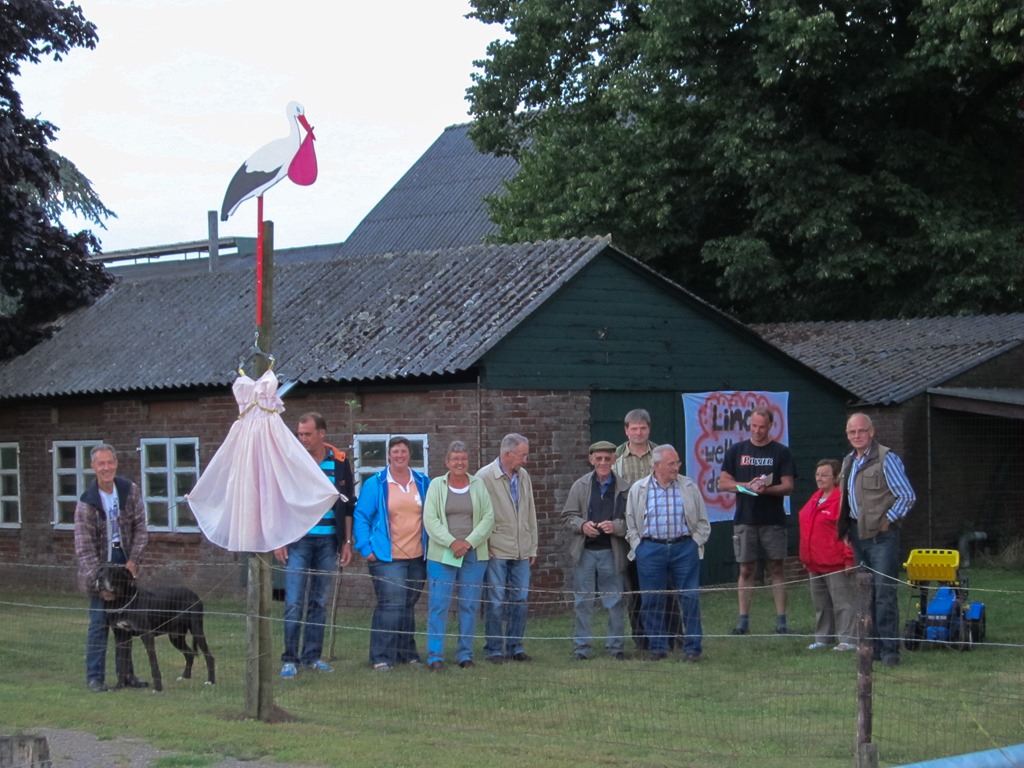
    Our nearest neighbours, Herman and José are currently celebrating (and having sleepless nights) because José gave birth to their second child last Tuesday. Her name is Linde.

    Yesterday, as is traditional around these parts, we, the neighbours, assembled to erect a stork in the garden to proclaim the arrival of a baby.

    20120830-1955-07

    Because Linde is a girl, Martin added the princess dress to indicate the fact. He also decorated the entrance to the cattle barn…

    20120830-1953-48

    The text reads Welkom, Linde, in de Buurt (Welcome, Linde, into the Neighbourhood).

  • “Windows 8 is Windows 7+1”

    I’ve mentioned before how much I’ve been surprised by the level of vitriol and hatred that has been unleashed against Microsoft’s forthcoming Windows 8 operating system. Everywhere I turn, on tech blogs and forums, there are articles, posts and threads complaining about the “disaster” that is Windows 8. Opinions galore, often complete with falsehoods stated as facts.

    I find it all a bit bemusing. To be sure, Windows 8 is not without blemishes, but it’s hardly a disaster. I actually like it. I’ll be upgrading my release preview of Windows 8 to the full Windows 8 Pro when it is released on October 26. I certainly will not be returning to Windows 7.

    So it’s something of a relief to find a kindred spirit in the form of Scott Hanselman, who describes Windows 8 as Windows 7+1:

    Maybe I’m too relaxed but after a few days and some hotkeys I’ve found Windows 8 to be Windows 7+1. Works fine, no crashes, lots of improvements. I spend most of my desktop time in Windows apps, all of which work. I keep News apps or Video apps in full screen on other monitors and I do move the Start Screen around but generally the whole thing has been a non-issue.

    And he actually shows why he has reached this conclusion in a detailed post. It’s worth reading.

  • Microsoft’s Photo Gallery – Yet Another Missed Opportunity?

    As I wrote in my last post, Microsoft has recently released a new version of Windows Live Photo Gallery, now simply known as “Photo Gallery”. That last post documented an issue that Photo Gallery has over its handling of geotags. In this post I want to look at what I would consider to be missed opportunities by Microsoft to set the lead in the field of software aimed at organising digital photos.

    Microsoft is a founding member of the Metadata Working Group, a consortium of leading companies in the digital media industry, focused on the following goals:

    • Preservation and seamless interoperability of digital image metadata
    • Interoperability and availability to all applications, devices, and services

    Almost two years ago, in November 2010, the group published version 2 of its Guidelines for Handling Image Metadata. As I wrote at the time, it’s “a major new version of the Guidelines”. The document states:

    This expanded specification builds on existing metadata standards to describe several emerging consumer properties that:

    • Use regions to record faces, focus points, barcodes, or other data in an image
    • Provide hierarchical keywords to richly describe and classify images
    • Flexibly identify an image as part of a greater media collection

    While software applications are supporting features such as people tags and hierarchical keywords, they use differing implementations, so that interoperability between applications is difficult, if not often impossible.

    Version 2 of the Guidelines was an attempt to define a common specification in these areas, to drive interoperability forward.

    What I find disappointing is that, nearly two years later, the new version of Photo Gallery has not implemented any of these proposed specifications, and continues with the old Microsoft-proprietary ways of doing things, despite the fact that Microsoft is a founding member of the Metadata Working Group.

    Still, the same charge can also be levelled at Adobe, another founding member. Their latest version of Lightroom, Lightroom 4, also continues with the Adobe-proprietary ways of doing things. The result? You can forget about any real interoperability between Photo Gallery and Lightroom when it comes to People Tags and Hierarchical Keywords.

    One last, rather ironic, point. Despite the fact that Google is not a member of the Metadata Working Group, I’m heartened to see that Google has actually implemented the version 2 Guidelines proposed standard for People Tags in version 3.9 of Picasa. So it can be done. C’mon Microsoft and Adobe, get with the programme, give us tools that actually talk to each other…

  • Windows Photo Gallery, Geotags and Other Issues

    Microsoft has recently released a new version of Windows Live Photo Gallery. In keeping with Microsoft’s plan to kill off the “Live” branding, it is now simply known as “Photo Gallery”, and the suite of software utilities is now known as Windows Essentials, rather than the old name of Windows Live Essentials.

    Since this is a step change in the software (it’s now at version 16.4.3503.728, while the last version of Windows Live Photo Gallery was 15.4.3538.513), I thought I’d take another look at it.

    Apart from the name change, not much seems to have been done with the product. Yes, Microsoft has added in the possibility to publish videos to the Vimeo service and Photo Gallery now includes an Auto-Collage feature by default (this was a downloadable plug-in for the previous version), but that’s about it.

    However, while playing around with it, I discovered there was an issue with the way in which Photo Gallery was handling geotags.

    Some of you may recall that, when it was first released in 2010, Windows Live Photo Gallery had a major problem with geotags.  It was writing out GPS coordinate data into photos that was often completely wrong. Microsoft got this fixed in December 2010.

    And there the matter rested, or so I thought.

    However, I have discovered another issue related to geotags in Photo Gallery. For a long time now, Microsoft has said that it holds to the principle that “the truth is in the file”. That means that metadata you apply to your photos is part of the photo, and available to any application that knows how to read it. But I’ve found that this does not apply to geotags in all cases. Photo Gallery looks to see if the image contains metadata, and if so, the following operations occur:

    • If the photo contains Keywords in its metadata, these are added to PG’s list of Descriptive Tags, which it holds in its database and displayed alongside the photo in PG’s information pane. 
    • If the photo contains technical data in Exif (e.g. date taken, shutter and ISO speeds, etc.), these will be copied to PG’s database and displayed in PG’s information pane.
    • If the photo contains GPS coordinates in its metadata when it’s examined by PG, reverse geocoding will be triggered and the location is displayed as text addresses in the information pane.

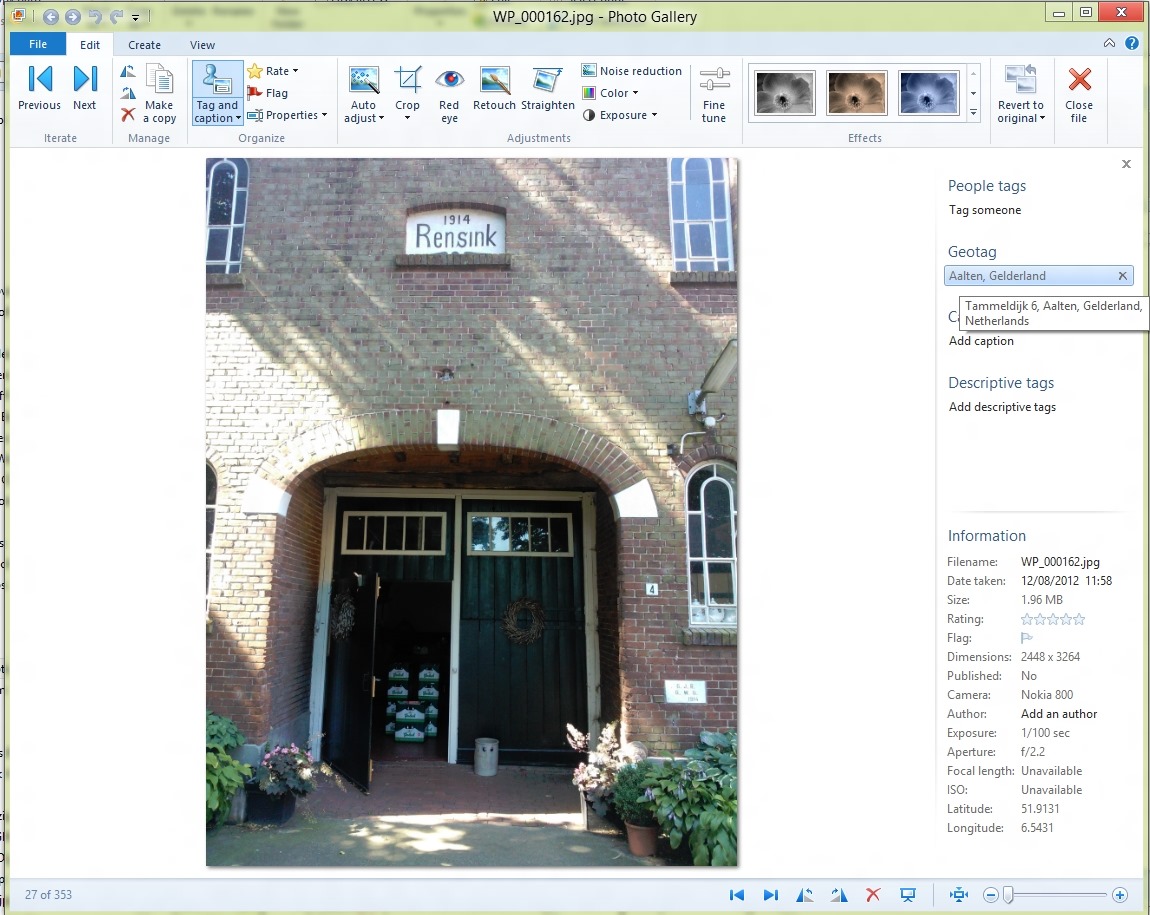
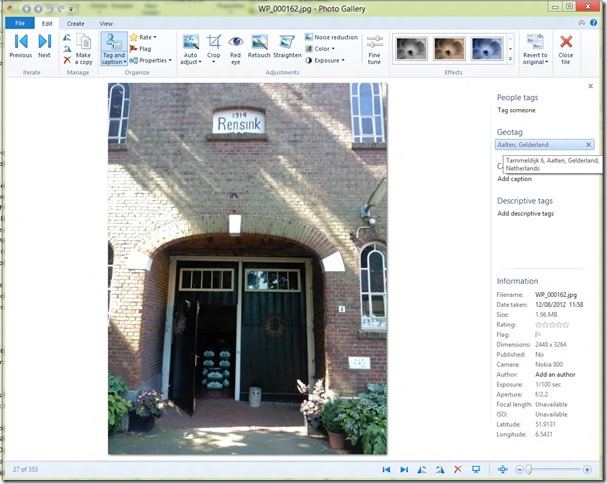
    The screenshot below shows a photo taken with my Nokia Lumia 800 Windows Phone being displayed in Photo Gallery (click for the full-sized image).
    WPG test 10

    In the information pane on the right, you can see some of the metadata present in the image being shown, including the GPS Latitude and Longitude (at the bottom right). Photo Gallery has used this GPS data to do reverse geocoding via a Bing service to resolve the coordinates to an address. That is being shown under the Geotag heading in the information pane. By default, only the City and Province/State data is shown (i.e. Aalten, Gelderland in this case). The full address is shown in a tooltip if the mouse cursor is placed over the Geotag – in this case, Bing has said that the GPS data is for the location: Tammeldijk 6, Aalten, Gelderland, Netherlands.

    As an aside, Bing has actually got the address wrong. It should be Tammeldijk 4, not 6. Google Maps will show the correct address, if fed these GPS coordinates…

    So, Photo Gallery has just generated some location data based on the GPS coordinates. Now the question is, how is it going to stay with the principle of “the truth is in the file”? It needs to write this generated data out into the image metadata in some fashion. How will it do this, and what standard will it use? I need to make a short digression here into the murky waters of industry standards…

    One very common industry standard for location (and other) metadata used in photos is that defined by the International Press and Telecommunications Council. Back in the early 1990s, the IPTC defined a standard for image metadata: IPTC-IIM. This became widely adopted and supported in many software tools and applications. However, it had design limitations, and the IPTC introduced a new version in 2005, based on the XMP standard, known as IPTC Core. Many software tools and applications handle both standards, and keep the metadata content synchronised between the legacy IIM and the new Core standards. Along with the Core standard, the IPTC also published a set of extensions, known, unsurprisingly, as Extension. The IPTC Core and Extension are published together as the IPTC Photo Metadata Standards.

    Both IPTC-IIM and IPTC Core contain fields for defining locations. Essentially, both define a hierarchy of (sub)location, city, state/province, country and country code. I, like many other photographers, use these fields for assigning locations to my photographs.

    However, somewhere along the line, photographers realised that the term “location” was ambiguous. Did it refer to where the photograph was taken, or did it refer to the location depicted in the photograph? These were not necessarily the same place. The standards did not specify a resolution to this conundrum. That is why, in the IPTC Extension standard, there are two sets of location fields: the location where the photograph was created, and the location depicted in the image.

    Clearly, the GPS coordinates reflect the location where the photograph was created, and Microsoft elected to use the IPTC Extension LocationCreated fields to store the results of the reverse geocoding lookup. The correct decision, in my opinion.

    Back in 2010 when I found that false GPS coordinates were being written out to my photos, what was happening was that Windows Live Photo Gallery was doing the following:

    • If a file contained IPTC-IIM or Core location metadata when it was brought into WLPG, then WLPG used the IPTC Location data to set the location strings in the geotag field of the info pane, and wrote them out into the image metadata as IPTC LocationCreated fields.
    • If the file did not contain GPS coordinates, WLPG would attempt to use the Location metadata with a Bing lookup to get the closest match for the GPS coordinates. In many cases, “the closest match” was miles away, or even in another country…
    • WLPG would then write out its idea of the “correct” GPS coordinates into the Exif metadata of the image.

    I, and other photographers, who had been using IPTC-IIM/Core location metadata, suddenly found our photo collections filled with false GPS coordinates. We complained, and Microsoft responded and changed the way in which WLPG worked. Microsoft told me the changes were:

    • GPS coordinates on a file are read-only inside of WLPG.  WLPG will never add, change or delete the GPS coordinates.
    • If a file contains GPS coordinates when it’s brought in to WLPG, reverse geocoding will be triggered and location strings are displayed in the info pane, users can rename or remove the strings but GPS coordinates won’t be touched. Users may Rename a location but it will then leave a mismatch between the coordinates and the string since the coordinates are read-only.
    • If a file does not contain GPS coordinates, users will be able to geotag by adding a string (that gets validated against Bing as it does today) but no GPS coordinates are added to the file.  The user can remove the string or rename it.
    • If the file contains a geo name only, there will be no GPS coordinates calculated for it.

    What I now see that I missed at the time is that WLPG, and now PG, no longer write out the result of a reverse geocode lookup into the IPTC Extension LocationCreated fields when the lookup is triggered by the presence of GPS coordinates in the image.

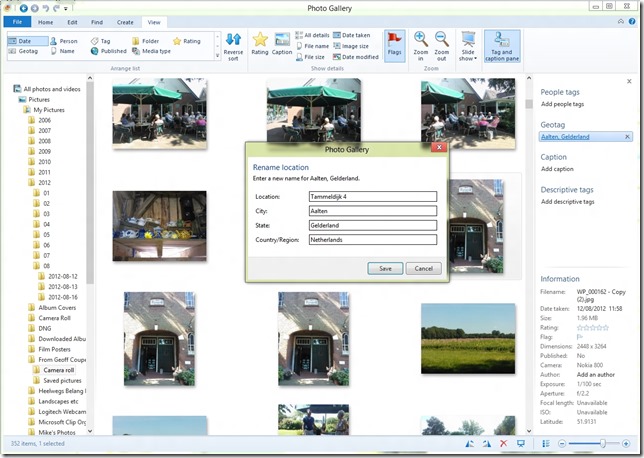
    The only time that LocationCreated metadata gets written out into the image is when the user makes an explicit change to the geotag information in PG. And it has to be a real change. I can open up the “rename location” panel, and click “Save”, but unless I’ve actually made a change in the data, nothing gets written out as metadata – the geotag information resides solely in Photo Gallery’s local database. In other words, the truth is no longer in the file.

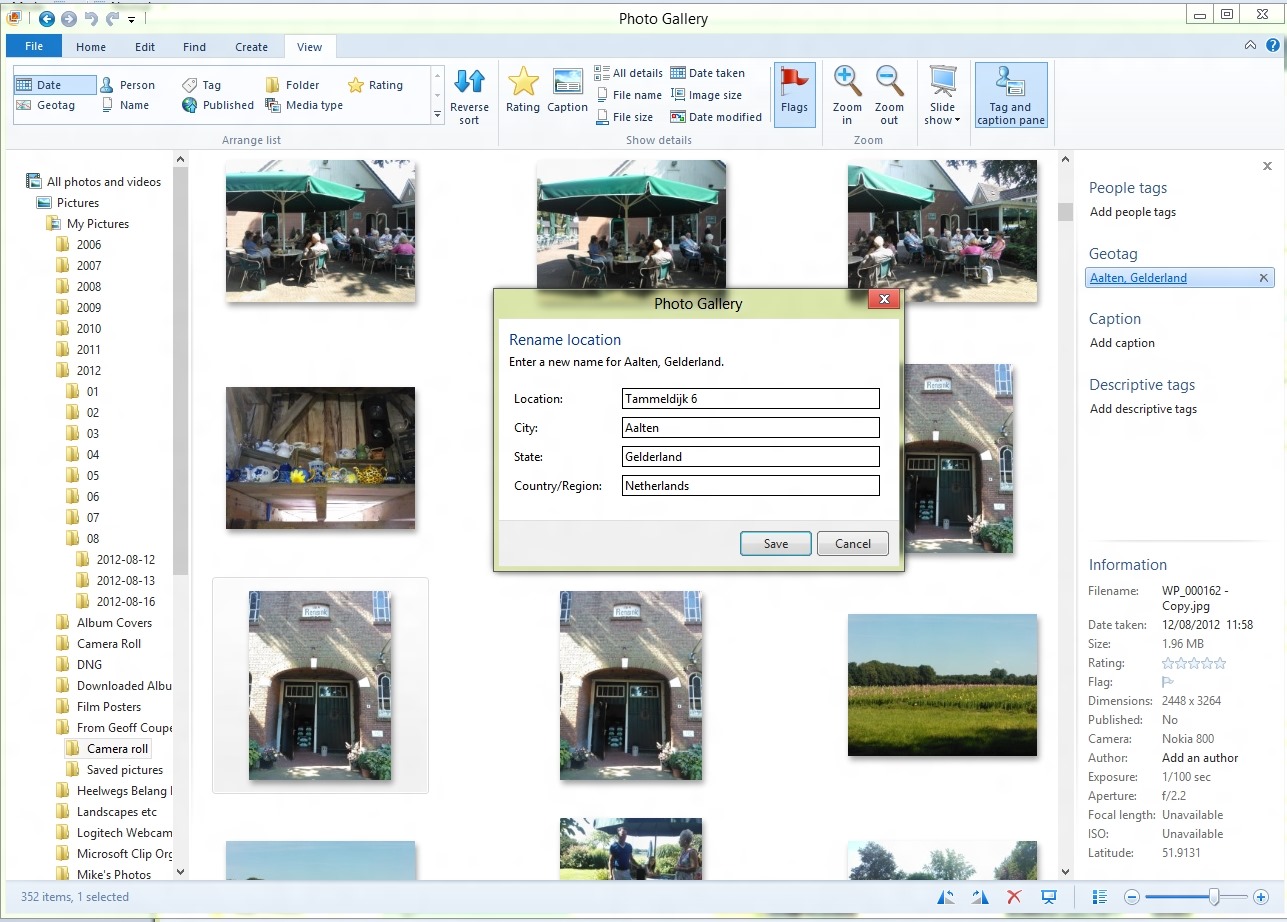
    This screenshot shows the “rename location” panel. Clicking “save” does not make Photo Gallery write out the metadata, because I’ve left the contents unchanged.

    WPG test 2

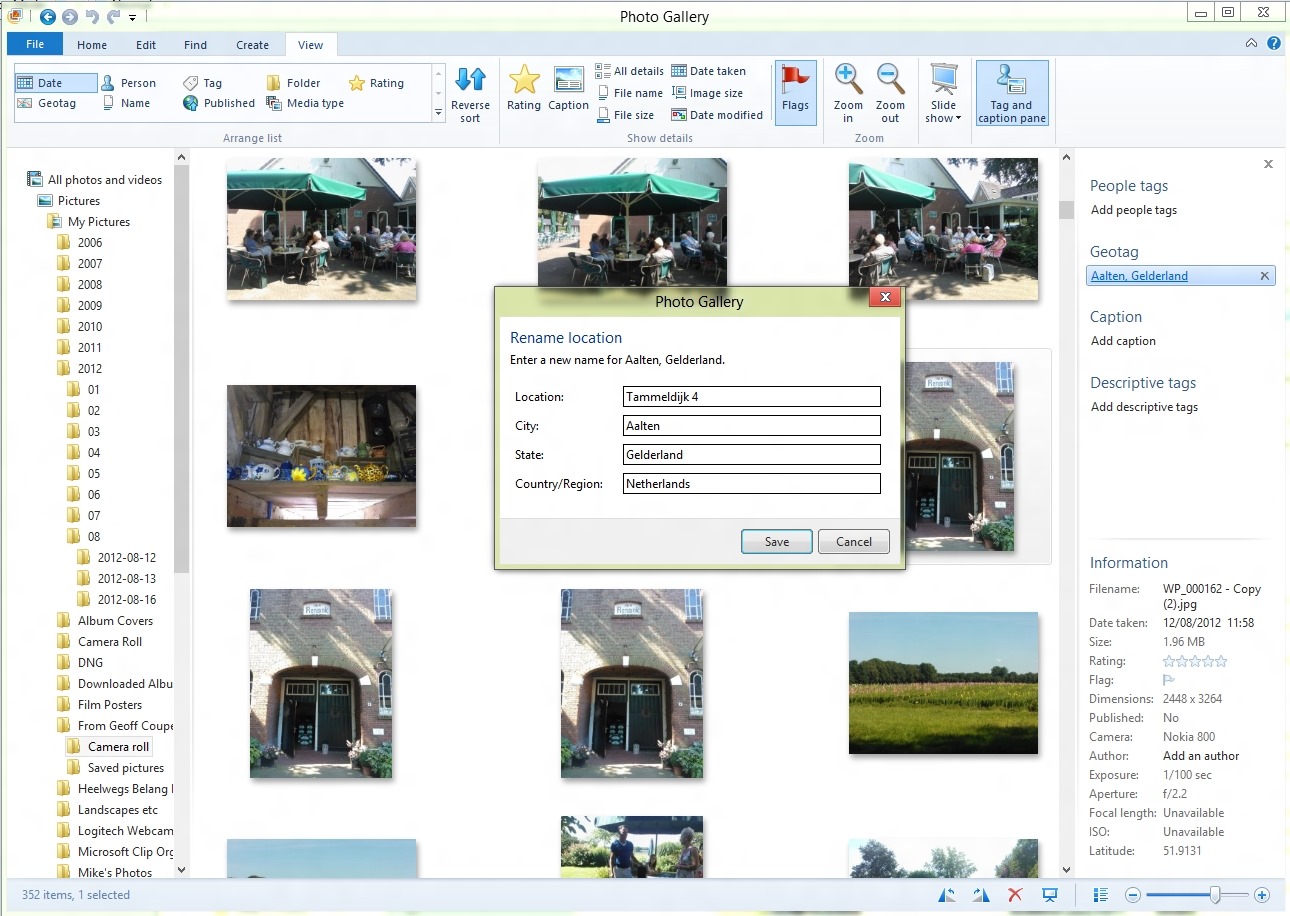
    In this screenshot, I’ve changed “Tammeldijk 6” to “Tammeldijk 4”, and now when I clicked “Save”, the LocationCreated metadata was written out.
    WPG test 3

    This strikes me as a bit counter-intuitive. I would think that clicking “Save” in both cases should force a write of metadata. After all, if Microsoft is going to say that writing out of metadata should be under the explicit control of the user (which I tend to agree with), then even if I don’t change the result of the reverse lookup, I should be able to confirm my acceptance of it by the act of clicking “Save”. If I don’t want PG to write out the metadata, then I would click “Cancel” instead.

    So we currently have here a design where “the truth is in the file” is not fully in place, and where user confirmation is inconsistent.

    That’s poor design, and a poor user experience, in my book.

    I have to say that in one way, I’m rather thankful that the design is still broken. That’s because one of the other bugs in Photo Gallery is still present: it corrupts Canon Makernotes data when it writes out metadata to images. Just imagine: Photo Gallery would be finding location data or GPS coordinates in my photos and writing out LocationCreated metadata to those images. And in doing so, it would be merrily corrupting the Makernotes metadata in every single one of those images. Shudder.