Reflections on life at “De Witte Wand”…

Year: 2012

  • The Right To Die

    I am profoundly thankful that I live in a country where I can choose if I wish to die.

    Tony Nicklinson has been denied that choice, and is condemned to serve more time in a living hell.

    Update #1: Polly Toynbee has a good article on this issue. As she says:

    The verdict was morally abominable – but inevitable. However bad a law may be, it is not for the courts to make fundamental change but for parliament – even when parliament sentences thousands a year to brutal and pointless suffering.

    However, as she points out, it will be difficult to persuade the UK Parliament to right this wrong. The religious lobby is extremely powerful.

    In opinion polls, for years, more than 80% have supported this change in the law, but every attempt at a right-to-die reform has been sabotaged by the large religious lobby, galvanised by Care Not Killing. The red benches, heavily stacked with the religious, including 26 bishops, saw off the last bills.

    Rowan Williams’s pretence is that their opposition springs from a fear this will lead to mass extermination of the inconvenient old. But why should the religious worry more about that than everyone else? The law would provide safeguards. The real religious reason is theological, as voiced in the Lords by the bishop of Oxford when he proclaimed “We are not autonomous beings” – we must all wait for God’s release. Presumably avoidable suffering is part of God’s mysterious purpose.

    As I said, I am thankful that I live in the Netherlands. Contrary to what the bishop of Oxford may choose to believe, I am an autonomous being.

    Update #2: Sarah Wollaston has an atrocious article on this issue. It appears that not only is she a physician, but she is also the Member of Parliament for Totnes. My heart goes out to the people of Totnes for being saddled with her to represent them in the democratic process, and I would hate to end up as one of her patients. She would quite cheerfully condemn me to continued suffering rather than respect my wishes to end my life.

    As Eric MacDonald says:

    The trouble with people like Sarah Wollaston is that they do not seem to understand what a human life is. They think, for some reason, that human life is simply a biological reality, the fact that a body is breathing. The human life that we value is very different. A life is a continuum of sorts, with a unity of conception. I do not want to enter into the philosophical problem of identity, but the important thing about a well-lived life is that it has a sense of overall consistency and coherence. That is why we respect people’s autonomy, the right to make their own decisions about life: what to do with their lives, who to marry, whether to have children, which vocation to pursue, and many other decisions that go to make up a life rich in experience and held together, so far as is possible, by a single, or at least a unified sense of what is appropriate for a life so conceived.

    A life conceived in this way includes some of the most important decisions that must be made, and includes, as an essential part, how that person understands the part that death plays in life. Most of us do not think much about death, especially when we are in the midst of life, but the time will come when the issue of dying will loom very large indeed. To be unable to make decisions about dying is to put outside the scope of a person’s conception of life all those things that may befall them at the end of life.

    Update #3: Tony Nicklinson has died. RIP. He fought well for the right to die with dignity.

  • Lest We Forget

    The BBC showed a one hour documentary last night: Death Camp Treblinka: Survivor Stories. The survivors in question were Samuel Willenberg and Kalman Taigman. They were among 600 prisoners who escaped during a revolt at the camp on August 2nd, 1943. Only 40 of them were known to have survived to the end of the war, and now, only Samuel Willenberg remains to bear witness – Kalman Taigman died in July this year.

    The programme was profoundly shocking – Treblinka II was a death camp that existed for no other purpose than for the killing of human beings. Over 800,000 Jews and Gypsies were gassed, shot and cremated during the 13 months of the camp’s operation.

    What struck me was how small Treblinka II was – only 600 metres by 400 metres. The Nazis kept between 700 and 800 prisoners to operate the camp, while 90% of the inmates sent to Treblinka were killed within the first 2 hours of arriving.

    Willenberg and Taigman told their stories to camera, and they were harrowing. For example, Willenberg found the coats of his two younger sisters among the personal effects of the dead he had been made to sort through by the Nazis. Or the fact that during his escape from the camp, a fellow escapee, who was wounded, begged Willenberg to shoot him, rather than be recaptured. Willenberg gave him his wished-for coup de grâce.

    The light at the end of the tunnel was the closing section of the programme that showed that the two men had survived the horrors of Treblinka and rebuilt their lives. Taigman had gone on to fight in the Warsaw Uprising, while Willenberg was a witness at the trial of Adolf Eichmann. The closing moments of the programme managed to bring a profound sense of peace and regeneration of the human spirit at its best – something that I never thought would be possible given what I had just seen and heard earlier in the hour

  • RIP, Harry

    Harry Harrison has died. When I was going through my phase of devouring SF books during my teens and twenties, he was one of my favourite authors. On one level, his books could be read as action tales, but there was usually a serious underpinning. So Deathworld was underpinned by Darwinian selection, Bill, The Galactic Hero by an almost Swiftian satire, and Make Room! Make Room! by the question and consequences of human overpopulation.

    But I think my favourite of his novels remains Captive Universe, which opens with a heartstopping sequence (quite literally) in an apparently Aztec setting. It develops into a thought-provoking tale about colonisation and eugenic control. Well worth reading.

  • When All Else Fails…

    …change the cable.

    A few days ago, my Nokia Lumia 800 phone suddenly refused to connect to my PC for synchronising. I’d plug it in, but nothing would happen – Windows would not react to the connection, the Zune software would not start, zilch. And when I disconnected the phone, Windows would give me an error saying: “USB device not recognized”. However, the phone would still charge via the connecting cable, so at least something was happening.

    So I searched the web for this error and got lots of advice. Mostly involving uninstalling and re-installing the Zune software on the PC and doing a hard reset on the phone (which loses all my information on the phone).

    I followed all of this, without any resolution of the problem. I even installed the Zune software on another PC and tried connecting the phone there. Still the same error.

    Right, this then meant that there were two possibilities:

    • Either the phone was faulty, or
    • the connecting cable was faulty.

    Not having a spare micro-USB cable handy, I decided to buy a new cable, at – gulp – €24.95. It arrived today. With some trepidation, I plugged it in and voilá – synchronisation began.

    So the moral of the story is that even with modern electronic devices it can still be simply a  faulty cable that causes the problem.

  • Intricate Processes of Fantastic Horror

    In the novel, The Midwich Cuckoos, by John Wyndham, one of the characters, Gordon Zellaby, says:

    “I wonder if a sillier and more ignorant catachresis than “Mother Nature” was ever perpetuated? It  is because nature is ruthless, hideous, and cruel beyond belief that it was necessary to invent civilization. One thinks of wild animals as savage but the fiercest of them begins to look almost domesticated when one considers the viciousness required of a survivor in the sea; as for the insects, their lives are sustained only by intricate processes of fantastic horror.” 

    Using that as a springboard, Kij Johnson has penned a page of unsettling ruminations: Mantis Wives.

    Eerie, disturbing, and practically factual descriptions of the sex lives of the Mantis.

  • The Perseids

    The Perseid meteor swarm reached its annual maximum at around 14:00 yesterday afternoon (local time) on the 12th August. That meant that for the past couple of nights (and hopefully tonight) the chances of seeing a meteor streak across the sky have been substantially increased.

    So far, I’ve had a couple of attempts at observing. I was out at 04:00 on the 12th (I couldn’t sleep), and I did see many meteors. However, I was singularly unsuccessful at capturing any of them with my camera.

    Last night, I tried again at about 00:30 for an hour or so. It seemed to me that the rate of meteors had fallen away considerably from the night before, but I did manage to capture one with my camera. It’s not a very good photo, but it does show Ursa Major (the Plough) over the house, with a Perseid streaking in from the right of the frame.

    20120813-0129-25

  • Fun and Games With WHS 2011

    Despite some quirks and shortcomings, my Windows Home Server system has been quietly backing itself up onto a pair of hard drives that I rotate to an off-site location.

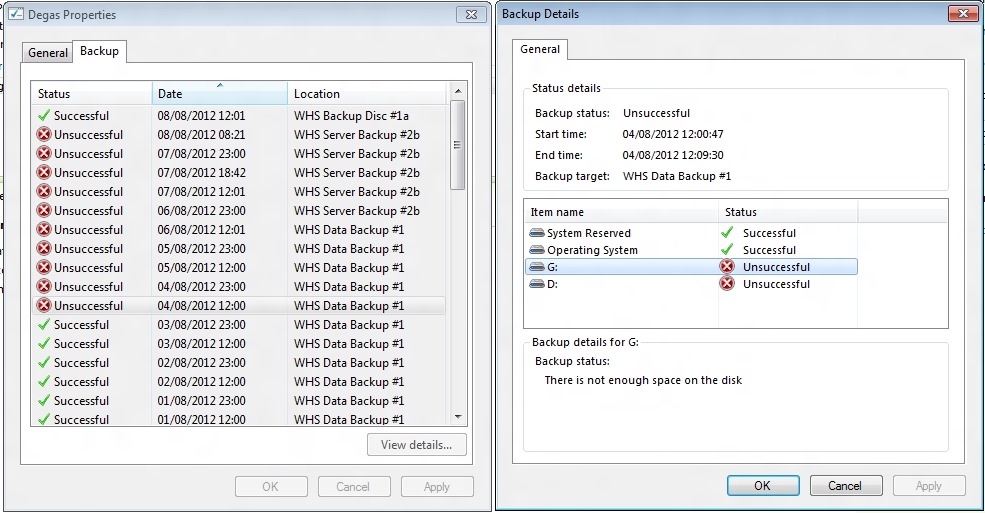
    But four days ago, the server backups started failing. The error being reported was “There is not enough space on the disk”. This was being reported for both the G: and the D: drives on my system.

    WHS2011 106

    Well, I could understand that being the case for the G: drive, since that had filled up with data leaving only 60 GB free on a 1 TB drive. However, the D: drive had nearly 385 GB free on a 405 GB drive.

    I wondered whether in fact the disk being referred to was not the data disk, but the backup disk, WHS Data Backup #1, which only had a few GB free. WHS 2011 is supposed to purge old backups from the backup drives when they get full, but there seems to be no way to predict when it will do this – I’ve had backup drives bob along for months with only a few GB free.

    I tried a few more server backups, but as you can see from the screenshot, they were all unsuccessful. I also swapped the backup drive for a second drive (WHS Server Backup #2b), but as you can see, server backups still weren’t working.

    I began to wonder whether it was data drive G: being almost full that was triggering the failure, so I moved one of the Shared Folders from the G: drive to the J: drive. Unlike WHS v1, WHS 2011 does not have drive pooling, so you have to manage the storage as a bunch of separate drives.

    Once I’d moved the Folder across to the J: drive (using the “Move the Folder” task in the WHS 2011 Dashboard), the G: drive now had 248 GB of free space, while the J: drive now had 714 GB of free space.

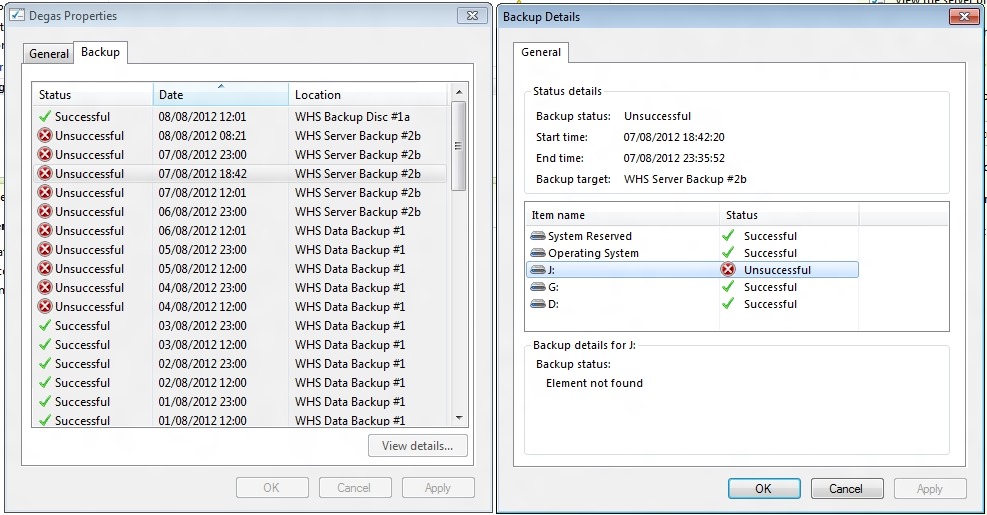
    I tried another server backup. This was also unsuccessful, with an “Element not found” error (whatever that means) being reported on the J: drive.

    WHS2011 107

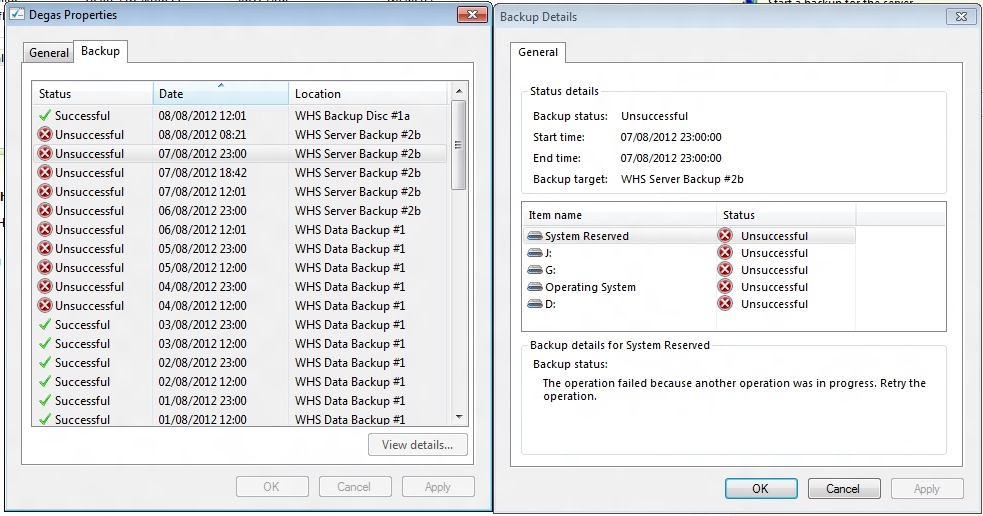
    I left the system running and waited to see whether the next scheduled backup (at 23:00) would work. That was also reported as unsuccessful, with all drives reporting a “The operation failed because another operation was in progress. Retry the operation” error.

    WHS2011 110

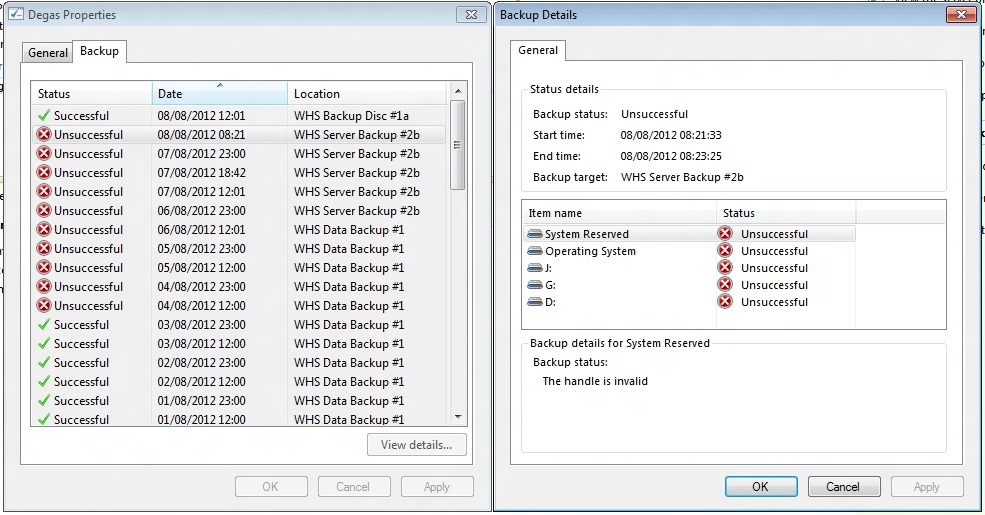
    Trying not to panic, I rebooted the system and tried one more time. Now I got a “The handle is invalid” error on all drives. Another mysterious and opaque message.

    WHS2011 108

    Finally, in desperation, I told WHS 2011 to remove the WHS Data Backup #1 drive from the server backup definition, and added it back as though it was a totally new backup drive. WHS 2011 formatted it, and I gave it the name of WHS Backup Disc #1a.

    The next time server backup ran, the backup was successful. Phew!

    WHS2011 109

    I suspect I’m going to have to reformat the second backup drive, and add it back into the server backup task as a new drive.

    I think things are back to normal again, but I have to confess that this little episode has shaken my confidence in WHS 2011 a bit.

  • Curiosity Rover and Usain Bolt

    Yesterday, a man ran 100 metres in 9.63 seconds. This morning, a robot laboratory successfully landed on Mars and will begin its search for evidence that life may also have existed on a neighbouring planet.

    Of these two stories, it’s the second that makes me feel more proud of what my species can achieve when it puts its mind to it.

    And as one of the comments on the Curiosity Rover story says:

    Oh man, that was so cool!

    They basically just parked a Volkswagen Beetle on a predetermined spot on another planet more than 150 million miles away by lowering it with ropes from an almost hovering jetpack.

    Just like that.

    Of course, ordinary folks like me in the nation that managed such a feat still can’t afford healthcare insurance, and Texas is about to execute someone with an IQ somewhere in the 60’s.

    Goddam, this is one crazy fucking world, ain’t it? You couldn’t make this shit up, y’know?

    Quite.

  • The Amish – Lovely People…

    So, the BBC had yet another documentary about the Amish last night. Following on from the programmes about the Stoltzfus families, the BBC gave us a programme about David and Miriam Lapp and their adorable children.

    And, just as with the Stoltzfus families, I found myself simultaneously liking the Lapps, but also cringing at their complete obliviousness of what humanity has achieved, for better or for worse.

    David and Miriam came across as genuinely likeable, but there was that awful frisson when Miriam started talking about the rod (as the Bible states), as an effective method of chastisement of her children, while smiling all the while. At this point, her youngest son pipes up to implore her not to use the rod (in her case a wooden spoon – with a smiley face drawn upon it!) on him. She grinned. I found that shocking and not at all cute or lovely.

    In the end, I once more found myself thanking my lucky stars that I was not born into an Amish community. The chains around the human spirit would have proved too much for me.

  • “So, How Much Trouble Are We In?”

    The opening quote, from the lovely Rory, in the trailer for the BBC’s next season of…

    Doctor Who!

    Ooh! I can’t wait! And was that a baby weeping angel doing a riff on the definitive moment from Pitch Black? Damn, this looks to be worth waiting for…

  • Let’s Have A Kiki

    Despite those who feel that this is merely passé, I like this track enormously, and am pleased to see the video from the Scissor Sisters.

    My niece recently sent me an email reporting that she and her family had seen Scissor Sisters at the Wickerman Festival this year, and saying how much they had enjoyed the performance. As she wrote:

    They will be the talk of the festival for years and I’m delighted many of Ana Matronic’s comments will have upset all the homophobes in the audience.

    Amen!

  • Litmus Test

    Reading the reactions to Danny Boyle’s Olympic Opening Ceremony is something of a litmus test, gauging where the commentator resides on the spectrum from left to right, or from heartfelt to disingenuous.

    I have to say that I loved it, although it was so full of cultural references that I will need a second or third viewing to appreciate them all. As Marina Hyde wrote,

    …as deliciously indigestible to global tastes as Marmite or jellied eels. I loved it.

    Just to make it clear, I am on the opposite end of the spectrum to the tweets from Aidan Burley, and from the blindness of those who did not see the Windrush reference (Ranga Mberi, I’m looking at you).

    Overall, I find myself in agreement with Al Weiwei, who compared the machine-like opening of the Beijing games (impressive as it was) with the gentler, more human-scale vision of the London Olympics.

    But I have to doff my hat at Marina Hyde’s invention of the term “the global arseoisie”, and her description of them:

    For while it was the best of folks, it was also the worst of folks. Gazing stonily down on a parade of athletes, about whose dreams and sacrifices this entire extravaganza is supposed to be, were some absolute shockers. Taking gold in the Biggest Scumbag in the Stadium event was probably the Bahraini prince, on whose directives athletes are reportedly tortured, flanked on the podium by Rwanda’s Paul Kagame and Prince Andrew’s brutal mate from Azerbaijan.

    That’s humanity – the best and the worst; thrown together, with mostly the worst in charge…

  • Cloud Atlas

    “Cloud Atlas” is the name of a remarkable book by David Mitchell. A Russian Doll of a book, it contains stories within stories that link and arc to form a narrative that spans centuries and civilizations.

    I thought it was amazing.

    And now, it appears that a film of the book has been made. Even the trailer is almost six minutes long – it will be interesting to see how the film stacks up to the book. There are, at least, some good actors involved, so one can but hope.

    Update 4 September 2012: there’s a very good article on the making of the film in the current New Yorker. Definitely worth reading. I still fear for how the film will turn out. The Wachowskis are known for their bravura visual style over depth of characterisation (e.g. The Matrix), while the book is almost the complete opposite. Still, fingers crossed, the film may yet stand on its own feet as a work of art.

  • A Letter to a Mother

    Abdellah Taïa wrote a letter to his mother. A letter in which he explained his homosexuality to her. I regret that I cannot fully understand the French of the original letter, but this translation retains, I think, much of the power and passion of the original.

    Once again, I must say that I have been lucky enough to never have faced the same battles in my own family, but I’m mindful of those who do.

  • Subscribe, Not Purchase?

    There’s a post today on Microsoft’s official Office blog that talks about Office and the Cloud. One thing that leapt out at me was this:

    As part of the Customer Preview, we announced that you’ll be able to sign up for an Office subscription, which will ensure that wherever you go and whatever Windows device you are on, the latest and greatest version of Office will be there for you. We’ll be talking more about our subscription offer in a future post so please stay tuned.

    I’m all ears. I fear that in future, we will no longer be able to purchase the Office software, but we will have to subscribe (on a yearly basis?). I prefer to be able to purchase software, and then be able to make an informed decision about whether I upgrade to the latest and greatest version. It’s for that reason that I’m still using Office 2007 (and some of my neighbours are still using Office 2003). I, and they, saw no reason to upgrade. Will I move to Office 2013 – and will I have to also move to a different pricing structure? Time will tell.

    Update: I see that John Jendrezak (the author of the Microsoft blog post) has replied to my question assuring me that we will still be able to purchase the software as we always have done. So that’s a relief.

  • Just Testing

    This blog post was been created in Microsoft’s Word 2013. Up until now, I’ve been using Microsoft’s Windows Live Writer very happily to do all my blogging with. However, I suspect the writing is on the wall (as it were), and Microsoft will be killing Windows Live Writer off in the not-too-distant future. So now I will probably have to get used to another tool. I’m not overly happy with using Word, but I’ll give it a try for a while.

    It does seem to be a bit of a step backwards from Windows Live Writer. For example, WLW had a facility to add in a photo album, but I’m not sure that Word can do this, it only seems to deal with individual images.

    It also seems to be getting confused with special characters. I’ve just opened a previous blog entry (Windows 8 “Play to” Revisted), and Word seems to think the title is:

    Windows 8 “Play to” Revisited

     And while Word’s template supports the WordPress Categories that I’ve set up, it doesn’t appear to support Tags in the template.

    Oh gawd – now it’s gone and changed the font…

    And I can’t see how I can retrieve older posts for revision, or open the pages (e.g. “About”) on my blog. I’m not impressed.

    Oh well, one step forwards, two steps back – as usual.

  • Backing Up Your Data

    Here’s a simple question: do you have backups of the data held on your Windows PC or your Mac?

    Apparently, the answer from most people (if they’ve ever even thought about the question) is a resounding “no”. That’s the conclusion that Microsoft has reached. In a post on the Building Windows 8 blog, they state:

    Our telemetry shows that less than 5% of consumer PCs use Windows Backup and even adding up all the third party tools in use, it is clear nowhere near half of consumer PCs are backed up. This leaves user’s personal data and digital memories quite vulnerable as any accident can lead to data loss.

    Windows has had data backup tools included in it for years, but the fact is that very few people actually use them. Microsoft is introducing a totally new backup method in Windows 8 called File History. It comes with a user interface that is designed to be attractive and easy to use.

    Now there’s a lot to like about the Windows 8 File History feature, but it focuses on the user’s personal data. It will only backup data held in the user’s Libraries, Desktop, Contacts and Favourites. It will completely ignore applications that have their own databases, e.g. Adobe’s Lightroom. For some time, Microsoft has been telling developers to store application data in locations contained in the C:\ProgramData folder, and now the File History feature will totally ignore such files. Also, user data that is not document-based is supposed to be held in locations contained in the C:\Users\Username\AppData folder. That is also ignored by the File History feature. It turns out that Microsoft’s own Windows 8 Mail App stores mail messages in the AppData folder, so File History will not backup your mail messages. Microsoft seems to be assuming that we store our mail in the Cloud, e.g. in their Hotmail service. I’ve got news for them – we don’t all do this.

    I’ve got used to the elegant and simple-to-use client PC Backup function of Windows Home Server (which covers all files and provides a bare-metal restore). Moving to Windows 8 on my current hardware will mean that I will continue to use WHS for backup.

    However, because WHS does not support backup/restore of client PCs that use EFI/GPT technology, that will mean that I will have to use a combination of File History and some other method of backing up application data, if I invest in new hardware (a PC or a Tablet). Modern PCs use EFI/GPT.

    [Update 4 March 2013: Microsoft has at last issued a Hotfix to add backup support for UEFI-based computers to back up to servers that are running Windows Home Server 2011]

    Frankly, that makes it sound a bit of a kludge, instead of the current “set it and forget it” method of WHS.

    Peter Bright has a good analysis of the new File History feature, and a comparison with the older methods of data backup in Windows here. I rather like one of the comments on his analysis:

    So basically, they killed Windows Home Server but still don’t have an effective product to replace its backup mechanism. Got it.

  • Well, I Told You So…

    So Microsoft has effectively killed off their Windows Home Server product.

    Being Microsoft, of course, they don’t say this quite as baldly as I just did. Instead, they’ve announced some details of their forthcoming Windows Server 2012 lineup of software, and buried on page 4 of the 6 page FAQ we find this:

    Q: Will there be a next version of Windows Home Server?

    A: No. Windows Home Server has seen its greatest success in small office/home office (SOHO) environments and among the technology enthusiast community. For this reason, Microsoft is combining the features that were previously only found in Windows Home Server, such as support for DLNA-compliant devices and media streaming, into Windows Server 2012 Essentials and focusing our efforts into making Windows Server 2012 Essentials the ideal first server operating system for both small business and home use—offering an intuitive administration experience, elastic and resilient storage features with Storage Spaces, and robust data protection for the server and client computers.

    OK, so they are saying that Windows Server 2012 Essentials is to be “the ideal first server operating system for both small business and home use”. And how much will it cost? Well, it’s $425. And how much does Windows Home Server 2011 cost? Er, $40. There’s no way I can possibly justify shelling out $425 for Microsoft’s proposed successor to WHS 2011.

    Now, to be fair, that $425 price is a retail price, while the $40 is an OEM price. There isn’t an OEM price for Windows Server 2012 Essentials, instead, there’s another product in the range that will be available as OEM software, and that’s Windows Server 2012 Foundation. We don’t yet know what the OEM price will be for this software, and while it will be less than $425, I very much doubt that it will be $40 either, probably more in the $100 – $150 range.

    But there’s another issue to worry about, will there be things missing from the Foundation version that are present in Essentials? Microsoft says this:

    “If you’re a small business with limited in-house skills, Windows Server 2012 Essentials is an appropriate option. It’s simple, affordable, and easy to manage, and has been tailored to address common small business IT scenarios. Windows Server 2012 Essentials is the ideal solution if you plan to expand your business capabilities through the cloud as it is designed to facilitate your connection to online services. On the other hand, if you have some level of in-house IT skills and want the ability to tailor server roles to their unique environments, then Windows Server Foundation is potentially better suited to your business.”

    In other words, if you are a home user, then you had better have some degree of IT skills at your fingertips if you want to use Windows Server Foundation, assuming that it does contain all the necessary functionality. It certainly won’t have the easy-to-use Wizards that will be present in the Essentials edition…

    The upshot of all this is that Microsoft has essentially dropped the whole concept of a Home Server product, priced for the consumer market. I can’t say that I’m the least little bit surprised, the writing has been on the wall since the early days of the development of WHS 2011.

    The first version of Windows Home Server began with a vision and a focus on the home consumer. There was even a set of guiding principles for the design of the storage system for WHS v1 that were predicated on the needs of the home consumer. After the release of that first version of WHS, the team leader (Charlie Kindel) moved on, the WHS team got reorganised, and ended up in the Server group at Microsoft – small fish in a very big pond. In the process of developing WHS 2011, they effectively tore up Kindel’s guiding principles, and the result has been a product that while it bears the word “Home” in its title, is far less focused on the home consumer than the first version. Now that focus has been reduced even further to a blur.

    While some people will question the value proposition of a home server in these days of cloud services and online streaming, I firmly believe that it has a place. I have more data than I can affordably hold in the cloud, and living as I do in the countryside, I am at the end of a piece of wet string, so streaming of high-quality content is not an option.

    The original concept of WHS, with its easy to manage storage, and single-instance backup of up to 10 client PCs was something that had clear value to me. Microsoft weakened that with WHS 2011, and now they are in effect getting out of the home server market altogether.

    The one possible ray of hope is that it may be possible to replicate the functionality of WHS using Windows 8. That is dependent on someone developing an App for Windows 8 that replicates the client PC backup functionality that is present in WHS, while addressing its limitation (it can’t backup PCs that use EFI/GPT technology). There’s a gap in the market opening up – let’s hope someone will fill it…

    [Update 4th March 2013: Microsoft has at last issued a Hotfix to add backup support for UEFI-based computers to back up to servers that are running Windows Home Server 2011]

    Update 15 July 2012

    Being somewhat curious, I downloaded the beta of Windows Server 2012 Essentials and installed it into a virtual machine. I followed the excellent guides provided by Jim McCarthy on how to do this. Here’s his guide on installing Hyper-V (the virtual machine environment) in Windows 8 and here’s his guide on installing the beta of Windows Server 2012 Essentials.

    I found that I needed to make a change to my PC to enable the virtualisation mode of the CPU, but once that was done (and the PC rebooted multiple times), the Hyper-V environment was up and running. The installation of the beta of WSE 2012 was very straightforward, and before too long, I saw the server appear on my home network.

    I have to say that I think Microsoft is being disingenous when they say that WSE 2012 is suitable for “home use”. From what I saw of the environment, it is clearly aimed at a small business, not the home. For one thing, it provides a full domain controller environment, which is very much overkill for the home.

    I confess that I didn’t leave WSE 2012 in place for very long before I deleted it and removed the Hyper-V environment.

    For one thing, although it may have been a coincidence, following the installation of WSE 2012 into Hyper-V running on my main Desktop PC, the WHS backup service of that PC stopped running. Looking in the Event Viewer showed .NET runtime errors occurring with the Windows Server Client Computer Backup Provider Service, which manages the backup and restore service for client computers. Since this service was stopped (and couldn’t be restarted without errors), I could not back up or restore data for my Desktop PC.

    The other thing that sealed the fate of WSE 2012 for me was the news that a version of MyMovies will not be developed for WSE 2012. Brian Binnerup, the developer of MyMovies, believes (quite rightly, in my view) that the market will be too small to justify development and support of a WSE 2012 version. Since I have the MyMovies server installed on my WHS 2011 system, that rather closes off a possible upgrade path from WHS 2011 to WSE 2012 (quite apart from the cost of WSE 2012, of course). It looks as though a future version of the MyMovies server will only be developed for Windows 8. Update 24 August 2012: I see that Brian Binnerup now seems to have changed his mind about supporting Windows Server Essentials 2012. That’s good to know, but it’s still too expensive for me.

    As a result, I have turned my back on Windows Server Essentials 2012. It has been removed from my PC. I’ve reinstalled the WHS 2011 Connector, and now my Desktop PC is once more being backed up on a daily basis to my WHS 2011 server.


  • The Gauntlet Has Been Thrown Down

    Just to follow up on my post about Microsoft Surface for a moment, I do think we live in interesting times.

    Peter Bright, over at Ars Technica, has a good article on the impact on OEMs of Microsoft entering the tablet hardware market; he likens it to Microsoft giving the OEMs a gentle kick in the teeth. The problem is that, compared with Apple’s iPad, the build quality of tablets running either Android or Windows is pretty dire. Even the so-called quality manufacturers have not exactly covered themselves with glory here. Samsung’s flagship Windows 7 Tablet, the 700T, for example is still plagued with the fact that its screen lifts away from the housing.

    As Peter Bright says:

    To allow Windows 8 to compete with iOS, Microsoft needs hardware to compete with the iPad. Bad hardware would jeopardize Redmond’s ability to play in the tablet space, but the PC OEMs have established for themselves a track record of producing little else. And while many of the OEMs have produced Android tablets to try to compete with the iPad, they’ve also consistently failed to match its quality.

    So Microsoft has drawn upon its 30-year history of producing hardware and made two models of Windows 8 tablets to show the OEMs how its done. Now admittedly, that 30-year history has been mostly spent in the area of producing mice and keyboards. But, on the other hand, Microsoft also makes the Xbox, which although it is a game console, has a similar level of complexity as a PC. Still, the engineering that is required for a high-quality tablet is definitely up a notch from the Xbox, so I am intrigued to see whether Microsoft can pull it off, and kick the OEMs in the teeth.

    What I also find intriguing is Peter Bright’s thoughts on how this might all play out. Scenario one is that the OEMs rise to the challenge and produce high-quality Windows 8 tablets. In which case, Microsoft can keep the Surface going as a small-scale, US-only operation.

    However, as Peter Bright points out, at least one OEM, Acer, has dismissed Microsoft’s challenge. In fact Acer, in the form of Oliver Ahrens, Acer’s senior VP and president for Europe, Middle East and Africa, believes that Microsoft is making a failed attempt to mimic Apple. He’s quoted as saying “I don’t think it will be successful because you cannot be a hardware player with two products”. Ahrens appears to overlook the fact that Apple dominates the tablet market with just two iPad products.

    Frankly, with friends like Oliver Ahrens, I don’t think Microsoft needs enemies.

    So then it might be opportune for Peter Bright’s second scenario to be realised. If the OEMs fail to rise to the challenge, the Microsoft must ramp up the Surface operation to a global scale, much as they have done with the Xbox.

    As I say, we live in interesting times.

    Addendum, 27 July 2012

    Charlie Kindel has an interesting post up on this subject of whether Microsoft is a hardware company. His view?

    Microsoft is not, and never will be, a hardware company.

    Kindel worked in Microsoft for over twenty years, and knows the company well. What I found particularly telling in today’s post was the observation that there are still organisational silos there:

    I know some of the people who drove the Xbox360 hardware design and supply chain management. They are now war scarred and seasoned experts. They are the type of people you want working on the next big thing. None of them even knew about Surface until it was announced. Typical Microsoft organizational silos.

    Oh dear.

  • Some People Just Don’t Grok It

    Yesterday, Microsoft revealed that it would be entering the Tablet market with two models of its own. I’ll come back to them later, but first, I must say that I’m struck by the continuing negative press that Windows 8 continues to receive. While it’s by no means perfect, I find the hyperbolical vitriol poured on it by some of the technical press quite astounding, and almost entirely without basis.

    Yes, the Metro user interface (UI) is very different from the UI of the traditional Windows Desktop, but I note that the iPad UI is very different from the traditional Mac desktop OS X UI, and yet none of the negative reviewers seem to even give this a second thought. Somehow, they seem to have adapted to being able to use both devices, and praise Apple to the skies.

    Apple, when it created iOS, took the view that a touch-oriented direct-manipulation user interface demands entirely different solutions and paradigms than mouse/pointer-driven user interfaces do. Microsoft, on the other hand, recognises the same challenge, yet is attempting to support both within the one operating system: Windows 8. That seems to me to be a far riskier strategy that the play-it-safe one that Apple has followed.

    I don’t have either a touchscreen or a touchpad on my PC, yet I’ve not found any problem about continuing to be productive using Windows 8, unlike some technical reviewers. I rather suspect that either they don’t like change, or they don’t like Microsoft.

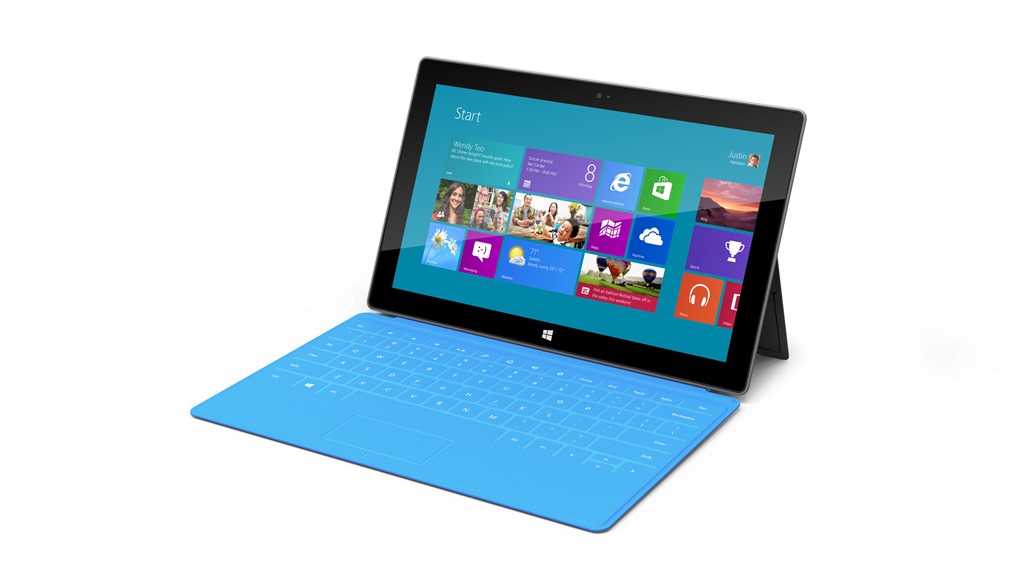
    And now Microsoft has further upped the ante, by announcing two Tablets bearing the Microsoft name, and called Surface. The entry-level Tablet runs Windows RT (the version of Windows 8 designed to run on ARM hardware), while the top-of-the-range model runs Windows 8 Pro and uses Intel’s Ivy Bridge architecture.

    The entry-level Tablet is clearly aimed at the iPad market niche, but I’ve never found that market niche particularly interesting. I want something that is more than just a device for consuming content. I want one that has the power of a desktop available. So the more interesting one (to me) is the one running Windows 8 Pro. This comes with a pen, and (excellent) handwriting recognition is part of Windows 8. Coupled with the detachable keyboard, this model of the Surface range looks as though it meets my desire for origami computing.

    surface_01

    As well as the Surface tablets, Microsoft also announced two new keyboards (which double as covers for the Surface). The “Touch” model (3mm thick) is shown in the picture above. The “Type” model (5 mm thick) comes with moving keys for a traditional feel.

    The specifications of the Surface tablets are still not spelt out in great detail, but the top model seems to have two cameras (one forward-facing and one rear-facing), and a screen resolution of 1920 x 1080 pixels. The Intel-based Surface has a mini DisplayPort for Video. I wonder whether this could also be a Thunderbolt port for connecting other devices, although I suspect that that will come in a future Surface model in 2013. No word on price, either, so I’ll have to wait to see whether this is a good match with my wishlist. But I have to say, it does look good.

    Update: I watched the video of the Microsoft presentation yesterday and picked up on a couple of things.

    First, the Windows RT machine being demonstrated by Steven Sinofsky froze up on him during the demo. He had to switch it for another machine. To be fair, demos of unreleased hardware and software are always a highwire act, so it’s hardly surprising he had to rely on the safety net of a second machine.

    Second, the words that are spoken during these Microsoft presentations are very carefully chosen. When Sinofsky talked about retail channels, he only talked about Microsoft’s own stores, both physical and online. These are both US-only, which leads me to worry that Surface may only ever be available in the US. It won’t be the first time Microsoft has done this; the Zune and Microsoft Kin products were also US-only. If that does turn out to be the case, then that will be a real disappointment to me.

    One other thought, I know that I said that it would be the Windows 8 Pro version of Surface that I would be interested in, because I thought the Windows RT Surface would be too limiting, like the iPad. Someone pointed out that you can still get the full PC experience on a Windows RT device by using the Remote Desktop App, and accessing the full environment of a desktop PC through the Surface tablet. Now that is a very interesting idea, and one that I had not considered. I often use the Remote Desktop App to remotely login to my Windows Home Server from my desktop PC, and the experience is indeed just as though I have my monitor, keyboard and mouse directly connected to the server. However, it would mean that I would have to upgrade my Desktop PC to Windows 8 Pro, so it is not a cost-free route.

    So I may have options. Options are good.