Reflections on life at “De Witte Wand”…

Year: 2012

  • The Centre Cannot Hold

    I’m not a Christian, nor even religious, but I have respect for Rowan Williams, the current Archbishop of Canterbury. I say current, because it was announced today that he will be stepping down at the end of the year from his post and returning to academia.

    I couldn’t resist a wry smile at this quote from the article:

    …he has been respected on all sides for his gifts as a preacher of great eloquence and flashes of clarity.

    Yes, “flashes of clarity” – I confess that I find his writing a bit of a struggle to comprehend. A clear writer he is not. I sometimes amuse myself by putting his prose through the reading comprehension tester in Microsoft Word. Inevitably it will rate the text as being difficult to understand.

    I think that he’s basically a good man, who has been trying to do an impossible job as leader of the Anglican Church. It will probably come as a relief to be able to pass on the poisoned chalice to his successor. That looks as though it may well be John Sentamu, whose hard-line views will contrast greatly with Williams. I can’t say that I feel particularly well-disposed towards Sentamu, based on his past performance. Still, I shouldn’t think that’s going to worry him one iota.

  • Please Send Money

    I received an email this morning from a distant relative. This is what it said:

    I’m sorry for this odd request because it might get to you too urgent but it’s because of the situation of things right now, I’m stuck in Madrid Spain with Family right now, we came down here on holiday we were robbed,the situation seems worse as bags,cash ,credit cards and cell phone were stolen at GUN POINT, It’s such a crazy experience for us, we need help flying back home, the authorities are not being 100% supportive but the good thing is that we still have our passport but don’t have enough money to get our flight ticket back home, please I need you to lend me some money, I will reimburse you right as soon as I’m back home. I promise

    Alarm bells started ringing immediately. It looked suspicious, but at first I wasn’t sure. I only had an email address for this person, so I couldn’t ring her up and ask if her email address had been hacked.

    It didn’t take long to confirm that indeed the message was a scam – typing in just the first phrase from the message into Bing produced over 500,000 hits.

    It’s clear that her Hotmail account has been hacked, and taken over by a scammer. She may be able to get it back, with Hotmail’s help, but any damage has already been done.

    This article, Hacked!, by James Fallows describes the situation very well, and in fact it’s almost the same scam email that was used. The only difference is that in the article, it’s a Gmail account that was hacked. One statistic that leapt out at me:

    At Google I asked Byrant Gehring, of Gmail’s consumer-operations team, how often attacks occur. “Probably in the low thousands,” he said. “Per month?,” I asked. “No, per day,” followed by the reassurance that most were short-lived “hijackings,” used to send spam and phishing messages, and caused little or no damage, unlike our full-out attack.

    As more of us start relying on the Cloud to handle our email and to store confidential data, it becomes even more important to use strong passwords that are changed often. As the saying goes: passwords are like underwear…

  • This Isn’t A Pub Anymore!

    Yesterday’s Jesus and Mo is a humorous allegory on a current topic. Cardinal Keith O’Brien is credited as the scriptwriter.

  • Feet of Clay

    One of my daily joys is walking the dogs in the nearby woods. Since I bought my Windows Phone, I’ve got an additional dimension of joy by listening the podcasts of In Our Time, a weekly radio programme on a wide range of subjects (e.g. Science, Religion, Philosophy, History, etc.). Each 40 minute episode nicely times with the morning walk in the woods. The programme has the format of three experts on the week’s topic being led in a discussion by Melvyn Bragg (now Baron Bragg of Wigton).

    Now I like Melvyn Bragg – I think he’s a good writer and broadcaster, and In Our Time deals with serious ideas in a way that does them justice.

    So I was somewhat shocked at this attack on Richard Dawkins from Bragg. I had expected better of him. As Ophelia says:

    He’s either bullshitting or totally confused, and since he’s a knowledgeable guy, I’m guessing he’s bullshitting. Yes feelings are important; yes we mostly don’t rely on reason; no it is not therefore the case that emotions and feelings are reliable sources of knowledge. He implies that they are. I call bullshit.

    Baron Bragg is proudly displaying his feet of clay.

  • You Couldn’t Make It Up!

    That revered institution, the Thought For The Day on BBC Radio 4, is still carrying on churning out platitudes. I always read the Rev. Dr. Peter Hearty’s merciless skewering of the Thoughts. Yesterday, we had Canon Angela Tilby’s thoughts on gay marriage.

    The poor woman was a bit caught in the middle, as she likes to think of herself as a liberal, but she couldn’t quite bring herself to say that the Churches had got it wrong.

    I particularly liked the moment when she actually said:

    The point about sacraments is that they can’t be made up…

    Ah, but Canon Tilby, the whole point is that they are made up. Humanity has created its gods, not the other way around, however much you might want to believe that.

    Meanwhile, I suppose we are into hearing more of the same from churchmen (and women) saying that same-sex marriage is simply wrong. The UK has clearly got some distance to travel before they arrive at the point that we enjoy here in The Netherlands. As a commentator (who lives in The Netherlands) wrote in response to Canon Tilby’s piece:

    It’s obvious from the pronouncements from a variety of god-botherers over the last week or so, that they still think their Church, (whichever one it happens to be), still owns marriage, and consequently they have the right to decide who may or may not get married. But marriage, in this country [the Netherlands] at least, is not a religious institution, but a social and legally binding secular contract. Although couples may choose to have a religious ceremony, the marriage still has to be registered with secular authorities in order to be valid. Weddings not so validated, as sometimes happens with ones carried out according to Islamic rites, are not recognised in law, and the couples do not have the rights of married couples regarding property, custody of children, inheritance, etc.

    As I understand it, there is no suggestion that any church or religious institution will be forced to conduct gay marriages, but equally they should have no right to dictate who should or should not be allowed to marry outside of religious buildings.

    Quite.

    Here, couples who are religious will always have their civil marriage ceremony in the local Townhall first, before trooping across the market square into the church for the religious marriage ceremony. Even Prince Willem-Alexander and Princess Máxima did the same. They were married, by Amsterdam’s Mayor at the time, Job Cohen, on the 2nd February 2002 in a civil ceremony in the Great Hall of the Beurs van Belage, before going to the Nieuwe Kerk (the New Church) for the religious ceremony.

  • Just Testing…

    You can ignore this post. It’s just a test to check something out.

    I use Windows Live Writer to prepare blog posts. It’s a very good application; easy to use and functional. However, I’ve noticed that since I’ve been running the Windows 8 Consumer Preview, I often get an error message when I try and publish a post to my blog.

  • Petitioning Microsoft

    I’ve mentioned a number of times before on this blog how irritating it is to be saddled with a Zune/Xbox Live/Windows Phone account that has the wrong country shown for my country of residence, and being totally unable to correct it.

    The issue is now spelt out in detail over at the It Is Our Data web site, and there’s a petition set up asking Microsoft to rectify this shortcoming.

    I’ve signed, and will be sending letters to Microsoft and the relevant Data Protection authority. Will you?

    Update: As a result of sending letters, I finally managed to get Microsoft to correct the false data in my account, so it can be done…

  • A Voice of Sanity

    After Cardinal Keith O’Brien’s very unpleasant outburst on the possibility of the UK’s legalising same-sex marriage, it comes as something of a relief to be able to point to a voice of sanity on the subject. It belongs to the philosopher Norman Geras.

    Actually, he has two blog posts on the subject. The first is a reaction to the Cardinal directly, in which Geras notes how feeble the arguments put forward by the Cardinal are.

    The second is his reaction to the text of a letter co-signed by the Archbishop of Westminster and the Archbishop of Southwark on the subject of same-sex marriage that will be read out 2,500 Catholic churches in the UK next Sunday. As Geras says:

    I make no attempt to judge these remarks in the light of Catholic teaching, since I’m not competent to do so. But if we measure them against the more general understanding of marriage in our society, the exercise suggests that what the two Archbishops define as the true meaning of marriage is an insult to many people’s marriages.

    By the way, I found it instructive to read the comments on the article in the Catholic Herald that gave the text of the letter. It was mostly a singularly unpleasant experience. Clearly there are plenty of Catholics who align themselves with Cardinal O’Brien. Bigotry is alive and well.

  • Raising the Drawbridge

    I’ve written a couple of times before over my worries that the Dutch government will make it illegal to hold dual nationality.

    We seem to be getting close to that position. Last Friday, the Dutch Cabinet decided to go ahead with legislation aimed at reducing the number of people with dual nationality.

    The idiotic thing is that it will not affect those who are presumably the real targets of this xenophobic drive. The real targets (in the sights of the “Little Hollander” view of the PVV and its supporters) are the Turks and Moroccans who settle here. Unfortunately (from the PVV’s perspective), they are required, by their country of birth, to hold onto their original nationality. So the proposed law cannot apply to them. Meanwhile, others, whose country of birth is more relaxed about the holding of dual nationality, will be required to renounce their birth nationality, simply because the Dutch government can make it so.

    So I’ll be forced to renounce my British and Manx nationalities, merely to satisfy the xenophobia of the Dutch government and the PVV. A plague on them both.

    Meanwhile, in other news, Geert Wilders, leader of the PVV, announced today that the Netherlands should leave the Euro and return to the Guilder.

    The drawbridge is being raised a little further every day…

  • Beside the Seaside…

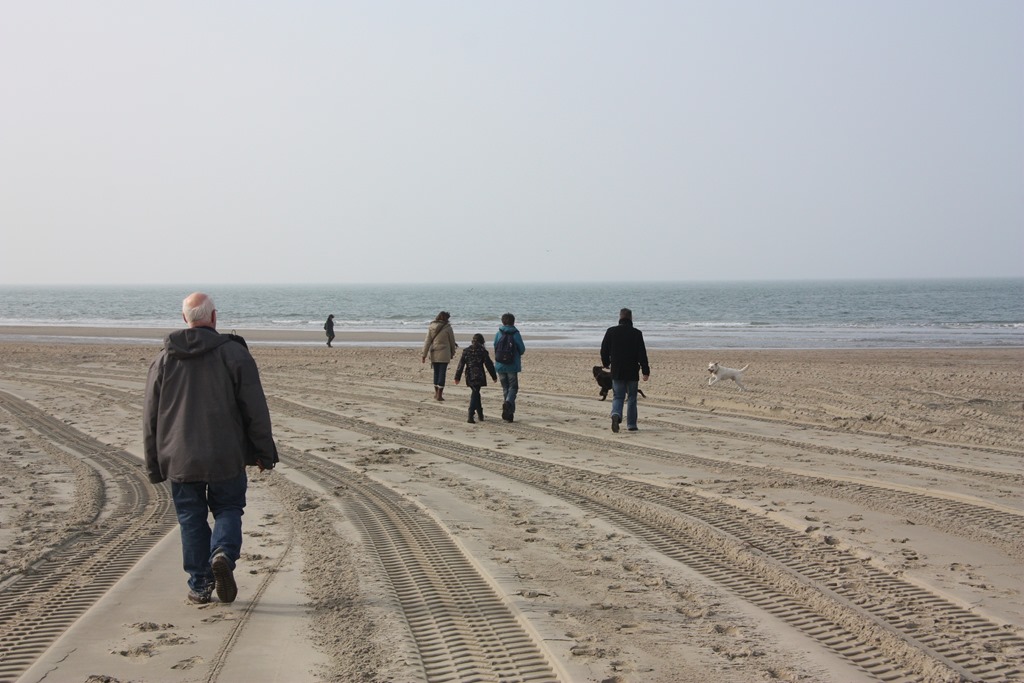
    We paid a short visit to friends in The Hague last weekend. The city lies on the North Sea coast, and many of its inhabitants go for weekend walks in the dunes or along the beach – usually whatever the weather.

    20120303-1410-45

    20120303-1351-27

    We, and the dogs, joined them. This was our younger dog Watson’s first experience of the sea. He loved it.

    20120303-1353-16

  • Microsoft’s Marmite

    Marmite is a British food – a paste that is smeared on bread or toast. It has a very distinctive taste, which splits people into two camps: they either love it or hate it.This polarised reaction seems to be how people are reacting to Microsoft’s Windows 8 Consumer Preview: they either love it or hate it. This post is about my first impressions of W8CP.

    As I said I would, I’ve installed the Windows 8 Consumer Preview, and have been playing with it over the past couple of days. There are several ways to install it: in a virtual machine, on a separate drive partition for dual-boot with Windows 7, but I’ve gone for the highwire act – I’ve done an upgrade installation. My PC is no longer running Windows 7, but it is running only Windows 8.

    I haven’t completely lost my mind – I took a full backup of my running Windows 7 installation immediately prior to installing the Consumer Preview, so I can always rollback to Windows 7 if I lose my nerve.

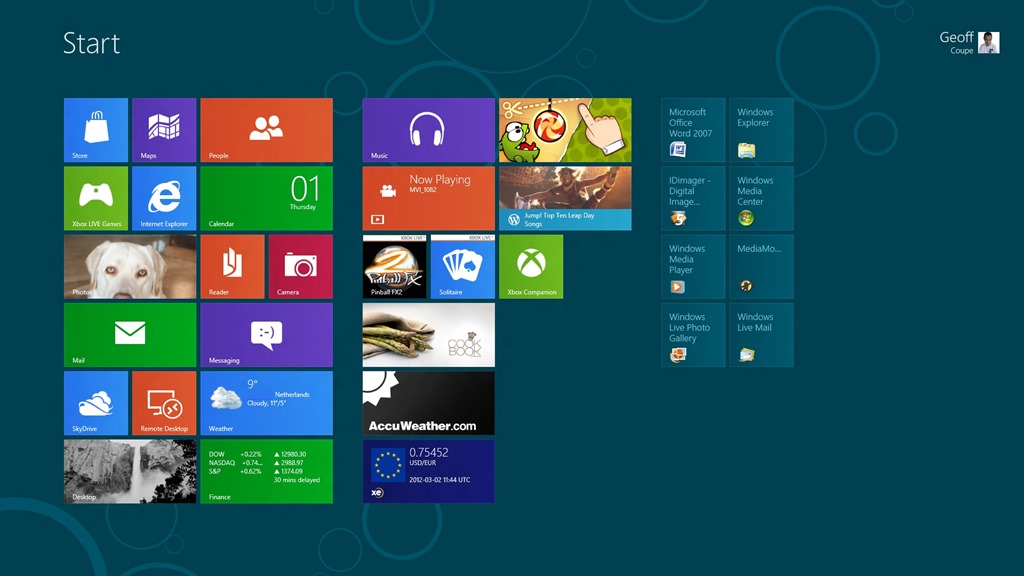
    So now, what I see when I sign on to Windows 8 is something like this:

    W8CP 01

    This Start screen has effectively replaced the Start button, that has been a part of Windows since Windows 95. On the traditional Desktop view in Windows 8, there is no Start button, instead, when you mouse down to the bottom left corner of the Desktop (where the Start button traditionally was), you get a small pictogram of the Start screen. Clicking the mouse brings you to the Start screen itself.

    It’s certainly a shock to the system, and I found it needed getting used to. Some people have already found ways of forcing the traditional Start button back into Windows 8, but I don’t want to go down that route. I’d rather give Windows 8 a chance, and see how I feel about the UI after a few weeks.

    I’ve already started adding icons for some of my most-used applications onto the Start screen, and am starting to use the Search function much more than I used to in Windows 7.

    One thing that I am definitely finding at the moment: I spend the majority of my time on the traditional Desktop, using traditional applications. The much-vaunted Metro Apps that have shipped with the Consumer Preview are dumbed down too far for me. To be fair, many of them are previews themselves, and Microsoft claim that they will be improved for final release. Still, I don’t think Microsoft has done itself any favours by shipping such limited Apps in the Preview. Let’s look at a few examples.

    The Mail App. Unless you have a Hotmail, Google, or Exchange account, you won’t be able to use the Mail App – it has no support for IMAP or POP mail servers. Guess what I have? Yup, my Internet Service Provider supports IMAP and POP mail services. So I won’t be using the Mail App. One other thing, it is just a very simple mail application. I use Windows Live Mail as my mail client, and this integrates my mail, my calendar, and my contacts list. In Windows 8, these are separate applications. I like the integrated approach. Windows 8 seems to be taking a step backwards. Although Microsoft have introduced a new mechanism for sharing information between apps in Windows 8, at the moment all three, Mail, Calendar and People apps, plaintively bleat that they can’t share… This may change on final release. I hope so.

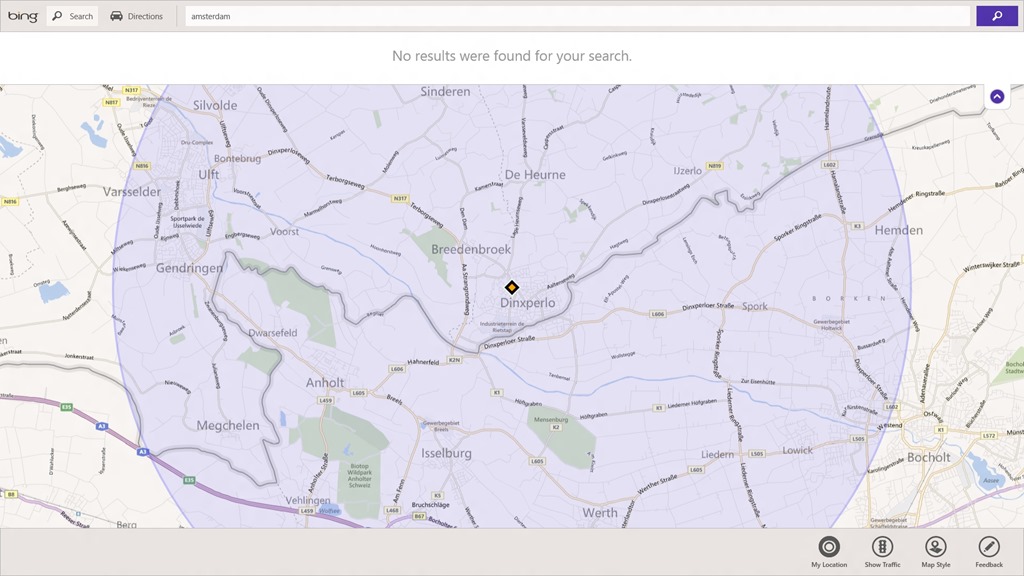
    The Maps App. The Search function in this app doesn’t work. Here, for example, it claims it can’t find Amsterdam:

    W8CP 02

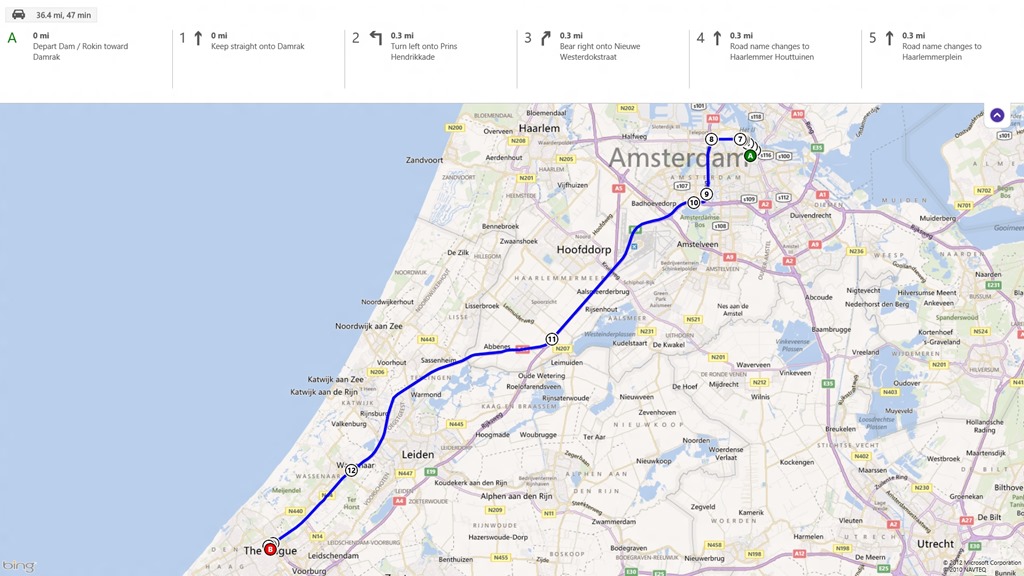
    Yet, strangely enough, it works with driving directions:

    W8CP 03

    Update 7 March 2012: The Map App was updated today, and that seems to have fixed the search problem. Excellent.

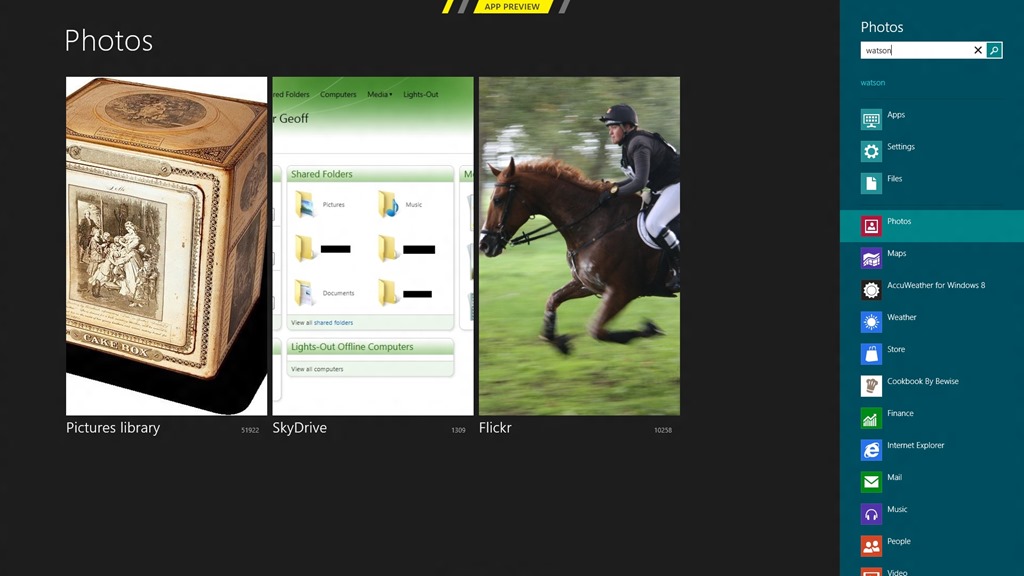
    The Photos App. Another very simple application, really only suitable for searching and browsing. It will display photos held both locally and online. Note that in the screenshot below, there is no Facebook panel shown, because I don’t use Facebook, so I removed the panel.

    W8CP 04

    At least the searches are aware of tags in the photos, so searching for the name of my dog turns up all the photos that have been tagged “Watson”:

    W8CP 05

    However, unlike Windows Live Photo Gallery, I don’t think you can do complex searches (a AND b, but NOT c), and there’s certainly no function for editing photos as WLPG has. Once again, though, this is a preview – the final release may be another story. The Photos app can Share with the Mail app, and use it to send photos via email; either as attachments or via Skydrive. However, unlike WLPG, there doesn’t seem to be any way of choosing the size of the photo files that you send. Update 13 March 2012: hmm, even the Search functiona has problems at the moment. I discovered today that it finds less photos with a given tag than actually exist. It seems to only find about half the number it should be finding.

    The Music App. You may have thought that Windows Media Player and the Zune application were limited – this one’s even worse. No Podcast support, no “Play to” support, no way to view and filter your collection other than by Album, Artist, Song, and Genre.

    The opportunity is here for this app to be a full DLNA implementation – a player, a renderer and a control device (think of a Windows 8 tablet running this app being used to control your home’s networked media – music, video, movies, photos – stored locally and in the Cloud). Unless this app improves, it will be a missed opportunity. The Consumer Preview comes with the old Windows Media Center application, that has been around since 2005. I would like to think that Microsoft are revamping it for Windows 8…

    And so it goes – I don’t think I’ve found a single app yet that I find I’m using in preference to an equivalent traditional Windows 7 application. Yes, it’s early days; but thus far, I find the experience disappointing.

    The other thing I’m noticing is that my system feels sluggish. Not too much (at least not too often), but it has definitely slowed. Once again, this is to be expected with a beta, so I’m pretty confident that come final release, things will have improved so that it is no longer an issue.

    The most positive thing I’m noticing at the moment is that underneath it all, Windows 8 is running all my Windows 7 applications without (so far) any issue. I’m very hopeful that I can continue to use the Consumer Preview on my main PC as my everyday operating system.

    The one big concern I have is that the issue of being unable to change my country of residence in the Windows Store could be a make or break issue for me.

  • Lipstick On A Pig

    Yes, this is a post about the Windows 8 Consumer Preview, but despite what you may be thinking, this is not a post about how awful the Metro UI is. I’ll deal with that later. No, this is a post about how awful “Microsoft Account” is.

    You may recall my post of last week, where I was worried about whether Windows 8 would do anything to change the inflexibility of Microsoft’s back-end infrastructure used for digital distribution of apps and digital media. Well, now I’ve got my answer:

    Absolutely nothing.

    Yes, there’s been a name change: the Windows Live ID service has been rebranded to Microsoft Account, but beyond that, the same problem remains: once you have registered a country of residence in your Zune or Xbox Live billing account, neither you nor Microsoft can change it, nor even delete your account.

    So the name change to Microsoft Account is the lipstick, and the pig of the billing account remains as porcine as ever.

    I thought I’d try one last time to contact Customer Support via the online Chat channel to see if I could get my Zune account deleted without having to also delete my Windows Live ID. Nope. No joy.

    As I wrote last week:

    Unfortunately (for me), a few years ago I made the mistake of downloading and playing with the Zune software. Along the way, I created a Zune account using my Windows Live ID, just to try out the experience, not realising that the country of residence would be hardwired to the US without any possibility of change or deletion. At the time, I just shrugged my shoulders and thought no more about it.

    And because of that mistake, if Windows 8 uses the same backend infrastructure as Zune, I will not be able to use my trusty Windows Live ID. If I did, I will not be able to purchase anything in Windows Store, because I do not have a credit card with a US address. Because of a badly-thought-out design in a Microsoft infrastructure, I’m expected to throw all the history of what’s associated with my old Windows Live ID away, and start again with a new one.

    Windows 8 does use the same backend infrastructure. I’m screwed.

    Update: It took writing letters to Microsoft, but I finally managed to get my old Zune/Xbox Live account deleted, and used my existing Windows Live ID to create a new account.

  • A Plug for a Plug – Again

    A couple of years back, I wrote about Min-Kyu Choi’s brilliant idea for a folding plug. I see that the design is now more than a concept, and is now an actual product. It’s a pity that the idea has been reduced in scope to being simply a USB charger for Smartphones. I expect that the dizzying combinations of cable connections that would have been needed for the original concept of a mains plug would have been uneconomic to produce.

  • I Don’t Want to be Born Again

    Next week, Microsoft are promising to deliver the Consumer Preview of Windows 8. I will certainly download and install it, and I expect, for the most part, to like what I see. I’ve been following, with interest, the Building Windows 8 blog, in which the engineering team have been detailing the design and features of the new operating system. But there’s one aspect of Windows 8 that is worrying me, and I fear that, going on past performance, Microsoft will disappoint me yet again.

    I’m referring to the backend infrastructure that Microsoft will use to support the Windows Store.

    Windows Store is the upcoming digital distribution platform developed by Microsoft Corporation for software applications (“apps”) designed to run on Windows 8, and possibly also Windows Phone in the longer term.

    At present, apps designed for Windows Phone are delivered via the Marketplace, which is accessible via the web, via the phones directly, or via the Zune application running on a Windows PC. These all use Windows Live ID. The Windows Live ID service manages your online identity, and your access to other services (for example, the Marketplace). And all of these access channels to the Marketplace, and the Xbox Live online service, share a common backend infrastructure for digital distribution.

    And there’s an issue (read: problem) with this backend infrastructure: once you have registered a country of residence in it, you can neither change it nor even delete your account. In addition, if you register a credit card to pay for marketplace purchases, the card must have a country billing address that matches the one registered in the marketplace. In other words, this infrastructure refuses to recognise the simple fact that many people move around and relocate to different countries.

    I first became aware of this issue back in December 2010, shortly after the Windows Phone was introduced. As I wrote at the time, the issue is recognised by Microsoft, there have been many threads about it in both the Zune and the Windows Phone 7 forums.  Back then, Jessica Zahn, a Senior Program Manager for Zune, wrote in one of these threads:

    I can tell you we’re working through those questions now and figuring out how to allow people to move countries, etc – but it’s not easy, and those of you who have said this has been a problem for Xbox for a long time are correct – and we use the same infrastructure as Xbox.

    Fifteen months on and absolutely nothing has changed – the issue is still there, Microsoft still don’t appear to have figured out a way to deal with people who move between countries. Interestingly, for us EU citizens, it could be argued that this issue is infringing our rights to the free movement of goods and services within the EU.

    The only workaround that Microsoft currently offer is to say that if you move countries, you have to set up another Windows Live ID for yourself in the new country. And that brings a whole other set of issues, which I’ll address shortly.

    But first, what’s all this got to do with Windows 8? Well, the question is: what are Microsoft going to use as the backend infrastructure for Windows Store? If they are simply going to add Windows Store to the same infrastructure alongside Windows Phone, Zune and Xbox Live, then I think we have a problem, and that’s what worries me.

    Windows 8 is going to make more use of the Windows Live ID service than any previous version of Windows. Today, when a home user signs on to a Windows PC, they do it with an account name and password that is tied to that particular PC. In Windows 8, they will have to sign on with a Windows Live ID. This will then give them access to Windows Store. It will also give them a means of transparently sharing their personal data (for example, documents, contacts and calendars) between multiple PCs and other devices (for example Windows Phones and Windows 8 tablets).

    And here’s the rub. Ideally, I want to have one Windows Live ID to represent me and my online identity. All the information that’s important to me (documents, contacts, calendars, etc.) can then be brought under one umbrella – one Windows Live ID. But because of this issue with the backend infrastructure, I end up with multiple identities, and having to juggle information between them.

    I have a Windows Live ID that I set up more than 10 years ago – in the days when it was called Microsoft Passport. It’s tied to my primary email address, which I’ve had since the early 1990s. It is the key to all my contacts, my calendar, and my online identity on dozens of web sites. My online identity is also, for good or ill, how I am known and judged by others – it defines my reputation, my trustworthiness, my views. In short, it is the online me.

    Unfortunately (for me), a few years ago I made the mistake of downloading and playing with the Zune software. Along the way, I created a Zune account using my Windows Live ID, just to try out the experience, not realising that the country of residence would be hardwired to the US without any possibility of change or deletion. At the time, I just shrugged my shoulders and thought no more about it.

    And because of that mistake, if Windows 8 uses the same backend infrastructure as Zune, I will not be able to use my trusty Windows Live ID. If I did, I will not be able to purchase anything in Windows Store, because I do not have a credit card with a US address. Because of a badly-thought-out design in a Microsoft infrastructure, I’m expected to throw all the history of what’s associated with my old Windows Live ID away, and start again with a new one. I’ve never been fond of the concept of being born again, and this merely confirms me in my view.

    Update 25 February 2012: It looks as though Microsoft are revamping all their web sites that deal with the different service accounts, and bringing it all together under one umbrella: Microsoft Your Account.

    Admittedly, the site is still under construction (it says), but on my profile page, I can change everything EXCEPT country of residence. And there is still no option to delete the account entirely.

    So I think that Microsoft are still in contravention of European Directive 95/46/EC, Article 12(b), which states:

    “Member States shall guarantee every data subject (that’s me) the right to obtain from the controller (that’s Microsoft): as appropriate the rectification, erasure or blocking of data the processing of which does not comply with the provisions of this Directive, in particular because of the incomplete or inaccurate nature of the data”  (my emphasis)

    My Zune/Xbox Live account has inaccurate data: the country of residence is shown as the US, instead of the NL.

    If Microsoft cannot change this, then I want the entire Zune/Xbox account deleted, as per the EU directive, while keeping my Windows Live ID, which does contain accurate data..

    Update: It took writing letters to Microsoft, but I finally managed to get my old Zune/Xbox account deleted, and used my existing Windows Live ID to create a new account.

  • A False Sense of Security

    A while back, I was a frequent visitor to the Microsoft support forum for Windows Live Photo Gallery. There was a particularly bad bug in WLPG that I was bitten by, back in November 2010. Since that was fixed, I’ve been only an occasional visitor to the support forum. I go there mainly to see what sort of issues are being reported, and also to see what the quality of support from Microsoft is like.

    The last couple of visits have made me think that there’s yet another bad bug in WLPG that Microsoft have not yet realised is present.

    It started with this statement being posted by a user back in December 2011: Windows Live Photo Galley doesn’t write metadata to the file, only to the database.

    The response from the Windows Live Support person was misleading and wrong:

    Currently, Live Photo Gallery’s slideshow doesn’t support embedding captions or other metadata in the photo. If you feel that such a feature can improve the product, I suggest you submit this as request to our product team. You may post it in our feedback page at https://feedback.live.com/.

    Misleading, because the original statement had nothing to do with the Slideshow feature in WLPG, and wrong, because as I posted on the forum thread: with one exception, WLPG does write metadata into JPEG files. WLPG will save Descriptive Tags, Captions, Geotags, People Tags (if you’ve identified faces in the image) and Ratings as metadata into JPEG files, as well as holding this information in its local database. However, WLPG does not save Flags as metadata in the image files, but only in its local database.

    There was, alas, no further follow-up from Windows Live Support to the issue.

    Then I noticed another thread in the forum that concerned an issue with metadata: Lost metadata from Photo Gallery. This time, it concerned someone who had bought a new PC and transferred the photo files from his/her old PC, only to find that all the “Date taken” metadata of the photos was wrong.

    Once again, the Windows Live Support person jumped to the wrong conclusions, and gave irrelevant advice. There then followed much to-ing and fro-ing between the original poster and a succession of Windows Live Support people. Not one of them cottoned on to the salient fact that the cause of the issue was that the WLPG running on the old PC had not been writing out metadata into the photo files as it should have been doing. So when the photos got transferred to the new PC, all the metadata changes that the user had done got left behind in the local database of WLPG on the old PC.

    I pointed this out in the thread, and someone else chimed in saying that he was seeing it on one of his PCs – WLPG was not writing out metadata into the photo files as it should do. Together, we came up with a simple test for this issue. In WLPG, select a photo, right-click and select “Properties”. This brings up the Properties window of the file itself. Many of the fields in this window are directly editable, e.g. the “Date taken” field. If everything is working correctly, you should be able to edit these fields, and the changes are being written into the file’s metadata directly. If, however, WLPG is not working correctly, then these fields cannot be changed. It’s as though WLPG thinks the files are Read-only, and hence all metadata is being held only in the local database and not written out to the files themselves.

    We then asked for a response from Windows Live Support, and, once again, the response was misleading and irrelevant to the issue at hand. Sigh.

    So, to summarise, it looks as though, under some circumstances, WLPG is not writing out metadata into photo (JPEG) files, but merely recording the metadata in its local database. It’s difficult to say how widespread this is, because most people will not be aware that things aren’t working properly. Not until, for example, they transfer their photos across to a new PC and discover that all of the metadata is missing or wrong.

    WLPG users are being lulled into a false sense of security.

  • Apotemnophilia And Phantom Limbs

    V. S. Ramachandran is a neurologist, and someone whom I can listen to for hours. He is fascinated by, and fascinating about, all aspects of the human mind – particularly the more unusual manifestations of behaviour.

    He’s probably best known for his work on the phantom limb syndrome, but recently he’s been looking at its converse: apotemnophilia, or the desire that some people have to have a perfectly healthy limb amputated.

    Edge have posted a video (and transcript) of him talking about these, and other syndromes under the title of Adventures In Behavioral Neurology—Or—What Neurology Can Tell Us About Human Nature.

    We saw a patient recently who was a prominent dean of an engineering school and soon after he retired he came out and said he wants his left arm amputated above the elbow. Here’s a perfectly normal guy who has been living a normal life in society interacting with people. He’s never told anybody that he harbored this secret desire—intense desire—to have his arm amputated ever since early childhood, and he never came out and told people about it for fear that they might think he was crazy. He came to see us recently and we tried to figure out what was going on in his brain. And by the way, this disorder is not rare. There are websites devoted to it. About one-third of them go on to actually get it amputated. Not in this country because it’s not legal, but they go to Mexico or somewhere else and get it amputated.

    It’s worth listening to.

  • The Sins of the Fathers

    Richard Dawkins writes about the phone calls he received recently from journalist Adam Lusher, who began the first call somewhat as follows:

    “We’ve been researching the history of the Dawkins family, and have discovered that your ancestors owned slaves in Jamaica in the seventeenth and eighteenth century. What have you got to say about that?”

    Dawkins replied:

    “Your ancestors probably did too. It’s just that we happen to know who my ancestors were and perhaps we don’t know yours.”

    After a second call, in which Lusher demonstrated his total lack of understanding about genetics, the fruits of his labour were duly published in the Sunday Telegraph. The article is at best laughable, and at worst low, cheap and out of order – and that is apparently the view of a fellow journalist at the Telegraph.

    For the record, I can trace my family back to Sir John Gordon of Embo, who died in 1779. I note that my great-great-great-grandfather (George Home Murray) had two uncles on his mother’s side (Dr. John Gordon and George Gordon) who were both, as I understand it, plantation and slave owners in Jamaica. It’s not unusual.

  • The Past Is Another Country…

    Thanks to a reference from another ex-Shell person, I came across this short film, made in 1963, about Shell Centre in London. It’s quite an extraordinary social document in a way, chock-full of unconscious sexism. But on the other hand, it does give the sense that, at the time, Shell thought of its staff as assets to be looked after and cultivated. Paternalistic, yes, but you got the sense that they cared.

    It was still like that when I joined Shell and began working in Shell Centre in 1980. It really felt like joining a family. I have to say that by the time I retired from Shell, that way of thinking felt as dated as this film. I can’t say that I think it is entirely an improvement.

  • Secularism and Tolerance

    The recent pronouncements on “militant” secularisation by Baroness Warsi have triggered a flurry of comments, both pro- and anti- in the media. I found this piece by Julian Baggini came close to summarising my own thoughts on the matter. But then today I found this comment by Norman Geras on Baggini’s piece introduced two important qualifications that brought things into focus for me.

    Baggini’s central point is something that both Geras and I wholeheartedly support:

    Secularism, in the political sense, is not a comprehensive project to sweep religion out of public life altogether… Rather it is – or should be – a beautifully simple way of bringing people of all faiths and none together, not a means of pitting them against each other.

    It all goes back to how we understand the core secularist principle of neutrality in the public square. Neutrality means just that: neither standing for or against religion or any other comprehensive world-view.

    Geras then states two reservations with Baggini’s thesis: first, concerning Baggini’s claim that ‘we are obliged to talk to each other in terms we can share and understand, not in ways that are tied to our specific “comprehensive doctrines”‘. Geras thinks that no such obligation exists; we may not be persuasive if we do not use terms that we can share and understand, but that is not the same as making it an obligation.

    Geras’ second point concerns the tenor of Baggini’s last paragraphs, where he (Baggini) is asking “us secularists that we be more relaxed towards religion, not acting as its enemy. It’s a plea for a more tolerant attitude than some militant atheists today display”. I think Geras puts it very well when he says:

    Though (once again) I know what motivates his saying what he does, and share his feelings about a certain kind of relentless discourse of hostility towards religious belief and religious practice, I also think the plea for tolerance in this matter ought to be bounded by clear limits. There are believers who, in the name of religion, act to silence, harm and sometimes indeed kill others, and there is, unfortunately, a lot of this sort of thing about. No secularist is obliged to adopt a relaxed attitude towards it. On the contrary, in defence of freedom of belief, they should be intolerant of it. Secularism, just like genuine liberalism, does not entail tolerance of the appeal to religion to justify intolerant, cruel or murderous ends.

    Exactly.

  • WHS 2011 and Metadata

    Last June, I wrote about the fact that Windows Home Server 2011 was overwriting the metadata contained in media files. In August, Microsoft finally acknowledged the issue.

    Yesterday, Microsoft issued the second Update Rollup for WHS 2011. It contains a fix for the metadata issue (issue 2 in the list of fixes).

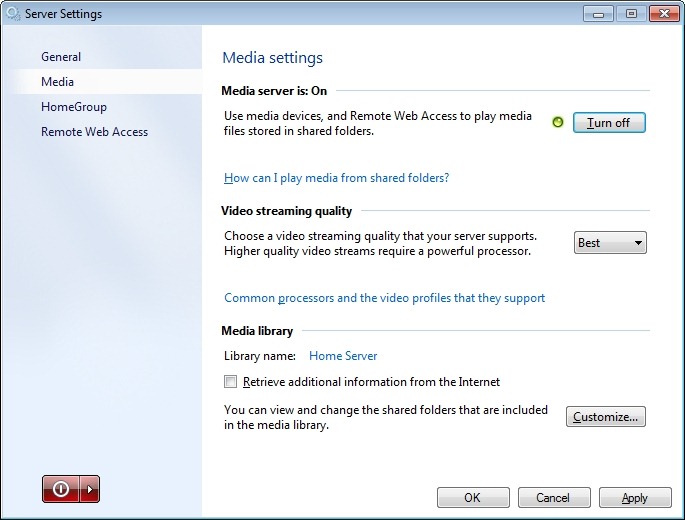
    Now, WHS 2011 will no longer retrieve metadata from the internet and use it to overwrite your music files by default. With the update, it has become an option that can be turned on or off. The setting is found on the Media Settings page of the WHS 2011 Server Settings (the “Retrieve additional information from the Internet” checkbox).

    WHS2011 104

    You’ll see from the screenshot that I have the retrieve function turned off, that’s because the last thing I want is for Microsoft to overwrite all my carefully set up metadata in my Music library.

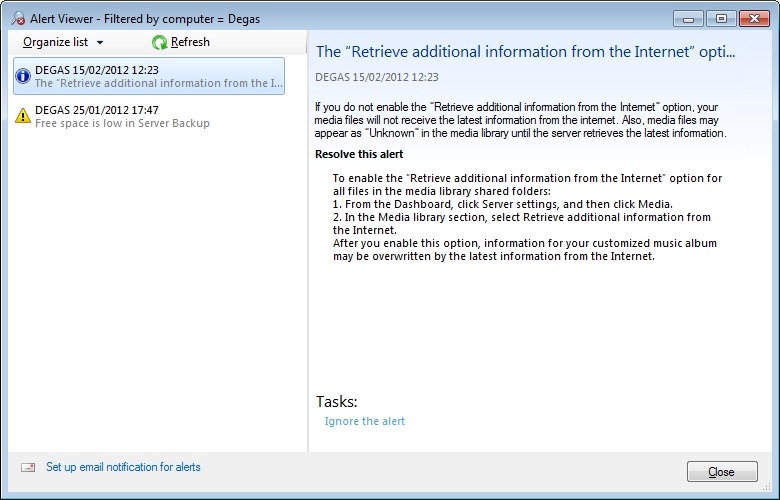
    In fact, installing this update has changed the default behaviour. Whereas before, metadata was always retrieved (it could not be turned off in the Server Settings) and used to overwrite files, the new default is for the retrieve function to be turned off. Microsoft have also implemented a new alert, which appears if the retrieve function is turned off:

    WHS2011 103

    I think the change to the default behaviour was the right thing for Microsoft to do. Suppose that they had not changed the default. Then I suspect those people who are blithely unaware of the metadata update task (and the likely damage it’s doing) would continue to be blithely unaware. And new users, having set up their brand new WHS 2011 installations, would also be unaware of the danger.

    At least this way, everyone who has, up until now, been unaware of this issue is now going to get this alert, which hopefully will prompt them to think about the metadata issue. They now have the choice to either set the “ignore the alert” switch, or revert to turning the update task back on.

    I just wish that Microsoft had bothered to update their WHS 2011 Help pages about this issue. They still say nothing about it (or even about the newly-implemented checkbox). This is not helpful for the “Home user”…

    Oh, and I think I should add that none of the many other issues with the Media Library in WHS 2011 listed in this post have been resolved. They are all still there, making the use of the Media Library via the Web totally useless as far as I’m concerned…