Reflections on life at “De Witte Wand”…

Year: 2013

  • Windows 8.1 Preview

    Microsoft has released a pre-release version of its next Windows operating system: Windows 8.1. Being a pre-release, it is of course not finished, and comes with all sorts of health warnings. Despite this, I, like thousands of others, am keen to take a look at it.

    When the Customer Preview of Windows 8 came out in February 2012, I installed it as my main operating system on my desktop PC, overwriting the running Windows 7 OS. Microsoft gave similar health warnings back then about using the Customer Preview as the main operating system. Nevertheless, I felt confident enough to go ahead and do just that.

    Fast forward 18 months or so, and I need to make a similar decision, by choosing between one of several options to installing the Windows 8.1 Preview:

    1. Installed as my main operating system on my Desktop PC.
    2. Installed alongside Windows 8 in dual boot mode on my Desktop PC.
    3. Installed in a Virtual Machine on my Desktop PC.
    4. Installed on my Lenovo ThinkPad Tablet 2.

    Option 4 was in fact my first thought, but then when I went to Microsoft’s Download page, I noticed:

    Important: Windows 8.1 Preview isn’t currently supported on some tablets and PCs with newer 32-bit Atom processors.

    Sure enough, that includes the Lenovo ThinkPad Tablet 2. Oh well, that rules option 4 out. As an aside, it is clear that many people don’t bother to read before downloading and installing the 8.1 Preview – I’ve seen many posts from people complaining that the Preview is not working on their Atom-based machines…

    Option 3 is doable, but I’m a simple soul, all this new-fangled stuff of Virtual Machines has never really appealed to me. Which leaves the safe, but boring, option 2 or the high wire act of option 1.

    I know that if I choose option 1, then if anything goes wrong, I can restore my PC using the backups held on my Windows Home Server. However, I also know that when Windows 8.1 is finally released, I will have to do a complete fresh install of the operating system and all my applications and data.

    I’ll think it over for a day or two, monitor the forums for any issues that are emerging and then make my decision.

    Update 30 June 2013: Well, I tried option 3, but I found it a bit limiting. Too many hardware devices couldn’t be added, and the virtual PC could not see my home network, and therefore couldn’t access my home server.

    I didn’t feel comfortable about the risks of option 1, and thus I’ve gone with option 2. I’ll report my findings in a day or two, but one thing stands out: the 8.1 version of the Photos App is an absolute fecking disaster.

  • The Last Interview

    I’m returning, once again, to the subject of Iain (M.) Banks and his all-too-soon departure from the world. The reason is this interview – perhaps the last he gave before his death.

    Let it be noted that I stand in awe of this man. His humanity, his wit, his clear-sightedness and his self-deprecation are something that I would wish to emulate, but know that I would fall far short of.

    It’s a good interview of a good man. Go and read it. Some key passages:

    His political zeal burns equally ardently. He confesses that “for half a second”, as he and Adele travelled across the Alps from Venice to Paris on honeymoon, he was “elated” when he heard that Thatcher had died. “Then I realised I was celebrating the death of a human being, no matter how vile she was. And there was nothing symbolic about her death, because her baleful influence on British politics remains undiminished. Squeeze practically any Tory, any Blairite and any Lib Dem of the Orange Book persuasion, and it’s the same poisonous Thatcherite pus that comes oozing out of all of them.”

    We reminisce about other significant turning points. Blair entering Downing Street: “Watching the helicopter shots of his car journeying from Islington to Buck House was like witnessing the liberation of a city … yet almost immediately he was having tea with Thatcher. My injured self-respect can at least fall back on the fact that I never voted for New Labour – Labour yes, and nothing but Labour for as long as it existed and I could vote, but not for a party that embraced privatisation and refused to scrap nuclear weapons; not for a party slightly to the right of Ted Heath’s government.” As for the war on terror, there is palpable fury when he discusses “the great lie that our boys are fighting, killing and dying in Afghanistan to keep us safe. It’s 180 degrees off the truth. They’re dying worse than needlessly; they’re dying to save political face, and for every grieving or just aggrieved Afghan family we create the conditions for further atrocities to be visited on us.”

    I won’t miss waiting for the next financial disaster because we haven’t dealt with the underlying causes of the last one. Nor will I be disappointed not to experience the results of the proto-fascism that’s rearing its grisly head right now. It’s the utter idiocy, the sheer wrong-headedness of the response that beggars belief. I mean, your society’s broken, so who should we blame? Should we blame the rich, powerful people who caused it? No let’s blame the people with no power and no money and these immigrants who don’t even have the vote, yeah it must be their fucking fault.

  • Good and Bad Shorts

    I occasionally peruse the io9 web site. Occasionally, because, quite frankly, I find it a bit tiresome. It just seems a bit over the top and too much in love with itself.

    Here, for example, is the piece on R’ha, which exhorts us to watch the short film. Well, I did, and it struck me as the sort of thing a male teenager in the grip of his hormones might do. Portentous, limited, and ultimately something that I would not want to engage with. Technically well-realised; but intellectually, a single note plucked on a well-worn string.

    Then again there’s Mama. This has more meat on its bones. But whether it can be stretched out into a full length feature, I have my doubts. I’ll wait and see.

  • Thank You, Iain Menzies Banks

    There’s been a slight disturbance in the Force (otherwise known as the internet) the past couple of days.

    A Scottish author, beloved by many – and me – has recently died. Far too soon, and with too many stories yet untold.

    I’ve been reading the many tributes left to him by fans and fellow-writers alike.

    I find it strange and intriguing how much his death has affected me. I never knew the man, never met him, and yet somehow his death has caused tears to spring unbidden to my eyes. God forbid that I’m having a Princess Di moment. I would like to think that my sorrow is caused simply by the fact that he was, by all accounts, a good man, and his voice has been stilled far too early.

    He wrote in both major and minor keys. For the snobs, the major keys were his “mainstream” literary works; such as The Wasp Factory and Complicity.

    But, great though they were, for the rest of us, his so-called “minor”works – his SF novels – were the real thing. He wove an entire civilisation – The Culture – spanning multiple worlds and thousands of years. And he made it real. As Ken MacLeod wrote:

    He likened writing literary fiction to playing a piano, and writing SF to playing a vast church organ. Squandering the “unlimited effects budget” of his imagination on the vast scale of SF was always, by a small edge, the greater joy.

    It’s difficult to choose one passage from all his work that stands for him and what he said to me. But I think it has to be this, from Against A Dark Background:

    Sorrow be damned and all your plans. Fuck the faithful, fuck the committed, the dedicated, the true believers; fuck all the sure and certain people prepared to maim and kill whoever got in their way; fuck every cause that ended in murder and a child screaming.

    Amen.

  • 18 Arguments Against Gay Marriage

    The New Statesman’s Caroline Crampton lists 18 arguments voiced today in the UK’s House of Lords against same-sex marriage.

    All the usual suspects are there, including the new Archbishop of Canterbury. I can’t say that I’m surprised by his stance. Religion poisons pretty much everything.

    I suspect that very similar arguments were once made against the abolition of slavery.

  • The Swapper

    That’s the title of a new game for Windows. It’s a series of puzzles woven around the story of an astronaut who comes into possession of a cloning device.

    It has beautiful visuals, literally hand-crafted from clay and everyday objects, and an intriguing storyline. The idea of cloning, and transference of consciousness between clones, has a long and deep philosophical history. Derek Parfit’s Reasons and Persons, with Daniel Dennett’s and Douglas Hofstadter’s The Mind’s I are excellent places to continue the exploration of self and consciousness.

    Forget first person shooter games, this is the sort of thing that I can engage with. Highly recommended.

  • Photo Metadata

    The BBC’s News web site has a video report on photo metadata. It’s a fairly good introduction to the topic, and worth five minutes of your time.

    The reporter, Ian Hardy, makes the point that your grandfather’s photos often had some explanatory text written on the back of them – and that’s the metadata. In today’s digital world, the vast majority of images are being created with technical metadata (camera type, shutter speed, etc.) but often without any information on who is in the picture. The situation is not being helped by the new generation of social media web sites or mobile Apps for smartphones, Tablets or iPads that do not support management of metadata, or even worse, strip it out.

    I’m a firm believer in the value of metadata. Unfortunately, at the moment, it’s a minefield, with competing and conflicting standards and poor, faulty, or non-existent support in applications and online services. Things can only get better, but there’s no guarantee that they will.

  • You Say Tomayto…

    …and I say tomahto

    The Beeb has a new series of historical programmes being broadcast under the portmanteau title of Life and Death in the Tudor Court.

    Last Thursday saw the broadcast of The Last Days of Anne Boleyn, and what a rich plum pudding of a programme it was. It had a collection of historians and novelists – big guns, such as David Starkey and Hilary Mantel – battling it out over whose interpretation of the facts – as far as they are known – were the real McCoy. I thought it was absolutely riveting. The programme makers interviewed the experts individually, and then cut between them so that it was very apparent that history is fluid, and the truth is never as clear-cut as some would like to profess. The cut-and-thrust between the experts was excellently done, and pointed up the fact that history is never cut-and-dried.

    The following night, we had professor Diarmaid MacCulloch covering much the same ground with his examination of the rise and fall of Thomas Cromwell.

    Unfortunately for the good professor, having seen how interpretations of the players in the Tudor Court were presented and interpreted by a gallery of experts on the previous night, I was far less ready to go along with his thesis. I kept wondering how his fellow historians might have wanted to present a somewhat different picture.

    And then there was his pronunciation of the name of Anne Boleyn. The previous night, all the assembled experts had said Anne Bowlin, just as I’ve always thought of it. And now here was the good professor calling her Anne Bollin. I’m sorry, but something is not right in the state of Denmark…

    You say potahto, and he says potayto – let’s call the whole thing orff.

  • Photo Editor Apps

    My needs are fairly simple when it comes to a tool to edit digital photos. I don’t need all the bells and whistles of an Adobe Photoshop, just something that I can use to crop, resize, or adjust the contrast or colour balance of an image. Very occasionally, I need to to be able to make a cut-out mask of part of an image and paste it into another. For example, in this blog’s header image (which changes with the seasons), you can see our two dogs sitting in front of the house. They are always there, whatever the season, and that’s because their image has been pasted in to each of the seasons’ images.

    The features of Microsoft’s Windows Photo Gallery are the sort of thing that I have in mind (although it doesn’t handle masks), but I found out a long time ago that it corrupts image metadata. In particular, it destroys Canon’s Makernotes, which are stored in the Exif metadata of images made using my Canon cameras. Despite reporting this to Microsoft over two years ago, and Microsoft acknowledging that there is a bug, this still hasn’t been fixed. In fact, the same bug is present in Microsoft’s Photos App, built for Windows 8.

    For this reason, I only use Windows Photo Gallery to stitch together panoramas – it is very good at that – and don’t use any other of its editing tools. I also don’t use it to modify image metadata, because whenever Photo Gallery writes back metadata into the image file, it will corrupt the Makernotes. For editing and metadata work, I use Photo Supreme. It is excellent for metadata, and the image editor is good enough for my simple tasks. When I need to use masking, then I fire up the ancient, and long since withdrawn, Microsoft Digital Image Pro 10. As an aside, I often wonder why on earth Microsoft dropped this product. It certainly outshines any of their current digital imaging products…

    Anyway, I was curious to see whether there was an easy to use photo editor available for the Windows 8 environment. At the moment, there are over 700 Apps listed in the Windows Store under the Photo category.
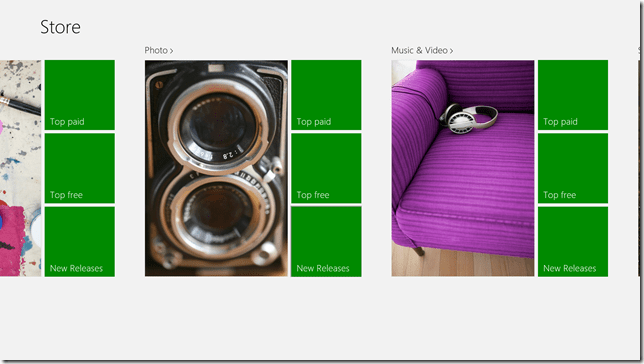
    Photo Apps 02

    Admittedly, some of those listed are Desktop Apps, designed to run in the Windows 7 Desktop environment, but the vast majority are built as Modern UI Apps for Windows 8.

    Last month, there was a post on Microsoft’s Windows Experience Blog that listed, and recommended, four Modern UI photo editor Apps. These were:

    I took a quick look at three of the suggestions (Fotor, Fhotoroom and Perfect365), and they all seem to strip out all metadata from a saved image, Exif and XMP. This is not useful, and completely contrary to the guidance from the Metadata Working Group, of which Microsoft is one of the founding members. As far as I’m concerned, that rules out any of these applications for me.

    Today, I saw that Adobe has made their Photoshop Express available as a Modern UI App for Windows 8, so I’ve taken a quick look.
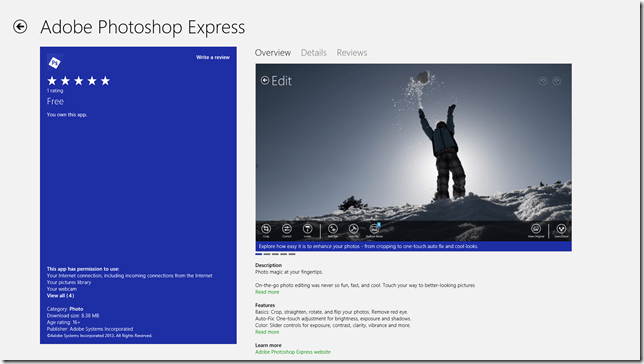
    Photo Apps 01

    Well, on the positive side, it preserves metadata, and doesn’t corrupt it, so that’s a step forward from Microsoft’s efforts. However, it is still very limited in what it can do, and it has at least one irritating quirk all of its own. In this list of capabilities, unless otherwise stated, you can take it that Windows Photo Gallery (WPG) and Photo Supreme (PSU) can match the features listed.

    • It can crop and resize the image, with or without ratio guides.
    • It can rotate the image in fixed 90 degree increments (PSU can also handle free rotation, with or without cropping).
    • It can flip the image (WPG cannot).
    • It cannot resize the image resolution (WPG and PSU both can).
    • It can adjust (both manually and auto-fix) contrast, exposure and white balance, and apply preset filters.
    • It can remove Red Eye (PSU cannot).
    • It can heal images (WPG cannot).
    • It cannot handle masks and image layers (neither can WPG or PSU).
    • It cannot handle RAW images (PSU can, while WPG can only display them)

    Interestingly, it looks as though the App is extensible. You can add paid-for filters. So it’s possible that some of the limitations may be overcome in the future.

    And what of the irritation?

    Well, I don’t know whether the App is saving images at full quality, or whether it is applying compression. As a test, I took an original JPEG image that was 6.82 MB in size, and used the App to save a copy (no changes were made). The resulting copy was 4.08 MB in size. I suspect that some compression has been applied, but I have no way of telling how much, or more importantly, be able to save with no compression. That I do not like in an application.

    I also get slightly irritated by the fact that I can only save to one online Cloud storage service: Adobe’s own Revel. Fine, but I want to use my existing (and free) SkyDrive storage, rather than have yet another service to deal with.

    So in summary, all I can say is that Adobe’s Photoshop Express has promise, but it is not yet at a stage where I will drop my other digital image editor tools in its favour. Ask me again in a year.

    Addendum: I asked on an Adobe forum whether I could stop Photoshop Express from compressing my images. The answer is no, and that’s apparently by design.

    Also, I raised the issue of metadata being stripped out by Fotor with their support people. I had a response in which their programmer confirmed that Fotor does not save all of the Exif metadata in edited images. Unfortunately, he also seemed to be completely unaware that there are other types of image metadata besides Exif – and these are equally important to photographers.

    This link http://www.photometadata.org/META-101-metadata-types has an easy to understand introduction to image metadata.

    As it stands, Fotor is not a suitable tool for any photographer who cares about preservation of image metadata. The same seems to be true for many of the photo Apps currently available.

  • IDAHo

    Since 2004, May 17 has been marked as the International Day Against Homophobia. The Dutch Government is hosting a three day international conference in The Hague on the subject of homophobia at the moment.

    Today, the EU Fundamental Rights Agency published a report on the experience of LGBT people across the EU and in Croatia. It doesn’t make for very comfortable reading. The survey (of 93,000 people) found:

    • Some 26% of respondents (and 35% of transgender respondents) said they had been attacked or threatened with violence in the past five years
    • Most of the hate attacks reported took place in public and were perpetrated by more than one person, with the attackers predominantly being male
    • More than half of those who said they had been attacked did not report the incident to the authorities, believing no action would be taken
    • Half of respondents said they had felt personally discriminated against in the year before the survey, although 90% did not report the discrimination
    • Some 20% of gay or bisexual respondents and 29% of transgender respondents said they had suffered discrimination at work or when looking for a job
    • Two-thirds of respondents said they had tried to hide or disguise their sexuality at school.

    Full details of the report and its findings are here.

    Yesterday, the Netherlands Institute for Social Research published its own report on the situation of LGBT people in the Netherlands. It makes slightly more comfortable reading than the EU report, but we are also likely to be the target of homophobia from the usual suspects within Dutch society.

  • “They Were Not A Family”

    I see that my birthplace, the Isle of Man, is still home to some old and ugly prejudice. Kira Izzard and Laura Cull have been refused a tenancy application because they are a lesbian couple. Their landlord, Keith Price, who is a Methodist Minister, stated:

    “We understood that they were not a family so we said we couldn’t proceed [with the rental agreement].

    “We believe that God has a plan for our lives within the context of marriage, the scripture is quite clear in its teaching on this.”

    In the UK, such a refusal would be illegal; unfortunately, the Isle of Man is a Crown Dependency, and not part of the UK, so it makes its own laws.

    Ms Izzard has started a petition to ask the Manx Parliament to support the UK Equality Act 2010 in the Isle of Man. Naturally, I’ve signed it.

  • Rewriting 2001

    The Dreams of Space blog has an entry that shows a children’s comic produced in 1968 that ties-in to the release that year of 2001: A Space Odyssey. It depicts two children, Debbie and Robin, being taken to see the premiere of the film by their parents.

    It’s an interesting piece of ephemera, but it does lie about the story. It states that the “repairman” (actually Dr. Frank Poole), sent out to repair the communications unit on the spaceship Discovery, slips and floats away into space. Er, no he didn’t – he was murdered.

    There’s also the obligatory cringeworthy ending in the final panel when Debbie announces that she wants to be a space stewardess when she grows up, while Robin says he wants to be a space pilot. Gah!

  • Music In The Cathedral

    The ISS is one of science’s cathedrals. Scientists can also be musicians. Space Oddity has always been one of my favourite songs.

    Commander Chris Hadfield brings it all together. The special effects were all provided by nature. Wonderful.

  • Feynman’s Philosophy

    A good video that nicely summarises the philosophy of Richard Feynman, narrated by Feynman himself.

    A key section:

    “You see, one thing is I can live with doubt and uncertainty and not knowing. I think it’s much more interesting to live not knowing than to have answers which might be wrong. I have approximate answers and possible beliefs and different degrees of certainty about different thing but I’m not absolutely sure of anything and there are many things I don’t know anything about, but I don’t have to know an answer. I don’t feel frightened by not knowing things, by being lost in a mysterious universe without having any purpose, which is the way it really is as far as I can tell, possibly. It doesn’t frighten me.

    And so altogether I can’t believe the special stories that have been made up about our relationship to the universe at large, because they seem to be too simple, too connected, too local, too provincial…”

    Amen to that.

  • Potential Food

    I’ve always had a barrier about eating insects. Sea crustaceans, no problem; but insects in general? Well no, thank you.

    So cricket broth, or wax moth larvae mousse are not exactly what I’ll be sitting down for.

    Unfortunately, it’s probably the future.

  • Romanticising Pain And Suffering

    Giles Fraser has an article in the Guardian, in which he claims “I want to be a burden on my family as I die, and for them to be a burden on me”.

    Well, bully for him. And a bully is what he is proposing to be, with his pernicious nonsense. I reject his argument that the “problem with euthanasia is not that it is a immoral way to die, but that it has its roots in a fearful way to live”.

    Eric MacDonald also demolishes Fraser’s argument completely, and I refer you to him for chapter and verse. A couple of key quotes:

    But it’s not called “looking after each other” if what the person who is suffering is asking for is help to die. It’s called coercion, then — which has a very different resonance — and if someone is being coerced into being a burden, then Fraser has simply has missed the point about what looking after each other is all about. Moreover — and this, coming from a priest, is inexcusable — it simply papers over the cracks with regard to how people die. Sometimes the burden, if Fraser really wants to know, is borne by those who are dying, and if those who are watching someone die in misery doesn’t notice this, then they are simply not watching closely enough!

    And this just shows that Fraser hasn’t the least understanding — but not the slightest understanding! – of what is meant by assisted dying. It’s not the last desperate act of a person who has no inkling of what is happening until the very last moment, when farewells are almost impossible; it is, rather, a conscious act of taking the decision to die upon oneself, instead of leaving it up to the vagaries of the dying process, or to the all but certain stages that the trajectories of some diseases will follow to carry one away either gasping for breath or crying out in pain. Fraser seems to have not the slightest idea of how people die, or, if he does, he deliberately hides it from his readers the less to worry them at the end of life. But it is just as well to know, beforehand, just how terrible death can be, not so that we can be afraid of it — which seems as far as Fraser’s puny imagination will take him — but so that we can be prepared for it, and take our leave before the worst overtakes us.

  • It’s NOT a Coronation!

    It’s been a momentous day here in the small country of The Netherlands. This morning, at 10:10, Queen Beatrix signed the document that confirmed that she has abdicated in favour of her eldest son, Willem-Alexander, who has now become King. The first Dutch King since the 19th Century.

    This signing took place in the Dam Palace, which started out life as the Amsterdam City Hall in the Dutch Golden Age of the 17th Century.

    Now, I’m no monarchist, but I was moved by the day’s events. Right from the moment that Queen Beatrix announced she welcomed everyone to the ceremony, and the roar of approval from the crowd outside in the Dam Square brought a smile to her face as she realised that the Dutch people were watching and supporting this move.

    Not that Beatrix has been a bad Queen. Far from it. She has become beloved by us in a way that could only have been dreamed of when she became Queen in 1980. Then, there were protests and smoke bombs in the Dam.

    Following the signing of the Abdication document, this afternoon was the inauguration of the new King. I found it almost astonishing.

    I grew up in the United Kingdom, where the British Monarchy is seen as something established by God. There is a Coronation, where the crown is placed on the head of the new monarch by the Archbishop of Canterbury. Religion and Monarchy are completely intertwined.

    In stark contrast, here in The Netherlands, the Monarch is not crowned. Instead, King Willem-Alexander was inaugurated in a ceremony that involved the State – not the Church.

    The King pledged his allegiance to the democratic process, and affirmed his responsibilities to the citizens. He made a good, and thoughtful speech, honouring the service of his mother, and promising that he would do his best for the Dutch citizens and the State. In return, the State, in the form of the members of the Dutch parliament, signalled their assent to his assumption of the role of king. And they did that individually – each standing when their name was called, and either swearing by God, or a simple “I promise”. It was interesting to see how many members did not invoke God. Another indication of how secular the Netherlands is, and how the United Kingdom still is not.

    King Willem-Alexander pledged his allegiance in front of symbols of the State – the books of the Law of the Land – as well as symbols of his own status, the crown, sceptre and orb. He also had five representatives of the Dutch people present to bear witness, and to bear symbols of the importance of the citizen to Dutch society. They were his “Koningwapenen”, or Kings of Arms. One of them was André Kuipers, Dutch physician and astronaut.

    As I say, I was moved. The importance of ritual to humans is unmissable, and touches something deep within us.

    I wish Willem-Alexander, and his very impressive wife, Máxima, all the best in their new roles as King and Queen of the Netherlands. I think that they will both do well.

  • The Ghost in the House of Wonks

    Adam Curtis makes amazing documentaries. Here’s one he did earlier – The Attic. A cautionary tale.

  • "Windows 8 sucks because Windows 8 apps suck"

    Not my words, but the words of Michael Cherry, an analyst with Directions on Microsoft, quoted in Computerworld. To be honest, I think he has a point. I’ve long bemoaned the fact that, far from using the opportunity to showcase the capabilities of Windows 8, the quality of most of the Apps supplied by Microsoft is abysmal.

    I still find myself using traditional Desktop applications for the majority of the time, and that’s simply because their Modern UI equivalents just don’t cut the mustard. They are still toys by comparison.

    I’ve found that Microsoft’s Mail, Calendar and People Apps are still far inferior to Windows Live Mail. The Xbox Music App is still lagging traditional music library applications, and the less said about the Photos and Video Apps the better.

    Microsoft is certainly not doing itself any favours with the current state of its Apps.