I think that this young man has a future in showbusiness…
Clever words, too…

Reflections on life at “De Witte Wand”…
I think that this young man has a future in showbusiness…
Clever words, too…
Last night, BBC Two showed “The Challenger” – a film dramatisation of the public inquiry (the Rogers Commission) that investigated the causes of the catastrophic accident that befell the space shuttle Challenger. The film has the title Feynman and the Challenger in the US.
It was riveting. Amidst the political manoeuvering, and the attempts by NASA officials to mislead the inquiry at the time, Richard Feynman ploughed a course that uncovered the true cause of the disaster. He was played in this dramatisation by William Hurt, who delivered a completely believable portrait of Feynman, culminating in the scene where Feynman destroys the testimony of the NASA officials with a glass of iced water. I remember seeing the actual event on TV at the time, and thinking how extraordinary it was.
The dramatisation was based on Feynman’s experience on the Rogers Commission, as documented in his book What Do You Care What Other People Think? As wikipedia has it:
Feynman’s account reveals a disconnect between NASA‘s engineers and executives that was far more striking than he expected. His interviews of NASA’s high-ranking managers revealed startling misunderstandings of elementary concepts. For instance, NASA managers claimed that there was a 1 in 100,000 chance of a catastrophic failure aboard the shuttle, but Feynman discovered that NASA’s own engineers estimated the chance of a catastrophe at closer to 1 in 100. He concluded that the space shuttle reliability estimate by NASA management was fantastically unrealistic, and he was particularly angered that NASA used these figures to recruit Christa McAuliffe into the Teacher-in-Space program. He warned in his appendix to the commission’s report (which was included only after he threatened not to sign the report), “For a successful technology, reality must take precedence over public relations, for nature cannot be fooled.”
That statement closed the film. It’s a film worth seeing.
Just a reminder of what some people are going through because they say that: There is no god except Allah; Mohammed is his messenger.
Via Gia Milinovich’s blog, I came across the Great British Innovations web site, which is asking members of the public to vote for their top past and future scientific innovations. The results will be announced on the 25th March 2013.
The lists are interesting, and I’m finding it difficult to choose which two (past and future) I will vote for. Perhaps it’s just me, but when I think of the term innovation, I tend to think of something that results in practical impact on our lives in a fairly direct manner. So, for example, while Turing’s Universal Machine was a stunning scientific theorising about the nature of computation, I don’t think it could be said to lead directly to computers as we know them today. Tim Berners-Lee’s invention of the protocols that underpin the World Wide Web, on the other hand, has completely transformed the way in which we share information in just over twenty years. In the same vein of practical impacts, Percy Shaw’s catseyes have had direct impact on making the roads safer for millions of road users.
I see that Gia will be voting for Jocelyn Bell Burnell’s discovery of pulsars, which, again, while it transformed aspects of astronomy enormously, I don’t think it has resulted in practical impacts on most of our lives. The Bell Burnell story is an interesting one, and one that, as Gia says, deserves to be better known. But, practical impact? I’m not so sure.
The shorter list of future innovations also contains a couple that seem to me to be out of place when judged in terms of direct practical impact. For example, the discovery of the Higgs boson is indeed a stunning scientific achievement, and a confirmation of the standard model in physics, but isn’t this really about the engineering achievement of the building of the Large Hadron Collider? I’m not sure what the practical impact of that will be for the rest of us, unless it leads to the engineering that will enable us to build fusion reactors. That would indeed be a real innovation, and a revolution in our energy sources.
It looks as though the Raspberry Pi is currently the front-runner in the votes. Personally, it’s not a favourite of mine. I can see that it has had a direct impact on a new generation of children growing up and getting them introduced to programming, but I’m not entirely convinced that we really need “to create a new generation of computer programmers”. I think I’d be more inclined to vote for one of the others, e.g. Graphene, or Ionic Liquids, or Quantum Dots.
Jesus and Mo ponder the puzzle of why many Christians do not condone assisted dying.
I was out working in the garden today, when I became aware of bird cries that were unfamiliar. Looking up, I saw a flock of Cranes (Grus grus) lazily circling above the house.

The flock of 38 birds continued circling and wheeling, gradually moving away to the North.




And, just as I’ve been writing this some hours later, I saw another, even larger, flock of cranes pass in single file over the house. Alas, I didn’t have time to grab the camera, I could only watch entranced as they disappeared Northwards into the twilight.
Pure magic.
In this part of the Netherlands (the Achterhoek), there’s a tradition that when a new building is constructed, and the highest point is reached, then the neighbours will erect a Meiboom (a Maypole) alongside the building. Here’s a translation of the relevant section of the entry in the Dutch Wikipedia:
In addition, it is customary in some parts of the Netherlands (including the Achterhoek and Limburg), that when a newly built House has reached the highest point of the building, a Maypole is placed by it. The maypole also stands for in this case as a symbol for fertility and prosperity. The tree is fetched by local residents from, for example, a neighbouring forest and after the placement, a glass is drunk and a toast raised together. The maypole is sometimes placed on the building, in other cases next to or nearby. In some cases, a permit must be applied for if one wants to plant a maypole.
This is traditionally done when it’s dark, so that the building’s owner doesn’t know what’s going on until it’s too late. The maypole also has to be taller than the highest point of the building. I’ve been told that traditionally, the building’s owner would subsequently use the maypole to make a ladder to reach the roof for putting on the roof tiles, but I suspect that might be apocryphal.
Our nearest neighbour is a dairy farmer, and he’s having a new cattle stall built. Last week, the building frame was complete, and so the highest point was reached.
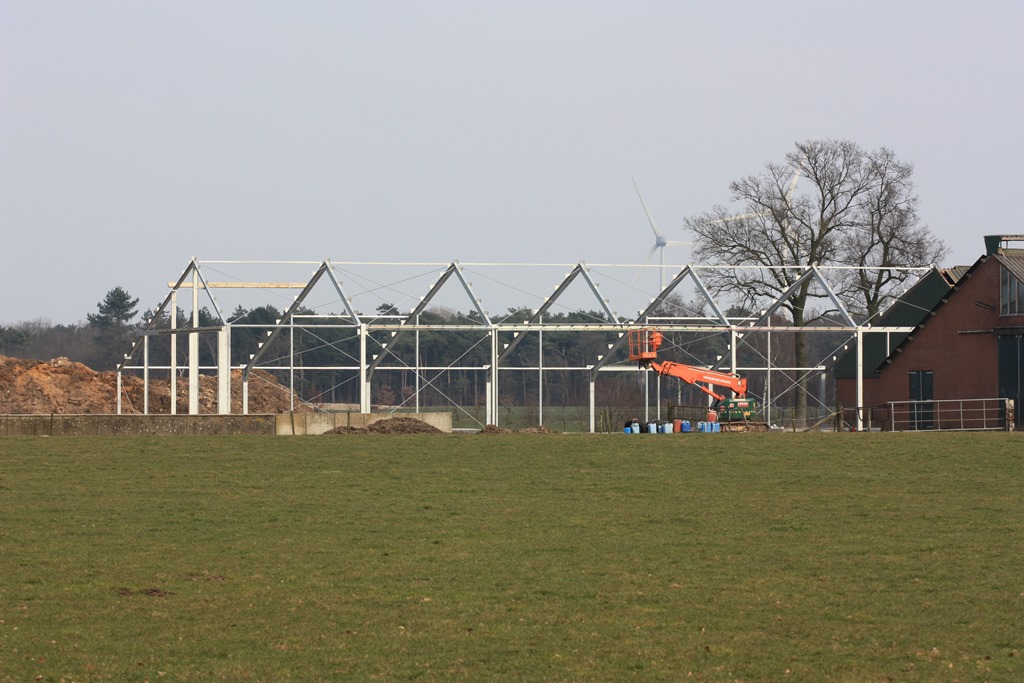
Martin and I are his noaste noabers, so we are responsible for organising the rest of the neighbours in his buurt (neighbourhood) to celebrate occasions such as this.
Last Friday afternoon, while it was still daylight, four of us, including myself, met up at a local forester’s, and selected a fir tree that was tall enough to use as a meiboom. It was felled by the forester, and the lower branches were trimmed off. Some were kept for the later making of a wreath that is suspended around the trunk on the meiboom. One of the neighbours had borrowed a large tractor and trailer to haul it back to the neighbourhood.
That evening, the neighbours gathered at our house to prepare the meiboom. It’s the tradition to decorate the meiboom with crêpe paper flowers, so we made dozens of the things. It’s also the tradition that it’s the women who do this, while the men prepare the tree. Martin and I naturally wanted to break down this separation on roles, so Martin and one of the men also set to work on making the flowers. It was noticeable though that the older men refused to break with tradition here!
Later we prepared the tree, by making the wreath, putting it around the tree, and attaching the flowers. A spot was selected next to the cattle stall, and a hole was dug for the tree to be rooted in. When all was ready, we went back to the house for a toast.
Then we brought the tree to the selected spot and erected it in position. Traditionally, this would be done by manpower alone (and I’ve been involved a couple of times where this was done). The tree is gradually raised by pushing ladders under it to make it upright. It requires a lot of men and brute force. We didn’t have a lot of (young) men this time, but what we had was someone who had thought it through. He said that in place of blood pressure, we should use hydraulic pressure. So he fetched a tractor with a fork raise attachment on it, and he used that to raise the tree. It worked wonderfully, and the tree was raised and in position in a couple of minutes.

Martin then pinned the traditional poem from the buurt onto the tree, and we went back to the house to raise a few more toasts to celebrate. A job well done, and a tradition upheld. We all felt very pleased with ourselves, and the farmer and his wife like the meiboom as well.
I’m sorry, but I cannot refrain from giving in to some feelings of schadenfreude at the news that Cardinal Keith O’Brien has resigned following accusations of acts of inappropriate behaviour.
This is the man who has consistently demonised us.
Good riddance.
Update 3 March 2013: O’Brien has now admitted, and apologised for, sexual misconduct. However, even in his statement it seems as though he wishes to offer his disingenuous version of the facts. His statement reads, in part:
In recent days certain allegations which have been made against me have become public. Initially, their anonymous and non-specific nature led me to contest them.
However, the facts of the matter are that the allegations, by an ex-priest and four serving priests, were not anonymous and non-specific:
A narrative has begun to be embroidered on the cardinal’s magic mitre. A fairytale. He is named but his accusers are not, and therefore the accusations are invalid. Let us be clear about one thing: the three priests, and one former priest, who have made complaints are not anonymous. They have given sworn, signed statements to the papal nuncio.
…
The four complainants made their statements to the papal nuncio, Archbishop Mennini, around 8 or 9 February.
The Cardinal is either being utterly disingenuous, or he’s telling porkies.
Once again, with feeling: good riddance.
I see that I’ve used the phrase “open mouth, change feet” a number of times in the life of this blog to describe the continuing ability of Microsoft to snatch defeat from the jaws of victory. Today I came across yet another example.
I had noticed some reports that people weren’t able to get their navigation software to interface with the GPS sensor built in to some Windows 8 tablets.
Now the thing is that until very recently, PCs did not have GPS hardware built into them. Instead, external devices such as GPS Data Loggers were used to provide GPS data, and interfaced to Windows software applications via Windows COM (communications) ports. In the old days, these were physical RS232 ports. These days, they are “virtual” ports set up over a Bluetooth or USB connection.
In the development of Windows 8, support for a variety of sensors, including GPS, was built into the operating system, and exposed by a new set of APIs. The point being that this means that there is a new set of interfaces for developers to use, and they are different from the traditional COM port interfaces.
So, as you might expect, traditional Windows navigation software, which has been written expecting to find GPS data coming in via traditional COM port interfaces, won’t see the new generation of GPS receivers being built directly into PC hardware running Windows 8.
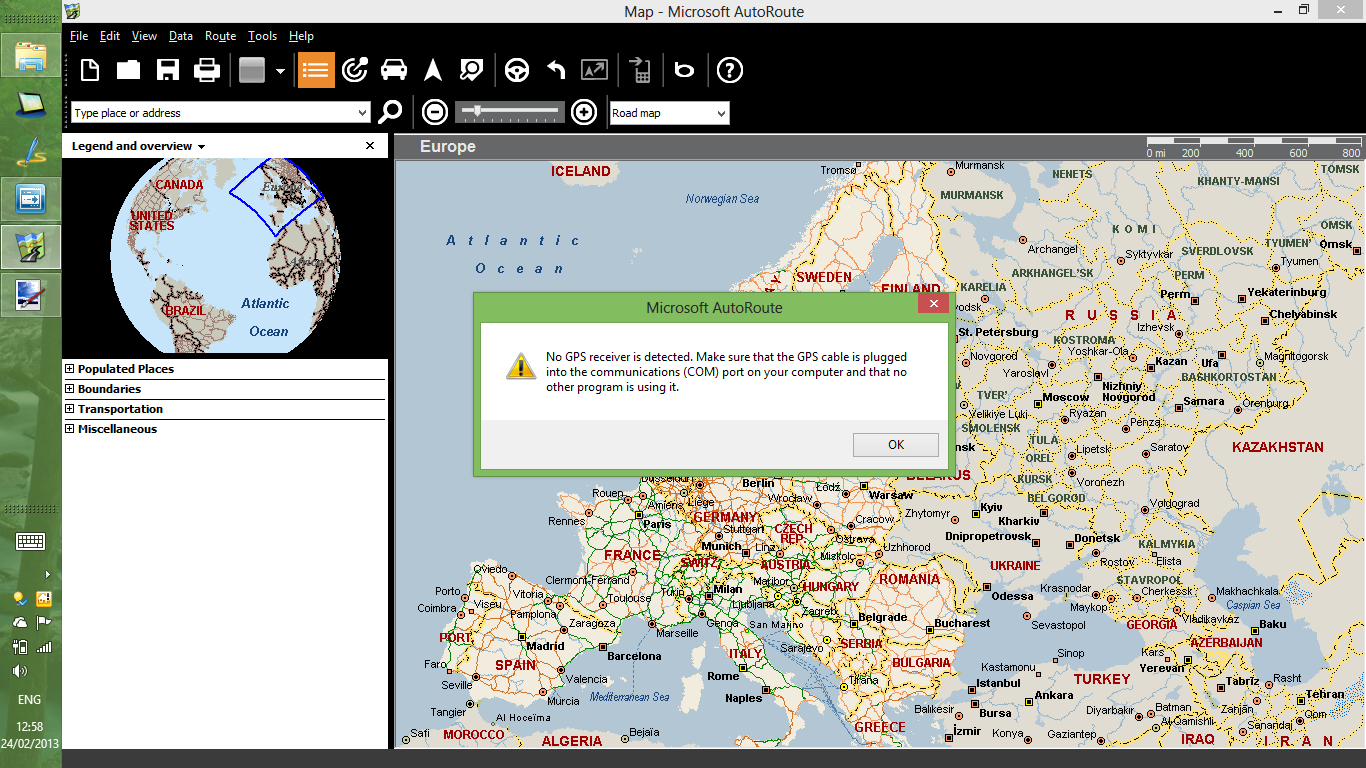
And so it is. Here for example is the very latest version of Microsoft’s AutoRoute 2013. I downloaded a trial version and installed it on my Lenovo ThinkPad Tablet 2, which has a Broadcom GNSS Gelocation Sensor in it. As you can see, AutoRoute 2013 expects to find GPS data arriving via a COM port, and complains that it can’t find the GPS receiver:
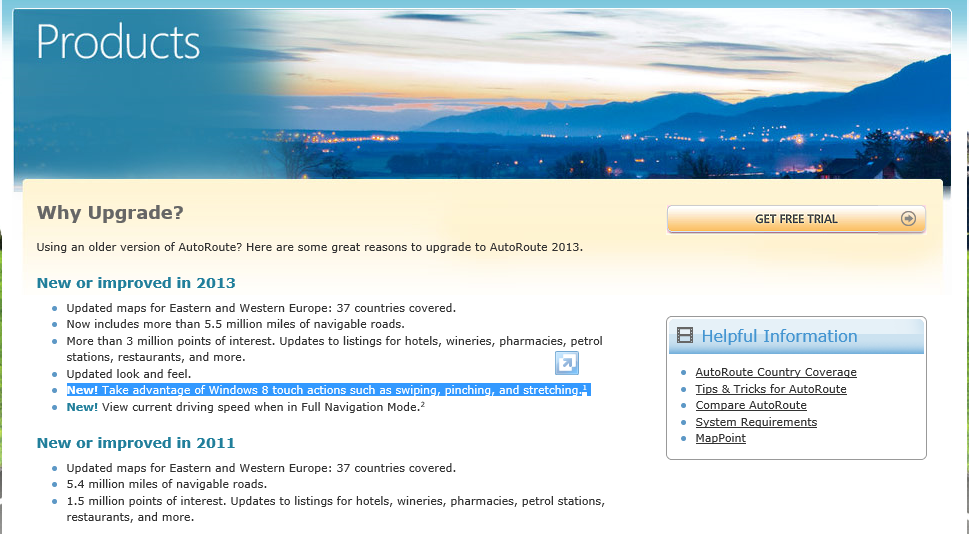
What I find truly ironic about this is that Microsoft trumpets the fact that AutoRoute 2013 now has support for the Touch features of Windows 8:
However, the AutoRoute team has completely forgotten to use the new interfaces for GPS sensors that may be present in Windows 8 devices. Open mouth, change feet.
A further irony is given by the fact that when this issue was raised in a Microsoft forum, Janet Schneider, a Microsoft employee, blithely writes that
You can use the Location API and a Location Provider Driver to get NMEA strings, instead of using a virtual COM port.
Janet, please tell that to your fellow developers in Microsoft, not us, the poor users of this stuff. The left hand of Microsoft clearly has no clue what the right hand is doing.
Now what would be really useful is for someone in Microsoft to code a software shim that would connect a virtual COM port to a Location Provider Driver. That would enable us to carry on using our legacy Windows navigation software on Windows 8 tablets with GPS receivers. It would even allow the AutoRoute 2013 software to work as advertised.
Addendum: Well, Microsoft hasn’t bothered to write a software shim, or updated their Streets & Trips or AutoRoute software at this time of writing (December 2013), but at least two third parties have developed shims:
Addendum 25 February 2014: If you’re looking for a map application that has maps held on your Tablet, and which will work directly with the GNSS sensor in the ThinkPad Tablet 2, then the good news is that Nokia has released its HERE Maps App for all Windows 8.1 devices. Even better, it’s free.
Addendum 8 July 2014: Microsoft has announced that AutoRoute, Streets and Trips, and Mappoint will no longer be developed, and will be dropped. I can’t say that I’m surprised, but on the other hand there are many Line of Business applications that have been built on top of MapPoint services, so those will have to be migrated over to Bing, HERE or Google Maps…
Addendum 25 August 2015: And Microsoft drops the ball once more… I’m now seeing reports that Microsoft has changed something in Windows 10 that affects the traditional virtual COM ports. The effect is that Bluetooth GPS loggers no longer connect properly. This means that I can no longer use my Qstarz GPS logger with my Surface 3 to feed GPS data into the Microsoft Maps app. Honestly, I despair at Microsoft sometimes; they are their own worst enemy…
Addendum 30 August 2015: For those of us who are definitely having problems getting the SPP slave port to work, there could be some good news on the horizon…
I’ve just upgraded my Yoga 3 Pro to the latest Insider Preview build (10532), and the SPP problem seems to have been fixed. I’m able to connect my Qstarz GPS logger and get data. This result has been confirmed by another person who had the same problem with the 10240 build of Windows 10. I hope that this fix will be present in the October update to Windows 10 that will be available to everyone…
Addendum 1 October 2015: Microsoft has issued an update (KB3093266) to Windows 10 that fixes the virtual COM ports issue. Excellent.
I’ve commented a couple of times before on the new licensing models that Microsoft has introduced with Office 2013.
The nub of the situation is that whilst with earlier versions of Office (e.g. Office 2003, Office 2007 and Office 2010) it was possible to transfer your licence from one computer to another; with Office 2013, if you buy a licence for Office 2013 and install it on a computer, that’s it. You can’t transfer it to another computer. So if, for example, after a couple of years, you upgrade your computer to a newer model, you can’t move your Office 2013 licence across. You have to purchase a completely new licence, which is in turn locked to your new computer.
I see that Jevon Fark, in Microsoft’s Office Team, has attempted to clarify the licensing situation. However, he singularly fails to make the proper comparison between the earlier so-called Full Package Product versions of Office 2003, 2007 and 2010 (i.e. Office products that were supplied with actual DVDs) and the current situation with Office 2013, where it is no longer possible to purchase the software. Instead, all you get is a product key, and if you download the software to a computer and activate it using the key – that’s it – it is locked to that particular computer.
So, is Fark’s blog post disingenuous, contemptible, or both?
In my opinion, it’s both.
I will neither purchase Office 2013 licences, nor subscribe (at five times the cost of my current Office licences). Instead I will continue to use my (transferable) Office 2010 licences for the foreseeable future. And if in the future I require to replace my Office 2010 product, then I will seriously consider alternatives before I look again at what Microsoft has to offer.
Update 6 March 2013: Well, it appears as though Microsoft has had second thoughts. Mr. Fark has now posted that it is possible to transfer licences between computers. Good to see that common sense can prevail after all. Thank you to all those who protested that Microsoft were doing the wrong thing with the original licence conditions.
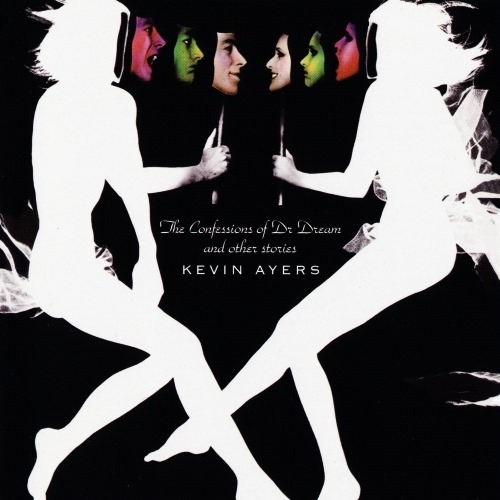
Another influencer on my early adulthood is no more: Kevin Ayers has died. Damn. Time to listen again to some of his work: Joy of a Toy, Bananamour, and of course: The Confessions of Doctor Dream. RIP Mr. Ayers.
…instead of making asinine comments on media storms in teacups?
Honestly, I despair about David Cameron’s ability to discern what is important and what is not.
Hilary Mantel’s piece about Royal Bodies was a forensic analysis, flensing the media spin from the actuality. It’s a pity that Cameron could not comprehend this, and does not bode well for his governance.
Hadley Freeman has a better eye than David Cameron for what is going on.
While still shaking my head over the idiocy of David Jones, who claims that two same-sex partners cannot provide a warm and safe environment for their children, I came across a new book written by Andrew Solomon: Far From the Tree: A Dozen Kinds of Love. In it he:
tells the stories of parents who learn to deal with their exceptional children and find profound meaning in doing so.
He introduces us to families coping with deafness, dwarfism, Down syndrome, autism, schizophrenia, disability, with children who are prodigies, who are conceived in rape, who become criminals, who are transgender. While each of these characteristics is potentially isolating, Solomon documents repeated triumphs of human love and compassion to show that the shared experience of difference is what unites us.
Solomon is himself the gay child of straight parents, and is now, in turn, a parent himself. Here he talks movingly and lucidly about the nature of vertical identities (those that we inherit from our parents) and horizontal identities (those that we do not share with our parents, and which we develop through our peer groups). This short video is worth watching.
The Guardian’s Carole Cadwalladr also has an interesting interview with him.
His book is now on my list to get. Perhaps David Jones should also read it. He might learn a thing or two.
It’s a word that I use a lot in my blog posts: “Clearly”.
I use it where others might deploy “Obviously” or “Without a shadow of a doubt” or “It must be patently obvious to all people with more than one brain cell to rub together that…”
And today I read that Tory MP David Jones, the Welsh Secretary, no less, has used the same word in an interview. He said:
“I regard marriage as an institution that has developed over many centuries, essentially for the provision of a warm and safe environment for the upbringing of children, which is clearly something that two same-sex partners can’t do”.
Clearly, David Jones is a fuckwit. Clearly, some people voted for him to represent them. Clearly, they should be regretting that they ever thought that he had any ability to think things through. Clearly, if ever I happened to find myself in his constituency, I would not be voting for either him or his idiotic ideas.
Clearly.
Ronald Dworkin has died. By coincidence, I listened last week to the podcast of Thinking Allowed, originally broadcast on 26 January 2011. In it, Dworkin discussed his book Justice for Hedgehogs with the philosopher A. C. Grayling and the sociologist Laurie Taylor. I thought at the time that I should get hold of the book, and now I definitely will.
…is sauce for the gander.
Not being a Catholic, I have little skin in the game. However, given that Pope Benedict has little time for us homosexual secularists, and has made it plain enough, I just thought that I would muse on the fact that:
a) He seems keen on pointing out that contraception is a thwarting of God’s will, whilst at the same time being happy to…
b) …have a pacemaker fitted to extend his allotted time in this vale of tears. God might well feel cheated at the presumption.
I gain no joy and I shed no tears at his relinquishing of the Papal crown, knowing full well that the next wearer will be stamped from the same ultra-conservative, human-hating mould.
As a bit of light relief, here’s Crispian Jago’s version of the Situation Vacant ad:

And so the British Parliament finally decided to see sense. Not without the usual grumblings from the bigots and homophobes. Even Jesus and Mo seem surprised at the lack of divine retribution. Welcome to the 21st century. Meanwhile, we’re heading towards our 15th wedding anniversary.
I’ve written before about the issues I’ve had with the “Play to” function in Windows 8. Paul Thurrott wrote an article yesterday: The Sad Tale of Play To and Windows 8, with much the same conclusions. It is worth reading the comment by John Galt after the Thurrott article. He lists a number of shortcomings in the media “features” that Microsoft have implemented in Windows 8, any one of which has me tearing my hair out.
For example, the Music App
Issues 4, 5, and 6 are also common to the other Microsoft-supplied Media Apps, i.e. the Video App and the Photos App.
One wonders how Microsoft can be so dismal in delivering products that should delight, and not disappoint in so many ways.
Addendum: here’s a secondary rant about the Music App, triggered by a comment below.
Navigation in the Music App is really badly thought out.
Take the Album view, for example. Choose it, and you’ll see a list of your albums.
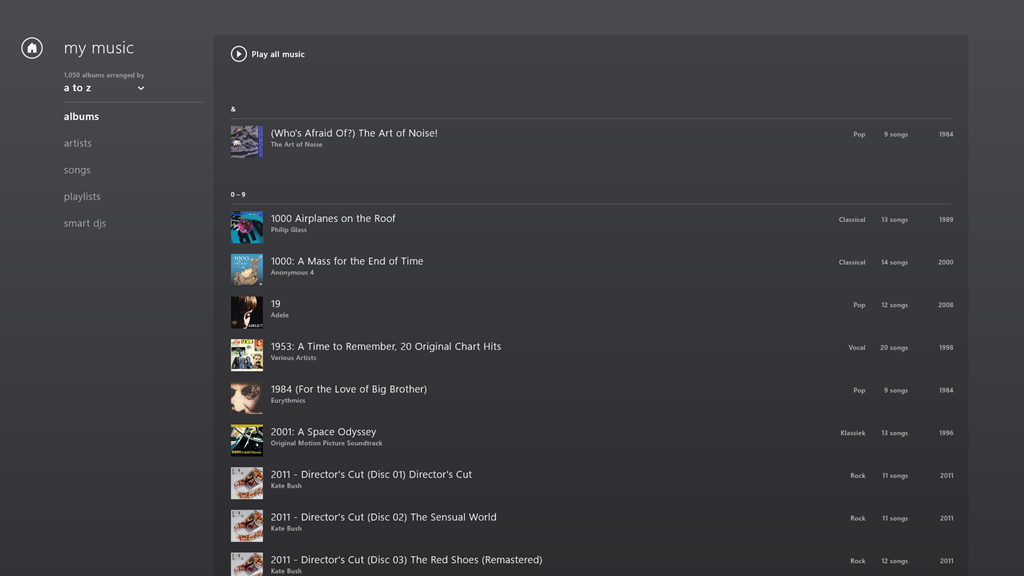
The question is, how do you rapidly navigate through the list? The answer is: you can’t. You have to manually scroll up and down, using either your mouse or your finger. Since I have over 1,000 albums in my library, this gets very tiresome, very quickly.
The answer that Windows Media Center came up with in 2001 is that pressing a character on your keyboard will cause the display to jump to that position in the list. So pressing “m” for example, will immediately skip the display to the start of the list of albums beginning with “m”.
But the keyboard is dead in the Music App’s list displays… You can only scroll up or down.
What I find really irritating is that the developers of this App have also learned nothing from Apps built for Windows Phone. Here, there is support in the operating system itself for viewing lists at two levels of zoom. You can see a view at the level of the alphabet (a,b,c, etc.), and by touching a letter, you instantly zoom into the detailed list at that level.
This can be done for Windows 8 applications as well. Here for example, is the Media Center Remote app built by Brad Mauk, and available for both Windows Phone and Windows 8. These are screenshots taken from the Windows 8 App. On entering the Albums view, you are presented with the zoomed-out view of your library:

Notice that “x” is dimmed – this immediately tells me that I have no albums with titles beginning with “X” in my library. Now, it is true that in this App, in this view, the keyboard is also not active. So I can’t type a character on my keyboard and jump to that part of my library. However, and crucially, I can use either my mouse or Touch to choose one of the characters on this screen to jump into my library. Let’s click (or Touch) “l”:
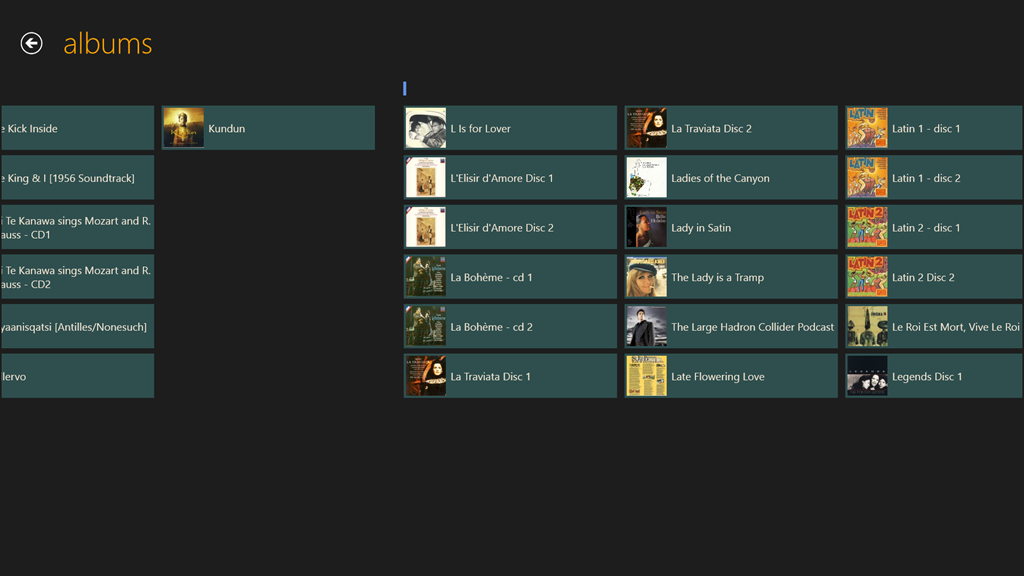
Instantly, I’m there. If I want to return to the high-level view, I can either click the “-“ icon that appears with the horizontal scrollbar when I mouse down:

…or, if I’m using Touch, I simply use the “pinch” gesture on the screen to return to the alphabetic list of the high-level view:

Navigation within my library is easy with this App, and I happily use it to control my Windows Media Center.
The developers of Microsoft’s Music App should take note. What they have produced thus far is abysmal.
Today, the Music App has received an update. I’m very pleased to see that Microsoft has at last incorporated a “zoom” function to make navigation in a large library more practical. It’s implemented slightly differently from the “Windows Phone” approach taken by the Media Center Remote App described above.
In the new version of Music App, the contents of the various views (Albums, Artists, Songs, Playlists etc.) are separated alphabet headings, when listed in alphabetical order. Here you can see the start of the list of my albums:
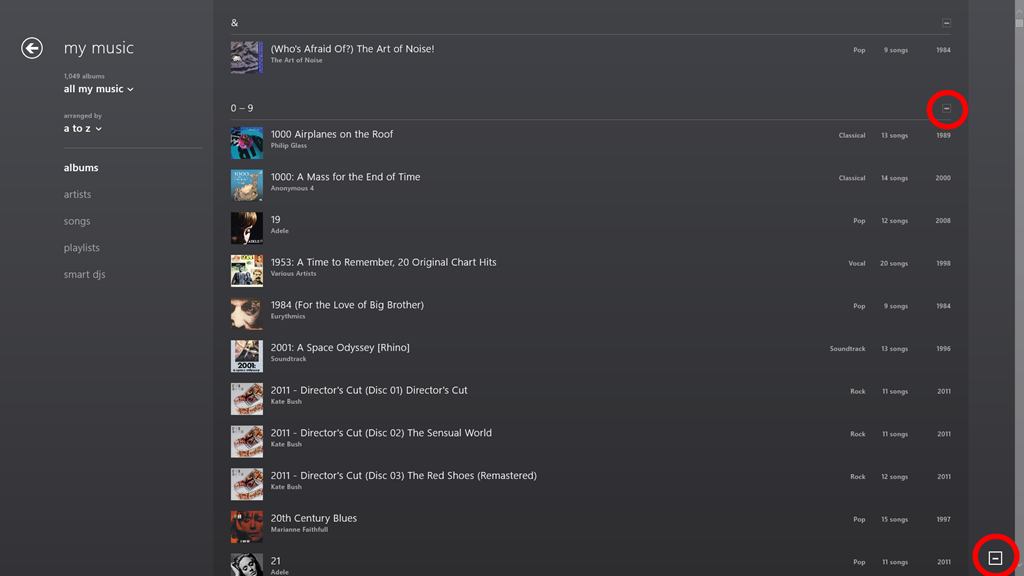
Note the icons that I’ve circled in red. When clicked (or touched), the view zooms out to the alphabetic sections only:

One rather nice touch is that the length of the bars represents the number of albums in that section as a proportion of the highest section total. If there are no albums in a particular section, then – unlike the Windows Phone convention, where the section is dimmed – here it is dropped altogether. For example, there is no entry for “X”, since I have no albums that begin with “X”:

Clicking, or touching, anywhere along the dark/light grey bar of a section will zoom back into the library to the point represented by the section heading. In the screenshot above, I have moved my mouse over the “T” section, which is why it has become highlighted (the touch interface does not use this highlighting prompt). Left-clicking (or touching) jumps me back into the list of individual albums, starting with those beginning with “T”:

You’ll notice that the “T” section contains the highest total number of albums. That’s because the Music App – unlike Windows Media Center – has not the intelligence to ignore words like “The” or “A” in an album title. It’s a small point, but it’s evidence that teams in Microsoft often don’t appear to build on what went before, but start with a blank sheet of paper. One step forward, two steps back…
In summary, while it’s nice to see that this new version of the Music App has addressed the navigation issue, it still has a long way to go. Of the six issues that I give at the top of this post, only issue 3 seems to have been resolved, the other five issues have yet to be addressed – if indeed they ever will be.
I’ve been using the Music App to play music stored in my Library, and I’ve got good news and bad news.
…as you’ve never seen it before…
Strangely, I seem to have remembered the same odd places from the 1970s as well…
August Schram – clearly someone who has the same odd recollections, even if he is too young to have been there.
…but I couldn’t possibly comment.
Ah, that immortal line, uttered by Francis Urquhart MP in the BBC’s masterful adaptation of House of Cards.
Fast Forward twenty years or so, and we have House of Cards – American style. Actually, I think it could be pretty good. Kevin Spacey could give the late, lamented, Ian Richardson a run for his money. However, not having Netflix, or any of these new-fangled internet channel thingies, it may take me a while before I can compare the two.
 Geoff Coupe's Blog