Reflections on life at “De Witte Wand”…

Year: 2014

  • Presidential? – I Think Not

    Reading President Museveni’s speech at his signing of Uganda’s Anti-homosexuality bill is depressing. Not so much because of his clear bigotry, ignorance, and politicking – that’s only to be expected – but because of my realisation of what this means for gay people – and people who have gay brothers, sisters, parents, relations and friends – in Uganda. They have just been thrown to the wolves. And it hasn’t taken long for the wolves to start howling. A Ugandan newspaper has published a list of what it called “the country’s 200 top homosexuals”, outing some who previously had not identified themselves as gay.

    I was heartened, but not surprised, by Desmond Tutu’s condemnation of the new law. I fear, however, that his voice will be drowned by a new wave of witchhunts in Uganda.

  • Essential? – I Think Not

    I received an email today from Nokia which had the strapline:

    Essential Apps for your Lumia: Facebook, WhatsApp and Instagram

    Perhaps it’s just me, what with my hardening arteries, old age and all that, but “Essential”? – I think not. In fact, I refuse to touch any of them with a bargepole.

    I’ve long thought that Facebook is the spawn of the devil, and its recent acquisition of WhatsApp for the absurd sum of $19 billion merely confirms it. WhatsApp is a proprietary, cross-platform instant messaging subscription service for smartphones. It also has the nasty habit of harvesting all telephone numbers that are in a subscribers contact list, whether their owners are subscribers or not. Dutch newspapers are carrying the story today that the Dutch Data Protection Authority (the CBP) are saying that WhatsApp is breaking Dutch Law. The newspapers are a bit late, the CBP published its report on WhatsApp over a year ago, and it concluded:

    People who want to use the app must grant WhatsApp access to their entire electronic address book, including the mobile phone numbers of contacts that are not using the app (except in the latest app version on an iPhone with iOS 6). Because WhatsApp does not obtain unambiguous consent from non-users to process their personal data and does not have any other legal ground for processing that data, WhatsApp is acting in breach of the provisions of Article 8 of the Wbp [the Dutch Data Protection Act].

    I think I’ll stick to the good old-fashioned (non-proprietary) SMS for my Smartphone messaging needs, thank you very much.

    As Jeff Atwood puts it:

    Nothing terrifies me more than an app with no moral conscience in the desperate pursuit of revenue that has full access to everything on my phone: contacts, address book, pictures, email, auth tokens, you name it. I’m not excited by the prospect of installing an app on my phone these days. It’s more like a vague sense of impending dread, with my finger shakily hovering over the uninstall button the whole time. All I can think is what shitty thing is this “free” app going to do to me so they can satisfy their investors?

  • Intel’s Obstacles

    I’ve been using Microsoft’s Windows Home Server since 2007. In the years that it’s been installed, it’s been doing sterling work, acting as our server for digital media around the house, and also being responsible for taking nightly backups of our other computers. Unfortunately, the motherboard in our homebuilt server developed a fault, so that was all the excuse I needed to replace the old motherboard with a modern Intel Haswell-based design. I chose an ASUS H87I-Plus board, since it had six SATA ports and also came with an Intel controller for the Ethernet LAN interface to the network. The previous board had a RealTek LAN controller, and while it worked, I kept reading that the Intel design was better. So I decided to switch.

    That decision caused a few hours of cursing.

    Replacing the old motherboard with the new one was straightforward, and being a mini-ITX form factor, it is smaller than the old board, gives more room in the case and should be more energy-efficient. After booting it up into the BIOS to check that the hardware was all working as expected, I began to install Windows Home Server 2011. At first, everything went as expected, but then the installation process halted with an error – there was no driver installed for the Ethernet LAN controller.

    No problem, thought I, I have all the necessary software on the CD that ASUS supply with the motherboard. I quickly located the folder for the LAN drivers, and started the setup procedure. First of all, the ASUS setup software refused to run because it discovered that it was on a machine running WHS 2011 instead of Windows 7 or Windows 8. So I dug down a bit and located the Intel setup software and started that running directly. After accepting the license agreement and a few screens marking the progress, everything came to a grinding halt when the setup stated that it wasn’t going to install the necessary drivers on this machine.

    Fighting a rising sense of panic, I went to Intel’s download site, and downloaded the necessary drivers straight from there. Trying to install these produced the same result – no network drivers were installed.

    A search on the internet produced the reason why.

    Intel have decided that consumers should not be running a “server” operating system on a chipset that Intel deem to be for the consumer market. Intel have the i217-V (desktop) and i217-LM (server) versions of their gigabit Ethernet chip. They are in fact the same chip. The only difference is that the –V variant has support for Windows 7 and Windows 8 (desktop operating systems) while the -LM variant has support for Windows Server 2008 and Windows Server 2012, i.e. server operating systems. Unfortunately, Microsoft built WHS 2011 (which is intended for the consumer market) on top of Windows Server 2008. So when the driver installation software detected  that it was running on a “server” operating system, and the motherboard had the consumer variant of the Ethernet chip, then it simply refused to install the driver.

    Fortunately, the same search produced a solution. Ivo Beerens has a post on his blog describing this situation, and giving a solution – a few simple edits to an Intel configuration file. I was able to follow his instructions and have successfully installed the driver. WHS 2011 has now been able to connect to the network and complete its installation. It’s now downloading and installing a further 120 updates to itself. Hopefully, I will have been able to complete the rebuild of the server by the end of the weekend…

    Thanks to Ivo, and no thanks at all to Intel.

  • The Streisand Effect in Action

    In 2009, Wendy Doniger’s book The Hindus: An Alternative History was published by Penguin. It seems to have attracted the wrath of Hindu (male) chauvinists; to the extent that a lawsuit from the Hindu group Shiksha Bachao Andolan accusing Doniger (a University of Chicago professor) of “hurt[ing] the religious feelings of millions of Hindus”  was instigated in India. As a result, Penguin have withdrawn the book from sale in India and intend to pulp the copies.

    Quite rightly, this decision has resulted in a storm of protest, and propelled the book up the bestseller list. I’ve ordered my own copies (paperback and Kindle) out of interest, in support of Doniger, and against the tiresome president of Shiksha Bachao Andolan, Dinanath Batra. As Ophelia says, Batra is an experienced religious bully.

  • Be Careful What You Click For

    Scott Hanselman has a terrific post about how most people’s computers seem to end up getting infested with Adware, Malware and Spyware. It’s all true. Whenever I’m asked by a friend, relative or neighbour to take a look at their PC “because it’s not running very well”, I usually find it filled to the gunwales with crap that the owner seems to have no knowledge of how it got there.

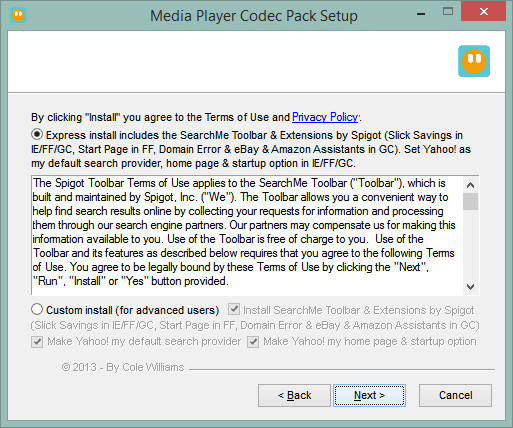
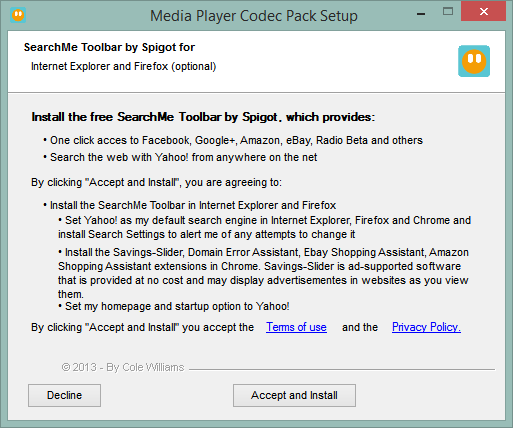
    Even I have to be constantly on my guard that I’m not inadvertently letting something else in along for the ride when downloading and installing software. The latest example is the set of codecs that I use to handle media. I’ve been using the Media Player Codec Pack. The previous version (4.2.9) attempted to persuade me to install some crapware along with the codec pack. Fortunately, the Accept/Decline choice was straightforward.

    MPCP 01

    The latest version (4.3.0) has changed tactics. This time it attempts to sneak in by expecting the user to choose the “express installation” route, as most people invariably do

    MPCP 02

    I’m not sure that I would define an “advanced user” as someone who doesn’t want crapware installed on their computer. I would have thought that this would also apply to non-technical users as well. This may well be is the last time I use this particular codec pack. I don’t like this sort of tactic.

  • RIP Stuart

    Stuart Hall died today. As the Guardian obituary says:

    Hall was always among the first to identify key questions of the age, and routinely sceptical about easy answers. A spellbinding orator and a teacher of enormous influence, he never indulged in academic point-scoring. Hall’s political imagination combined vitality and subtlety; in the field of ideas he was tough, ready to combat positions he believed to be politically dangerous. Yet he was unfailingly courteous, generous towards students, activists, artists and visitors from across the globe, many of whom came to love him. Hall won accolades from universities worldwide, despite never thinking of himself as a scholar. Universities offered him a base from which he could teach – a source of great pleasure for him – and collaborate with others in public debate.

    It’s a great loss. It was only a couple of months ago that I was walking through the woods listening to a podcast of a discussion between him and Laurie Taylor and being impressed anew at his insight.

    For an overview of his work and thought, this article, also in today’s Guardian, is a good start.

  • Nasty, Brutish, and Wrong

    The Guardian published an opinion piece by Kevin McKenna last Saturday: Scotland’s assisted suicide bill is an offence to our human dignity. Frankly, if anything was an offence to human dignity, it was this piece of invective. But then again, McKenna is an executive editor of the Daily Mail in Scotland. Says it all, really. The Guardian should be ashamed at publishing such tripe. I see that the comments pretty much call out the piece for the bullshit it is.

    I am thankful that I live in a country where I can ask for a peaceful death, should it prove necessary, and where safeguards exist to protect the vulnerable.

  • My Head Hurts

    The saga of trying to get Microsoft’s Customer Support to fix an issue with Martin’s Microsoft Account rolls on. It’s been over three weeks now, and it still hasn’t got sorted. It’s not helped by the fact that the “Advocacy Specialist”  assigned to the case apparently doesn’t bother to read his emails or respond to voicemails. He’s now claiming that the issue has been fixed, when it hasn’t, and so far I’m unable to reach him to disabuse him of his notion.

    I’m thinking that the next step will be a formal letter of complaint plea for help to Rob Warwick in the Xbox EMEA Senior Advocacy Team. At least he managed to get a similar issue with my Microsoft Account sorted.

  • Out With A Bang

    The third series of Sherlock closed with a thundering good episode last night. Lucy Mangan’s review says it much better than I ever could, so go and read that. I’ll wait until you get back.

    The cliffhanger this time around is the revelation in the closing seconds that apparently suggests that Moriarty faked his own death, and is back to take his revenge. Personally, I rather doubt it. I’m more inclined to go along with the theory that because Sherlock knew that being sent undercover would result in his own death within six months, he has engineered the apparent resurrection of Moriarty in order to bring himself back to London and out of the undercover mission.

  • A Camera With A Phone Attached

    I dabble in photography, but I’d hesitate to call myself a photographer. Nevertheless, I invested in a Canon EOS 300D back in 2005, and replaced it with a Canon EOS 450D in 2008. Along with the cameras came investment in four lenses to cover a range of situations. I’ve been very satisfied with the equipment, despite having to spend 145 euros on a repair to the electronics in one of the lenses that failed during a shoot.

    However, having to lug the camera bag with a selection of lenses around means that I have to make a deliberate decision whether to take the camera with me if I’m going somewhere. That’s the advantage of point-and-shoot cameras; they are portable enough to slip into a pocket and be available at all times. Of course, the quality is not comparable with a DSLR. Martin has a Canon IXUS 300 HS, and I sometimes find that I borrow that rather than have the hassle of lugging around the Canon EOS and lenses.

    Meanwhile, smartphones have been in a race to improve the quality of the photos they made. I entered the race two years ago when I bought a Nokia Lumia 800. The quality and resolution of the Lumia was not quite up to that of the IXUS, but at least I had it with me at all times. Then, last July, Nokia introduced the Lumia 1020, which has a staggering 41 Megapixel image sensor.  To be fair, Nokia had also introduced the Nokia PureView 808 smartphone 18 months previously, which had a similar specification. However that smartphone runs the Symbian operating system, and represents an ecosystem that I have no interest in. The imaging technology that had been introduced in the PureView 808 was further tweaked for the Lumia 1020 to produce image quality that far outstrips any other smartphone. So the Lumia 1020 was the flagship phone at the time of introduction, and it commanded a flagship price – too rich for me. But six months is a long time in the smartphone market, the prices started to fall to the point where I became tempted. In the dying days of 2013, I purchased my own Lumia 1020.

    The Nokia Lumia 1020, like the Lumia 800 before it, is a Windows Phone, so I was able to move all my information and applications across without issue. The prime differentiator for me is the camera. It’s clearly not at DSLR quality, but it’s good enough for me for most occasions. If you want a comparison, then this article: Smartphones versus DSLRs versus film: A look at how far we’ve come, is highly recommended. A few choice quotes:

    When I first saw the images from the Nokia Lumia 1020, I did a double take. Clear and crisp, lots of detail and super strong colors that you’ll either love or wince at. I loved them. And did I mention the detail? After years of seeing bigger cameras perform better, I couldn’t believe that a tiny plastic and glass Zeiss lens could resolve so much from the center to the edge of the image. It was close to the Nikon D800. I was stunned. I’ll list the shortcomings of the Nokia below, but first, some more stand-out results.

    How many years are smartphones behind the best $2,000 DSLRs? Comparing detail resolved, I’ll say the iPhone 5S currently sits 8-9 years behind the DLSRs in bright light, while the Nokia trails by less than 6 years — probably nearer to 3. This is even when you allow the DSLRs the luxury of a $1,700 lens, and shooting in raw. In bright light, the Nokia came close to competing with the detail from the best DLSR yet made.

    The Nokia 1020 has redefined what I thought possible from a phone. I used to think of smartphones as a separate branch of ‘wannabe’ cameras, doomed to forever play catch-up with real cameras. I used to think like Takafumi Hongo, a Canon spokesperson who told the Wall Street Journal “Taking photos with smartphones and editing them with apps is like cooking with cheap ingredients and a lot of artificial flavoring. Using interchangeable [lens] cameras is like slow food cooked with natural, genuine ingredients.” He has a point. With a smartphone you’ll miss a lot of the joy of learning to cook traditionally. But in photography, the important ingredients come from you. Smartphones are now good enough not to need artificial flavoring from apps.

    I look forward to wielding my new camera that happens to have a phone attached to it. It will always be in my pocket, ready to hand.

  • Head, Meet Brick Wall…

    Customer Support, the phrase that all too often seems to take on oxymoronic overtones.

    Once again, I’m currently battling Microsoft’s Customer Support services in an attempt to fix an issue on Martin’s Windows Phone.

    I’ve recently invested in a Nokia Lumia 1020 (of which more in another post), and passed on my old Nokia Lumia 800 phone to Martin. It’s been reset, and is now installed with the Dutch Language and has its region set to the Netherlands. I added Martin’s Microsoft Account details to it, and all seemed well. The phone started displaying his emails, his contacts and his calendar correctly. But there was a snake in the grass.

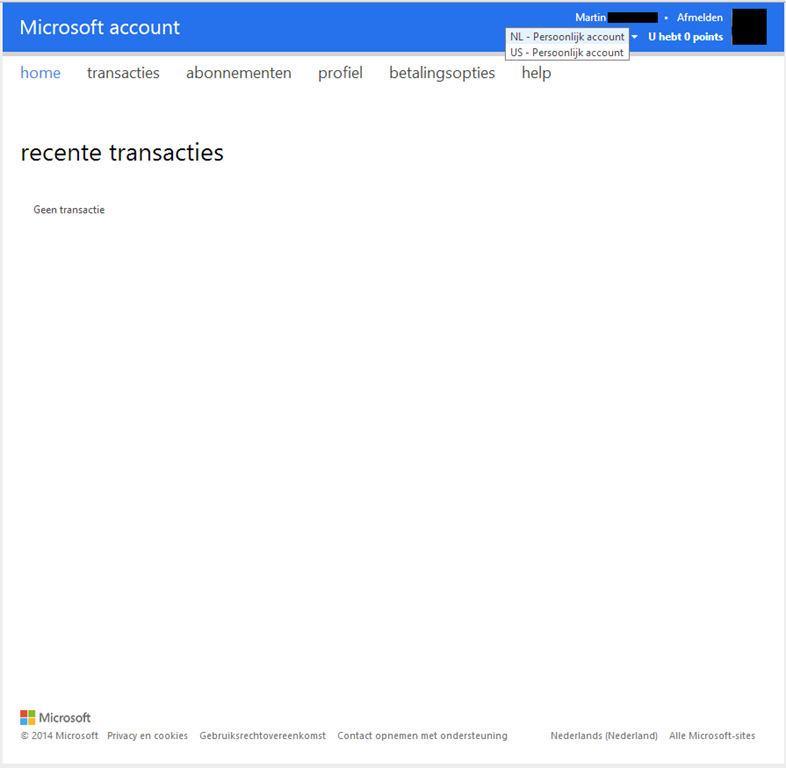
    We attempted to install a couple of Apps from the Marketplace onto the phone, and discovered that the phone was displaying the contents of the US Marketplace, not the Dutch one. Any attempt to purchase an App was met with the message that a payment method needed to be set up, which I found a bit odd, since that has already been done for Martin’s Microsoft Account. Further investigation revealed that his Microsoft Account has got two billing accounts associated with it: a Dutch account (which has the payment options set up) and a “ghost” US account, which has no payment accounts associated with it.
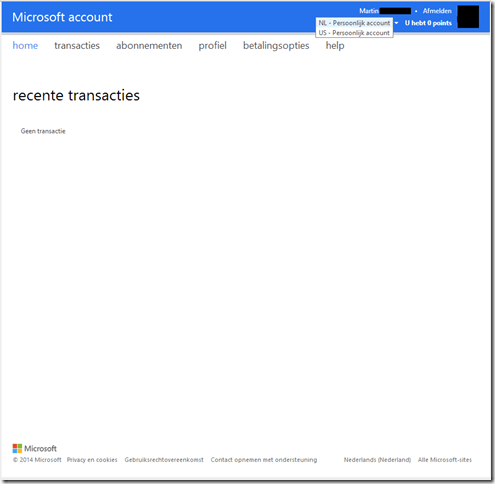
    Xbox Account 01

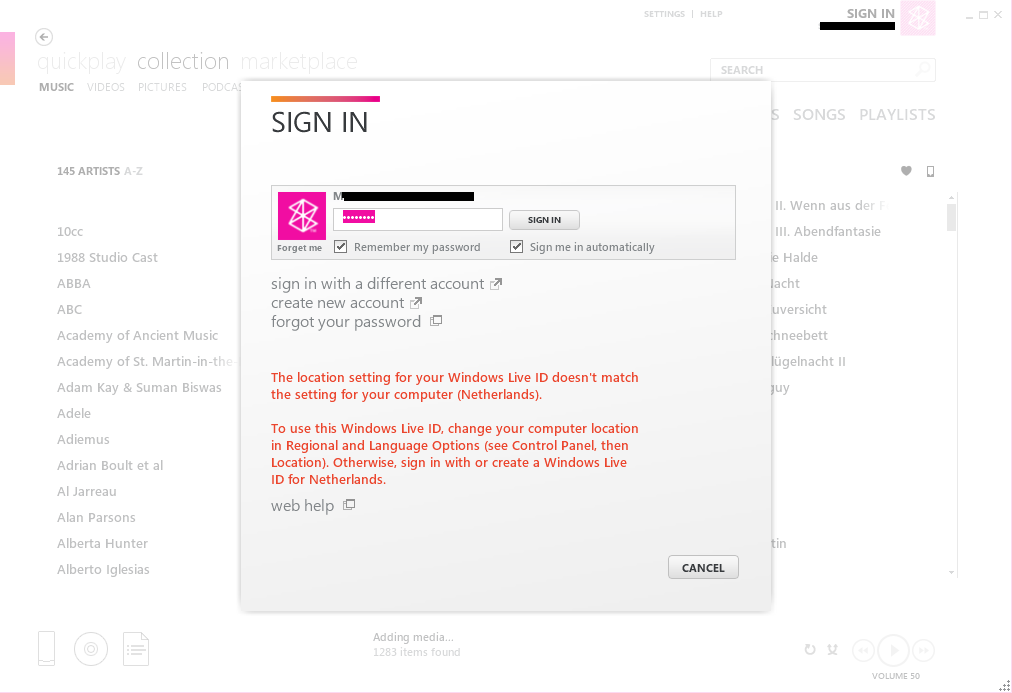
    This ghost account probably got created years ago when Martin first created his Windows Live ID (which subsequently became known as the Microsoft Account). It’s lain unnoticed until now, when Martin’s Windows Phone has decided that it will use it instead of the Dutch account. The phone uses Microsoft’s Zune software on the PC to synchronise content between the PC and the phone, and this also showed that it was attempting to use the US account instead of the Dutch one.
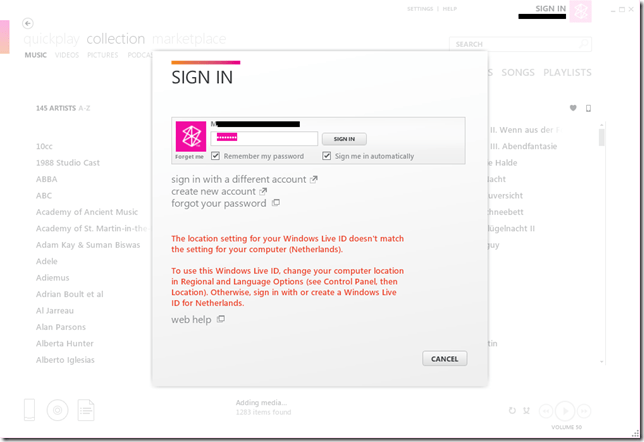
    Zune 01

    It was with a sinking heart that I saw all this, because I had exactly the same issue with my Windows Live ID – a US billing account was created some years ago, even though I live in the Netherlands. That took eighteen months of battling Microsoft to get it resolved. Things have moved on, so perhaps it would not take so much effort this time around?

    I posted a request to have the issue resolved on the Windows Phone Customer Support site. The first response from a Support representative understood the issue and believed the resolution to be “relatively  simple and painless”.

    Cue hollow laughter.

    I could see the logic behind his suggestion (changing the region of the Xbox Live account), but when we tried it, we found that it wouldn’t work for our situation. The reason was that Martin’s Xbox Live account is already set to the Netherlands region. So, back to Customer Support. He suggested several alternative support routes, with as a final resort, a live chat with Windows Phone Support. Needless to say, we rapidly ended up trying the final resort.

    I started a live chat via the Netherlands page of Windows Phone support and ended up chatting with a support rep in the US (or at least somewhere where they don’t understand Dutch). She directed me to call Microsoft Support here in the Netherlands, who were worse than useless – the Dutch support rep insisted I would have to take up the issue with Nokia Support. Fortunately, the US rep was waiting until I had called the Netherlands number, and since I had got nowhere, I asked for the issue to be escalated. She agreed, and said I would receive an email from Microsoft within 3 working days.

    It arrived yesterday – head, meet brick wall. It said:

    The senior team could not find any reason for this behaviour other than the account region. So we kindly ask you to refer to the Account support to clean and fix any relation of your account with other countries.

    Account support link:

    https://support.microsoft.com/oas/default.aspx?gprid=15834&st=1&wfxredirect=1&sd=gn

    Global Customer Service phone numbers
    http://support.microsoft.com/gp/customer-service-phone-numbers/en-gb

    The Account Support link merely asks me a couple of questions, and then unceremoniously dumps me in the Office forum of Microsoft Answers, where I know this issue cannot be resolved.

    The Global Customer Service numbers just gives me the Netherlands support number, and as I learned, they cannot help us. The support person I spoke to insisted that I should take the issue up with Nokia, even though this is clearly a Microsoft Account and billing issue.

    I know that the problem is caused by the account region – it’s the fact that there is a US billing account associated with Martin’s account alongside his NL account. We need to get that US account deleted, or merged with the NL account. I cannot use the Xbox Live migration technique, because Martin’s Xbox Live account is already in the Netherlands.

    This resolution can only be done by someone in Microsoft.

    I have replied to that email with these points, but somehow I get the feeling that I’m shouting in deaf ears.

    Customer Support? Gone missing in action in this case.

    Update 9 January 2014: I decided to go into battle with Microsoft’s Customer Support again today, since I had heard nothing back from my last contact. Today, I got bounced around four completely different departments in a combination of Live Chats and telephone calls. I journeyed through Windows Phone Support, Microsoft Account Support, Office Billing Support and Xbox Live Support.

    The telephone call was with Office 365 Billing Support, and the person I spoke with expressed surprise that I had been referred to them. Me too, since we don’t use Office 365. I had said as much to the person in Microsoft Account Support, but she assured me that it was the correct department.

    No, it wasn’t.

    The last person I was in contact with in Xbox Live Support has escalated the issue once again, this time to yet another team – the Advocacy Team, so cross fingers, it might have a better outcome than the last attempt to get this resolved.

    Update 10 January 2014: Another day, another failed attempt at getting a resolution. We had an email reply from the Advocacy Team yesterday, but it failed to resolve anything. None of the suggested steps were either relevant or helped to attack the issue. The whole point is that nothing that either Martin or I can do with his account settings will delete the false US account. That can only be done by someone in Microsoft.

    So, back once more to Customer Support Live Chat. Today’s representative, Vincent, promised to pass the message back to the Advocacy Team that we had not got the issue resolved. He also suggested that I reply to the Team’s email with a complaint. He claimed to be certain that someone would read it. However, I doubt it. It’s never worked before, and I note that at the bottom of the email it says:

    This email is sent from an unattended address.  Please contact Xbox Support directly if you have any questions or concerns.

    I hold out but faint hope that anything will get done…

    Update 13th January 2014: This evening I had an email from a member of the Customer Advocacy and Exceptions team at Microsoft, who is looking into the issue. Cross fingers, we may be getting somewhere…

    Update 17th January 2014: This evening I was called by the team member. He said that the ghost account should get removed sometime during the next few days. It’s looking good…

    Update 24th January 2014: I suppose I should have learned by now that these things never go smoothly. Here we are, a week later, and still no sign that the issue has been resolved. Emails and telephone calls to the team member supposed to be responsible for the issue go unanswered…

    Update 29th January 2014: This is beginning to get truly annoying. I noticed on Monday that the US billing account had been removed. However, the Windows Phone and Zune were still locking onto it. I even tried resetting Martin’s phone to its factory settings, but that made no difference whatsoever. I sent an email stating this to Robert L., the “Advocacy Specialist” assigned to the case. Today, two days later, I get an email from him saying:

    It appears our Team was able to remove the US account from your partner’s account. You may need to restore the phone to factory settings before the issue is completely disappeared, but they have reported that your account should be fixed.

    Let me know if your issues persist.

    Well, yes, they do and I had told him this, so it would appear that Robert L. does not read his emails. I tried calling him (again). Once again he was not available, and his voice mailbox is full, so I can’t leave him a message. Just as well I suppose, or I would have given him an earful.

    Update 30th January 2014: I thought I would try restoring Martin’s phone back to the Factory Settings one last time to see if the issue has been fixed. Nope. It is still there. Interestingly, for the first minute or two, I saw the Dutch Marketplace on Martin’s phone, but then it was once again replaced with the US version. See this photo of my phone (the Nokia 1020 on the left) and Martin’s phone (the Nokia 800 on the right). They are both displaying the entry screen for the Marketplace. My phone is showing the Dutch Marketplace (called the Store), while Martin’s phone is showing the US Marketplace (with the extra US-only entry of Podcasts). Ironically, it’s showing the US Marketplace in Dutch…
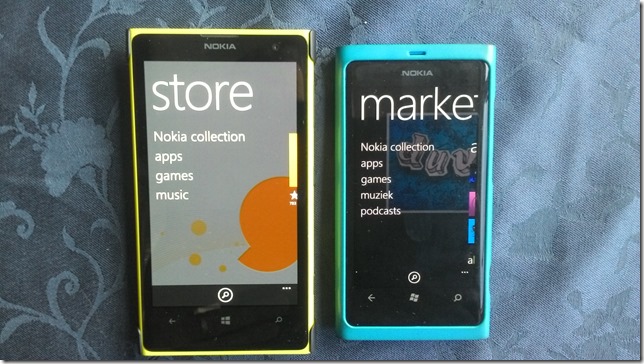
    WIN_20140130_164053

    There is something in Microsoft’s services infrastructure that the Windows Phone (and the Zune software) is locking onto which is saying that Martin’s account is in the US when it is not… Robert L’s voice mailbox is still full, and he never seems to answer his phone or emails, so there seems little hope that he will resolve the issue. Next step: a plea for help to Rob Warwick, head of the Xbox EMEA Senior Advocacy Team, I suppose.

    Update 7th February 2014: We’re no further forward. The problem is still there, Robert L. doesn’t respond to emails, never seems to be in the office, and still has a full voice mailbox. I’m posting the plea for help tomorrow. It’s my last resort.

    Update 12th February 2014: Perhaps it’s coincidence, but I received an email from Robert L. yesterday evening. He wrote:

    It appears that a service or software Martin is using is or was set to a US Region, which is automatically generating a US Billing account for his Microsoft Account (MSA). I was informed that this can happen from the Zune software, Surface, Windows 8 marketplace, and Xbox Marketplace.

    E.g. Using a US region Surface, and accessing Windows 8 Marketplace will generate a US Region account on the MSA.

    Per our support page: http://support.microsoft.com/kb/2692008

    “2. If the Microsoft account used for signing in was previously used for Xbox LIVE, Zune, or a premium service, the account locale will default to the locale of the service.”

    In regards to the issue with, particularly, your region of the Windows Phone marketplace, if we are not able to determine the root source of the auto-generation, and then change its Region, it may be in Martin’s best interest to create an MSA intended just for accessing the Windows Phone marketplace that is separate from the MSA in question. He can then set up the account in question as his secondary account.

    As far as we are aware, Martin has never previously used Xbox Live, Zune, or a premium service, yet his Microsoft Account is clearly set to the US locale. I suspect it is simply because his Windows Live ID was set up years ago when only the US locale existed as far as Microsoft was concerned, and so the associated service account has a US locale.

    Be that as it may, the suggestion that Martin now create a new Microsoft Account solely for his Windows Phone is also not acceptable for the following reasons:

    1. Martin would end up with multiple online identities (the MSAs), and multiple service accounts – one of which would still be holding incorrect data.
    2. It also seems to us that Microsoft would also be contravening EU law on Data Protection, by not correcting false data that they hold on Martin.

    If Microsoft cannot change the locale of the service account, then surely they can follow the procedure that was done for my MSA, which I had already outlined in an email to Robert L. on the 20th January: Microsoft simply creates a new temporary email address that would be attached to Martin’s old service account, thus freeing up his existing MSA to create a new service account (with the correct data). The old service account, and the temporary email address, would then be deleted by Microsoft.

    I’ve replied with these points to Robert L.’s email, we’ll see whether I get any response.

    Update 18th February 2014: No response from Robert L. to my last email; just like all the other null responses. However, yesterday I noticed that Martin’s Phone was now accessing the Dutch Marketplace. So, at long last, a result! Strangely enough, the Marketplace entry page is still showing the US-only “Podcasts” menu item, but Martin is now able to browse, and purchase, Apps from the Dutch Marketplace, so we consider the issue resolved. I sent him an email to this effect.

    Update 20th February 2014: Today I received an email from Bella D., who apparently works in the Xbox Global Escalations Executive Team – yet another department. She wrote:

    I am taking over some of Robert’s case [load] and I will be working with you with the problem that you have been experiencing.

    I read your last email and Robert’s notes. It seems like the issue has been resolved on your end. Would you please confirm if that is still the case?

    That would seem to imply that all my former emails had indeed been received, but never responded to. An acknowledgement would have been at least something. I replied to Bella:

    I think we can say that the issue has been resolved. There is just the oddity that the Marketplace App on Martin’s phone is also displaying the US-only Podcast list alongside the Dutch Apps list. However, the main thing is that he can now browse the Dutch Marketplace and purchase Apps from it – which is what we’ve been asking for. So long as that continues to be the case, then the issue has been resolved.

    Hopefully, we can now close this saga. It’s taken six weeks, but that’s a blink of the eye compared to the eighteen months it took the last time we went through this…

  • So That’s How He Did It – Maybe…

    Sherlock returned to the TV screen last night with an episode containing the solution as to how he faked his own death at the end of the last series. Well, to be more accurate, the episode contained at least three possible solutions. However, two of them were explanations provided by secondary characters, which I think can be discounted – particularly the one involving a gay romance between Moriarty and Holmes.

    No, the one that is most probably true was the one recounted by Holmes himself. Of course, part of the reason why I want that to be the real story was because it was the theory that I came up with when I first saw The Reichenbach Fall a year ago. When Holmes confirmed all the points I had listed I punched the air with a loud shout of Yes!

    I thoroughly enjoyed the whole episode, which was a real cracker.