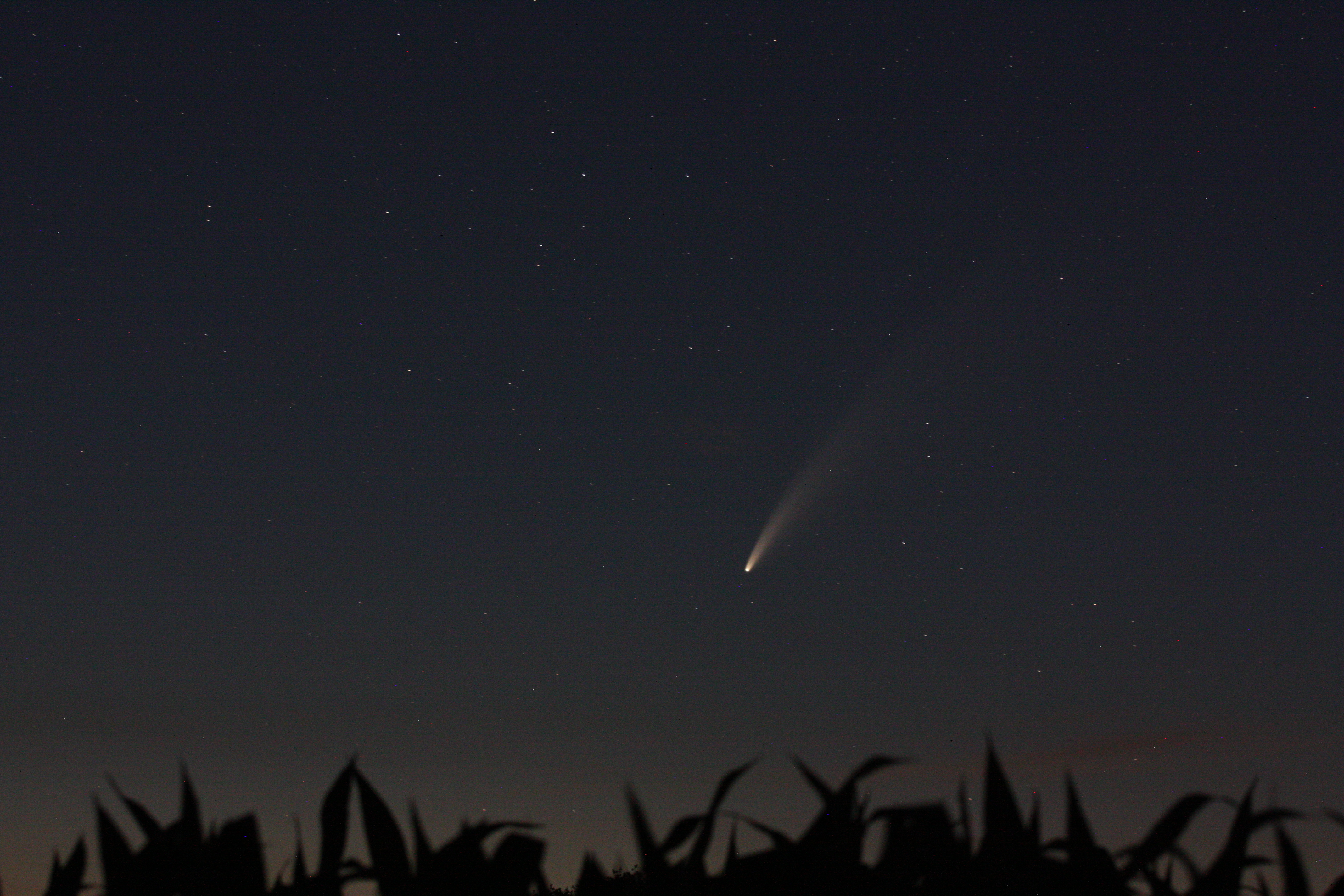
There’s a field of maize at one side of our garden. Last night comet Neowise was clearly visible above the field.

Reflections on life at “De Witte Wand”…
There’s a field of maize at one side of our garden. Last night comet Neowise was clearly visible above the field.
For the past 25 years, the folks behind Astronomy Picture of the Day have been providing a daily astronomical image or video that illustrate the beauty of science. Congratulations to them…
I use their Apps to set a new daily wallpaper on all my screens – PCs, laptops, tablets and smartphone. Thank you for all the images.
Today was an opportunity to see a partial eclipse here in the Netherlands. Unfortunately the weather gods were not smiling. Much of the country had cloudy skies.
Here in the Achterhoek, there were not only cloudy skies but heavy mist. So in a sense, we had not only a missed eclipse, but a mist eclipse. When I took the dogs out for their morning walk, we were surrounded by mist; not a chance of even a glimpse of the sun. We went for a walk in the woods at around the time of the eclipse. It was very noticeable how it became much darker during the maximum coverage of the sun by the moon, and then the day returned to normal brightness as we returned home.
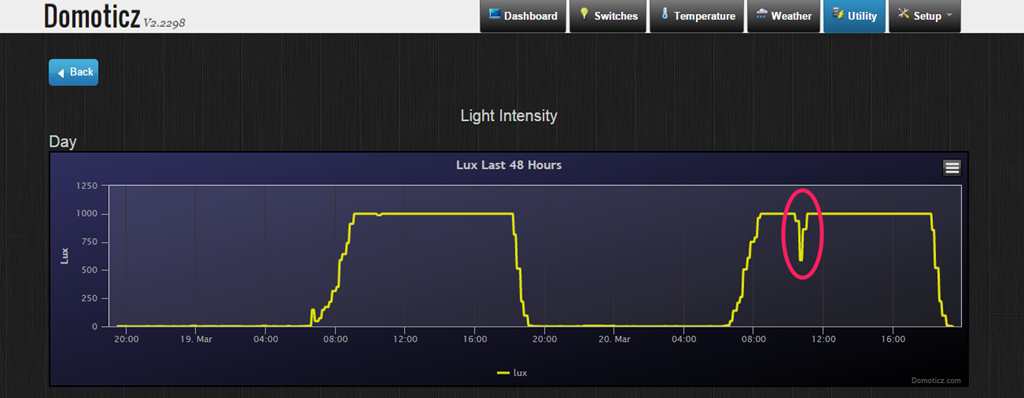
Therefore, even though I was not able to observe the eclipse directly, I certainly had indirect evidence that something was afoot. In addition, one of our outside motion sensors (part of our Home Automation installation) has a light sensor. The readings from that today clearly show how the light from the sun was obscured during the moon’s transit:
A rather impressive short film, with the always impressive words of Carl Sagan. I won’t live to see these scenes in reality, but hopefully some of our species will.
I watched Particle Fever last night. It’s a documentary about the Large Hadron Collider and the search for the Higgs Boson.
It’s staggeringly good.
Equally staggering is the scale of the physics experiment that the LHC embodies. It’s probably the largest experiment ever constructed by humans; built with a budget of 7.5 billion euros by over 10,000 scientists and engineers from more than 100 countries. The documentary easily delivers a sense of awe at the scale of the endeavour, but, more importantly by following six physicists over six years, also gives an insight into the purpose of the project and the passion of the people for the physics behind it.
Physicists fall into two camps: the theorists and the experimentalists, and both were represented in the documentary. Whilst all the featured physicists were interesting and engaging, I was particularly struck by two of them: experimentalist Monica Dunford (who came across as being exactly like Dr. Ellie Arroway, the character played by Jodie Foster, in the film Contact) and the theorist Nima Arkani-Hamed. His explanations, together with those of David Kaplan, another physicist and producer of the film, managed to make the physics clear to me, and pointed out the struggle of theories going on – supersymmetry versus multiverse – that the LHC experiments aim to resolve through discovering and understanding the Higgs Boson.
What I find fascinating is the way in which supersymmetry almost implies support for the strong Anthropic principle (the suspicion that someone/something is twiddling the knobs of the universe to fine-tune physical laws and constants so that the universe as we know it can actually exist). The Multiverse theory, on the other hand, removes the need for all this knob-twiddling, since it posits that our universe, with its particular knob settings, is just one possibility out of a myriad of alternative universes that might exist.
It was hoped that, if the Higgs Boson were to be discovered by the LHC experiments, then this would go some way to favouring one of the above opposing theories. Unfortunately, like some cosmic joke, the data that the LHC has given us about the nature of the Higgs Boson is almost exactly sitting on the fence, with neither theory being able to be declared the outright winner. This is like ascending a mountain, only to discover when you’re at the peak, that it is merely a foothill of some larger chain. If you have passion, as these physicists clearly demonstrate, this will simply act as the spur to drive you on further.
At a time when both religion and politics are increasingly demonstrating their most baleful influences on humanity, it warmed the cockles of my misanthropic old heart to see a scientific endeavour on the scale of the LHC uniting thousands in a common search for knowledge.
I spent a hour or two outside in the garden looking for evidence of the Perseid meteor shower. I really should have been out on Monday – when the shower was at its peak – but, as usual, cloud cover won the night.
I saw a few (less than ten), but I couldn’t help feeling that the Perseids are a bit overrated. They were both fast and faint; not very spectacular. By coincidence, I was out walking the dogs just after 10pm, when it was getting dark, and I saw an absolutely spectacular slow-moving meteor (not a Perseid) that went from the zenith almost down to the northern horizon, leaving a trail for half of its flight.
During the observation of the Perseids, I attempted to make one of those time lapse films that are very popular these days. The Guardian has an example of one of these films, but they rather spoiled it by saying that the objects streaking across the sky are Perseids. Nope – they’re either aircraft or satellites.
I was struck last night by just how many satellites are visible to the naked eye – flitting about in all directions. Several of them also displayed flaring – as the sun catches their antennae or solar panels – the so-called Iridium Flares. That almost made up for the disappointment in the Perseids.
The moon has stirred the imagination of humans for millennia. It still does. Here’s a view of the rising moon captured by Mark Gee. Worth watching.
Full Moon Silhouettes from Mark Gee on Vimeo.
(hat tip to Jerry Coyne)
So Sir Patrick Moore has died – at the age of 89. I can’t say I’m surprised, he has not looked at all well in his recent Sky at Night programmes, but it is still sad news.
I grew up watching the Sky at Night – it introduced me to Astronomy – and I still have my dog-eared copy of The Observer’s Book of Astronomy, authored by Patrick Moore F.R.A.S., F. R. S. A. He inspired generations of children to look up, wonder at, and, above all, observe the heavens. He was an amateur in the true sense of the word, and one whose meticulous work advanced our understanding of the moon in particular.
The next time I look up and see the moon in a clear night sky I shall remember him with affection and respect.
The Perseid meteor swarm reached its annual maximum at around 14:00 yesterday afternoon (local time) on the 12th August. That meant that for the past couple of nights (and hopefully tonight) the chances of seeing a meteor streak across the sky have been substantially increased.
So far, I’ve had a couple of attempts at observing. I was out at 04:00 on the 12th (I couldn’t sleep), and I did see many meteors. However, I was singularly unsuccessful at capturing any of them with my camera.
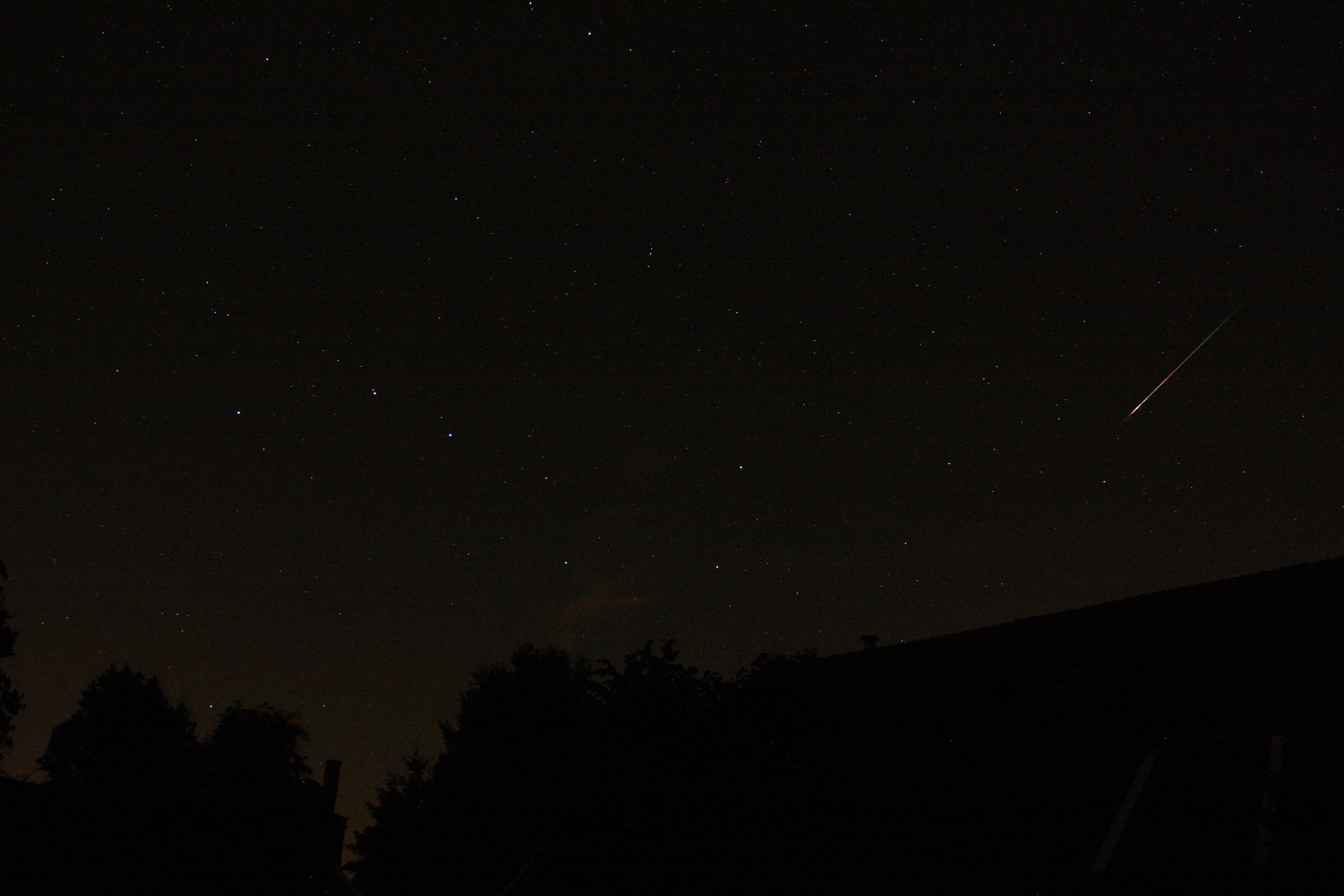
Last night, I tried again at about 00:30 for an hour or so. It seemed to me that the rate of meteors had fallen away considerably from the night before, but I did manage to capture one with my camera. It’s not a very good photo, but it does show Ursa Major (the Plough) over the house, with a Perseid streaking in from the right of the frame.
Yesterday, a man ran 100 metres in 9.63 seconds. This morning, a robot laboratory successfully landed on Mars and will begin its search for evidence that life may also have existed on a neighbouring planet.
Of these two stories, it’s the second that makes me feel more proud of what my species can achieve when it puts its mind to it.
And as one of the comments on the Curiosity Rover story says:
Oh man, that was so cool!
They basically just parked a Volkswagen Beetle on a predetermined spot on another planet more than 150 million miles away by lowering it with ropes from an almost hovering jetpack.
Just like that.
Of course, ordinary folks like me in the nation that managed such a feat still can’t afford healthcare insurance, and Texas is about to execute someone with an IQ somewhere in the 60’s.
Goddam, this is one crazy fucking world, ain’t it? You couldn’t make this shit up, y’know?
Quite.
Ever since I was a small boy with an interest in astronomy, I’ve wanted an Orrery.
Today, 55 years further on, I’m no closer to owning my very own Orrery than ever I was.
Still, hope is on the horizon. Dr. David Brown has been working on the 21st century’s equivalent of an Orrery with his NUIverse designed for Microsoft Surface. I reckon it will be between 5 and 10 years before this trickles down to Windows 8 Tablets.
I might just be able to make it before I die.
I found it hard to suppress a titter, let alone a guffaw of derision, when I read today that the Astrological Association of Great Britain is sending a petition to the BBC. In one of the brilliant Stargazing Live programmes broadcast at the beginning of the month, the presenters (Dara Ó Briain and the physicist Brian Cox) made statements to the effect that astrology is rubbish.
Gasp! Who would have thought it?
This shocking revelation has spurred the AAGB into outraged action. Their petition is requesting that
the BBC make a public apology and a statement that they do not support the personal views of Professor Brian Cox or Dara O’Briain’s on the subject of astrology. We also request that the BBC will commit to making a fair and balanced representation of astrology when aired in the future.
It seems to me that the views of Cox and Ó Briain were a perfectly fair and balanced representation of astrology. Nothing more needs to be said.
Well, I had a spot of luck after all last night, despite the fact that we had snow showers and the sky was cloudy during the evening. I woke up at 03:30 am and found that the sky was cloudless, although it was a little misty. However, I was able to see Orion, Taurus and the Pleiades quite clearly through the window, so I settled down to watch for an hour. I chickened out of getting dressed and going outside – it was –5C.
I tallied 21 meteors and three planes during that time, so it wasn’t entirely wasted effort.
It’s the peak of the annual Geminid meteor shower tonight. I’m hoping that there will be clear skies here, but at the moment we have snow showers passing through, so it’s highly probable that 2010 will be another missed opportunity. Sigh.
Here’s a stunning time-lapse video made by Stéphane Guisard of the night sky at the Paranal Observatory in Chile. Do watch it at the full 1080p resolution and in fullscreen mode for the best effect. Seriously beautiful. I just wish that the night sky around here was as clear, but alas there’s simply too much light pollution here in the densely populated Netherlands.
(hat tip to The Bad Astronomer)
Last Thursday night was the peak of the annual Perseid meteor shower. The sky was reasonably clear, so I stayed out for about ninety minutes at around midnight. I saw a number of Perseids, but nowhere near the 60 per hour that had been forecast. I did see an Iridium flare, which was rather satisfying.
I was also trying to photograph the meteors. This involved having the camera on a tripod, pointing the camera at the sky and taking a succession of 30 second exposures. By Murphy’s Law, the camera was never pointing at a part of the sky where a meteor happened to appear during an exposure…
Not everyone was as unlucky. Here’s a great shot from reway2007:

 Geoff Coupe's Blog