Reflections on life at “De Witte Wand”…

Category: Books

  • From the Sublime…

    …to the ridiculous. After the glories of Zafon’s The Shadow of the Wind, I hesitate to mention the name of Dan Brown, but Geoffrey Pullum over at the Language Log drags me crashing back to earth with yet another example of Brown’s atrocious writing. Yup, Pullum is going to don the decontamination suit and venture into the hideous depths of Brown’s Digital Fortress.
     
    It looks like it’s going to be eyebrows arched all the way in…
  • The Shadow of the Wind

    That’s the translated name of a novel by Carlos Ruiz Zafon. The Spanish title is La Sombra del Viento.
     
    I first came across it when it was mentioned in a blog by a someone working in the Far East. It sounded intriguing, so I added it to the list of books to read.
     
    I’ve just finished it, and I can thoroughly recommend it to people who like both books and Barcelona (a near-perfect combination, as far as I am concerned). The book starts with such an arresting idea (a child is taken by his father to a mysterious building housing the Cemetery of Forgotten Books, and is told to choose a book to read). That the book takes root in his life and those around him is almost inevitable. The book was like a marvellous piece of machinery – a great steam locomotive  – that gradually gains speed and ultimately becomes an elemental force pursuing its inexorable course to the climax. I loved it. As the blurb on the dustjacket says: the subplots have subplots; but never once did I feel that Zafon was losing control of his material. This is storytelling with the simplicity and power of Dickens. Read it.
  • Secrets and Lies

    In today’s Guardian, Roy Greenslade – professor of journalism at London’s City University – reviews Dilip Hiro’s book: Secrets and Lies: The True Story of the Iraq War.
    "Hiro is painstaking as he holds up every piece of fake intelligence to scrutiny, revealing both its falsity and the propaganda use to which it was put. Every excuse advanced by Bush and Blair for the invasion is shown to be hollow, as they seek to conceal the main reason for their pre-emptive strike: the desire for regime change. In some of the most telling passages, Hiro reveals the key roles played by the sinister group who surrounded Bush, such as his deputy, Dick Cheney; Rumsfeld’s deputy, Paul Wolfowitz; the under secretary of defence, Douglas Feith; the defence adviser Richard Perle; the president’s chief political adviser, Karl Rove; and, of course, the national security adviser, Condoleezza Rice. Meanwhile, the senior man, Colin Powell, the secretary of state, was largely isolated from Bush’s gung-ho squad. Despite his policy disagreements however, he performed important tasks on behalf of the warriors, none more so than his lengthy speech to the UN Security Council in the build-up to the invasion. Hiro’s point-by-point rebuttal of Powell’s allegations is masterly."
    In summary, Greenslade salutes the book as a depressing but magisterial assessment of the reasoning that led to the invasion of Iraq.
     
    Another book for the library, I think.
  • Cryptonomicon

    Kieran Healey over at Crooked Timber is finding that reading Neal Stephenson’s Cryptonomicon is a hard slog. He’s got 100 pages in, and with another 800 pages to go is wondering whether he should bother.
     
    He’s not the only one. I managed to reach page 296 before I gave up in sheer boredom tinged with irritation at the smug writing. I notice that most of the people who commented on Kieran’s entry were also of the opinion that it’s just a bad book. Usually they claimed that his other books, e.g. Snow Crash were much better. Well, I did at least finish Snow Crash, but I can’t remember a single thing about it now. I don’t think that’s the mark of a great novel – it’s usually the mark of disposable summer reading.
  • Ladybird Books on Computers

    Ooooh! I remember Ladybird books! they were wonderful – in a bizarre sort of way. Now someone has scanned two versions of the Ladybird book of Computers and put them on the web to delight all lovers of serious camp (and computers, naturally).
     
    Golly.
     
    (hat tip to Boing Boing)
  • Sappho Speaks

    Sappho had a great reputation as a poetess in the time of the ancient Greeks, yet only three complete poems, plus fragments of verse, have survived to our day. So there’s great excitement over the fact that another complete poem (of 12 lines) has now been identified and published. The full story, by Martin West, emeritus fellow of All Souls, Oford, is published in this week’s Times Literary Supplement.

    The poem itself is a tiny masterpiece, describing the poetess’ feeling of growing old, while being surrounded by young women. She accepts her fate:

    This state I oft bemoan; but what’s to do?
    Not to grow old, being human, there’s no way.

    I know what she means…

  • When Librarians Become Barbarians

    OK, it’s not the end of the world, but naturally the story about a university library just dumping books in skips would tug at my soul, bibliophile that I am.

  • 2,083

    Following on from the last post, I now have 2,083 books – another package from Amazon dropped through the letterbox today.

    And, joy of joys, it’s "The Unbearable Lightness of Being in Aberystwyth" by Malcolm Pryce. This is the third novel by Pryce set in an Aberystwyth that hails from some parallel universe to our own. Reading the books is like reading Raymond Chandler crossed with The League of Gentlemen – noir, bizarre, and laugh-out-loud funny. The synopsis of this book will give you an idea:

    There was nothing unusual about the barrel-organ man who walked into private detective Louie Knight’s office. Apart from the fact that he had lost his memory. And his monkey was a former astronaut on the Welsh Space Programme. And he carried a suitcase that he was too terrified to open. And he wanted a murder investigated. The only thing unusual about that was, it took place a hundred years ago. And he needed it solved by the following week. Louie was too smart to take a case like that but also too broke to turn it down. Soon he is lost in a labyrinth of intrigue and terror, tormented at every turn by a gallery of mad nuns, gangsters and waifs and haunted by the loss of his girlfriend, Myfanwy, who disappeared one day after being fed drugged raspberry ripple…

    Pryce has a knack of writing sentences that become instant aphorisms, or that immediately conjure up strangeness – like looking at life in a mirror that ever-so-slightly distorts – or putting your foot down expecting a step that isn’t there… Examples from the first few pages in the book:

    "…there’s nothing lonelier than the bought smile of a harlot."

    "She was a small monkey, and very old, with fur turning white around the muzzle and deep sad dark eyes, like two wishing wells that hadn’t seen a penny in years."

    "I wouldn’t go so far as to say she smiled – she was a capuchin monkey and they generally keep their cards close to their chest – but a look of heightened interest was evident."

      Oooh, I think I’m going to like this novel as much as the first two…

  • Books and Reading

    As you might know, I like books. At the moment, I have 2,082 of them – a few dozen which I can hear calling out to me: "Read me, read me!" – while many more are whispering "No, re-read me!".

    I simply cannot imagine being someone who doesn’t read books if they have the opportunity to do so. And to be someone who actively disdains books – well, Farenheit 451 cannot be far away.

    And so, when I read Flea’s Too Many Books Isn’t Enough over at One Good Thing, I knew instantly what she meant.

  • Robert Sheckley – Back in the US

    One piece of good news: Robert Sheckley is now back home. As I reported here, Sheckley had been taken ill in the Ukraine and was unable to pay the medical bills for the Kiev hospital, or for a flight back home to the US.

    An item in today’s Russian News & Information Agency says that he was able to fly back home on last Friday. Mind you, it also says that the doctors weren’t happy with his condition (he has a serious respiratory disease), so perhaps the 76 year old author isn’t entirely home and dry yet. Here’s hoping that he pulls through.

  • Harlan Ellison

    Harlan Ellison is one of the authors I grew up reading. His Dangerous Visions were mind-expanding. His Glass Teat deconstructed TV before anyone else could see where things were going. So he’s always been something of a hero to me. There’s a good interview with him here. Once you’ve read that, read the other two parts, and get an inkling as to what makes him tick (-tock, tick-tock – the sound of the bomb just before it goes up in your face).

  • Robert Sheckley

    Robert Sheckley is an author of Science Fiction. I have a few books of his in my collection, of which I enjoyed The Alchemical Marriage of Alistair Crompton and The Journey of Joenes the most.

    Why am I telling you this? Because at the moment, Sheckley is apparently ill in a hospital in the Ukraine, and needs to be flown home to the US for further treatment. His medical insurance doesn’t cover this, and so his family is trying to raise the money. If you would like to help, you can find out more on Neil Gaiman’s blog.

  • The Lord Of the Rings – The Bookseller’s Tale

    When I was 17, I bought the three hardcover books that comprise The Lord of the Rings, by J. R. R. Tolkien. At the time (1966), the second, revised, edition had just been published – so my set was the first printing of the second edition. I’ve had the books in my possession ever since. They have been read three times, and with their original dustjackets, they are in very good condition.

    A few weeks ago, there was a TV programme on the BBC (20th Century Antiques) that featured the same edition of the books, and it would seem that they have some monetary value – the books on the programme were quoted as being worth £1,500. That piqued my interest, so I thought I would seek advice as to whether my books were in the same ballpark, or (knowing my luck) worth a couple of quid.

    I happened to be in the south of The Netherlands for our friends’ wedding, and nearby was Bredevoort – a small picturesque village that has a large number of antiquarian bookshops. So I took myself off to the village, lugging my set of The Lord of the Rings.

    I first visited the Pergamon bookshop, and explained I was seeking advice about the books. The bookseller examined them, and perhaps I was imagining it, but I swear his eyebrows raised ever so slightly. He said that indeed the books could be worth something, and went to a bookcase where he had a set of the first edition, eleventh impression (1965). These were on sale for €700. He thought that perhaps the first printing of the second edition would be worth less, but I recalled that on the BBC programme, the expert had said that because the second edition was revised, a first printing was still pretty valuable. Be that as it may, the bookseller advised that I should take them to the English Bookshop in the village, where Mr. Webb could give his advice. In any event, he advised me to be careful with the books.

    So, off I trundled, and found the bookshop and its owner to whom I showed the books. He examined them carefully (my tension mounting), and then casually offered me €15 per book.

    Er, excuse me? Now, I realise that a bookseller has to have a markup, but this does seem a trifle on the low side. I notice that there’s been an auction on eBay for a set of the books – a second printing of the second edition (so less interesting for collectors) that closed at the equivalent of about €300.

    So I declined Mr. Webb’s kind offer and trundled off with my books again.

    I’m in no hurry to sell these books, but I will continue to seek advice on their value. And they will remain unread – I have yet another edition of the books that I use when I return to re-read Tolkien’s masterwork.

  • The [Widget], the [Wadget], and Boff

    The mind is an amazing thing. I spent much of last night, both awake and asleep, with that phrase – the [Widget], the [Wadget] and Boff – running through my head. By this morning I had recognised it as the title of a Science Fiction story. A quick Google, and I had established it as a short story by Theodore Sturgeon from his “The Joyous Invasions” collection.

    Now why I should be thinking of that phrase, I have no idea. The last time I probably read that story was when I bought the Penguin paperback (complete with a front cover painted by Alan Aldridge, the fashionable illustrator of the time) way back in 1967.

    So I’ve just got the book out of the library upstairs (yep, I still have the book) to re-read. Perhaps that will give me a clue about last night.

  • Pop-Up Books

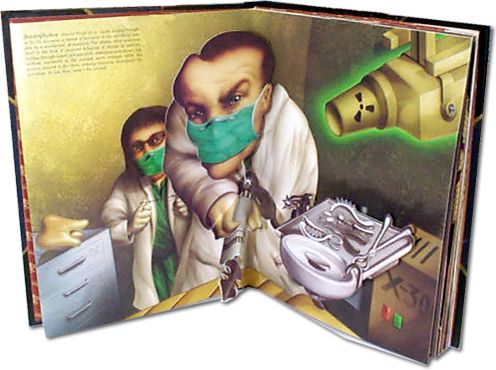
    I came across this site describing the history of Pop-up Books. Now, those who know me well, know that I love books – and pop-up books are a particular weakness of mine.

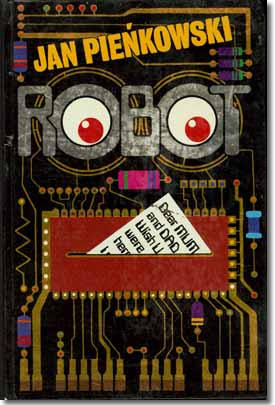
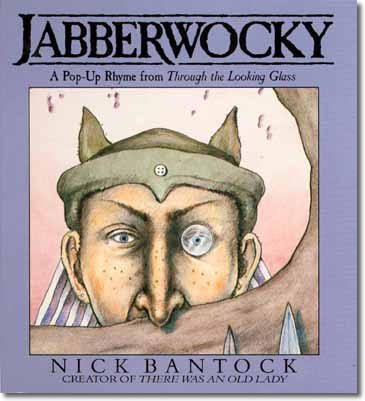
    I have been collecting them for a little while. Most of them are from the 1980s and later – for example – Jan Pienkowski’s Robot. Actually, I think that that is the book that got me started. Along the way, I’ve been collecting Nick Bantock’s series of Nursery Rhymes and books for the "older" reader such as the Pop-Up Book of Phobias. I don’t have any examples earlier than about 1950 – the one book that I have using the mechanisms of Lothar Meggendorfer is a 20th Century reproduction with a foreword by Maurice Sendak.

    I do like the creations by Ron van den Meer – who has worked on a series of education books such as The Architecture Pack, The Art Pack and the Brain Pack. I have refused to acquire The Parascience Pack because I refuse to support Uri Geller’s pseudoscience rubbish.

    But at the moment, I think one of the foremost paper engineers working in this field has to be Robert Sabuda. His Wizard of Oz and Alice in Wonderland are magnificent examples of their kind. 

  • Kitchen Confidential

    I’m currently reading Anthony Bourdain’s "Kitchen Confidential", which was recommended to me (thanks, Mike!). This is not your usual autobiography of a chef – this is a combination of a ride on the Ghost train crossed with a roller coaster through Hell. Simultaneously both laugh-out loud funny and a peer over the edge into the Abyss. Highly recommended.

    I am prompted to write this in part because Heston Blumenthal’s restaurant The Fat Duck in Bray has just been voted the best restaurant in the world by 500 experts around the world for Restaurant magazine. There is no doubt that Blumenthal is a culinary innovator, but I sometimes think that the line between worthwhile innovation and schlock shock is a thin one. It’s interesting that these same experts put the El Bulli restaurant in Spain at number two, a restaurant which according to a food-writer friend of mine, is simply a case of "the Emperor’s New Clothes".

    Oh well, only a complete of weeks to go before Martin and I make another pilgrimage to a restaurant that I know will deliver: Can Fabes.

  • Reimagined Romances

    Attention Chris and Ed – this one’s for you… The wry smile for the day.

    Take one copy of Photoshop, a pile of "Mills and Boon" covers, a little imagination, and these can be the results.

  • Books I don’t Intend to Read: The Da Vinci Code

    #1 in another occasional series.

    Sometimes, you get a bad feeling about books – particularly those that confront you in great piles as you walk into a bookshop. Just because a book is a bestseller is no guarantee that it’s actually any good. Barbara Cartland, for instance, sold shedloads of trashy romantic novels. Now that her dear pinkness has gone to the great remainder department in the sky, her mantle of bad writing would seem to have been inherited by Dan Brown. I mean, even the title of the book is nonsensical: "The Da Vinci Code". Da Vinci  literally means of, or from, Vinci, and it’s a prepositional phrase that needs to be attached to Leonardo  for it to make any sense.

    And so it was that I was pleased to read Geoffrey K. Pullum’s piece on the book on Language Log. A small sample: "Brown’s writing is not just bad; it is staggeringly, clumsily, thoughtlessly, almost ingeniously bad". 

    That’s a good enough reason for me not to want to read this book.

    Sometimes I do consciously search out trash, on the basis that "it’s so bad, it’s good". Plan 9 from Outer Space, for example. But it’s not something that I can do for long periods of time.

    I find it hard to imagine myself reading a whole book filled with mangled language like: "Five months ago, the kaleidoscope of power had been shaken, and Aringarosa was still reeling from the blow." As Pullum’s son said: What the fuck does that even mean? Perhaps Brown meant something like: "The kaleidoscope of power had been shaken and the orange-green pattern of courage had been consumed by the yellow-red jumble of fear"?