Damn.
Category: Books
-
Parenthood Is No Place For Perfectionists
While still shaking my head over the idiocy of David Jones, who claims that two same-sex partners cannot provide a warm and safe environment for their children, I came across a new book written by Andrew Solomon: Far From the Tree: A Dozen Kinds of Love. In it he:
tells the stories of parents who learn to deal with their exceptional children and find profound meaning in doing so.
He introduces us to families coping with deafness, dwarfism, Down syndrome, autism, schizophrenia, disability, with children who are prodigies, who are conceived in rape, who become criminals, who are transgender. While each of these characteristics is potentially isolating, Solomon documents repeated triumphs of human love and compassion to show that the shared experience of difference is what unites us.
Solomon is himself the gay child of straight parents, and is now, in turn, a parent himself. Here he talks movingly and lucidly about the nature of vertical identities (those that we inherit from our parents) and horizontal identities (those that we do not share with our parents, and which we develop through our peer groups). This short video is worth watching.
The Guardian’s Carole Cadwalladr also has an interesting interview with him.
His book is now on my list to get. Perhaps David Jones should also read it. He might learn a thing or two.
-
A Sad Day For Hedgehogs Everywhere
Ronald Dworkin has died. By coincidence, I listened last week to the podcast of Thinking Allowed, originally broadcast on 26 January 2011. In it, Dworkin discussed his book Justice for Hedgehogs with the philosopher A. C. Grayling and the sociologist Laurie Taylor. I thought at the time that I should get hold of the book, and now I definitely will.
-
Terry Pratchett
The New Statesman has an excellent interview with Sir Terry Pratchett. It is well worth reading. He’s not going gently into that Good Night; but instead with his head held up high and fearlessly facing the final curtain. I wonder if I could do the same.
Here’s Terry Pratchett’s award-winning documentary “Choosing to Die”
Please watch it.
-
The Book Mountain
After that last post, I needed something to give me hope. Perhaps the news of the opening of the Book Mountain and Library quarter in Spijkenisse, here in the Netherlands, is something to restore my spirits.
-
This Land is Mine
I’m currently reading (very slowly) Steven Pinker’s magisterial The Better Angels of Our Nature. It’s a history of violence in human societies, and his thesis is that violence has actually declined over the centuries. It seems difficult to believe, but Pinker marshals his facts and presents a convincing case.
And on the theme of the distressing fact that violence and humanity are inextricably locked together, here’s Nina Paley’s offering on that theme.
More about the film, Seder Masochism, together with a handy guide to who’s killing who, can be found on Nina’s Blog.
-
RIP, Harry
Harry Harrison has died. When I was going through my phase of devouring SF books during my teens and twenties, he was one of my favourite authors. On one level, his books could be read as action tales, but there was usually a serious underpinning. So Deathworld was underpinned by Darwinian selection, Bill, The Galactic Hero by an almost Swiftian satire, and Make Room! Make Room! by the question and consequences of human overpopulation.
But I think my favourite of his novels remains Captive Universe, which opens with a heartstopping sequence (quite literally) in an apparently Aztec setting. It develops into a thought-provoking tale about colonisation and eugenic control. Well worth reading.
-
Intricate Processes of Fantastic Horror
In the novel, The Midwich Cuckoos, by John Wyndham, one of the characters, Gordon Zellaby, says:
“I wonder if a sillier and more ignorant catachresis than “Mother Nature” was ever perpetuated? It is because nature is ruthless, hideous, and cruel beyond belief that it was necessary to invent civilization. One thinks of wild animals as savage but the fiercest of them begins to look almost domesticated when one considers the viciousness required of a survivor in the sea; as for the insects, their lives are sustained only by intricate processes of fantastic horror.”
Using that as a springboard, Kij Johnson has penned a page of unsettling ruminations: Mantis Wives.
Eerie, disturbing, and practically factual descriptions of the sex lives of the Mantis.
-
Cloud Atlas
“Cloud Atlas” is the name of a remarkable book by David Mitchell. A Russian Doll of a book, it contains stories within stories that link and arc to form a narrative that spans centuries and civilizations.
And now, it appears that a film of the book has been made. Even the trailer is almost six minutes long – it will be interesting to see how the film stacks up to the book. There are, at least, some good actors involved, so one can but hope.
Update 4 September 2012: there’s a very good article on the making of the film in the current New Yorker. Definitely worth reading. I still fear for how the film will turn out. The Wachowskis are known for their bravura visual style over depth of characterisation (e.g. The Matrix), while the book is almost the complete opposite. Still, fingers crossed, the film may yet stand on its own feet as a work of art.
-
Gone, But Not Forgotten
I didn’t write about the fact that Ray Bradbury died on the 5th June 2012, simply because I didn’t feel able to say anything of note. Like millions of people, I grew up recognising my feelings and emotions in some of his stories, and being amazed and shaken by the visions of others.
However, Neil Gaiman has the ability to pen something that is a worthy memento of Bradbury. Go and read his short story: The Man Who Forgot Ray Bradbury.
If you have ever read anything by Bradbury, you will feel the echoes and remember anew.
-
Through The Valley Of The Nest Of Spiders
That’s the title of the latest book by Samuel R. Delany.
Judging by this review, it is a book that, like The Mad Man, simultaneously repels and attracts.
Delany writes like an angel even when he’s describing the depths of hell, and he makes it sound like paradise.
Um, I think I’ll add this to the library and open it when I feel strong enough.
-
The Devils
Hurrah! The British Film Institute has just released the complete UK ‘X’-rated version of Ken Russell’s The Devils on DVD. It’s in its original aspect ratio of 2:35:1 and looks absolutely stunning. Derek Jarman’s sets are seen to the best effect, and the cast give all they’ve got to Ken’s extraordinary vision.
It’s forty years since the film was first released, and Russell had problems with both the studio (Warner Brothers) and the censors. For years, the only version that was available was a cut version of questionable technical quality in the wrong aspect ratio.
In retrospect, it’s hardly surprising that Russell had to fight to get his vision realised. Even after forty years, the mixture of religion, politics, sex (both sacred and profane) and violence is a heady brew, with more than a whiff of brimstone about it. As my favourite film critic, Mark Kermode, says, it is:
Russell’s greatest work. A fearsome, breathtaking masterpiece.
Despite the extravagance of Russell’s vision, the core facts of the story are historically true. His screenplay is based on Aldous Huxley’s The Devils of Loudun, which documents the events of the time, and includes letters written by the protagonists. Wikipedia sums it up thus:
Urbain Grandier was a priest burned at the stake at Loudun, France on August 18, 1634. He was accused of seducing an entire convent of Ursuline nuns and of being in league with the devil. Grandier was probably too promiscuous and too insolent to his peers. He had antagonised the Mother Superior, Sister Jeanne of the Angels, when he rejected her offer to become the spiritual advisor to the convent. He faced an ecclesiastical tribunal and was acquitted.
It was only after he had publicly spoken against Cardinal Richelieu that a new trial was ordered by the Cardinal. He was tortured, found guilty and executed by being burnt alive but never admitted guilt.
I must get a copy of the book for myself.
I watched the DVD last night and what struck me was how little things change, the same religious and political struggles are still with us, as are those who are prepared to use them for their own ends.
-
The Science Delusion
There’s a book review in today’s Guardian. It caught my eye, because the book’s title is The Science Delusion, which sounded rather provocative.
Turning to the review, I saw that it was written by Mary Midgley, and my heart sank. I read the review, and she likes the book. That settled it for me. The book, by author Rupert Sheldrake, is probably tosh, and not worth getting. She also ends her review with a not-unexpected swipe at her bête noire, Richard Dawkins.
I see that Dr. Adam Rutherford has felt moved to add in the comments on the review:
I’ve read this dreadful book, and fail to recognise any of it in this review. It is, I’m sorry to say, drivel. Drivel that stands in opposition to Dawkins’ work to cynically promote Sheldrake’s many times debunked fantasy supernatural gubbins. If there is a philiosophical point therein, I missed it for all the tales of dogs who know when their owners are coming home, experiments abut the Nolan Sisters and Sheldrake’s woo phlogiston which he calls Morphic Resonance.
A couple of years ago, I wrote this piece on Sheldrake, which applies to this current book too. A book for ignoring.
Based on my previous exposure to both Midgley’s and Rutherford’s work, I judge Rutherford’s opinion to be the more sound. The book is almost certainly tosh and I definitely will not be buying it.
-
A Reminder of Magic
There’s a wonderful article in today’s Observer. It’s by Susannah Clapp, and it’s reminiscences about her friend Angela Carter.
Carter was a brilliant novelist who died of lung cancer ten years ago at the young age of 51. As Clapp says:
She was 10 years too old and entirely too female to be mentioned routinely alongside Martin Amis, Julian Barnes and Ian McEwan as being a young pillar of British fiction. She was 20 years too young to belong to what she considered the “alternative pantheon” of Iris Murdoch, Doris Lessing and Muriel Spark in the 40s.
I see I have twenty-two of her books in my library, a couple in multiple editions. Time to go back and re-read them, I think. Meanwhile, if you’ve never heard of Angela Carter, do go and read the article, and then get one of her books: I suggest either Nights at the Circus or Wise Children.
-
How Did He Do It?
If you saw last night’s Sherlock episode (The Reichenbach Fall – note the singular, by the way, a nice joke), you’ll know what I’m talking about. If you didn’t, and don’t want spoilers, then stop reading now.
…
I suppose, in a way, with a title echoing the climax of the original Conan Doyle story The Final Problem, which features the Reichenbach Falls, it was obvious what was going to happen; but the question is: how did he do it? There are lots of theories floating around, and while I’m unsure of the precise mechanics, I’m fairly sure of the following:
- Molly was in on it (and what a wonderful character she has proved to be throughout the two series)
- John Watson was not.
- Mycroft may have been.
- We did see a live human being jump (he was moving his arms to control his balance), and I am sure it was Holmes.
- Watson was knocked over by a bicyclist in the period between seeing the jump and running to Holmes’ body. That is certainly significant.
- Watson feels for Holmes’ pulse, and presumably doesn’t find one. Holmes was shown earlier playing with a squash ball. Could this be the old “squash ball in the armpit to stop the pulse trick”?
Some viewers have complained that we shouldn’t have got obvious confirmation that Holmes faked his own death by seeing Holmes alive in the closing seconds, but I thought it was a good plot device:
- It confirms to the viewer that Holmes is alive and sets the ball rolling on “how did he do it?” Great for the next series…
- It gives extra poignancy to the fact that we now know that Holmes has heard Watson’s eulogy to a friend that he supposes is dead.
The writing and the acting of this series has been outstanding. Hats off to all concerned.
-
The Joy of Books
What books get up to at night.
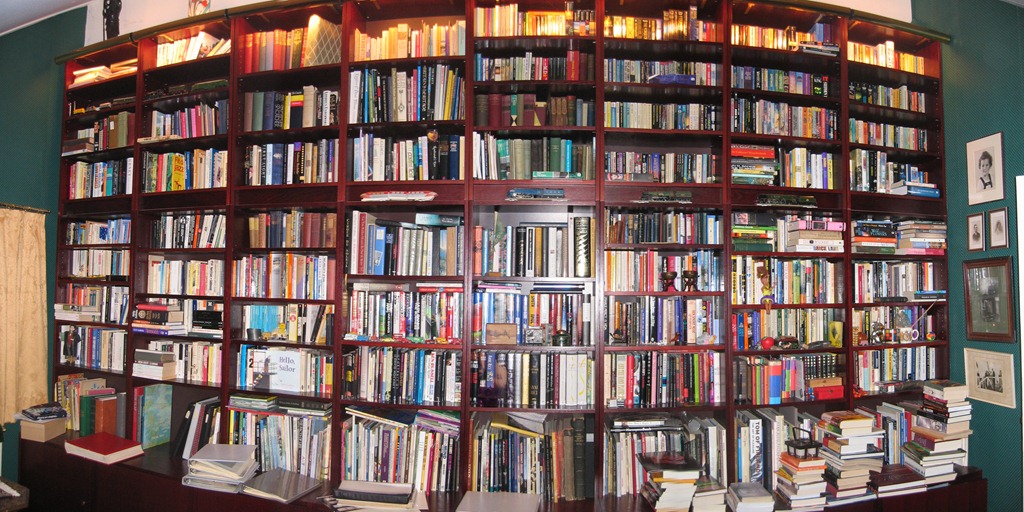
I sometimes wonder what happens in my library deep in the night as well.
(hat tip to Matthew Cobb over at Why Evolution is True)
-
RIP, Hitch
So, Christopher Hitchens is dead. He has left Tumortown and passed beyond the Land of Malady, after leaving us with some last words of advice on dealing with mortal illness.
I’ll miss his voice and his writings. We now have all that we are going to have from him.
I can’t resist adding his widely-quoted words of wisdom:
“The four most over-rated things in life are champagne, lobster, anal sex and picnics.”
Like Christopher Hitchens, I’ve enjoyed them all. Over-rated? Possibly. Enjoyable? Certainly.
RIP, Hitch.
-
Hugo
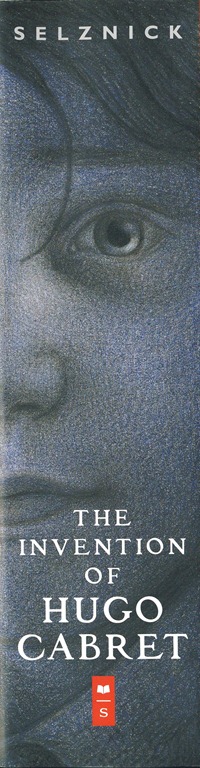
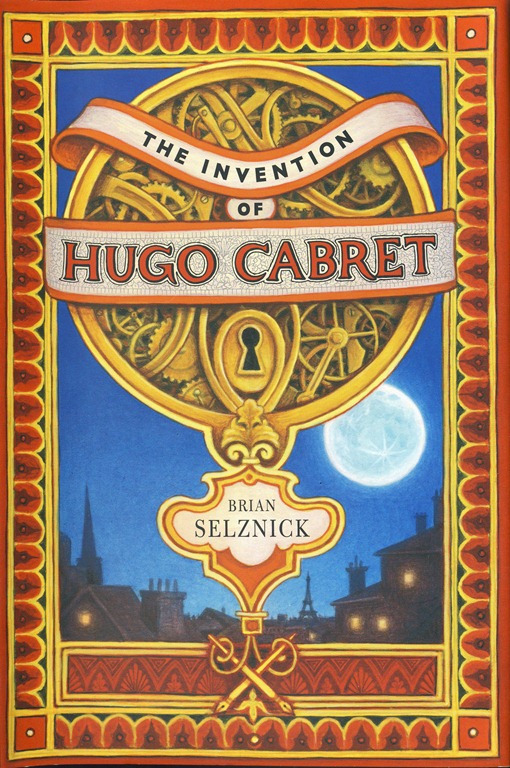
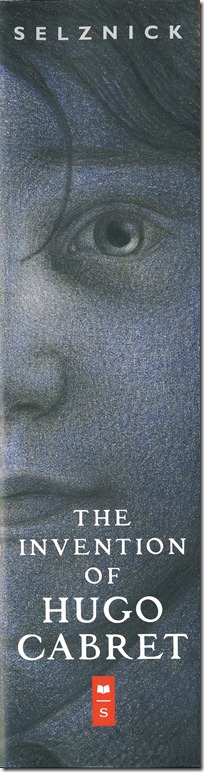
A few years back, I bought The Invention of Hugo Cabret by Brian Selznick. Although it’s ostensibly a children’s book, I was attracted to it because the book is a work of art in its own right. Even when the book is closed and sitting on the bookshelf, Hugo’s eye stares out at you and you feel yourself drawn to reach out and discover what lies within.
The only bit of colour is the book’s cover, everything else is black or white or shades of grey.

Selznick mixes pages of black and white drawings into his text, and, as befits a story that concerns Georges Méliès, the sequences of drawings, on pages edged with black, flow like an unfolding film, with pans, zooms, and cuts. Indeed, the very first page invites the reader to imagine sitting in a darkened room waiting for a film to start:
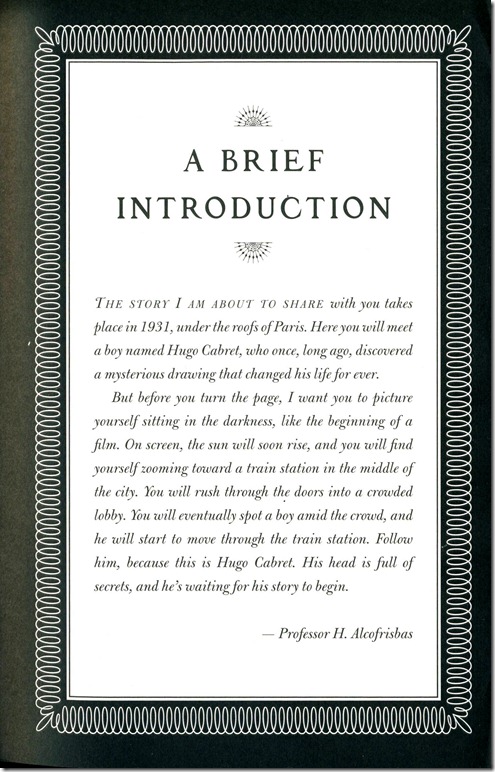
And now, a film has been made of the book. Because this is a children’s film, the director, somewhat surprisingly, turns out to be Martin Scorsese. But it makes sense when you realise that he has a great knowledge of, and affection for, the history of film. The trailer looks good (although I detest, with a passion, the sound of the trailer narrator’s voice), and the film is garnering good reviews.
It doesn’t open here in The Netherlands until next February, but, when it does, I’ll definitely make one of my rare trips to the cinema to see it.
-
A Mild Case of Bibliomania
Here’s a flavour of what it means to be a book-collector
I don’t really fall into the category of being a book-collector, but I do have an inkling of what it means…

-
The Annotated Jules Verne
A couple of months ago, I went to the book market at Bredevoort. I found a version of Jules Verne’s Twenty Thousand Leagues Under The Sea published in an English translation with annotations by Walter James Miller. It is a large (almost A4-sized) book, profusely annotated in the margins of the text and containing many illustrations sourced from old engravings – some of which come from the original French edition of the book.
Intrigued, I bought it, and have now finished reading it. It’s been a revelation. I knew of the story, of course, along with others by Verne, but I have never actually read any of them. I had always thought that they were books written for children, but it turns out that my view was probably formed by osmosis from the reactions of the English-speaking literary establishment to the English translations.
Miller takes as his starting point the standard English translation produced in the 1870s by one “Mercier Lewis”. This turns out to be Lewis Page Mercier, a theologian. This “grim parson” (Miller’s description) thought nothing of excising 23 percent of Verne’s original text, often where he apparently disagrees with Verne’s views (e.g. on Darwinism). The remaining text is subject to hundreds of errors of translation, and he destroys many of Verne’s character sketches and jokes. What remained, and has formed the basis of the English translations ever since, is a travesty of the original novel.
Miller restored the missing 23 percent with his own translation, and provides annotations to show where Mercier, either unknowingly or deliberately got it wrong. Some of the translation howlers seem unbelievable, as where Mercier translates lentille (French for either the lentil or a lens) and has Verne write that Ned Land (the harpooner) could light a fire by holding a lentil up to the sun…
The restored and annotated translation thus becomes a completely new and powerful story for adults containing Verne’s scientific, social and political predictions. To quote from the dust-jacket:
In an imperialist age, Verne was concerned not only with the treatment of primitive peoples, but with the burgeoning power of what today we call the military-industrial complex; Nemo himself lives out the principles of philosophical anarchism. Verne also foresaw the smouldering of French separatism in Canada, the rebirth of China, and the rise of the American Goliath – all this in addition to his scientific prophecies, ranging from the use of electric “stun guns” to the ecological problems that would be caused by hunting the whale and other sea creatures to extinction.
What adds another layer of resonance to this tale is that the copy of the book I have is stamped with the imprint of the library of the merchant ship Royal Viking Star. So perhaps this book, before coming to rest in my library for the moment, has travelled twenty thousand leagues over the sea…