Reflections on life at “De Witte Wand”…

Category: Computers and Internet

  • Google Earth

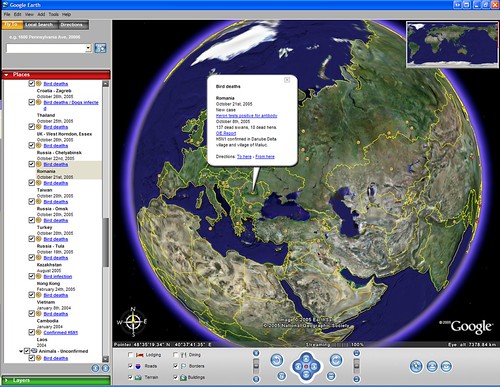
    I mentioned the user community that has grown up around the Google Earth application earlier today. As an example of how Google Earth is being used, Frank Taylor, over at the Google Earth Blog, writes about how the spread of avian flu around the globe is being tracked by a member of the Google Earth Community. Here’s a screenshot showing a sample of the data (click to go to the original on Flickr, where you can choose higher resolution versions of the shot for greater clarity).
     
     Google Earth Snapshot
     
    Update: Frank Taylor, over at the Google Earth Blog reports that Declan Butler, a senior reporter at Nature Magazine, has published a new version of the avian flu outbreak map. He advises this new map be used for accuracy.
     
  • Yahoo Maps

    A new version of Yahoo Maps was launched yesterday. It uses Flash technology, instead of Ajax (which is used by its rivals, Google Maps and Microsoft’s Virtual Earth.
     
    It’s a good thing it’s a beta, because it crashed on me within seconds when I tried to use my mouse’s scroll-wheel to zoom.
     
    By the way, one thing that I find supremely irritating is that Google’s use of the scroll wheel to zoom is the exact opposite of the way in which Microsoft and Yahoo use it. Google wins the Donald A. Norman award for piss-poor user interface consistency in my view. They don’t even give you the option to reverse it. 
     
    Google Maps (despite the user interface cock-up) works the best for me. Microsoft’s offering returns blank map tiles too often for my liking. And all of them are either sketchy or non-existent when it comes to showing maps outside of North America.
     
    But my favourite map application is still Google Earth. The combination of the PC application fed by data from Google’s map servers is still a far richer user experience than any browser-based map application that I’ve yet seen. There’s a really vibrant user community adding data to the maps. I’ve recently been visiting all of the locations mentioned by Shakespeare in his plays. All added by enthusiastic users.
  • Thin? – It’s Anorexic

    Thin-client computers were all the rage a few years ago, with some vendors claiming huge savings over the costs of infrastructures built with traditional PCs. Thankfully, the hype has been exposed for what it was, and thin-client technologies have settled in alongside PCs as a useful and sensible alternative in particular situations.
     
    Now Chip PC have announced the Jack-PC – a thin client so thin that it’s actually installed inside the wall socket. This is not thin – this is anorexic.
  • OTT Workstation

    The Total Immersion PCE takes the term "couch potato" to new heights. I confess that I wouldn’t mind having a ride on it though.
  • XBOX 360

    Apparently Microsoft’s XBOX 360 has just been released. I doubt very much that I’ll be lining up to purchase one – all the gee-whizzery seems to be devoted to games of the first-person shooter variety. This is a genre that appeals to me not one jot or tittle. Perhaps it’s just me, but I get a real feeling of dissonance when I read this in Greg Hughes’ blog entry of first impressions of the XBOX:
    The crowd was excited. A sign is taped to the end cap where the 360 resides that says "5 minutes, please." The crew of giddy people (mostly adults by the way) quietly contained themselves and politely took turns splattering people with their virtual firearms. It pretty much rocked. Ooohs and Aahhhhs abound.
    "Politely took turns splattering people"? I don’t think I’ll ever be able to understand it.
     
    And if you want to see something really depressing, then watch and listen to this video of a 9 year-old (a 9! year-old) child playing a first person shooter game. It’s linked to by PZ Myers in his blog entry here. The child is a brat, his mother is completely ineffectual. I don’t know which is worse. All I know is that I think there’s going to be trouble around him when he gets older.
     
     
  • Turing’s Cathedral

    Interesting piece penned by George Dyson that has been posted over at the Edge. Dyson is reflecting on his visit to Google in the context of the history of computing, from von Neumann and Turing onwards.
    My visit to Google? Despite the whimsical furniture and other toys, I felt I was entering a 14th-century cathedral — not in the 14th century but in the 12th century, while it was being built. Everyone was busy carving one stone here and another stone there, with some invisible architect getting everything to fit. The mood was playful, yet there was a palpable reverence in the air. "We are not scanning all those books to be read by people," explained one of my hosts after my talk. "We are scanning them to be read by an AI."
    And he raises a nice little frisson in the mind of this reader with:

    Google is Turing’s cathedral, awaiting its soul. We hope. In the words of an unusually perceptive friend: "When I was there, just before the IPO, I thought the coziness to be almost overwhelming. Happy Golden Retrievers running in slow motion through water sprinklers on the lawn. People waving and smiling, toys everywhere. I immediately suspected that unimaginable evil was happening somewhere in the dark corners. If the devil would come to earth, what place would be better to hide?"

    Is there a John Connor in the house?

  • Recognising Faces

    We humans do it easily – at least with people we are familiar with. But it’s a bit more tricky for computers to do it. At least, it used to be.
     
    I’ve just upgraded my copy of Adobe’s Photoshop Elements to the latest version, version 4.0. While some aspects of that software irritate me beyond belief, there are some interesting features. A new feature with version 4.0 is the ability to pick out faces in your photographs. It’s surprisingly effective, even if not always 100% accurate. It also picks out the faces of cats…
     
    But there’s a difference between picking out an area in a photograph and saying that "this is a face" and actually identifying the face, e.g. "this is your uncle John".
     
    However, that day may not be far off. TechCrunch has news of a new software application – Riya – that promises to do just that.
  • The Softer Side of Software

    The material from Microsoft’s Professional Developers’ Conference for 2005 are now up online as video streams as well as downloadable presentations. 
     
    One aspect of software development that has always interested me is that of user interface design and usability. There’s a fascinating, opinionated presentation on user interface design given by Hillel Cooperman. Well worth watching. In addition, he uses as an example the photo-sharing application Max developed in Microsoft to show off some of the features of Vista. It’s interesting (well, to me at least) that the sharing aspect is a P2P experience like Groove – i.e. it’s really simple and transparent to use.
  • Who Owns The Root?

    In the Unix operating system, the Root user is the equivalent of god, with absolute power over every aspect of the system, including all other users.
     
    There’s a somewhat similar concept in the Internet itself – there’s a bunch of servers – the root servers – that dictate Internet addresses, and how the numerical addresses are mapped to domain names such as www.google.com or www.bbc.co.uk.
     
    Up until now, these servers have been very firmly under the control of the US government. Not surprisingly, since the Internet has its origins in a US military network project. Equally not surprisingly, now that the Internet is a global phenomenon, other governments have started voicing concerns about the degree of control that the US has over the Internet. Those voices have gradually been getting louder, until now it seems as though some sort of inter-goverment body is likely, according to this report in yesterday’s Guardian.
     
    Personally, I would prefer to see the political governance of the Internet invested in some form of UN-related body. Naturally, some people see that as a very bad thing, but then, Mandy Rice-Davies Applies…
  • Third Time Lucky?

    Those of us who use Microsoft products have probably often had the feeling that it takes Microsoft until version three of a product before they start to get it right. It seems to be the case now for version 3.0 of Windows Sharepoint Services. Here’s the list of new features. I see that built-in breadcrumb trails on every page is at the top of the list. About bloody time. I’ve been asking for this since version 1.
  • Pointless, Incessant Barking

    I’m beginning to feel like the dog in this New Yorker cartoon
    (hat tip to Geoffrey K. Pullum over at the Language Log)
  • Am I Real?

    Jason Striegel is a blogger. He’s recently come to the conclusion that in this wired world, he’s unable to convince some people that he’s a human being. The Turing Test as seen through the Looking Glass, perhaps?
  • WinFS Beta 1 Released

    Once upon a time, long long ago (well in 1991, to be precise), Microsoft announced the Cairo project. Sometimes it was touted as an operating system, sometimes it was a project to develop new technologies, but whatever it was, it was something that used to remind me of the attempts of the Brown Booby bird to get off the ground, and never quite managing to do so. Still, over the years, more of the technologies that it was supposed to deliver have in fact finally appeared from Microsoft. All except one – and arguably the most important one – the "radically new" Object File System.
     
    Now, the first beta of that has arrived in the form of WinFS. Channel 9 has a video interview with some of the developers, and a demonstration of some of the capabilities. The beta itself is currently only available to MSDN subscribers. I think it’s significant that the beta is available for Windows XP, and not confined to the next generation of the Windows operating system family, Windows Vista. But that does raise the question of what will be the value proposition of Vista, if all the major technologies (WinFS, WinFX) are also available for Windows XP.
  • Celestia

    Following on from World Wind, another stunning piece of free software is Celestia – planetarium software that lets you explore the universe in three dimensions. It’s available for Windows, Mac OS and LInux. Warp Factor 9, Mr. Scott!
     
  • MSN Weather

    Microsoft has released a rather nifty little add-on to their MSN Toolbar for Internet Explorer that shows you the weather for places of your choice.
     
    Mind you, like most weather forecasting, I’ve learned to take it with a pinch of salt. For example, according to the add-on, today we will be having a little light rain in Gouda, with current conditions being "mostly cloudy".
     
    Er, actually we’re currently sitting in the middle of a huge fucking thunderstorm that extends from horizon to horizon; the garden and the road outside are all but flooded, and the idea of being able to watch the Perseids tonight is further away than ever.
  • Sir Tim Berners-Lee

    There’s a good profile of Sir Tim Berners-Lee in the Guardian today. The profile fleshes out, and gives life to the man, rather than being just a dry recounting of facts like the Wikipedia entry.
     
    Sir Tim is of course the father of the World Wide Web. While the Internet itself has been around for 35 years, for 25 of those years it existed as a communications network hosting a number of different applications. Berners-Lee’s contribution was twofold:
    • to invent two killer ideas – the language that describes a web page (HTML) and the transfer protocol (HTTP) to allow access to the web page over the Internet.
    • to make these specifications freely available for anyone to use.

    It’s probably that last point that is the key to the incredible rise of the Web since the first page was put up on 6th August 1991. The specifications (HTML and HTTP) are "good enough" – in other words, they could have been better engineered. Indeed, Clay Shirky called HTTP and HTML "the Whoopee Cushion and the Joy Buzzer of the Internet". For example, there is nothing in the transfer protocol to help test for, and repair, broken links to web pages. How many times have you clicked on a link, only to find the page has disappeared?

    So the form of Hypertext that we have ended up with is by no means perfect, just good enough. There was an idea for a form of Hypertext that preceded the Web: Project Xanadu, proposed by Ted Nelson back in 1960. However, Xanadu has turned out to be the equivalent of the superior Betamax video format losing out in the market to the "good enough" VHS.

  • We Are The Web

    Kevin Kelly has written a superb article on the history and the future of the World Wide Web. It’s called We Are The Web, and it’s published here in Wired magazine. Go and read it, stretch your mind a little.
    "With the steady advance of new ways to share, the Web has embedded itself into every class, occupation, and region. Indeed, people’s anxiety about the Internet being out of the mainstream seems quaint now. In part because of the ease of creation and dissemination, online culture is the culture. Likewise, the worry about the Internet being 100 percent male was entirely misplaced. Everyone missed the party celebrating the 2002 flip-point when women online first outnumbered men. Today, 52 percent of netizens are female. And, of course, the Internet is not and has never been a teenage realm. In 2005, the average user is a bone-creaking 41 years old.
     
    What could be a better mark of irreversible acceptance than adoption by the Amish? I was visiting some Amish farmers recently. They fit the archetype perfectly: straw hats, scraggly beards, wives with bonnets, no electricity, no phones or TVs, horse and buggy outside. They have an undeserved reputation for resisting all technology, when actually they are just very late adopters. Still, I was amazed to hear them mention their Web sites."
  • Sluggish Data Transport

    A little while back, I mentioned RFC 1149 – a paper describing a standard for the transmission of data using avian carriers – otherwise known as pigeons.
     
    Now, researchers in Israel have built upon this important work by describing an experiment in which a Giant African Snail, acting as a data transfer agent, exceeded all known “lastmile” communications technologies in terms of bit-per-second performance, adding to the many paradoxes of broadband communications.
     
    They discuss "the unique motivational and guidance systems necessary to facilitate snail-based data transport, and observe with satisfaction that in a society that worships the fittest, fastest, and furtherest, the meek and the slow can sometimes outperform all known competitors, giving rise to the new and exciting field of sluggish data networks".
     
    Their work appears in a paper published in that august journal, the Annals of Improbable Research, July-August 2005
  • Watch Me Change

    Oh alright, I’m shallow – but this raised a smile: Watch Me Change.