Reflections on life at “De Witte Wand”…

Category: Consumer Electronics

  • One Step Forward, Two Steps Back?

    Yes, this is yet another grumbling post about how the current Windows Home Server team just don’t seem to understand what the word “Home” means in the name of the product.

    I decided that I’d take a closer look at the Release Candidate for Windows Home Server 2011. So, I’ve wiped out the Windows 7 installation on my HP TX2000 laptop, and installed the WHS 2011 RC on it. On the plus side, I appreciated the way in which the installation process recognised hardware that had been developed since the days of Windows Server 2003 (that WHS V1 was based on). The installation process was painless.

    On the other hand, there are some losses if I compare what I would have with WHS 2011 versus what I had with the first version of WHS.

    The major difference is of course the removal of the Drive Extender technology. Now, this has been done to death (but that doesn’t mean that it’s not important), however, let’s look beyond that.

    I approach Windows Home Server from the perspective of a consumer who has computers in their home. I’m someone who wants to have two things:

    1. backup to a centralised server of all the data in the individual computers, such that, in the event of a failure of any individual computer, I can quickly restore that computer to a running state with the most recent data and,
    2. to have digital media (music, pictures, videos, movies) available throughout my home from the same centralised server, with connected devices sharing media as simply, and as directly, as possible.

    And I want that centralised server to be easy to manage, with regular offsite backups being made to ensure that the integrity of that server for both shared media and the data of client computers is preserved.

    All this must be done as simply as possible. I really don’t want to carry on being the IT guy in my household. If I fell under a bus tomorrow, I would want my nearest and dearest to be able to carry on without any special knowledge.

    And there’s the rub. While WHS V1 was certainly not perfect in this respect, it seems to me to be light-years ahead of the retrograde step of WHS 2011.

    As I said, let’s ignore the elephant in the room, the Drive Extender technology, for the moment. Let’s just look at managing storage on WHS 2011.

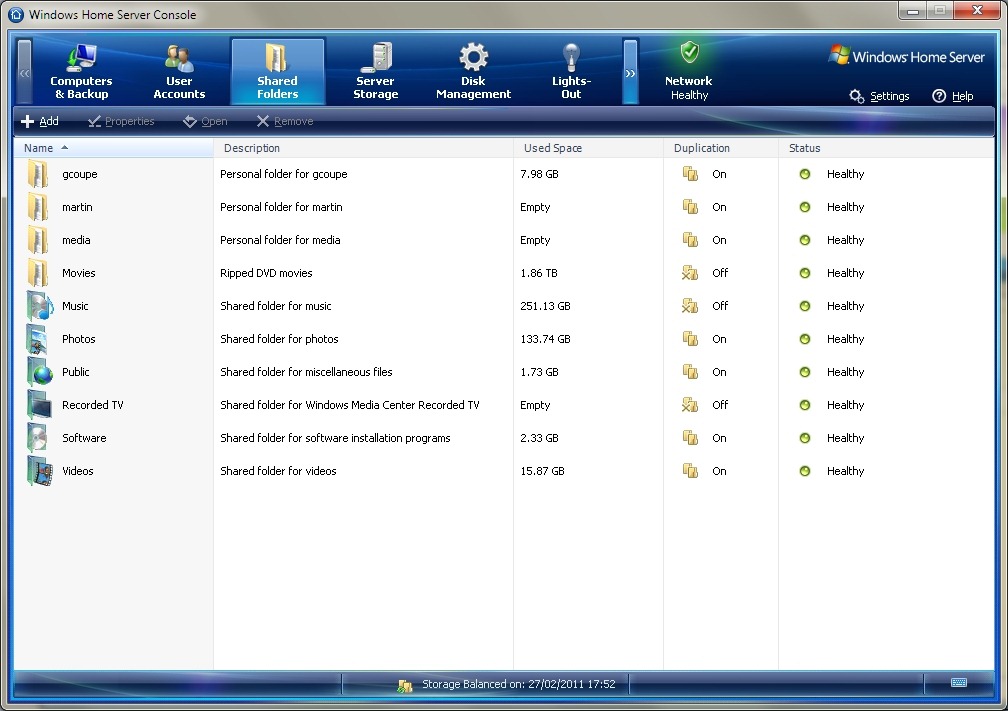
    In WHS V1, you could look at the shared folders to see how much space they currently took up. Here’s an example from my WHS V1 system:

    WHS Storage 2

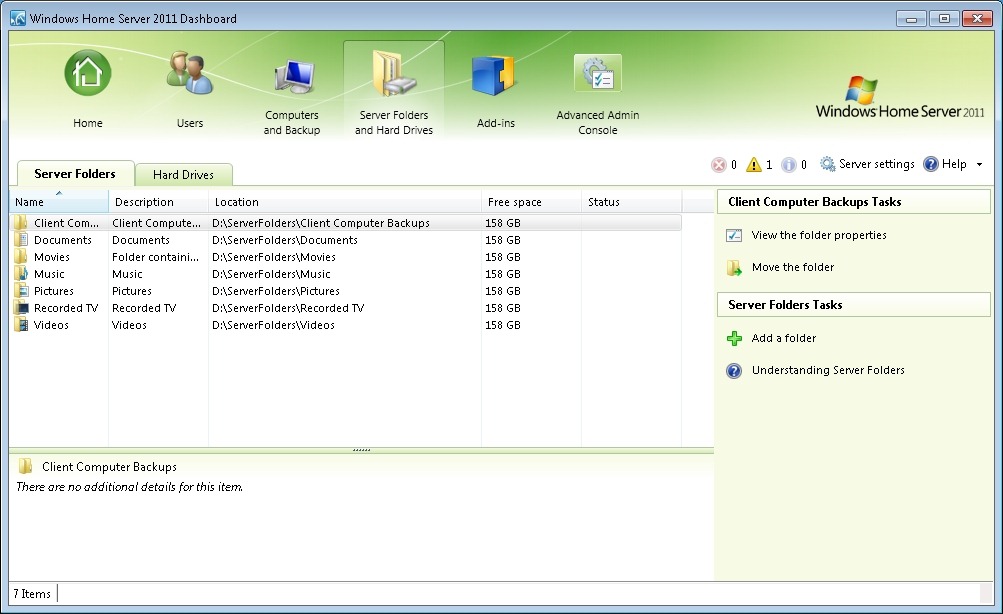
    And here’s the equivalent screenshot from WHS 2011:

    WHS2011 1

    Er, where’s the “used space” column? Well, surprise! It isn’t there. Instead, you have a “Free space” column that represents the space available on an individual drive. Nowhere near as useful. Because drive extender has been removed, the support person has to start thinking in terms of individual drives, not in terms of the total amount of storage as in WHS V1.

    This mode of thinking in terms of individual drives, instead of the total storage pool is also reflected when considering backups. WHS 2011 is unable to deal with backups (or discs) larger than 2TB.

    Frankly, if I were designing the follow-on product from WHS V1, then it would seem to me to be essential that I would handle the situation where discs and backups would be larger than 2TB. After all, if I’m going to claim that:

    Today large hard drives of over 1TB are reasonably priced, and freely available. We are also seeing further expansion of hard drive sizes at a fast rate, where 2Tb drives and more are becoming easy [sic] accessible. Since customers looking to buy Windows Home Server solutons [sic] from OEM’s will now have the ability to include larger drives, this will reduce the need for Drive Extender functionality.

    …then I would make sure that a 2TB limit did not exist in my product. Not so with WHS 2011.

    I really do wonder who the team are designing the product for. Certainly not home users.

  • Soldiering On

    I see that Paul Thurrott, in an article published on his Supersite for Windows, has done a U-turn and is now betting on Windows Home Server 2011. Back in October 2010, when he was first told by the current WHS team that they would be removing the Drive Extender technology from WHS 2011, his first reaction was that:

    “Removing Drive Extender was the equivalent of driving a dagger right through the heart of the product”.

    Indeed, that was my first reaction on hearing the news when it became public a month later, and the reaction of many, if not most, of us who had bought the original version of Windows Home Server.

    Despite the outcry (for example, there are currently 5,581 votes in favour of retaining the DE technology in WHS 2011 versus 73 against over at the Microsoft Connect site – tagline: your feedback improving Microsoft products), the technology will not be put back into the final WHS 2011 product. (Addendum: on the 12 March 2011, Microsoft removed all the suggestions that had been posted by WHS 2011 beta testers in the connect forum, including this one. An act that reminded me of the Soviet’s airbrushing ex-politicos out of photographs. One way of removing embarrassing facts, I suppose)

    So now, Paul Thurrott has put his sense of disappointment behind him, and written that:

    So yes, I’m disappointed about Drive Extender, I really am. And yes, I’ve sweated this decision for months. But when the final version of Windows Home Server 2011 appears in the months ahead, I’m switching. And I’ll let you know how it goes, of course. But I can tell you now that Microsoft’s home server solution is still the best game in town, even with the removal of Drive Extender. And if you could stop crying into your beer, I think you’ll admit the same.

    Well, perhaps. But what I find most telling about this whole debacle has been the way that it has been (mis)handled by Microsoft. It seems clear, from Thurrott’s own account, that the current WHS team did not have a clue, at least in the beginning, that the decision to remove DE would have such a negative reaction.

    In effect, the team had just torn up the guiding principles for the product developed by Charlie Kindel and the original WHS V1 team – but they don’t seem to have appreciated that fact, or the likely reaction from customers who had bought V1 on the strength of those principles.

    The team then soldiered on with the decision – and I have to give them credit for their brass necks – and very probably have weathered the storm. But I really could have done without the disingenous posts on their blog telling us that they were only following feedback from their customers:

    “When weighing up the future direction of storage in the consumer and SMB market, the team felt the Drive Extender technology was not meeting our customer needs”.

    There are some good things remaining in WHS 2011, but the heart of WHS V1 – its provision of consumer-friendly storage – has been surgically removed.

    The die has been cast – we’ll see what happens.

  • Being Economical with the Truth

    I know I’ve said it before, but I do loathe and detest marketing-speak. The last time my distaste was directed at Google; this time it’s Microsoft’s turn.

    This year’s Mobile World Congress is currently underway in Barcelona. So naturally, Microsoft is there publicising Windows Phone 7. The Marketing arm of Microsoft is running full tilt to supply the hungry maw of the news media, so we get this piece from Microsoft’s News Center. It includes the following quote attributed to Andy Lees, president of Microsoft’s Mobile Communications Business:

    Microsoft sold 2 million phone licenses in Windows Phone 7’s first two months, and the phone is now available from 60 mobile operators in 30 countries around the world, Lees said. As phone availability and sales grow, so too does the app marketplace – there are now more than 8,000 apps in the marketplace and 28,000 registered developers.

    Now, right there, is a prime example of why I loathe and detest marketing-speak. On the face of it, Mr. Lees’ statements are perfectly true. However, they are not the whole story. While Windows Phone 7 handsets are indeed available in 30 countries around the world, the applications marketplace is not. At my last reckoning, it was only available in 16 countries. So those “more than 8,000 apps in the marketplace” are not actually available to customers living in countries such as India, Norway, Sweden and the Netherlands.

    So customers buying phones in these, and similar countries, are then finding that instead of a smartphone they have little more than a premium-priced dumbphone.

    That does not make for happy customers.

    In that light, I find it very ironic that the Microsoft News Center puff piece ends with this quote from JP Wollersheim, a Windows Phone 7 product manager:

    “You don’t sell phones if people aren’t happy. That’s the leading indicator of where we’re at, and it’s predictive as to how many we’re going to eventually sell,” Wollersheim said. “We want it to sell, and we want customers to be super happy, and we want them to tell their friends and family. That’s the best recommendation you could have.”

    Be careful what you wish for.

  • In Praise of the Dumbphone

    The leaking of Stephen Elop’s memo to his troops at Nokia has certainly focused the attention of business and technical analysts on the company.

    However, in all the excitement, Francis Sedgemore has picked up on something that he thinks is in danger of being forgotten, and I think he is right to do so. He has written to Elop reminding him that not everyone is enamoured of Smartphones with touchscreens. Some of us still find that mobile phones, with real buttons, that just make and receive phone calls and SMS messages are sufficient. He has a point. And, as he says, some attention should be paid to the poor quality software that Nokia (like most mobile phone manufacturers) provide to synchronise contacts and content with the user’s PC or Mac.

  • Making a Silk Purse out of a Sow’s Ear – Not

    Oh dearie me, Microsoft has just unleashed the Release Candidate of Windows Home Server 2011 upon the world. And as they had promised, they have surgically removed the one unique selling point that WHS version 1 had – the drive extender technology.

    Frankly, this confirms to me that Microsoft has totally lost the plot when it comes to crafting consumer technology that ordinary people – as opposed to IT experts – actually feel comfortable about having.

    They are, of course, putting their spin on how WHS 2011 will be wonderful, but it all has the air of them trying to make a silk purse out of a sow’s ear, and failing miserably. Take, for example, this YouTube video that they put up to show us how to manage our storage in WHS 2011. With WHS version 1, when your storage was getting full, you could just add another drive and carry on. Now, as this video painfully points out, you have to worry about whether you need to move your folders around to rebalance your storage across your discs.

    Hello, Microsoft, wake up – Mr or Ms average consumer doesn’t want to think like an IT support person.

    I, for one, will be carrying on with WHS version 1 for as long as I possibly can. WHS 2011, with the removal of Drive Extender, has nothing to offer.

  • A Tale of Two Markets

    Following on from the previous post on Android 3.0 (Honeycomb), I see that Google also announced, and have opened, a web presence for Android applications: the Android Market.

    I found it quite instructive to compare using Google’s Android Market with the Microsoft equivalent, the Zune Marketplace.

    The first thing to note is that, in the Android Market, it is possible to browse and purchase applications for your Android devices directly via the web site. The Zune web site, on the other hand, does not allow you to browse applications for your Windows Phone directly. Instead, when you click on the “Browse Zune Marketplace” link, it fires up the Zune client application on your PC, which accesses the applications for Windows Phone 7 available in your location. And there’s the rub: the Android Market seems to be a single global marketplace, accessible to everyone, while the Zune Marketplace is heavily fragmented, and not open in all countries. I’ve written about this Microsoft Marketplace disaster before, but to see it laid bare by comparing the user experience with Android Market is very revealing.

    Microsoft really should open up a web site to allow global access to WP7 applications along the same lines as Google’s Android Market. If they don’t, then they will continue to be on the back foot in the Smartphone market.

  • Honeycomb Looks Sweet

    Google presented the latest version of their Android operating system yesterday, which is codenamed Honeycomb. The presentation has been posted on YouTube.

    I must admit that there were some nice touches in the User Interface of Android 3.0, particularly the use of hardware accelerated graphics. The UI is finger-driven, of course, and watching the demo really drives home the point that a Windows Tablet just isn’t designed for fingers. If Microsoft still haven’t grasped that fundamental point, and continue to insist that Windows Tablets, in their current form, can compete against Android and iPad tablets, then they will fail miserably.

    Watching the presentation also drove home another couple of points to me. First, how much I loathe and detest marketing-speak. I’m afraid watching people with false smiles saying how excited they are to be here today to tell you all about their “cool” and “awesome” products has never been one of my favourite pastimes. Secondly, I am so clearly not in the target markets. I might just as well be from another planet. I think that was exemplified by the gentleman from Disney Mobile gushing excitedly about something called Tap Tap Revenge, which has probably earned the Disney Corporation more money than the GDP of most small countries.

    And then there was the team from CNN showing their news application for the Android tablets. Quite apart from the fact that quality journalism is already a threatened species, CNN seem to be wanting to drive it further into extinction by introducing something called iReport. Essentially, CNN want to fool us into submitting news reports to them, for free, and my bet is that the rights subsequently belong to CNN, and not to the originator. I suspect that the quality of the majority of the stories will merely underline the veracity of Sturgeon’s Law. For example, on the page of news stories being demonstrated was one concerned with the fact that the iReporter’s miniature dachshund was caught in a recent snowfall. 

    I was left with the feeling that if Sturgeon were to redefine his Law today, he would probably revise the estimate of 90% (of everything being crud) to a number that would be considerably higher.

    Still, looking beyond the fact that I am an old curmudgeon, it will be interesting to see how the Tablet market develops. This challenge from Google with Android 3.0 looks to be a good one.

  • Microsoft’s Marketplace Mess

    Following on from the last post about Windows Phone 7 and the shortcomings of its Marketplace infrastructure, here’s some information about the different types of services offered by the Marketplace around the globe. As you can see, it’s a bit of a mess.

    It’s particularly bad here in the Netherlands, because although there are currently three models of Windows Phone 7 available on the open market (with more on the way), you can’t actually buy any applications, because there’s no Apps Marketplace available. Some people set the Location in their Windows PC to the US or the UK. That allows the Zune software on their PC to display the Apps Marketplace for those countries. However, unless you have a credit card issued by either a US or a UK bank, you may still find that you won’t be able to buy any applications. A few people have reported success, but others are saying that their credit cards are being refused by the Marketplace because they are issued by Dutch banks.

    I note that, currently, Table 1 in Andrew’s post is showing that both India and Hong Kong have the App Marketplace available. I don’t think this is correct. I’m seeing people from both territories (India and Hong Kong) complaining in the Zune and Windows Phone 7 forums that the App Marketplace is not available to them. As far as I’m aware, there’s an easy way to test this. Just set your Location in Windows 7 to a particular country, and then start up the Zune software on your PC (which is used to browse the App Marketplace in those countries where it is offered). Most country settings will not even display the Marketplace menu (e.g. India and Hong Kong do not), and even for some that do, the App Marketplace is still not available (e.g. the Netherlands).

    While I can understand that the deals with third parties to offer music and video media via the Marketplace can take Microsoft some time to set up, I don’t think that’s a valid excuse for Windows Phone 7 applications. If the phones are being openly sold in your country, and supported by your local carriers, then the App Marketplace should be available to you. That’s clearly not the case in many countries, some of them (e.g. India) being major markets. I really want Microsoft to succeed with WP7, but they seem intent on shooting themselves in the foot at every opportunity.

  • Review of Windows Phone 7

    There’s an excellent in-depth review of Microsoft’s Windows Phone 7 over at MobileTechWorld. Well worth checking out if you’re interested to read a clear-eyed view of WP7.

    I note also that the reviewer has pointed out the problem that Microsoft has created for itself in the Marketplace infrastructure:

    Unfortunately there’s a really important issue that Microsoft doesn’t seem to really care about: it is impossible to change your Zune/Xbox Live country location once it is create[d] and linked to your Hotmail account. I created it nearly 5 years ago just to check an Xbox 360 demo that was only available in the US and I’m now stuck with it because it’s tied to my main Hotmail account. The end result is that I can’t buy anything using this account (needs a US credit card). Come on Redmond! Just give me the ability to choose the local Marketplace I want to buy from on the fly. Let me download free apps and trials in the US and buy apps where I live. Or simply allow me to correct my location.

    Until Microsoft correct this Marketplace misstep, I’m not even considering the purchase of a Windows Phone.

  • Microsoft’s Marketplace Merry-go-round

    My mobile phone is an ancient (in mobile phone terms) Nokia 6310i. I bought it for myself back in 2002. It still functions perfectly well as a phone, but in these days of Smartphones, it’s positively primitive.

    Thus far, I’ve successfully resisted the lure of replacing it with a Smartphone. I certainly don’t want to buy an iPhone, I’m not convinced by smartphones based on Google’s Android operating system, and the Windows Mobile operating system always struck me as unbearably clunky. Now, however, Microsoft has introduced a completely new smartphone operating system into the market: Windows Phone 7. My impression, from the reviews is that it’s pretty good as a first version of a completely new system. So I’ve been casting envious glances at the WP7 phones that are available and wondering if I should take the plunge. Here in the Netherlands, that means that, at the moment, I have a choice of three handsets: The Samsung Omnia 7, the HTC 7 Trophy and the LG Optimus 7. Of the three, the LG Optimus 7 would be the one I would go for. But should I do it? Apart from the cost (even though it’s a good deal less than the eye-watering price tags on Apple’s iPhones), when looking further into it, there are some flies in the ointment that rather temper my enthusiasm.

    The thing is, like other smartphones, a Windows Phone 7 device lives in an ecosystem that makes material such as music, video and applications available. For Windows Phone 7 devices, that means Microsoft’s Windows Phone Marketplace, and I’ve discovered a problem with it.

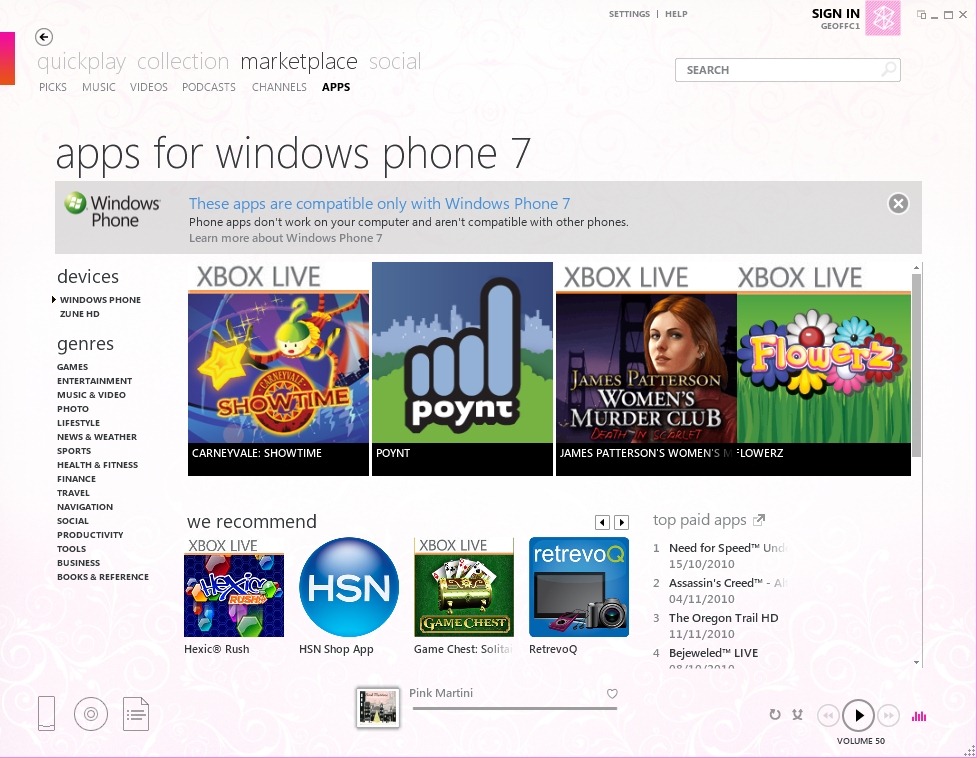
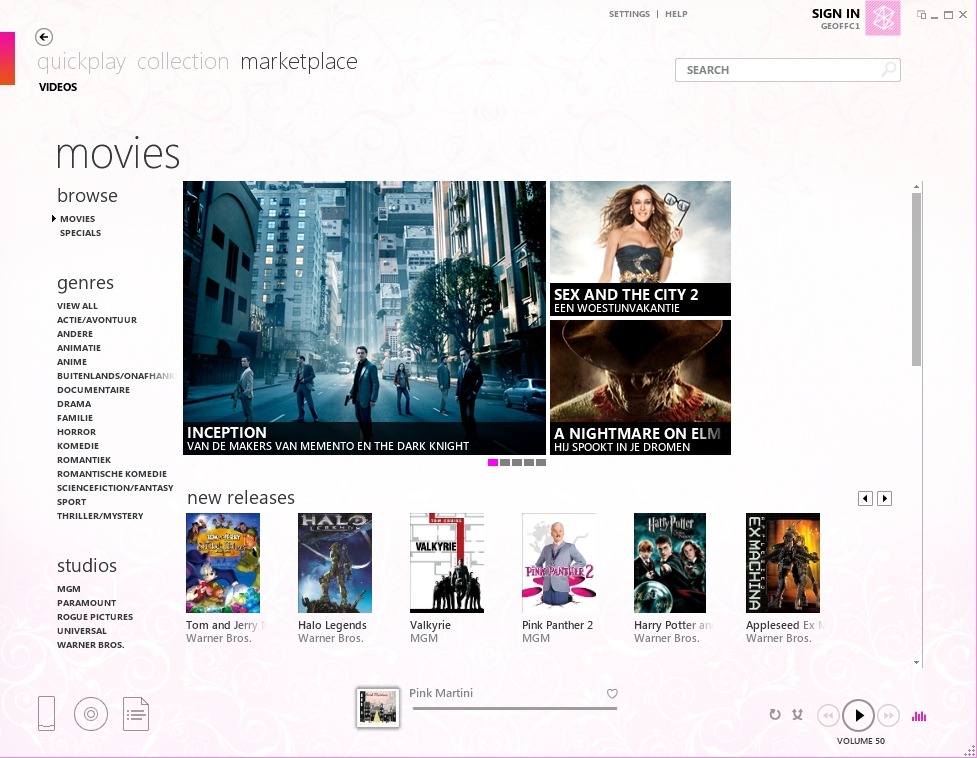
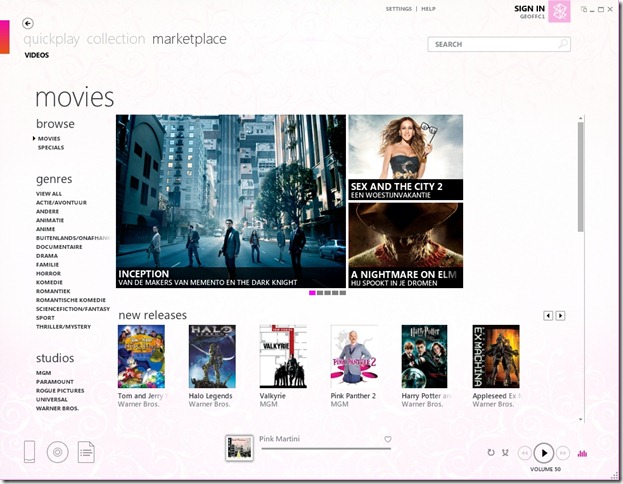
    The marketplace is built on the same back-end infrastructure used by Microsoft’s Xbox Live Marketplace and the Zune Marketplace. This infrastructure is country-aware, that is, the products and services that are offered through the marketplaces may vary from country to country. Here, for example, are two screenshots of the Zune software on my PC displaying the marketplace. The first is taken with my PC with its location set to the US, while the second has the PC location set to The Netherlands.
    Zune 1

    Zune 3

    As you can see, the range of products available in the US is much broader (music, videos, podcasts, channels and applications for both the Zune and Windows Phone 7) than the current miserable selection available to us Dutch. We only get to be able to rent videos.

    The Zune device is not officially available here in The Netherlands (or indeed lots of other countries), but many people buy one from the US. Then, in order to gain access to the wider range of products and services, they create an account for themselves in the US.

    However, somewhere along the line, a design decision was taken within Microsoft regarding how to register the country of residence of marketplace users that now makes the whole marketplace ecosystem unworkable for some of us. The issue is that, once you have registered a country of residence, you can neither change it nor even delete your account. In addition, you’ll find that, if you try and register a credit card to pay for marketplace purchases, the card must have a country billing address that matches the one registered in the marketplace.

    So those people who have created an account in a different country from where they now live are stuck. This not only applies to people who have bought grey imports of the Zune device, but innocents who have bought their device in the US when they lived there, but who now live and work elsewhere.

    It also applies to me. I don’t own an Xbox, a Zune device or a Windows Phone. However, I made the mistake of downloading and playing with the Zune software about a year ago to compare it with Windows Media Player (that’s another story). Along the way, I created a Zune account using my Windows Live ID, just to try out the experience, not realising that the country of residence would be hardwired to the US without any possibility of change or deletion. At the time, I just shrugged my shoulders and thought no more about it. However, now that the Windows Phone 7 is available in The Netherlands, that means that I can’t actually buy any applications through the marketplace, either in the US or in the Netherlands. In effect, I find myself in limbo, along with probably thousands of others.

    The issue is recognised by Microsoft, there have been many threads about it in both the Zune and the Windows Phone 7 forums. Jessica Zahn, a Senior Program Manager for Zune, has written in one of these threads:

    Like I said, it’s not about what your Live ID itself says – it’s about what country you chose when you first joined Zune with that Live ID. You can change your Live ID country at account.live.com, I think – it’s the Zune country that can’t be changed. Here’s an example of why it’s complicated:

    You live in France. You sign up for Zune and you say you’re in the US so you can use the Zune software and Marketplace. You buy lots of music, and we love you for that.

    When Zune offers a Marketplace in France, you decide it’s time to switch over so you can read everything in your native language and get access to music that’s only available in the marketplace for France, etc. BUT what happens to the music you already bought, that we don’t have rights to sell in France?

    Do we take it away from you? Not let you re-download .wmas or video? What will the content owners say if they find out we were selling content to people in regions where we’re not allowed to sell?

    I can tell you we’re working through those questions now and figuring out how to allow people to move countries, etc – but it’s not easy, and those of you who have said this has been a problem for Xbox for a long time are correct – and we use the same infrastructure as Xbox.

    There’s a couple of things about that. The first is her reference to “music [that] you already bought”. The thing is, according to the terms and conditions, we don’t “buy” music (or indeed any other content offered through the Marketplaces) – we only license it. Section 8:

    Marketplace is the online store for the service.  All content made available through the Marketplace is licensed, not sold, to you.

    And further, the terms and conditions spell out very clearly in section 3 that:

    We may change, delete, modify or discontinue, temporarily or permanently, the service, any functions, features or content of the service, at any time and for any reason, in any country, in our sole discretion.

    Due to contractual or other limitations, some content available in the service may from time to time become unavailable. Consequently, you may not be able to re-download or re-stream certain content that you have purchased.  For music and video content, to the extent we receive information from the content owners indicating the date their content will be unavailable, we will endeavor to share this information with you.

    Your ability to access the service and obtain certain content is restricted to your territory. If you change your account to a different territory, you may not be able to re-download or re-stream content that was available to you in your previous territory. In your new territory, you may be required to purchase and pay for content even if you have already paid for that content in the previous territory.

    So professing concerns about “taking your music away from you” seems a little disingenuous – it’s been quite clear from day one in the terms and conditions that this was always on the cards. It’s interesting, though, that the terms and conditions cover the case where the country (territory) is changed, even though this is not currently possible.

    Ms. Zahn’s solution to this conundrum is for users caught in this trap to create another Windows Live ID. That is both simplistic and doesn’t really address the problem. I’ve been using my Windows Live ID for a long time – it’s tied to my primary email address (which I’ve had since the early 1990s). Setting up a new Windows Live ID for a Windows Phone that is not using that email address doesn’t help.

    However, it does appear that Microsoft are thinking about the issue, so perhaps I’ll be able to change or delete my current Zune account (which I have never used) in readiness for the Dutch Windows Phone 7 marketplace when it finally gets launched in mid-2011. Nonetheless, knowing my luck, and on past experiences with Microsoft, my betting is that the Dutch Marketplace will only offer applications in Dutch. As a Dutch user vents in the same thread:

    I may be Dutch and live in the Netherlands, but can it please be my own decision what language I speak? I speak English at home and I speak English at work and I have never ever installed a non-English piece of software on my PC. But Microsoft doesn’t want to open the windows Phone market place for me to download free apps to my phone, because I am Dutch. It is so frustrating, I can’t even put it into words. I just got my nice Samsung phone and I have never felt so much frustration with a new gadget.

    It looks as though if I were to buy a Windows Phone 7 device today, I would have a device that has had a lobotomy forced upon it by Microsoft’s Marketplace missteps. I think I’ll stick with my trusty Nokia for a while longer.

  • The iPad is Not a PC

    Peter Bright has a very good article in Ars Technica on why Steve Ballmer and Microsoft still don’t understand why the iPad has been so successful. After all, Microsoft’s partners have been trying to sell Tablet PCs running Microsoft operating systems for years, but the number of sales have been like a drop in the ocean compared to the dominance of traditional PCs. On the other hand, sales of the iPad in its first three months of availability have already outstripped total sales of Tablet PCs for the whole of last year.

    Bright’s argument – and I think he has got it spot-on – is that the Windows operating system with its multiple miniature icons used for control is just not suitable for the human finger. I have a Tablet PC myself – the now obsolete HP TX2000. It came installed with Windows Vista, but I have replaced that with Windows 7. And although some of the touch aspects of Windows 7 are good – the handwriting recognition is almost frighteningly good – for the most part I find myself using the keyboard and trackpad in place of the touchscreen. When I do use the touchscreen, it is usually with the stylus – I very rarely just use my finger, for the very reasons that Bright points out.

    It’s odd that Ballmer appears to be insisting that Tablet and Slates are just another PC form factor – they are not, and they need something other than simply loading them up with bog-standard Windows 7. A way forward may be to adopt the approach of the forthcoming Windows Phone user interface, which is designed from the ground up to be driven by the human finger. After all, the iPad owes more to its roots in the iPhone than it does to the traditional Mac. If Ballmer can’t see that as an analogy for the next generation of Tablets and Slates, then it seems likely that sales will continue to languish.

  • Kindling My Interest

    I see that Amazon have announced the next generation of the Kindle eBook reader, and its availability in the UK. I must admit that I am somewhat tempted by the Wi-Fi model at £109. Reading the pro and con comments on the Guardian story, I can sympathise with both points of view.

    I think that means I’m going to sit on the fence until at least the next generation of devices, and possibly more importantly, of the business model that lurks behind them.

    Update: I’m going to be sitting on the fence, whether I like it or not, because bloody Amazon.co.uk won’t (a) ship the Kindle to Europe and (b) won’t allow me to purchase Kindle ebooks from the UK store.