Back in June, I blogged about the intrusive adverts that are infesting YouTube videos these days. While YouTube Premium offers ad-free viewing, it also includes the ability to watch content offline and stream music ad-free. However, it also comes at a hefty (in my view) price: €11.99 per month. I’m not prepared to pay that price.
Back in June, YouTube introduced a Premium Lite membership tier that made viewing YouTube content Ad-free. At €6.99 per month this was a proposition that was somewhat more attractive.
I decided that I would sign up for the trial, and after a month of blissfully watching content Ad-free, the experience was so pleasant that I decided that I would carry on paying for Premium Lite.
Alas, it was too good to last.
Last week I got the following email from Google:
Your Premium Lite membership will be discontinued
Hi Geoff, Thank you for being one of our first Premium Lite members.
We’re writing to let you know that after 25 October 2023, we will no longer be offering your version of Premium Lite. While we understand that this may be disappointing news, we continue to work on different versions of Premium Lite as we incorporate feedback from our users, creators and partners.
We will cancel your membership on 25 October 2023. Your Premium Lite benefits will expire at the end of your billing cycle and you will not be billed further.
To show our appreciation, we’re offering a one-month trial of YouTube Premium (even if you’ve had a trial before). With YouTube Premium, you can watch videos ad-free, offline and in the background. Plus, stream music ad-free in the YouTube Music app. If you’d like to redeem this offer, you’ll need to cancel your Premium Lite membership or wait for it to be cancelled for you. You can find more information in the YouTube Help Centre.
Kind regards, The YouTube Premium team
Sorry, Google, but €11.99 per month is not an amount I’m prepared to pay for simply wanting to watch content without your damn adverts.
I’ll go back to cursing you and your adverts as from the 25th of October.
The force of nature that was Tina Turner has left us. Not only a powerful singer and performer, but she also gave us some great screen roles – Aunty Entity in Mad Max: Beyond Thunderdome, and (my favourite) The Acid Queen in Ken Russell’s Tommy.
I would quibble with her obituary in the Guardian which says “her performance [in Tommy] was one of its few critically acclaimed moments…” Few? What film was the writer thinking of? Ken Russell’s Tommy is a visual tour de force with Ann-Margret giving her all along with Tina…
I’m in the study pottering behind the computer while Martin is in the living room watching the Coronation Concert for King Charles III on the Beeb. I can hear the sound – and so far it seems to consist of interminable voiceovers telling us how memorable the whole thing is going to be. It sounds as though it’s going to be absolutely dreadful…
Dear god – we’re 20 minutes in and it hasn’t even got under way. Where the f*ck are Charlie and Camilla?
By way of contrast, we watched the Liberation day concert a few days ago which is held each year in the presence of Willem-Alexander and Maxima on a stage by an Amsterdam canal, and many of the audience are in boats. It went like clockwork and was brilliant. Take that, you Brits!
Martin’s given up watching it. Thumbs-down from him. Oh well, it’s Eurovision this week – something to look forward to…
There’s a little slider on the Guardian’s liveblog page marked “Show key events only”. I fear that if I activate it, the whole page will disappear into electronic oblivion…
That’s the title of a five-part TV series written by Russell T. Davies. Spanning the years 1981 to 1991, and set in London, it charts the impact of the AIDS crisis on a group of friends.
It is, quite simply, a stunning piece of work, a masterpiece. A strong cast, inspired directing, and RTD’s writing combine to give explosions of joy, horror, and homophobia.
Watching it together with Martin brought all those times back to us. The friendships we made, the friends we lost, the callousness of Thatcher’s government, and the homophobia in British society, fanned by the tabloid press.
RTD’s writing draws upon all of this – there are references to the infamous Section 28 legislation, and he puts the word “cesspit” into the mouth of a policeman in one scene that directly references the utterance by the then Chief Constable of Greater Manchester, James Anderton, who said that homosexuals, drug addicts and prostitutes who had HIV/AIDS were “swirling in a human cesspit of their own making”.
As well as the wider references, RTD has drawn upon his own memories of the friends he knew to create his central characters. The character of Jill Baxter is modelled on his actress friend Jill Nalder, who herself plays the role of Jill Baxter’s mother in the series.
As I say, watching the events unfold brought all the best and the worst of those times flooding back. These days, while HIV/AIDS is not the automatic death sentence that it once was, it is still not something that should be treated casually. I hope that the series will be watched by the younger gay generations to learn something of what we went through and the awakening of our political action.
It struck me that RTD and his team have produced a work that completely fulfils Lord Reith’s directive to the BBC that its programming should “inform, educate and entertain”. The irony is that it ended up, not on the BBC, but on its commercial rival, Channel 4…
The Guardian reports today that Steve Ditko has died aged 90. He was one of the great comic book artists. I remember as a boy going round the corner to the newsagents in Walpole Avenue, in Douglas, Isle of Man, because they had the best selection of American comics in town. I soon came to recognise the Ditko name and his style of art, and always picked up an issue if he had illustrated a story in it. Alas, my comic collection has long since perished.
Walpole Avenue was a narrow street, and across the road from the newsagents was the Royalty Cinema, long since demolished. During the summer seasons in the 1950’s and up until the mid 1960’s it hosted live shows, usually of the stage hypnotist, Josef Karma – always billed as “The Great Karma”. I saw his show on at least two occasions, and was suitably impressed.
I’ve written a couple of posts over the past six weeks about Hi-Fi and Home Cinema, and I thought it would be useful to document the current state of play here in the Witte Wand.
Six weeks ago, I was at the point where I had come to the conclusion that Microsoft has lost the plot when it comes to integrating Hi-Fi systems into the Windows ecosystem. I was still trying to decide between Plex and Emby as the basis for an all-in-one media handling system, and I had just come across the Roon music system.
Part of the problem is that trying to base Hi-Fi audio streaming on the open protocol UPnP or Apple’s proprietary AirPlay protocol is an exercise ultimately doomed to failure. Some of the reasons why this is so are documented in this thread on the Roon Community forum.
In addition, it is clear that handling music is not the focus of either Plex or Emby – their prime objective is on handling visual media: movies and TV.
With this in mind, I decided that the way forward was to use Roon as the basis for managing and playing music to Hi-Fi quality in the house, and select between either Plex or Emby as the basis for our Home Cinema.
Music
To my mind, Roon has two key strengths. The first is that the user experience is the best of all the music systems that I’ve ever tried. The second is its underlying audio streaming protocol, RAAT (Roon Advanced Audio Transport), which is far in advance of anything else out there for handling Hi-Fi quality streaming audio that I know of. RAAT is being adopted by audio hardware manufacturers into so-called “RoonReady” devices.
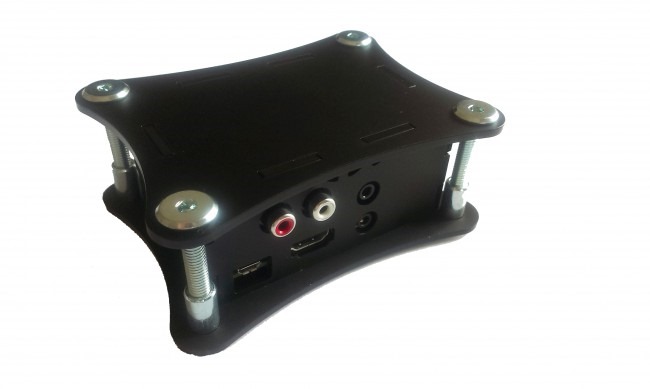
So I’ve put together a Raspberry Pi 3 with an IQaudIO Pi-DAC+ running the IQaudIO RoonReady software into a neat little enclosure from IQaudIO, and used it to connect Roon to my Quad 44 pre-amp. For a tad over €100, I’ve got an audiophile-quality network-connected DAC (Digital-to-Analogue Converter) delivering audio streams to my Hi-Fi system.
I also wanted to connect Roon to the Denon AVR-3808 used in our home cinema system. This time, because the Denon has its own internal DAC, I wanted to feed the digital audio stream straight into one of the Denon’s coaxial digital inputs. So I assembled a Raspberry Pi 2 with a HiFiBerry Digi+ card into a HiFiBerry enclosure to give me a network-connected S/PDIF device; total cost: €83.
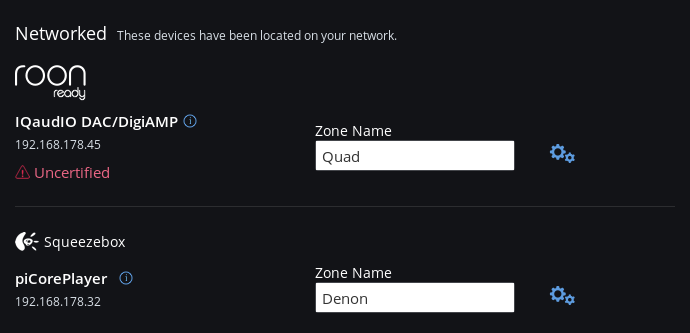
At the original time of writing this post, HiFiBerry didn’t have RoonReady software available, so originally I installed the open-source PiCorePlayer software onto the Raspberry Pi. Roon supports Squeezebox devices, so that both the Quad and the Denon systems were recognised as Roon endpoints in the network.
(note: the IQaudIO device is showing as “uncertified” because Roon haven’t released a Roon build since the device was approved in-house. Roon build 1.2 is expected in a few weeks, and then this warning will go away)
Addendum 19 April 2016: In mid-April, Roon Labs released version 1.2 of Roon. As part of the release, they introduced Roon Bridge – a software package that (according to Roon Labs):
…extends Roon’s audio playback capabilities to other devices or computers in your home.
After installing RoonBridge on a device, any audio hardware attached to that device is made available to your Roon install exactly as if Roon had direct access to to the audio hardware.
This enables you to place audio outputs anywhere in your home where you can connect an Ethernet cable or muster a decent WiFi signal, and makes it that much easier to separate the media server from your listening environment.
So then what I did was to install Raspbian on the Raspberry Pi with the HiFiBerry hardware, and download and install Roon Bridge onto it.
Now both the Raspberry Pi devices are recognised as true Roon endpoints, and I don’t need Squeezebox emulation any more.
Movies and TV
As I said at the outset, the choice for handling our movie and TV collections was between Plex and Emby. I’ve decided to go for Emby for the following, completely personal, reasons:
Even though the new generation of Home Theatre clients of both Plex and Emby are still in beta, that of Emby is already more mature and appears to be evolving faster. The Plex client is still very crude, and Plex’s UI Experience team are still sitting on the pot wondering what to do as far as I can see.
Emby has explicitly stated that their Home Theatre client is designed to be controlled by a simple six-button remote from the ground up. Plex has gone the mouse/keyboard route, with support of a remote seemingly added on as an afterthought (it didn’t work at all in early betas). Since I want to carry on using my trusty MCE Remote, the point is awarded to Emby.
Unfortunately, neither Emby nor Plex have a clue when it comes to supporting and displaying photo collections. The photo library functions in both is embarrassingly bad. This is particularly surprising given that one of the founders of Plex is a keen photographer. It may well be that Plex will buck their ideas up and deliver a more rounded product in the future. If so, I’ll revisit my current decision at that time. Until then, my money has gone to support Emby for at least the following year.
The Music and Home Cinema Setup
As a result of all of the above, our current home network now looks like this:
All our media is held on the central server (with off-site backup), and can be viewed/played on any of the attached PCs/laptops/tablets. In addition the Home Cinema system can handle both visual and music media, whilst the Quad system delivers the best Hi-Fi musical experience.
My journey to get the best experience of listening to music began many years ago, when I was still a teenager. That was when I first dipped my toes into the waters of HiFi. Using the wages from the first couple of years of summer jobs, I invested in a Quad 33 pre-amp and a Quad 303 power amp, coupled with a pair of modest KEF speakers, Goldring Lenco turntable and Shure pickup. The resulting sound was a revelation when compared with my parent’s radiogram that squatted in the lounge of our family home.
Over the course of the years I’ve been through several upgrades all of the components, and moved from vinyl to CD (yes, yes, I know many audiophiles will be frowning). There have been some constants over the years as well: I’ve stuck with Quad equipment. In 1976 I invested in a pair of Quad Electrostatic Loudspeakers, and in 1981 upgraded the amplifiers to a Quad 44 pre-amp and Quad 405 power amp. Today they are still going strong and continue to give me much listening pleasure.
Movies
The journey with Home Cinema only began in 2008, when I assembled our first flatscreen TV, a Bluray player, a Denon AVR, and eight B&W loudspeakers for our first Home Cinema system. This worked pretty well, but there were niggles. A couple of years later, these niggles grew in importance to the point where I decided to replace the Bluray player with an HTPC. So I built my first HTPC, and coupled it to my Windows Home Server, which by this time was holding the contents of our CD, DVD and Bluray discs.
The next couple of years proved that HTPCs are still for enthusiasts who are able to roll up their sleeves and fiddle about, still I was happy doing that. Fast forward to October 2014, and it was clear that major changes would be necessary in the media application software of the HTPC. Microsoft would be dropping support for Windows Media Center (WMC) and I would have to find an alternative. I found two candidates: Plex and Emby. Neither of them were as good as WMC at the time, but I placed them on the waiting list.
As promised, when Microsoft released Windows 10 at the end of July 2015, they had removed WMC from the operating system, so I needed a replacement. I was still not convinced that either Plex or Emby had Home Theater applications that were better than WMC had been, but needs must, and I ended up installing both on my HTPC, with the corresponding Plex and Emby server applications installed on the Windows Home Server 2011 system.
From my perspective, and requirements, the weak points of both Plex and Emby are that they focus primarily on movies and TV; music and photos are way down the list of priorities as far as the developers are concerned. Another drawback is that both Plex and Emby are in the throes of redeveloping their Home Theater applications, and the new versions are little better than early alphas. We may be six months to a year away from solid releases of the new versions. What is even more disappointing is that the Plex Media Player (the new HT application) is even more limited in its handling of music collections than the Plex Home Theater application that it is supposed to be replacing.
The current state of play is that I have both Plex and Emby servers running. I tend to use the old (now obsolete) Plex Home Theater application on the HTPC primarily for showing movies and TV episodes. I use both Plex and Emby Windows 10 apps on our other PCs and tablets, with a slight preference for the Emby app. I’m still looking at both to improve before being able to make a choice for one or the other.
Music + Movies?
There was a time when the HiFi system was integrated into the rest of the media environment. That was when I had Windows 7 or Windows 8.1 running on our PCs or tablets. Both operating systems supported “Play to”, which meant that I could use a music player application on a PC or tablet to stream music from the server to the Denon, and thence to the Quad pre-amp.
Microsoft has effectively ruined “Play to” in Windows 10 to the point where it is not usable. I’ve given up any hope that Microsoft will get its act together and sort this out; the Windows 10 music player Groove continues to be without a “Play to” function and is practically useless in other ways. In addition, with every release of Windows 10 Microsoft seems content to give us a new collection of bugs, whilst crowing how much its customers love Windows 10.
It’s difficult to switch between the Denon and the Quad when using either Plex or Emby; neither of them seem designed to handle multiple outputs, so I was rather resigned to going back to my physical CDs when I wanted to play music via the Quads.
Then, a couple of weeks ago, I chanced upon a post in a Plex forum that alerted me to a music application called Roon.
Roon – A Revelation
So, what is Roon? It is an application available for both Windows and Mac OSX (with Linux coming soon) that:
cross references your own digital music library (plus the content of the Tidal streaming service if you subscribe to it) with hyperlinked metadata and editorial content in an intuitive interface; and
sends digital music in a variety of formats over a variety of connections to equipment that can play it.
It certainly ain’t cheap (a yearly subscription costs $119 per year, while Lifetime membership costs $499). However, people choose to use Roon because it is the best “front end” for a music collection. The only thing like it is Sooloos, which is where Roon came from. Roon helps you organise and discover music.
Audiophiles like Roon because it supports high resolution digital files and the sound quality it provides is second only to a very small number of other programs.
Roon Labs is the company behind Roon, and although it is new, the people involved have been doing this stuff for a while (e.g. Sooloos). Roon Labs is working on the Roon software, and licenses software to hardware manufacturers for inclusion in output devices. So the Roon ecosystem over time will look something like:
Control Apps
Core (the central library management system and database)
Output devices
In terms of software, Roon Labs are leaning towards:
Plus you can get output devices from hardware manufacturers:
Roon Ready Audio Devices (Networked output devices, implementing RAAT – the network protocol used by Roon)
Roon Certified USB Device (USB devices that are known to work well and without quirks with Roon)
And you can get server devices from hardware manufacturers (these devices run Roon Core and may or may not include Outputs):
Roon Core Certified Devices (Roon takes these devices into consideration when planning for the future, and assures they have a very long life with Roon)
Roon Core Capable Devices (Devices that work fine with Roon for now, but will not be taken into consideration when planning for future updates. For example, ARM, Intel Atom and J1900 based devices).
Roon Labs haven’t committed to all the names yet, and that Roon Core Certified vs Roon Core Capable thing isn’t nailed down yet.
Being an (ex-)Software Architect, I was impressed by the software design, and decided I’d give it a trial.
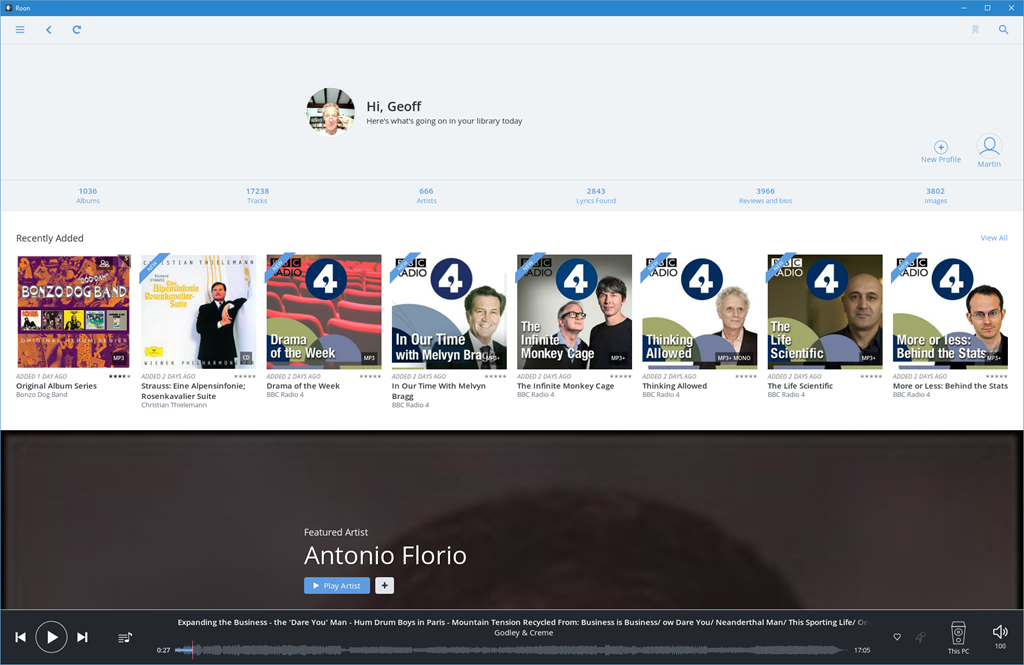
Roon’s user interface is very elegant, and blows those of Plex, Emby and Groove clean out of the water. The entry screen gives an overview of your collection (note that it can be personalised for different users).
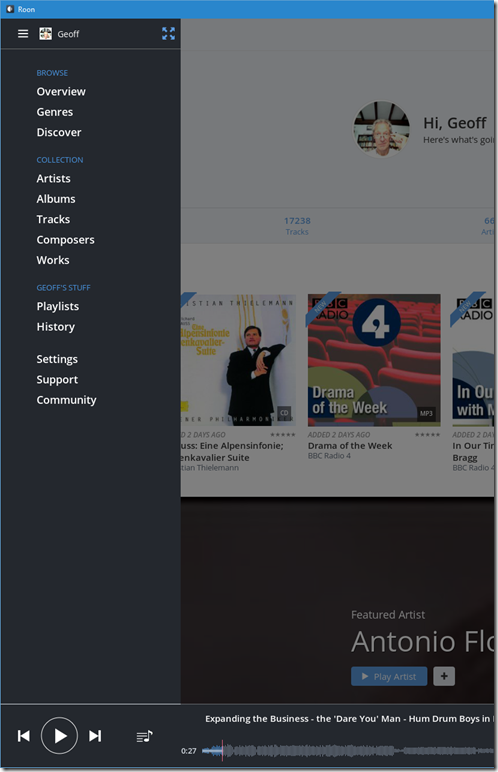
The top level menu immediately shows that in addition to Albums, Artists, and Tracks, Roon also knows about Composers and Works – these are elements that Plex, Emby and Groove haven’t got a clue about.
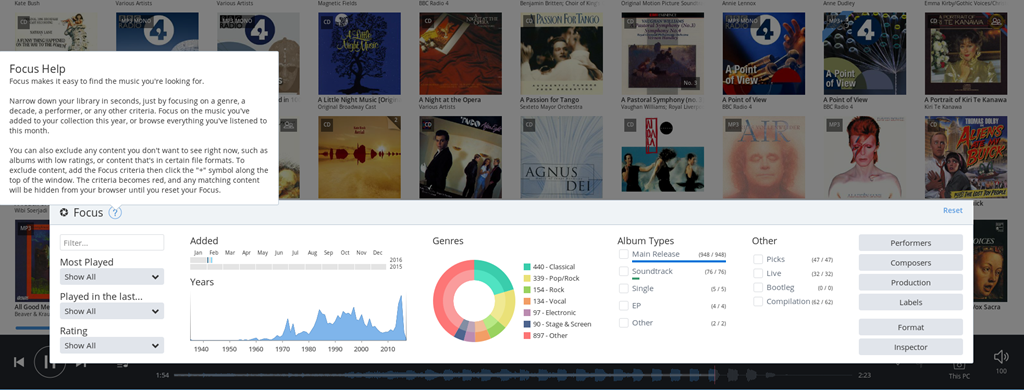
What I particularly like is that it can be clean and simple to use, but it is also easy to slice and dice your music collection (using the Focus feature) to find that hidden gem.
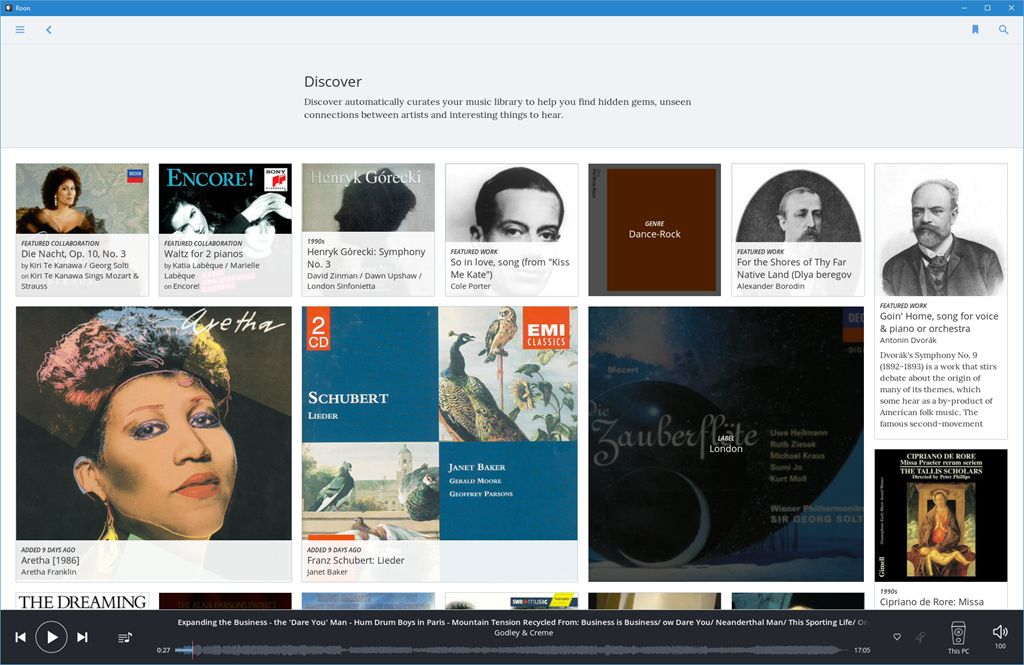
Or you can choose for serendipity, and follow links from the Discover screen, which changes over time:
Hans Beekhuyzen, a Dutch audiophile, has made a good introduction (in English) to the Roon user interface on his YouTube channel:
I decided I would trial a client/server configuration of Roon – have the Core component of Roon (RoonServer) installed on the Windows Home Server 2011 system, and install Roon software on all our tablets and PCs – including the HTPC. That way I could use any device to play back the content of our music library.
I also added an Audioquest Dragonfly DAC to the HTPC to connect it to the Quad pre-amp. Roon can support multiple outputs, so with the Roon software on the HTPC, I could easily choose to play music either through the Quad or through the Denon.
I ran into a couple of problems:
The RoonServer software didn’t really like running on WHS 2011, and Roon Labs don’t support WHS 2011.
Streaming music (FLAC 44.1 kHz, 16 bit stereo format) from RoonServer to Roon running on tablets or laptops (i.e. devices connected via WiFi) was occasionally problematic. The streaming would break or stop altogether. This does not happen with the same music streamed via Plex or Emby.
I solved problem 1 by deciding to migrate our server system off WHS 2011 to Windows 10 (which Roon Labs do support). The writing has been on the wall for a while that I would eventually have to do this migration. Microsoft stops mainstream support of WHS 2011 in April 2016. This issue with RoonServer was the straw that broke the camel’s back for me, and provided the impetus to migrate.
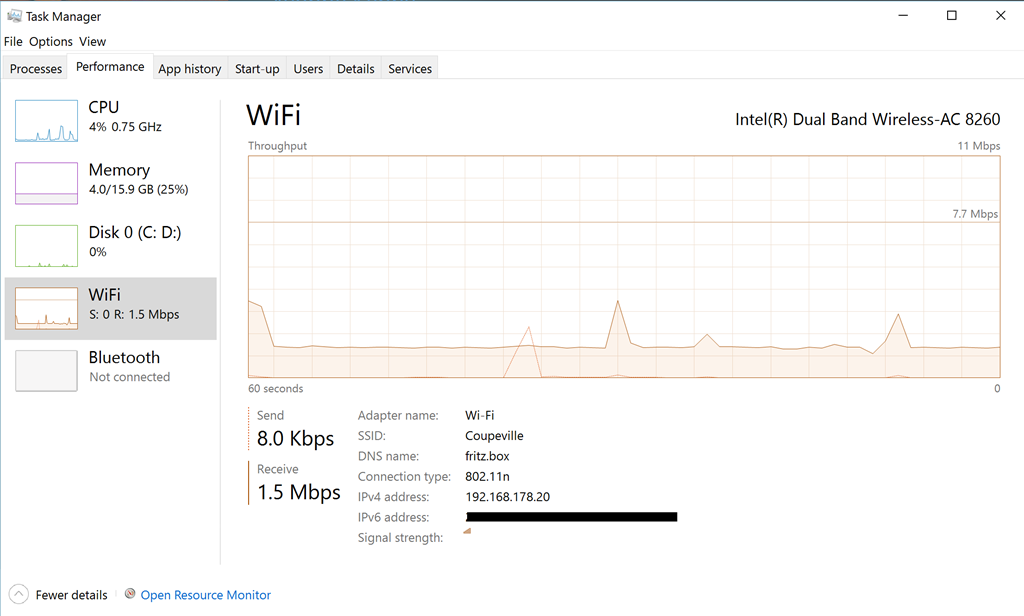
I’ve provided Roon logs to Roon Labs for the second problem, and they are investigating. I suspect that it is caused by the fact that I have two access points for our WiFi network here – the main access point at the router in the meter cupboard at the front of the house, and a repeater in the attic. In some parts of the house, a tablet will dynamically switch between taking the Wifi from the router or the repeater and vice versa. The network traffic of Roon seems to be a fairly constant 1,5 Mbps:
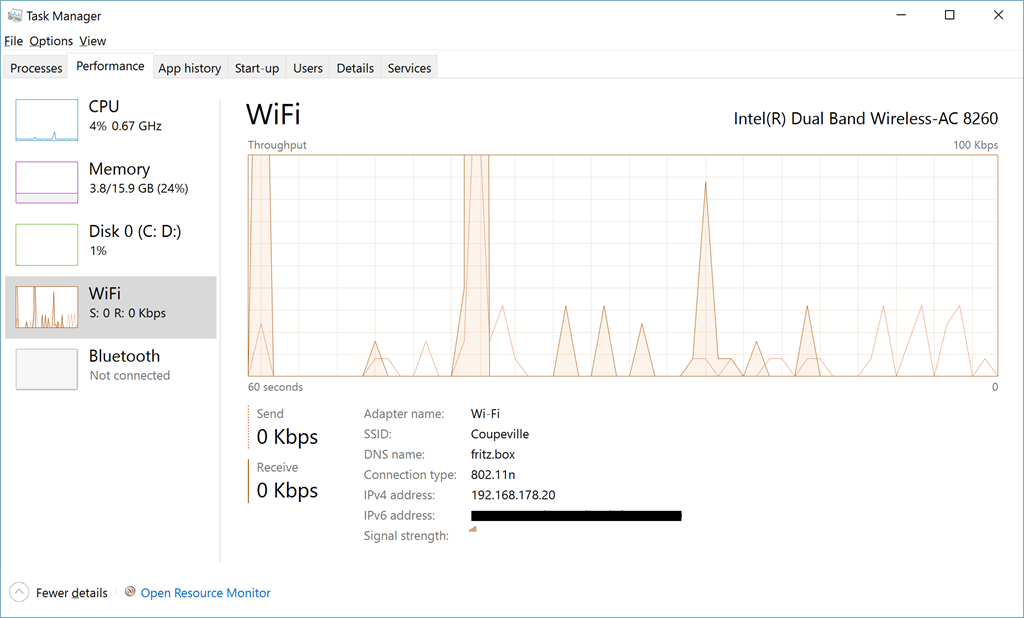
whereas that of Plex or Emby is much more “bursty”:
I am confident that this issue can be dealt with, and if the worst comes to the worst, I will still be able to use the tablets to browse the library and to control playback to the HTPC and the Quad. This feature comes in the upcoming version 1.2 of Roon. I can then continue with using Plex and Emby for music on our WiFi connected devices. Not perfect, but workable.
Final Thoughts
The journey is not at an end, but I think, at least as far as my music is concerned, I’ve reached a basecamp where I can pause awhile. It’s nice to be able to hear my music as it was intended to be heard on my Quad HiFi system once more, and that now includes high resolution music purchased online.
Yes, I’ve crossed the Rubicon and invested in a lifetime subscription to Roon. I just hope that both I and the company can survive long enough to give me a decent return on my investment…
With regards to our Home Theater experience, either Plex or Emby do it pretty well. I’ll wait to see how their Home Theater clients develop before deciding which one to go for. In the meantime, the now obsolete Plex Home Theater serves its purpose.
Addendum: 18 May 2021
I thought I’d add a note here to update the state of play as of the time of writing this addendum.
I’ve dropped the use of Emby, but still use Plex for playing movies and video. I don’t use it for anything else (e.g. for Music, Photos, or Live TV).
I’m still with Roon, which is now up to version 1.8, with much more functionality than when I started. And unlike some software applications, the additional functionality is genuinely useful.
Funny how things can stick in your mind. Impressions from years ago that, even then, were hand-me-downs from your parents and older family members. Things that you would never have experienced firsthand, yet were alive to you.
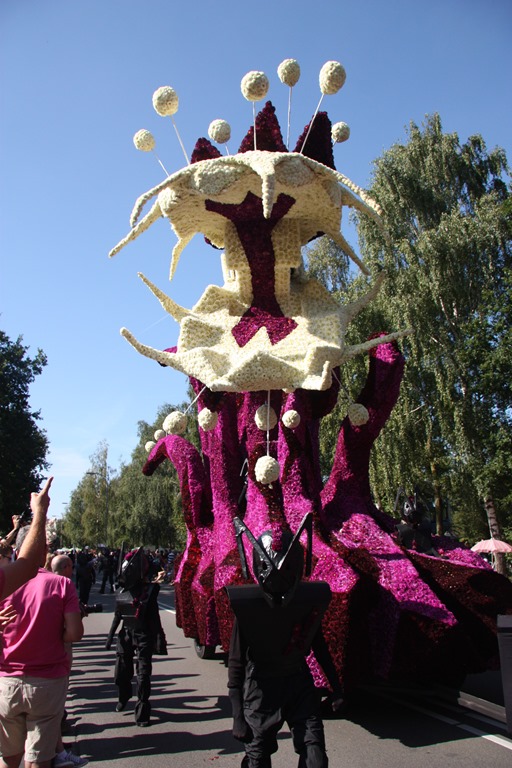
The nearby town of Lichtenvoorde holds a Bloemencorso, or Flower Parade, every year on the second Sunday in September. For 2012, that was yesterday, and as it was a beautiful sunny day, we went along to watch the parade.
There’s a quite staggering amount of work that goes into making these floats, involving thousands of Dahlia blooms, and the results are spectacular. I took about 400 photos, but unfortunately, my camera lens (a Canon EFS 17-85mm) developed a fault during the parade, so I didn’t capture all of it.
As well as the floats, there are a number of marching bands and theatre groups taking part. First up was a Brazilian dance and percussion group from The Hague:
The children of Lichtenvoorde and the surrounding area have their own section in the parade. These are just a few of the floats (click for larger images):
Then the main floats started to arrive…
Many of the floats had moving parts. This next one is difficult to appreciate in a photograph, but the bison and the hunters both turned in constant motion:
This next one was titled “Water and Fire”:
Then came my personal favourite of the parade – carnivorous plants, complete with black flies in attendance. The plants opened and closed their jaws as they passed:
Keeping with the Nature theme, this next float was titled “Tarantula”:
Followed in turn by a bunch of killer wasps in “Attack”:
This next float was titled “Underground”, and presumably represented a mechanical mole, judging by the “miners” working it:
I’m afraid that it was at this point that my lens began to play up, so I haven’t got good pictures of the last floats. However, I want to make special mention of the “Verpakt” (packaging) float. This represented six Japanese toy dolls in their packaging. The dolls moved as they passed by.
A nice touch was the inclusion of a QR code on the “box”, which takes you to the fake web site of the Go-Kyo toy…
Reading the reactions to Danny Boyle’s Olympic Opening Ceremony is something of a litmus test, gauging where the commentator resides on the spectrum from left to right, or from heartfelt to disingenuous.
I have to say that I loved it, although it was so full of cultural references that I will need a second or third viewing to appreciate them all. As Marina Hyde wrote,
…as deliciously indigestible to global tastes as Marmite or jellied eels. I loved it.
Just to make it clear, I am on the opposite end of the spectrum to the tweets from Aidan Burley, and from the blindness of those who did not see the Windrush reference (Ranga Mberi, I’m looking at you).
Overall, I find myself in agreement with Al Weiwei, who compared the machine-like opening of the Beijing games (impressive as it was) with the gentler, more human-scale vision of the London Olympics.
For while it was the best of folks, it was also the worst of folks. Gazing stonily down on a parade of athletes, about whose dreams and sacrifices this entire extravaganza is supposed to be, were some absolute shockers. Taking gold in the Biggest Scumbag in the Stadium event was probably the Bahraini prince, on whose directives athletes are reportedly tortured, flanked on the podium by Rwanda’s Paul Kagame and Prince Andrew’s brutal mate from Azerbaijan.
That’s humanity – the best and the worst; thrown together, with mostly the worst in charge…
So I was otherwise engaged last weekend when the latest episode of Doctor Who aired. I had travelled to Northern Ireland to say a final goodbye to my dearest friend. That’s another story, and I don’t feel ready to tell it, so instead I’ll turn to the artifice ofThe Girl Who Waited. I caught up with it today.
There’s something about a good story, well told. It can seize the heart and provoke a deep emotional reaction. The Girl Who Waited had that effect on me. Simply superb, developing from the basic setting up of the story, to the working out of the morality of how it affects the three protagonists, in particular the relationship of Rory and Amy, both balanced and unbalanced through time. As before, others can tell the story better than I.
“This is a kindness”. But, of course, it isn’t, and like the older Amy, one wants to rage against it. Arthur Darvill, and above all, Karen Gillan, as both the old and the young Amy, made this one of the best episodes of Doctor Who I’ve ever seen.
The next series of Doctor Who launches this weekend with what, by all accounts is a seriously good episode. Still, with Steven Moffat at the helm, I expect nothing less.
I’ll be parked on the sofa, instead of almost behind it when I was very young, on Saturday evening to watch it. This time around, being almost fifty years older, I’ll also have the benefit of my PVR to record the episode for my continued viewing pleasure.
One thing which I can’t quite grok: for some reason, Martin does not like Doctor Who. It leaves him cold for reasons that I cannot fathom. He goes off into his study when it’s on. I find that somewhat bizarre, but that’s life. I’m from Mars, he’s from Venus.
I’ve always had a soft spot for Adventure games, ever since the original Myst. I much prefer this genre of game over the first-person shooter type, which, frankly, I find appalling.
After Myst, and its various sequels, there were a series of rather sub-standard knock-offs of the same idea. It wasn’t until Benoit Sokal’s Syberia arrived that I thought that the same standard had been achieved. That was followed by Syberia II that managed to reduce me to tears at a climatic moment in the game (for all the right reasons!). Although a Syberia III has been talked of, there’s still no sign of it appearing on the market.
In the meantime, there’s the Dream Machine, an online game using clay and cardboard models (I recall The Neverhood with fond memories!) that is surprisingly involving and immersive. You can play the first chapter for free, the subsequent chapters can be unlocked for less than €5 each.
The puzzles are not as mind-bending as in Myst, but it has a charm that I really liked. It’s the product of two Swedish nerds, Erik Zaring and Anders Gustafsson, with help from others. It has the potential to become a classic. Try it.
BBC TV is running a series of dramas under the theme of "Back to the 80s" at the moment. Last night, we had Abi Morgan’s Royal Wedding, a play set in a Welsh village on the day of Charles and Di’s wedding in 1981. It was superbly observed – even the colours were those of 1980s TV; too warm and sickly. The events at the village street party were intercut with footage from the actual TV coverage of the royal wedding with toe-curling results. Clearly, Charles was an idiot even back then and he hasn’t improved with age. Presiding over it all, like the ghost at the banquet, was the spirit of Thatcher, setting in motion the changes that would change British society forever.
































 Geoff Coupe's Blog