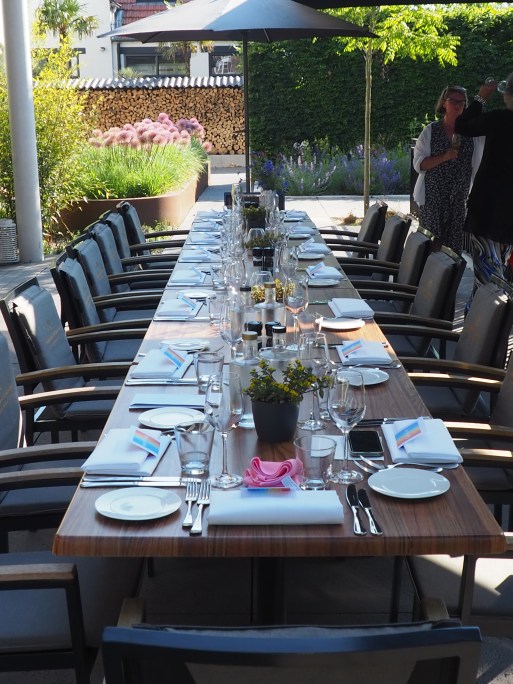
Our very good friend Carolien treated us to lunch yesterday by way of celebrating Martin’s 70th birthday and our 25th Wedding Anniversary. She really pushed the boat out and found a restaurant in nearby Braamt (only 20 minutes drive away): Karels.
Absolutely magnificent. They even had footstools for the ladies’ handbags! A tradition, I believe, of classy French restaurants, which I first heard about from Jay Rayner. Fortunately, if Jay ever reviews Karels, I feel sure that he won’t give the same stinker of a review as he did for Le Cinq…
Every course was a work of art – and tasted sublime as well. Service was friendly, knowledgeable and attentive. A restaurant to be added to the list of places to return to.
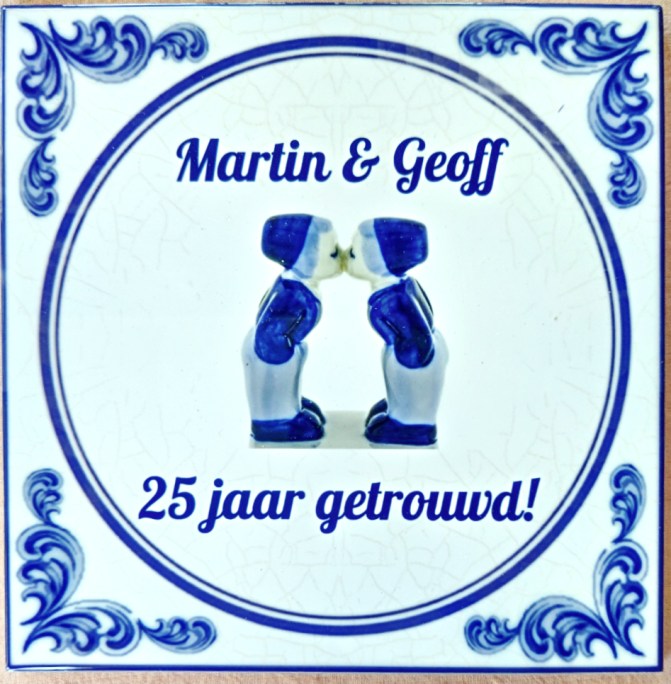
We can’t quite believe it, but a couple of days ago (the 12th June) marked 25 years since we were married – our Silver Wedding Anniversary. Time is passing far too fast these days.
We celebrated the fact last weekend by inviting friends to join us for dinner at the Hotel Heerlyckheid in Bredevoort. We had packed our dog, Watson, off to the local kennels for an overnight stay so that we could do the same at the hotel.
The evening was a great success, and thanks go to the staff and the chef at the hotel for making it so.
Somehow, given both our ages, I doubt that we will make it to the Golden Wedding, but we can look back on this with pride and satisfaction that a significant milestone was reached.
I was in the UK last week visiting family and seeing old friends. Martin stayed at home to look after Watson and the garden.
Long-distance travel was entirely by train. First travelling from home to Amsterdam to connect with the Eurostar direct to London. Then after an overnight stay in London and lunch with an old friend and his partner in Stratford (my god, how Stratford has changed…), back to Euston to catch the Avanti West Coast express to Lockerbie, where my brother collected me and drove me to his home.
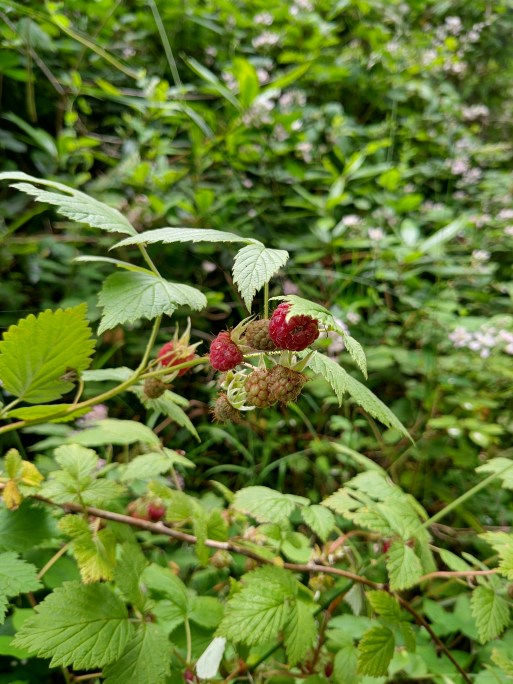
I spent a few days in the area seeing family and taking short walks, for example down St. Mary’s Isle (actually an isthmus), where wild raspberries grew in abundance in the woods.
wild raspberries
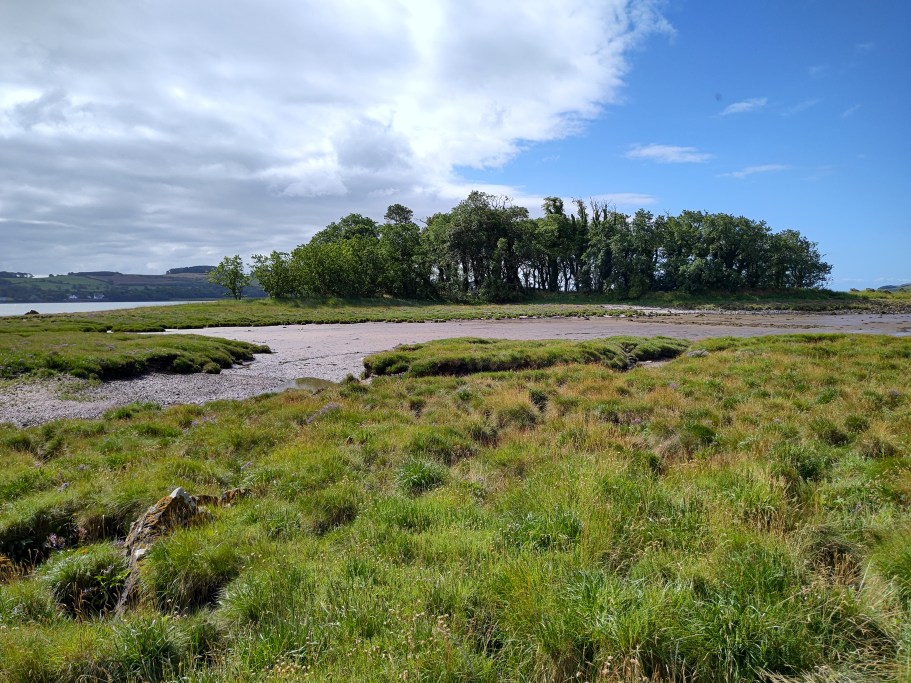
At the end of the isthmus, southwards is the Irish Sea:
On the ground…In the air…In the air – looking back towards Kirkcudbright
When I graduated from Liverpool University in July 1970, I worked for a couple of months in a Summer job at the Liverpool Museum. I had been a member of the Astronomical Society at the university, so I was lucky enough to be selected to operate the newly-opened planetarium in the museum as one of my tasks. That planetarium was fitted with a Zeiss projector; at its heart was a light source that shone through tiny holes in copper foil and then focused through an array of lenses to display the night sky on the inner surface of the planetarium’s domed roof. It was, I suppose, the “analogue” version of a planetarium – at the Dark Space Planetarium the system was fully digital. A series of projectors mounted around the rim of the dome were controlled by a computer. That meant that trips through time and space could be simulated. Very sophisticated in comparison with what we had back in 1970. I mentioned that I had operated a Zeiss projector to the young man giving the show in Kirkcudbright, and his response was: “what’s a Zeiss projector?”… Time marches on and I felt old.
At the end of the week I travelled back to London for the weekend. I was staying at The Standard hotel on Euston Road. Once again I was made to feel old – the marketing of the hotel seems to be aimed exclusively at hip young people. However, it was comfortable and the staff were pleasant. The building was originally the annex to Camden Town Hall, and once housed Camden’s public library. A remnant of the library has been preserved in the hotel’s lounge area and I felt right at home there…
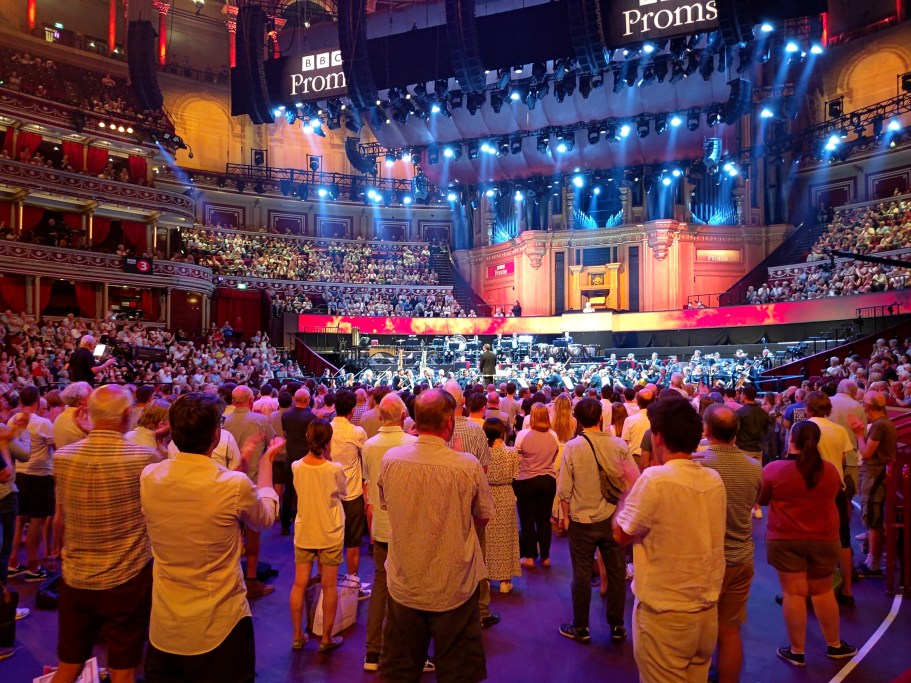
Saturday evening was spent in the company of John Wilson and the Sinfonia of London at a Prom concert in the Royal Albert Hall. The programme was English music: Vaughan Williams, Bax, Walton and Elgar, with a new piece by Huw Watkins.
The Elgar was the old warhorse of the Enigma Variations, but John Wilson found things in it that I had not heard before – he is an excellent conductor and the Sinfonia of London (with members hand-picked by Wilson) is a very good orchestra. The audience cheered and stamped its appreciation at the end.
Prom Concert
Sunday morning was spent at the Wellcome Collection. I only had time to see three of the exhibitions and one installation there:
Medicine Man
Being Human
In The Air
The Archive of an Unseen (installation)
The Medicine Man gallery houses (a very small part of) the collection of Sir Henry Wellcome – a real cabinet of curiosities. The most bizarre (for me) was the tobacco resuscitation kit. In the eighteenth century the Royal Humane Society of London placed these kits along the river Thames for use in drowning incidents. It was believed that blowing tobacco smoke up the arse of a drowned person would revive them. I loved the deadpan caption that read “[this practice] might seem strange to us…” – no, it is bloody insane…
Tobacco resuscitation kit
And then it was off to the British Museum to (re)visit some of the galleries before meeting three old friends for High Tea in the Great Court Restaurant. I hadn’t seen them for years (in one case I think it has been 30 years since we last clapped eyes on each other). Thankfully, we were all still recognisable to each other – green carnations were not required – and a hugely enjoyable time was had by all.
Monday saw me catch the early morning Eurostar to Amsterdam, and then back home to the Achterhoek and the reunion with Martin and Watson. It was a very pleasant break, and now back to our usual routine – with extra watering of the garden needed in the current heatwave…
I had read about a new series on Netflix called Heartstopper, the coming-of-age story of a gay teenage boy. It’s based on a webcomic by Alice Oseman.
Martin and I sat down to watch the first episode, and were delighted by it. It’s warm and funny, and shows the joy and angst of teenagers beginning to navigate their way through relationships.
Two things struck me. The first being how “normal” it seemed; Charlie, a 15-year old boy, is out at school, and being gay is not “a statement”, but just part of him, like his hair colour. He’s got a small group of supportive friends, and he’s able to ask an openly-gay teacher for advice.
The other thing was that the very normality was so very different from what I experienced growing up gay, and it made me somewhat sad to think back on how much I had missed out of life as a teenager.
Heartstopper is a little marvel – I hope that it shows some LGBTQ teenagers that they do not need to hate themselves, and that things will get better.
Addendum 27 May 2022: I just found out today that Joe Locke – who plays Charlie in Heartstopper – is another gay Manx lad! More power to your elbow Mr. Locke. You’ve made this old gay Manxman very proud of what you and your fellow actors and crew have achieved with Heartstopper.
It doesn’t seem possible that it has been ten years since Len died. He is still much missed. He still occasionally visits me in my dreams. I’ll be back in a dream version of our house in Bristol Gardens, and Len will be smiling and giving me some good advice as usual.
I think he would be appalled and angry about the events that have occurred since his death. Brexit and the damage wreaked by the public school boys Cameron and Johnson in particular. Len always did have an outlook that was European and beyond in scope.
We moved here to our house in the Achterhoek in the Netherlands ten years ago. Our closest neighbours, a field away were a dairy farmer and his wife. In January 2007, the farmer sold his farm to Herman Bongen and retired. Herman had worked on the farm since he was a teenager, and his dream had always been to become a farmer himself.
So in 2007, the dream became a reality for Herman and his girlfriend José. We, and the rest of the neighbourhood welcomed them to their new home and workplace.
Since that time, much has happened, both good and bad. The good has been the fact that Herman and José have become happily married, and have two lovely children: Baastian and Linde.
The bad has been the struggle that Dutch dairy farmers have had to keep their heads above water in a bad market.
It’s a struggle that has, in the last couple of months, become too much for Herman and José. They have decided to put their dairy farm up for sale. Herman told me the news some weeks ago.
José posted the news on her Facebook on the 27th August. This is what she wrote (translated from the Dutch):
More and more often we are asked: ‘Is it true? Are you getting rid of your cows?’
I waited to get in touch because my plan to write a pointed political essay just wasn’t happening. It was supposed to be my final statement about a hypocritical political system and society which shows such compassion for sustainability and the well-being of animals, but in the meantime allows for the supermarkets to demand the lowest possible price, using mega-margins over the backs of farmer and cow, flushing the market with cheap bulk milk. But my political words are gone.
No, we have not gone bankrupt. We do not have to leave our home. We did not sell the place to Fortis (a Dutch bank). And my husband Herman also does not have Parkinson’s disease. (Could be an interesting research project: how facts change through the grapevine, fascinating!) But we are putting our farm business up for sale.
Up to now we have always been able to pay our bills -something unfortunately not every farmer is able to say-, through hard work and using every bit of our savings. But we have had to surrender to the depressing feeling: ‘what are we doing this for?’. The romance which was still surrounding farm life, even in the 21st century, has gone. The most straightforward and accurate explanation of our situation I saw yesterday: ‘Farming: the art of losing money while working 400 hours a month to feed people who think you are trying to kill them.’ Very funny, if only it wouldn’t be so terribly true.
The reason for our decision is very simple: a milk price of 25 cents at a production cost of 35 cents. ‘A farmer with a brain will not become a farmer anymore ’, I read recently. That is so very true. We cannot produce our milk any cheaper. Technically we are a success story. The vet and feed specialist are always praising our cows for their healthy looks, our good quality silage heaps, the low level use of antibiotics and how well-run the whole farm is in general. Those very healthy cows, their very well-being, we will not sacrifice any of that, ever.
The practical bottleneck is mainly our high mortgage. It never was a matter of course that Herman would become a farmer. It demanded extraordinary cooperation, a sharp mind, long hours and, yes, that mortgage, in order to set up a modern business with 90 dairy cows and 50 hectares of land. I am so very proud of his passion to achieve all this!
Our very nice veterinarian was the first one to know. He was shocked: ‘You are doing such a fantastic job! You’ve got such a great farm!’ He’s right! But for two whole years now we have been totally knackered. We have bottomed out financially, whilst we will still have to replace our big barn from ’72 which includes shifting hundreds of square meters of asbestos. ‘The milk price is finally going up’, the news said yesterday. A bit early, because the new price will be publicized on Monday. But even if it does go up: even 26 cents results into a loss of 5000 euros per month. The bank will probably give us more credit, but the turn-over is low, losing money every moment. So when does one throw in the towel?
Other than the financial bottleneck there is the social one. Because of the low milk price, we cannot hire people, which makes Herman’s days longer and longer. He is more than fed-up with 80-hour weeks, how little time he’s got for the children, how his body is suffering. Also, we are fed up with not being appreciated economically, politically and socially for our efforts; worse at times. How the political parties and media get their knowledge about dairy farms from Wikipedia (how often have I had to write that the use of hormones is outlawed since 1961 and that milk and meat from animals with antibiotics in their system are not allowed to go into the human food chain?). And how new whimsical laws are made whilst crucial decisions are delayed yet again.
With great vigour we have educated ourselves this past year on how to convert to organic: a thought which had been with us for a longer spell of time but never yet got the attention it deserved. Both we and our farm are supposedly very suitable, the organic advisor told us. Only… we do not have enough land. And manpower. And there is already a waiting list. Because the consumer demands but does not buy.
The final straw was when Herman recently heard the news: ‘It is far cheaper for the consumer to buy their organic products in the supermarket.’ ‘Why are we still doing this… Does no one understand that taking good care of our cows costs money?’
I thought I’d given up on the idea of turning this into a political statement, but yet…’When our harvest fails, you are meant to get worried’, a headline said in a newspaper in an article about the loss of harvest caused by bad weather in the south of Holland. ‘When driven, responsible, intelligent farmers give up, you are also meant to get worried’, I would like to add.
Because we are not the first, and certainly not the last. Where will our milk come from twenty years from now? And how much influence will we have by then over the way it is produced? That is what worries me terrifically. For us the facts are: by getting out now, now that our debts have not dug huge holes and we’re still ‘young’, we hope to be able to make a fresh start. A house in the countryside, being self-sufficient (also twenty years from now we will still remember how to produce good food!), possibly turning it into an educational project for youngsters… you never know.
I keep on trying to focus on all of that: how relaxed and fun life could be, yet again. How wonderful it will be to have time for each other again. To have the peace of mind and spare time for a hobby and a normal social life. But that does not come easy, this new kind of dreaming. Because we are leaving another dream behind, a whole life as a matter of fact. Yesterday I watched as in the evening light our cows ambled out of the milking parlour back into their beautiful field, sheltered by woodland. And I could not help myself from sobbing out loud for the umpteenth time…
Her Facebook post went viral, and has been shared more than 18,000 times. She and Herman have been interviewed by the Press, and have appeared on Dutch television. Whilst the focus on the situation that they are in, and which is shared by many Dutch diary farmers, has been good, it does not change it one iota. The hard decision to sell the farm seems to be the right one.
It’s come as a shock to all of us in the neighbourhood, but there seems to be no alternative. I said to José the other week that the best way of viewing this was as the beginning of a new chapter, a new adventure, in their lives. To use a somewhat well-worn cliché, when one door closes, another often opens. It may seem trite, but that has often been my experience in life – I sincerely hope it will be the same for them.
One of the pleasant things about living in the Dutch countryside is that we get to participate in traditions that are non-existent or being eclipsed in cities. One such tradition is Noaberschap (neighbourliness). Martin and I are the Noaste Noabers (closest neighbours) of Herman and José. This means that we are responsible for organising the rest of Herman and José’s neighbourhood (Buurt) in times of celebration or need.
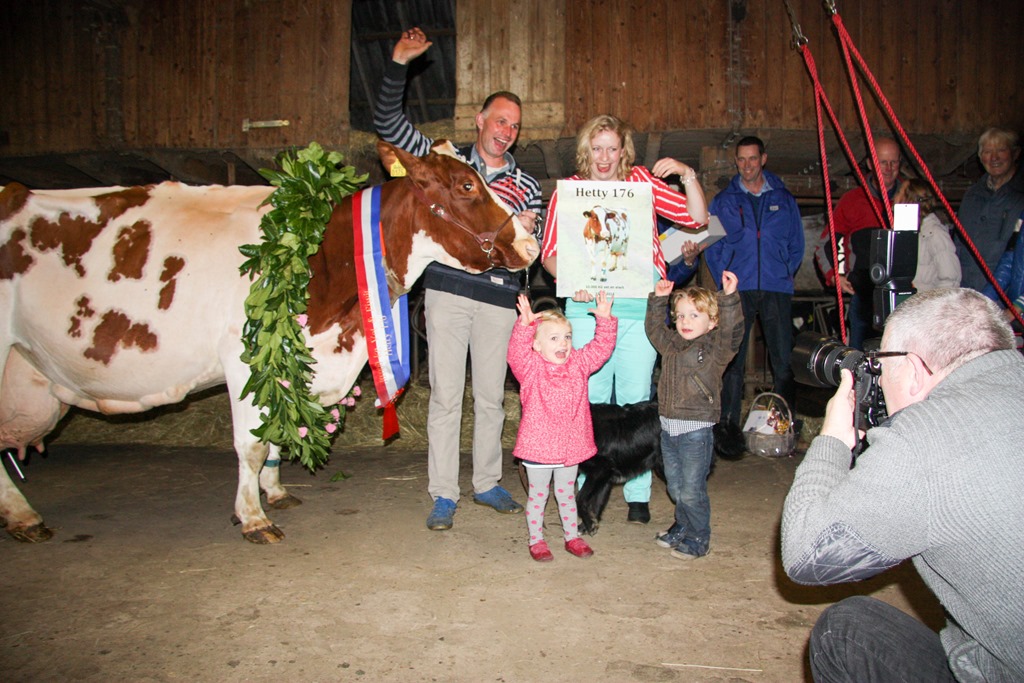
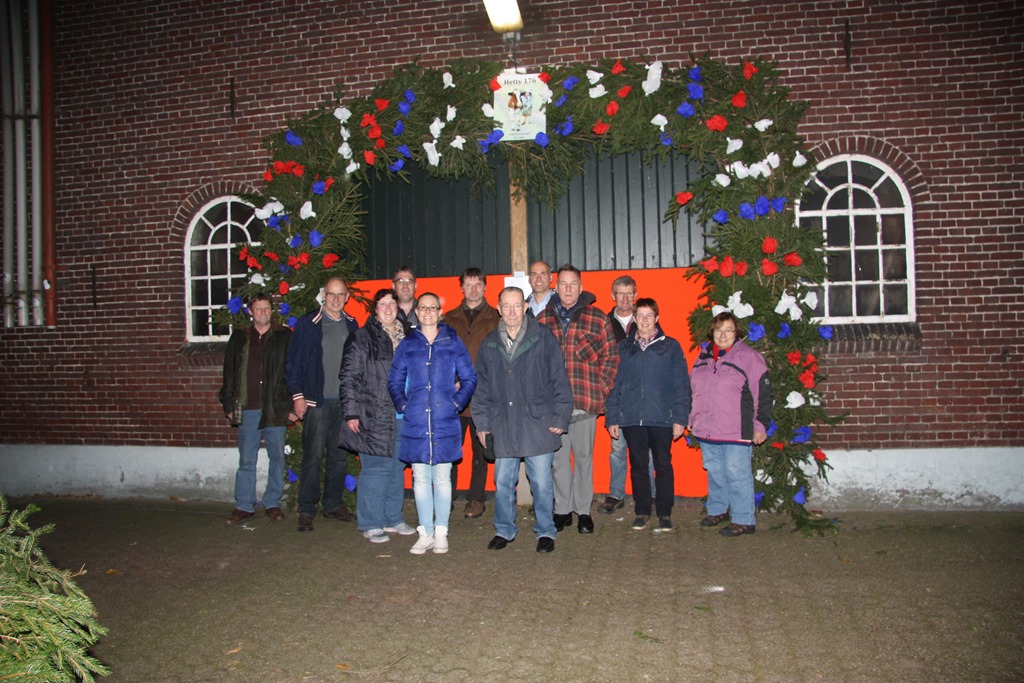
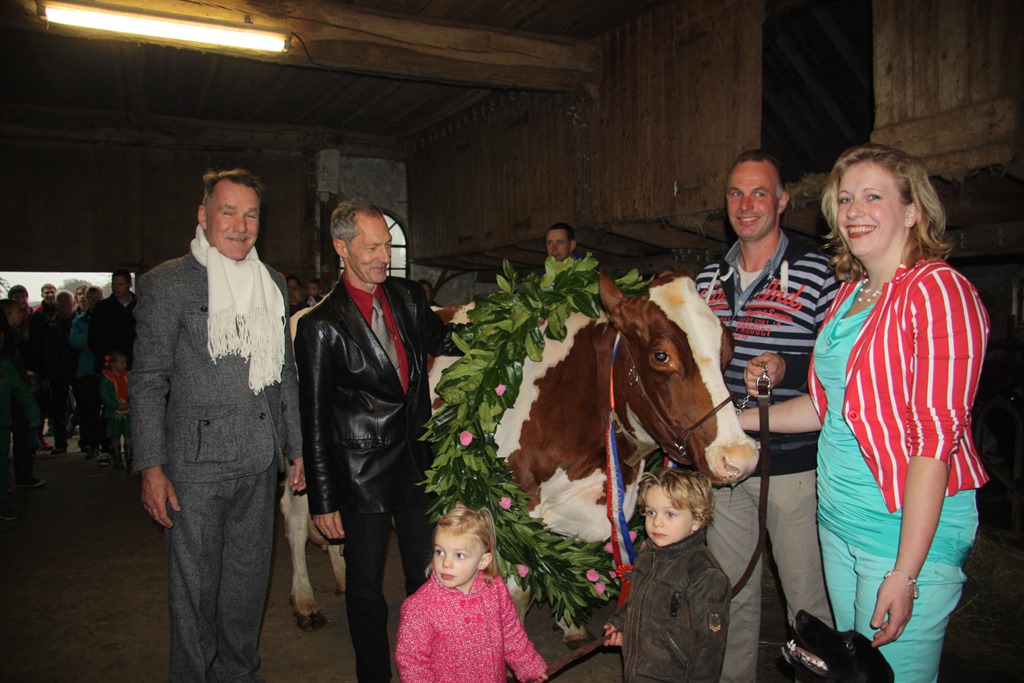
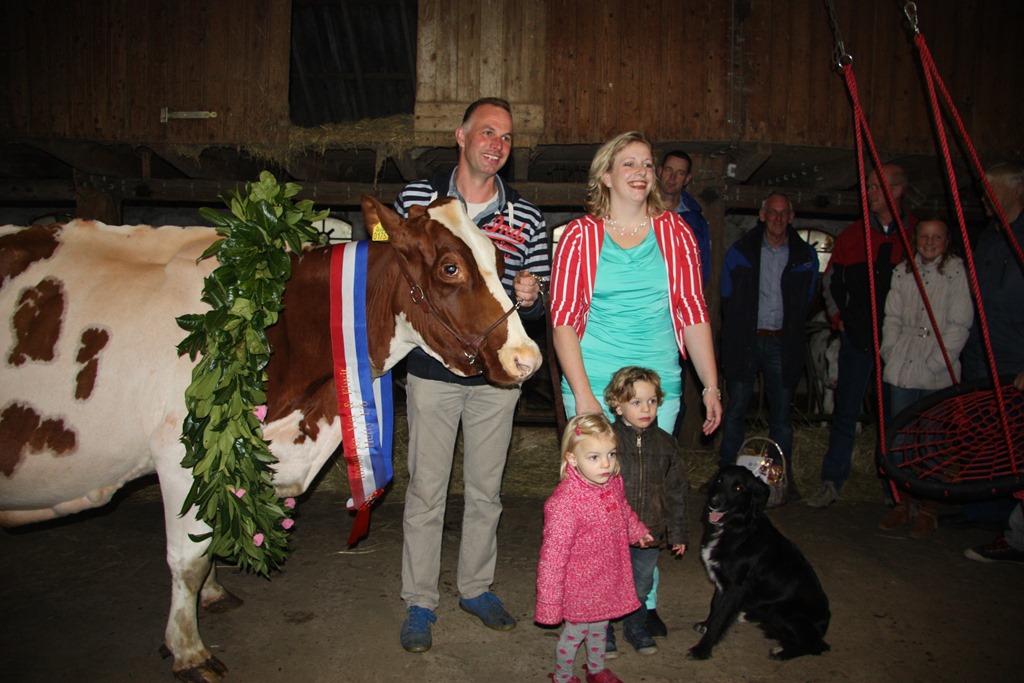
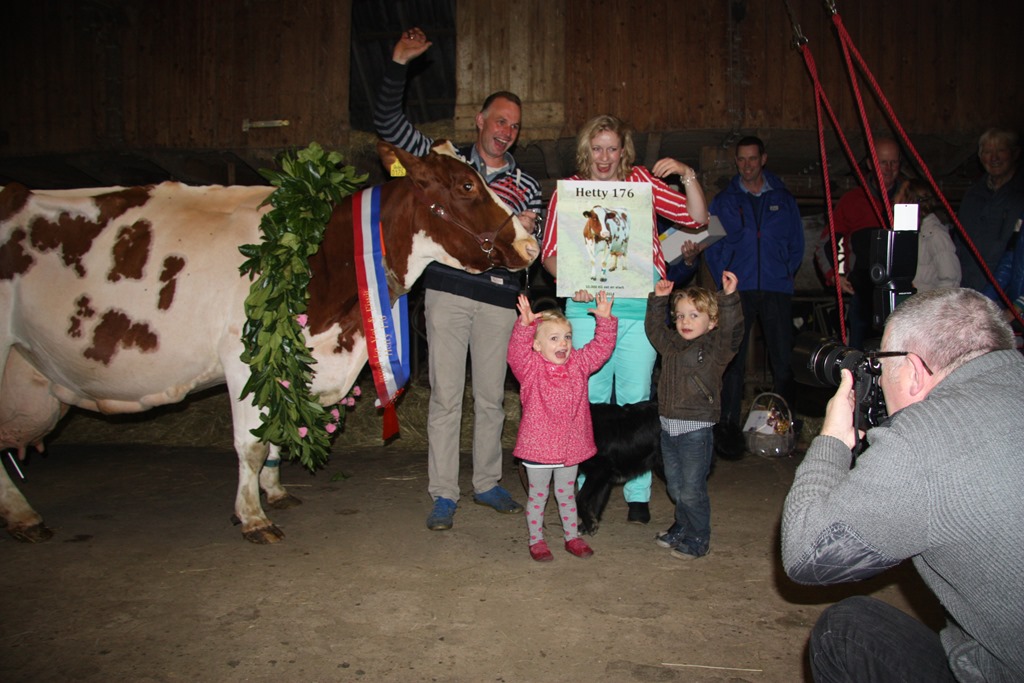
Herman is a dairy farmer, and last month one of his cows, Hetty 176, reached a milestone. In her 14 years of life, she has produced 132,000 litres of milk and 10,000 Kg of fat and protein. That, coupled with the fact that the farm has been in existence for 101 years, meant that it was clearly time for a celebration. So last Friday evening, the Buurt gathered in a neighbour’s barn, and we decorated an arch with greenery and paper flowers (red, white, and blue, the colours of the Dutch flag). Late in the evening we took the arch round to Herman and José’s and erected it in front of the entrance to their barn.
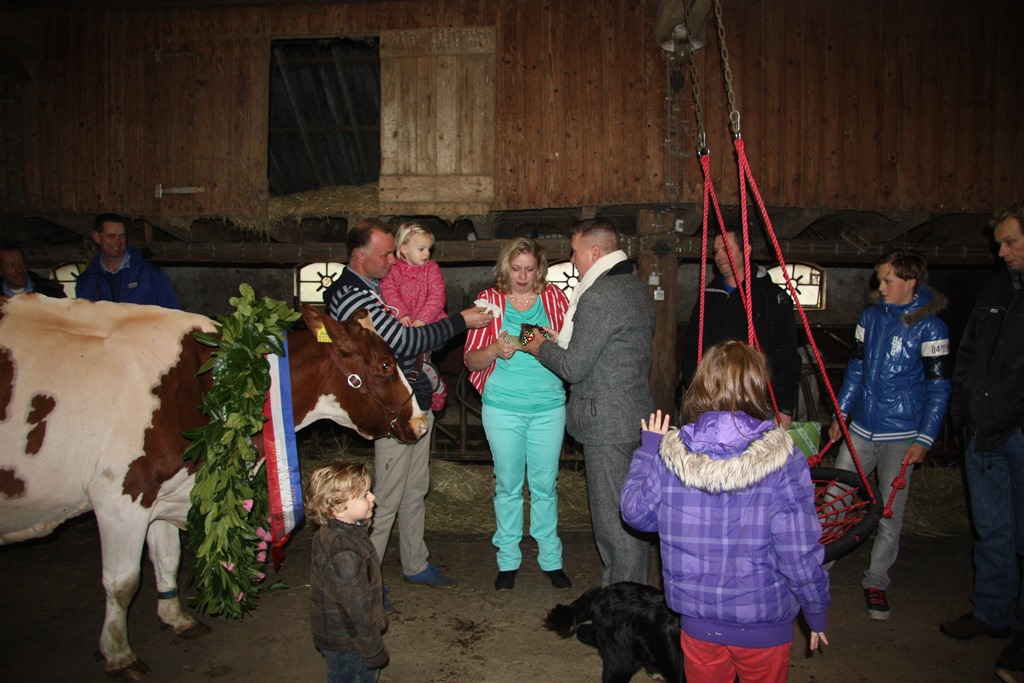
Yesterday, the Buurt, together with Herman and José’s family, friends and farming colleagues, met in the barn to celebrate Hetty’s achievement. There were representatives from CRV (a Dutch cattle herd improvement company) to present a ribbon to Hetty and a certificate to Herman. Martin and I, on behalf of the Buurt, put a laurel wreath on Hetty, and presented gifts from the Buurt to Herman and José. More speeches followed, including an emotional one from José, who reminded us that farmers do not have an easy life, and that good farmers care about their animals above and beyond the call of duty. José is very proud of Herman, and rightly so.
The afternoon was rounded off by a meal at a nearby restaurant hosted by Herman and José. A very good day.
I’m afraid I’m of an age where I read the obituaries to see if another connection with my past or present has gone. Most of the time they are of somebody famous, a well-known author perhaps, whose work has influenced me, but with whom I have had no personal connection.
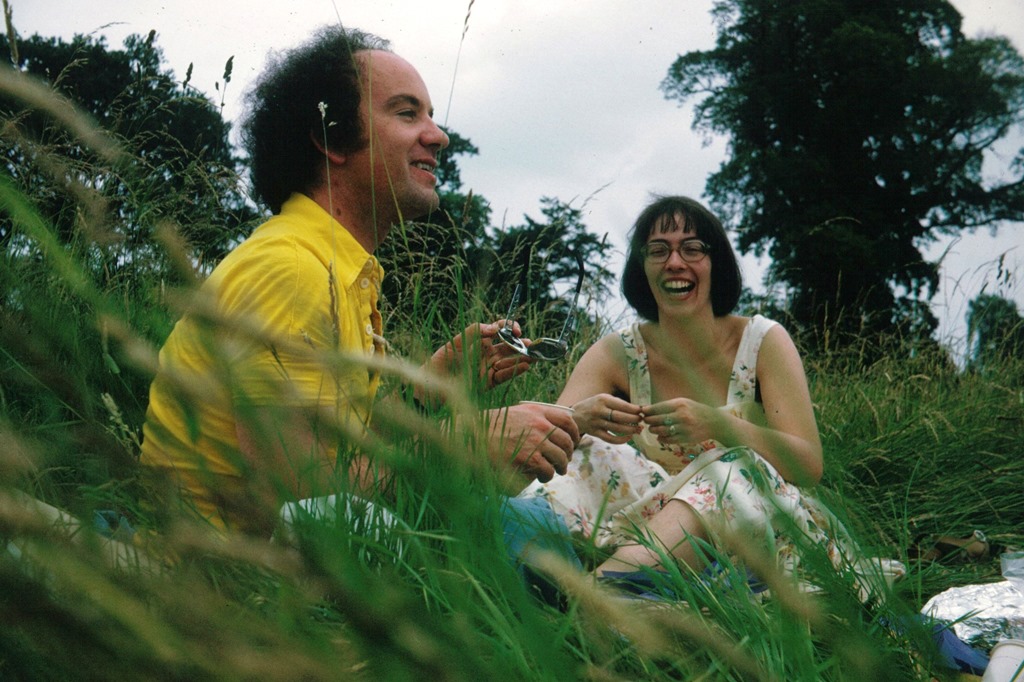
Occasionally, however, I come across the obituary of someone whom I have known quite well, and it comes as something of a shock. It happened again last Thursday, when I read the obituary of Margi Levy in the Guardian. I knew Margi back in the 1970s. She was warm, funny, passionate and intelligent. I met her via a mutual friend, Len Curran. He was a great one for having parties, and I would often see Margi at one of these affairs, where wine and good conversation would flow freely. I still have a photo of a picnic that the three of us (and two other friends) had in August 1974 in Windsor Great Park. The photo is of Len and Margi sharing a joke, and Margi has the same broad smile as in the photo that accompanies her obituary.
We became geographically separated in the 1980s – I moved to the Netherlands, Margi moved to Australia, and I lost touch with her. Alas, both Len and Margi are now gone, but their memories will remain for a while with me. I thank them for the time we shared.
Today is World AIDS day. Wear your red ribbon, or better still, give a donation to an AIDS charity. It’s also a day to remember some lost friends: Kerry, Lance, Eric, Humphrey, Peter, John, Kingsley, Graham, and Neil. I’m sorry that you’re not around with the rest of us today.
A sober reminder yesterday of how fragile our lives are. I received an email passing on the news that someone I knew, liked, and respected from my days of working in IT in Shell was killed in a light aircraft crash last Friday. He was only 42.
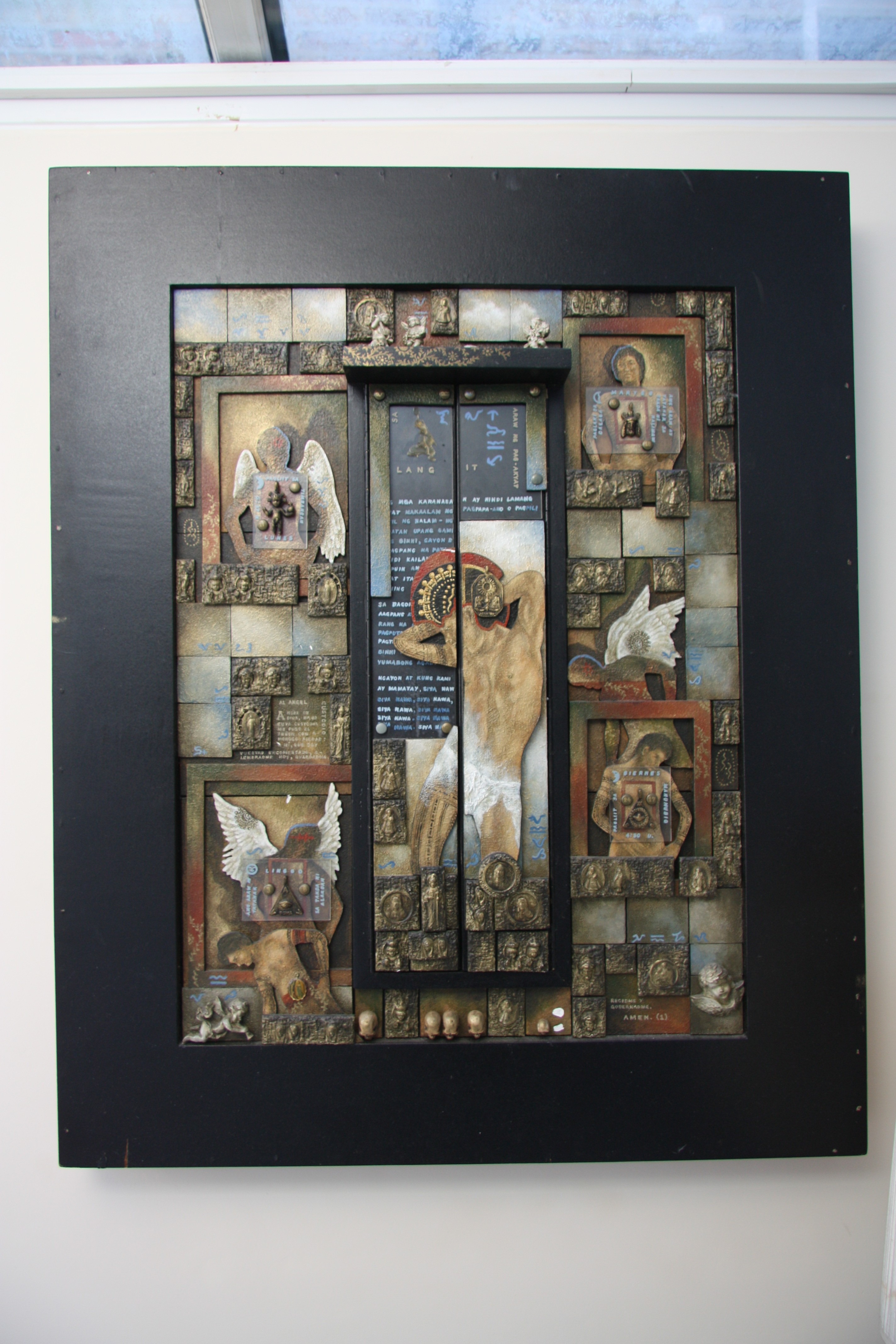
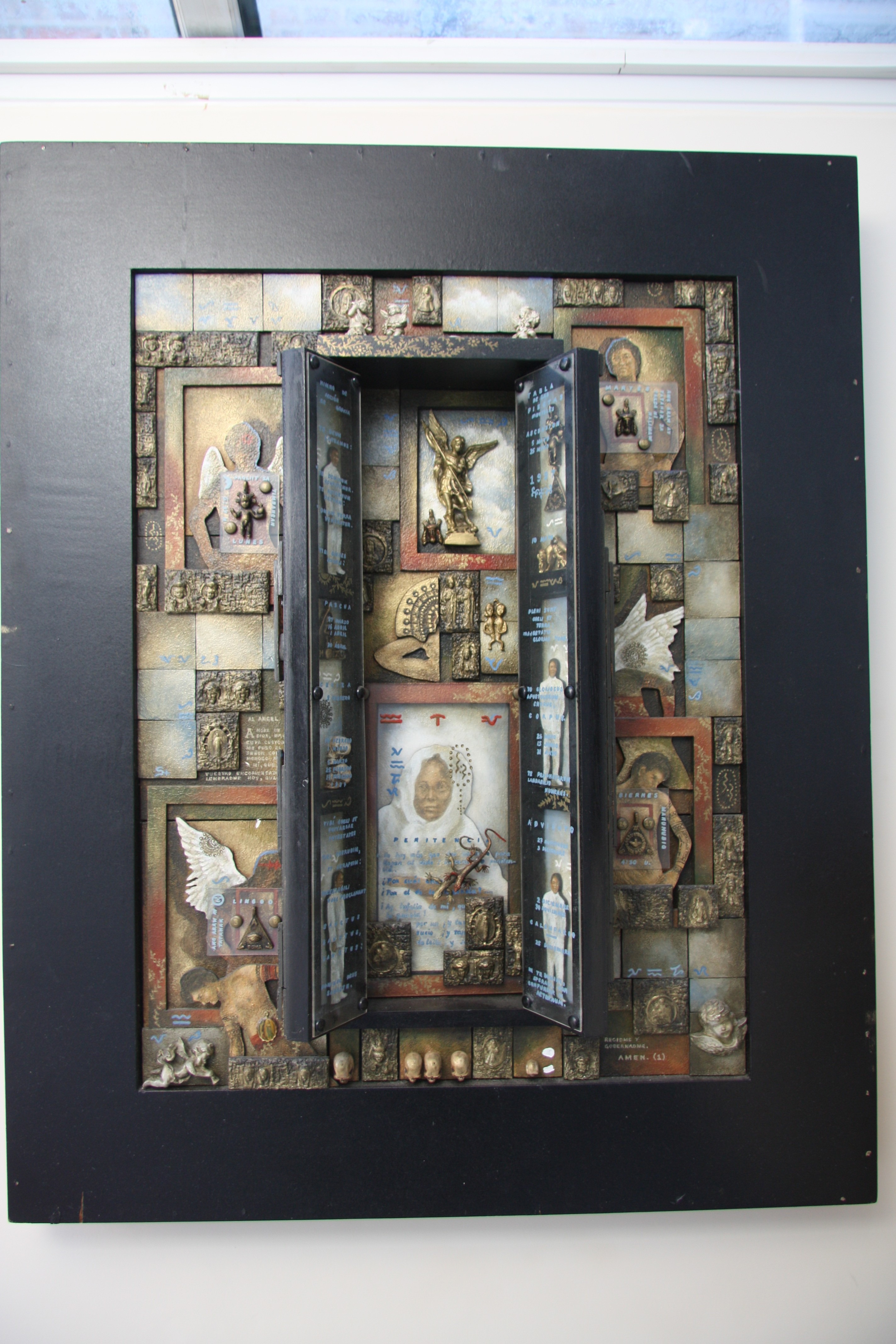
A large package was delivered yesterday morning. It turned out to be a work of art. My dearest friend, Len Curran, had, amongst his many other talents, an eye for Art. Many was the time during his travels abroad that he would struggle back with a sculpture, or a huge painting, and then argue with the airline about excess baggage.
The end result was that his house became ever more stuffed with his art collection. It was made even more acute as he downsized his accommodation space over the course of the years.
When Len died, his closest friend Mo asked me if I wanted anything from the collection as a memento, and I said that, if it were possible, I would like one particular piece. It’s by a Filipino artist, Noel Soler Cuizon, and is a mixed media piece with the title: Someday, I’ll Go Back To Heaven. That’s what arrived yesterday.
Unfortunately, it got a bit shaken up in transit, so I’m going to have to do a bit of restoration work (these photos were taken in Len’s last house), but it shouldn’t be too much of a problem. I’m looking forward to it hanging on the wall, and it will be a constant reminder of Len.
This is a very difficult post to write. It concerns my oldest and closest friend.
We first met back in the early 1970s when I first moved up to London. I wanted to do some volunteer work, and ended up asking a gay counselling organisation, Centre, if I could be a volunteer. I was interviewed by, amongst others, Dr. Leonard Patrick Curran, a psychologist who was working for the UK’s Home Office in the Prison Service department at the time.
Thus began a friendship that has continued for almost forty years. Alas, it has now been brought to a close because Len has died.
Len Curran was a psychologist and an epidemiologist. He worked for many years in the UK’s Prison Service where he was responsible for the development of policy on HIV/AIDS in prisons, for medical research and ethics. After leaving the Prison Service he worked for international agencies such as the World Health Organisation and the International Red Cross as a consultant on infectious diseases in uniformed services. In this capacity he worked in over 40 countries across the globe. He was also a Trustee on the Board of Red Kite Learning for six years.
He was, perhaps, the most intelligent man I have ever known personally. He could also be, and frequently was, the most frustrating, infuriating, and angst-inducing friend that ever was inflicted upon us mere mortals. Len did not suffer fools gladly.
I liken the experience of knowing Len to that of living on the slopes of a volcano. The intellectual view is amazing, wonderful and far-reaching, the soil of intelligent discussion is rich, deep and fertile. But every now and then there comes an eruption, seemingly out of nowhere, and then you are simply left wondering what you have done to incur the wrath of the gods.
I don’t think I ever measured up to his exacting standards – I suspect very few did. But, all the same, I kept going back for more. He was a powerful drug, that at its best delivered pure enlightenment and joie de vivre.
He supported me through good times and bad times, and he also provided the lash to my back when he thought I was not measuring up.
In the late 1970s, we bought a house together in London’s Maida Vale. A former squat, it was a Victorian terrace house that had seen far better days. I remember the first time he drove me along the street – Bristol Gardens – pointing out the two properties that he thought we should put in a bid for. He was very excited at the prospect of us going into a joint project together, I was just looking at the faded glory, the bricked-up windows and thinking: “Aarghh!”
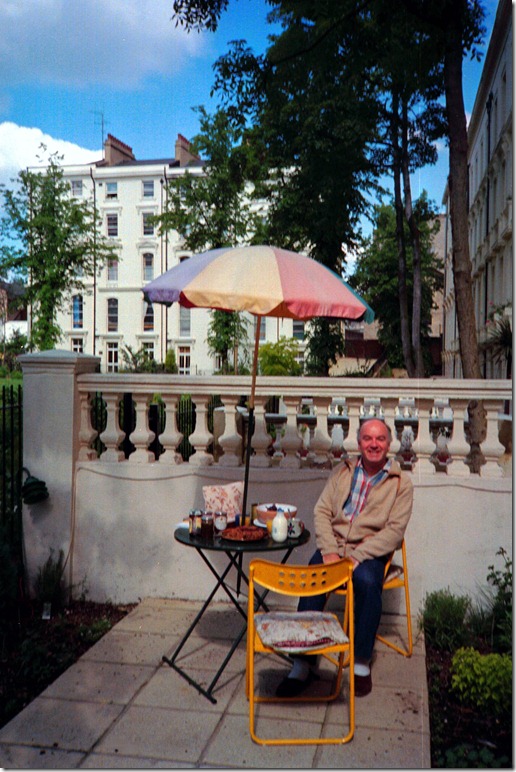
I thought he was out of his mind. However, such was his persuasive power that we ended up as the successful bidders for one of the two properties: 15 Bristol Gardens. Then came the heartburn of securing the finance – Len’s first option, the Allied Irish Bank (Len was born in Belfast), got cold feet, but finally we managed to persuade Barclays Bank to come through with the mortgages. With the help of an architect friend (Peter W.) and a builder (Peter B.), this disaster of a house was turned into two flats – one for Len (the garden flat) and one for me (the top two floors). I’m afraid that we managed to drive our builder into bankruptcy in the process, but eventually, and through a lot of our own work, we ended up with two flats in the up and coming area of Maida Vale. The house was a bit cantankerous, but it did deliver a lot of pleasure and good times during the 1980s to us both. Here’s Len partaking of breakfast in his garden at the back of the house.
I moved to the Netherlands for my work in late 1983, and eventually started renting out the top flat to a succession of people. This put Len in the position of being the landlord’s representative living downstairs, a role that he certainly didn’t want or ask for. However, after telling me in no uncertain terms that he objected to the role being thrust upon him, he accepted it with good grace and performed it admirably. Finally, in 1995, I sold the flat to Len. I can’t now recall how long he continued to live in Bristol Gardens, but eventually he sold the house and moved to a house in a nearby Mews.
Up until mid-2004, I would often be back in London on business, and very often stayed with Len. That invariably meant very late nights full of wide-ranging conversations washed down by a bottle or two of wine (or, as he would say: a bucket of wine). I recall one occasion, following a visit to the newly-opened Tate Modern, where we sat up all night talking about the art, and life in general. Fortunately, I did not have to go to work the following morning.
Because I was living in the Netherlands in the mid-1980s, Len stepped in to being in direct contact with a friend of mine who was HIV-positive. As a result, he became close friends with Kerry, with whom he shared the same wicked sense of humour. The three of us went on holiday together to the South of Spain in September 1986.
We stayed in the holiday home owned by Kerry’s sister in Murcia. They drove down in Kerry’s car from Calais, having many adventures on the way, while I flew to Malaga, where they picked me up. By the time we arrived at the house, it was dark, so they asked me to go ahead and switch on the porch light while they got the case out of the car. I didn’t suspect a thing, so I went ahead, found the switch and turned it on. Instantly, a swarm of insects and beetles flew straight at me – some of them bright green, and hard, like dried peas. Naturally, I let out a shriek, whereupon Len and Kerry turned to each other and said loudly in unison: “Yep, he’s a queen…”
Kerry and Len could both truthfully say that they had danced with Nureyev. Kerry, because he was a ballet dancer by profession, and Len, because he once met Nureyev at a party and asked him for a dance.
Len lived life to the full; I could never keep up with him. So I contented myself with listening to the many tales that he told. He was a great raconteur, and at many a dinner-party would hold us all spellbound as he wove his tales, which were frequently outrageous and would reduce his listeners to tears of laughter. He moved through all of society’s strata, and brought back stories to share with us. As a result of this oral storytelling, most of his anecdotes only exist in our memories, but here’s one I found in one of his letters:
It reminds me of when I was staying at the Loyal Liver Hotel in Bangkok (Royal River Hotel). Eventually I got so used to this that I used to leap into a taxi and with a straight face say in perfect Thai-English “Loyal Liver Hotel, Sangheee!” Which usually worked, though not always, because not all taxi drivers spoke Tinglish. So the hotels had cards printed with the address in English on one side and in Thai on the other.
One night I had been out visiting the boy-boy and boy-girl bars with the AIDS Task Force and they gave me a card showing their new condom promotion campaign for sex tourists which said: “Welcome to Bangkok. We want you to be safe whilst you are here. Please wear this condom when you are with me and it will make me feel safer and we can have good times together”. English on one side, Thai language on the other.
At the end of the evening, I leapt into a taxi and said “Loyal Liver hotel Sangheee!”, but no response so I took out a card and gave it to the taxi driver, who as Thais do when they haven’t understood, went into a meditative state to work out what you mean. We sat like that for a few minutes until I realised I’d given him the wrong card. I can imagine him later telling his wife in Thai: “Hey Martha, you’ll never guess what happened tonight!”
He also had a reflective side, so that his stories could also be moving and profound. I keep a letter in which he describes the experience of attending the funeral of a friend’s father where he pens loving portraits of the participants that bring them instantly to mind for me.
In September 1996, Len turned 50. Despite living in London, Len decided to mark the occasion by holding the party in Southern Spain at a campsite run by José and Tony, two close friends of his. People came from far and wide and it was a huge success. We ended the party dinner with a singing contest between the Spaniards and the rest of the guests fighting back with a variety of Irish, Scottish, American and German ditties. I think it was a draw, but my memory was extremely hazy by that point in the evening…
Len was born into an Irish Catholic family. Whilst in later life, he was an atheist and no longer a practicing Catholic, he recognised the value of his Catholic education:
During that time I received a very good education, compassion for those poorer and needier than me, a sense of honesty and of public service which I followed all my working life. I never suffered any guilt and I often laugh when I hear my ex-prison service psychologist (English) colleagues pontificate about ‘Catholic’ guilt. The most guilt ridden people I’ve met have been the English… not the French, Spanish, Irish or Italians. It’s true that in Ireland ‘Holy Mother Church’ was very down on sex but without that the whole country would have been at it day and night!!
Late in life, he had the rewards of being the “uncle” to the twin children of his dearest friend, Mo (Mohammed). He doted on Ayman and Ayaa, and they adored him in return.
He often remarked to me on the simple and unalloyed joy that they brought him. They, like his beloved Mo, will miss Len sorely.
In 2009, although he was not in the best of health, he still made the effort to travel to the Netherlands and attend my 60th birthday party. During the weekend we were together we again had the opportunity to talk about life in general and at length. We talked about the choice of music for our own funerals. Typical of Len, as well as the Mozart and Monteverdi, one of the songs he wanted to have at his own memorial service was Marlene Dietrich singing “See What the Boys in the Backroom Will Have”:
See what the boys in the backroom will have
And tell them I’m having the same
Go see what the boys in the backroom will have
And give them the poison they name
And when I die don’t spend my money
On flowers and my picture in a frame
Chorus: Just see what the boys in the backroom will have
And tell them I sighed and tell them I cried
And tell them I died of the same
And when I die don’t buy a casket of silver
With the candles all aflame
Just see what the boys in the backroom will have
And tell them I sighed and tell them I cried
And tell them I died of the same
And when I die don’t pay the preacher
For speaking of my glory and my fame
Just see what the boys in the backroom will have
And tell them I sighed and tell them I cried
And tell them I died of the same
I last saw Len in person in January 2011, when I visited him in the Royal Free Hospital in London over the course of three days. It was the opportunity for him to confirm his choice of music for his memorial service; he gave me my instructions as to what he wanted, and which versions. It was also an opportunity to reminisce on all the times we had together. When the time came to take our leave, we both fully expected that this would be the last we would see of each other. It was bittersweet, but with no regrets. However, Len had one last trick up his sleeve.
Len was moved to a Nursing Home, but he was determined to get back home to his house in Oliphant Street and lead as independent a life as he could to the very end. It seemed an impossible goal back in January, but once Len put his mind to something, he would get there. And get there, he did. In June, he moved back home. I spoke to him a few times via computer video conference, and he was very much improved and on very good form. The difference between then and when I saw him in January was incredible.
It was, perhaps, too good to last. He went back into hospital very recently, and developed heart problems last Sunday. He died a peaceful death yesterday. Mo rang us late last night with the news. Martin says that we should open our best bottle of champagne and drink it to his memory, and today that’s just what we’ll do.
Len, for all the ups and downs we had, it’s been wonderful. We miss you.
I don’t know where the year has gone, but here we are at the last day of 2010. And in the Dutch countryside, the last day of the year is celebrated by Carbideschieten. So once again, we enjoyed the hospitality of our neighbours; drank mulled wine, and ate oliebollen and snert. It was the very definition of gezelligheid – a practically untranslatable Dutch word.
When I first moved up to London from the countryside, way back in the early 1970s, I became a volunteer helper at one of the first gay counselling groups that sprang up around that time. This was Centre, long since gone, but it was similar to London Friend, which still exists.
At Centre, I met some people who I can still count amongst my friends, nearly forty years on. One of them was Sameer Bowyer, a volunteer like myself, but who took me under his wing to help me learn the ropes. Sameer was an interesting guy, a member of the Royal Zoological Society (he was a herpetologist) and a jeweller (he was making jewellery for an eclectic set of people such as Alvin Stardust, David Bowie, Mick Jagger, Toyah, George Melly, Humphrey Littleton, and many other pop and jazz stars of the time). He kept a collection of snakes at his home, and I remember visiting him once at feeding time. I was simultaneously fascinated and somewhat taken aback to find that their diet consisted of live white mice.
However, we had rather lost touch with each other by the end of the 1970s. Centre had closed, and we were both involved in our own lives and in our work. It was through my work that I moved to the Netherlands in 1983. On the occasional trip back to London, I would go to the open-air art market that was held on Sundays along the Bayswater Road, where Sameer used to have a pitch. The first couple of times, the other traders said that they remembered him, but that he hadn’t been there for a long while; later they would simply shake their heads – they didn’t know the name.
And that’s where it stood for many years. Then in 2008, I was idly using Google to search for long-lost friends, and turned up a reference to a Sameer Bowyer. Curious, I followed it up, and thus re-established contact with him after a gap of thirty years. Emails and the occasional telephone call followed to exchange our stories of what had been happening in the intervening period. He’d lived a full and happy life, but recently tragedy had struck – his partner of 34 years had recently died of meningitis. Sameer himself was not in the best of health, although at that point no firm diagnosis had been made.
I had hoped to meet up with him during a brief visit to the UK last year, but he was ill at the time and did not feel up to receiving visitors. So we contented ourselves with exchanging Christmas cards.
This year, I sent him a card as usual. Alas, I received an email yesterday from the husband of his niece to say that Sameer died on the 7th December, and his funeral was on the 15th. Apparently, he came out of hospital a short while ago having being told that his lung cancer (the diagnosis finally came through…) had passed into his lymphatic system and had entered the brain. He spent his last few days in a hospice in Windsor.
I regret that we did not manage to meet up again. However, I am glad that we managed to re-establish contact and exchange tales of what had happened in that thirty year gap. I shall remember Sameer with fondness. A real gent.
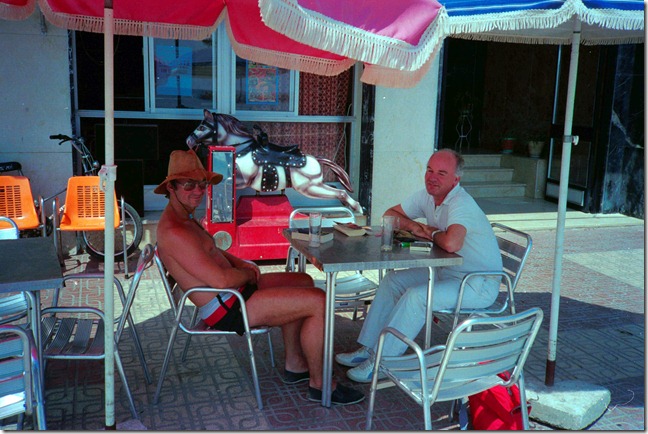
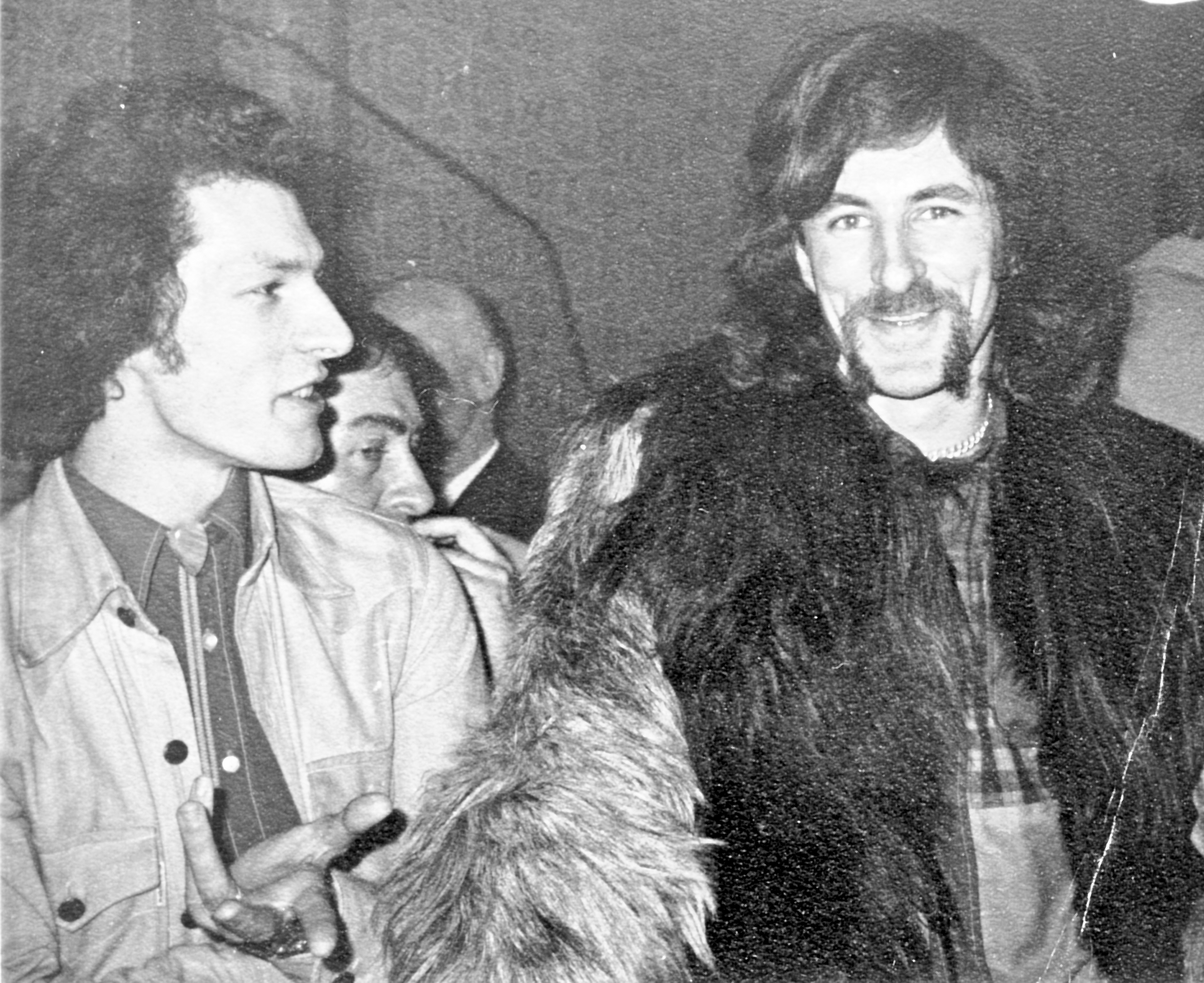
Addendum 19 November 2019: I’ve managed to find an old photo taken of us both when we were at Centre – that’s Sameer on the right in his wolfskin coat…









 Geoff Coupe's Blog