Reflections on life at “De Witte Wand”…

Category: History

  • Let’s Cultivate Xenophobia

    I see that the US Administration thinks that:

    Europe faces “civilisational erasure” within the next two decades as a result of migration and EU integration, arguing in a policy document that the US must “cultivate resistance” within the continent to “Europe’s current trajectory”.

    I suppose I shouldn’t be surprised that the current US Administration would espouse the Great Replacement Theory along with its other dubious morals.

    I await the time when I’m deported back to India, because that was where my great-great-grandmother came from.

  • Rewriting History

    I see that the Trump virus that causes the rewriting of history has apparently reached the Netherlands.

    The Guardian reports today that displays commemorating African American servicemen in the visitors’ centre at a Dutch War Cemetery have been removed.

    At least the local community and others are up in arms about it. The provincial government of Limburg will be formally asking the American Battle Monuments Commission (ABMC), which runs the cemetery and the US Ambassador to put the commemoration panels back on display.

    Lest we forget” – well, unless you are a member of a group in Trump’s crosshairs of course – then you will be marginalised and swept aside at the earliest opportunity…

    Addendum 12 December 2025: It’s now been reported in the Dutch newspaper the Gelderlander that it was the then Secretary of the AMBC himself who caused the displays removal out of fear following the publication of Trump’s “Anti-Woke decree”.

    On March 19 of this year, he emailed the staff of ABMC about Trump’s decree, which put an end to the ‘discriminatory equality ideology’. Although the ABMC was not mentioned, the then Secretary Charles Djou emphasized that the committee had to comply with Trump’s anti-woke policies to avoid negative publicity.

    He wanted to make sure that the databases on fallen African Americans and Native Americans did not violate the decree. And he asked the head of the visitor service, to check whether there are “panels” in the visitor centres in the overseas cemeteries that could cause problems for the committee.

    A day later, the head of education and public information, responds saying that certain texts have been removed from the ABMC site and that the database is not accessible to the public. He also suggests the removal of the panels from the Visitor Centre.

    The Deputy Secretary at the time, Robert Dallesandro agrees, saying in an email: “That panel has to go. Frankly, it never should have been there in the first place.”

    I note that Charles Djou has since departed from the AMBC, and Dallesandro has taken over as acting Secretary. He clearly sees no problem with rewriting history.

  • The Zone of Interest

    I want to see this, even though I know it will be stressful. As Jonathan Glazer says: ” I think something in me is aware – and fearful – that these things are on the rise again with the growth of rightwing populism everywhere. The road that so many people took is a few steps away. It is always just a few steps away.”

  • Eldorado

    Netflix has a documentary: Eldorado: Everything the Nazis Hate.

    It is worth watching.

    I’m not a fan of staged recreations of actual events, but this works because of the inclusion of actual documentary footage.

    Some good talking heads and always the feeling that, really, what have we learned from that time? History is always in danger of repeating itself.

    The clear message being that those who do not learn from history are doomed to repeat it.

  • Hitler Stalin Mum and Dad…

    … is the title of Daniel Finkelstein’s memoir about his family, and his parents’ survival of the Holocaust. It is very powerful and impressive; a real “Lest we forget” must-read.

    Still, as Rohan Silva says in his Observer review:

    Perhaps the more people that read this brilliant book, the less likely it will be that our liberal society ever disintegrates. But that faith in rationality was what Finkelstein’s grandfather, Alfred, believed in too, and it didn’t change a damned thing.

  • It’s A Sin

    That’s the title of a five-part TV series written by Russell T. Davies. Spanning the years 1981 to 1991, and set in London, it charts the impact of the AIDS crisis on a group of friends.

    It is, quite simply, a stunning piece of work, a masterpiece. A strong cast, inspired directing, and RTD’s writing combine to give explosions of joy, horror, and homophobia.

    Watching it together with Martin brought all those times back to us. The friendships we made, the friends we lost, the callousness of Thatcher’s government, and the homophobia in British society, fanned by the tabloid press.

    RTD’s writing draws upon all of this – there are references to the infamous Section 28 legislation, and he puts the word “cesspit” into the mouth of a policeman in one scene that directly references the utterance by the then Chief Constable of Greater Manchester, James Anderton, who said that homosexuals, drug addicts and prostitutes who had HIV/AIDS were “swirling in a human cesspit of their own making”.

    As well as the wider references, RTD has drawn upon his own memories of the friends he knew to create his central characters. The character of Jill Baxter is modelled on his actress friend Jill Nalder, who herself plays the role of Jill Baxter’s mother in the series.

    As I say, watching the events unfold brought all the best and the worst of those times flooding back. These days, while HIV/AIDS is not the automatic death sentence that it once was, it is still not something that should be treated casually. I hope that the series will be watched by the younger gay generations to learn something of what we went through and the awakening of our political action.

    It struck me that RTD and his team have produced a work that completely fulfils Lord Reith’s directive to the BBC that its programming should “inform, educate and entertain”. The irony is that it ended up, not on the BBC, but on its commercial rival, Channel 4…

  • A Cataclysm Down Memory Lane…

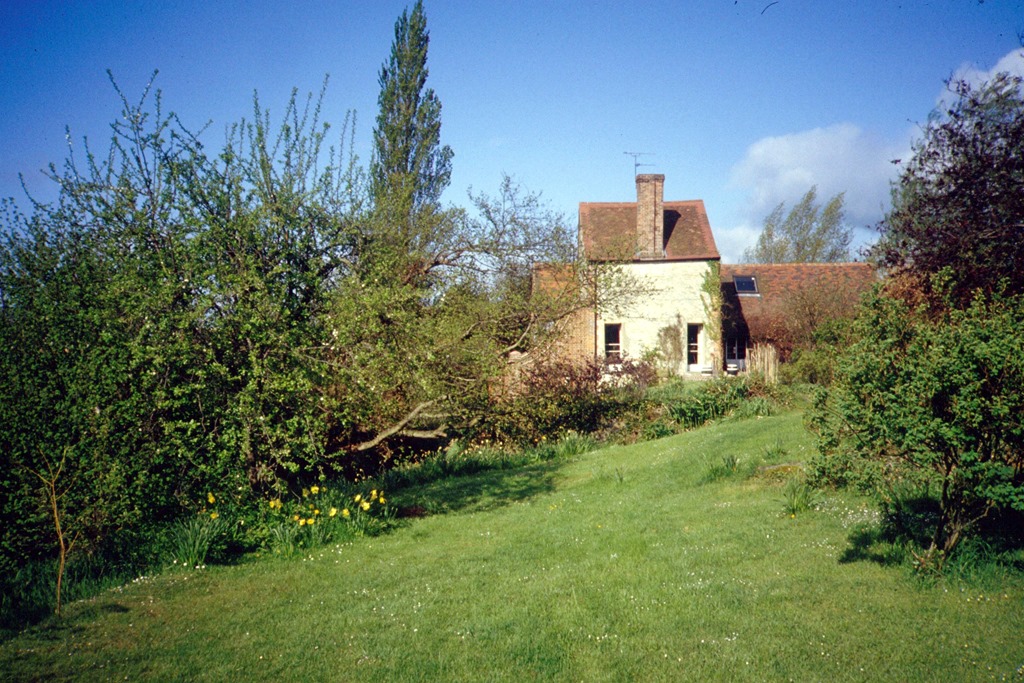
    Back in the early 1980s, I got to know William Clark, who was almost a father figure to my partner at the time. We would be frequent weekend visitors at William’s country retreat, a converted mill in the Oxfordshire village of Cuxham.

    The Mill

    Summer or winter, the house had charm and was filled with William’s memorabilia from his years in public service, the Observer newspaper, the BBC and the World Bank.

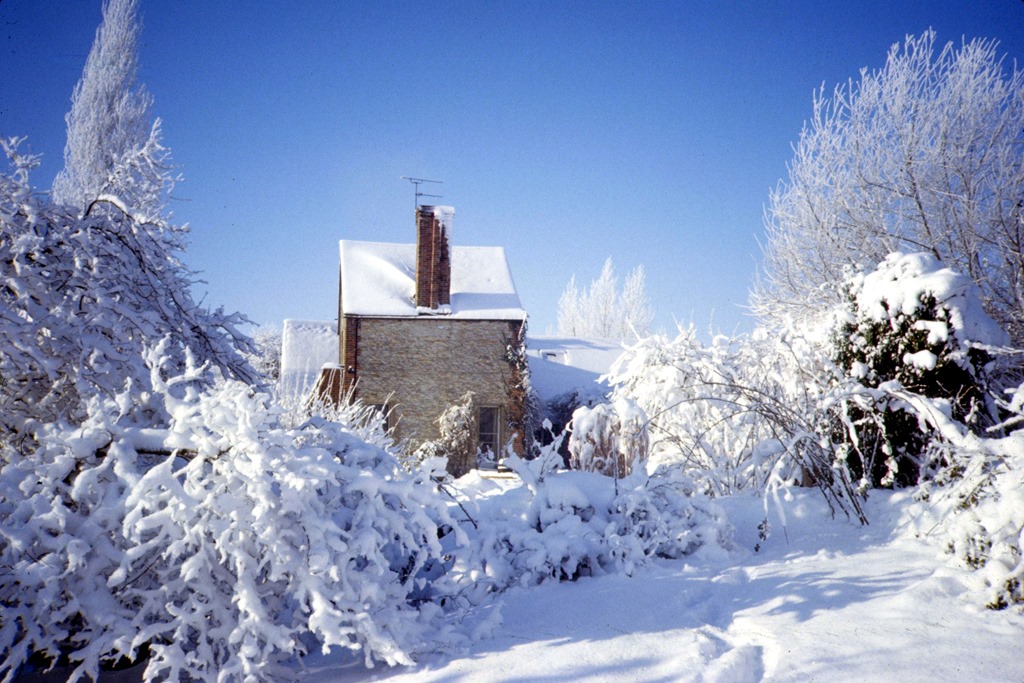
    The Mill

    Sunday lunches often had guests from the worlds in which William lived, and I found it a fascinating experience to be able to eavesdrop on their conversations.

    In 1982-3, William was engaged in writing a novel – Cataclysm – a fictional scenario in which an international debt crisis in 1987 escalates into an all-out conflict between the developed and underdeveloped worlds. A minor plot point was the use of what today would be called cybercrime, but the word, and the internet as we know it, simply didn’t exist at the time. William, knowing that I worked in IT, asked me to read the drafts and comment on the technical aspects. I did that to the best of my ability, but I suspect that my crystal ball was even cloudier than his.

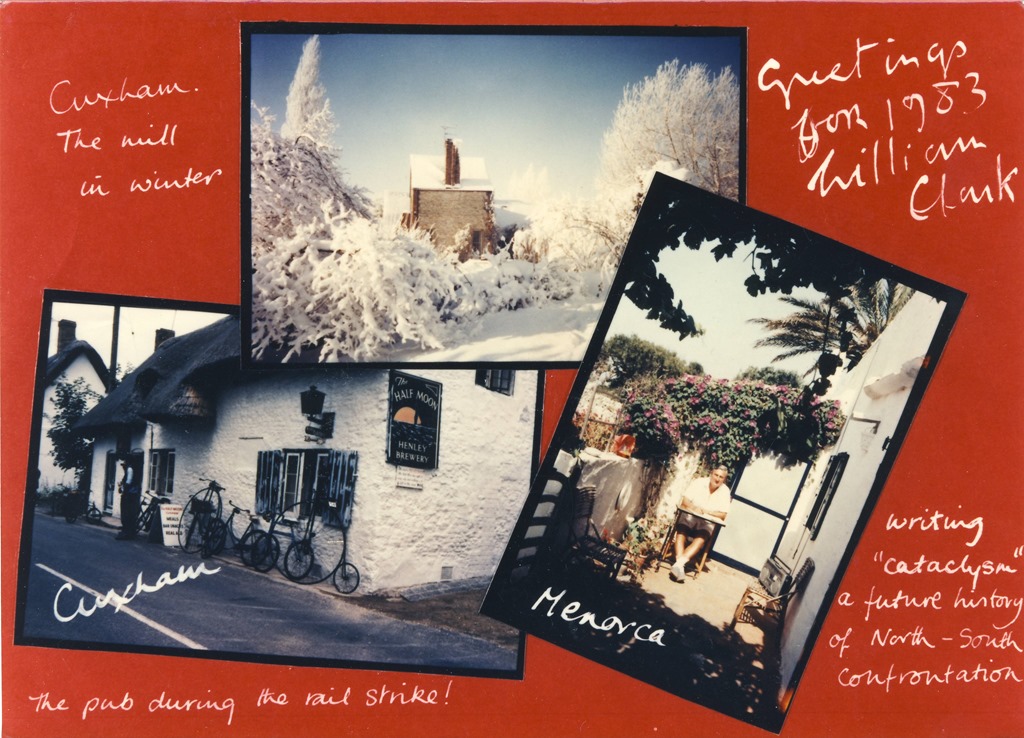
    His Christmas card of 1982 referenced both his writing of the novel and the photo I had taken of the mill in winter.

    Scan10014

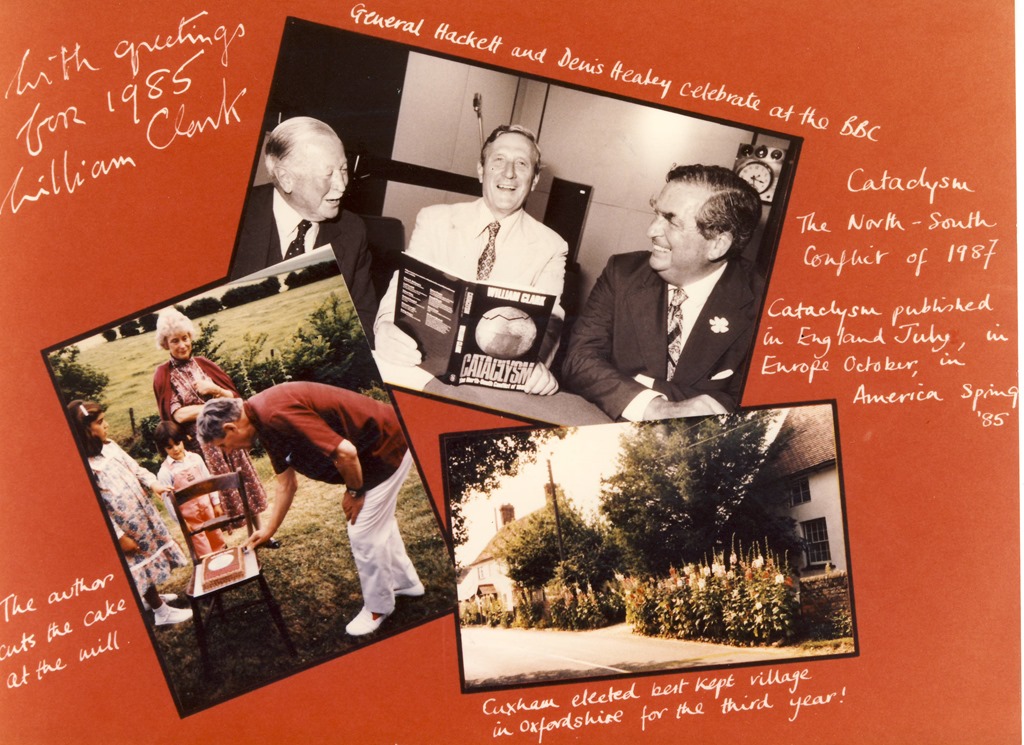
    Cataclysm was published in 1984, as that year’s Christmas card illustrates:

    1984-12-01

    I had a rather acrimonious breakup with my partner at around this time, so I’m afraid I lost touch with William, and he died, of liver cancer, in June 1985.

    I’ve often wondered how I would view the technical aspects of Cataclysm with the benefit of hindsight, so a couple of weeks ago, I went on to the Abebooks web site to track it down. I found a copy, which also apparently contained a letter signed by William, held by an Oxfordshire bookshop. I snapped it up, and it arrived yesterday.

    Cataclysm

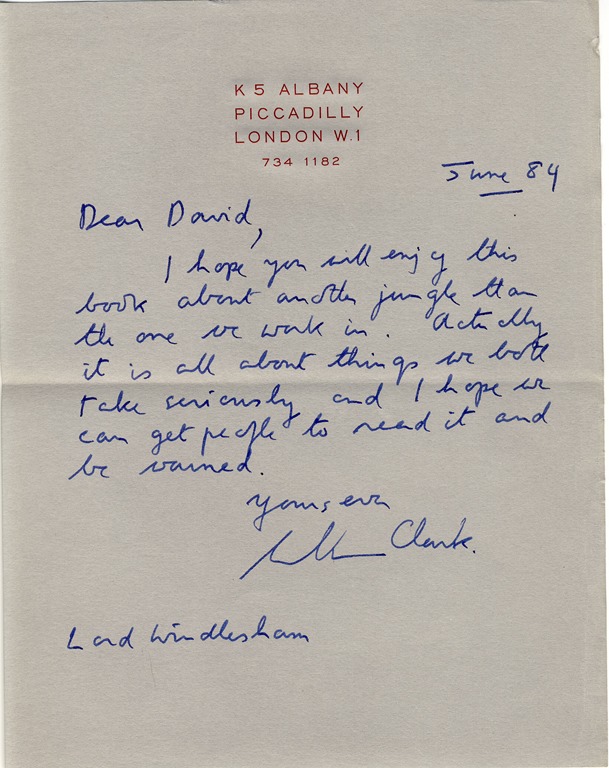
    I look forward (with a modicum of trepidation) to re-reading it. And, as promised, there was also a signed letter from William.

    William Clark

    It is written on William’s notepaper, with the heading of William’s London flat in Albany, and addressed, I believe, to David Hennessey, 3rd Baron Windlesham.

    A little piece of history.

    I recall William with much fondness. The house and garden at Cuxham would often echo to his cry of “For God’s Sake…” – with a prolonged emphasis on the second word. For all the exasperation that he was able to inject into the phrase, we all knew that there was a wink as well.

    The book, and the letter, will now reside in my library until they move on to the next owner.

  • Chuck, Vlad, and Godwin’s Law

    Heaven knows, I don’t have much time for Prince Charles. His views, particularly on the subject of alternative medicine, strike me as being not only misguided, but downright dangerous because of his position of influence. Still, just as a stopped clock is right twice a day, he is capable of saying something close to sensible sometimes. Except on this last occasion he appears to have broken the media’s version of Godwin’s law by comparing Vladimir Putin to Hitler. Naturally, our Vlad doesn’t like it.

    While it’s easy to laugh at both Charles’ continuing ability to open his mouth to change feet, and at Putin’s reaction, it’s probably better to consider the comparison between Putin and Hitler more soberly. Stephen Liddell has done just that, and it makes for interesting, and rather worrying, reading.

    Addendum: I have just read David Mitchell’s article on the same topic, and notice that he also uses the “stopped clock is right twice a day” line. Pure coincidence, I assure you – I definitely didn’t plagiarise Mitchell’s article…

  • Note To Self…

    …wait until after the 7th September 2014 before visiting the Rijksmuseum. Why? Because until then, my least-favourite philosopher, Alain de Botton, has apparently filled the Rijksmuseum with giant Post-it notes of his own. It doesn’t sound promising:

    De Botton’s evangelising and his huckster’s sincerity make him the least congenial gallery guide imaginable. He has no eye, and no ear for language. With their smarmy sermons and symptomology of human failings, their aphorisms about art leading us to better parts of ourselves, De Botton’s texts feel like being doorstepped.

    Pity, I still haven’t managed to get back to visit the Rijksmuseum since its grand reopening following a ten-year refurbishment. I want to see L’Amour Menaçant by Etienne-Maurice Falconet again. However, I really don’t want to wade through de Botton’s golden shower of musings during my visit.

    Addendum: whilst I don’t like to kick a man while he’s down, this piece of invective from the Spectator contains some choice morsels:

    All this would be easy to ignore, except that his latest book Art as Therapy, co-written with art historian John Armstrong, now has a wretched afterlife in a museum. And it’s not just any old provincial museum, but the Rijksmuseum. This important and scholarly institution should frankly be embarrassed. From April to September this year we’ll be able to visit its world-class collection of medieval art, Dutch Golden Age paintings and 20th-century artefacts and find de Botton’s anodyne thoughts, in their utterly uninsightful, depressingly reductionist therapeutic guise, accompanying not only the works on display, but items in the shop, the café, the cloakroom and the entrance.

    Well, quite.

  • The Streisand Effect in Action

    In 2009, Wendy Doniger’s book The Hindus: An Alternative History was published by Penguin. It seems to have attracted the wrath of Hindu (male) chauvinists; to the extent that a lawsuit from the Hindu group Shiksha Bachao Andolan accusing Doniger (a University of Chicago professor) of “hurt[ing] the religious feelings of millions of Hindus”  was instigated in India. As a result, Penguin have withdrawn the book from sale in India and intend to pulp the copies.

    Quite rightly, this decision has resulted in a storm of protest, and propelled the book up the bestseller list. I’ve ordered my own copies (paperback and Kindle) out of interest, in support of Doniger, and against the tiresome president of Shiksha Bachao Andolan, Dinanath Batra. As Ophelia says, Batra is an experienced religious bully.

  • You Say Tomayto…

    …and I say tomahto

    The Beeb has a new series of historical programmes being broadcast under the portmanteau title of Life and Death in the Tudor Court.

    Last Thursday saw the broadcast of The Last Days of Anne Boleyn, and what a rich plum pudding of a programme it was. It had a collection of historians and novelists – big guns, such as David Starkey and Hilary Mantel – battling it out over whose interpretation of the facts – as far as they are known – were the real McCoy. I thought it was absolutely riveting. The programme makers interviewed the experts individually, and then cut between them so that it was very apparent that history is fluid, and the truth is never as clear-cut as some would like to profess. The cut-and-thrust between the experts was excellently done, and pointed up the fact that history is never cut-and-dried.

    The following night, we had professor Diarmaid MacCulloch covering much the same ground with his examination of the rise and fall of Thomas Cromwell.

    Unfortunately for the good professor, having seen how interpretations of the players in the Tudor Court were presented and interpreted by a gallery of experts on the previous night, I was far less ready to go along with his thesis. I kept wondering how his fellow historians might have wanted to present a somewhat different picture.

    And then there was his pronunciation of the name of Anne Boleyn. The previous night, all the assembled experts had said Anne Bowlin, just as I’ve always thought of it. And now here was the good professor calling her Anne Bollin. I’m sorry, but something is not right in the state of Denmark…

    You say potahto, and he says potayto – let’s call the whole thing orff.

  • It’s NOT a Coronation!

    It’s been a momentous day here in the small country of The Netherlands. This morning, at 10:10, Queen Beatrix signed the document that confirmed that she has abdicated in favour of her eldest son, Willem-Alexander, who has now become King. The first Dutch King since the 19th Century.

    This signing took place in the Dam Palace, which started out life as the Amsterdam City Hall in the Dutch Golden Age of the 17th Century.

    Now, I’m no monarchist, but I was moved by the day’s events. Right from the moment that Queen Beatrix announced she welcomed everyone to the ceremony, and the roar of approval from the crowd outside in the Dam Square brought a smile to her face as she realised that the Dutch people were watching and supporting this move.

    Not that Beatrix has been a bad Queen. Far from it. She has become beloved by us in a way that could only have been dreamed of when she became Queen in 1980. Then, there were protests and smoke bombs in the Dam.

    Following the signing of the Abdication document, this afternoon was the inauguration of the new King. I found it almost astonishing.

    I grew up in the United Kingdom, where the British Monarchy is seen as something established by God. There is a Coronation, where the crown is placed on the head of the new monarch by the Archbishop of Canterbury. Religion and Monarchy are completely intertwined.

    In stark contrast, here in The Netherlands, the Monarch is not crowned. Instead, King Willem-Alexander was inaugurated in a ceremony that involved the State – not the Church.

    The King pledged his allegiance to the democratic process, and affirmed his responsibilities to the citizens. He made a good, and thoughtful speech, honouring the service of his mother, and promising that he would do his best for the Dutch citizens and the State. In return, the State, in the form of the members of the Dutch parliament, signalled their assent to his assumption of the role of king. And they did that individually – each standing when their name was called, and either swearing by God, or a simple “I promise”. It was interesting to see how many members did not invoke God. Another indication of how secular the Netherlands is, and how the United Kingdom still is not.

    King Willem-Alexander pledged his allegiance in front of symbols of the State – the books of the Law of the Land – as well as symbols of his own status, the crown, sceptre and orb. He also had five representatives of the Dutch people present to bear witness, and to bear symbols of the importance of the citizen to Dutch society. They were his “Koningwapenen”, or Kings of Arms. One of them was André Kuipers, Dutch physician and astronaut.

    As I say, I was moved. The importance of ritual to humans is unmissable, and touches something deep within us.

    I wish Willem-Alexander, and his very impressive wife, Máxima, all the best in their new roles as King and Queen of the Netherlands. I think that they will both do well.

  • The Grand Reopening

    I’ve always enjoyed visiting the Rijksmuseum, the grand old lady of Amsterdam’s many museums. However, she’s been closed since 2003 for a refurbishment that was supposed to have been completed in 2006.

    Here we are in 2013, and she’s about to throw open her doors once more to the world. I’ll be paying her a visit later this year, to marvel at her many wonders.

  • Best Laid Down – And Avoided

    In recent years, there’s been a fashion for “historical drama documentaries” on TV. You know the sort of thing – get a historian to front a programme on say, the Wars of the Roses, and fill most of the airtime with badly-paid and badly-acting extras re-enacting the battles. What could have been an opportunity for a knowledgeable expert to analyse a historical event gets pushed aside in favour of amateur dramatics and, shudder, “spectacle”.

    Tonight, for example, on BBC One, there will be a programme on Pompeii, fronted by Dr. Margaret Mountford. Now, Dr. Mountford recently completed her studies with her thesis on Papyrology, so she may well have the chops to be able to talk knowledgeably about the lives of Pompeiians in 79 AD, but I fear the worst. The programme is called Pompeii: The Mystery of the People Frozen in Time, and is billed as “a one-off landmark drama documentary”. The programme web site contains plenty of stills of costumed extras pretending to be citizens of Pompeii.

    Oh dear, this does not look promising. Particularly when I recall a documentary on the same subject that the BBC first broadcast in 2010: Pompeii: Life and Death in a Roman Town. No pointless dramatical reconstructions there – just an acknowledged expert on Roman life, Professor Mary Beard, talking about her beloved subject. And because of her knowledge and enthusiasm, she was able to bring the citizens of Pompeii to life for me far better than hordes of the toga-clad extras that I suspect will be paraded before us this evening.

    Just last year, the BBC broadcast a series of programmes made by Professor Beard on the Romans, and once again she brought them all to life without any need for “dramatical reconstructions”. Give me that sort of approach to history, and I’m happy. I think I’ll be giving Dr. Mountford’s drama documentary a miss this evening. I see that on BBC Two at the same time we have Sir Terry Pratchett contemplating the role of mankind in the eradication of the planet’s species, and considering his own inevitable extinction, hastened as it is likely to be by his Alzheimer’s disease. That sounds much more interesting and thought-provoking to me.

  • Keeping Tradition Alive

    In this part of the Netherlands (the Achterhoek), there’s a tradition that when a new building is constructed, and the highest point is reached, then the neighbours will erect a Meiboom (a Maypole) alongside the building. Here’s a translation of the relevant section of the entry in the Dutch Wikipedia:

    In addition, it is customary in some parts of the Netherlands (including the Achterhoek and Limburg), that when a newly built House has reached the highest point of the building, a Maypole is placed by it. The maypole also stands for in this case as a symbol for fertility and prosperity. The tree is fetched by local residents from, for example, a neighbouring forest and after the placement, a glass is drunk and a toast raised together. The maypole is sometimes placed on the building, in other cases next to or nearby. In some cases, a permit must be applied for if one wants to plant a maypole.

    This is traditionally done when it’s dark, so that the building’s owner doesn’t know what’s going on until it’s too late. The maypole also has to be taller than the highest point of the building. I’ve been told that traditionally, the building’s owner would subsequently use the maypole to make a ladder to reach the roof for putting on the roof tiles, but I suspect that might be apocryphal.

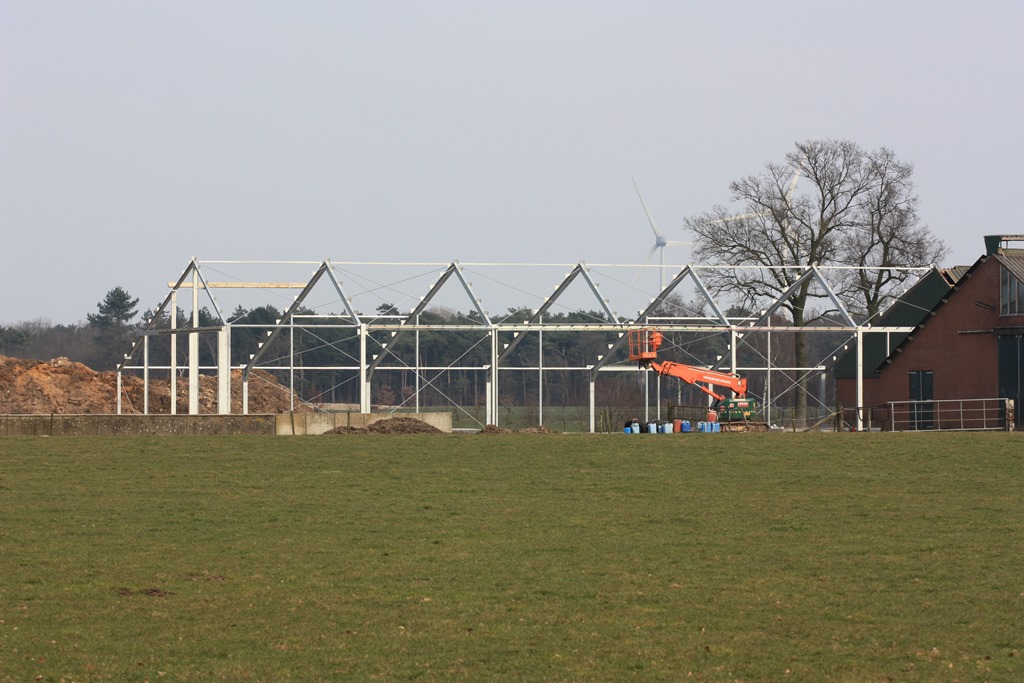
    Our nearest neighbour is a dairy farmer, and he’s having a new cattle stall built. Last week, the building frame was complete, and so the highest point was reached.

    20130223-1501-27

    Martin and I are his noaste noabers, so we are responsible for organising the rest of the neighbours in his buurt (neighbourhood) to celebrate occasions such as this.

    Last Friday afternoon, while it was still daylight, four of us, including myself, met up at a local forester’s, and selected a fir tree that was tall enough to use as a meiboom. It was felled by the forester, and the lower branches were trimmed off. Some were kept for the later making of a wreath that is suspended around the trunk on the meiboom. One of the neighbours had borrowed a large tractor and trailer to haul it back to the neighbourhood.

    That evening, the neighbours gathered at our house to prepare the meiboom. It’s the tradition to decorate the meiboom with crêpe paper flowers, so we made dozens of the things. It’s also the tradition that it’s the women who do this, while the men prepare the tree. Martin and I naturally wanted to break down this separation on roles, so Martin and one of the men also set to work on making the flowers. It was noticeable though that the older men refused to break with tradition here!

    Later we prepared the tree, by making the wreath, putting it around the tree, and attaching the flowers. A spot was selected next to the cattle stall, and a hole was dug for the tree to be rooted in. When all was ready, we went back to the house for a toast.

    Then we brought the tree to the selected spot and erected it in position. Traditionally, this would be done by manpower alone (and I’ve been involved a couple of times where this was done). The tree is gradually raised by pushing ladders under it to make it upright. It requires a lot of men and brute force. We didn’t have a lot of (young) men this time, but what we had was someone who had thought it through. He said that in place of blood pressure, we should use hydraulic pressure. So he fetched a tractor with a fork raise attachment on it, and he used that to raise the tree. It worked wonderfully, and the tree was raised and in position in a couple of minutes.
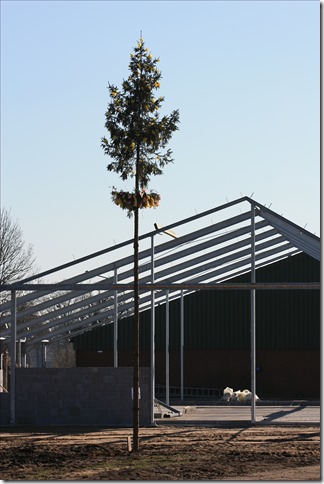
    20130304-1314-58

    Martin then pinned the traditional poem from the buurt onto the tree, and we went back to the house to raise a few more toasts to celebrate. A job well done, and a tradition upheld. We all felt very pleased with ourselves, and the farmer and his wife like the meiboom as well.

  • Lest We Forget

    The BBC showed a one hour documentary last night: Death Camp Treblinka: Survivor Stories. The survivors in question were Samuel Willenberg and Kalman Taigman. They were among 600 prisoners who escaped during a revolt at the camp on August 2nd, 1943. Only 40 of them were known to have survived to the end of the war, and now, only Samuel Willenberg remains to bear witness – Kalman Taigman died in July this year.

    The programme was profoundly shocking – Treblinka II was a death camp that existed for no other purpose than for the killing of human beings. Over 800,000 Jews and Gypsies were gassed, shot and cremated during the 13 months of the camp’s operation.

    What struck me was how small Treblinka II was – only 600 metres by 400 metres. The Nazis kept between 700 and 800 prisoners to operate the camp, while 90% of the inmates sent to Treblinka were killed within the first 2 hours of arriving.

    Willenberg and Taigman told their stories to camera, and they were harrowing. For example, Willenberg found the coats of his two younger sisters among the personal effects of the dead he had been made to sort through by the Nazis. Or the fact that during his escape from the camp, a fellow escapee, who was wounded, begged Willenberg to shoot him, rather than be recaptured. Willenberg gave him his wished-for coup de grâce.

    The light at the end of the tunnel was the closing section of the programme that showed that the two men had survived the horrors of Treblinka and rebuilt their lives. Taigman had gone on to fight in the Warsaw Uprising, while Willenberg was a witness at the trial of Adolf Eichmann. The closing moments of the programme managed to bring a profound sense of peace and regeneration of the human spirit at its best – something that I never thought would be possible given what I had just seen and heard earlier in the hour

  • Meet The Romans With Mary Beard

    May I just say, what an absolute pleasure it was to be in the company of Professor Mary Beard last night when she introduced us to a variety of long-dead Romans.

    This was TV in the very best tradition of the BBC: to educate, inform and entertain.

    I’m pleased to see that I was not the only one so impressed.

    Roll on next week when we get to see Professor Beard enthusiastically declaiming about the social impact of the Roman latrines…

  • The Devils

    Hurrah! The British Film Institute has just released the complete UK ‘X’-rated version of Ken Russell’s The Devils on DVD. It’s in its original aspect ratio of 2:35:1 and looks absolutely stunning. Derek Jarman’s sets are seen to the best effect, and the cast give all they’ve got to Ken’s extraordinary vision.

    It’s forty years since the film was first released, and Russell had problems with both the studio (Warner Brothers) and the censors. For years, the only version that was available was a cut version of questionable technical quality in the wrong aspect ratio.

    In retrospect, it’s hardly surprising that Russell had to fight to get his vision realised. Even after forty years, the mixture of religion, politics, sex (both sacred and profane) and violence is a heady brew, with more than a whiff of brimstone about it. As my favourite film critic, Mark Kermode, says, it is:

    Russell’s greatest work. A fearsome, breathtaking masterpiece.

    Despite the extravagance of Russell’s vision, the core facts of the story are historically true. His screenplay is based on Aldous Huxley’s The Devils of Loudun, which documents the events of the time, and includes letters written by the protagonists. Wikipedia sums it up thus:

    Urbain Grandier was a priest burned at the stake at Loudun, France on August 18, 1634. He was accused of seducing an entire convent of Ursuline nuns and of being in league with the devil. Grandier was probably too promiscuous and too insolent to his peers. He had antagonised the Mother Superior, Sister Jeanne of the Angels, when he rejected her offer to become the spiritual advisor to the convent. He faced an ecclesiastical tribunal and was acquitted.

    It was only after he had publicly spoken against Cardinal Richelieu that a new trial was ordered by the Cardinal. He was tortured, found guilty and executed by being burnt alive but never admitted guilt.

    I must get a copy of the book for myself.

    I watched the DVD last night and what struck me was how little things change, the same religious and political struggles are still with us, as are those who are prepared to use them for their own ends.

  • A Short Tale of Two Alans

    Today’s Guardian has a short tale (less than a page) in the My Hero series. It’s by Alan Garner and reveals a connection between him and Alan Turing. Worth reading.

  • The History of the User Interface

    Here’s a video of Bill Buxton talking about the history of (some of the) user interfaces in computing.

    http://channel9.msdn.com/Series/Show-Us-Your-Tech/Bill-Buxton-Shows-Us-His-Favorite-Tech/player?w=512&h=288

    An interview with a researcher who has passion and whose passion shines through to teach important lessons. And the basic lesson is that history is important. Those who forget their history are condemned to repeat it.