Reflections on life at “De Witte Wand”…

Category: Music

  • Lucy in the Sky with Debussy

    It brings tears to my eyes every time. She makes the piano sing.

  • RIP Tina

    The force of nature that was Tina Turner has left us. Not only a powerful singer and performer, but she also gave us some great screen roles – Aunty Entity in Mad Max: Beyond Thunderdome, and (my favourite) The Acid Queen in Ken Russell’s Tommy.

    I would quibble with her obituary in the Guardian which says “her performance [in Tommy] was one of its few critically acclaimed moments…” Few? What film was the writer thinking of? Ken Russell’s Tommy is a visual tour de force with Ann-Margret giving her all along with Tina…

    This tribute from George Miller (the director of Mad Max) gives a better sense of who she was as a person.

  • Love and Hate

    Here’s a talent…

    And here’s a different cut of the same song and performer, with a cold douche of reality at the end…

  • Celebrating the Invisible People

    Stromae is back with a song celebrating those who keep the world running, but who are never noticed.

    Welcome back, Stromae.

  • The UK’s Home Office Does It Again…

    Are they incompetent, malign, or both?

    Acclaimed British cellist has passport cancelled by Home Office

    Judging by their past performance: both is probably the closest to the truth.

  • It’s A Sin

    And following on from the It’s A Sin TV drama, Olly Alexander teams up with Elton to perform a big production number of The Pet Shop Boy’s classic:

  • Vote!

    Dear US citizens, for all our sakes make the change happen on November 3rd.

  • If Donald Got Fired…

    A little balm for the soul at this moment of crisis…

    And to my American readers… Vote! All our futures depend on it!

  • Last Night of the Proms 2019

    So, it’s over for another year – we will have to wait until the 17th July 2020 for the next season of the BBC Proms to start.

    Meanwhile, I’ll remember the Last Night of the Proms for 2019 (last night…) with joy and affection. Some stunning music: the world premiere of a new piece, Woke, by Daniel Kidane, an arrangement of Laura Mvula’s Sing to the Moon, Elisabeth Maconchy’s Proud Thames, and all the old favourites.

    And we all fell instantly in love with the mezzo-soprano Jamie Barton. What a woman, what a voice! And when she produced the Rainbow flag during the second chorus of Rule Britannia and waved it proudly for all the world to see, we were overjoyed…

    Of course, the elephant in the room was Brexit, but we all managed to avoid mentioning it, and instead we simply enjoyed the music, waving Union Jacks and European flags together.

  • Carmina Burana

    I was revisiting an old post of mine about a strange version of Carmen, and discovered that there’s a sequel that is perhaps even more weird: Carmina Burana – as you’ve definitely never seen it before…

  • Bohemian Gravity

    I know I’m very late to this, but I’ve just come across this via a link in another online forum. Worth a listen…

  • An Afternoon Concert

    Yesterday I went to an afternoon concert in which Lucas Jussen played Saint-Saëns 5th Piano Concerto with Het Gelders Orkest. I enjoyed it very much.

    Also on the program were the orchestral suites of Daphnis et Chloé, but what was a revelation to me was the opening piece: Stravinsky’s Chant Funèbre. This was composed in 1909 as a memorial to his teacher Rimsky-Korsakov, but the score was lost. It was only rediscovered in the spring of 2015. Worlds away from the Rite, which was to follow a scant few years afterwards, but a beautiful memento mori.

  • QUAD Artera Link – Rare Bird or Lame Duck?

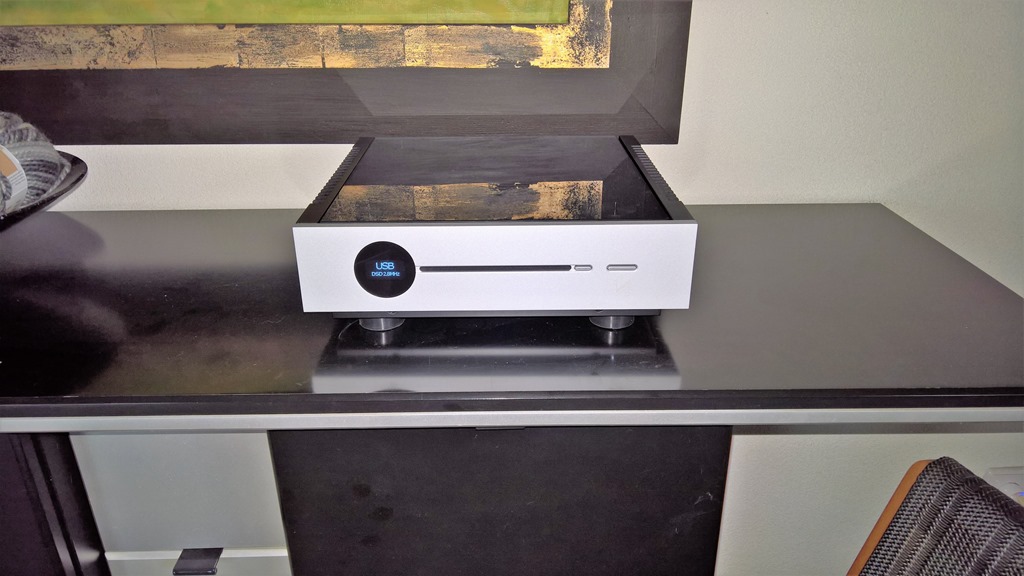
    The audio manufacturer QUAD introduced the Artera line of products back in 2015. At the 2016 Sound and Vision show in Bristol, QUAD previewed two additional models in the range: an all-in-one player and amplifier (the Artera One) and a player and streamer (the Artera Link). A full year went by without these models appearing on the market, and they ended up being re-announced at the 2017 show, and production began.

    I managed to purchase an Artera Link in February 2017, and it’s been a key component in our HiFi system during the past year.

    Yet something odd happened; apart from a passing mention in the Artera product page at QUAD’s web site, the Artera One and the Artera Link models were rarer than hen’s teeth, and not found on QUAD’s dealer price lists. Then, a week ago, QUAD suddenly announced the Artera Solus – to all intents and purposes, exactly the same model as the Artera One (a player and amplifier), and all references to the Artera One and the Artera Link were expunged from QUAD’s web site. It is said that a second version of the Artera Solus will become available later this year, which will add streamer capabilities. This seems to suggest that a pure player/streamer model (i.e. equivalent to the Artera Link) is not part of QUAD’s plans.

    So I seem to have ended up with one of the few Artera Links that have been produced. And with zero chance that it will become a Roon-Certified network player. That’s a pity.

    Quad Artera Link

  • You Gotta Believe

    Nina Paley has been working on Seder-Masochism, the follow-up to her wonderful Sita Sings The Blues, for a while now. Here’s a snippet, visuals courtesy Nina, song courtesy The Pointer Sisters. Fabulous (in all meanings of the word)!

  • Temptation

    Yesterday I went to Arnhem to listen to a pair of the Kii Three speakers. They were being demonstrated in WiFi Media. They are a new product from a young company, and have had very good reviews in the audiophile press.

    I have to admit that the speakers sounded very good. I’ve lived with a pair of Quad ESL57s for forty years (refurbished last year), and the Kii speakers were the first I’ve heard to make me think about a divorce.

    I think if the Kiis were Roon Ready, I’d be signing papers. I asked about this, but Thomas Jansen, the Kii product manager, wouldn’t be drawn other than to say it would require a new model of the Kii Control to deliver this (and I’ve since heard that there is a rumour than a new control unit with expanded capabilities is under development).

    I should probably sleep on the idea of selling all my Quad kit just at the moment, but I am rather tempted to ask for a home trial…

  • A New Lease of Life

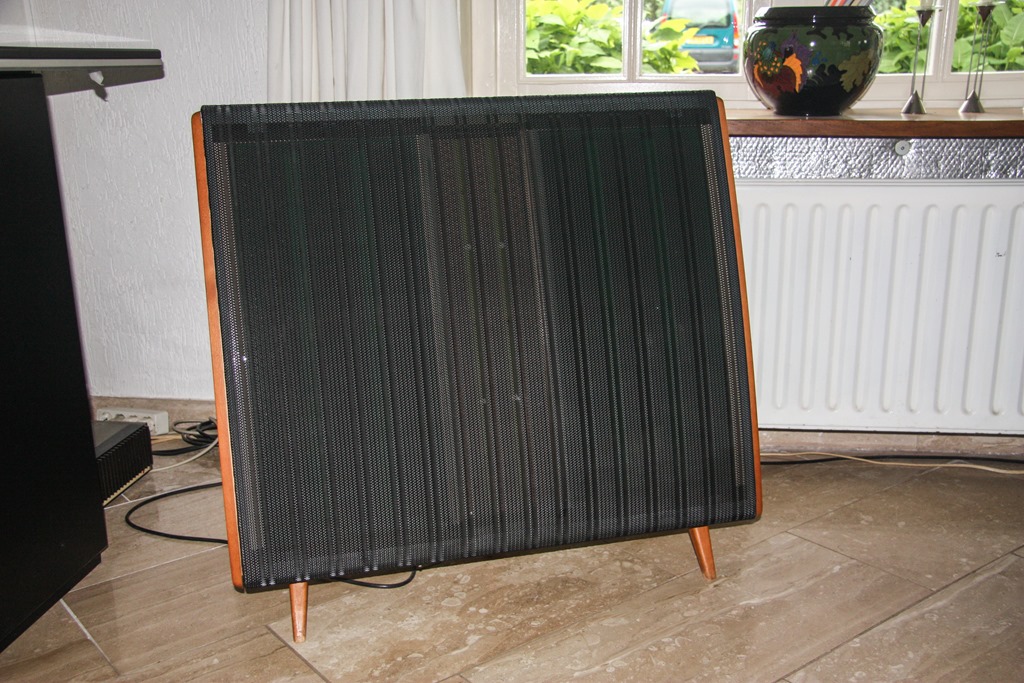
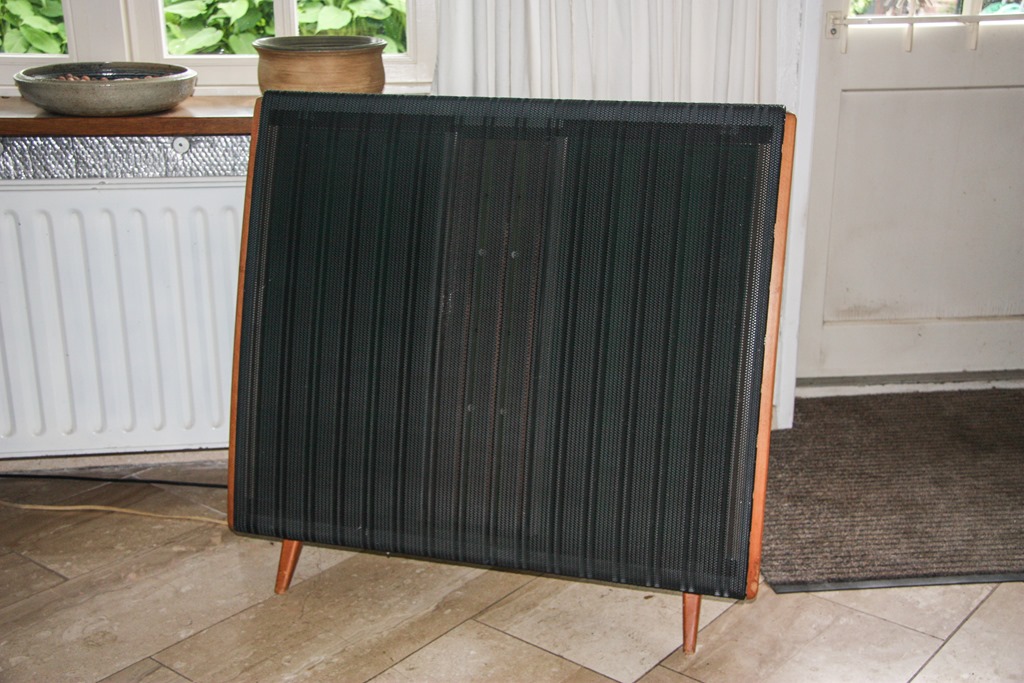
    As I’ve mentioned before, the speakers in my Hi-Fi system are a pair of QUAD electrostatic loudspeakers – the ESL 57 model to be precise – and this year, they will be forty years old. They still sound pretty good, but, like me, they are getting on in years. In order to celebrate their fortieth birthday, I thought that I should get them checked for a possible refurbishment.

    A search on the internet turned up QUAD Musikwiedergabe in Germany. When QUAD stopped production of the ESL 57 model in 1996, QUAD Musikwiedergabe took over the necessary jigs and tools to Germany. Initially this was to manufacture spare parts for the ESL 57, but eventually they started building completely new ESL 57 speakers, such was the continuing demand.

    I contacted them, and a few weeks later, the speakers were collected by Manfred Stein, the owner of QUAD Musikwiedergabe. His team checked them out, and he reported back that, considering their age, both speakers were not bad. However, he recommended replacements of the treble panels and the EHT units which deliver the high voltage. The treble panels had been overloaded (probably by me playing music far too loudly!) and the EHT’s were no longer delivering the right voltage. The bass panels were OK, but were now sounding “boomy”because of their age. I decided to go for a complete transplant of the internals, and the externals were smartened up with a fresh coat of paint.

    Manfred returned the ESL 57s this morning, and I’ve been listening to Handel operas for most of the day.

    20160621-1118-41
    20160621-1119-29

    Bliss.

  • Media in the Home–The State of Play

    I’ve written a couple of posts over the past six weeks about Hi-Fi and Home Cinema, and I thought it would be useful to document the current state of play here in the Witte Wand.

    Six weeks ago, I was at the point where I had come to the conclusion that Microsoft has lost the plot when it comes to integrating Hi-Fi systems into the Windows ecosystem. I was still trying to decide between Plex and Emby as the basis for an all-in-one media handling system, and I had just come across the Roon music system.

    Part of the problem is that trying to base Hi-Fi audio streaming on the open protocol UPnP or Apple’s proprietary AirPlay protocol is an exercise ultimately doomed to failure. Some of the reasons why this is so are documented in this thread on the Roon Community forum.

    In addition, it is clear that handling music is not the focus of either Plex or Emby – their prime objective is on handling visual media: movies and TV.

    With this in mind, I decided that the way forward was to use Roon as the basis for managing and playing music to Hi-Fi quality in the house, and select between either Plex or Emby as the basis for our Home Cinema.

    Music

    To my mind, Roon has two key strengths. The first is that the user experience is the best of all the music systems that I’ve ever tried. The second is its underlying audio streaming protocol, RAAT (Roon Advanced Audio Transport), which is far in advance of anything else out there for handling Hi-Fi quality streaming audio that I know of. RAAT is being adopted by audio hardware manufacturers into so-called “RoonReady” devices.
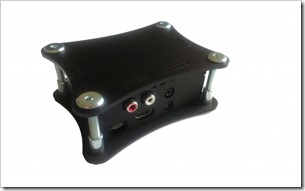
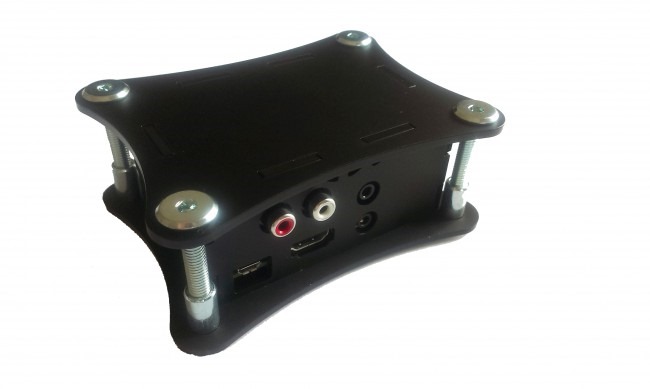
    PI-DACSo I’ve put together a Raspberry Pi 3 with an IQaudIO Pi-DAC+ running the IQaudIO RoonReady software into a neat little enclosure from IQaudIO, and used it to connect Roon to my Quad 44 pre-amp. For a tad over €100, I’ve got an audiophile-quality network-connected DAC (Digital-to-Analogue Converter) delivering audio streams to my Hi-Fi system.

    hifiberryI also wanted to connect Roon to the Denon AVR-3808 used in our home cinema system. This time, because the Denon has its own internal DAC, I wanted to feed the digital audio stream straight into one of the Denon’s coaxial digital inputs. So I assembled a Raspberry Pi 2 with a HiFiBerry Digi+ card into a HiFiBerry enclosure to give me a network-connected S/PDIF device; total cost: €83.

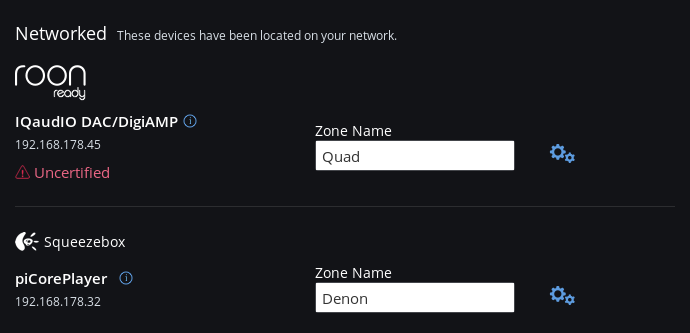
    At the original time of writing this post, HiFiBerry didn’t have RoonReady software available, so originally I installed the open-source PiCorePlayer software onto the Raspberry Pi. Roon supports Squeezebox devices, so that both the Quad and the Denon systems were recognised as Roon endpoints in the network.

    Roon 49

    (note: the IQaudIO device is showing as “uncertified” because Roon haven’t released a Roon build since the device was approved in-house. Roon build 1.2 is expected in a few weeks, and then this warning will go away)

    Addendum 19 April 2016: In mid-April, Roon Labs released version 1.2 of Roon. As part of the release, they introduced Roon Bridge – a software package that (according to Roon Labs):

    …extends Roon’s audio playback capabilities to other devices or computers in your home.

    After installing RoonBridge on a device, any audio hardware attached to that device is made available to your Roon install exactly as if Roon had direct access to to the audio hardware.

    This enables you to place audio outputs anywhere in your home where you can connect an Ethernet cable or muster a decent WiFi signal, and makes it that much easier to separate the media server from your listening environment.

    So then what I did was to install Raspbian on the Raspberry Pi with the HiFiBerry hardware, and download and install Roon Bridge onto it.

    Now both the Raspberry Pi devices are recognised as true Roon endpoints, and I don’t need Squeezebox emulation any more.
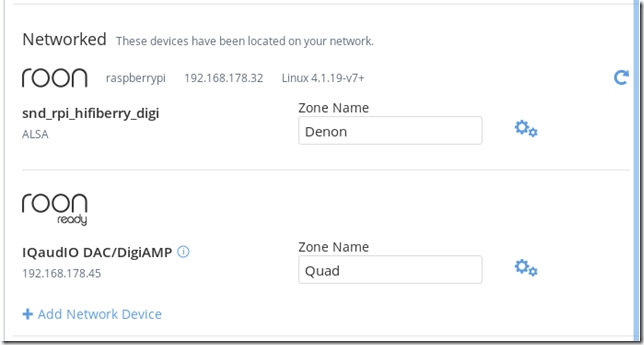
    Roon 62

    Movies and TV

    As I said at the outset, the choice for handling our movie and TV collections was between Plex and Emby. I’ve decided to go for Emby for the following, completely personal, reasons:

    • Even though the new generation of Home Theatre clients of both Plex and Emby are still in beta, that of Emby is already more mature and appears to be evolving faster. The Plex client is still very crude, and Plex’s UI Experience team are still sitting on the pot wondering what to do as far as I can see.
    • Emby has explicitly stated that their Home Theatre client is designed to be controlled by a simple six-button remote from the ground up. Plex has gone the mouse/keyboard route, with support of a remote seemingly added on as an afterthought (it didn’t work at all in early betas). Since I want to carry on using my trusty MCE Remote, the point is awarded to Emby.

    Unfortunately, neither Emby nor Plex have a clue when it comes to supporting and displaying photo collections. The photo library functions in both is embarrassingly bad. This is particularly surprising given that one of the founders of Plex is a keen photographer. It may well be that Plex will buck their ideas up and deliver a more rounded product in the future. If so, I’ll revisit my current decision at that time. Until then, my money has gone to support Emby for at least the following year.

    The Music and Home Cinema Setup

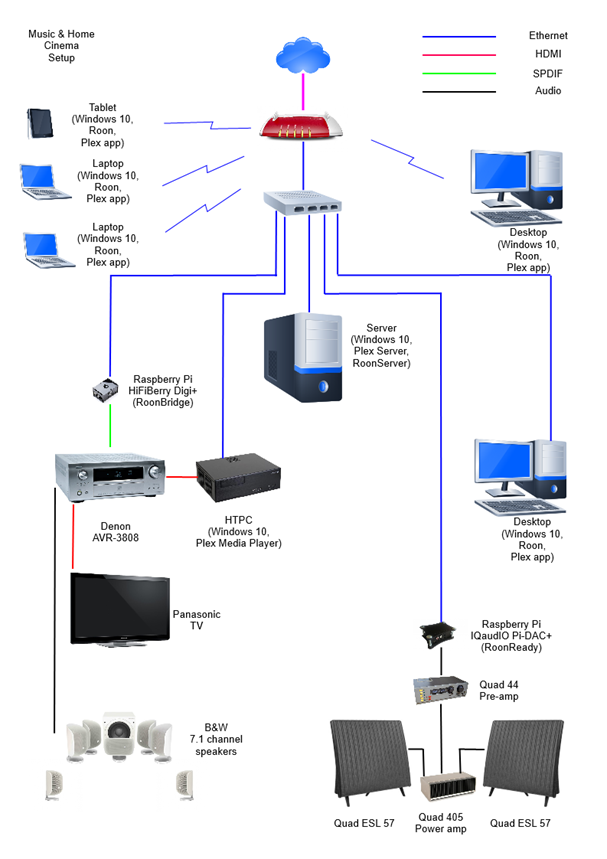
    As a result of all of the above, our current home network now looks like this:
    Network Layout

    All our media is held on the central server (with off-site backup), and can be viewed/played on any of the attached PCs/laptops/tablets. In addition the Home Cinema system can handle both visual and music media, whilst the Quad system delivers the best Hi-Fi musical experience.

  • The Pursuit of Excellence or Excess?

    A couple of weeks ago, I wrote about my adventures in the world of Hi-Fi. With the discovery of Roon, I’ve rekindled my quest to listen to music, rather than have it as background noise. It’s also had the side effect of making me take a look at my current Hi-Fi equipment and wondering whether I should upgrade or tweak it.

    Ever since I started my journey into the lands of Hi-Fi, back in 1968, I’ve been aware that there were esoteric areas, complete with warring tribes, contained within. Now, revisiting the subject some fifty years later, it seems that Hi-Fi has got more complex, rather than completely mapped out.

    There are many more companies involved in the field now. When I started there were a few well-known names, now there are seemingly thousands that I’ve never heard of. The choice is overwhelming. I’m finding it very difficult to sort the wheat from the chaff. Some decisions are easily made; for example, I don’t see myself plonking down £44,000 for an amplifier (the Dan D’Agostino Momentum Integrated Amplifier). Even if I had that sort of money lying around, I would be thinking twice or three times about it. And then there are the products which, to my mind, seem more associated with snake oil than science.

    Connecting cables is the big area here. Some of the claims made for expensive cables seem, shall we say, somewhat over the top? But then, if you are going to pay $22,000 for a cable to connect one piece of equipment to another (the Skogrand Beethoven cable), you have to believe that it makes a difference. This reviewer (and his cat) clearly did, but me? I doubt it very much. I’d be asking for the guaranteed blind testing of all such claims, and even then I’d probably suck my teeth and say “thanks, but no thanks”.

    As someone once said: ‘Although it is fully understood scientifically, the phenomenon of “gullibility” has been experienced by many audiophiles’.

    With all this in mind, I looked at my current Quad 44 preamp + Quad 405 amp + Quad ESL 57 speakers, and wondered: upgrade or tweak?

    My first port of call was Quad themselves. I see that they have introduced a new preamp/amp combo for the digital age: the Quad Artera. The product web page rather jarringly still gushes that it’s “coming soon for 2015” [since corrected, after I sent them an email to point it out]. That aside, it certainly looks good, and has very good specs. I took a look at the manual and noticed something missing: unlike the Quad 44 preamp, the Artera Play has no switched mains outlets. Those of us who use mains-powered loudspeakers (e.g. the Quad ESLs) like the convenience of being able to switch on the preamp, and everything else in the system gets powered up. Likewise for switching off. That convenience is gone with the Artera – it seems a step backwards to me, and something that seems to have been overlooked in the design. I wonder why?

    I think at this stage, I’m leaning towards a tweak of my existing setup. Although I’ve now got the Quad system hooked into our HTPC so that I can play music from our music server through it, I think that I can improve the sound quality further. This coming week I hope to get a Pi-DAC+ from IQaudIO, and then I can re-use my spare Raspberry Pi 2 to build a Roon endpoint. I’ve run an ethernet cable into the cabinet housing the Quad system, and then I can connect the RPi2 + Pi-DAC+ (housed in a neat little box) up to the Quad 44. An upgrade that hasn’t cost an arm and a leg.

    Addendum 1st March 2016: I emailed Quad to ask about the missing mains outlets, and got back the following from the Service Manager:

    The Artera uses true standby function is this is why we did not place a mains outlet socket on either unit.  The mains outlet sockets on the 44 pre-amp were for other Quad units and not really designed for ESL’s switching on and off.

    They may not have been really designed for that purpose, but I’d be prepared to bet that the majority of ESL owners used them that way…

  • Media in the Home – The Journey Continues, and Roon is Discovered

    Music

    My journey to get the best experience of listening to music began many years ago, when I was still a teenager. That was when I first dipped my toes into the waters of HiFi. Using the wages from the first couple of years of summer jobs, I invested in a Quad 33 pre-amp and a Quad 303 power amp, coupled with a pair of modest KEF speakers, Goldring Lenco turntable and Shure pickup. The resulting sound was a revelation when compared with my parent’s radiogram that squatted in the lounge of our family home.

    Over the course of the years I’ve been through several upgrades all of the components, and moved from vinyl to CD (yes, yes, I know many audiophiles will be frowning). There have been some constants over the years as well: I’ve stuck with Quad equipment. In 1976 I invested in a pair of Quad Electrostatic Loudspeakers, and in 1981 upgraded the amplifiers to a Quad 44 pre-amp and Quad 405 power amp. Today they are still going strong and continue to give me much listening pleasure.

    Movies

    The journey with Home Cinema only began in 2008, when I assembled our first flatscreen TV, a Bluray player, a Denon AVR, and eight B&W loudspeakers for our first Home Cinema system. This worked pretty well, but there were niggles. A couple of years later, these niggles grew in importance to the point where I decided to replace the Bluray player with an HTPC. So I built my first HTPC, and coupled it to my Windows Home Server, which by this time was holding the contents of our CD, DVD and Bluray discs.

    The next couple of years proved that HTPCs are still for enthusiasts who are able to roll up their sleeves and fiddle about, still I was happy doing that. Fast forward to October 2014, and it was clear that major changes would be necessary in the media application software of the HTPC. Microsoft would be dropping support for Windows Media Center (WMC) and I would have to find an alternative. I found two candidates: Plex and Emby. Neither of them were as good as WMC at the time, but I placed them on the waiting list.

    As promised, when Microsoft released Windows 10 at the end of July 2015, they had removed WMC from the operating system, so I needed a replacement. I was still not convinced that either Plex or Emby had Home Theater applications that were better than WMC had been, but needs must, and I ended up installing both on my HTPC, with the corresponding Plex and Emby server applications installed on the Windows Home Server 2011 system.

    From my perspective, and requirements, the weak points of both Plex and Emby are that they focus primarily on movies and TV; music and photos are way down the list of priorities as far as the developers are concerned. Another drawback is that both Plex and Emby are in the throes of redeveloping their Home Theater applications, and the new versions are little better than early alphas. We may be six months to a year away from solid releases of the new versions. What is even more disappointing is that the Plex Media Player (the new HT application) is even more limited in its handling of music collections than the Plex Home Theater application that it is supposed to be replacing.

    The current state of play is that I have both Plex and Emby servers running. I tend to use the old (now obsolete) Plex Home Theater application on the HTPC primarily for showing movies and TV episodes. I use both Plex and Emby Windows 10 apps on our other PCs and tablets, with a slight preference for the Emby app. I’m still looking at both to improve before being able to make a choice for one or the other.

    Music + Movies?

    There was a time when the HiFi system was integrated into the rest of the media environment. That was when I had Windows 7 or Windows 8.1 running on our PCs or tablets. Both operating systems supported “Play to”, which meant that I could use a music player application on a PC or tablet to stream music from the server to the Denon, and thence to the Quad pre-amp.

    Microsoft has effectively ruined “Play to” in Windows 10 to the point where it is not usable. I’ve given up any hope that Microsoft will get its act together and sort this out; the Windows 10 music player Groove continues to be without a “Play to” function and is practically useless in other ways. In addition, with every release of Windows 10 Microsoft seems content to give us a new collection of bugs, whilst crowing how much its customers love Windows 10.

    It’s difficult to switch between the Denon and the Quad when using either Plex or Emby; neither of them seem designed to handle multiple outputs, so I was rather resigned to going back to my physical CDs when I wanted to play music via the Quads.

    Then, a couple of weeks ago, I chanced upon a post in a Plex forum that alerted me to a music application called Roon.

    Roon – A Revelation

    So, what is Roon? It is an application available for both Windows and Mac OSX (with Linux coming soon) that:

    • cross references your own digital music library (plus the content of the Tidal streaming service if you subscribe to it) with hyperlinked metadata and editorial content in an intuitive interface; and
    • sends digital music in a variety of formats over a variety of connections to equipment that can play it.

    It certainly ain’t cheap (a yearly subscription costs $119 per year, while Lifetime membership costs $499). However, people choose to use Roon because it is the best “front end” for a music collection. The only thing like it is Sooloos, which is where Roon came from. Roon helps you organise and discover music.

    Audiophiles like Roon because it supports high resolution digital files and the sound quality it provides is second only to a very small number of other programs.

    Roon Labs is the company behind Roon, and although it is new, the people involved have been doing this stuff for a while (e.g. Sooloos). Roon Labs is working on the Roon software, and licenses software to hardware manufacturers for inclusion in output devices. So the Roon ecosystem over time will look something like:

    • Control Apps
    • Core (the central library management system and database)
    • Output devices

    In terms of software, Roon Labs are leaning towards:

    • Roon (all-in-one)
    • Roon Remote (Control App + Outputs (if applicable))
    • Roon Server (Core + Outputs)
    • Roon Bridge (Outputs)

    Plus you can get output devices from hardware manufacturers:

    • Roon Ready Audio Devices (Networked output devices, implementing RAAT – the network protocol used by Roon)
    • Roon Certified USB Device (USB devices that are known to work well and without quirks with Roon)

    And you can get server devices from hardware manufacturers (these devices run Roon Core and may or may not include Outputs):

    • Roon Core Certified Devices (Roon takes these devices into consideration when planning for the future, and assures they have a very long life with Roon)
    • Roon Core Capable Devices (Devices that work fine with Roon for now, but will not be taken into consideration when planning for future updates. For example, ARM, Intel Atom and J1900 based devices).

    Roon Labs haven’t committed to all the names yet, and that Roon Core Certified vs Roon Core Capable thing isn’t nailed down yet.

    Being an (ex-)Software Architect, I was impressed by the software design, and decided I’d give it a trial.

    Roon’s user interface is very elegant, and blows those of Plex, Emby and Groove clean out of the water. The entry screen gives an overview of your collection (note that it can be personalised for different users).

    Roon 20

    The top level menu immediately shows that in addition to Albums, Artists, and Tracks, Roon also knows about Composers and Works – these are elements that Plex, Emby and Groove haven’t got a clue about.

    Roon 21

    What I particularly like is that it can be clean and simple to use, but it is also easy to slice and dice your music collection (using the Focus feature) to find that hidden gem.

    Roon 22

    Or you can choose for serendipity, and follow links from the Discover screen, which changes over time:

    roon 23

    Hans Beekhuyzen, a Dutch audiophile, has made a good introduction (in English) to the Roon user interface on his YouTube channel:

    I decided I would trial a client/server configuration of Roon – have the Core component of Roon (RoonServer) installed on the Windows Home Server 2011 system, and install Roon software on all our tablets and PCs – including the HTPC. That way I could use any device to play back the content of our music library.

    I also added an Audioquest Dragonfly DAC to the HTPC to connect it to the Quad pre-amp. Roon can support multiple outputs, so with the Roon software on the HTPC, I could easily choose to play music either through the Quad or through the Denon.

    I ran into a couple of problems:

    1. The RoonServer software didn’t really like running on WHS 2011, and Roon Labs don’t support WHS 2011.
    2. Streaming music (FLAC 44.1 kHz, 16 bit stereo format) from RoonServer to Roon running on tablets or laptops (i.e. devices connected via WiFi) was occasionally problematic. The streaming would break or stop altogether. This does not happen with the same music streamed via Plex or Emby.

    I solved problem 1 by deciding to migrate our server system off WHS 2011 to Windows 10 (which Roon Labs do support). The writing has been on the wall for a while that I would eventually have to do this migration. Microsoft stops mainstream support of WHS 2011 in April 2016. This issue with RoonServer was the straw that broke the camel’s back for me, and provided the impetus to migrate.

    I’ve provided Roon logs to Roon Labs for the second problem, and they are investigating. I suspect that it is caused by the fact that I have two access points for our WiFi network here – the main access point at the router in the meter cupboard at the front of the house, and a repeater in the attic. In some parts of the house, a tablet will dynamically switch between taking the Wifi from the router or the repeater and vice versa. The network traffic of Roon seems to be a fairly constant 1,5 Mbps:

    Roon 08

    whereas that of Plex or Emby is much more “bursty”:

    Roon 10

    I am confident that this issue can be dealt with, and if the worst comes to the worst, I will still be able to use the tablets to browse the library and to control playback to the HTPC and the Quad. This feature comes in the upcoming version 1.2 of Roon. I can then continue with using Plex and Emby for music on our WiFi connected devices. Not perfect, but workable.

    Final Thoughts

    The journey is not at an end, but I think, at least as far as my music is concerned, I’ve reached a basecamp where I can pause awhile. It’s nice to be able to hear my music as it was intended to be heard on my Quad HiFi system once more, and that now includes high resolution music purchased online.

    Yes, I’ve crossed the Rubicon and invested in a lifetime subscription to Roon. I just hope that both I and the company can survive long enough to give me a decent return on my investment…

    With regards to our Home Theater experience, either Plex or Emby do it pretty well. I’ll wait to see how their Home Theater clients develop before deciding which one to go for. In the meantime, the now obsolete Plex Home Theater serves its purpose.

    Addendum: 18 May 2021

    I thought I’d add a note here to update the state of play as of the time of writing this addendum.

    I’ve dropped the use of Emby, but still use Plex for playing movies and video. I don’t use it for anything else (e.g. for Music, Photos, or Live TV).

    I’m still with Roon, which is now up to version 1.8, with much more functionality than when I started. And unlike some software applications, the additional functionality is genuinely useful.