Reflections on life at “De Witte Wand”…

Category: Music

  • VST and ASIO Performance in Cubase 6

    Here’s a tip if you’ve been struggling with poor performance of your VST instruments and ASIO in Cubase.

    But first, a bit of history…

    The History

    Steinberg’s Cubase is one of the leading software applications for music production. It’s been around in various forms since 1984. In fact, I bought a copy of Pro-24 (the forerunner of Cubase) for my old Atari-ST computer back in 1987. The Atari was the first ever home computer that had built-in MIDI ports, and the Pro-24 was one of the first software MIDI sequencer applications for creating music.

    Over the course of the years, I have gradually acquired more MIDI equipment, and sold a few bits as well. Now I’ve ended up with three E-mu Proteus sound modules, and an ancient Yamaha TX81Z. I still use a Yamaha PF80 electronic piano as my MIDI keyboard, with a Yamaha MCS52 as a MIDI controller, both dating from around 1985. By the early 1990s I had also switched from my trusty old Atari ST over to what has become, over the years, a series of Windows PCs running various generations of Cubase software.

    In 1996, Steinberg introduced VST (Virtual Studio Technology), a software recreation of a variety of external synthesisers and effects modules. It also introduced ASIO (Audio Stream Input/Output) to handle the recording and playback of audio, in addition to MIDI.

    Up until now, I’ve not made much use of either VST or ASIO, using Cubase primarily as a MIDI sequencer and editor to drive my external MIDI equipment. However, I recently treated myself to an upgrade of my Cubase software from version 4 to version 6, and for the first time thought that perhaps I should look into using VST to supplement my external MIDI sound modules. For example, Cubase 6 came with a trial of HALion Symphonic Orchestra, a set of samples of the instruments of a symphony orchestra made for VST.

    The Issue

    But when I came to try out the HSO VST in Cubase, I found that the performance was pretty poor. After adding only a few instruments into the mix, I could see that the ASIO performance meter was overloading, and could hear clicks and pops on the audio channels.

    This struck me as odd, since the PC that I’m using has an AMD Phenom II X4 955 processor, i.e. it has four CPU cores, which Cubase should be making full use of. I looked through the Cubase manual and scoured the Cubase user forums to see if I could get a clue as to why the performance on my system was so poor. Nothing obvious came up.

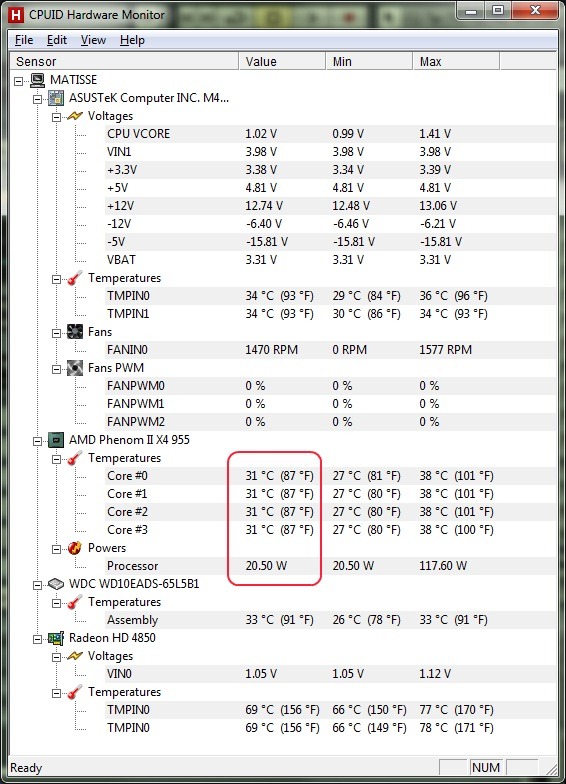
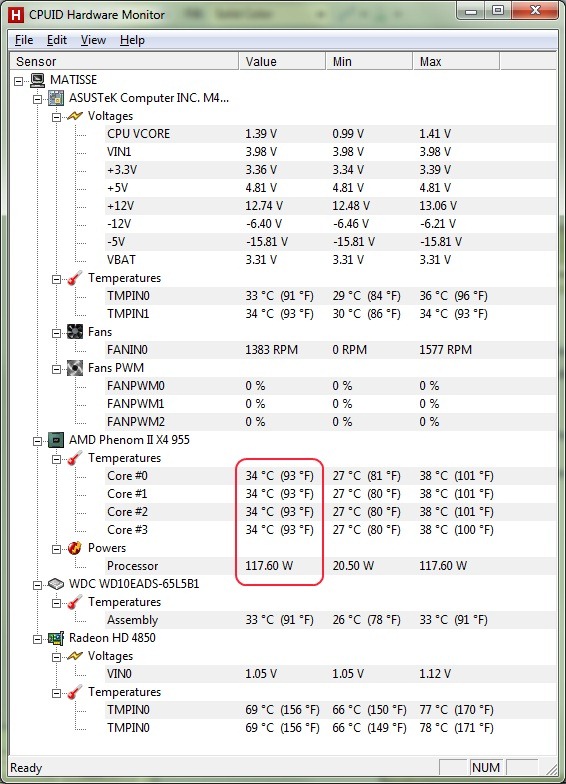
    After scratching my head for a while, I remembered that I had enabled AMD’s “Cool’n’Quiet” feature in my PC’s BIOS. This technology feature reduces the processor’s clock rate and voltage when the processor is idle, to reduce overall power consumption and lower heat generation. Here, for example, using CPUID’s HW Monitor, you can see that the power consumption of the processor is only 20.5 watts, in place of the usual 117.6 watts:
    VST 1

    As an experiment, I disabled Cool’n’Quiet in the BIOS, and ran Cubase again. This time, I did not experience performance problems. So it would seem that AMD’s power monitoring technology was interfering with the demands of Steinberg’s ASIO, causing performance glitches in the latter.

    I didn’t really want to run my computer with Cool’n’Quiet disabled for most of the time, and having to switch it on and off in the BIOS is somewhat of a nuisance. I wondered whether the power plans in Windows 7 were capable of doing the switching for me. Here’s what the Windows 7 Help and Support says about the Power Plans:

    Windows provides the following plans to help you manage your computer’s power:

    • Balanced. Offers full performance when you need it and saves power during periods of inactivity. This is the best power plan for most people.
    • Power saver. Saves power by reducing system performance and screen brightness. This plan can help laptop users get the most from a single battery charge.
    • High performance. Maximizes screen brightness and might increase the computer’s performance in some circumstances. This plan uses a lot more energy and will reduce the amount of time that a laptop battery lasts between charges.

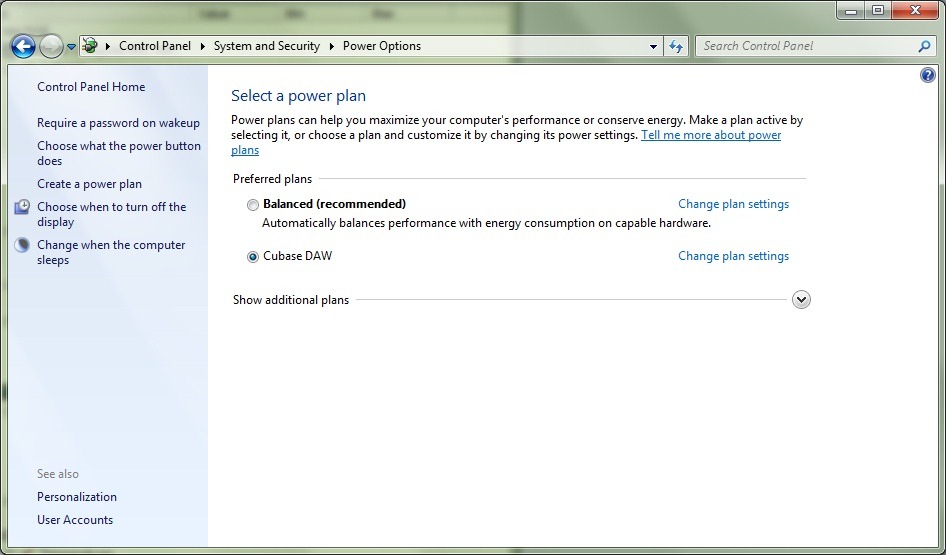
    I always run my PC with the Balanced power plan active. I decided to try enabling Cool’n’Quiet in the BIOS, but also to create a new power plan for when I am using Cubase. The new plan, based on the High performance plan, I named Cubase DAW (for Digital Audio Workstation).

    When I selected this plan, I discovered that Windows 7 itself disables Cool’n’Quiet, so I was able to run the processor at full power, and maximise ASIO performance.
    VST 3

    The Solution

    So now I have the best of both worlds; I can run my PC economically for most of the time using the Balanced power plan, but when I want to work with Cubase and HSO VST, I can readily switch over to the Cubase DAW power plan directly within Windows.
    VST 4

    Another problem solved – on to the next…

  • Someone Like You

    I wrote a couple of months ago that I was looking forward to the release of Adele’s next album: 21. We got it a couple of weeks ago, and have been playing it frequently ever since. It’s very, very good.

    Here she is performing “Someone Like You” at the BRIT Awards recently; just her voice and a piano – but what a depth in that performance:

  • Eurovision Looms

    Well, it’s a new year, and the annual spectacle of Eurovision is on the horizon. Last night, we were treated (if that’s the word) to the selection process of the Dutch entry. This year, the Dutch banner is being lofted by a three-man band called the 3JS, whose main claim to fame seems to be that they hail from Volendam.

    Last night, the Dutch TV viewing public (including Martin and I) were subjected – I think that is the correct term – to the 3JS performing five of their songs, from which one would be selected by the public to be the official Dutch entry to Eurovision 2011.

    Dear lord, but it was truly dire… I honestly think that if you sat yourself down to pick five songs that you, in your heart of hearts, believed had not a snowball’s chance in hell of being the winner of any Eurovision contest in its long and chequered history, let alone Eurovision 2011, then these five songs would be the result.

    The schadenfreude of seeing the judges desperately trying not to say that the songs were utter crap as potential Eurovision entries was truly wondrous to behold. It was car-crash television at its finest.

    This is the winning entry. Judge for yourself. To give the song credit, this was the last song, and the only decent stab at what Eurovision demands (you really don’t want to experience the others). However, the Netherlands has failed to qualify for the Eurovision final for the past six years running. This song is not going to change that.

    If this wins Eurovision, I’ll eat my hat.

  • Ken, Ken, and their Operas

    I’ve just watched the version of Mozart’s Magic Flute filmed by Kenneth Branagh. I was absolutely blown away by its sheer bravura. From the opening single tracking shot beginning in the trenches of World War 1, then rising far above; to the finale where summer returns to the blasted fields, it was an absolute visual tour-de-force.

    But the visuals were not alone. It was Mozart’s glorious music, after all. The performers were excellent, singing was top class, and there was an English translation of the libretto that was extremely good and witty. I saw from the credits at the end that the translation was done by Stephen Fry, so I suppose I shouldn’t be surprised at its quality.

    In the end though, the visual feel of the film was what struck me, and Kenneth Branagh’s direction reminded me of the baroque style of Ken Russell –particularly of Tommy, his rock opera. The sheer adrenaline rush of watching their imaginations writ large on the silver screen is terrific.

  • It Gets Better, Sorta…

    After the last post featuring Rebecca Drysdale, here’s a rather tamer effort in the same theme from Ricky Martin.

    http://www.youtube.com/v/kzxoQ9rbDAA&hl=en_US&feature=player_embedded&version=3

    While it’s really good to see that he’s dropped the pretence that he’s straight, I still don’t find this latest video as good as the one from Ms. Drysdale. For one thing, it is so carefully bland, with good-looking young people, chosen from an IKEA diversity catalogue. Perhaps as I approach 62 years of age I am just having an attack of sour grapes, but, Ricky, you really could have done better.

  • It Gets Better–Part III

    I’ve been here before – but here’s a video from Rebecca Drysdale that rocks. I’ve never heard of her before, but this is very good – I particularly liked the homage to Vogue.

    You go, girl!

  • Political Ska

    Although I no longer live in the UK, I still follow what’s happening there. And the acts of the new coalition government fill me with despair. We seem to have learned nothing since Thatcher. Here’s a musical take on the situation.

  • Sorrowful Songs

    Henryk Górecki’s 3rd Symphony, the Symphony of Sorrowful Songs, was composed in 1976. While many take its meaning as a remembrance of the Holocaust, Górecki himself said that it was an evocation of the ties between mother and child.

    Here’s the second movement in a filming that underscores the Holocaust interpretation. It’s an extract from Holocaust – A Music Memorial Film, which was shot in Auschwitz. The soprano is Isabel Bayrakdaraian, and she is accompanied by the Sinfonietta Cracovia, conducted by John Axelrod.

    According to the Wikipedia entry for the 3rd Symphony, the text of the second movement is an inscription scrawled on the wall of a cell of a Gestapo prison in the town of Zakopane, in southern Poland. The words were those of 18-year-old Helena Wanda Błażusiakówna, a highland woman incarcerated on 25 September, 1944. It read “O Mamo nie płacz nie—Niebios Przeczysta Królowo Ty zawsze wspieraj mnie” (Oh Mamma do not cry—Immaculate Queen of Heaven support me always). 

    (hat tip to The Observer for the link to the video)

  • Someone Like You

    I’m looking forward to the release of Adele’s next album “21” on the 24th January. That young woman has talent. Here she is singing one of the songs from the forthcoming album.

  • Dog Training

    I’m currently enrolled with Watson in a series of dog training courses. We’ve got an exam coming up in November, whereby I have to convince an independent examiner that Watson is well-behaved and obeys me. I can’t say that I’m full of confidence. Watson has a will of his own, and usually demonstrates that he does not yet see me as top dog.

    Having wrestled with training, I’m always impressed when I see other dogs who apparently obey their owners every command. Like these dogs in OK Go’s latest music video:

    Did you spot the goat?

  • This Too Shall Pass

    An amazing video done in one take…
    http://www.youtube.com/v/qybUFnY7Y8w&color1=0xb1b1b1&color2=0xd0d0d0&hl=en_US&feature=player_embedded&fs=1
    I wonder how many attempts they had before it all worked? – Thanks to this, I’ve answered my own question: it took 85 takes before everything worked together.

  • Damn

    Johnny Dankworth is dead. I’ll miss his music.
  • Showing Off

    Paul Morley has a terrific multimedia episode online at the moment. The interviews with Goldie and Sir Peter Maxwell Davies are paydirt in themselves. Marvellous.
  • Surrealism While Shopping

    I mentioned a Lily Allen song a little while back. It’s currently being played quite a lot on Dutch radio stations. And it has a certain earworm power.
     
    I’m finding it somewhat bizarre that when I’m in shops, where the radio substitutes as muzak, that I’m confronted with Dutch matrons of a certain age lip-syncing along to the tune:
    "Fuck you, fuck you very, very, mu-u-u-u-uch…" 
  • Mr. Darwin

    Here’s a winner of the Darwin Day Science song contest – a rather charming, typically British, little ditty…


    I am currently re-reading Darwin’s Origin of Species and discovering again what a thoughtful, delightful author he was. In addition to making his world-changing discovery, of course.
     
    (hat tip to the Science and Religion News blog)
  • Big Hands

    Rachmaninov’s Prelude in C# Minor is a tricky piece to play, not just for the necessary speed and precision for the allegro section, but also for the chord stretches. At the peak of my piano-playing ability (when I was 17, sigh) I could manage a passable stab at it. As Igudesman and Joo demonstrate, there are other ways of achieving those stretches…


    The Wikipedia entry doesn’t mention it, but I’d always understood the piece to represent a burial where the unfortunate occupant of the coffin is not in fact dead, and the allegro is the frantic scrabbling of the interred trying to escape before succumbing to the inevitable…
     
    (hat tip to Raymond Chen for the link)
  • The Astrobiology Rap

    Rap music is not usually my cup of tea, but every once in a while a piece comes along that makes me sit up and listen. It happened with the Dawkins Rap a little while back. And now, here’s the Astrobiology Rap by Oort Kuiper, a.k.a. Jonathan Chase, a postgraduate student.


    (hat tip to SciencePunk)
  • Heartless

    Well, this music video is certainly different… First of all, there’s the irritating existentialism of soured love, but then – oh, but then – we take off into Little Shop of Horrors territory. Watch it through to the end…
     
     
  • Pull Yer Pants Up

    I had visions of Flying Toasters during this.


    Just one thing – I refuse to download iTunes, so this Flash version is all that I will experience.
  • A Little List

    DC Colquhoun went to a revival of Jonathan Miller’s staging of The Mikado recently, and rewrote the verses to Ko-Ko’s song: "I’ve Got a Little List". Perfect.