Reflections on life at “De Witte Wand”…

Category: Music

  • Matmos Meets Turing

    I came across an article in Seed Magazine today about the music duo Matmos. I hadn’t heard of them before, but was immediately intrigued. First, because of their name – the Matmos was the living liquid underneath the city of Sogo in the film Barbarella. The film is a cult favourite of mine. Second, because they have created a musical tribute to Alan Turing, and used, as the basis, recordings of an actual Enigma machine in action. The result can be heard here. Fascinating.
     
    In addition, there’s also a video lecture given by the duo at the Mathematical Sciences Research Institute on this piece. 
  • A Day Out

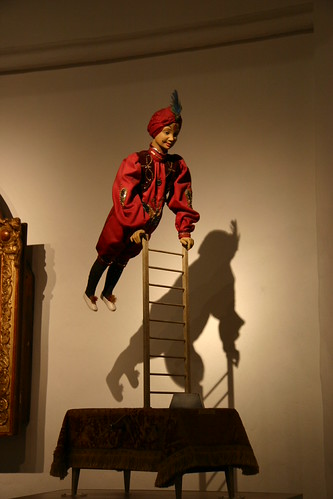
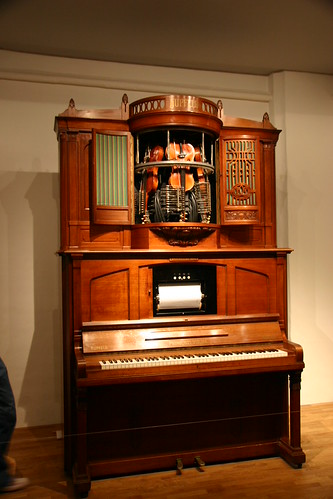
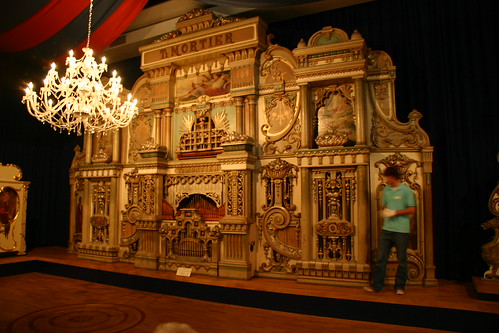
    I had a day out in Utrecht today to meet with a couple of old colleagues for lunch. Like me, they are both now retired, and also like me, they don’t regret it in the slightest. After lunch, one of them suggested that we pay a visit to the National Museum Van Speelklok Tot Pierement (from Musical Clock to Street Organ). A fascinating place. Housed in an old church, it has a nice collection of musical automata and organs. Well worth a visit if you find yourself in Utrecht.
     

    060912-1236-59


    060912-1250-18


    060912-1306-02

    Some more photos here.

     
  • Theremin Themes

    Ever since I first heard it, as a very young lad, I always wanted to get my hands on a theremin. Actually, I suppose the operative phrase is "hands off" – for the most part, the theremin is played without being touched. It’s also, I think, extraordinarily difficult to play well. I went in search of videos of theremin performances on YouTube, and the most reasonable one I could find is this rendering of Debussy’s Clair de Lune by Lydia Kavina
     
    Some of the other theremin videos available on YouTube are pretty excruciating – so you have been warned.
     
    However, worth watching, both for this explanation of the workings of theremin and his subsequent sly send-up song, is Bill Bailey’s demonstration. Let the shining shin of truth be our beacon of hope, indeed.
     
    Next up: the Ondes Martenot.
  • Happy Birthday, Gustav!

    It’s the birthday today of one of my favourite composers. I was reminded of this by The Ridger, over at the Greenbelt blog, who also mentions Alma Maria Mahler. She led a very colourful life, which prompted Tom Lehrer to pen one of his witty ditties. The introduction and lyrics can be found in The Ridger’s entry.
     
    I love the photograph of Alma in the Wikipedia entry. The person shines through, and you can tell she has depth to her character.
  • Pachelbel’s Canon

    Johann Pachelbel wrote a little tune in, or around, 1680 for three violins and a basso continuo. His Canon has become one of those iconic pieces of music that continues to be played today, either as originally scored, or in new and ever more outlandish arrangements.
     
    We chose the version for orchestra and boy’s choir, performed by Libera, as one of the pieces of music to be played at my mother’s cremation. It worked perfectly for the occasion.
     
    But the Canon has many guises. One that I’ve only just found out about is the hard rock version arranged and played by JerryC – a young Taiwanese guitarist. And even that has been trumped by the version played by funtwo – a young Korean.
     
    Just watch the video of Pachelbel’s Canon played by funtwo – recorded in his bedroom, and viewed over 5 million times on the Internet. Ain’t human life amazing? Thank you Johann, JerryC and funtwo.
     
    (hat tip to Tom Reynolds for bringing the video to my attention)
  • Jumped-up Walkmans

    Lucy Mangan, in today’s Guardian, has a most satisfying rant against iPods and their witless owners. She sums up my feelings precisely.
  • Queenie of the Night

    A video of a boy soprano doing a credible job of Mozart’s Queen of the Night aria. Bet he can’t do that in a few years time…
     
    (hat tip to Robert)
  • Britons’ Ignorance of Classical Music

    The Guardian reports today on a survey that apparently shows that more than half of Britons polled did not know that Elgar was English, or that Beethoven was born in Germany. But before I get too worked up about this appalling ignorance and start tut-tutting about the state of knowledge today, I should perhaps reflect that my knowledge of today’s pop music is practically non-existent. Pot, kettle, black. 
  • Happy Birthday, Wendy!

    Today is the birthday of Wendy Carlos. A musician and composer who brought the attention of the emerging electronic synthesiser to the public with her "Switched-On Bach" I think I almost wore out my copy with constant replaying, and it fired me up to construct my own synthesiser from a kit.
  • Last Night of the Proms

    The annual series of classical music concerts held during the summer months in London’s Royal Albert Hall has become a Britiish institution. The Promenade Concerts – now known simply as The Proms – have been running for 110 years. What has also become an institution is the Last Night of the Proms, where the second half of the concert always includes the same three pieces: Elgar’s Pomp and Circumstance march, Henry Wood’s Fantasia on British Sea Songs and Parry’s Jerusalem. The concert is invariably broadcast on BBC TV, and I invariably watch it.
     
    I have to say though, that I am getting increasingly disenchanted by the trio of pieces that concludes the concert. Not because they aren’t good music – they are – but because the atmosphere in which they are received comes across to me as jingoistic little englander nationalism of a particularly creepy kind. A point taken up by Anthony Holden’s review of the last few concerts in today’s Observer.
     
    That feeling was hammered home again to me while watching last night’s performance. And what I thought was especially interesting was the audience in the Royal Albert Hall – that sea of thousands of faces: they were overwhelmingly white. Where were the black or the brown faces? I did not see any, and believe me, I was looking. I did see a very few Chinese or Japanese faces in the audience, but surely the enjoyment of classical music is not confined to the British white middle classes?
     
    When I lived in London, I went to quite a few Proms – including one Last Night. And yes, I waved and shouted and sang along with everybody else, and perhaps it is just a bit of fun – that is how I viewed it at the time anyway. But that season, I was also in the audience for the concert on the night before the Last Night – and at that time, there was also something of a tradition to include Beethoven’s Ninth Symphony as the finale. And that, to me, was something far better – the Ode to Joy  filled my soul and made it one of the great musical experiences of my life. These days, Pomp and Circumstance and Jerusalem come with too much baggage for me to be able listen to them without prejudice.
  • The NYT on Mr. Wainwright

    The New York Times has a story about the influence of opera on Rufus Wainwright. It’s quite interesting, and throws up a couple of good images – such as the music war played between Wainwright and his mother – she contending that "poor people’s music" (jazz, the Blues) was "real music" – and him replying with Verdi.
     
    But what also struck me about the piece was that way that the author (Anthony Tommasini) consistently referred to Rufus Wainwright as "Mr. Wainwright". Strange how that seems prissy and old-fashioned in today’s journalism.
  • Robert Moog

    Bob Moog, the inventor of the Moog synthesiser, died yesterday. He was 71.
     
    The synthesiser was an instrument that fascinated me – to the point where I built one for myself. Bob’s invention has had a massive impact on popular music. While analogue synthesisers have largely given way to their digital descendants, the initial impetus came about because of Bob’s designs. 
     
  • The JCB Song

    And now, by way of something a little lighter, here’s the JCB song by Nizlopi, with a charming video from Monkeehub (and a nice web site, too). Be sure to read the story behind the song.
     
    (hat tip to Daddy, Papa and me for the link)
  • You’ve Stolen My Heart

    …is the title of a soon-to-be-released CD of Bollywood music. It’s the result of a collaboration between the Kronos Quartet, Asha Bhosle and Rahul Dev Burman – Bollywood’s pre-eminent composer (and Bhosle’s husband). Sounds good. My pre-order’s gone in.
     
    Kronos are not your father’s classical string quartet. They seem to take a delight in pushing the boundaries with interesting collaborations. I’ve got a copy of Gorey End  in my music collection – the collaboration with the Tiger Lillies – which captures the atmosphere of Edward Gorey perfectly. You can almost feel the mist rolling out of the rusty iron gate of a delapidated graveyard.
     
    Oh, and if you want to hear the full glory of The Tiger Lillies, may I recommend Shockheaded Peter?
     
    (hat tip to Sepia Mutiny)
  • Beethoven Downloads

    The BBC is about to broadcast every single note of all of Ludwig van Beethoven’s works this week on Radio 3.

    What’s more, it’s going to offer all of Beethoven’s symphonies in a downloadable format for a period of one week after they have been broadcast.

    To quote Alex de Large:

    "And it was like for a moment, O my brothers, some great bird had flown into the milkbar and I felt all the malenky little hairs on my plott standing endwise and the shivers crawling up like slow malenky lizards and then down again. Because I knew what she sang. It was a bit from the glorious Ninth, by Ludwig van."

    And again:

    "Oh bliss, bliss and heaven. Oh, it was gorgeousness and gorgeosity made flesh. It was like a bird of rarest spun heaven metal, or like silvery wine flowing in a space ship, gravity all nonsense now. As I slooshied I knew such lovely pictures."

  • Want One and Two

    OK, I admit it, you don’t have to go very far before you come up against one of my boundaries in knowledge. My excuse is that there’s so much stuff out there and three score and ten doesn’t even start to come close to the time that I would need to rectify it.

    And so it was that ten days ago I read a piece in the Observer on Rufus Wainwright.

    I’d never consciously heard the name before reading the article, although, in my defense, I had heard of his mother Kate McGarrigle. In fact, I think I’ve even listened to some of her folk songs in the dear and distant days of my youth. And I’m pretty sure that I’d heard of his father, Loudon Wainwright III (I point to the ‘III’ as the clincher that made it stick in the memory cells – a family that is so dumb as to use the same name three times in a row has to be dysfunctional somewhere along the line).

    Anyway, the article was intriguing – Rufus sounded like a real bundle of twitching contradictions mixed in with musical talent inherited from his parents. The whole family seem to have had their share of angst – as his sister drily observed: "It wasn’t the Von Trapp Family". And Rufus is queer, to boot. OK, I thought, I must listen to some of his music.

    Today, Want One arrived from Amazon, and I’ve been playing it all day. Loved the opening track: Oh What A World – with its mixing in of Ravel’s Bolero. I think I’m going to listen to more of the young Wainwright. I suspect my order to Want Two will shortly be placed with Amazon.

  • Hamster-Powered Music

    Boing Boing comes up trumps again and points me to (drumroll) The Hamster-Powered MIDI Sequencer.

    I swear, you couldn’t make this up if you tried…