It’s only this week that the weather has become noticeably colder, and thus more in keeping with the season. Last Monday, the mist rolled in, so the daily walk in the woods took on an additional air of mystery.
We’re unlikely to have a White Christmas though, which is a pity…
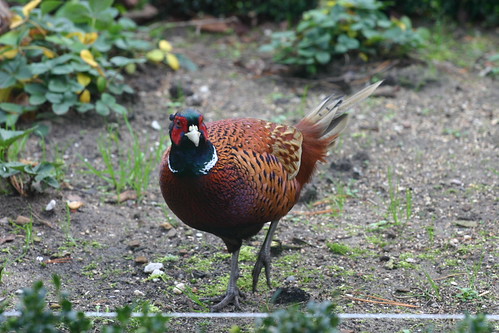
I’ve hung up a bird feeder and bags of nuts on the tree outside my study window. They’ve proved a great success with the local bird population, particularly the Coal Tits and Blue Tits. The Tits are also pretty messy feeders, scattering seed in all directions. This has proved a boon for other visitors to the garden, including this pheasant.
Carl Zimmer, over at The Loom, reminds us of his fascination with parasites. In this case, the Cordyceps fungus, which takes over the brain of an ant. David Attenborough narrates. I was particularly struck by the fact that other ants, on discovering one of their fellows suffering from the onset of symptoms of Cordyceps infection will carry away bodily the unfortunate victim to a safe distance beyond the colony, so that the spores will not infect the rest of the colony.
I’ve mentioned before that at this time of the year I regularly see crops of mushrooms in the woods. Today’s Guardian has an article by Giorgio Locatelli extolling the delights of gathering, cooking and eating wild mushrooms. Trouble is, I don’t feel confident enough to be able to identify them, even though I have illustrated guides on my bookshelves. Knowing my luck, I’d probably pick poisonous varieties. I mean, when it’s something like the Fly Agaric mushroom (see below), then it’s easy to identify and obvious what it is. But how about Amanita virosa – also known as the Destroying Angel? It looks so innocent. Richard Eshelman thought he knew his mushrooms. Read about what happened to him here.
The Fly Agaric (Amanita muscaria) mushroom – poisonous and obvious
That’s possibly what will happen tonight with the Leonid meteor shower. More details here. I saw a spectacular Leonid last night – there will probably be some around, but the peak could be really spectacular, if short-lived.
Update: Well, there might have been some spectacular meteors – but unfortunately, if there were, they were all happening on the other side of thick cloud cover. Foiled again! Oh well, perhaps next month on the 14/15 December I’ll get a crack at seeing the Geminids.
Should you have a need to know about the biology of Caenorhabditis elegans, then you’ll probably find more than you need in Wormbook. You can even download all 380 megabytes (zipped) for your offline reading pleasure…
Peter Tatchell has an article in the Guardian‘s Comment is Free section on people’s apathy towards the threat of Global Warming. Judging by the tone of most of the comments on his article, it would appear that there are many people in denial as well. I think Norm puts his finger on the probable cause of the apathy – people just can’t get worked up about something that will happen years in the future. As he says, "compassion doesn’t work terribly well over great distances". And those distances can be measured in either space or time – the observation will still hold true.
It seems to me that the only thing that might avert the disaster is to have another one – an outbreak of a human form of avian flu that decimates the world population. That might throw a sufficiently big spanner into the works and stop our spiralling contributions to global warming in its tracks…
The Natural History Museum of Rotterdam opens a major exhibition next week: The Grand House Sparrow Exhibition. It’s your chance to see serried ranks of stuffed sparrows, including some celebrity birds. Improbable Research has more information.
Marc D. Hauser, a biologist working at Harvard, is proposing people are born with a "moral grammar" hardwired into their brains by evolution. He has written a book on the hypothesis – The Moral Mind – and it’s reviewed here in the New York Times.
The trouble is, it seems to rather beg the question. The "moral grammar" could well be simply an emergent by-product of the brain’s decision-making mechanisms themselves. Jonah Lehrer, over at The Frontal Cortex, explores this nagging doubt very well.
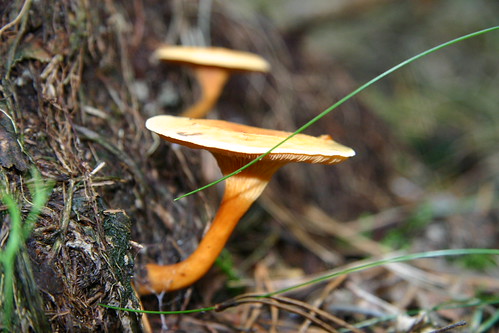
Now that we live in the countryside; this year, for the first time, I’ve had the opportunity to observe the life of fungi. During the past couple of months, my daily walk in the woods with the dog usually reveals a few new specimens each time.
Today, we went with a couple of friends to visit the gardens at de Wiersse – a moated manor house in Gelderland. The gardens are only open a few times each year, but they are well worth a visit. Some of the photos I took can be found in this photo set up on Flickr. The main web site for the house and gardens is here.





 Geoff Coupe's Blog