Reflections on life at “De Witte Wand”…

Category: News and politics

  • MH17 & Dutch Pragmatism

    It’s shocking news about the loss of flight MH17. All the more so because 298 civilians appear to have been killed in a conflict that has nothing whatsoever to do with them. And all because some trigger-happy Ukrainian rebels, armed by the Russians with surface-to-air missiles, appear to have mistaken a passenger airliner, flying above 32,000 feet on an established route over Ukrainian air-space, for a Ukrainian military transport plane.

    It’s a route and flight that was well-known to me during my last years working for Shell. We were setting up a data centre in Kuala Lumpur, and many of my colleagues, of many nationalities, would be travelling back and forth between Shell’s head office in The Hague and KL. I myself flew that route on a couple of occasions. It would not surprise me in the least to learn that at least one Shell employee, working in IT, was on that flight.

    This article in today’s Guardian points up the phenomenon of Dutch pragmatism. Dutch passengers checking in at Schiphol today seem to be of the opinion that the downing of flight MH17 was an isolated incident, and unlikely to happen ever again. They are right, but that’s probably of little comfort to those who have lost family, friends or colleagues in this tragic event.

  • On the Wrong Side of the Track – Both Sides!

    We live in the so-called Achterhoek region of the Netherlands – the name literally means “back corner”. It’s predominantly farmland and countryside, and tourism is, after farming, the major industry. Many Dutch people living in the densely populated Randstad come here on holiday seeking a bit of peace and quiet, and some, like us, retire here.

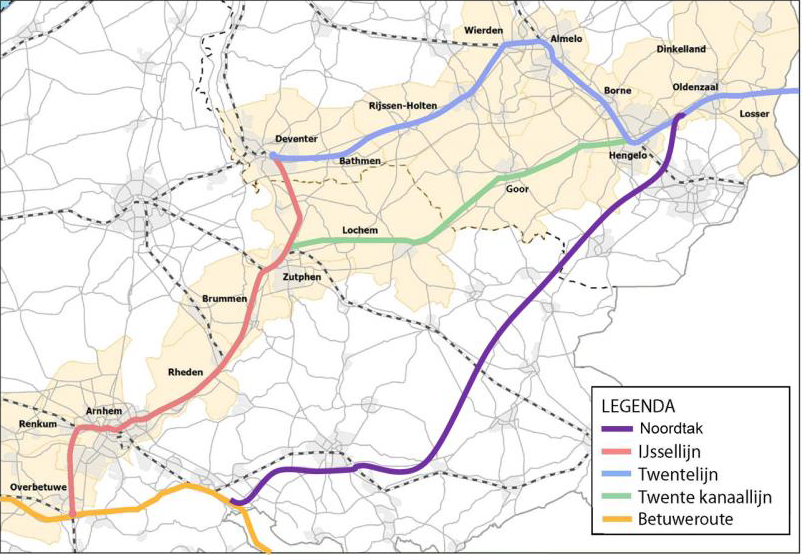
    As the years go by, the pressure increases on what remains of the countryside. The latest turn of the screw is the Noordtak Betuweroute. This is a proposal to lay a new railway line (the Noordtak – literally, the “North branch”) through the Achterhoek, connecting the current goods train line (the Betuweroute) at Zevenaar in the west through to the Dutch/German border in the east. At present, the Betuweroute currently goes south of Zevenaar to cross the border and connects with Emmerich and thence to Duisburg. This is the Zuidtak (the “South branch”).

    The Noordtak proposal was originally the brainchild of the Port of Rotterdam Authority, who were looking to increase the flow of goods from ships unloading in Rotterdam through to German industries in the Ruhr. There was a study into the Noordtak carried out in 2012 by the engineering firm Movares on behalf of the Dutch Ministry of Infrastructure and Environment. It looked at three alternative routes through the Achterhoek. When word got out about the two favoured alternatives, it galvanised protests from communities through which the routes passed.

    As a result, two of the three alternatives have effectively been killed, leaving just one. The Port of Rotterdam Authority then joined forces with the two provincial governments in the Achterhoek and commissioned a “Quick Study” of this third alternative route. The outcome, surprise, surprise, was what the PRA wanted. According to a press release issued jointly by the PRA and the Provinces, the proposed route would be “faster, safer, and less nuisance” than the rejected routes.

    But, guess what, it would pass quite close to us (it’s the route in purple in this map):
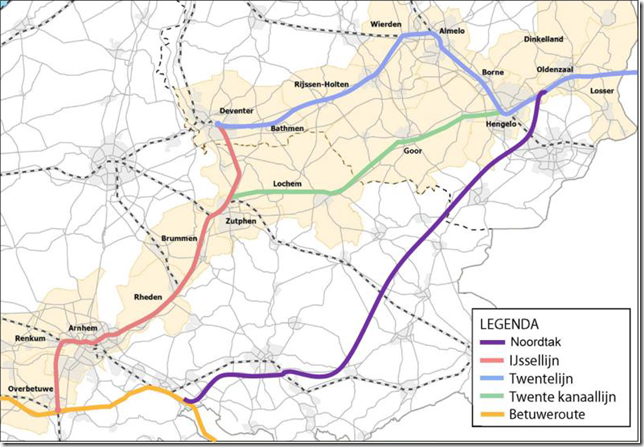
    Trace Noordtak 02

    We live near to the village of Heelweg, and it will be a lot worse for them. Heelweg actually consists of two hamlets, Heelweg-Oost and Heelweg-West (Heelweg-East and Heelweg-West). The Noordtak line would go straight through between them, a metaphorical stake through the heart of the community. As you might imagine, the inhabitants are not best pleased with the proposal, and we are joining forces with other action groups, such as the Gelderland’s Nature and Environment Federation, that are now springing up along the proposed route.

    Now you might think that this is simply a NIMBY reaction, and to some extent you would be right; whichever route such a railway takes, it is bound to affect someone. However, we feel that some of the bigger questions need satisfactory answers. What will the overall effect on the economy of the Achterhoek be? Even the press release mentioned above is cautious about this, admitting that:

    “The effect on the regional economy is difficult to estimate. Perhaps the maximum number of trains on the track (36 per 24 hours) is too small to make investment in a new goods train terminal cost-effective”.

    The press release also quotes a member of the regional government as saying:

    “There may well be indirect effects, such as an increase in industrial activity alongside, and in the area of the railway. This is, at this moment, not quantifiable in monetary terms.”

    Frankly, I find this ridiculous. Since the goods trains won’t be stopping anywhere in the Achterhoek, why should that be attractive for firms to build facilities alongside the railway? And if they do build, they simply cause more damage to the tourist economy by destroying the very asset that makes people want to come here and spend their tourist euros.

    A further question that needs to be answered is whether the Germans are wanting this new line. They have dragged their heels over connecting up with the Zuidtak, and all the signs are that they have little or no enthusiasm for connecting up with the Noordtak.

    The Dutch Minister for the Environment is due to give her decision on whether she supports the Noordtak proposal in the next few days. Even if she does support it, there will have to be a further, more detailed study done on the environmental impact of such a line. I would hope that an equally long hard look would also be taken at the economic justification for such a line. Many people are far from convinced that the figures would add up.

    We live in interesting times.

    Addendum 18 June 2014: The Minister has spoken, and she’s not convinced that the case for the Noordtak has been sufficiently proven, or that the figures in the “Quick Study” add up. She (or her successor) will take another look in 2020 to see if anything has changed that would require starting up a detailed study… So we can chalk that one up to a Minister showing commonsense. Nice to see.

    Addendum 25 January 2022: Well, here we are again. The Rotterdam and Amsterdam Harbour Authorities have been doing some hard lobbying over the past year, and the Noordtak is back on the agenda. There was a vote last November in the Second Chamber of the Dutch parliament on looking again at the route. 148 members voted for the motion, and one against. The sole vote against belonged to the only member of parliament who actually lives in the Achterhoek.

    The politicians in the local and provincial authorities have finally woken up and are now fighting back. They are demanding proper involvement in the ongoing research over the possible route, but perhaps more importantly are demanding research into whether there is a good business case for the Noordtak in the first place. The Germans are still lukewarm about connecting with the existing goods train line (the Betuwelijn), and it’s highly unlikely that they would want to connect with the Noordtak. They are looking to improve rail routes to their own harbours of Hamburg and Bremen.

  • A Cataclysm Down Memory Lane…

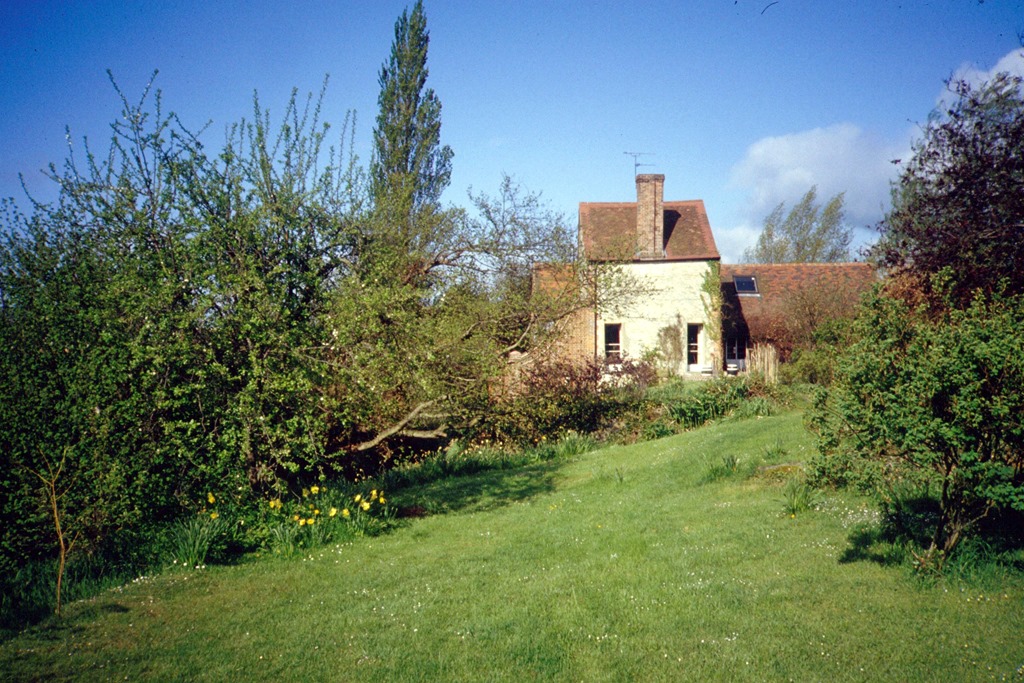
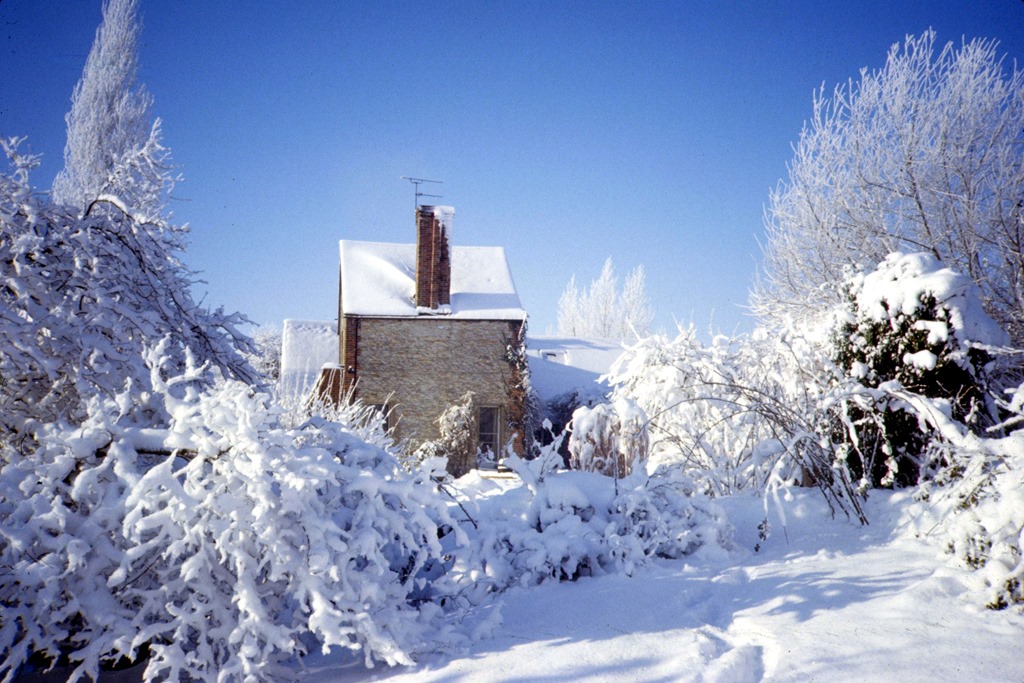
    Back in the early 1980s, I got to know William Clark, who was almost a father figure to my partner at the time. We would be frequent weekend visitors at William’s country retreat, a converted mill in the Oxfordshire village of Cuxham.

    The Mill

    Summer or winter, the house had charm and was filled with William’s memorabilia from his years in public service, the Observer newspaper, the BBC and the World Bank.

    The Mill

    Sunday lunches often had guests from the worlds in which William lived, and I found it a fascinating experience to be able to eavesdrop on their conversations.

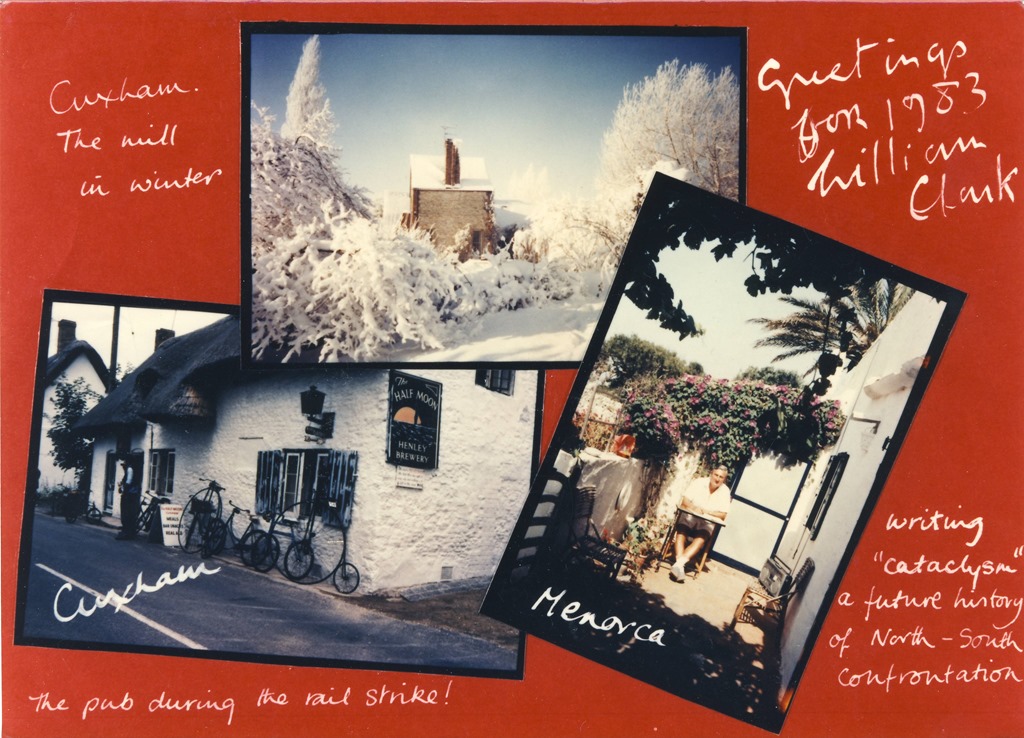
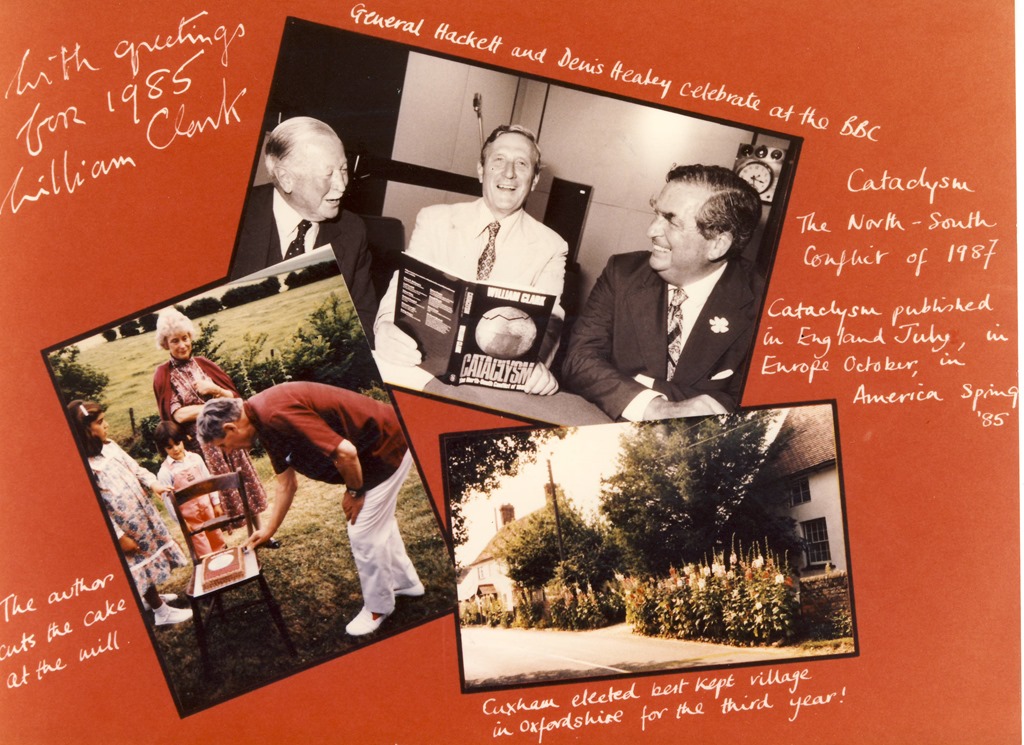
    In 1982-3, William was engaged in writing a novel – Cataclysm – a fictional scenario in which an international debt crisis in 1987 escalates into an all-out conflict between the developed and underdeveloped worlds. A minor plot point was the use of what today would be called cybercrime, but the word, and the internet as we know it, simply didn’t exist at the time. William, knowing that I worked in IT, asked me to read the drafts and comment on the technical aspects. I did that to the best of my ability, but I suspect that my crystal ball was even cloudier than his.

    His Christmas card of 1982 referenced both his writing of the novel and the photo I had taken of the mill in winter.

    Scan10014

    Cataclysm was published in 1984, as that year’s Christmas card illustrates:

    1984-12-01

    I had a rather acrimonious breakup with my partner at around this time, so I’m afraid I lost touch with William, and he died, of liver cancer, in June 1985.

    I’ve often wondered how I would view the technical aspects of Cataclysm with the benefit of hindsight, so a couple of weeks ago, I went on to the Abebooks web site to track it down. I found a copy, which also apparently contained a letter signed by William, held by an Oxfordshire bookshop. I snapped it up, and it arrived yesterday.

    Cataclysm

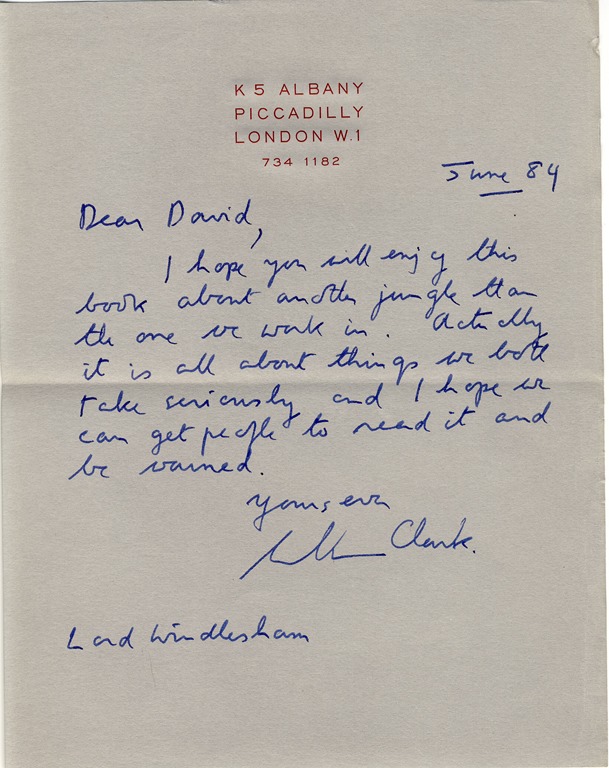
    I look forward (with a modicum of trepidation) to re-reading it. And, as promised, there was also a signed letter from William.

    William Clark

    It is written on William’s notepaper, with the heading of William’s London flat in Albany, and addressed, I believe, to David Hennessey, 3rd Baron Windlesham.

    A little piece of history.

    I recall William with much fondness. The house and garden at Cuxham would often echo to his cry of “For God’s Sake…” – with a prolonged emphasis on the second word. For all the exasperation that he was able to inject into the phrase, we all knew that there was a wink as well.

    The book, and the letter, will now reside in my library until they move on to the next owner.

  • Chuck, Vlad, and Godwin’s Law

    Heaven knows, I don’t have much time for Prince Charles. His views, particularly on the subject of alternative medicine, strike me as being not only misguided, but downright dangerous because of his position of influence. Still, just as a stopped clock is right twice a day, he is capable of saying something close to sensible sometimes. Except on this last occasion he appears to have broken the media’s version of Godwin’s law by comparing Vladimir Putin to Hitler. Naturally, our Vlad doesn’t like it.

    While it’s easy to laugh at both Charles’ continuing ability to open his mouth to change feet, and at Putin’s reaction, it’s probably better to consider the comparison between Putin and Hitler more soberly. Stephen Liddell has done just that, and it makes for interesting, and rather worrying, reading.

    Addendum: I have just read David Mitchell’s article on the same topic, and notice that he also uses the “stopped clock is right twice a day” line. Pure coincidence, I assure you – I definitely didn’t plagiarise Mitchell’s article…

  • Geert and Gedogen

    Gedogen is one of those (many?) Dutch words that is somewhat difficult to translate. On the face of it, it means to tolerate, permit, suffer and allow. However, there is something lurking behind those straightforward definitions; an additional layer of meaning that indicates that the tolerance, the permission and so forth are granted, well, perhaps not grudgingly per se, but perhaps almost in spite of the thing that is being tolerated. There’s a sense of turning a blind eye to behaviour that, strictly speaking, is illegal, or should not be condoned, but which one tolerates out of a sense of liberalism and of a sense of “live and let live”.

    Someone who has been the beneficiary of much gedogen is the Dutch populist politician Geert Wilders. He, on the other hand, exhibits near zero gedogen for his targets: immigrants, Muslims and Moroccans.

    We’ve just had elections here in the Netherlands for the town councils (the Gemeenten), and Wilders’ party fielded candidates in just two places: The Hague and Almere. During the campaign, Wilders went on record as saying that voters in The Hague should vote for a city with lower taxes and, if possible, fewer Moroccans. As a result, one Labour candidate (Fouad Sidhali) tweeted a comparison of Wilders to Hitler, a statement he later withdrew after criticism from senior Labour officials, saying the comparison had been unjustified.

    I found it fascinating to observe the media and politicians exhibiting gedogen towards Wilders by focusing on Sidhali’s tweet, rather than the initial remark by Wilders. It was as though Wilders was the injured party, rather than Sidhali, who had probably responded with understandable exasperation over yet more of Wilders’ xenophobic rhetoric.

    Wilders then (oh so predictably) responded by saying Fouad Sidali’s rethink was sensible but that ‘it would have been more sensible to leave for Morocco’.

    And so it goes. Geert grins under the grace of gedogen.

    But perhaps a line has now been crossed. During last night’s after-election celebrations in the Hague, Wilder asked his supporters ‘and do you want more or fewer Moroccans in your city and in the Netherlands?’ To which the crowd chanted ‘fewer, fewer, fewer’. ‘ We’ll arrange that,’ Wilders said with a faint smile (or was it a smirk?) when the chanting died down.

    I would like to think that people are beginning to think that enough is enough, and that the emperor has no clothes, other than rags of xenophobia and racism. We will see what happens during the European elections in May.

  • RIP, Tony

    Tony Benn has died. One of the few politicians, it seems to me, who combined honesty, integrity and compassion. I never met him, but news of his death has saddened me as much as the loss of a good friend. Of the many tributes gathered here, the one that stands out for me is from Shami Chakrabati, director of Liberty, in particular her final summation:

    In an age of spin, he was solid, a signpost and not a weather-vane.

  • RIP, Norm

    One of the bloggers that I make a habit of reading is Norman Geras. That is, until last Friday, when I found an entry on his blog from Jenny Geras (his daughter) saying that Norm had died that day.

    Another voice of reason stilled. Here’s his obituary. It’s worth reading to get a sense of the man, and of course you can still read his writings on his blog.

  • “100,000 dead, seven million displaced and a nation turned to rubble”

    Kenan Malik sums up the real consequences of the terrible conflict in Syria. It makes for depressing reading. The posturing of Putin in particular is pure politics. However, as Malik says, none of the players come out of this well. Meanwhile, the slaughter and the flood of refugees continue.

  • TW3 and RIP

    It’s been something of a week for drawing breath, what with the announcements of the deaths of first Seamus Heaney, and now David Frost. Both were 74, and both, in very different ways, contributed to the cultural lives of many.

    Much as it pains me to say it; if I’m honest, then Frost’s influence on my life has been much greater than that of Heaney’s. I was transfixed, at an impressionable age, like a deer caught in the headlights of an oncoming car, by That Was The Week That Was on BBC TV.

    Devised by Ned Sherrin, fronted by Frost, but with sterling support from many others, TW3 was a satirical landmark in British Television. We shall not see its like again.

    It only ran in 1962 and 1963, when I was just 13 and 14. It was a late-night show, live, and ran each week for as long as it took to get through the material, often into the small hours. Looking back, I am slightly surprised that my parents allowed me to watch it at all.

    As is quoted on TW3’s Wikipedia page:

    TW3…did its research, thought its arguments through and seemed unafraid of anything or anyone… Every hypocrisy was highlighted and each contradiction was held up for sardonic inspection. No target was deemed out of bounds: royalty was reviewed by republicans; rival religions were subjected to no-nonsense ‘consumer reports’; pompous priests were symbolically defrocked; corrupt businessmen, closet bigots and chronic plagiarists were exposed; and topical ideologies were treated to swingeing critiques.”

    So thank you, David Frost (not forgetting Ned Sherrin, Timothy Birdsall, Bernard Levin, Lance Percival, Kenneth Cope, Roy Kinnear, Willie Rushton, Al Mancini, Robert Lang, Frankie Howerd, David Kernan, Millicent Martin, John Albery, John Antrobus, John Betjeman, John Bird, Graham Chapman, John Cleese, Peter Cook, Roald Dahl, Richard Ingrams, Lyndon Irving, Gerald Kaufman, Frank Muir, David Nobbs, Denis Norden, Bill Oddie, Dennis Potter, Eric Sykes, Kenneth Tynan, and Keith Waterhouse). You helped form me into the person I am today.

  • 18 Arguments Against Gay Marriage

    The New Statesman’s Caroline Crampton lists 18 arguments voiced today in the UK’s House of Lords against same-sex marriage.

    All the usual suspects are there, including the new Archbishop of Canterbury. I can’t say that I’m surprised by his stance. Religion poisons pretty much everything.

    I suspect that very similar arguments were once made against the abolition of slavery.

  • It’s NOT a Coronation!

    It’s been a momentous day here in the small country of The Netherlands. This morning, at 10:10, Queen Beatrix signed the document that confirmed that she has abdicated in favour of her eldest son, Willem-Alexander, who has now become King. The first Dutch King since the 19th Century.

    This signing took place in the Dam Palace, which started out life as the Amsterdam City Hall in the Dutch Golden Age of the 17th Century.

    Now, I’m no monarchist, but I was moved by the day’s events. Right from the moment that Queen Beatrix announced she welcomed everyone to the ceremony, and the roar of approval from the crowd outside in the Dam Square brought a smile to her face as she realised that the Dutch people were watching and supporting this move.

    Not that Beatrix has been a bad Queen. Far from it. She has become beloved by us in a way that could only have been dreamed of when she became Queen in 1980. Then, there were protests and smoke bombs in the Dam.

    Following the signing of the Abdication document, this afternoon was the inauguration of the new King. I found it almost astonishing.

    I grew up in the United Kingdom, where the British Monarchy is seen as something established by God. There is a Coronation, where the crown is placed on the head of the new monarch by the Archbishop of Canterbury. Religion and Monarchy are completely intertwined.

    In stark contrast, here in The Netherlands, the Monarch is not crowned. Instead, King Willem-Alexander was inaugurated in a ceremony that involved the State – not the Church.

    The King pledged his allegiance to the democratic process, and affirmed his responsibilities to the citizens. He made a good, and thoughtful speech, honouring the service of his mother, and promising that he would do his best for the Dutch citizens and the State. In return, the State, in the form of the members of the Dutch parliament, signalled their assent to his assumption of the role of king. And they did that individually – each standing when their name was called, and either swearing by God, or a simple “I promise”. It was interesting to see how many members did not invoke God. Another indication of how secular the Netherlands is, and how the United Kingdom still is not.

    King Willem-Alexander pledged his allegiance in front of symbols of the State – the books of the Law of the Land – as well as symbols of his own status, the crown, sceptre and orb. He also had five representatives of the Dutch people present to bear witness, and to bear symbols of the importance of the citizen to Dutch society. They were his “Koningwapenen”, or Kings of Arms. One of them was André Kuipers, Dutch physician and astronaut.

    As I say, I was moved. The importance of ritual to humans is unmissable, and touches something deep within us.

    I wish Willem-Alexander, and his very impressive wife, Máxima, all the best in their new roles as King and Queen of the Netherlands. I think that they will both do well.

  • The Ghost in the House of Wonks

    Adam Curtis makes amazing documentaries. Here’s one he did earlier – The Attic. A cautionary tale.

  • The End

    So, she’s dead. She certainly changed our world, but, personally speaking, I’m not convinced she improved it. For me, Elvis Costello’s song: Shipbuilding is the perfect summary of that time.

    Craig Murray, while he personally found her quite likeable, sums her up rather well:

    …she was a terrible, terrible disaster to this country. The utter devastation of heavy industry, the writing off of countless billions worth of tooling and equipment, the near total loss of the world’s greatest concentrated manufacturing skills base, the horrible political division of society and tearing of the bonds within our community. She was a complete, utter disaster.

    The Guardian’s editorial, while praising her, also damns her:

    She was an exceptionally consequential leader, in many ways a very great woman. There should be no dancing on her grave but it is right there is no state funeral either. Her legacy is of public division, private selfishness and a cult of greed, which together shackle far more of the human spirit than they ever set free.

    Her legacy lives on.

    Addendum. Norman Geras makes my feelings succint,

  • A Fool, A Liar, or a Thief?

    Lucy Mangan poses the question about Ian Duncan Smith. It’s a valid question.

    I propose the answer is that he is at least two out of the three, and that he isn’t a fool. Unfortunately, he’s far from the only person in power who thinks that way.

  • The Challenger

    Last night, BBC Two showed “The Challenger” – a film dramatisation of the public inquiry (the Rogers Commission) that investigated the causes of the catastrophic accident that befell the space shuttle Challenger. The film has the title Feynman and the Challenger in the US.

    It was riveting. Amidst the political manoeuvering, and the attempts by NASA officials to mislead the inquiry at the time, Richard Feynman ploughed a course that uncovered the true cause of the disaster. He was played in this dramatisation by William Hurt, who delivered a completely believable portrait of Feynman, culminating in the scene where Feynman destroys the testimony of the NASA officials with a glass of iced water. I remember seeing the actual event on TV at the time, and thinking how extraordinary it was.

    The dramatisation was based on Feynman’s experience on the Rogers Commission, as documented in his book What Do You Care What Other People Think? As wikipedia has it:

    Feynman’s account reveals a disconnect between NASA‘s engineers and executives that was far more striking than he expected. His interviews of NASA’s high-ranking managers revealed startling misunderstandings of elementary concepts. For instance, NASA managers claimed that there was a 1 in 100,000 chance of a catastrophic failure aboard the shuttle, but Feynman discovered that NASA’s own engineers estimated the chance of a catastrophe at closer to 1 in 100. He concluded that the space shuttle reliability estimate by NASA management was fantastically unrealistic, and he was particularly angered that NASA used these figures to recruit Christa McAuliffe into the Teacher-in-Space program. He warned in his appendix to the commission’s report (which was included only after he threatened not to sign the report), “For a successful technology, reality must take precedence over public relations, for nature cannot be fooled.”

    That statement closed the film. It’s a film worth seeing.

  • Why Don’t You Govern The Bloody Country?

    …instead of making asinine comments on media storms in teacups?

    Honestly, I despair about David Cameron’s ability to discern what is important and what is not.

    Hilary Mantel’s piece about Royal Bodies was a forensic analysis, flensing the media spin from the actuality. It’s a pity that Cameron could not comprehend this, and does not bode well for his governance.

    Hadley Freeman has a better eye than David Cameron for what is going on.

  • “Clearly”

    It’s a word that I use a lot in my blog posts: “Clearly”.

    I use it where others might deploy “Obviously” or “Without a shadow of a doubt” or “It must be patently obvious to all people with more than one brain cell to rub together that…

    And today I read that Tory MP David Jones, the Welsh Secretary, no less, has used the same word in an interview. He said:

    “I regard marriage as an institution that has developed over many centuries, essentially for the provision of a warm and safe environment for the upbringing of children, which is clearly something that two same-sex partners can’t do”.

    Clearly, David Jones is a fuckwit. Clearly, some people voted for him to represent them. Clearly, they should be regretting that they ever thought that he had any ability to think things through. Clearly, if ever I happened to find myself in his constituency, I would not be voting for either him or his idiotic ideas.

    Clearly.

  • What’s Changed?

    And so the British Parliament finally decided to see sense. Not without the usual grumblings from the bigots and homophobes. Even Jesus and Mo seem surprised at the lack of divine retribution. Welcome to the 21st century. Meanwhile, we’re heading towards our 15th wedding anniversary.

  • Queen Abdicates

    Stop Press: the Queen is abdicating in favour of her middle-aged son.

    Nope, this is not Betty handing over the reins of the monarchy to Charlie (god forbid); it’s Queen Beatrix of The Netherlands handing the reins over to Prince Willem-Alexander.

    A well-timed and sensible choice.

    The Prince and Princess Maxima are well-equipped to pick up the reins and carry on. They are, like Beatrix herself, not unintelligent, understand both business and society and are well-liked by their subjects. I’m no monarchist, but I have a lot of respect for them.

  • Carey Invokes Godwin’s Law

    I admit, when I first read of Lord Carey’s performance at the Coalition for Marriage rally at the recent Conservative Party Conference in the UK, I rolled my eyes, sighed deeply, and thought I should just ignore it. While it was yet more evidence that he, and his fellow travellers, such as Anne Widdicombe, are simply bigots, it gets tiresome pointing this out every time.

    But then I read Martin Robbins’ response, and I thought, yes, if Lord Carey wants to play the victim card by likening himself and his supporters to the Jews in Nazi Germany, then he fully deserves the fury of Martin Robbins’ response.

    So I call your attention to what Martin Robbins wrote. In particular, I echo the sentiments he expressed in two paragraphs in the piece:

    I have no words powerful enough to describe the disgrace, the ignorance, the self-absorbed vileness of a man who believes that being called a bigot by Nick Clegg is even remotely comparable to the experiences of men like Pierre Seel, or thousands of others who were slaughtered by the Nazi regime…

    But perhaps Carey’s most disturbing remark was that eerily familiar question he posed: “Why does it feel to us that our cultural homeland and identity is being plundered?” The answer, Lord Carey, is that it is not your homeland, it is our homeland; and homosexuals are just as much a part of our identity as anyone else. The day we allow bigots to deny that, or to suggest that the emotions felt by certain people are somehow not on the ‘same level’ as other human beings, is the day we start heading back down a dark and dangerous path.