Reflections on life at “De Witte Wand”…

Category: Science

  • The Alan Turing Lecture 2025

    Sandi Toksvig gave this year’s Alan Turing Lecture. I urge you to watch it. She is thought-provoking about the nature of bias and the creeping stultification of thought that seems to be pervading Western societies.

    The Mappa Mundi Project that she is involved with is also very interesting. It has the simple but essential goal of telling the stories of women. There’s a Chinese Proverb (probably apocryphal) that “women hold up half the sky”, but women only account for 0.5% of recorded human history.

    On a related note, the book “Half the Sky” by Nicholas D. Kristof and Sheryl WuDunn is worth reading…

  • Accidents Will Happen…

    Following on from my last post, it would seem that people are beginning to at least consider all the options concerning the origins of Covid-19. A good thing too, however uncomfortable it may be to consider the possibility that it was an accident arising out of virus research being carried out in labs that were only at BSL2 level.

    There are four degrees of safety, designated BSL1 to BSL4, with BSL4 being the most restrictive and designed for deadly pathogens like the Ebola virus. From Nicholas Wade’s article:

    Before 2020, the rules followed by virologists in China and elsewhere required that experiments with the SARS1 and MERS viruses be conducted in BSL3 conditions. But all other bat coronaviruses could be studied in BSL2, the next level down. BSL2 requires taking fairly minimal safety precautions, such as wearing lab coats and gloves, not sucking up liquids in a pipette, and putting up biohazard warning signs. Yet a gain-of-function experiment conducted in BSL2 might produce an agent more infectious than either SARS1 or MERS. And if it did, then lab workers would stand a high chance of infection, especially if unvaccinated.

    Much of Shi’s work on gain-of-function in coronaviruses was performed at the BSL2 safety level, as is stated in her publications and other documents. She has said in an interview with Science magazine that ‘[t]he coronavirus research in our laboratory is conducted in BSL-2 or BSL-3 laboratories.’

    The origin of COVID: Did people or nature open Pandora’s box at Wuhan? – Bulletin of the Atomic Scientists (thebulletin.org)

    And so, questions are beginning to be asked…

    And so, like many other times over the past year, we’re stuck without a clear answer. The point has been made that, epidemiologically, none of this really matters. Lab or not, the pandemic happened and is still going. But finding its origin would be hugely consequential. A natural origin would absolve any one person, but further confirm that our nature-encircling world is incubating pandemic disease at an unprecedented rate. A lab-leak would tarnish the job of scientific research for a lifetime and prove some of the worst people in the culture war – partially – right. I think I’d prefer the first case, but even more than that, I’d like to know the truth.

    Why the ‘lab-leak’ theory of Covid’s origins has gained prominence again | Stephen Buranyi | The Guardian

    Absolutely.

  • Oops…

    Nicholas Wade has written a long analysis of the question: Did people or nature open Pandora’s box at Wuhan?

    As he writes:

    I’ll describe the two theories, explain why each is plausible, and then ask which provides the better explanation of the available facts. It’s important to note that so far there is no direct evidence for either theory. Each depends on a set of reasonable conjectures but so far lacks proof. So I have only clues, not conclusions, to offer. But those clues point in a specific direction.

    What I find worrying in his analysis is the early strenuous denial by researchers that the COVID-19 pandemic could possibly have been the result of a laboratory accident because of a conflict of interests.

    The conflict of interest point about Peter Daszak seems pretty damning to me. And what is also worrying is that the WHO team visiting the Wuhan lab had others who could potentially fall prey to this. e.g. Marion Koopmans from the Netherlands who heads (with Ron Fouchier) the Dutch lab that has been doing gain-of-function research for many years. She’s been on Dutch TV talkshows regularly over the past year.

    Until now, I had never thought about whether GOF studies had any real benefit in combatting pandemics. Now I’m more inclined to view them as playing with fire, because we can…

  • The Fox in the Henhouse?

    According to a news story in the Guardian, none other than Nigel Farage has been appointed to the Advisory Board of the Dutch Green Business Group.

    This does seem to be a rather ill-thought out decision for a company supposedly proud of its “green” credentials.

    Farage has a long history of climate warming denialism. I doubt that this particular leopard has suddenly changed his spots. And now he is to act as a “spokesman” for the company? The mind positively boggles.

    Addendum: It just goes from bad to worse.

  • The Robots Are Coming

    I don’t know whether to be amazed or terrified…

  • Is It Downhill From Now On?

    Today’s Guardian has a sobering article on what the environment could be like in 2050. The most worrying aspect is not the environment itself, but the impact it will have on human society. It’s perhaps not such a stretch to say, as the article does, that civilisation itself will be at risk.

    The author suggests that the risk may be reduced:

    When it comes to the science, the dangers can be substantially reduced if humanity shifts decisively away from business-as-usual behaviour over the next decade. When it comes to the psychology and politics, we can make our situation better immediately if we focus on hope in shared solutions, rather than fears of what we will lose as individuals.

    I know I’m old and cynical, but I see little chance of that shift happening. Fasten your seatbelts, we’re in for a bumpy ride.

  • Climate Crisis

    I see that the Guardian has updated its style guide to introduce terms that more accurately describe the environmental crises facing the world, using “climate emergency, crisis or breakdown” and “global heating” instead of “climate change” and “global warming”.

    All the political insanity that is currently rampaging through the world at the moment surely pales into insignificance compared to the existential threat that is the ongoing climate crisis? Indeed the latter will only exacerbate the former as time goes on.

    A few months back, I read The Uninhabitable Earth, by David Wallace-Wells. Yesterday, I read in one sitting, We Are The Weather, by Jonathan Safran Foer. Wallace-Wells is a journalist, Foer a novelist. As you might expect, the books are very different in style, whilst both dealing with the subject of the climate crisis.

    Foer’s book is a mixture of styles in itself, ranging from thought-provoking essays, to shocks to the brain from short chapters giving lists of factoids, to a “dispute with the soul” – a dialogue with himself over why it is that we seem unable to deal with the fact of the climate crisis. That’s all of us, whether you accept the science or deny it.

    Foer offers a path to help mitigate the extent of the crisis: switch to a plant-based diet from a meat-based one. The link between farming animals and the climate crisis is the backbone of his book, and he makes a persuasive case. Livestock are the leading source of methane emissions, whilst nitrous oxide is emitted by livestock urine, manure, and the fertilisers used for growing crops. Nitrous oxide has significant global warming potential as a greenhouse gas. On a per-molecule basis, considered over a 100-year period, nitrous oxide has 298 times the atmospheric heat-trapping ability of carbon dioxide.

    The Netherlands has just woken up to this inconvenient truth about nitrous oxide and other nitrogen compounds. We currently have what is known as the Stikstofcrisis (the nitrogen crisis), which arose this year when permit applications for an estimated 18,000 construction and infrastructure projects were stopped. Too high a concentration of these nitrogen compounds leads to a deterioration of nature and to a loss of biodiversity. A reported 61 percent of the nitrogen compounds produced comes from agriculture, with intensive livestock farming being one of the most important sources. So the farmers are up in arms about this, seeing the government placing the blame for the crisis on their shoulders. There have been protests and demonstrations.

    The trouble is, we simply can’t go on as we did before. Things will have to change, but that process will be a painful one, whatever we do.

  • Apocalypse Now?

    The Guardian review of “The Uninhabitable Earth” by David Wallace-Wells has the subtitle “Enough to induce a panic attack…”

    I can attest to that. I started reading the book today on the train to Amsterdam, and got thoroughly depressed. Considering that I was on my way to attend the birthday party of two friends, it probably wasn’t the best choice of reading material. Nonetheless, it’s an important book, delivering a wake-up call as solid as a punch to the solar plexus.

    I think the most salutary lesson that comes through is that the effects of climate change are already with us, and that the scale will only ratchet up. The best we can hope for is to take action to ameliorate the extent; we cannot hope to reverse it and you can abandon all hope of stopping it.

    And with his calm recitation of the facts of recent events – hurricanes, droughts, floods and the like – he makes it abundantly clear that we are not heading for an apocalypse, we are already living in its opening chapters.

  • Bohemian Gravity

    I know I’m very late to this, but I’ve just come across this via a link in another online forum. Worth a listen…

  • Hung Out To Dry – Or Hoist By His Own Petard?

    There’s been a disturbance in the Force recently over remarks made by Sir Tim Hunt at a luncheon organised by the Korea Federation of Women’s Science and Technology Associations. He stood up and said:

    “Let me tell you about my trouble with girls … three things happen when they are in the lab … You fall in love with them, they fall in love with you and when you criticise them, they cry.”

    Adding that he was in favour of single-sex labs, but allowing that he didn’t want to “stand in the way of women”.

    Hunt was clearly unprepared for the wave of negative reactions that followed, saying that while what he said was wrong, the price he and his wife have had to pay for his mistakes has been extreme and unfair. “I have been hung out to dry,” says Hunt. He has resigned from his position as Honorary Professor with the UCL Faculty of Life Sciences.

    And just as night follows day, the wave of negative reactions has been followed by a wave of support from fellow scientists such as Richard Dawkins and Brian Cox. However, I can’t help but feel that Dawkins, in particular, is certainly not helping with statements such as

    “ the baying witch-hunt that it unleashed among our academic thought police: nothing less than a feeding frenzy of mob-rule self-righteousness.”

    There’s none so blind as those who will not see, professor Dawkins. At least Sir Tim has recognised the enormity of his gaffe. As his hosts pointed out in a letter:

    “As women scientists we were deeply shocked and saddened by these remarks, but we are comforted by the widespread angered response from international social and news media: we are not alone in seeing these comments as sexist and damaging to science. Although Dr. Hunt is a senior and highly accomplished scientist in his field who has closely collaborated with Korean scientists in the past, his comments have caused great concern and regret in Korea.”

    They also noted that although Hunt belatedly called his remarks an attempt at humour, he had earlier defended them as “trying to be honest.” His remarks, the letter said, 

    “show that old prejudices are still well embedded in science cultures. On behalf of Korean female scientists, and all Koreans, we wish to express our great disappointment that these remarks were made at the event hosted by KOFWST. This unfortunate incident must not be portrayed as a private story told as a joke”.

    Sir Tim has written to them regretting his “stupid and ill-judged remarks.” He added:

    “I am mortified to have upset my hosts, which was the very last thing I intended. I also fully accept that the sentiments as interpreted have no place in modern science and deeply apologize to all those good friends who fear I have undermined their efforts to put these stereotypes behind us.”

    As is said in the article in which this exchange of letters is quoted:

    The real point is our failure, so far, to make science a truly inclusive profession. The real point is that that telling a roomful of female scientists that they aren’t really welcome in a male-run laboratory is the sound of a slamming door. The real point is that to pry that door open means change. And change is hard, uncomfortable, and necessary.

    What we certainly don’t need is other old, white, male scientists telling us that this is a “baying witch-hunt”.

  • Mist Eclipse

    Today was an opportunity to see a partial eclipse here in the Netherlands. Unfortunately the weather gods were not smiling. Much of the country had cloudy skies.

    Here in the Achterhoek, there were not only cloudy skies but heavy mist. So in a sense, we had not only a missed eclipse, but a mist eclipse. When I took the dogs out for their morning walk, we were surrounded by mist; not a chance of even a glimpse of the sun. We went for a walk in the woods at around the time of the eclipse. It was very noticeable how it became much darker during the maximum coverage of the sun by the moon, and then the day returned to normal brightness as we returned home.

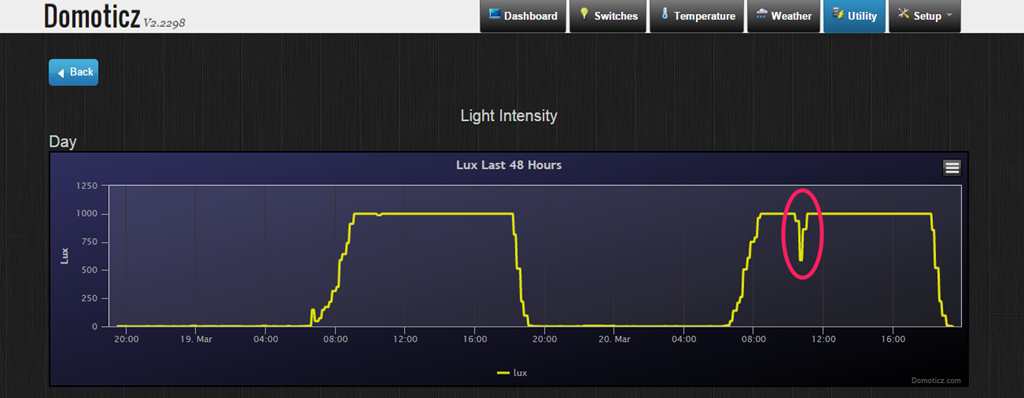
    Therefore, even though I was not able to observe the eclipse directly, I certainly had indirect evidence that something was afoot. In addition, one of our outside motion sensors (part of our Home Automation installation) has a light sensor. The readings from that today clearly show how the light from the sun was obscured during the moon’s transit:

    Domoticz 25

  • The World’s Most Important Operating System

    I was saddened to learn today that Bill Hill died of a heart attack back in October 2012. Bill was a Scotsman who started out life as a newspaperman and became a typographer, but ended up working for Microsoft.

    In this short video clip Bill explains why the world’s most important operating system is not Windows or OSX or Linux or Android. It’s Homo sapiens 1.0. It’s an operating system that first booted up about 100,000 years ago, and has never yet had an upgrade.

    There’s more videos of Bill available here. A memorial, of sorts. RIP, Bill.

  • The Wanderers

    A rather impressive short film, with the always impressive words of Carl Sagan. I won’t live to see these scenes in reality, but hopefully some of our species will.

  • Particle Fever

    I watched Particle Fever last night. It’s a documentary about the Large Hadron Collider and the search for the Higgs Boson.

    It’s staggeringly good.

    Equally staggering is the scale of the physics experiment that the LHC embodies. It’s probably the largest experiment ever constructed by humans; built with a budget of 7.5 billion euros by over 10,000 scientists and engineers from more than 100 countries. The documentary easily delivers a sense of awe at the scale of the endeavour, but, more importantly by following six physicists over six years, also gives an insight into the purpose of the project and the passion of the people for the physics behind it.

    Physicists fall into two camps: the theorists and the experimentalists, and both were represented in the documentary. Whilst all the featured physicists were interesting and engaging, I was particularly struck by two of them: experimentalist Monica Dunford (who came across as being exactly like Dr. Ellie Arroway, the character played by Jodie Foster, in the film Contact) and the theorist Nima Arkani-Hamed. His explanations, together with those of David Kaplan, another physicist and producer of the film, managed to make the physics clear to me, and pointed out the struggle of theories going on – supersymmetry versus multiverse – that the LHC experiments aim to resolve through discovering and understanding the Higgs Boson.

    What I find fascinating is the way in which supersymmetry almost implies support for the strong Anthropic principle (the suspicion that someone/something is twiddling the knobs of the universe to fine-tune physical laws and constants so that the universe as we know it can actually exist). The Multiverse theory, on the other hand, removes the need for all this knob-twiddling, since it posits that our universe, with its particular knob settings, is just one possibility out of a myriad of alternative universes that might exist.

    It was hoped that, if the Higgs Boson were to be discovered by the LHC experiments, then this would go some way to favouring one of the above opposing theories. Unfortunately, like some cosmic joke, the data that the LHC has given us about the nature of the Higgs Boson is almost exactly sitting on the fence, with neither theory being able to be declared the outright winner. This is like ascending a mountain, only to discover when you’re at the peak, that it is merely a foothill of some larger chain. If you have passion, as these physicists clearly demonstrate, this will simply act as the spur to drive you on further.

    At a time when both religion and politics are increasingly demonstrating their most baleful influences on humanity, it warmed the cockles of my misanthropic old heart to see a scientific endeavour on the scale of the LHC uniting thousands in a common search for knowledge.

  • Step Away, Professor Dawkins, Step Away…

    One of the reasons why I refuse to use Twitter is because it is impossible to have nuanced conversation and argument in a straitjacket of 140 characters. However, as the saying goes, fools rush in, where angels fear to tread

    And so it is with Richard Dawkins, who in response to someone who tweeted:

    I honestly don’t know what I would do if I were pregnant with a kid with Down Syndrome. Real ethical dilemma.

    responded with

    Abort it and try again. It would be immoral to bring it into the world if you have the choice.

    Oh god; *facepalm*. Talk about a hostage to fortune. Ophelia references a discussion between Michael Bérubé (whose son, Jamie, has Down Syndrome) and the moral philosopher Peter Singer. It’s worth reading.  Dawkins, it should be noted is a scientist, not an ethicist or moral philosopher.

    Professor Dawkins has a history of opening his mouth to change feet when he uses Twitter. Personally, I think he should stop using it. It’s an embarrassment to all concerned.

  • Noctilucent Clouds

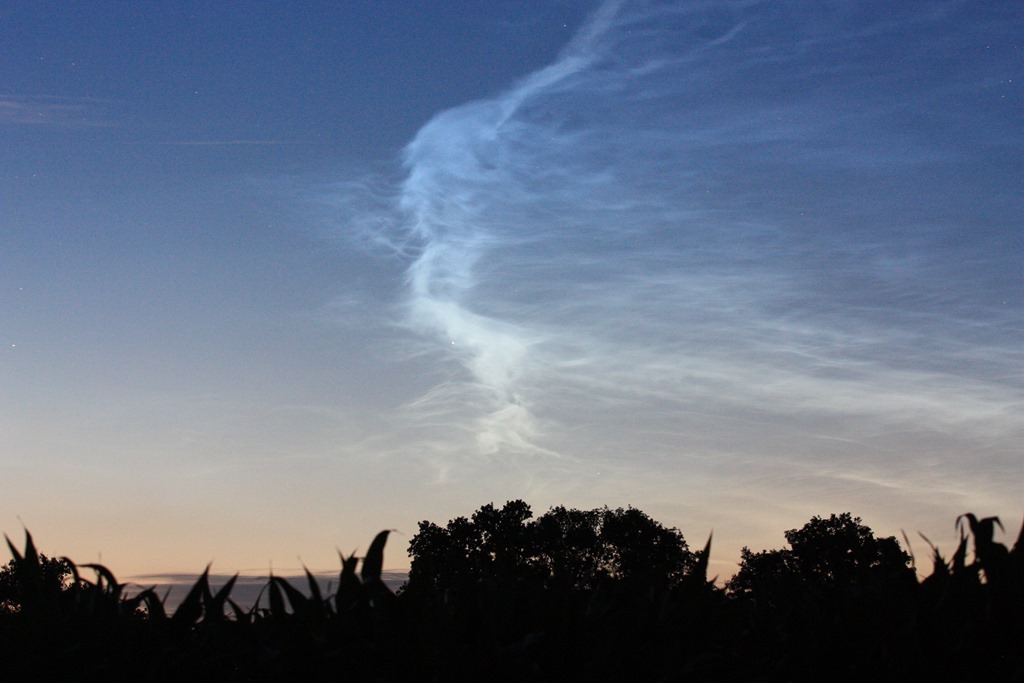
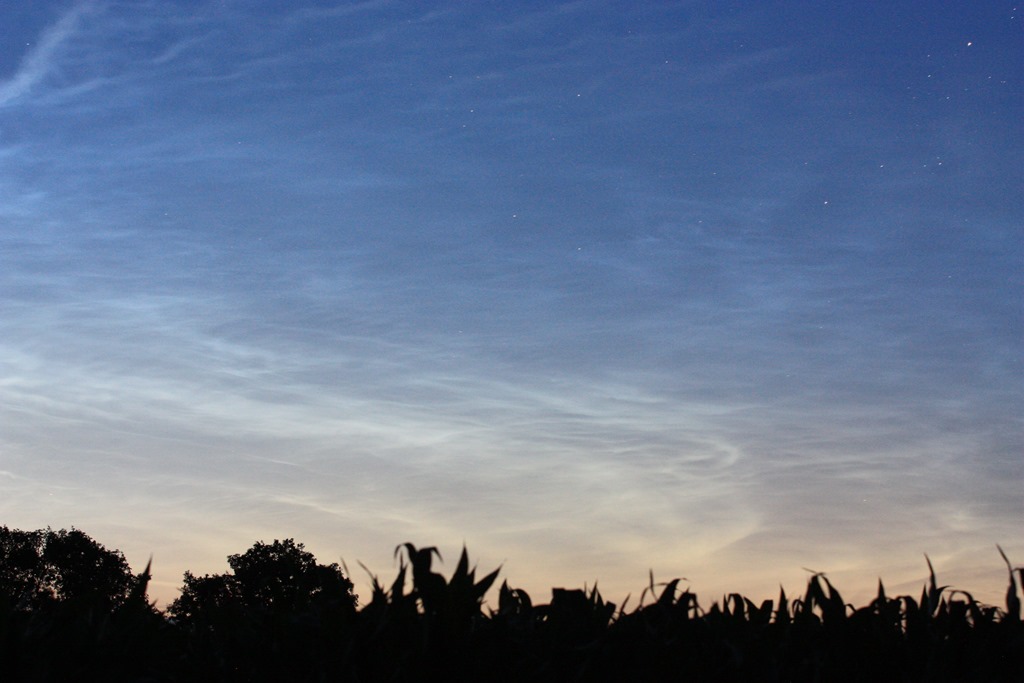
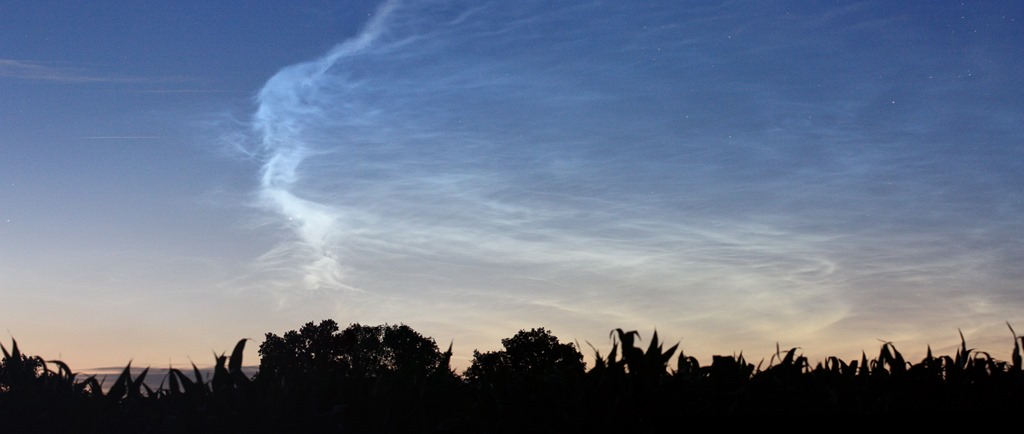
    When I took the dogs out last night at 11pm, I noticed that there were noctilucent clouds showing up above the Northern horizon. I dashed back and grabbed the camera for a couple of shots before they faded from view:

    20140703-2340-24

    20140703-2341-12

    20140703-2340-57 Stitch

    These are time exposures of ten seconds, so the sky appears brighter than in fact it was (you can also see some stars). This is the first time that I’ve ever been aware that I was looking at this particular meteorological phenomenon. 

  • Indistinguishable From Magic

    Arthur C. Clarke once wrote:

    Any sufficiently advanced technology is indistinguishable from magic.

    That’s the thought behind this video: Box.

    (hat tip: Richard Wiseman)

  • Gee’s Swizz

    There was a time, round about 2008, when I was a regular reader of Henry Gee’s blog. He’s a senior editor of Nature, and I found his blog writing amusing enough. After a while though, I found I became somewhat disenchanted with his views, and stopped reading him.

    He popped up again this week with an opinion piece in The Guardian where he set out his case that Science is a religion that must not be questioned. I found it mostly to be a load of old bollocks, and it served as a reminder as to why I stopped reading him. The one point where I found myself half-nodding in agreement was his charge that:

    TV programmes on science pursue a line that’s often cringe-makingly reverential. Switch on any episode of Horizon, and the mood lighting, doom-laden music and Shakespearean voiceover convince you that you are entering the Houses of the Holy – somewhere where debate and dissent are not so much not permitted as inconceivable.

    But even here, my argument would not be because the programmes are reverential, but because they are bad. I’ve said in the past that Horizon has been simultaneously both dumbed-down and jazzed up by the programme makers to an almost unwatchable extent. With rare exceptions, the programmes are not made by the scientists themselves, but by non-scientists who seem to prefer (questionable) style over substance.

    For a proper rebuttal of Gee’s piece, I refer you to Jerry Coyne, who takes it apart in a most satisfying manner.

  • Music In The Cathedral

    The ISS is one of science’s cathedrals. Scientists can also be musicians. Space Oddity has always been one of my favourite songs.

    Commander Chris Hadfield brings it all together. The special effects were all provided by nature. Wonderful.

  • Feynman’s Philosophy

    A good video that nicely summarises the philosophy of Richard Feynman, narrated by Feynman himself.

    A key section:

    “You see, one thing is I can live with doubt and uncertainty and not knowing. I think it’s much more interesting to live not knowing than to have answers which might be wrong. I have approximate answers and possible beliefs and different degrees of certainty about different thing but I’m not absolutely sure of anything and there are many things I don’t know anything about, but I don’t have to know an answer. I don’t feel frightened by not knowing things, by being lost in a mysterious universe without having any purpose, which is the way it really is as far as I can tell, possibly. It doesn’t frighten me.

    And so altogether I can’t believe the special stories that have been made up about our relationship to the universe at large, because they seem to be too simple, too connected, too local, too provincial…”

    Amen to that.