Reflections on life at “De Witte Wand”…

Category: Science

  • For Carl

    … That was the dedication on the film Contact, the best film of exploring the wonder of the universe by the scientific method I’ve ever seen. The stunning opening three and a half minutes that takes you travelling out across the universe and back in time to the Big Bang is worth the price of admission in itself, but the film goes on to frame the old religion versus science debate with a cracking good story. And since the Carl of the dedication is Carl Sagan, who wrote the original novel, then the film comes down on the side of science, and not superstition.
     
    I am reminded, by Obscene Desserts, that today marks the tenth anniversary of Sagan’s death. He is sorely missed. Time both to watch Contact and read The Demon Haunted World again, I think.
  • FizerPharm Inc.

    I’ve blogged about this FizerPharm Inc. presentation before. But now I see that it has come to the attention of PZ Myers, so I feel that it’s worth repeating. What I didn’t realise the first time around is that Peter Watts, the author of this creepy little presentation, also wrote an SF novel: Blindsight, from which the material for the presentation was taken. The novel is now available for download, as it has been released under a Creative Commons license.
     
    Peter Watts’ web site itself is also worth visiting via the front door, despite Watts’ antithesis to people (like me) who use Internet Explorer.
  • SETI@home

    SETI@home is a scientific experiment that uses Internet-connected computers in the Search for Extraterrestrial Intelligence (SETI). I’ve been running the SETI@home client on one of my computers at home for some years now. The team behind the experiment are on a fund-rasing drive at the moment. This morning, I received an email signed by Dan Werthimer (the Chief Scientist of SETI@home) and Arthur C. Clarke. An extract:
    SETI@home needs your help. The SETI@home team has accomplished much in the past 6 months. We have successfully deployed the "enhanced" version of SETI@home. The new seven beam data recorder has been installed at Arecibo (the world’s largest radio telescope) and is recording the data that will be analyzed in the next phase of SETI@home.
     
    But there is still far more to be done. We would like to be able to sift through the results returned by your computers in order to identify candidates more rapidly so we can re-observe them. This rapid response validation system would also give you the ability to see the results your computers have/has returned in more detail. To keep SETI@home operating for the next year, and to provide these new capabilities, will require approximately $540,000. Currently SETI@home is entirely funded by donations from people like you.  
    If you’d like to help (either by running the client on your own computer to help analyse the data, or by donating), then go to the SETI@home  site to learn more. 
  • Living In The Unknown

    And talking once again about the Beyond Belief conference, here’s the snippet that perfectly illustrates for me the reason why I want to "live in the unknown". Ann Druyan’s response to Darren Schreiber is quiet, measured and moving.
  • Dividing By Zero

    Sometimes I feel thankful that I managed to be educated in school without being exposed to either too many crackpot ideas on how children should be educated or too many crackpot ideas, period. It would seem that there’s a rise in the latter in particular (the former will probably always be with us). For example, the attempt, now spreading to the UK, on trying to teach Intelligent Design as though it were a science. But here comes another, a real beauty. I’ll hand you over to Dr. Ben Goldacre to take up the story. I note that Dr. Anderson is from the University of Reading’s Computer Science department. I am now also thankful that I went to the University of Liverpool’s Computer Science department all those years ago…
  • Father Neil

    I mentioned the other day how impressed I was by Neil deGrasse Tyson. I’ve now watched one of the final sessions from Beyond Belief. I now understand why he was called Father Neil in the conference. He is an absolutely brilliant communicator. Bravo. Watch the session and pick it up from about one hour one minute in. Mind you, he is proceeded by V.S. Ramachandran, who is damn good as well, but Tyson takes the sense of awe to a whole other level.
  • Snail Telegraphy

    The ever-dependable Proceedings of the Athanasius Kircher Society has a corker of an entry today: The Snail Telegraph. It was based on the well-known scientific principle that any two snails, once mated, will remain forever in telepathic contact with each other, no matter what the distance between them. Er, right. But just supposing this bizarre hypothesis was true. How different the world would have been following the introduction of the snail telegraph back in 1850…
  • Monckton’s Mockery

    Apparently, the Sunday Telegraph has published a two-part article by Christopher Monckton on climate change, in which he accuses scientists and the UN of distorting the facts about global warming. I didn’t read it myself (I don’t often dip into the Telegraph’s pages). However, I see that today’s Guardian carries an article by George Monbiot that thoroughly shreds the "facts" presented by Monckton. It’s a pretty good demolition job – and, following the article, the first comment by "rashers101" is rather good and somewhat sobering.
  • Oiling the Wheels of Industry

    Dr. Ben Goldacre writes a weekly column in The Guardian on the subject of "Bad Science".  He also has a blog of the same name. Recently, he’s been digging into a story about Durham Council introducing, at taxpayers’ expense, fish oil food supplements into the local schools. The council claims that the supplements have proven to be effective in improving the children’s performance at school.
     
    Goldacre has repeatedly asked to see the evidence for these claims, and surprise, surprise, the data has not been forthcoming. In fact, Durham Council have been stonewalling. One might almost think that they might have something to hide.
     
  • Cross-Fertilisation – Take Two

    PZ Myers riffs on possible developments in techniques for stem-cell research. Mind-boggling stuff!
  • Bang!

    So, I mentioned the book that a seemingly unlikely trio have collaborated on. I’ve now got a copy, and it’s not bad at all. Suitable for a wide age range of people who are interested in science. There’s even a web page with a new riff by Brian May on it to publicise the book. Brings back memories of Queen!
  • The Blind Watchmaker

    And sticking with the theme of 1980s TV, here’s a link that will lead you to a TV special from that time starring a younger Richard Dawkins, talking about the Blind Watchmaker… Terrific stuff!
     
    And I can’t help but note that this programme was made by the BBC’s Horizon team. That was then, when programme makers were not afraid to have experts, such as Dawkins, address the camera directly to put across complex ideas without the need for flashy graphics, bizarre camera angles and loud music. Today’s Horizon, by comparison, seems to embody the very worst of bad ideas from generations of meeja-studies graduates. Damn them all to hell.
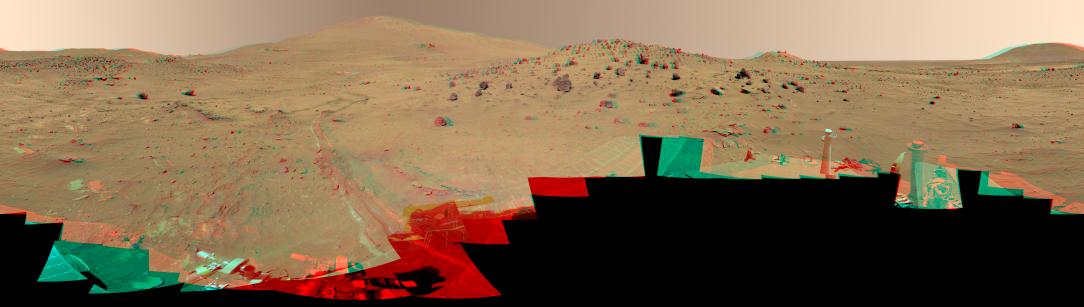
  • Mars In Stereo

    To commemorate the fact that NASA’a Mars Exploration Rover Spirit has been traipsing about the Martian landscape for 1000 days, Nasa has released a photographic panorama of the landscape in stereo anaglyph format. Dig out your red/blue spectacles to see the image in glorious 3D. Luckily I still had a pair tucked away in The Illustrated Harlan Ellison – long since out of print…
     
    (hat tip to the Bad Astronomer for the link)
  • Odd Sympathy

    Yesterday’s entry in the Proceedings of the Athanasius Kircher Society deals with the phenomenon of Odd Sympathy:
    The term “odd sympathy” was coined by the 17th-century Dutch mathematician and physicist Christiaan Huygens to describe the strange phenomenon he observed while laying sick in bed and looking up at two of his newly invented pendulum clocks hanging on the wall beside him. Inexplicably, the two pendulums always swung in opposite directions. Even when he would release them in different positions, they eventually fell back in synch (or antisynch, to be precise). Huygens had discovered the principle of coupled oscillation, but it took a recent study by physicists at Georgia Tech to prove that it was the miniscule force of the pendulums operating on a beam in the wall that caused them to link up. 
    Interesting stuff (well, I think so, anyway)
  • Darwin Online

    The Guardian reports today that Cambridge University has put a microfilm copy of a notebook of Charles Darwin onto the web. The original has gone missing, presumed stolen. Cambridge University is putting the complete works of Darwin onto the web for free access to everyone. To date there are a staggering 50,000 pages of searchable text and 40,000 scanned images of Darwins writings and illustrations. This is only 50% of the material that is still to be published. 
  • Calling Time

    I see that BBC Four starts a new four part documentary on the nature of time tonight. It has Michio Kaku as the anchorman. I don’t know whether that’s a good thing or a bad thing. Whenever I’ve seen him in the past, it has been on BBC’s Horizon programmes, where frankly, the production values of the programme makers made me want to throw things at him. Heavy objects, not plaudits.
  • Sometimes Behaves So Strangely

    Here’s a link, courtesy of Crooked Timber, to a quite amazing radio broadcast dealing with the connection between language and music. There’s an interview with Diana Deutsch, a psychologist who deals with the psychology of music. I love the way the makers of the radio broadcast play with the interviews to create a soundscape that has a beauty of its own. Terrific stuff. And I have to say, it brought it back to me that for things like this, I really prefer listening to radio than to watch TV. No irrelevant flashy images – just the sparking of one’s own imagination.
  • Not Bad For Jumped-up Apes…

    I know that I come across as a misanthrope – gawd knows that as a species we do enough bad things to make that almost inescapable as my response to things. But then, every now and then, something happens to make me feel proud to be a hairless ape. This time it’s not in the area of morality or of helping relieve the burden of fellow-apes. It’s in the area of pure science – what’s out there, why is the universe the way it is – and so forth. Look at these pictures of the surface of Mars and think about the implications, That’s something to take a teensy bit of pride in. Next up, let’s find a cure for AIDS and stop global warming…
  • Cautious Cars And Cantankerous Kitchens

    Donald Norman has posted the draft first chapter of a new book on his web site. It’s about how machines take control, and why this can lead to unintended results. Worth reading.