Reflections on life at “De Witte Wand”…

Category: Science

  • Price and Value

    I read in today’s Guardian that there was an auction today of Alan Turing’s papers. While I was pleased to see that Google had donated $100,000 to the bid of Bletchley Park to keep the papers for the nation, I couldn’t help but feel disheartened by the thought that Turing’s papers could potentially disappear into a private collection, to be gazed upon by a single, wealthy individual, quite possibly hailing from Silicon Valley.

    Turing was an important individual in the history of not only computing, but in the fact that Nazi Germany was eventually defeated by the Allies. And Britain repaid that debt by persecuting him because he was gay, with the result that Turing committed suicide by eating an apple laced with cyanide.

    I can’t help feeling that Turing’s papers should have been acquired for the nation and humanity at large. Once again, we seem to understand only the price of everything and the value of nothing.

    Perhaps all is not lost; if the new owner will arrange for the papers to be made available online, then something may come out of this. Perhaps the Complete Works of Charles Darwin Online can serve as a model here.

  • “Treating People Like Pigeons Really Does Work”

    Adam Curtis has another fascinating blog entry. This time he takes as his cue the Behavioural Insights Unit recently set up by David Cameron to advise the UK Government. Curtis argues that this unit is built on the Operant Conditioning ideas of B. F. Skinner.

    It makes for fascinating, and somewhat unsettling, reading. Do check out the videoclips that Curtis includes, particularly the one of the two market researchers and the final comment from Lewis Mumford.

  • A Taxonomy of European Birds

    Looking through my photo collection, I see that I have taken over 1,300 photos that have a bird or birds as the subject. Up until now, I’ve catalogued these in a rather haphazard fashion, that’s to say that as I’ve photographed a new bird (for example a Green Woodpecker), I’ve added its common name to the list of keywords in my catalogue. As the list has grown, I’ve also tried to group the bird species a bit e.g. put the birds of prey together, or waterbirds together. So I’ve ended up with a rather messy taxonomy of birds.

    Then, a few days ago, I noticed that someone had posted a message in the Controlled Vocabulary group to say that he’d put together a list of keywords for Adobe’s Lightroom that followed the taxonomy of the list of Western Paleartic Birds produced by the Association of European Records and Rarities Committees, the AERC. As an aside, I note that whoever is responsible for the AERC web site needs to fix the missing or broken links that pepper it.

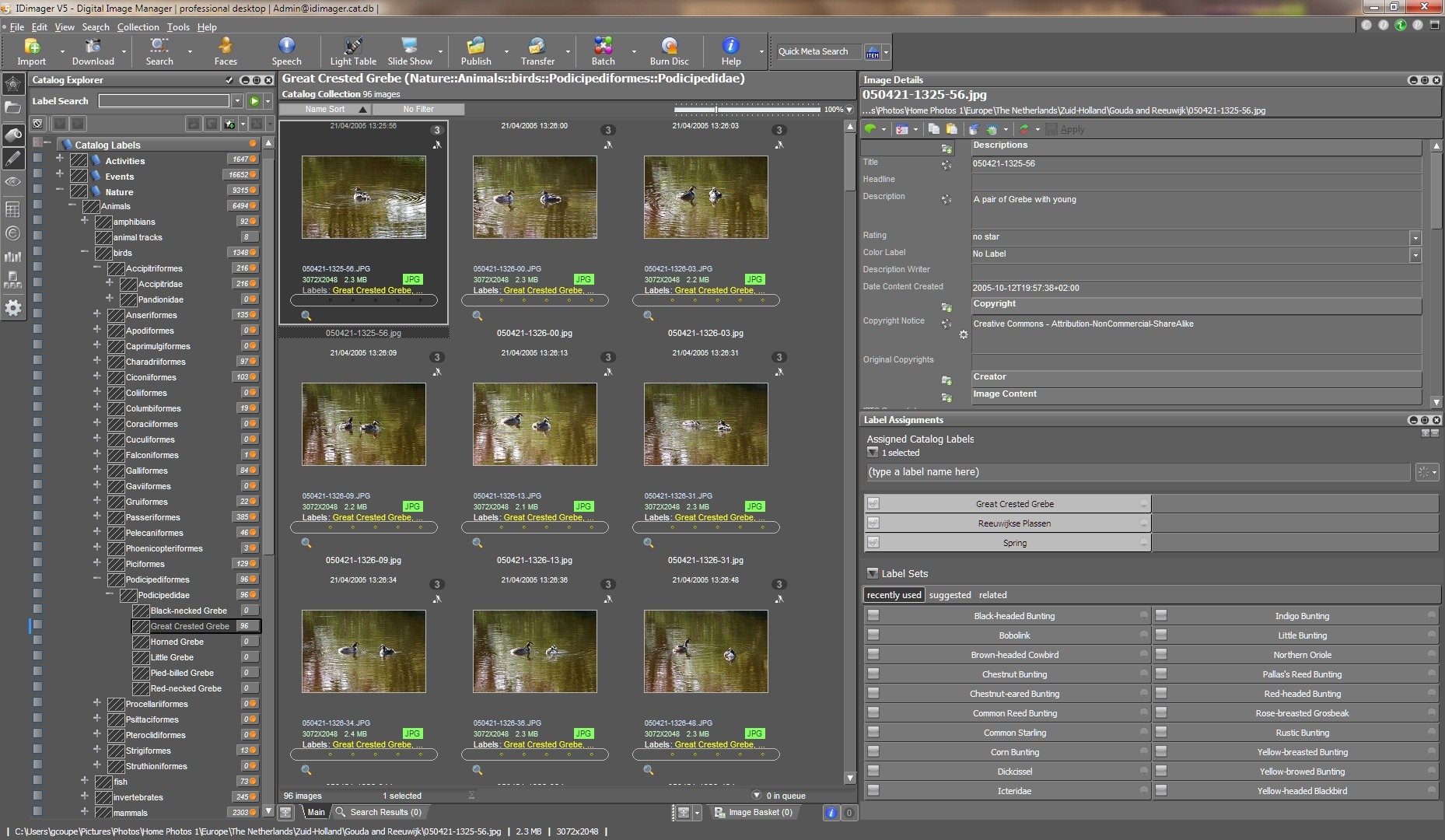
    Anyway, Rudi Theunis made his keywords list available to the members of the Controlled Vocabulary group, and I grabbed a copy to see if I could use it with IDimager, the program that I use to catalogue my photos. (Note: IDimager is no longer available. Its successor is Photo Supreme, which I am now using) It turns out that IDimager can easily import Lightroom keyword lists with one click, so I’ve now got a complete taxonomy of European Birds set up, with both common names and the scientific names as synonyms. See the following screenshot showing a partial view of the taxonomy (click on the image to see the full size screenshot in a new window).

    ID Birds Catalog

    I spent a few hours re-cataloguing my bird photos, and now they are all nicely fitted into the new taxonomy, thanks to Mr. Theunis.

  • What’s The Point – Part II

    Here we go again, more bilge to wade through. This time it’s Jonathan Jones, whom I understand to be an art critic, claiming that in the area of writing about Natural selection: “Give me Darwin over Dawkins any day.“

    Well, he’s every right to claim that of course, but his reasons don’t stand up to much scrutiny:

    “Darwin is the finest fruit of English empiricism. His modest presentation of evidence contrasts, I am sorry to say, with the rhetorical stridency of Richard Dawkins. Visit the famous atheist’s website and you will see two causes being pushed. Dawkins is campaigning with other secular stars against the pope’s visit to Britain. Meanwhile he is touring the paperback of his book The Greatest Show On Earth: The Evidence for Evolution. The trouble with this book is that it lacks Darwin’s empirical style. Where the Victorian writer presented masses of evidence, and let his astonishing, earth-shattering theory emerge from common-sense observations of nature, Dawkins lacks the patience, at this point in his career, to let natural history speak for itself. He has become the mirror image of the theological dogmatists he despises.

    He just can’t separate science from the debate he has got into with religious people.”

    Jones seems to have read a different version of The Greatest Show on Earth from the one that I did. Mine has Dawkins present and review the evidence, both that which Darwin saw and that which has become available in the 150 years since Darwin first published. As Jerry Coyne says, it’s “chapter after chapter of solid biology, natural history, genetics, evo-devo, and the like”.

    And if Dawkins can’t resist slipping in the occasional jab at the idiocy of creationists in the face of the mountains of evidence, then I, for one, cannot blame him. If it were me, I’d be screaming in their faces to get in the fecking sack, yer fecking eejits

    It’s all I can do to refrain from saying the same to a certain Mr. Jonathan Jones, erstwhile art critic of the Guardian and jury member for the 2009 Turner Prize. As Jerry Coyne says:

    “Jones is clearly out of his element here, which is writing about pictures of dogs playing poker. In his haste to defend faith against the depredations of Dawkins, he makes a complete fool of himself.”

    Oh, bugger it; Get in the fecking sack, Mr. Jones…

  • What’s the Point?

    I know I shouldn’t get irritated by it. I know that it is pointless to feel exasperated by twaddle. But when Lord (yup, Lord) Sacks starts heaping up strawmen, I really do feel like saying enough is enough, fer gawd’s sake.

    Let’s just examine what he is reported to have said:

    “There is a difference between science and religion. Science is about explanation. Religion is about interpretation. The Bible simply isn’t interested in how the universe came into being.”

    Erm, hello? The Bible simply isn’t interested, because it states how it happened. The fact that it’s nonsense seems to have passed by its readers who think they know how to interpret its fantasies. Its mind was made up by the original writers.

    And Religion is about interpretation, eh? Tell that to those who think that the Bible is God’s inerrant law.

    And of course, there’s a warning:

    Sacks also said the mutual hostility between religion and science was one of “the curses of our age” and warned it would be equally damaging to both.

    Enquiry is not a curse. The fact that your folklore feels under threat is not equally damaging to both..

    And Lord Sacks rounds off with:

    “But there is more to wisdom than science. It cannot tell us why we are here or how we should live. Science masquerading as religion is as unseemly as religion masquerading as science.”

    Science is not masquerading as a religion, except in your worldview, Lord Sacks. And that is simply because the results of scientific enquiry are undermining the strawmen set up by your interpretation of sacred texts. Texts that were written by human beings trying to do the best (or the worst) that they could in less enlightened ages.

    And of course, Moses speaks for Lord Sacks.

  • The Illusion of Free Will

    Over at Why Evolution Is True, Jerry Coyne muses on the concept of Free Will. His musings were prompted by reading Dan Dennett’s book: Freedom Evolves.

    His post is followed by a discussion by commenters batting the ideas back and forth. I’m no philosopher, and reading some of this stuff makes my brain hurt, but it’s enjoyable all the same to explore the ideas.

    When it comes down to it, I think I’m pretty much in the camp that believes that free will is an illusion, albeit an exceedingly strong one. I think Ophelia pretty much sums it up for me:

    This subject doesn’t fret me the way it does some people, and I suspect that’s because I’m lazy about it. I’m lazy about a lot of things. It doesn’t fret me because I always end up thinking “but it feels as if I choose and in a way that feeling amounts to the same thing as really choosing.” That’s probably lazy because of the “in a way” or the “amounts to” or both. It’s woolly. And yet –

    And yet if we all do live that way, feeling all the time as if we choose various things, then for the purposes of living that way, it does amount to the same thing. Or at least it seems to. It’s like the self, and other such illusions. We can agree that they’re illusions, and yet in everyday life, we go on living and thinking as if they’re not, and we can’t really do anything else.

    It’s like vision, too – we don’t really see what we see; what we see is a confabulation – we fill in all kinds of missing bits with our brains to make a seamless whole that our eyes don’t in fact see. I’m aware of that, but I certainly can’t refrain from doing it.

    Perhaps I should go back and re-read Freedom Evolves again. Now, is that a decision taken of my own free will?

  • The Acid Tanks Await

    I’ve always had this inkling feeling that the Transhumanist singularity is nothing much more than a rather daft idea peddled by the likes of Ray Kurzweil.

    It’s a topic that comes up for regular chewing over in the science blogosphere, particularly around the time when the proponents of transhumanism hold a shindig.

    I came across something today that triggered a faint memory. Over at Pharyngula, there’s a post today that contains a comment by Ye Olde Blacksmith that nails the flaw for me.

    To summarise the idea of the singularity, it is that at some point in the not-too-distant future, it will be possible to copy the consciousness of a human person into another, perhaps non-biological, substrate, such that the consciousness lives on in the new vessel.

    In a way, it’s what lies at the heart of the Star Trek transporter, but the idea was explored even earlier in Science Fiction in the 1964 book by Clifford D. Simak: Way Station. The central idea of the book is that what appears to be a remote rural farmstead in Earth is in fact a galactic way station that travellers are passing through. As Simak envisages it, travellers arrive at the way station by having their bodies and their consciousness replicated from the blueprints taken at the previous station. When they leave, the process begins with their complete blueprint, body, consciousness and all being transmitted to the next station. It is completed when the traveller on earth is killed and its body flushed into the underground tanks of acid that lie beneath the way station. That image has stayed with me.

    The comment on the Pharyngula thread rather brought the memory of that book back to me:

    Dr. Nick: Good evening, Mr. Anderson. Are you ready for the procedure?

    MeatbagMe: Hi. Um, yeah, I guess. Are you sure this will work? I’m really going to be in the machine?

    Dr. Nick: Yes, you will be in the machine and will no longer be biologically mortal.

    MeatbagMe: Oh, OK, let’s get this party started.

    *Dr. Nick admininstering sedative via I.V.*

    Dr. Nick: Ok, start counting backwards from 100.

    MeatbagMe: 99…98…97…9…..

    Dr. Nick: Are you there? Can you hear me, Mr. Anderson?

    DigiMe: Hey, yeah, I’m here! SWEET! I’m in a computer. The interfaces are awesome! I can’t even tell I’m not still in my body. So what happens now?

    Dr. Nick: Well, now that we have established that the procedure was successful, we will dispose of the body.

    DigiMe: Wait, what? So my original body is dead?

    Dr. Nick: No, it isn’t dead, but you have no use for it anymore. Now that you are digital, that is, you have not need for a biological carrier.

    *MeatbagMe comes to*

    MeatbagMe: Hey, what happened? Did it work? I don’t feel any different.

    Dr. Nick: Nurse, please begin the body disposal procudures.

    *Nurse begins administering something via I.V.*

    MeatbagMe: What? Hey, I’m still alive here! You can’t do this!

    Nurse: The body is prepping now, Dr.

    MeatbagMe: Hey! HEY! Stop this! I’m still here! I’m still here goddamm……………..

    Nurse: I will arrange for the transport of the remains.

    Dr. Nick: Thank you. Mr. Anderson, will you be requiring anything else?

    DigiMe: Nope, I’m good.

    Or, in devastating summary (comment #46):

    “As you can see, this new duplicate of you is an exact replica in every way, down to every last memory, down to every last arm hair. Now please step into the disintegration chamber.”

    This seems to me to be the fatal flaw. If I am a non-dualist, then I have to believe that “I” will cease to exist once I step into the disintegration chamber. The fact that a replica of me, carrying a perfect copy of my consciousness will carry on is of little comfort to the me that existed up until that point…

    The acid tanks await…

  • Begging The Question

    The Guardian’s Comment is Free section runs a feature called “The Question” Each week a question is posed and a series of writers offer their thoughts (usually both pro and con) on it. This week, the question is: Can we choose what we believe? Or, to put it another way: How do you believe the things you do, and are they things you can change?

    Julian Baggini gets things off to a good start, but as is so often in CiF, we lurch from the sublime to the ridiculous with the next response from Usama Hasan. His opening sentence is a perfect illustration of the begging the question fallacy:

    God exists, obviously.

    Erm, no, it ain’t obvious. His piece pretty much goes downhill from there. As Baggini concludes in his piece:

    The capacity to make free choices is not something we either have entirely or not at all. Rather, choices become freer the more they are the result of our own capacity to reflect on and assess facts and arguments. Beliefs based on ignorance or whim are thus less freely chosen than those held in full knowledge and on reflection. So to take one of the biggest belief choices of all, we do not choose to believe in God or not, but we can choose how much we attend to inconvenient facts, distorting self-motivations, and the rationality of arguments. In that sense, we are responsible for what we freely believe.

    There’s been a number of items recently on whether free will is itself an illusion or not. For example, the philosopher Dr. Galen Strawson had a good article in the New York Times recently. His position is that free will is definitely an illusion. Bradley Voytek, over at his Oscillatory Thoughts blog, has some comments to counter the argument. And Jerry Coyne had an item on his Why Evolution Is True blog outlining the surprising results of an experiment to test “free will”. As Coyne writes:

    Here’s the surprising result: the brain activity that predicted which button would be pressed began a full seven seconds before the subject was conscious of his decision to press the left or right button. The authors note, too, that there is a delay of three seconds before the MRI records neural activity since the machine detects blood oxygenation.  Taking this into account, neuronal activity predicting which button would be pressed began about ten seconds before a conscious decision was made.

    Food for thought, and a good deal more interesting than “God exists, obviously”.

  • Why, Oh Why, Do I Do It?

    That is, why do I continue to visit Mark Vernon’s blog? After all, the chances that he has written something that will make me want to bang my head against the wall are, on past performance, pretty high. Perhaps it’s because I must have a streak of masochism.

    Mr. Vernon has done it again with his praise over James Le Fanu’s book “Why Us? The book clearly speaks to his prejudices. e.g.:

    “The brain looks much more like the medium through which mental activity ripples, rather than the source of that mental activity itself”.

    “The vivid and liberating experience of consciousness also suggests, to Le Fanu, the need for the language of the soul, and of a natural sympathy not enmity between science and religion. Further, the apparently information rich operations of genes, and the syntactical nature of language, raises the possibility of a God-like intelligence, required as a kind of top-down, causative factor – he moots, sensibly towards the end”.

    “To my mind, reductionist materialism has pretty clearly almost exhausted its explanatory powers in these fields, though it’s had a great run. (That’s something physicists have long had to contemplate.) We might live to see a new science emerge”.

    Hmm. While I think we may see a new science emerge, it will not be along the lines of a “god of the gaps” that Le Fanu and Vernon would dearly like to see. It will be because the data that the reductionist approach continues to reveal will be refined into information and then knowledge. Frankly, I think Amanda Gefter is more on target with her New Scientist review of Le Fanu’s book:

    “I am all for a good mystery, but there is an important difference between revelling in the excitement of the unknown and turning away from knowledge because you simply don’t like the facts”.

    Quite.

  • Coincidences

    An instructive video pointing out why I get extremely exasperated by people who claim "It can’t be just coincidence – there’s something spooky going on!". The only thing going on is that they aren’t using their brains properly.
     
     
  • Martin Gardner

    Martin Gardner has died. Whenever I got my hands on a copy of Scientific American as I was growing up, his column Mathematical Games never failed to intrigue (and to make my brain hurt). He sparked interest in science, skepticism and magic in many people. He will be missed.
     
    He wrote many, many books, of which I have but a couple. Time to re-read them:
     
  • Wonders of the Solar System

    I’ve been thoroughly enjoying Professor Brian Cox’s Wonders of the Solar System series currently being shown on the BBC. He’s a great communicator, and doesn’t dumb down the science. Here’s a great spoof of his style:
     
     
  • Climate Denial Crock of the Week

    Peter Sinclair, doing his best to fight against the tide of misinformation on climate change:


    Good luck to him. I’m beginning to think that it’s a lost cause. Hat tip to Francis Sedgemore.
  • Pseudo-Metaphysics

    Massimo Pigliucci has a post over at Rationally Speaking that reminds me how easily I get irritated by pseudo-scientific waffle with a metaphysical slant. And I really get irate when it’s uttered by people who should know better. Pigliucci quotes the physicist Paul Davies as an example of a generator of metaphysical waffle, and I agree with the assessment. I was watching the BBC’s The Sky at Night special on "Life" last week and Davies was being interviewed. It was all I could do to refrain from picking up the TV and hurling it through the window. Templeton prize-winning stuff and nonsense.
  • The Symphony of Science – Part V

    Another installment of the Symphony of Science. This one proving that, although it’s amazing technology, even Auto-tune can’t make Professor Dawkins sing…
     
     
  • Which Web Animal Are You?

    The BBC has been running a series of programs on the effects of the internet and the World Wide Web on society called The Virtual Revolution. Fronted by Aleks Krotoski, it’s been a relatively good exploration of both the history and the societal effects of the Web. The fourth, and final, programme of the series looked at the societal impact of the web in more detail. It contained the inevitable soundbite from Baroness Greenfield expressing concerns about the negative impact on the brains of our youth, but this was rather nicely called “an extreme position” by Krotoski. The point is that there’s really little evidence either way – just plenty of anecdotes.

    To try and address this lack of research, the BBC joined forces with Professor David Nicolas, head of the CIBER research group at University College London and Professor Clifford Nass of Stanford University. A Web Behaviour Test has been launched in order to try and gather more data. The professors propose that there are eight different archetypes of people who interact with the web, and have defined their characteristics in terms of animals (fox, hedgehog, etc.). If you take the test, you will be shown which archetype of web user you are. Apparently, I’m a bear:

    bear

    Slow-moving – Web Bears browse the internet at a leisurely pace – just like real world bears who like to take their time over things.

    Solitary – Like real bears, Web Bears tend to be solitary animals. My results show that when I am looking for information, I am less likely to use social networks or other sites whose content is created by its users, preferring instead to go it alone.

    Adaptable – Web Bears are highly adaptable multitaskers, able to do several things at the same time. Real-bears are also very flexible, particularly in their diet, and will eat fish, insects, salmon and even scavenge in human refuse for new sources of food.

    I’m not sure about the eating insects bit, or scavenging in human refuse, mind.

  • The Stupid – It Burns

    I’m sorry, but hasn’t Mary Midgeley realised that she’s barking up the wrong tree by now? Or perhaps she’s simply barking.
  • Mirror, Mirror…

    A short, but sweet, presentation by VS Ramachandran on the role that mirror neurons play in our consciousness. I’m not entirely convinced, though, by his claim that mirror neurons were responsible for the ‘big bang’ in human consciousness and culture about 75,000 years ago. After all, other species are known to possess mirror neurons and we haven’t seen similar leaps forward. Still, fascinating stuff.
     
     
  • There and Back Again

    A trip from the Himalayas to the furthest known reaches of the universe and back again in six minutes. Wonderful.