There seems to be no end to the moral bankruptcy of Trump and his administration. The news of the diesel deal with Putin brokered by Witkoff and Kushner is merely the latest deep point and one that was underlined by Trump’s blaming Zelensky for the continuing war initiated by Putin.
The US could easily have bought the diesel from Canada, but it’s clear that Trump views Mark Carney as his enemy and Putin as his friend.
As Emily Maitlis says, Witkoff and Kushner are not diplomats involved in negotiations between Ukraine and Russia aimed at making a peace deal – they are only interested in deals that enrich themselves and their families – and Trump is 100% behind that.
It is astonishing to me that the Republicans continue to tow the Trump line and are doing as well as they are doing. Hopefully the mid-term elections in just three weeks will indeed show the popular distaste for Trump and his and his acolytes doings.
That’s the title of a new book by Naomi Klein and Astra Taylor. Here’s a short video from Klein and Taylor introducing the main themes of the book:
I found the video after I had listened to this podcast from the London Review of Books. It’s an interview of Klein and Taylor by Adam Shatz.
On the strength of this, I’ve ordered the book. With every passing day there seem to be less “Reasons to be cheerful” (thank you, Ian Dury), but Klein and Taylor offer some glimmers of hope. However, they need putting into action and that’s down to each and every one of us to do what we can.
One response to “End Times Fascism”
Joost
Hi Geoff, good you mention this item !!
I am preparing a presentation on endtime kapitalisme and endtime fascicm in relation of course to the TechBro’s, but also with an historic view on for example the “VOC Amsterdam”.
Loads of papers to be found on the subject. Most pervers is the website of Peter Thiel investments : https://foundersfund.com/2024/02/hereticon-2024/ with their Hereticon festival/meeting etc in November 2024
Joost Verhoeks
Er, hello, a Microsoft 365 Family plan can have up to six people enrolled in it – that means that currently six people can use up to 6TB of cloud storage; 1TB per person. Under the new regime, those six people will have to share just 2TB – a 66.6% reduction in storage space.
In my situation, I have four family members enrolled in the plan, myself and three others; so currently we can use up to 4TB of cloud storage, 1TB each. With the new plan, we have to share just 2TB of cloud storage – a 50% reduction to what we can currently have.
Of course Microsoft is putting an Orwellian Newspeak spin on this claiming that this gives us “more flexible cloud storage”, which is simply contemptible – they must think we are idiots not to see this for what it is – a price hike far above simply the cost of inflation.
I’ll have to do a check to see how much cloud storage we are using collectively at the moment – I know that I have over 70% of my 1TB used. Perhaps I need to plan to make more use of local server storage. There was a time when I was using Windows Home Server quite happily for this, but of course Microsoft killed that product 10 years ago…
Microsoft does it again – snatching defeat from the jaws of victory, whilst giving the two-finger salute to its customers.
International law either works for everyone or for no one. This court was established to protect us against impunity and it was built on the foundations of the Nuremberg and Tokyo trials. And now, with the ICC under attack, the writing is truly on the wall.
After all, how can you possibly be opposed to prosecuting the very worst crimes? And I believe there can be only one response: to say, hands off the ICC and all those other institutions that protect the international legal order.
That’s Kenneth Roth’s summation of Donald Trump after hearing Trump’s speech to the UN this week. Delusional because Trump’s mind is obviously going, and dangerous because of the position he holds and the fact that his administration seems determined to indulge his every whim.
The article is worth reading and reflecting on. As Roth says:
It is sad and dangerous that at such a perilous moment, the United States is saddled with a president who excels mainly in disseminating self-promoting fantasies while flouting the most basic rules of decency. His UN speech put that all on painful display.
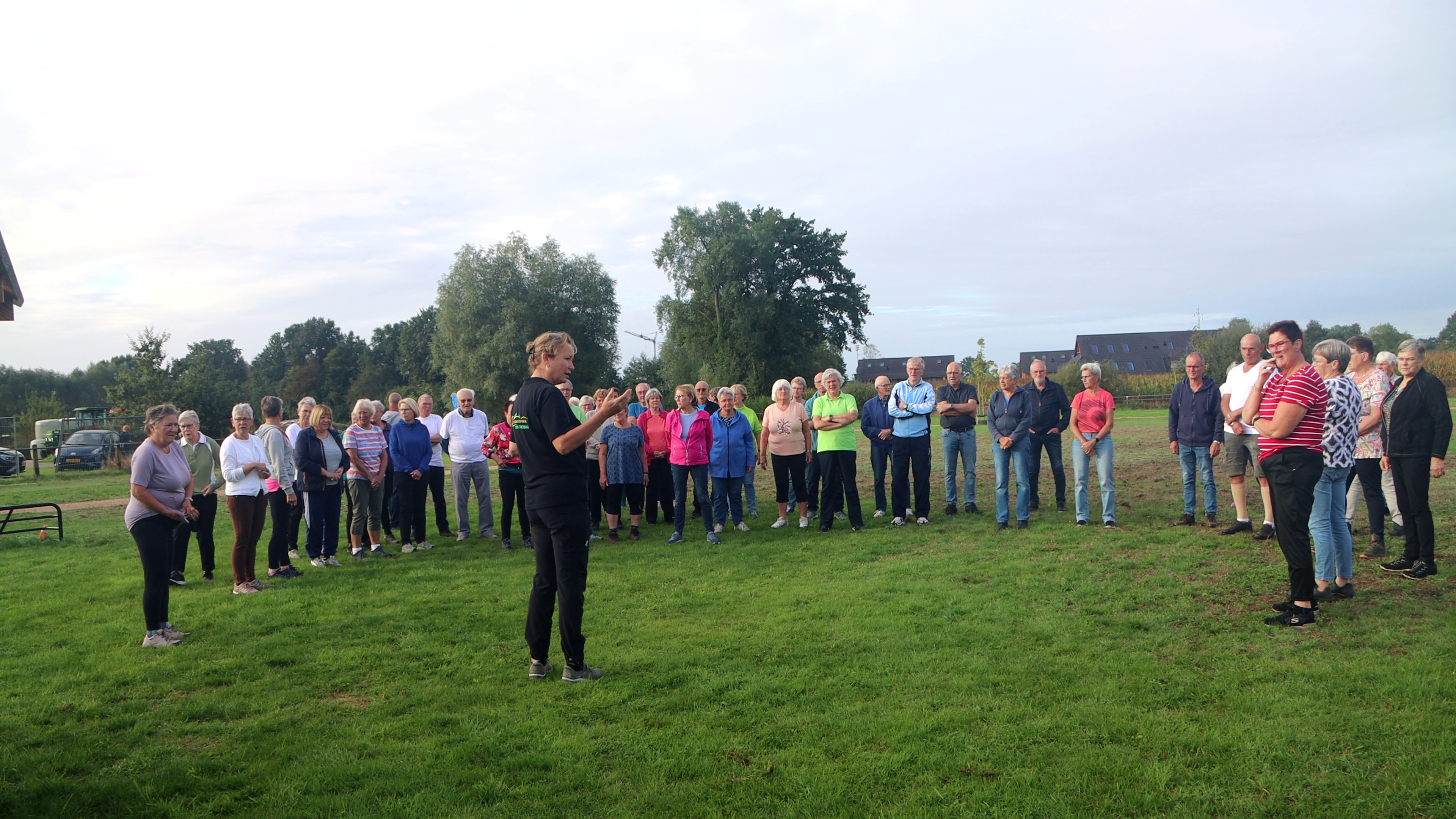
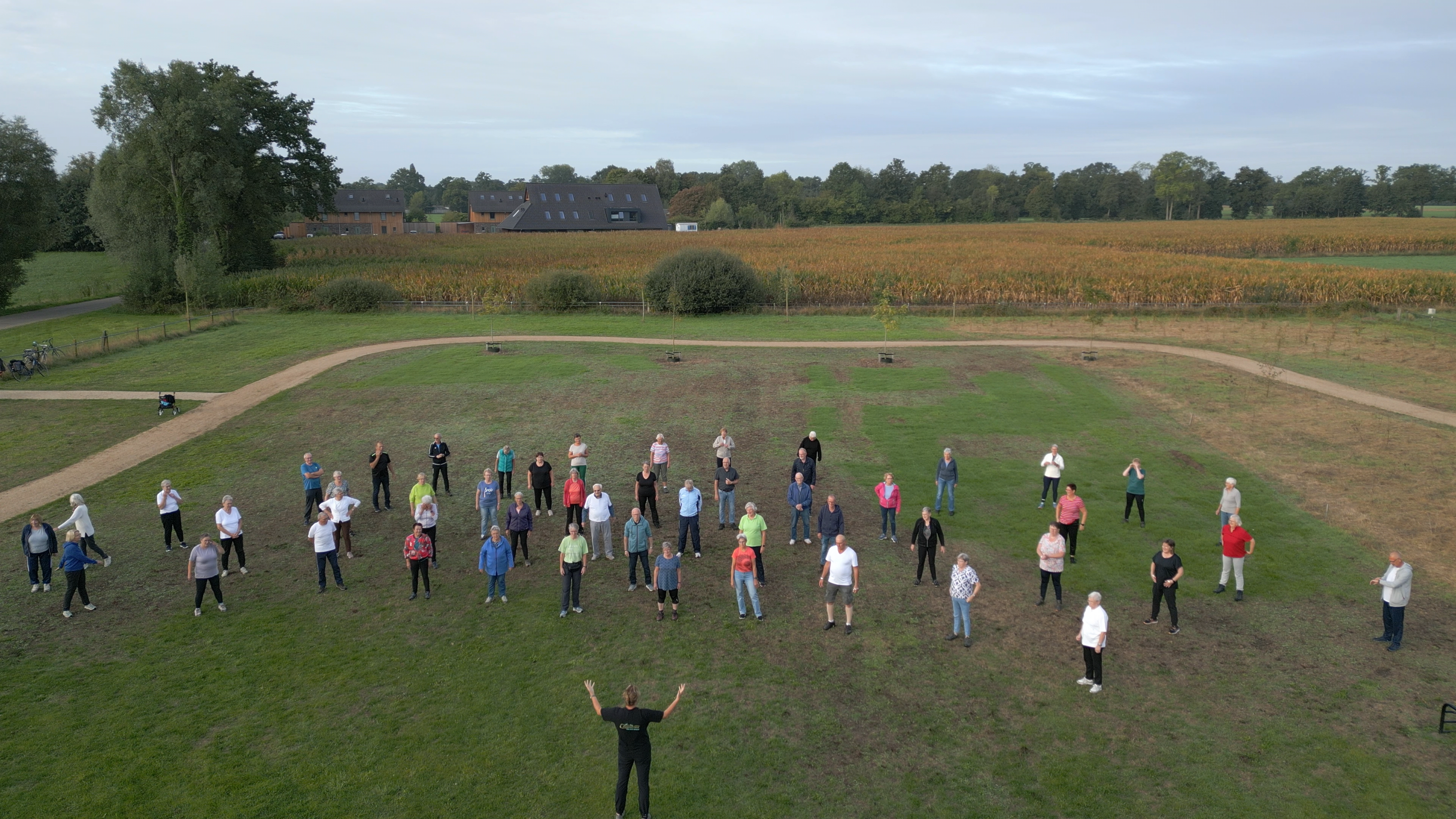
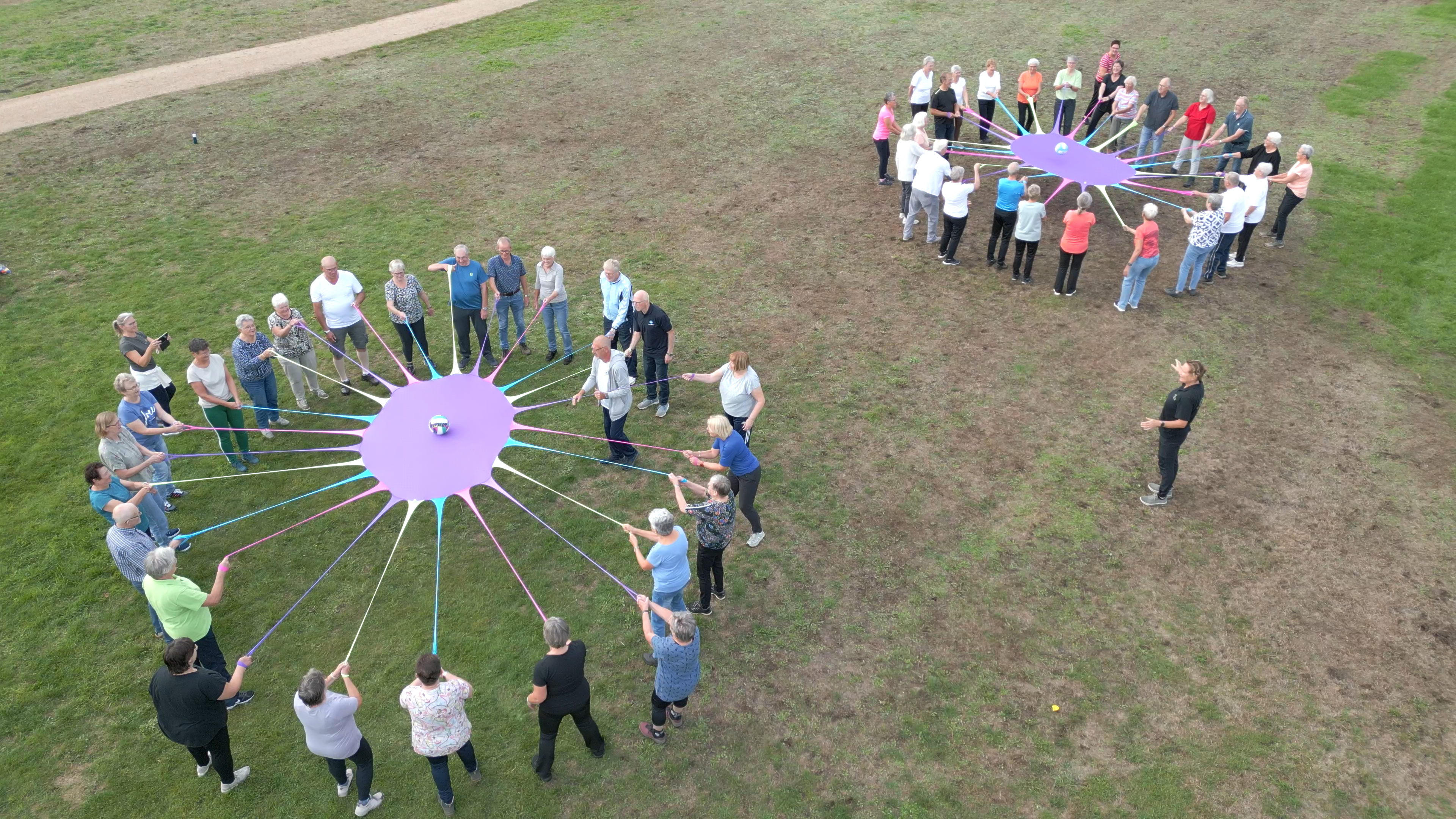
Here in the Netherlands, we have more than 100 “Vitality Clubs”. A Vitality Club is a group of people aged 55 and over who exercise together outdoors in a public space in a city or village. These Vitality Clubs operate on the basis of peer coaching – someone from the group who takes the lead during the exercise session. Since there is no need for a paid professional or an expensive venue, costs remain low. The accessibility, social atmosphere, and lack of obligation are important attributes of the Vitality Club.
Yesterday the clubs set themselves a challenge: to break their existing record to exercise with as many people aged 50+ as possible.
There’s a club that meets in our village, and I was asked to make a video using my drone. Here’s some photos from the day…
We have a walnut tree in the back garden and it’s that time of the year when the walnuts in their green casings are ripe for the picking.
I was out walking the dog this week along a nearby road that is lined by oak trees. The acorns are beginning to fall, so the road is covered with acorns that have been flattened by passing vehicles. I noticed that in among the acorns, there was also the occasional squashed walnut.
The road is at least 100 metres away from the walnut tree so the question arises: how did they get there? The answer is almost certainly that at least one of the local crow population has worked out that the way to get at the walnut encased in its shell and casing is to drop it on the road and wait for a passing car to break it open…
I see that Apple has just raised the middle finger to Microsoft by announcing the iPhone Duo. Serves Microsoft right, really – they cancelled their Surface Duo range of smartphones back in 2023 and never released a Surface Duo 3 that would likely have been all that the iPhone Duo is now.
Even my Surface Duo 2 had most of the core features and behaviours of the iPhone Duo – foldable form factor, multitasking and pen support.
It’s clear that Microsoft, under Satya Nadella’s leadership has long since turned its back on the consumer market as far as its hardware devices are concerned.
Well, I won’t be getting an iPhone Duo and in any case, I wouldn’t be able to carry over my nanoSIM to the Apple device – it only supports eSIMs and I don’t want to lose the mobile telephone number that I’ve had for over 20 years.
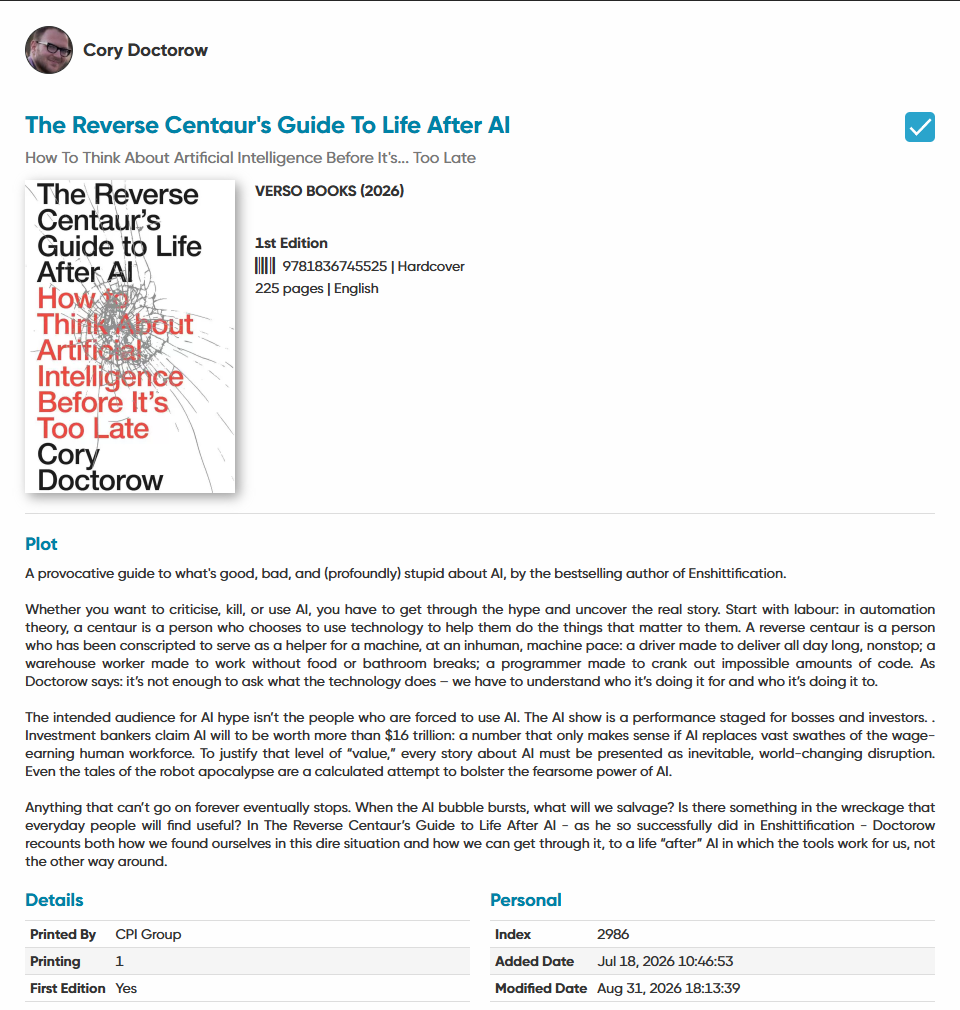
Here’s another book recommendation for you – and a question. Are you a centaur or a reverse centaur?
Confused? Then don’t be. Just read Cory Doctorow’s book: The Reverse Centaur’s Guide to Life After AI.
And as Brian Eno says in his blurb on the back: “Doctorow is the most lucid and generous guide I know of, and this book – ostensibly about AI, but more broadly about the new world of hyper-capitalism and high tech – is stunning in its clarity and breadth of vision”
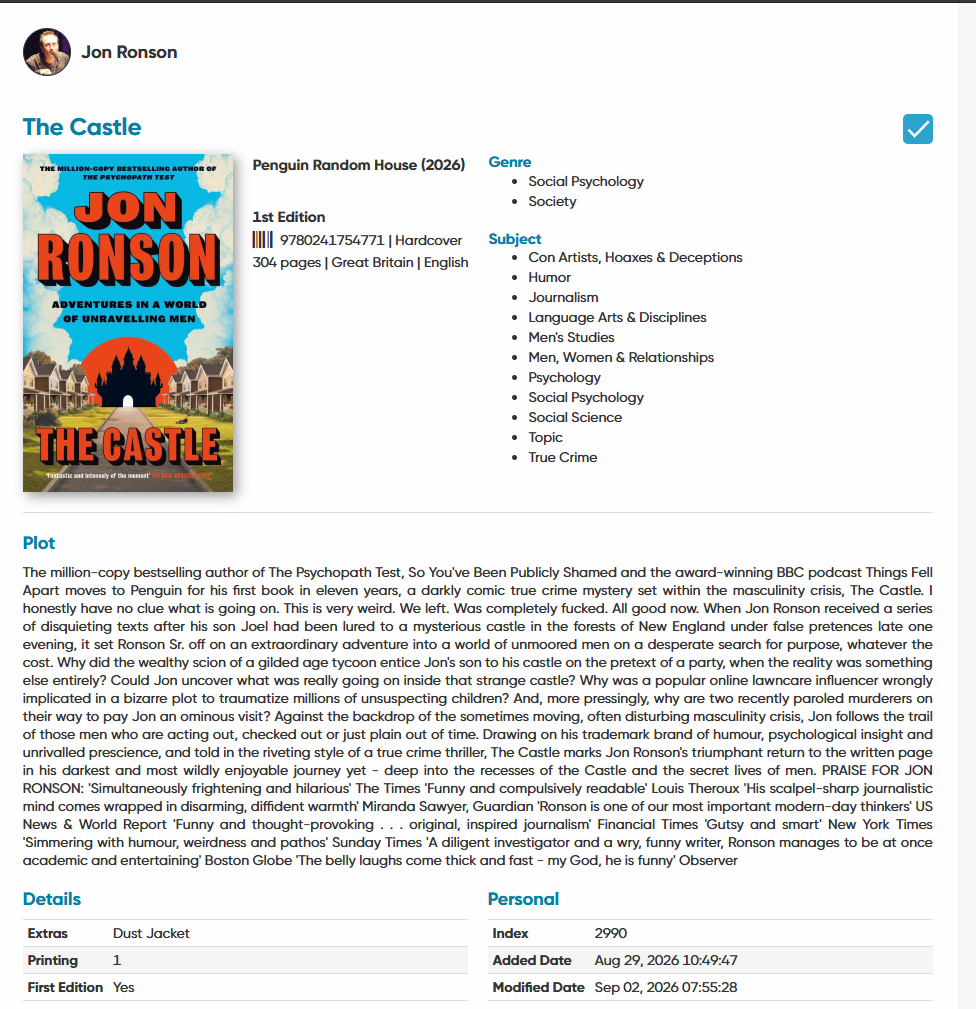
That’s the title of Jon Ronson’s most recent book. I’ve almost finished it, and am gobsmacked by it. I don’t know whether to feel pity for, or be aghast at, the flawed humans he has encountered. Highly recommended reading.
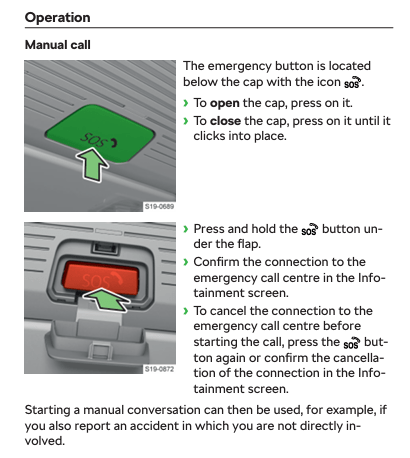
We bought our first fully-electric car five years ago – a Skoda Enyaq. We’ve been very pleased with it. Amongst its many bells and whistles is the ability to contact an Emergency Call Centre in the event of an accident. If an airbag inflates or a seat belt tensioner is activated, then a call will be made automatically and information such as the VIN (Vehicle Identification Number), the location and severity of the accident is also transmitted.
It is also possible to place a call manually by opening the cap that covers the SOS button in the unit situated overhead.
At the beginning of this year, the latch that holds the cap closed failed, and the cap was permanently in the open position. It didn’t worry us, because the SOS button itself is in a recess and unlikely to be pressed accidentally.
However, a couple of months later the car started reporting a problem with the unit and advised a visit to the garage. The car went in on the 9th April for inspection. The result was that a small 12v battery supplying power to the unit needed to be replaced but the battery was currently on backorder. The work could not be done until a replacement battery was available.
When I collected the car, I noticed that the cap was now closed, so I assumed that the garage had at least repaired the latch.
Yesterday, the car was back in the garage to have the battery replaced. After collecting the car, I thought I would try opening the cap, but it wouldn’t budge. I asked the service person at the garage to take a look and he came back a few minutes later to tell me that it had been glued shut. Consternation!
Why on earth someone in the garage had glued it shut in April, I really have no idea – it defeats the purpose of pushing the button if needed.
When I got home, I used a couple of small screwdrivers to prise open the cap and yes, it had indeed been glued shut.
The garage rang me this morning to apologise – they will replace the whole unit – and I’ve made an appointment for the work to be done.
I see that it’s been 10 years since a tiny majority of the citizens of the UK voted to leave the EU (51.89 per cent voted in favour of leaving the EU and 48.11 per cent voted to remain a member state). It was a referendum and the then Tory government had decided that a simple majority would be enough for the UK to pull the plug on EU membership. David Cameron, the then Prime Minister, resigned 24 hours later and walked away from the mess he had created.
10 years on and Brexit continues to be a disaster for the UK. Enter “Brexit” into the Search field on this blog and you get three pages of tales of woe that it has caused.
An interesting article in today’s Guardian from Ingrid Robeyns – a Belgian-Dutch economist and philosopher. In it she argues that extreme wealth (with Elon Musk as the most extreme example) is damaging to wider society. At one point she writes:
The ultimate danger is the so-called oligarchic endgame theory, whereby power is concentrated among the super-rich. Governments, captured by the richest, then do everything to protect the privileges of this group and its supporters. Democracy itself is at risk if the rigid social hierarchy implied by this concentration of power among the wealthiest comes to pass.
It seems to me that the “so-called oligarchic endgame theory” is no longer a theory, but a cold hard fact..
Russell T. Davies has a new drama called Tip Toe that is currently showing on Channel 4 in the UK. It charts the rise and consequences of a feud between two next-door neighbours: Leo, the gay owner of a gay bar on Manchester’s Canal Street and Clive, an electrician who has a wife and family.
The feud is powered by what’s happening at large in today’s social media-driven society. Here’s an early scene where Melba spells out to Leo just what is going on.
I can sympathise with Leo when he says, in effect, now that he’s 60, he wants to take it easy – he went on the marches in his younger days – let the bright young things take over. I’m older, but I did the same when I was young. But Melba’s message is that things are going backwards for us LGBTQ folks – perhaps we will need to man (and woman) the barricades once more.
This drama is geofenced by Channel 4 to the UK, so I can’t watch it. I hope that it will be picked up by a Dutch TV channel or, better still, come out on DVD/Bluray. It deserves to be seen.
Addendum: 25 July 2026
Dammit – I see that YouTube has now pulled the video. A pity, because Melba’s speech is very powerful and very true.
One good thing is that the series has been picked up by HBO Max here in the Netherlands, so Martin and I have now been able to watch the five episodes.
We’ve just finished watching the final episode and Jesus, Jesus, Jesus – we’re both still shaking. That was awful, brilliant, riveting, tragic and horribly plausible.
Kudos to all concerned in the making of this – to Russell T. Davies for the script and the actors, production team and director for bringing it to life. Gobsmackingly good – and a warning to be heeded.
And on tonight’s Dutch TV News was a report over research that they did about the experience of LGBTQI youth between 13 and 19 years. Of the 8,000 responses, around half said that their parents did not know that they were gay for fear of negative reactions… We’ve still got a long way to go… Veel jonge lhbti+’ers voelen zich onveilig thuis en op school
Marjane Satrapi has died. We have lost an eloquent voice against the oppression in Iran. In this Guardian article about her, take a moment to click on her image of the Revolutionary Guards. Notice how their eyes are underlined blood-red. That is what is so chilling and so telling about her showing of the world in which she lived.
Walking in the woods with the dog this morning, I heard a bird calling. The Merlin Bird ID app on my Xiaomi 17 Ultra said it was a Great Spotted Woodpecker.
I looked up, and there it was…
This is a crop from the 200 MP image taken with the Xiaomi’s Leica camera.
Addendum: Just learned from the BBC’s Springwatch programme that this is a juvenile, because it has a all-red crown. The adult male has a black crown with red at the back.
Here in the Netherlands, DigiD is the online identity management system used by millions of us in our interactions with the government, local councils, hospitals and many other organisations such as pension funds and insurers. It acts as a digital passport by which we can prove our identity to service providers.
DigiD is managed by the Dutch government organisation Logius, part of the Ministry of the Interior and Kingdom Relations. The company Solvinity provides the infrastructure platform that DigiD runs on, which is hosted in a government data centre.
It became known that Solvinity might be acquired by the American company Kyndryl, which led to questions being asked about digital sovereignty.
We have already seen the Trump Administration force American software service suppliers to cut off their services from members of the International Criminal Court in The Hague, and this week it emerged that sanctions have been imposed on European officials who enforce the European Digital Services Act.
So there is a very real danger that were DigiD to fall into American hands, we could be held hostage at the whim of Washington. The current Administration is no friend to Europe.










Leave a Reply