
Yesterday, Microsoft revealed that it would be entering the Tablet market with two models of its own. I’ll come back to them later, but first, I must say that I’m struck by the continuing negative press that Windows 8 continues to receive. While it’s by no means perfect, I find the hyperbolical vitriol poured on it by some of the technical press quite astounding, and almost entirely without basis.
Yes, the Metro user interface (UI) is very different from the UI of the traditional Windows Desktop, but I note that the iPad UI is very different from the traditional Mac desktop OS X UI, and yet none of the negative reviewers seem to even give this a second thought. Somehow, they seem to have adapted to being able to use both devices, and praise Apple to the skies.
Apple, when it created iOS, took the view that a touch-oriented direct-manipulation user interface demands entirely different solutions and paradigms than mouse/pointer-driven user interfaces do. Microsoft, on the other hand, recognises the same challenge, yet is attempting to support both within the one operating system: Windows 8. That seems to me to be a far riskier strategy that the play-it-safe one that Apple has followed.
I don’t have either a touchscreen or a touchpad on my PC, yet I’ve not found any problem about continuing to be productive using Windows 8, unlike some technical reviewers. I rather suspect that either they don’t like change, or they don’t like Microsoft.
And now Microsoft has further upped the ante, by announcing two Tablets bearing the Microsoft name, and called Surface. The entry-level Tablet runs Windows RT (the version of Windows 8 designed to run on ARM hardware), while the top-of-the-range model runs Windows 8 Pro and uses Intel’s Ivy Bridge architecture.
The entry-level Tablet is clearly aimed at the iPad market niche, but I’ve never found that market niche particularly interesting. I want something that is more than just a device for consuming content. I want one that has the power of a desktop available. So the more interesting one (to me) is the one running Windows 8 Pro. This comes with a pen, and (excellent) handwriting recognition is part of Windows 8. Coupled with the detachable keyboard, this model of the Surface range looks as though it meets my desire for origami computing.
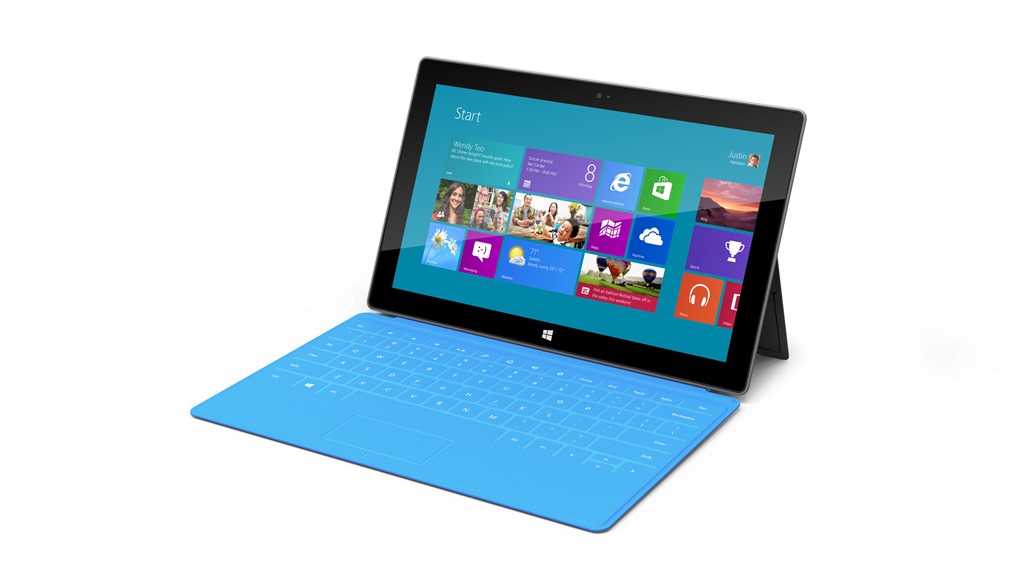
As well as the Surface tablets, Microsoft also announced two new keyboards (which double as covers for the Surface). The “Touch” model (3mm thick) is shown in the picture above. The “Type” model (5 mm thick) comes with moving keys for a traditional feel.
The specifications of the Surface tablets are still not spelt out in great detail, but the top model seems to have two cameras (one forward-facing and one rear-facing), and a screen resolution of 1920 x 1080 pixels. The Intel-based Surface has a mini DisplayPort for Video. I wonder whether this could also be a Thunderbolt port for connecting other devices, although I suspect that that will come in a future Surface model in 2013. No word on price, either, so I’ll have to wait to see whether this is a good match with my wishlist. But I have to say, it does look good.
Update: I watched the video of the Microsoft presentation yesterday and picked up on a couple of things.
First, the Windows RT machine being demonstrated by Steven Sinofsky froze up on him during the demo. He had to switch it for another machine. To be fair, demos of unreleased hardware and software are always a highwire act, so it’s hardly surprising he had to rely on the safety net of a second machine.
Second, the words that are spoken during these Microsoft presentations are very carefully chosen. When Sinofsky talked about retail channels, he only talked about Microsoft’s own stores, both physical and online. These are both US-only, which leads me to worry that Surface may only ever be available in the US. It won’t be the first time Microsoft has done this; the Zune and Microsoft Kin products were also US-only. If that does turn out to be the case, then that will be a real disappointment to me.
One other thought, I know that I said that it would be the Windows 8 Pro version of Surface that I would be interested in, because I thought the Windows RT Surface would be too limiting, like the iPad. Someone pointed out that you can still get the full PC experience on a Windows RT device by using the Remote Desktop App, and accessing the full environment of a desktop PC through the Surface tablet. Now that is a very interesting idea, and one that I had not considered. I often use the Remote Desktop App to remotely login to my Windows Home Server from my desktop PC, and the experience is indeed just as though I have my monitor, keyboard and mouse directly connected to the server. However, it would mean that I would have to upgrade my Desktop PC to Windows 8 Pro, so it is not a cost-free route.
So I may have options. Options are good.


 Geoff Coupe's Blog
Leave a reply to “Windows 8 is Windows 7+1” | Geoff Coupe's Blog Cancel reply