Reflections on life at “De Witte Wand”…

Category: Books

  • Now It’s Amazon’s Turn

    I often castigate Microsoft here on the blog for their seemingly boneheaded decisions. Now it’s Amazon’s turn in the spotlight of shame.

    I’ve been using their Kindle app for Windows 8 ever since it was launched back in 2012; never saw the need to buy an Amazon Kindle e-reader device.

    Now Amazon has announced that they will be withdrawing the Kindle app from the Windows store later this month, and advise people to install the Kindle desktop application instead. Hooray – let’s all go back to 2005. Why on earth Amazon isn’t putting its development effort into a UWP version of the Kindle app instead, I have no idea. If they did, the app would be usable across all Microsoft Windows devices (PCs, Phones, Xbox, HoloLens, etc.).

    It also rather begs the question as to what will happen to the existing Kindle app on Windows Phones. I’ll be prepared to bet that Amazon will shortly announce that it will be withdrawing that as well. Since you can’t use the Kindle desktop application on a Windows Phone, the only possibility will be to use the browser-based version of the Kindle reader on the phone. That promises to be such a poor experience that I expect to be giving up using my phone for Kindle books.

    Amazon – what on earth are you playing at?

  • Where Do You Get Your Ideas From?

    Ursula K. Le Guin is one of my favourite writers. The question: “where do you get your ideas from?” is the starting point for a wonderful essay and meditation on this question.

    Please follow the link and read it – I don’t think you’ll be disappointed. Even if you don’t want to spend the time reading it, follow the link anyway, and you’ll be rewarded with the most stunning photograph of the 86 year-old author: simultaneously wise and mischievous – the sort of human being it would surely be a privilege to know and to count on as a friend.

    (hat tip, once again, to Nicholas Whyte for drawing this essay to my attention)

  • Ireland Votes

    This coming Friday, Ireland will be voting in a referendum to legalise same-sex marriage. I’d like to think that sanity will prevail, and that the vote will be “Yes”, but I shouldn’t underestimate the continuing power of the Catholic Church, aided by US Christian groups, evangelical Christians and religious societies such as the Iona Institute to poison the well.

    Take, for example, Breda O’Brien’s opinion piece in the Irish Times: Think about intolerance of thought police before you vote. I confess, my irony meter all but exploded on reading that headline. O’Brien is a patron of the Iona Institute, thus she can quite blithely state:

    Think about the dogmatism and intolerance of the new thought police, the contempt for the conscientious objections of others, as you decide which way to vote.

    I would hope rather that the Irish voters will dwell more upon the dogmatism and the intolerance of the old thought police as they decide which way to vote. O’Brien’s piece fulminates:

    Nothing wrong with that, until you realise from the INTO LGBT group that they intend to normalise same-sex marriage in the teaching of children as young as four, using poster displays in classrooms and picture books.

    They suggest using King and King, described by Amazon as presenting “same-sex marriage as a viable, acceptable way of life within an immediately recognizable narrative form, the fairy tale”. The prince is only happy when he meets and marries another prince.

    Ah, yes, King and King – otherwise known as Koning & Koning in the original Dutch, published back in 2000. A charming little book for children – I have a copy in my library – whose message is nothing more than not everyone is the same, and love comes in different forms. Also in my library is a copy of Jenny lives with Eric and Martin, published way back in 1983, and which caused a similar furore in the UK at the time. The message here is that not all families are the same.

    These seem to be messages that worry and concern Ms. O’Brien. I fail to see why. Her implicit cry is “won’t somebody please think of the children!”. We do, Ms. O’Brien. we do. Your way of thinking is to continue to lock children up, and make some of them continue to feel wrong. Your way of thinking leads to a lifetime of suffering. Ask Ursula Halligan.

  • Visits to Dystopian Realms

    My bedside table has a small pile of the books that I’m currently reading. I tend to switch between fiction and non-fiction books, but I noticed yesterday that I seem to have been on a run of fictional dystopias.
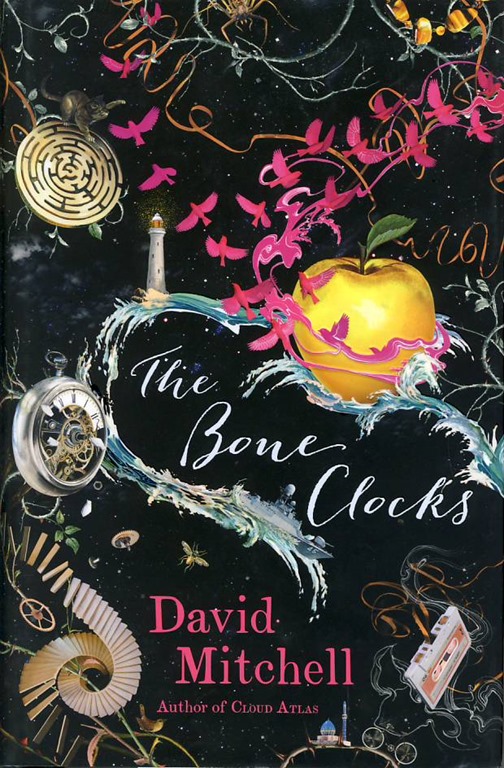
    9780340921609It kicked off a few months back with David Mitchell’s The Bone Clocks, which I enjoyed, but which I thought was less impressive than his Cloud Atlas, or The Thousand Autumns of Jacob de Zoet. The Bone Clocks uses the device of having different characters tell their story in the first person, and the main character’s voice and wisdom develops from that of a teenager to being an old woman over the course of the novel. I liked hearing the different voices (Crispin Hershey, the English novelist, is not a million miles from a caricature of Martin Amis), and Holly Sykes as the central protagonist is beautifully portrayed. There are explicit references to characters from other Mitchell books (I recall that he said, in an interview, something along the lines of that he’s writing one meta-book). If there’s a weakness (for me) in The Bone Clocks, it was the “An Horologist’s Labyrinth” section, which rather came across to me as in the style of Denis Wheatley’s “The Devil Rides Out” – a rattling yarn, but with rather over-wrought language.

    The final section, “Sheep’s Head” stepped back from the pyrotechnics of “An Horologist’s Labyrinth” and redeemed the book for me. This is where the dystopian society is portrayed – the Endarkenment – as it is named in the book. We return to Holly as a woman in her seventies, living in 2043 in a world where the chickens of energy-guzzling, resource-stripping and climate change have come home to roost. Darkness descends, but there is a glimmer of light as well.

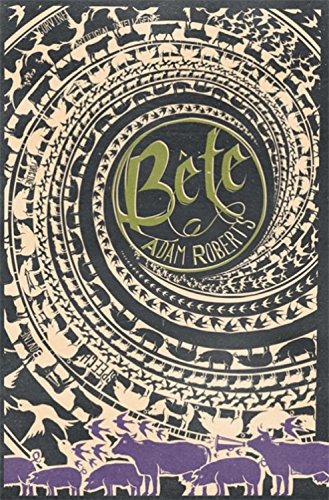
    beteNext up was Adam Roberts’ Bête. This was dystopia all the way down, but at times very funny with it. It opens with something that is almost straight from Monty Python – a farmer is about to kill his cow, but the animal insists on discussing his right to do so with him. The tale is set in a time not too distant from our own, where artificial intelligence computer chips have been embedded in some livestock by animal activists. The story is once again told in the first person, by Graham Penhaligon, the farmer. He’s irascible, unsympathetic, a Victor Meldrew sort, yet I couldn’t help but warm to him. Roberts has some amazing, and outrageous ideas (wait until you meet the lamb!), but the novel remains very believable. And the ending is a whole new beginning…
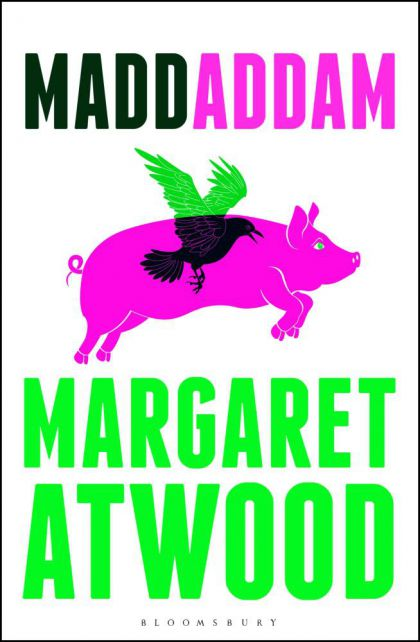
    9781408819708I followed that up with Margaret Atwood’s MaddAddam. This is the third in her trilogy of dystopian novels that began with Oryx and Crake, and continued with Year of the Flood. I read Oryx and Crake a few years back and enjoyed it, but I haven’t read Year of the Flood. However, I came across MaddAddam at the Deventer Book Fair last August, so I picked it up for a song and added it to the pile of books to read.

    I have to say that I don’t think it’s one of Atwood’s best works. Where Oryx and Crake resonated, MaddAddam fell flat for me. Yes, there’s a sense (right at the end) of how books and writing will be an important driver to the future post-human society of the Crakers, but most of the book is taken up with providing the backstory of a few characters that I assume were introduced in Year of the Flood, and waving the bogeymen of the Painballers in the reader’s face.
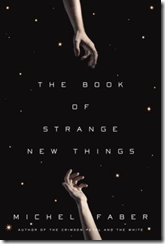
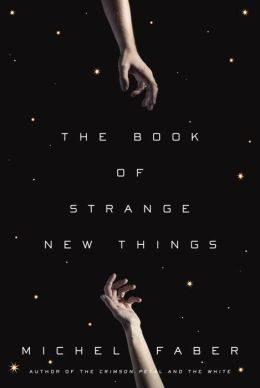
    9780553418842Now I’m on to Michel Faber’s The Book of Strange New Things. You might think that this is a strange choice, given that I’m an atheist, and the book’s protagonist is an evangelical Christian minister recruited to do missionary work. It’s true that I view all religions with the utmost suspicion, and I simply couldn’t finish Marilynne Robinson’s Gilead (an elderly Congregational minister writes to his 7-year old son). However, Faber also wrote Under The Skin, which engrossed me with its strange atmosphere and other-worldliness.

    I’m still reading The Book of Strange New Things (I’m at the point where Peter has just met with a member of his new flock), and the book of the title is, of course, the Bible. Already there is no doubt in my mind that this is a book that I will finish and find just as thought-provoking as Under The Skin. I don’t know yet whether the society of Peter’s new flock is a dystopia or a utopia, but it’s already clear that the society that Peter has left is painted in dystopian hues.

    Next up, a change of pace and subject matter; Kenan Malik’s The Quest for a Moral Compass; an exploration of the history of moral thought as it has developed over three millenia, across the world’s cultures…

  • The World’s Most Important Operating System

    I was saddened to learn today that Bill Hill died of a heart attack back in October 2012. Bill was a Scotsman who started out life as a newspaperman and became a typographer, but ended up working for Microsoft.

    In this short video clip Bill explains why the world’s most important operating system is not Windows or OSX or Linux or Android. It’s Homo sapiens 1.0. It’s an operating system that first booted up about 100,000 years ago, and has never yet had an upgrade.

    There’s more videos of Bill available here. A memorial, of sorts. RIP, Bill.

  • Ursula Le Guin

    The woman who has fired my imagination for more than forty-five years has received the US National Book Foundation’s Medal for Distinguished Contribution to American Letters. In her acceptance speech she reaffirmed her power. A wonderful author and great human.

  • Praise Indeed

    David Mitchell’s new book The Bone Clocks is published today. I was knocked out by his Cloud Atlas and by The Thousand Autumns of Jacob de Zoet, so I’m looking forward to reading the new book with great anticipation. I went down to the local village bookshop last week and ordered my copy.

    Today’s Guardian has a review of the book by another writer whom I admire without reservation and trust absolutely – Ursula le Guin. She likes it, so I’m sure I will too.

  • A Cataclysm Down Memory Lane…

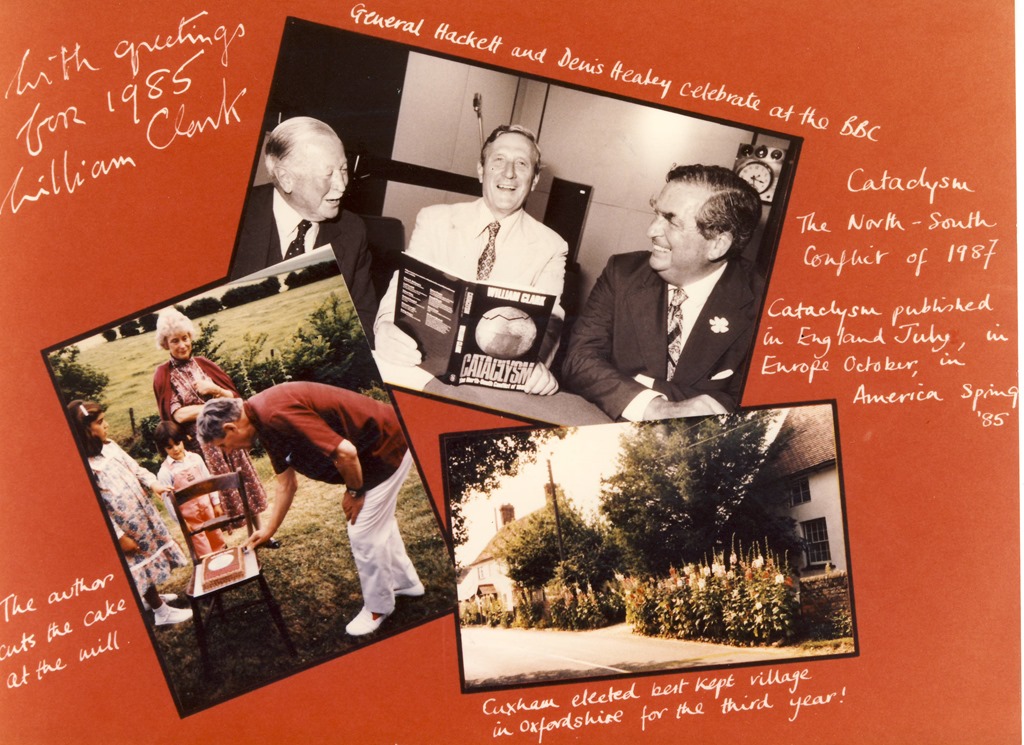
    Back in the early 1980s, I got to know William Clark, who was almost a father figure to my partner at the time. We would be frequent weekend visitors at William’s country retreat, a converted mill in the Oxfordshire village of Cuxham.

    The Mill

    Summer or winter, the house had charm and was filled with William’s memorabilia from his years in public service, the Observer newspaper, the BBC and the World Bank.

    The Mill

    Sunday lunches often had guests from the worlds in which William lived, and I found it a fascinating experience to be able to eavesdrop on their conversations.

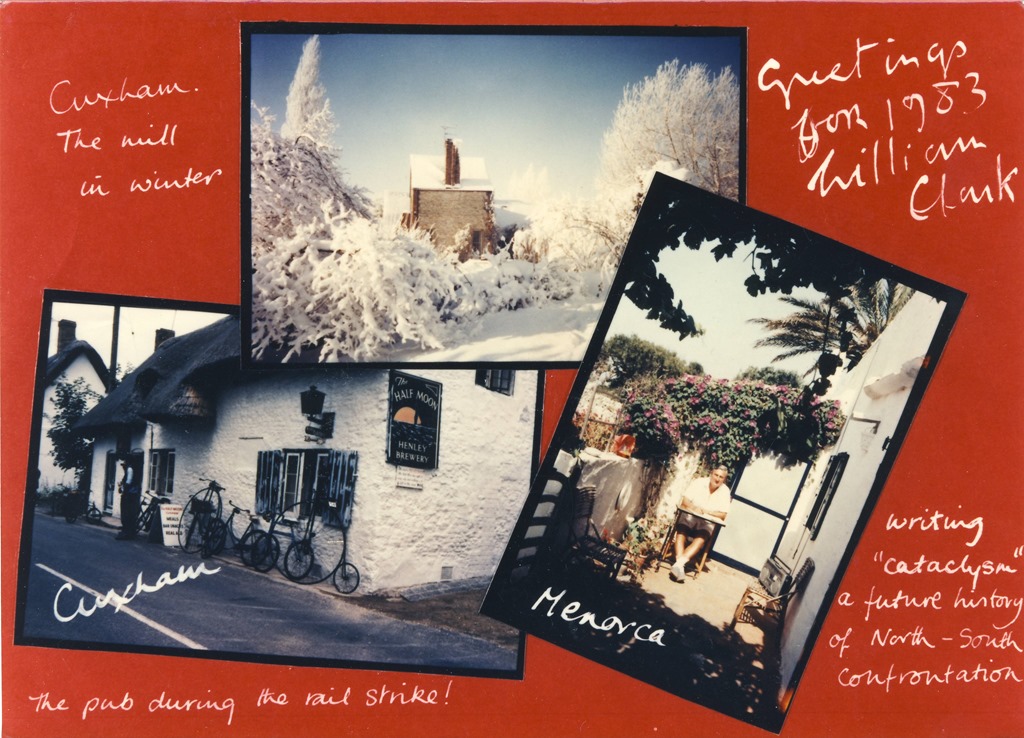
    In 1982-3, William was engaged in writing a novel – Cataclysm – a fictional scenario in which an international debt crisis in 1987 escalates into an all-out conflict between the developed and underdeveloped worlds. A minor plot point was the use of what today would be called cybercrime, but the word, and the internet as we know it, simply didn’t exist at the time. William, knowing that I worked in IT, asked me to read the drafts and comment on the technical aspects. I did that to the best of my ability, but I suspect that my crystal ball was even cloudier than his.

    His Christmas card of 1982 referenced both his writing of the novel and the photo I had taken of the mill in winter.

    Scan10014

    Cataclysm was published in 1984, as that year’s Christmas card illustrates:

    1984-12-01

    I had a rather acrimonious breakup with my partner at around this time, so I’m afraid I lost touch with William, and he died, of liver cancer, in June 1985.

    I’ve often wondered how I would view the technical aspects of Cataclysm with the benefit of hindsight, so a couple of weeks ago, I went on to the Abebooks web site to track it down. I found a copy, which also apparently contained a letter signed by William, held by an Oxfordshire bookshop. I snapped it up, and it arrived yesterday.

    Cataclysm

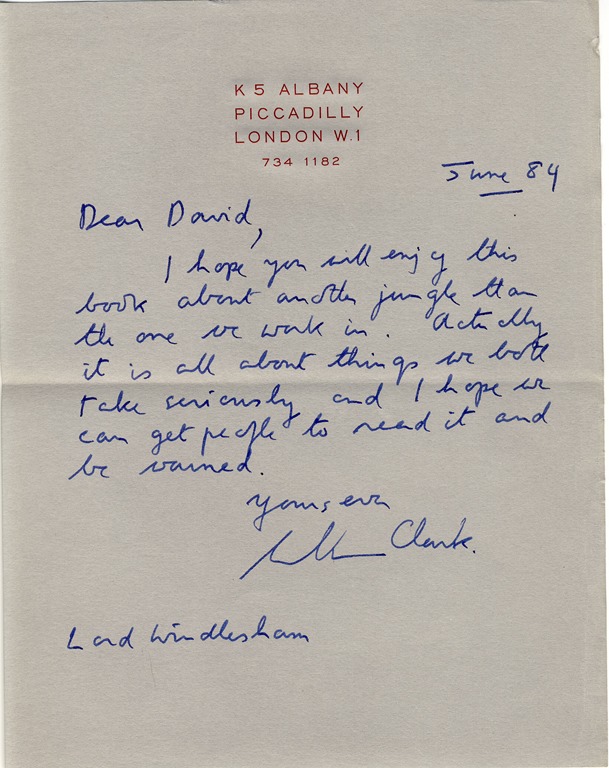
    I look forward (with a modicum of trepidation) to re-reading it. And, as promised, there was also a signed letter from William.

    William Clark

    It is written on William’s notepaper, with the heading of William’s London flat in Albany, and addressed, I believe, to David Hennessey, 3rd Baron Windlesham.

    A little piece of history.

    I recall William with much fondness. The house and garden at Cuxham would often echo to his cry of “For God’s Sake…” – with a prolonged emphasis on the second word. For all the exasperation that he was able to inject into the phrase, we all knew that there was a wink as well.

    The book, and the letter, will now reside in my library until they move on to the next owner.

  • RIP, Clarissa

    Clarissa Dickson Wright has died. The phrases: “larger than life” and “a true British eccentric” fitted her like gloves. It was almost 20 years ago that she, together with Jennifer Paterson (also, alas, dead) roared onto British TV with an unlikely cookery programme called Two Fat Ladies. It was an instant hit, and I have all their cookery books lined up on the shelf in the kitchen for occasional reference.

    Dickson Wright had an appalling childhood caused by an alcoholic and violent father. Her full name, as befitting the larger than life moniker, was Clarissa Theresa Philomena Aileen Mary Josephine Agnes Elsie Trilby Louise Esmerelda Dickson Wright.

    Whilst I did not agree with her on certain issues, she was undoubtedly a formidable woman, and life will be duller without her.

  • The Streisand Effect in Action

    In 2009, Wendy Doniger’s book The Hindus: An Alternative History was published by Penguin. It seems to have attracted the wrath of Hindu (male) chauvinists; to the extent that a lawsuit from the Hindu group Shiksha Bachao Andolan accusing Doniger (a University of Chicago professor) of “hurt[ing] the religious feelings of millions of Hindus”  was instigated in India. As a result, Penguin have withdrawn the book from sale in India and intend to pulp the copies.

    Quite rightly, this decision has resulted in a storm of protest, and propelled the book up the bestseller list. I’ve ordered my own copies (paperback and Kindle) out of interest, in support of Doniger, and against the tiresome president of Shiksha Bachao Andolan, Dinanath Batra. As Ophelia says, Batra is an experienced religious bully.

  • The Bankers Do It Again

    There’s a small village, Bredevoort, that lies about 7 kilometres distant from us. It’s a pretty little village of about 1,500 inhabitants, and it also has a disproportionate number of antiquarian bookshops in it. That’s because, since 1993, it has become known as a Boekenstad (book-town). Apart from the 20 or so bookshops, there are also regular antiquarian bookmarkets, with market stalls placed in and around the central market square.

    I often go along to the bookmarkets, and when I do, one of the things I invariably see is a queue of people waiting to get cash from Bredevoort’s one and only cash machine.

    Today, I read in the Volkskrant that the Rabobank, the bank responsible for the cash machine, intends to remove it from the village. According to Nicole Olde Meule, the person responsible for the bank’s consumer clients in this area, the number of transactions has fallen by 9% over the past year to 25,000 per year. And that, she thinks, is justification enough to remove the service.

    She clearly needs her head examined. At a time when the Rabobank has had its image severely dented by being fined €774m for its part in the Libor scandal, she thinks its OK to heap further hardship on the village, tourists and booklovers.

    She knows the cost of everything and the value of nothing.

  • Under The Skin – Again

    As I wrote back in 2009, Michel Faber’s first novel Under The Skin will probably get under your skin, and provoke a severe reaction. I see that the novel has now been made into a film. While it sounds as though liberties have been taken with the plot, I hope that Isserly’s odyssey remains as strange and as haunting as in the original story.

  • The Last Interview

    I’m returning, once again, to the subject of Iain (M.) Banks and his all-too-soon departure from the world. The reason is this interview – perhaps the last he gave before his death.

    Let it be noted that I stand in awe of this man. His humanity, his wit, his clear-sightedness and his self-deprecation are something that I would wish to emulate, but know that I would fall far short of.

    It’s a good interview of a good man. Go and read it. Some key passages:

    His political zeal burns equally ardently. He confesses that “for half a second”, as he and Adele travelled across the Alps from Venice to Paris on honeymoon, he was “elated” when he heard that Thatcher had died. “Then I realised I was celebrating the death of a human being, no matter how vile she was. And there was nothing symbolic about her death, because her baleful influence on British politics remains undiminished. Squeeze practically any Tory, any Blairite and any Lib Dem of the Orange Book persuasion, and it’s the same poisonous Thatcherite pus that comes oozing out of all of them.”

    We reminisce about other significant turning points. Blair entering Downing Street: “Watching the helicopter shots of his car journeying from Islington to Buck House was like witnessing the liberation of a city … yet almost immediately he was having tea with Thatcher. My injured self-respect can at least fall back on the fact that I never voted for New Labour – Labour yes, and nothing but Labour for as long as it existed and I could vote, but not for a party that embraced privatisation and refused to scrap nuclear weapons; not for a party slightly to the right of Ted Heath’s government.” As for the war on terror, there is palpable fury when he discusses “the great lie that our boys are fighting, killing and dying in Afghanistan to keep us safe. It’s 180 degrees off the truth. They’re dying worse than needlessly; they’re dying to save political face, and for every grieving or just aggrieved Afghan family we create the conditions for further atrocities to be visited on us.”

    I won’t miss waiting for the next financial disaster because we haven’t dealt with the underlying causes of the last one. Nor will I be disappointed not to experience the results of the proto-fascism that’s rearing its grisly head right now. It’s the utter idiocy, the sheer wrong-headedness of the response that beggars belief. I mean, your society’s broken, so who should we blame? Should we blame the rich, powerful people who caused it? No let’s blame the people with no power and no money and these immigrants who don’t even have the vote, yeah it must be their fucking fault.

  • Thank You, Iain Menzies Banks

    There’s been a slight disturbance in the Force (otherwise known as the internet) the past couple of days.

    A Scottish author, beloved by many – and me – has recently died. Far too soon, and with too many stories yet untold.

    I’ve been reading the many tributes left to him by fans and fellow-writers alike.

    I find it strange and intriguing how much his death has affected me. I never knew the man, never met him, and yet somehow his death has caused tears to spring unbidden to my eyes. God forbid that I’m having a Princess Di moment. I would like to think that my sorrow is caused simply by the fact that he was, by all accounts, a good man, and his voice has been stilled far too early.

    He wrote in both major and minor keys. For the snobs, the major keys were his “mainstream” literary works; such as The Wasp Factory and Complicity.

    But, great though they were, for the rest of us, his so-called “minor”works – his SF novels – were the real thing. He wove an entire civilisation – The Culture – spanning multiple worlds and thousands of years. And he made it real. As Ken MacLeod wrote:

    He likened writing literary fiction to playing a piano, and writing SF to playing a vast church organ. Squandering the “unlimited effects budget” of his imagination on the vast scale of SF was always, by a small edge, the greater joy.

    It’s difficult to choose one passage from all his work that stands for him and what he said to me. But I think it has to be this, from Against A Dark Background:

    Sorrow be damned and all your plans. Fuck the faithful, fuck the committed, the dedicated, the true believers; fuck all the sure and certain people prepared to maim and kill whoever got in their way; fuck every cause that ended in murder and a child screaming.

    Amen.

  • Rewriting 2001

    The Dreams of Space blog has an entry that shows a children’s comic produced in 1968 that ties-in to the release that year of 2001: A Space Odyssey. It depicts two children, Debbie and Robin, being taken to see the premiere of the film by their parents.

    It’s an interesting piece of ephemera, but it does lie about the story. It states that the “repairman” (actually Dr. Frank Poole), sent out to repair the communications unit on the spaceship Discovery, slips and floats away into space. Er, no he didn’t – he was murdered.

    There’s also the obligatory cringeworthy ending in the final panel when Debbie announces that she wants to be a space stewardess when she grows up, while Robin says he wants to be a space pilot. Gah!

  • Parenthood Is No Place For Perfectionists

    While still shaking my head over the idiocy of David Jones, who claims that two same-sex partners cannot provide a warm and safe environment for their children, I came across a new book written by Andrew Solomon: Far From the Tree: A Dozen Kinds of Love. In it he:

    tells the stories of parents who learn to deal with their exceptional children and find profound meaning in doing so.

    He introduces us to families coping with deafness, dwarfism, Down syndrome, autism, schizophrenia, disability, with children who are prodigies, who are conceived in rape, who become criminals, who are transgender. While each of these characteristics is potentially isolating, Solomon documents repeated triumphs of human love and compassion to show that the shared experience of difference is what unites us.

    Solomon is himself the gay child of straight parents, and is now, in turn, a parent himself. Here he talks movingly and lucidly about the nature of vertical identities (those that we inherit from our parents) and horizontal identities (those that we do not share with our parents, and which we develop through our peer groups). This short video is worth watching.

    The Guardian’s Carole Cadwalladr also has an interesting interview with him.

    His book is now on my list to get. Perhaps David Jones should also read it. He might learn a thing or two.

  • A Sad Day For Hedgehogs Everywhere

    Ronald Dworkin has died. By coincidence, I listened last week to the podcast of Thinking Allowed, originally broadcast on 26 January 2011. In it, Dworkin discussed his book Justice for Hedgehogs with the philosopher A. C. Grayling and the sociologist Laurie Taylor. I thought at the time that I should get hold of the book, and now I definitely will.