Eerie, disturbing, tragic, brilliant…
And watch the video on “The Making of…“. It took seven years to make this nine-minute film.

Reflections on life at “De Witte Wand”…
Eerie, disturbing, tragic, brilliant…
And watch the video on “The Making of…“. It took seven years to make this nine-minute film.
Way back in 1975 I had read Frank Herbert’s Dune and been mightily impressed by the story. The paperback had a sticker on the front “Soon to be a major film” – but that proved to be rather optimistic, it was 1984 before the first film adaptation of Dune reached the screen. There was an earlier attempt to film the book – the Chilean-French director Alejandro Jodorowsky had purchased the film rights in 1974 – but in the end it all came to naught, no film studio was prepared to fund Jodorowsky’s vision, which reportedly would have resulted in a film lasting 14 hours.
Then in 1984, the David Lynch version reached the cinemas. It was not a commercial success, and was mostly disliked by the critics, but I liked it – it certainly had visual style. Lynch himself was not happy with the result – the studio cut his three-hour film back to two hours.
Following that, there were two TV series adaptations of Dune that were relatively successful, but I still did not think that justice had been done to the source material.
Then, in 2021, Denis Villeneuve brought his version of Dune to the silver screen. For the first time, I thought that this was the version of Dune that I had been waiting for. It turned out that this was Dune Part One – Villeneuve intended that a book as complex as Dune required two parts to tell the story.
I never got to see Dune Part One in the cinema, I’ve only viewed it at home on our TV (with surround sound). Still, it is very impressive. A spectacle, but also very well played by excellent actors.
Dune Part Two was released in March this year. This time I was determined to see it in a cinema on an IMAX screen, as Villeneuve intended it should be experienced.
I went to a morning screening (there were just 20 of us in the IMAX theatre) at the Pathé cinema in Arnhem. This was my first ever experience of IMAX, and it did not disappoint. Dune Part Two is superbly well-realised – in my opinion, a successful adaptation of the book in every way. There are sequences in it that are simply breathtaking in their spectacle, while the characters are never drowned out, their stories play out in front of us with real emotional weight.
The film does say “based on the book” and while it does follow the plot in the main and often quotes the text, there are some significant deviations (no Count Fenring at all and no Alia in the final scenes, for example). I wondered about the dropping of Count Fenring – although a minor character in much of the book, he turns out to be significant at the climax. The closure of the film is also very different from the book, but points the way forward for part 3 (based on the “Dune Messiah” book) – which will probably arrive in 5 years’ time – I think Villeneuve wants to take a break and do something else next. I hope that I will live to see it…
I want to see this, even though I know it will be stressful. As Jonathan Glazer says: ” I think something in me is aware – and fearful – that these things are on the rise again with the growth of rightwing populism everywhere. The road that so many people took is a few steps away. It is always just a few steps away.”
The force of nature that was Tina Turner has left us. Not only a powerful singer and performer, but she also gave us some great screen roles – Aunty Entity in Mad Max: Beyond Thunderdome, and (my favourite) The Acid Queen in Ken Russell’s Tommy.
I would quibble with her obituary in the Guardian which says “her performance [in Tommy] was one of its few critically acclaimed moments…” Few? What film was the writer thinking of? Ken Russell’s Tommy is a visual tour de force with Ann-Margret giving her all along with Tina…
This tribute from George Miller (the director of Mad Max) gives a better sense of who she was as a person.
Here’s a talent…
And here’s a different cut of the same song and performer, with a cold douche of reality at the end…
I had read about a new series on Netflix called Heartstopper, the coming-of-age story of a gay teenage boy. It’s based on a webcomic by Alice Oseman.
Martin and I sat down to watch the first episode, and were delighted by it. It’s warm and funny, and shows the joy and angst of teenagers beginning to navigate their way through relationships.
Two things struck me. The first being how “normal” it seemed; Charlie, a 15-year old boy, is out at school, and being gay is not “a statement”, but just part of him, like his hair colour. He’s got a small group of supportive friends, and he’s able to ask an openly-gay teacher for advice.
The other thing was that the very normality was so very different from what I experienced growing up gay, and it made me somewhat sad to think back on how much I had missed out of life as a teenager.
Heartstopper is a little marvel – I hope that it shows some LGBTQ teenagers that they do not need to hate themselves, and that things will get better.
Addendum 27 May 2022: I just found out today that Joe Locke – who plays Charlie in Heartstopper – is another gay Manx lad! More power to your elbow Mr. Locke. You’ve made this old gay Manxman very proud of what you and your fellow actors and crew have achieved with Heartstopper.
Saddened to hear that Dame Diana Rigg has died. Even though she reached the respectable age of 82, I’m sure she would have carried on giving delight to audiences if cancer hadn’t got its claws into her.
I suppose that for most people she will be best known for her performance as Lady Olena Tyrell in Game of Thrones, but for many of us she remains etched in our memories as Emma Peel – the best partner that John Steed ever had. The House That Jack Built remains my favourite episode of The Avengers, right from when I first saw it in 1966.
Her range as an actress was wide – from Shakespeare to musicals (we were fortunate enough to see her in the London production of Follies in 1988), and she starred in productions in the theatre, film and TV. I still remember, with a shudder, her brilliant performance as Helena in Mother Love, and with a wry smile, her performance as Mrs. Gillyflower in The Crimson Horror episode of Doctor Who.
She lives on in our memories, and in the recordings of those productions to which she gave her talent.
Director Peter Strickland has a new film: “In Fabric“. The trailer looks intriguing:
I listened to Mark Kermode’s review, and the film is now definitely on my list to see. His summation ticked all the right boxes as far as I’m concerned:
“It’s Nigel Kneale, Suspiria, Are You Being Served and Doctor Who with added kink”
And for an added bonus:
“You could read the whole thing as a sort of ironic visual and aural essay on Freud’s theories of the origins and meanings of fetishism”.
Wow!
Nina Paley has finished her magnum opus and released it to the world.

Deceptively simple, yet raises uncomfortable questions. Worth watching.
Just watched “The Happy Prince” – a film about Oscar Wilde; written by, directed by, and starring Rupert Everett as Oscar.
Simply magnificent.
Nina Paley has been working on Seder-Masochism, the follow-up to her wonderful Sita Sings The Blues, for a while now. Here’s a snippet, visuals courtesy Nina, song courtesy The Pointer Sisters. Fabulous (in all meanings of the word)!
My journey to get the best experience of listening to music began many years ago, when I was still a teenager. That was when I first dipped my toes into the waters of HiFi. Using the wages from the first couple of years of summer jobs, I invested in a Quad 33 pre-amp and a Quad 303 power amp, coupled with a pair of modest KEF speakers, Goldring Lenco turntable and Shure pickup. The resulting sound was a revelation when compared with my parent’s radiogram that squatted in the lounge of our family home.
Over the course of the years I’ve been through several upgrades all of the components, and moved from vinyl to CD (yes, yes, I know many audiophiles will be frowning). There have been some constants over the years as well: I’ve stuck with Quad equipment. In 1976 I invested in a pair of Quad Electrostatic Loudspeakers, and in 1981 upgraded the amplifiers to a Quad 44 pre-amp and Quad 405 power amp. Today they are still going strong and continue to give me much listening pleasure.
The journey with Home Cinema only began in 2008, when I assembled our first flatscreen TV, a Bluray player, a Denon AVR, and eight B&W loudspeakers for our first Home Cinema system. This worked pretty well, but there were niggles. A couple of years later, these niggles grew in importance to the point where I decided to replace the Bluray player with an HTPC. So I built my first HTPC, and coupled it to my Windows Home Server, which by this time was holding the contents of our CD, DVD and Bluray discs.
The next couple of years proved that HTPCs are still for enthusiasts who are able to roll up their sleeves and fiddle about, still I was happy doing that. Fast forward to October 2014, and it was clear that major changes would be necessary in the media application software of the HTPC. Microsoft would be dropping support for Windows Media Center (WMC) and I would have to find an alternative. I found two candidates: Plex and Emby. Neither of them were as good as WMC at the time, but I placed them on the waiting list.
As promised, when Microsoft released Windows 10 at the end of July 2015, they had removed WMC from the operating system, so I needed a replacement. I was still not convinced that either Plex or Emby had Home Theater applications that were better than WMC had been, but needs must, and I ended up installing both on my HTPC, with the corresponding Plex and Emby server applications installed on the Windows Home Server 2011 system.
From my perspective, and requirements, the weak points of both Plex and Emby are that they focus primarily on movies and TV; music and photos are way down the list of priorities as far as the developers are concerned. Another drawback is that both Plex and Emby are in the throes of redeveloping their Home Theater applications, and the new versions are little better than early alphas. We may be six months to a year away from solid releases of the new versions. What is even more disappointing is that the Plex Media Player (the new HT application) is even more limited in its handling of music collections than the Plex Home Theater application that it is supposed to be replacing.
The current state of play is that I have both Plex and Emby servers running. I tend to use the old (now obsolete) Plex Home Theater application on the HTPC primarily for showing movies and TV episodes. I use both Plex and Emby Windows 10 apps on our other PCs and tablets, with a slight preference for the Emby app. I’m still looking at both to improve before being able to make a choice for one or the other.
There was a time when the HiFi system was integrated into the rest of the media environment. That was when I had Windows 7 or Windows 8.1 running on our PCs or tablets. Both operating systems supported “Play to”, which meant that I could use a music player application on a PC or tablet to stream music from the server to the Denon, and thence to the Quad pre-amp.
Microsoft has effectively ruined “Play to” in Windows 10 to the point where it is not usable. I’ve given up any hope that Microsoft will get its act together and sort this out; the Windows 10 music player Groove continues to be without a “Play to” function and is practically useless in other ways. In addition, with every release of Windows 10 Microsoft seems content to give us a new collection of bugs, whilst crowing how much its customers love Windows 10.
It’s difficult to switch between the Denon and the Quad when using either Plex or Emby; neither of them seem designed to handle multiple outputs, so I was rather resigned to going back to my physical CDs when I wanted to play music via the Quads.
Then, a couple of weeks ago, I chanced upon a post in a Plex forum that alerted me to a music application called Roon.
So, what is Roon? It is an application available for both Windows and Mac OSX (with Linux coming soon) that:
It certainly ain’t cheap (a yearly subscription costs $119 per year, while Lifetime membership costs $499). However, people choose to use Roon because it is the best “front end” for a music collection. The only thing like it is Sooloos, which is where Roon came from. Roon helps you organise and discover music.
Audiophiles like Roon because it supports high resolution digital files and the sound quality it provides is second only to a very small number of other programs.
Roon Labs is the company behind Roon, and although it is new, the people involved have been doing this stuff for a while (e.g. Sooloos). Roon Labs is working on the Roon software, and licenses software to hardware manufacturers for inclusion in output devices. So the Roon ecosystem over time will look something like:
In terms of software, Roon Labs are leaning towards:
Plus you can get output devices from hardware manufacturers:
And you can get server devices from hardware manufacturers (these devices run Roon Core and may or may not include Outputs):
Roon Labs haven’t committed to all the names yet, and that Roon Core Certified vs Roon Core Capable thing isn’t nailed down yet.
Being an (ex-)Software Architect, I was impressed by the software design, and decided I’d give it a trial.
Roon’s user interface is very elegant, and blows those of Plex, Emby and Groove clean out of the water. The entry screen gives an overview of your collection (note that it can be personalised for different users).
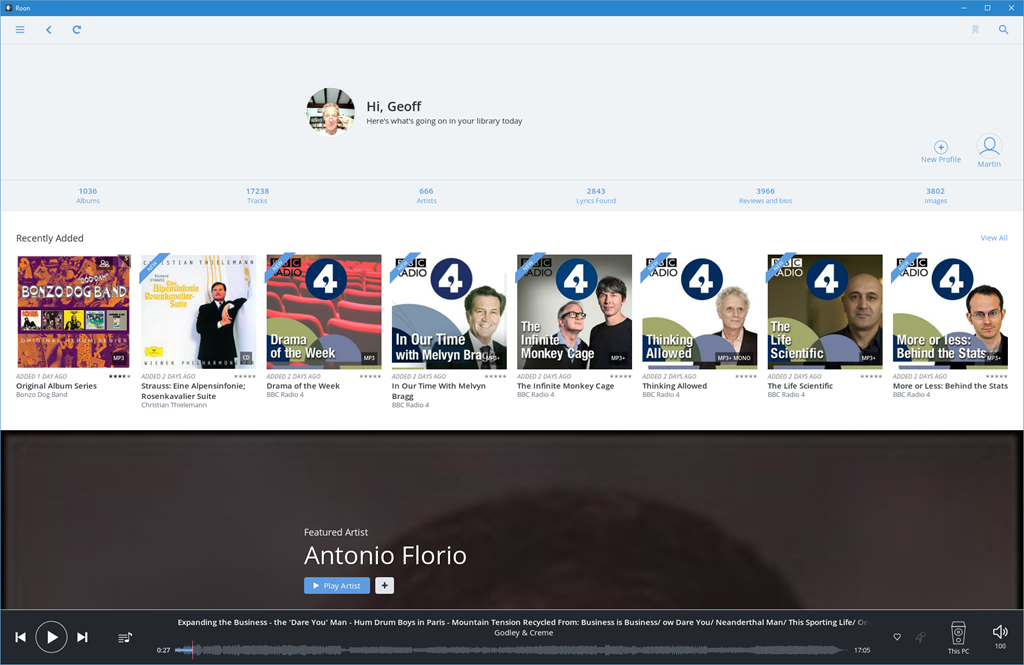
The top level menu immediately shows that in addition to Albums, Artists, and Tracks, Roon also knows about Composers and Works – these are elements that Plex, Emby and Groove haven’t got a clue about.
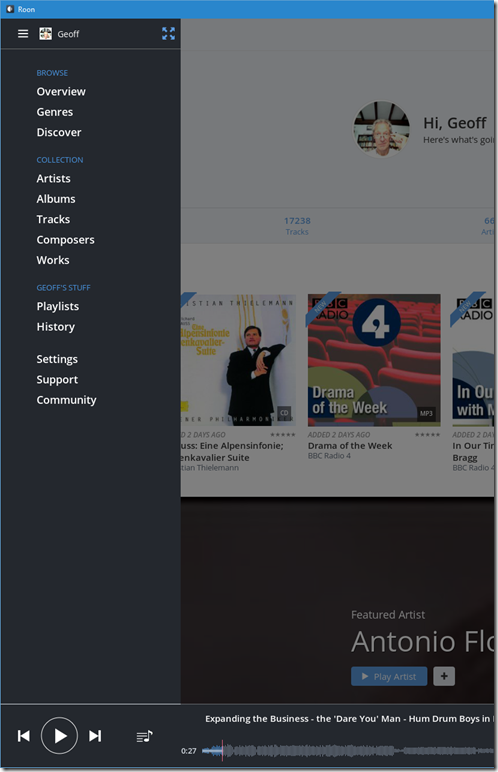
What I particularly like is that it can be clean and simple to use, but it is also easy to slice and dice your music collection (using the Focus feature) to find that hidden gem.
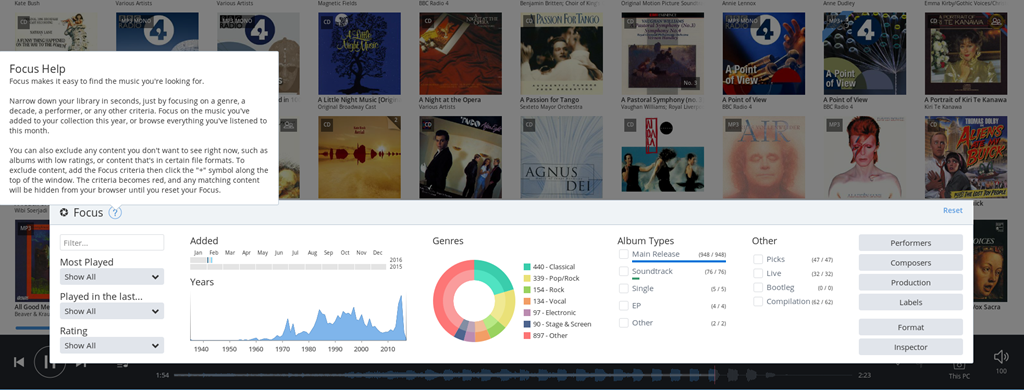
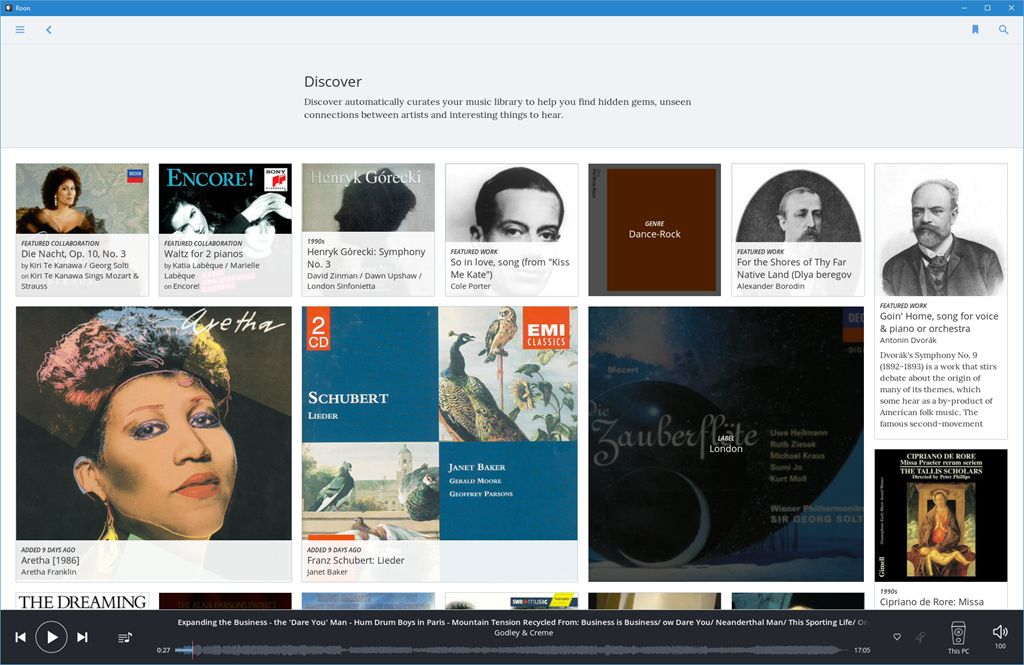
Or you can choose for serendipity, and follow links from the Discover screen, which changes over time:
Hans Beekhuyzen, a Dutch audiophile, has made a good introduction (in English) to the Roon user interface on his YouTube channel:
I decided I would trial a client/server configuration of Roon – have the Core component of Roon (RoonServer) installed on the Windows Home Server 2011 system, and install Roon software on all our tablets and PCs – including the HTPC. That way I could use any device to play back the content of our music library.
I also added an Audioquest Dragonfly DAC to the HTPC to connect it to the Quad pre-amp. Roon can support multiple outputs, so with the Roon software on the HTPC, I could easily choose to play music either through the Quad or through the Denon.
I ran into a couple of problems:
I solved problem 1 by deciding to migrate our server system off WHS 2011 to Windows 10 (which Roon Labs do support). The writing has been on the wall for a while that I would eventually have to do this migration. Microsoft stops mainstream support of WHS 2011 in April 2016. This issue with RoonServer was the straw that broke the camel’s back for me, and provided the impetus to migrate.
I’ve provided Roon logs to Roon Labs for the second problem, and they are investigating. I suspect that it is caused by the fact that I have two access points for our WiFi network here – the main access point at the router in the meter cupboard at the front of the house, and a repeater in the attic. In some parts of the house, a tablet will dynamically switch between taking the Wifi from the router or the repeater and vice versa. The network traffic of Roon seems to be a fairly constant 1,5 Mbps:
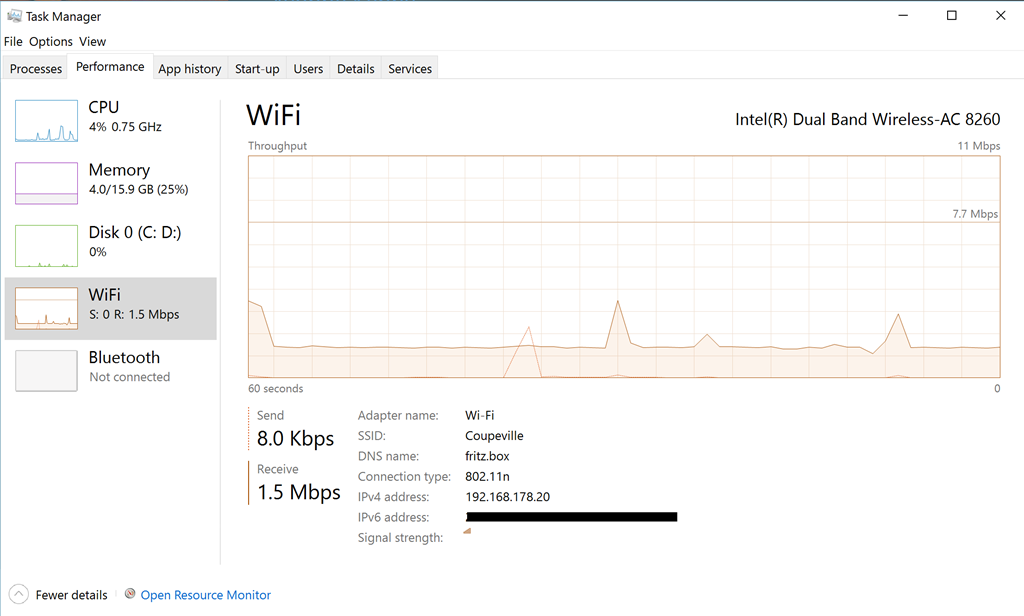
whereas that of Plex or Emby is much more “bursty”:
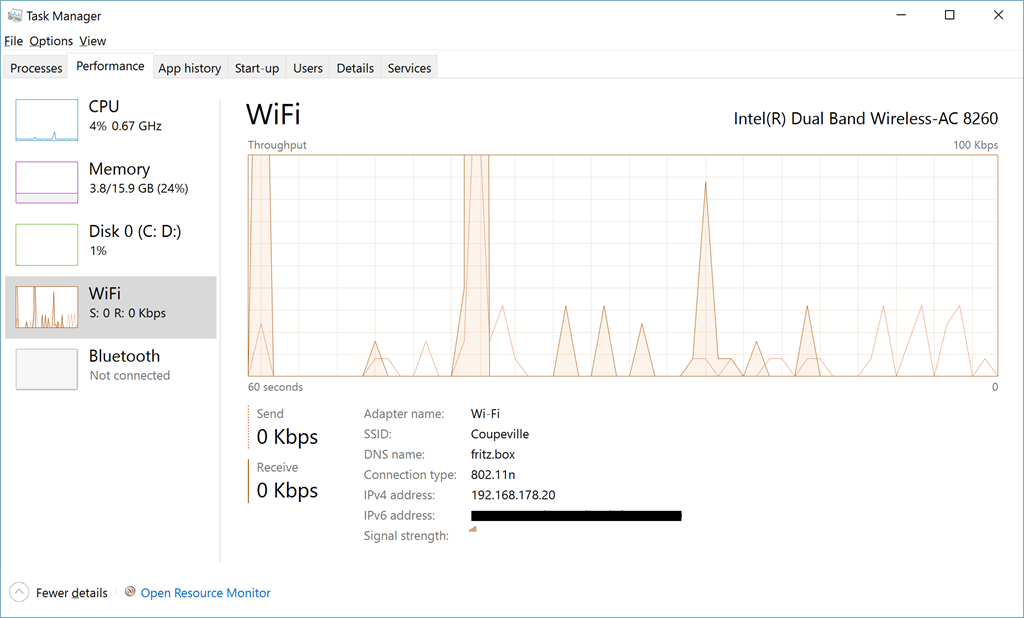
I am confident that this issue can be dealt with, and if the worst comes to the worst, I will still be able to use the tablets to browse the library and to control playback to the HTPC and the Quad. This feature comes in the upcoming version 1.2 of Roon. I can then continue with using Plex and Emby for music on our WiFi connected devices. Not perfect, but workable.
The journey is not at an end, but I think, at least as far as my music is concerned, I’ve reached a basecamp where I can pause awhile. It’s nice to be able to hear my music as it was intended to be heard on my Quad HiFi system once more, and that now includes high resolution music purchased online.
Yes, I’ve crossed the Rubicon and invested in a lifetime subscription to Roon. I just hope that both I and the company can survive long enough to give me a decent return on my investment…
With regards to our Home Theater experience, either Plex or Emby do it pretty well. I’ll wait to see how their Home Theater clients develop before deciding which one to go for. In the meantime, the now obsolete Plex Home Theater serves its purpose.
Addendum: 18 May 2021
I thought I’d add a note here to update the state of play as of the time of writing this addendum.
I’ve dropped the use of Emby, but still use Plex for playing movies and video. I don’t use it for anything else (e.g. for Music, Photos, or Live TV).
I’m still with Roon, which is now up to version 1.8, with much more functionality than when I started. And unlike some software applications, the additional functionality is genuinely useful.
Just over a year ago, I blogged about the forthcoming film version of Into the Woods, the musical by Stephen Sondheim, which would be produced by Disney. I was a bit concerned that, despite a strong cast, the saccharine hand of Disney would ruin one of Sondheim’s best works. Add to that the fact that it was rumoured that Disney would be changing the story, and I wondered whether justice would be done.
Fast forward a year, and I’ve now seen it. It’s not perfect, but it’s pretty damn good.
What astounds me are the hugely negative reviews on IMDB. Dozens of one-star reviews from people who clearly hated the film.
Some didn’t realise it was a musical, and hated it because of the fact that people sang in the film. Some who did realise that it was a musical didn’t like the tunes. This is rather like Emperor Joseph II telling Mozart that there are too many notes…
Sondheim is a genius, and Into the Woods contains some of his best work. Highlights are “Agony”, “On the Steps of the Palace”. These are nicely done in the film, while Meryl Streep gives “Stay with me” real power and pathos. And of course the perpetuum mobile of “Into the woods” itself is like a well-oiled sewing machine producing a rich tapestry of song.
And then there are the legions of parents who unthinkingly thought that a Disney film would be suitable for young children, despite the fact that it has a PG certificate. Er, hello, people, have you never actually read the Brothers Grimm? Clearly not, since in the original Cinderella story, the stepmother cuts off the toes and heels of her two daughters in order to make the shoe fit, while the witch blinds Rapunzel’s prince by having his horse throw him onto a forest of thorns.
There are five fairy tales: Cinderella, Jack and the Beanstalk, Little Red Riding Hood, Rapunzel, and a Sondheim invention, the Baker and his wife. The Baker’s tale is the thread stitching the other tales into one.
Act I ends “happily ever after”, but then Sondheim deepens the stories in Act II showing the broader skein of human frailties. Be careful what you wish for, indeed.
From the witch’s lament:
No matter what you say, children won’t listen.
No matter what you know, children refuse to learn.Guide them along the way, still they won’t listen.
Children can only grow from something you love to something you lose…
To the prince’s seduction of the baker’s wife in “Any moment”:
Right and wrongs don’t matter in the woods, only feelings.
Let us meet the moment unblushed, life is often so unpleasant,
You must know that, as a peasant –
Best to take the moment present as a present for the moment…
In the stage play, the narrator and the Baker’s father are played by the same person. In the film, they are not, and I feel the film is weakened by this decision, particularly since the Baker’s father is played by Simon Russell Beale, and he is rather wasted in his few moments on-screen.
It seems to me that Disney has softened the impact of Act II. In the stage play, Rapunzel is killed; here she lives happily ever after with her prince. Sondheim’s moral that life is messier than a simple fairy tale is somewhat lessened. Nevertheless, it’s a good effort – and far, far better than those depressing reviews on IMDB would suggest. It’s definitely worth taking a trip into the woods… No One Is Alone…
Last Tuesday, I paid one of my very rare visits to a cinema. I went to see a midnight showing of The Hobbit – The Battle of the Five Armies, in 3D no less. It was a somewhat surreal experience; I think that with the possible exception of three others, I was the oldest person present. The majority seemed to be in their late teens or of student age. There were also two people in full costume; one dressed as Gandalf, and one dressed as Bilbo. Unfortunately, the Dutch are, on average, a tall race, and this Bilbo was no exception. He towered over me, which rather ruined the Hobbit effect. However, to give him credit, he really was barefoot, which in December in the Netherlands is rather a brave thing to attempt. And I was pleased to see that Gandalf removed his large hat when seated in the cinema.
TH-TBOTFA is the third film in Peter Jackson’s Hobbit trilogy, and come last Tuesday, I hadn’t actually seen the second part (The Hobbit – The Desolation of Smaug). However, I made the pilgrimage because I wanted to see it in 3D, and the cinema in Winterswijk, although bijou, and with slightly tired decor, has good sound and a decent screen.
So, was it worth it? Well, my answer would be a slightly qualified yes. It’s visually spectacular, partly down to the beauty of the New Zealand locations, and partly down to the wizardry of CGI and set design that produces locations that feel real and lived in. The acting is good, and in some cases excellent. And the eponymous battle is epic. However, I didn’t feel that it reached the intensity of visual spectacle that Jackson achieved with the Battle of Helm’s Deep in The Lord of the Rings – the Two Towers. There is humour in the film, almost slapstick in places, and this does serve to lighten the mix. I did like it though, and I will certainly get it when Jackson releases the inevitable Extended Version in Bluray format sometime in 2015.
Speaking of which, the Bluray format of the Extended Version of the second film in the trilogy landed in our letterbox on Thursday, so I have now seen all three films, albeit in the wrong order. Of course, this filmic version of The Hobbit is not the book. There are new characters introduced, or those, who in the book flit past in an instant, who have their characters greatly inflated in the film. Tolkien purists hate this, but personally, I accept that the film is not the book. I do think that Jackson and his co-writers, Fran Walsh, Philippa Boyens and Guillermo del Toro, have captured the essence of Middle Earth.
With the release of TH-TBOTFA, my seventeen hour sojourn in Middle Earth has been completed. I’ve already revisited it several times since the journey began 13 years ago, and no doubt I will continue to do so, because Jackson’s vision is a compelling one. And I will also continue to reread the source material, because it too has fired my imagination.
A rather impressive short film, with the always impressive words of Carl Sagan. I won’t live to see these scenes in reality, but hopefully some of our species will.
I watched Particle Fever last night. It’s a documentary about the Large Hadron Collider and the search for the Higgs Boson.
It’s staggeringly good.
Equally staggering is the scale of the physics experiment that the LHC embodies. It’s probably the largest experiment ever constructed by humans; built with a budget of 7.5 billion euros by over 10,000 scientists and engineers from more than 100 countries. The documentary easily delivers a sense of awe at the scale of the endeavour, but, more importantly by following six physicists over six years, also gives an insight into the purpose of the project and the passion of the people for the physics behind it.
Physicists fall into two camps: the theorists and the experimentalists, and both were represented in the documentary. Whilst all the featured physicists were interesting and engaging, I was particularly struck by two of them: experimentalist Monica Dunford (who came across as being exactly like Dr. Ellie Arroway, the character played by Jodie Foster, in the film Contact) and the theorist Nima Arkani-Hamed. His explanations, together with those of David Kaplan, another physicist and producer of the film, managed to make the physics clear to me, and pointed out the struggle of theories going on – supersymmetry versus multiverse – that the LHC experiments aim to resolve through discovering and understanding the Higgs Boson.
What I find fascinating is the way in which supersymmetry almost implies support for the strong Anthropic principle (the suspicion that someone/something is twiddling the knobs of the universe to fine-tune physical laws and constants so that the universe as we know it can actually exist). The Multiverse theory, on the other hand, removes the need for all this knob-twiddling, since it posits that our universe, with its particular knob settings, is just one possibility out of a myriad of alternative universes that might exist.
It was hoped that, if the Higgs Boson were to be discovered by the LHC experiments, then this would go some way to favouring one of the above opposing theories. Unfortunately, like some cosmic joke, the data that the LHC has given us about the nature of the Higgs Boson is almost exactly sitting on the fence, with neither theory being able to be declared the outright winner. This is like ascending a mountain, only to discover when you’re at the peak, that it is merely a foothill of some larger chain. If you have passion, as these physicists clearly demonstrate, this will simply act as the spur to drive you on further.
At a time when both religion and politics are increasingly demonstrating their most baleful influences on humanity, it warmed the cockles of my misanthropic old heart to see a scientific endeavour on the scale of the LHC uniting thousands in a common search for knowledge.
There’s a new film coming out (if you’ll pardon the pun): Pride. It tells the true story of a group of lesbians and gay men from London who went deep into the Welsh valleys to support the miners during the dark days of the miners’ strike in the mid-1980s.
It looks as though it’s wonderful, and will take me back to remembering those times. There’s a good interview with actor Bill Nighy and writer Stephen Beresford here.
Addendum: Mark Simpson has a terrific post about the film and his recollections of being involved with the LGSM group. Shake that bucket!
…that the upcoming Disney version of Stephen Sondheim’s Into the Woods will do justice to the material.
The first teaser trailer for the film of Into the Woods has been released, and it’s notable that there ain’t no singing in it, even though it’s a Sondheim Musical. Apparently the filmmakers have also taken out a couple of the songs and changed the plot. All of which leaves me hoping that they haven’t wrecked one of Sondheim’s best works. At least I saw the stage production of Into the Woods when it played in London back in 1990, and I have the DVD of the American Playhouse production of the work to remind me of how good it could be.
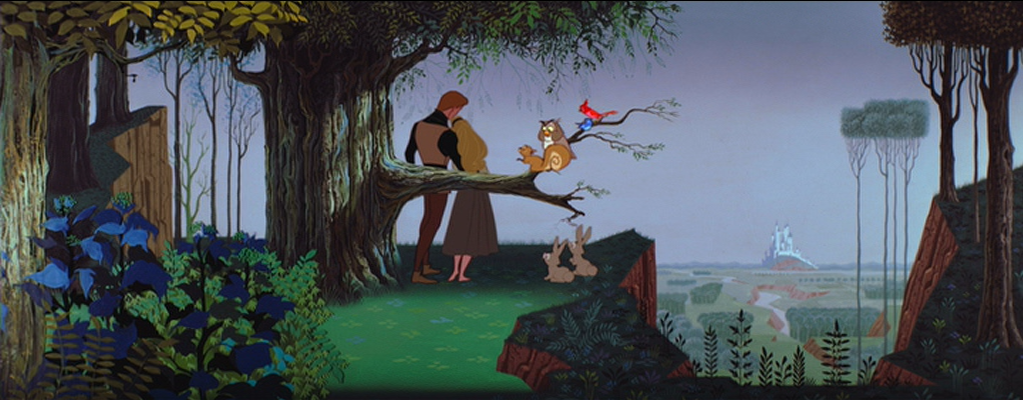
Back in 1959, when I was ten years old, I went to our local cinema and saw Walt Disney’s Sleeping Beauty. I was utterly mesmerised by it. Two things gripped me, and never let me go: the look of the film, and the music. Well, the music was by Tchaikovsky, after all, and it merely confirmed to me that classical music was worth listening to.
The look of the film was extraordinary. The backgrounds were styled after the illustrations in medieval Books of Hours. For Sleeping Beauty, although Disney’s regular production designer was in charge of the film’s overall look, the film’s colour stylist and chief background designer was Eyvind Earle. His work was detailed, heavily stylised, and brought a real sense of landscape into the film.
There was a terrific villainess as well – the bad fairy, and in Disney’s version, she had a name: Maleficent. And now, she’s back – there’s a new Disney live-action film coming out in May this year, with Angelina Jolie as the eponymous villainess. I must admit that the film’s trailer looks as though it may actually give the old film a run for its money.
 Geoff Coupe's Blog