
Aardman Animation’s latest, due in 2012. The Pirates! In an adventure with scientists. It doesn’t get better than this.
Category: Film
-
Gawd–That Voice!
Meryl Streep is playing the role of Margaret Thatcher in a forthcoming biopic. The first trailer is now available. Streep has caught the voice to a “T”, as it were, and it sends shivers down my spine.
I’m torn between wanting to see the film, and dreading all the negative emotions that will be dredged up thinking about the impact Thatcher has had on British society.
-
The Devils
The Devils is a film made by Ken Russell forty years ago. Right from the outset, it ran into trouble from the censors, and still today, it is not available on DVD.
I can understand why it caused such a furore, because it is probably Russell’s masterpiece, and he did not pull any punches. According to this interview with Russell, it’s going to be shown once more in the uncut version at the East End Film festival this coming Sunday. I rather hope that this might lead to a release on DVD. I would rather like to smell, once again, the whiff of brimstone that I recall from seeing the film (even in its cut version) all those years ago.
When it was first released, my best friend (brought up a good Irish Catholic) and his best friend (another Irish Catholic by upbringing) went to see a screening of The Devils. They hadn’t appreciated what the film was about, other than it was set in Medieval times and involved nuns and a priest. So off they went with the friend’s Spanish boyfriend and his extremely devout Catholic mother.
As the film unfolded, and the goings-on on the screen got ever more extravagant, they all shrank back further and further into their seats with ever-wider eyes, and did not dare glance at each other. After the screening, the friend’s mother got straight on the phone to her friends in Spain to warn them against ever seeing this blasphemous film…
-
The Tree of Life
I can still remember sitting in what was then the National Film Theatre on the Southbank during an afternoon showing of Days of Heaven back in 1978 and realising that I was watching something that would change the way I looked at things.
-
Ken, Ken, and their Operas
I’ve just watched the version of Mozart’s Magic Flute filmed by Kenneth Branagh. I was absolutely blown away by its sheer bravura. From the opening single tracking shot beginning in the trenches of World War 1, then rising far above; to the finale where summer returns to the blasted fields, it was an absolute visual tour-de-force.
But the visuals were not alone. It was Mozart’s glorious music, after all. The performers were excellent, singing was top class, and there was an English translation of the libretto that was extremely good and witty. I saw from the credits at the end that the translation was done by Stephen Fry, so I suppose I shouldn’t be surprised at its quality.
In the end though, the visual feel of the film was what struck me, and Kenneth Branagh’s direction reminded me of the baroque style of Ken Russell –particularly of Tommy, his rock opera. The sheer adrenaline rush of watching their imaginations writ large on the silver screen is terrific.
-
Rare Exports
I know I’ve blogged about this short film before, but I really think it is a little gem for Christmastime. The makers have now come up with a full-length feature film on the same theme, but I can’t help feeling that less is more. This short film hits all the right buttons.
-
Sorrowful Songs
Henryk Górecki’s 3rd Symphony, the Symphony of Sorrowful Songs, was composed in 1976. While many take its meaning as a remembrance of the Holocaust, Górecki himself said that it was an evocation of the ties between mother and child.
Here’s the second movement in a filming that underscores the Holocaust interpretation. It’s an extract from Holocaust – A Music Memorial Film, which was shot in Auschwitz. The soprano is Isabel Bayrakdaraian, and she is accompanied by the Sinfonietta Cracovia, conducted by John Axelrod.
According to the Wikipedia entry for the 3rd Symphony, the text of the second movement is an inscription scrawled on the wall of a cell of a Gestapo prison in the town of Zakopane, in southern Poland. The words were those of 18-year-old Helena Wanda Błażusiakówna, a highland woman incarcerated on 25 September, 1944. It read “O Mamo nie płacz nie—Niebios Przeczysta Królowo Ty zawsze wspieraj mnie” (Oh Mamma do not cry—Immaculate Queen of Heaven support me always).
(hat tip to The Observer for the link to the video)
-
Metropolis
There can be no understanding between the hands and the head unless the heart acts as mediator
That is the opening and closing motto of Fritz Lang’s Metropolis. A silent film released in 1927 that has become recognised as a masterpiece. It did not start out life that way; a poor critical reception led to it being heavily cut for distribution shortly after its release, and the original version was lost. Then in 2008, in a small museum in Buenos Aires, a poor, but complete, copy of the original was discovered. It has been used to supply the missing sequences, and now a restored version of Metropolis has been released that, at 150 minutes running time, is as close as possible to the original version and which has an additional 25 minutes of footage. It also has the original orchestral score composed by Gottfried Huppertz.
Until now, I’d never actually watched a screening of any version of Metropolis. Of course, I’d seen stills in books and magazines, or short sequences in TV programmes many times; but the whole thing? – no.
Now I have. I bought the Blu-ray/DVD of the restored version. It is indeed a revelation. The imagery is quite breathtaking in places – mixing both ancient (Rotwang’s house and the Cathedral) and modern (the city and the machine halls). The film is full of allegory (for example, the machine hall becomes a vision of Moloch to the city owner’s son) and often makes use of occult and religious symbolism. For example, Rotwang, the evil scientist, is almost akin to a medieval alchemist, much given to decorating his house and equipment with pentagrams, while the subterranean cavern where Maria speaks to the workers is full of Christian imagery.
The acting, as was the fashion in silent films, is not very subtle, and the ending is rather simplistic. However, its visual power cannot be faulted and the orchestral score adds to the effect. Lang certainly knew how to do crowd scenes – the workers’ mob pursuing the false Maria, or the children fleeing the flooding underground city have an intensity that astounds. Metropolis is indeed a masterpiece.
-
Science Fiction – Double Feature
A wonderfully evocative tribute using a song from Rocky Horror. Ah, it brings back memories…
-
The Bechdel Test
The author, Alison Bechdel, is credited for getting the meme spread on what has now become known as "The Bechdel Test for Women in Movies"While ostensibly raising an intriguing fact about film, it does, of course, illuminate something off-kilter about society and who wields the power in it. -
Seeing Is Believing
My dad always used Old Spice, but I don’t recall this ever happening to him. Nicely done special effects – most of them simple mechanics. Only the hand with the diamonds has been superimposed on the single take in this commercial. Mind you, it took three days and dozens of attempts before everything worked. -
Home Cinema
For my birthday, a neighbour of ours presented me with the DVD of Creation – the biopic about Charles Darwin.I am really touched by her thought on this, even though I have (without having yet seen the film) some misgivings over how Darwin’s life will be treated. Nonetheless, I think it will be a film worth watching. This still from the film shows both the potential and the dangers well, I think. A touch of fingers between an orang-utang and a human, but of course, with our cultural heritage firing on all cylinders, the pigments on the Sistine Chapel’s ceiling spring irresistably to mind…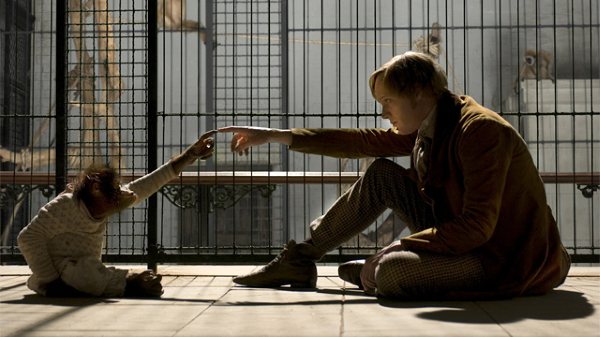
-
Subtle, It’s Not…
A friend recently went to see Avatar in 3D at an IMAX cinema, and reported that it was “quite flabbergastingly impressive”, and “if this is the future technology of film-making, then I like it”. The nearest IMAX cinema to me is over two hours away, so I couldn’t see myself making the effort to go to that. However, a quick search showed that there was a 3D cinema located in nearby Winterswijk, so last night I went to see Avatar for myself.
I totally agree that the film is an extremely impressive technical achievement, and visually stunning, but this is James Cameron that we are talking about, so it’s about as subtle as being bashed over the head with a lead pipe.
That’s not to say that I didn’t enjoy it, I did, but it’s not a ‘great’ film, in the sense of being a Citizen Kane or a 2001; at least in my view. The baddies are bad and the goodies are good – there’s no place for any moral ambiguity in Cameron’s films. And the allegories are up there in neon; the parallels with the European conquest of the Native Americans, or the second Iraq war – one character even utters the phrase ‘shock and awe’ for heaven’s sake, just in case anyone missed the point.
And it has a happy ending – it’s clearly not real life… Still, as good escapist entertainment, it’s a fine film, and will probably set the bar for films to come in the same way as the original Star Wars did.
There was also a 3D trailer for Tim Burton’s Alice – and I’ll definitely be going to see that in 3D. I’ll also be seeing it in Winterswijk. The cinema is bijou, the 3D auditorium has only 150 seats and it looks ever so slightly tired. But the staff are friendly, the sound system is good, the screen is big enough, and the 3D effect is excellent…
-
Alma
One of the traditions of the BBC is to have a ghost story at Christmas. I don’t know whether there will be one this year, but here’s a short animation that seems to fit the bill. You just know from very early on that it’s not going to end well… -
A Thing Of Beauty
A gorgeous little animated film by Gabe Askew set to the song Two Weeks by Grizzly Bear… -
Photograph of Jesus
Here’s a terrific little film about the impossible requests that the Hulton Photo Archive receives. Jeroen, this one’s for you… -
Tim Burton’s “Alice in Wonderland”
I see that the first trailer for Tim Burton’s forthcoming film "Alice in Wonderland" has surfaced. Despite the condescension dripping from many of the comments here, I want to see how Burton reinvents Alice. We’ve had Disney, we’ve had Miller (which I adored), we’ve had Svankmajer (which I admired), and now we’ll get Burton – I can’t wait. -
What’s In The Box?
That’s the title of a short demo film reportedly made for 150 Euros and a pizza by a young Dutch guy. It’s very well done. He should go far. -
Sita Sings!
I’ve mentioned Nina Paley and her wonderful Sita Sings the Blues several times before. And now (hooray!) the film is finally finished and released as a full-length animated feature. I love the way the shadow puppets argue over the story… And Nina has even released it under a Creative Commons licence.And as an additional incentive to support Nina, I hand you over to Rheinhard on Pharyngula:Also of great importance about this film: The reason that you can only see this film on the net this way and can’t buy it on DVD is because of the insane copyright law in the country. The film uses a number of late 1920s jazz recordings by Annette Hanshaw which, although the recordings are in the public domain, the songs she is singing are still in copyright to various holding companies. The composers of these songs are long dead and this music should have been in the public domain years ago, but because of the ridiculous permanent extension of copyright (thanks Disney!) these companies have demanded exorbitant sums (over $50K!) from the broke indie animator Nina Paley to show or distribute the film. The only reason PBS can show it is because it has different rules regarding copyright permissions! Please, if you care about this film and the ability of artists to have their work seen by the public, check out QuestionCopyright and Nina Paley’s blog for more info!
-
The Fall
Almost a year ago, I wrote about a film that I wanted to see: The Fall, a film directed by Tarsem Singh that was originally released back in 2006. It’s now finally been released on Blu-ray, so I invested in a copy and sat down to watch it with Martin and a friend.
Well, we were all entranced and stunned by the film. Visually, it’s one of the most beautiful films I’ve ever seen. Shot after shot were jaw-dropping. And the central performances of Lee Pace as the injured stuntman (and the bandit) and Catinca Untaru as the little girl were heart-stopping. Untaru’s performance, in particular, was not a performance at all – she was the little girl.
The film moves constantly between scenes set in a Los Angeles hospital in the 1920s, where the stuntman is weaving his fantastical tale for the little girl, and into the tale itself, which is being visualised by her.
The settings of the tale are, as I said, stunning. The interesting thing is that they are all real locations – there was no CGI trickery used to construct virtual reality here.
The film is, in effect, a love letter from Tarsem to the power of cinema and its abilities to spark the human imagination. It’s a masterpiece. See it.
 Geoff Coupe's Blog