Reflections on life at “De Witte Wand”…

Category: Health and wellness

  • World AIDS Day 2009

    Today is World AIDS Day. One of those occasions that you wish you didn’t have to have, but which is important to remember and do something about. 
     
    At  a personal level, it’s a chance for me to recall some lost friends: Kerry, Lance, Eric, Humphrey, Peter, John, Kingsley, Graham, and Neil. I’m sorry that you’re not around with the rest of us today.
     
  • A New Word

    I learnt a new word today: Lithopedion. It’s both horrifying and amazing at the same time.
  • Nightingales in the Orchard

    A wonderful article by Mary Warnock about self identity and ageing. Go and read it.
  • Swine Flu and Tuberculosis

    Hans Rosling deserves to be not just a National Treasure, but a Global Treasure for his analyses of the wash of data that we are all swimming in (if not drowning in).
     
    Here, for example, is his comparison of the Media’s reporting of Swine Flu versus Tuberculosis. Please note that he is not saying that the health agencies are not right to sound a warning, but that the Media has over-reacted beyond all reasonable measure,
  • Unlucky Klaus

    A completely serious health and safety video for forklift drivers. I think.


    (hat tip to the Lay Scientist)
  • Sixty

    I can’t really believe it, but it seems that I turned 60 last Saturday.

    Of course, there were signs and portents, such as the herd of deer that thundered past my study window on the day – a sight that I’d never seen before.
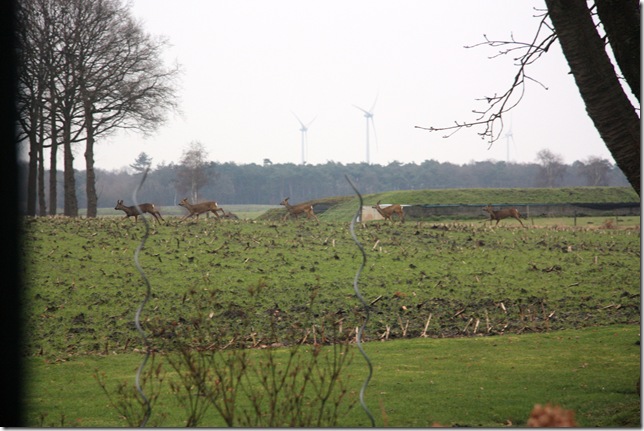
    20090117-1409-42(2)

    But, more prosaically, there was the calendar, and the fact that Martin had been having whispered telephone conversations and sending off emails for weeks (months?) beforehand. At 16:30, I was ordered out of the house and told to get in the car and open the first of a series of envelopes that he thrust into my hand. The contents of that first envelope instructed me to drive to a nearby town and collect my birthday cake from a baker’s shop.

    The first mission accomplished, and I was instructed to drive to a friend’s house where I was told to take a photo of the aforementioned cake.

    20090117-1706-59 (2)

    Well, of course, I was pleased…

    20090117-1712-05

    And then I was told to cut the cake (using a cheese slice for traditional Dutch cheeses) and serve slices for the assembled friends.
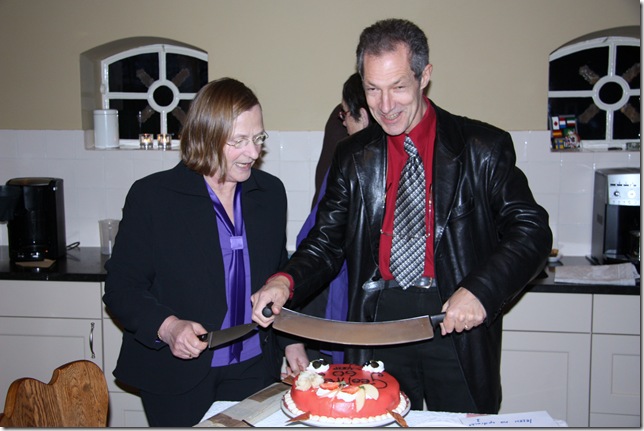
    20090117-1715-59 (2)

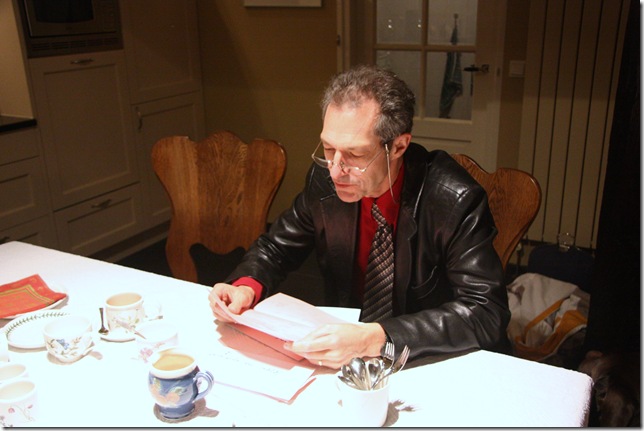
    After coffee and cake, it became time to open the third envelope…
    20090117-1831-18 (2)

    20090117-1831-26 (2)

    This instructed me to return home at 19:00 hours and be prepared for the worst – I mean, the next stage of the celebrations.

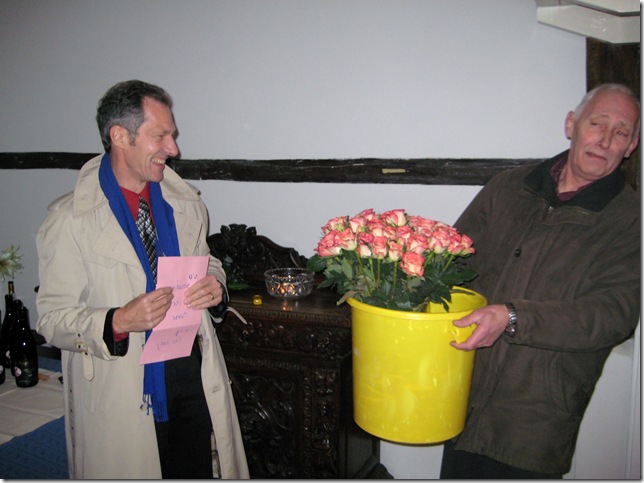
    So, I duly drove home, accompanied by Len, a friend from London who I have known since the early 1970s. Entering the house I was greeted by a roomful of friends and presented with a bucketful of sixty roses to mark the occasion…
    2009-01-17_IMG_3547 (2)

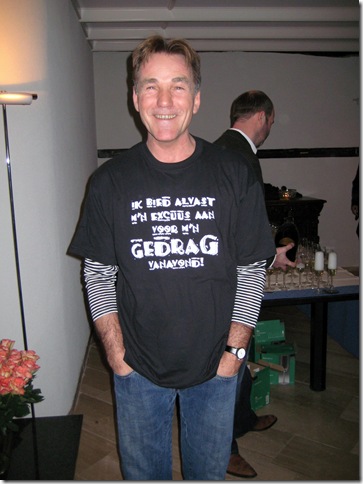
    I’ve often said about Martin that “I can’t take him anywhere”, because his Dutch directness has a habit of getting me into embarrassing situations. He’d prepared for that for this evening by wearing a T-shirt that proclaimed “I apologise in advance for my behaviour tonight”.
    2009-01-17_IMG_3548 (2)

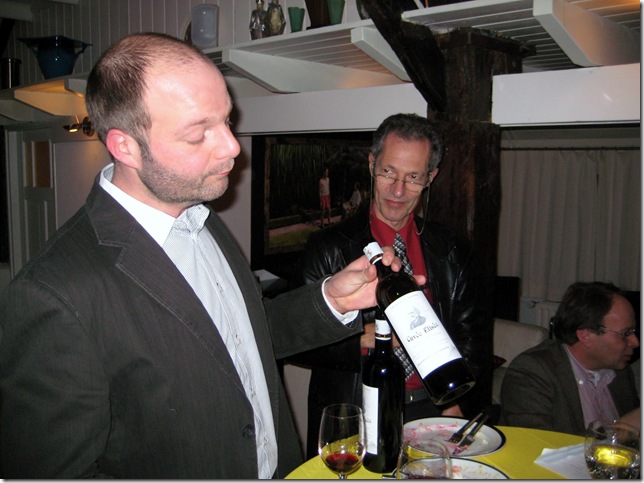
    In the event, he had (almost) nothing to apologise for. He’d engaged Bob Schoemaker, from Willy Schoemaker, the wine merchant, to lead us through an evening of wine-tasting.
    2009-01-17_IMG_3561 (2)

    As I said, he had almost nothing to apologise for. But that was before we had the tribute to Abba…
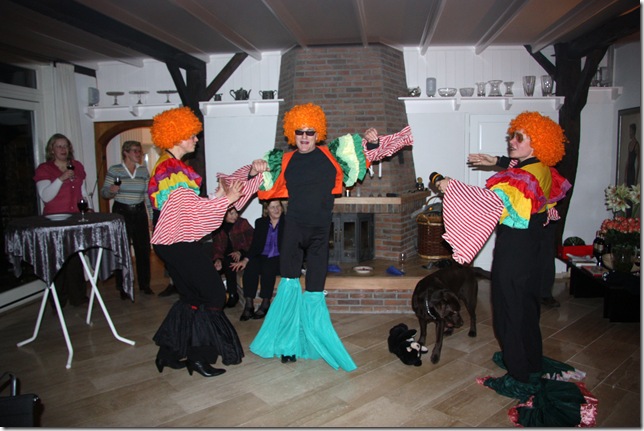
    20090117-2137-01

    Still, it was great fun, and we all had a ball, even though our dog, Kai, was beginning to wonder who the dominant species on the planet earth might be…
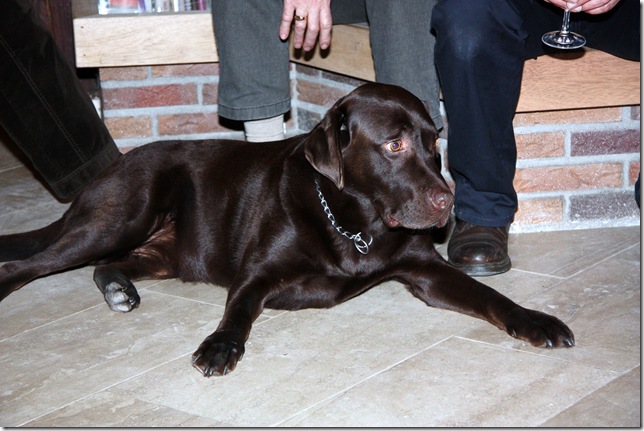
    20090117-2210-50 (2)

    Of course, I had to give a speech…

    2009-01-18_IMG_3589

    But I made up for it by opening more wine…

    2009-01-18_IMG_3607

    All in all, it was a great evening, and thanks must go to Martin, Bob Schoemaker and all our friends for making it so memorable.

    Onwards and upwards…

  • Struck Speechless

    So, I’m reading a blog entry over at Counterknowledge.com written by Matthew Hartfield. He’s looking at the correlation between the rising outbreaks of measles and the anti-vaccination scare caused by baseless fears that the MMR vaccine was linked to autism. Not unexpectedly, the UK has seen large outbreaks of measles as a result.
     
    But he also looks at the situation in other European countries that have seen outbreaks of measles, notably Switzerland and Austria. And here, he finds an interesting connection with Anthroposophy, developed by "mystic and social philosopher" Rudolf Steiner. His ideas live on in Waldorf/Steiner schools. Some of those ideas might be beneficial to child development, but some are clearly dangerous woo. For example:
    Waldorf’s official position on immunization is that there is no official Waldorf position on immunization. Instead, Waldorf says that immunization should be informed by medical professionals, and ultimately parents should decide whether or not to immunize their own children.
     
    Typically Waldorf schools do not encourage parents to immunize their children against the following diseases: Hepatitis B; Diphtheria, Tetanus, Pertussis; Haemophilus influenzae Type b; Inactivated Polio; Measles, Mumps, Rubella; Varicella and Pneumococcal Conjugate Vaccine (PCV).
    So what if your child falls ill, or even dies as a result of a preventable disease?
    Don’t be alarmed if your child dies from a preventable disease because he/she is not immunized, it was probably their destiny. It clearly wasn’t their destiny to be immunized.
    Hartfield writes: "I’m genuinely speechless". So am I. It’s appalling.
  • Saudade

    Saudade is a Portugese word that is defined as ‘a feeling of nostalgic remembrance of people or things, absent or forever lost, accompanied by the desire to see or possess them once more’ (Correia da Cunha,1982).

    The psychiatrist Carlos E. Sluzki writes beautifully and movingly about one of his case studies, an elderly Mexican woman who received weekly visits from her two sons, even though they were both long since dead. Do go and read this article, you won’t be disappointed.

    (hat tip to Mind Hacks)

  • Not The Day Of Rath

    I see that vitamin pill-pusher Matthias Rath has pulled out of his libel action against Ben Goldacre and the Guardian newspaper. Good news indeed. Read more about the case and the horrifying background over at Ben’s Bad Science blog.
  • Walking the Tightrope

    Oliver Sacks reviews Hurry Down Sunshine in the current issue of the New York Review of Books. His review has made me add the book to my wish list of books to get. He reminds us that we are walking through life on "a narrow ridge of normality…, with the abysses of mania and depression yawning to either side".
  • ReWalk

    Here’s an intriguing replacement for a wheelchair – an exoskeleton for the legs. I’m sure that this commercial airbrushes out some of the fiddly bits (getting in and out of the car, for instance), and I wonder what the battery life is like; but nevertheless it’s probably the beginning of something that we’ll see more of. In a few year’s time, I’m sure that the sticks will be dispensed with, and the exoskeletons will take on additional balancing function.


    (hat tip to Science Punk)
  • The Plague and the Party

    Earlier this month, I pointed to a good interview with Elizabeth Pisani, who has just published a book on HIV and the AIDS prevention industry. Now I see that she has an excellent article on the subject in this month’s Prospect magazine. Worth reading, and she repeats her sobering message that:
    …living with HIV is not all abseiling down canyons at sunset. It’s about going to the clinic for viral load monitoring and taking toxic drugs, for the rest of your life, at an annual cost to the NHS (the National Health Service) of about £16,000 per person (which means an annual bill of about £1.2bn). And the virus is beginning to outwit some of the drugs we have developed, raising the prospect of strains of HIV that don’t respond to treatment. Plus, we don’t know what effects even the oldest drugs might have in the long term—many men who have been on antiretrovirals for over a decade have osteoporosis and failing livers; they’re suffering not from the infection but the remedy.  
  • The Age of Cosmetic Neurology Is Coming

    An interesting article about Progivil from Johann Hari. It raises a number of interesting ethical questions. Discuss.
  • Time To Die

    Mark Crislip has a thought-provoking post over at Science Based Medicine on whether people can die simply by willing it. He points out that while he has anecdotal evidence of the phenomenon (he’s apparently a doctor working in an acute care hospital), the study data is much less clear-cut.
     
    It also, as he points out, shows up a contradiction of two views. One is that the mind is simply the result of the workings of the brain. He and I both share that view. But, on the other hand, if there is evidence of people who die simply because they will it, then does that not point to the "mind over matter" possibility? He’s not convinced that it does, but he remains intrigued (as do I) by that little niggle of doubt.
     
    Oh, and this article has a bearing on the topic, but I’m not convinced that the evidence that the physical changes in the brain that can be brought about by training (The Knowledge is another example of this) can be said to be the same as willing oneself to die.
  • A Stroke of Insight

    Jill Bolte Taylor relives the time when she had a stroke, and what happened as a result. Powerful stuff.
     
  • An Embuggerance

    The author Terry Pratchett has let it be known that he has early onset Alzheimer’s disease – an embuggerance, as he describes it. He recently gave a radio interview about it, and I must say that he seems to be dealing with the diagnosis remarkably well, all things considered.
  • Arachnophobia and Other Fears

    I empathise entirely with Dr. Brian Cox.
     
     
  • Health Warning

    Sidaction, the French organisation that campaigns for AIDS awareness, has this rather striking warning, which has overtones of Hieronymous Bosch.
  • Don’t Try This At Home

    I was going to write that I find it amazing that some people (generally US politicians) can claim, with a straight face, that waterboarding is not torture. On second thoughts, it’s not amazing at all, it merely feeds my misanthropy.
     
    That notwithstanding, what is the experience really like? Syclla will lead you to the depths of Hell and tell you. Now, torture or not? Frankly, what I would like for Christmas is for all those who claim that waterboarding is not torture to be put through the process. The rest of us can wait until it’s over and then come by and take a survey.
  • How We Die

    That’s the title of a wonderful book by Sherwin Nuland. I came across Nuland a little while ago when a talk by him was posted on the TED blog. As I said at the time, the talk is well worth watching and listening to. It brought tears to my eyes.
     
    As a result, I sought out a book by him: How We Die.
     
    I’m still reading it, but I am here to tell you that Nuland writes from a heart that is full of compassion, yet is realistic enough not to paint life in false colours. It is an amazing book. I have the feeling that he tells the truth, no matter how unpalatable that is. Yet he tells it in language that shows humanity, even at the direst end.
     
    There are chapters in the book that spell out just what will happen when you have cancer, or AIDS or Alzheimers. He takes you to the brink of the pit and turns your face to gaze into its depths, but the strange thing is that having shown you the horrors, the reader (or at least, this one) comes away strengthened and ready to face what life (or rather, death) might bring.
     
    I am reminded of this book because I was watching the John Grierson Awards on BBC Four, and Paul Watson won the Grierson Trust Award, in part for his documentary: Malcolm and Barbara: Love’s Farewell. I have not seen the whole documentary, only parts, but what I have seen only underlines that I would prefer to see the heartbreaking truth of things, rather than obfuscation and false colours. Truth matters, however uncomfortable it may be. In googling for the documentary, I came across this hit on the Orthfully Catholic blog that seems to me to miss the whole point so completely that it almost beggars belief. It’s a complete travesty of what Barbara Pointon was experiencing. That’s why I get so angry with religion, and the people who espouse such views.