Reflections on life at “De Witte Wand”…

Category: Nature

  • Cosmotions

    Some awesome time lapse photography of the night sky here. I particularly like the fact that the sequence of comet 73P/Schwassmann-Wachmann has picked up a passing meteor on one of the frames. Great stuff!
     
    (hat tip to Seed magazine)
  • The Sense of Smell

    I’m often struck by how evocative our sense of smell is. Today, for example, I was taking the dog out for his lunchtime walk through our local woods. While July this year was marked by a heatwave, this August has been one of the wettest on record. So the woods are pretty damp underfoot, and this has released various scents. At one point I smelt something that was a dead ringer for the smell of fresh plasticine – something I haven’t smelled for nigh on fifty years. But instantly, I was back there in my childhood, opening the box containing strips of plasticine in different colours and smelling that same smell.
     
    And of course, the human sense of smell is nothing compared to that of a dog. There he was, running around, snuffling and smelling heaven knows what all around me. He was clearly experiencing a symphony of smells, while all I was getting was a one-note samba. Still, it was a very loud note – and it did enable me to remember and revisit a time in the long gone past, so I am not complaining.
  • It’s Not Just The Cold…

    …that can make your penis shrink, apparently. There’s disturbing news for male polar bears – their genitals are shrinking because of industrial pollution. As if the cold weren’t enough…
  • Apophenia and Pareidolia

    Hard-wired into the human brain is the propensity to see patterns or forms in random data. A fact that leads to all manner of ridiculousness. Oh, and even more so here.
  • And Then There Were Eight…

    Planets, that is. Today, the general assembly of the International Astronomical Union voted to downgrade Pluto from its status of planet – a position it’s held since its discovery in 1930. We’re sorry to lose you, Pluto, but the viewers have spoken. Don’t slam the door on your way out…
  • Dark Matter Made Clear

    Some new observations of colliding galaxies would appear to confirm that Dark Matter is more than a theoretical construct. This is amazing stuff (well, it is to me, anyway).
  • Susan Blackmore on Memes

    Onegoodmove posts a link to an audio interview with Dr. Susan Blackmore on the subject of memes. She has a passion for this topic, which comes over clearly in the interview. Very thought-provoking. She discusses the concept of self in the light of "the meme machine". Her book is good too.
  • The Primeval Forest

    This is a brilliant shot of the sort of forest that exists deep in one’s imagination (well, at least it does in mine). Click on the photo to see it full size and then sink into your memories of childhood dreams all those long years ago…
  • I Rest My Case

    To all those idiots who say that being gay is not natural because it doesn’t exist in the animal world, I simply point to this heartwarming story of storks raising their chicks.
  • Multitasking

    I find it difficult enough to concentrate on one task, so Tapan Dey has got me knocked into a cocked hat.
     
    While we’re on the subject of doing multiple things at once, Dr. Crippen draws my attention to this piece of hard wiring in the neurons. Can you do it?
  • I Missed Them…

    The Perseids, I mean. Last night it was heavily overcast so I went to bed. This morning I woke up at 7am to brilliant sunshine and clear skies. So that means at some point during the night I probably would have had good conditions to watch the meteors. Typical, these days I often wake up at 3am for a few minutes, but not last night when it would have had some point to it…
  • Deckchair and Rug Time

    The start of this year’s meteor season has begun with the Perseid meteor shower. Last night it was too cloudy to see anything, but hopefully I’ll be able to watch the skies in the next night or so. The peak of this year’s shower will occur on Saturday night. The other fly in the ointment, besides the cloud, is the fact that the moon is also in the night sky, and its light drowns out the fainter meteors.
     
    There’s a good article on meteor-watching in today’s Guardian (which is where the title of this post comes from).
  • Whose Culture Is It Anyway?

    Once again, Toxoplasma gondii is back in the news. Carl Zimmer, over at the Loom, continues to be fascinated by this organism and draws our attention to some new research. This seems to suggest that Toxoplasma is capable of modifying human behaviour to the extent that the influences can be seen in human cultures.
     
    I find the implications of this fascinating, and was particularly struck by some of the comments on Zimmer’s post, to whit, what is my mind’s "I" anyway? Is it not simply the collection of my (brain) cells and the chemicals produced by both them and any parasites and bacteria that I am currently playing host to…
     
     
  • Don’t Lose Your Head

    I’m somewhat disappointed to learn that the female praying mantis does not always bite off the head of her mate during the sex act. Apparently, it’s much more likely to happen in the laboratory, where the sights and sounds (of anxious observers?) can make the female become more aggressive.
     
    Coturnix, over at his imaginatively-named Blog Around The Clock (he specialises in chronobiology), has more information about what the male praying mantis should know before he goes a-wooing…
  • What Grandmas Are For

    I’m currently reading William H. Calvin’s A Brief History of the Mind. Calvin writes really well, and puts together an absorbing and convincing story of how the human mind has developed. While he traces the development of the human species, starting about 7 million years ago when hominids shared a common ancestor with chimpanzees and bonobos, it appears that the evidence for the modern mind only appears as little as 50,000 years ago. And that’s even though Homo sapiens has been around for at least 100,000 years.
     
    So something caused (in Calvin’s phrase) "the mind’s big bang" to occur around 50,000 years ago. He posits a number of candidates for the trigger, for example, the use of the structured planning that is necessary to throw things accurately being applied in other modalities and time scales. He also argues that "if children are exposed to structured stuff can softwire their brains to better handle it, and if the younger they are exposed, the better they do as adults, then the more precocious children will soon double the amount of structured speech heard by the next generation of youngsters… So the transition might be language, acting like a contagious disease over a few generations’ time."
     
    This is EvoDevo, when evolution interacts with the development via the einviroment. Today, I ran across an interesting article in Seed magazine: Why Do Grandmas Exist? This points out that the menopause is something that is unique to the female Homo sapiens – none of the other primates have this. Other primate females are capable of becoming pregnant until they die. So the menopause might also be one of the triggers of the big bang: females who are no longer capable of child bearing have more time to babysit or to forage for food. And the babysitting might help the children be "exposed to structured stuff".
     
    Food for thought.
  • Forget Skippy – Who’s The Duck?

    My eye was caught by an article in The Telegraph today about some newly discovered fossils in Australia. The story centred around the remains found of a flesh-eating kangaroo – Ekaltadeta – but what really got my attention was the reference to a prehistoric bird known affectionately to scientists as the Demon Duck of Doom.
     
    Intrigued, I did a quick Google, and here, ladies, gentlemen, and small furry animals, I give you: Bullockornis planei. Ain’t Nature amazing?
  • Birdbrain

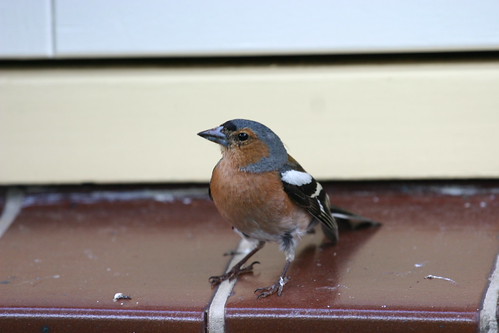
    This is a male chaffinch who has spent the last few days constantly attacking his own reflection in the windows of the house.
     

    060627-1815-49

     
    He hasn’t yet figured it out that he’s fighting a phantasm. There’s a moral there I think.
  • The Effeminate Sheep

    This month’s Seed Magazine has an interesting article on Joan Roughgarden and her theories on sexual selection. While she makes some valid observations, some think that her conclusions are a step too far ahead of the data. PZ Myers, for example, in a well-argued piece on his blog.

    Both PZ Myers and the original article are well worth reading. I like the lightness of touch and the flashes of wit and irony that the author of the article (Jonah Lehrer) has brought to bear on the topic. For example:

    As this list of activities suggests, having homosexual sex is the biological equivalent of apple pie: Everybody likes it. At last count, over 450 different vertebrate species could be beheaded in Saudi Arabia. You name it, there’s a vertebrate out there that does it.

    And I think Myers is right when he argues that:

    Roughgarden is an awkward case that provokes a difficult split in people’s opinions. She is 100% right that homosexuality is common and that its prevalence ought to be regarded more seriously as an indication of an interesting and enlightening phenomenon in evolution. However, she’s completely wrong in rejecting sexual selection: in rejecting a simplistically heterosexual view of nature she swings too far the other way, adopting a simplistically homosexual view instead of a messy, complex, and almost certainly more correct mixed view.

    By the way, if you want to read more about the 450 species who are ignoring the disapproving looks of God and Allah, then the best serious book to look out for is Biological Exuberance by Bruce Bagemihl. If you want to laugh out loud at life’s rich tapestry, then go for How Animals Have Sex by Gideon Defoe, one of the funniest books I’ve read in a long, long time.

  • The Cherry Tree

    We have a cherry tree in the front garden.
     

    060424-1404-18

     
    I was quite looking forward to harvesting some cherries, but I hadn’t reckoned on the local starling population. Now that the cherries are ripe, they have descended en masse onto the tree and are proceeding to strip it bare.
     
    Bastards.
  • “God Made The World…

    … But the Dutch made The Netherlands". So runs a saying here in The Netherlands. For 500 years the Dutch have been engaged in reclaiming land from the sea. But now there is a sea-change, as it were. In the light of global warming and rising sea levels, the Dutch water engineers are preparing to give back land to the sea.
     
    There’s an article by Elizabeth Kolbert in today’s Observer that gives the background. Well worth reading.