Reflections on life at “De Witte Wand”…

Category: Society

  • Religion Poisons Everything

    That quote, from the late Christopher Hitchens, seems apposite in the wake of the news that a 14 year-old girl has been shot in the head because, according to the Taliban spokesman (it is always, of course, a spokesman), her activities in highlighting Taliban atrocities needed to be stopped.

    He said the teenager’s work had been an “obscenity” that needed to be stopped: “This was a new chapter of obscenity, and we have to finish this chapter.”

    It is at times like this when I come close to despair for humanity’s future.

  • This Land is Mine

    I’m currently reading (very slowly) Steven Pinker’s magisterial The Better Angels of Our Nature. It’s a history of violence in human societies, and his thesis is that violence has actually declined over the centuries. It seems difficult to believe, but Pinker marshals his facts and presents a convincing case.

    And on the theme of the distressing fact that violence and humanity are inextricably locked together, here’s Nina Paley’s offering on that theme.

    More about the film, Seder Masochism, together with a handy guide to who’s killing who, can be found on Nina’s Blog.

  • Polling Day

    It’s polling day here in the Netherlands. It’s our chance to exercise our democratic right to choose the members of the Tweede Kamer (Second Chamber), and, indirectly, the makeup of the next Dutch Government. With twenty political parties to choose from, the next government will almost certainly be a coalition, as usual.

    There’s a chance that we might see a swing to the left, but it seems that it will be a close run thing.

    At least I should get some respite from the last few weeks of a constant barrage of web ads urging me to vote for the VVD. Their crude slogans – Meer straf en minder begrijp voor criminelen (more punishment and less understanding for criminals) – have merely confirmed me in my belief that I am doing the right thing by voting for the PVdA.

  • A New Arrival

    Our nearest neighbours, Herman and José are currently celebrating (and having sleepless nights) because José gave birth to their second child last Tuesday. Her name is Linde.

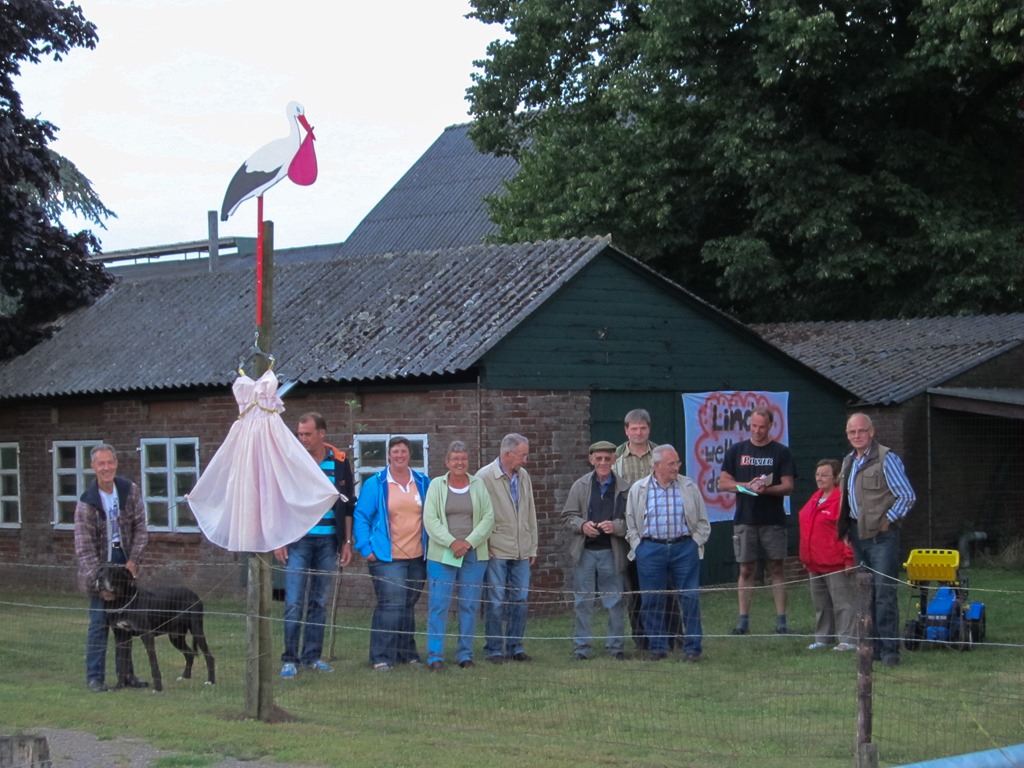
    Yesterday, as is traditional around these parts, we, the neighbours, assembled to erect a stork in the garden to proclaim the arrival of a baby.

    20120830-1955-07

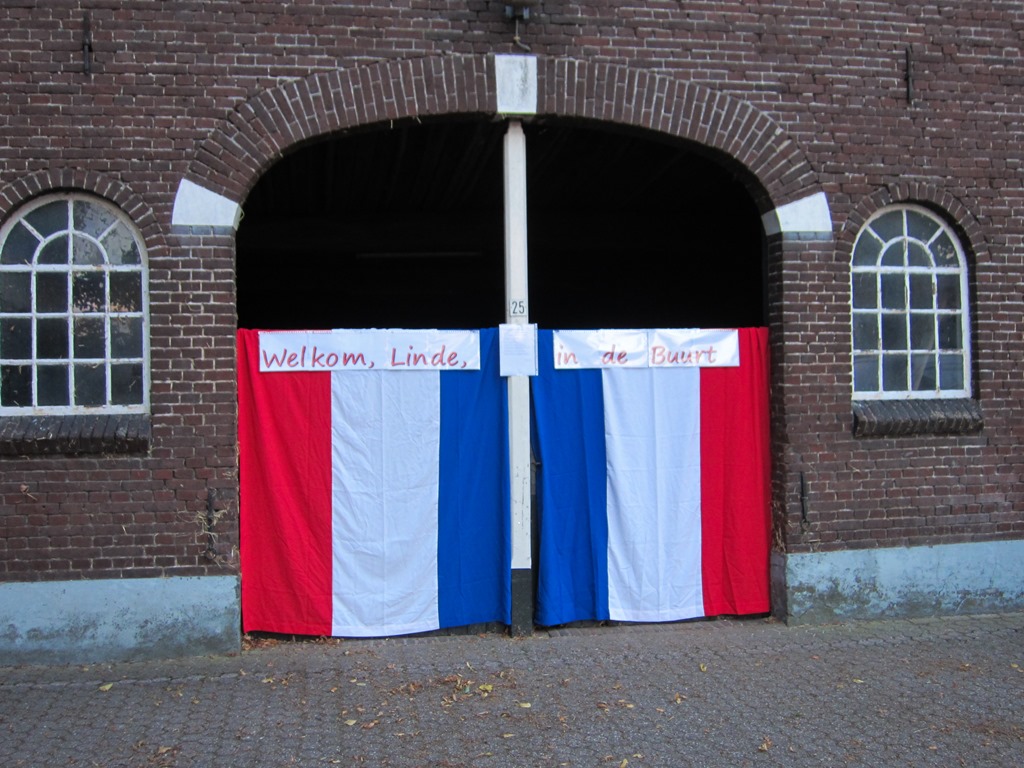
    Because Linde is a girl, Martin added the princess dress to indicate the fact. He also decorated the entrance to the cattle barn…

    20120830-1953-48

    The text reads Welkom, Linde, in de Buurt (Welcome, Linde, into the Neighbourhood).

  • The Right To Die

    I am profoundly thankful that I live in a country where I can choose if I wish to die.

    Tony Nicklinson has been denied that choice, and is condemned to serve more time in a living hell.

    Update #1: Polly Toynbee has a good article on this issue. As she says:

    The verdict was morally abominable – but inevitable. However bad a law may be, it is not for the courts to make fundamental change but for parliament – even when parliament sentences thousands a year to brutal and pointless suffering.

    However, as she points out, it will be difficult to persuade the UK Parliament to right this wrong. The religious lobby is extremely powerful.

    In opinion polls, for years, more than 80% have supported this change in the law, but every attempt at a right-to-die reform has been sabotaged by the large religious lobby, galvanised by Care Not Killing. The red benches, heavily stacked with the religious, including 26 bishops, saw off the last bills.

    Rowan Williams’s pretence is that their opposition springs from a fear this will lead to mass extermination of the inconvenient old. But why should the religious worry more about that than everyone else? The law would provide safeguards. The real religious reason is theological, as voiced in the Lords by the bishop of Oxford when he proclaimed “We are not autonomous beings” – we must all wait for God’s release. Presumably avoidable suffering is part of God’s mysterious purpose.

    As I said, I am thankful that I live in the Netherlands. Contrary to what the bishop of Oxford may choose to believe, I am an autonomous being.

    Update #2: Sarah Wollaston has an atrocious article on this issue. It appears that not only is she a physician, but she is also the Member of Parliament for Totnes. My heart goes out to the people of Totnes for being saddled with her to represent them in the democratic process, and I would hate to end up as one of her patients. She would quite cheerfully condemn me to continued suffering rather than respect my wishes to end my life.

    As Eric MacDonald says:

    The trouble with people like Sarah Wollaston is that they do not seem to understand what a human life is. They think, for some reason, that human life is simply a biological reality, the fact that a body is breathing. The human life that we value is very different. A life is a continuum of sorts, with a unity of conception. I do not want to enter into the philosophical problem of identity, but the important thing about a well-lived life is that it has a sense of overall consistency and coherence. That is why we respect people’s autonomy, the right to make their own decisions about life: what to do with their lives, who to marry, whether to have children, which vocation to pursue, and many other decisions that go to make up a life rich in experience and held together, so far as is possible, by a single, or at least a unified sense of what is appropriate for a life so conceived.

    A life conceived in this way includes some of the most important decisions that must be made, and includes, as an essential part, how that person understands the part that death plays in life. Most of us do not think much about death, especially when we are in the midst of life, but the time will come when the issue of dying will loom very large indeed. To be unable to make decisions about dying is to put outside the scope of a person’s conception of life all those things that may befall them at the end of life.

    Update #3: Tony Nicklinson has died. RIP. He fought well for the right to die with dignity.

  • Lest We Forget

    The BBC showed a one hour documentary last night: Death Camp Treblinka: Survivor Stories. The survivors in question were Samuel Willenberg and Kalman Taigman. They were among 600 prisoners who escaped during a revolt at the camp on August 2nd, 1943. Only 40 of them were known to have survived to the end of the war, and now, only Samuel Willenberg remains to bear witness – Kalman Taigman died in July this year.

    The programme was profoundly shocking – Treblinka II was a death camp that existed for no other purpose than for the killing of human beings. Over 800,000 Jews and Gypsies were gassed, shot and cremated during the 13 months of the camp’s operation.

    What struck me was how small Treblinka II was – only 600 metres by 400 metres. The Nazis kept between 700 and 800 prisoners to operate the camp, while 90% of the inmates sent to Treblinka were killed within the first 2 hours of arriving.

    Willenberg and Taigman told their stories to camera, and they were harrowing. For example, Willenberg found the coats of his two younger sisters among the personal effects of the dead he had been made to sort through by the Nazis. Or the fact that during his escape from the camp, a fellow escapee, who was wounded, begged Willenberg to shoot him, rather than be recaptured. Willenberg gave him his wished-for coup de grâce.

    The light at the end of the tunnel was the closing section of the programme that showed that the two men had survived the horrors of Treblinka and rebuilt their lives. Taigman had gone on to fight in the Warsaw Uprising, while Willenberg was a witness at the trial of Adolf Eichmann. The closing moments of the programme managed to bring a profound sense of peace and regeneration of the human spirit at its best – something that I never thought would be possible given what I had just seen and heard earlier in the hour

  • The Amish – Lovely People…

    So, the BBC had yet another documentary about the Amish last night. Following on from the programmes about the Stoltzfus families, the BBC gave us a programme about David and Miriam Lapp and their adorable children.

    And, just as with the Stoltzfus families, I found myself simultaneously liking the Lapps, but also cringing at their complete obliviousness of what humanity has achieved, for better or for worse.

    David and Miriam came across as genuinely likeable, but there was that awful frisson when Miriam started talking about the rod (as the Bible states), as an effective method of chastisement of her children, while smiling all the while. At this point, her youngest son pipes up to implore her not to use the rod (in her case a wooden spoon – with a smiley face drawn upon it!) on him. She grinned. I found that shocking and not at all cute or lovely.

    In the end, I once more found myself thanking my lucky stars that I was not born into an Amish community. The chains around the human spirit would have proved too much for me.

  • Onward Christian Soldiers…

    I see that the Church of England has now formally submitted its response to the UK Government’s consultation on same-sex marriage. They’re against it. If I were a Christian, like Giles Fraser, then, like him, I would be both ashamed and angry at the Church’s stance. But I’m not a Christian, so I’m simply disgusted and appalled at their continuing bigotry, and not in the least little bit surprised.

    The summary of the C of E’s 13-page submission makes interesting reading. They’re against it because:

    Such a move would alter the intrinsic nature of marriage as the union of a man and a woman, as enshrined in human institutions throughout history.

    Marriage, as they very well know, has taken on many forms in human institutions throughout history. There is nothing “intrinsic” about it. And if we’re talking about human institutions here, then your God can damn well keep his nose out of my marriage, thank you very much.

    Marriage benefits society in many ways, not only by promoting mutuality and fidelity, but also by acknowledging an underlying biological complementarity which, for many, includes the possibility of procreation.

    I totally agree with the first part of this statement, marriage does benefit society in many ways, including promoting mutuality and fidelity. However, after stating this, the C of E wants to erect “keep-out” signs to prevent this being available to same-sex couples. How very charitable of them. And as for “an underlying biological complementarity” it’s certainly easier if a married couple already possess the right bits, but if they don’t, it still doesn’t rule out the possibility of procreation and raising children in a loving family.

    We have supported various legal changes in recent years to remove unjustified discrimination and create greater legal rights for same sex couples and we welcome that fact that previous legal and material inequities between heterosexual and same-sex partnerships have now been satisfactorily addressed. To change the nature of marriage for everyone will be divisive and deliver no obvious legal gains given the rights already conferred by civil partnerships. We also believe that imposing for essentially ideological reasons a new meaning on a term as familiar and fundamental as marriage would be deeply unwise.

    To claim that the CofE has “supported various legal changes in recent years to remove unjustified discrimination and create greater legal rights for same sex couples” is a downright lie. As Giles Fraser writes:

    In the main House of Lords debate in June 2004 the majority spoke against it and voted six to one in favour of a wrecking amendment. The leadership of the C of E will do anything to keep gay people out of the church. It uses the sickly language of welcome but won’t let gay priests (even celibate ones) become bishops and is prepared to cut the Church of England off from the Episcopal church in the US because they do. At every turn, the Church of England treats gay people as an unwanted headache.

    As I say, I am not surprised that the C of E objects to the proposals, they’ve cherry-picked the bits of scriptures to form the basis of their objections. The bible also condones slavery and the stoning of adulterers, but somehow society (at least in the West) has managed to move on from that. But what I do object to is their insistence that their beliefs should apply to the rest of us:

    In common with almost all other Churches, the Church of England holds, as a matter of doctrine and derived from the teaching of Christ himself, that marriage in general – and not just the marriage of Christians – is, in its nature, a lifelong union of one man with one woman.

    from page 2 of the submission, my emphasis in bold. As I said above, their god can keep his nose out of my marriage.

    Then there’s the usual cry of “allowing same-sex marriages will dilute traditional marriage”. Section 13, page 4, of their submission (bold in the original):

    We believe that redefining marriage to include same-sex relationships will entail a dilution in the meaning of marriage for everyone by excluding the fundamental complementarity of men and women from the social and legal definition of marriage.

    You know, it’s ironic. Here in The Netherlands, civil partnership was introduced for same-sex couples back in 1998, and then in 2001 full civil marriage for same-sex couples became available. There’s been no “dilution in the meaning of marriage for everyone” at all. There are still church weddings for those who believe, but importantly, every couple first goes through a secular civil marriage ceremony, performed by a civil servant authorised to conduct weddings. This has long been the case – certainly before same-sex marriage became available. And there have been no challenges to the European Court of Human Rights to force Dutch Churches to marry same-sex couples, as the C of E apparently fears will happen in the UK.

    The news of the C of E’s submission has appeared on the 12th June 2012. By coincidence, this is what we consider as our 14th Wedding Anniversary. Martin and I had a civil partnership ceremony on the 12th June 1998. In 2003, we had this upgraded to a full civil marriage. The C of E’s continuing scaremongering on this issue of same-sex marriage is just another example of how, to quote Christopher Hitchens, religion poisons everything.

  • The Secret History of our Streets

    Last night, BBC Two broadcast the first in a series of documentaries about streets in London. It was The Secret History of our Streets: Deptford High Street.

    It was truly excellent – up there with what the BBC does best. Starting with the sociological maps of Charles Booth, it moved to the present day with vox pop interviews of residents and those connected with the history of Deptford High Street.

    The centre of the programme was John Price, whose family have lived in and around Deptford High Street for 250 years. His was the arresting voice of a community that was forced into a diaspora by the well-meaning, but ultimately ruinous, city planners of the 1960s.

    It was riveting television, that, as Lucy Mangan writes, prodded your brain awake as it broke your heart. Do read the comments on her article, and the comments on the producer’s blog of the programme, they are worth it.

    I was close to tears at several points, and moved to white-hot fury as the programme revealed that one street in Deptford had been saved from the city planners’ bulldozers. In a final irony, it turned out that the street that survived was of housing stock that was at the absolute bottom of the pile. Better streets, one of which contained John Price’s family, were flattened. And now, this street, consisting of tiny terraced houses built for the poorest of the poor in the 19th century, has properties that are on the market for £750,000.

    We were treated to the spectacle of an oleaginous estate agent showing a well-to-do couple around one such tiny property. I have never come closer to wanting to hurl something through the television as at that moment. It made me sick to the bottom of my heart.

    And while the programme showed some of the new life that has come to Deptford High Street, including the (to me) rather questionable evangelical preacher, I couldn’t help feeling that the programme makers had made the right choice by using the song and words of the evangelical choir to close what was a brilliant example of a documentary. The  choir sang ‘Will the Circle be Unbroken’ – a bitter comment on how a community was shattered for ever by the Council’s bulldozers. The chorus, ‘There’s a better home a-waitin’ – in the Sky, Lord, in the Sky’ was perhaps a cruel, but knowing, joke about the highrise apartment blocks the Council built. The new slums to be marked as such on the map of a 21st Century Charles Booth, whilst the original community has been scattered to the four winds…

  • A Prelate’s Pork Pies

    I drew your attention to John Sentamu’s piece on why he does not support same-sex marriage a few days ago. One thing I missed in that farrago is that His Grace was being economical with the truth. He stated that the bishops in the House of Lords supported civil partnerships when the bill was debated.

    Strange that, if one checks Hansard, as Iain McLean has done, that is not what you will find:

    The main Lords debate on the civil partnership bill took place in June 2004. Richard Harries, then bishop of Oxford, did indeed signal Church of England support for civil partnerships. But his efforts were contradicted by the five conservative bishops who spoke on the other side. Going by the bishops’ contributions to debate, the score is 5/3 against. Going by the bishops’ votes, it is 6/1 against. Six bishops voted for a successful wrecking amendment in the name of Lady O’Cathain, which made the bill unworkable. Only the Commons’ insistence on rejecting the O’Cathain amendment made it possible to enact civil partnerships.

    His Grace tells porkies. What a surprise. 

    A tip of the hat to Eric McDonald for drawing my attention to this doubtless unintended failure of His Grace to recall facts correctly when it suits him to do so.

  • A Prelate’s Petitio Principii

    …Or, a bigot begs the question. John Sentamu explains why he objects to same-sex marriage. It’s a staggering piece, chock-full of circular arguments and some breathtaking disingenuousness. A prime example of the latter is his opening:

    I will be the first to accept that homosexual people have suffered discrimination and sometimes worse through the decades and that the churches have, at times, been complicit in this.

    Er, at times the churches have been complicit in this? Dear God, Sentamu, your Christian church has our blood on its hands. It has been the powerhouse of discrimination and violence against us for centuries, and remains so in many cases, the Roman Catholic Church and the African Anglican churches to name but two.

    I think it’s instructive, as one of the commenters on this piece has done, to use Sentamu’s opening words and replace the targets of his piece. It throws into sharp relief Senatmu’s bigotry:

    I will be the first to accept that slaves have suffered discrimination and sometimes worse through the decades and that the churches have, at times, been complicit in this. There is much penance to be done before we can look our enslaved brothers and sisters in the eye. But that baleful history does not diminish the need to speak the truth in love.

    I firmly believe that redefining society to embrace emancipation would mean diminishing the meaning of life for most people, with very little if anything gained for black people. If I am right, in the long term we would all be losers.

    Of course, if someone should ask, “how will my household be affected if servants can be free to come and go as they please?”, the answer is: not at all. But let me put the question another way: what sort of a society would we have if we came to see all social relations primarily in terms of equal rights? Society is designed to meet the different needs of its different members in different ways. It is the model of the just society that responds intelligently to differences rather than treating everyone the same.

    While I am a strong supporter of justice and equality of opportunity for all people, I want to insist that with those rights go our responsibilities to one another. These are enshrined, I believe, in our legal definition of human property. Would we be a better society if we made the master-servant relation simply a private contract between two individuals, with no wider implications of society and property rights? I do not believe that we would. The issue is not the implication for any existing household,  but the implication for people in the future, when the social meaning of bondage has been changed and, in my view, diminished.

    Drawing parallels between the proposed emancipation and the introduction of same-sex marriage ignores the fact that there is more than one paradigm of equality. For me, sexual equality rests on the doctrine that there is only one dominant race – the white race – and any difference of treatment on sexual grounds is therefore unjustifiable. But there is another view, based on the complementary nature of blacks and whites. In short, should there be equality between the races because a black man  can do anything a white man can do or because a good society needs the different perspectives of blacks and whites equally?

    We’ve moved on from the days when people, including influential churchmen (they’re always men), could say something like the above in polite society. Sentamu may well believe that he is speaking the truth in love, but he is not. He is preaching the same old hatreds that have bedevilled humanity down the centuries.

    Sentamu is likely to be the next Archbishop of Canterbury. I’m glad I’m no longer a Christian.

  • Persecution?– I Think Not

    I see that Lord Carey, former Archbishop of Canterbury, is claiming that Christians are being persecuted in the UK.

    What I see is that UK society is waking up to the fact that historical privilege accorded to religion to practise its bigotry and condemnation of others is being questioned.

    Quite right too.

    Humanity is better than you, Lord Carey. Get over it.

    Oh, and I see that Shuggy has a few relevant examples over at his blog concerning Christian persecution. And I simply can’t resist mentioning Urban Grandier as an example of Christian persecution.

    Motes and beams, George?

  • The European LGBT Survey

    I noticed on the web site of the European Parliament’s Intergroup on LGBT Rights an item about the fact that members of the European Parliament have welcomed a new survey into the lives of lesbian, gay, bisexual and transgender people in the European Union and Croatia.

    The survey asks a range of questions about LGBT people’s experiences including:

    • Personal circumstances
    • Public perceptions and responses to homophobia and/or transphobia
    • Discrimination
    • Rights awareness
    • Safe environment
    • Violence and harassment
    • The social context of being an LGBT person

    The survey has been drawn up on behalf of the the European Union Agency for Fundamental Rights (FRA) in order to gather data in support of equal treatment legislation and policy making.

    I’ve just filled in my response. If you are an LGBT person living in the EU (or Croatia), I urge you to do the same.

  • Spambots and Sofas

    Jon Ronson always seems to turn up some interesting aspects of society. Sometimes however, it seems as though he’s turned over a stone and found something particularly unpleasant underneath.

    For example, I found it very difficult to watch the three specimens sitting on this sofa. The one in the middle, in particular, strikes me as someone I would find it very difficult to warm to under any circumstance. His name is Dan O’Hara, lecturer in literature at the University of Cologne. His rationale for doing what he did to Jon Ronson (when he finally reveals it at the end of the video) seemed to me to be thin, unconvincing, and insincere.

  • The Centre Cannot Hold

    I’m not a Christian, nor even religious, but I have respect for Rowan Williams, the current Archbishop of Canterbury. I say current, because it was announced today that he will be stepping down at the end of the year from his post and returning to academia.

    I couldn’t resist a wry smile at this quote from the article:

    …he has been respected on all sides for his gifts as a preacher of great eloquence and flashes of clarity.

    Yes, “flashes of clarity” – I confess that I find his writing a bit of a struggle to comprehend. A clear writer he is not. I sometimes amuse myself by putting his prose through the reading comprehension tester in Microsoft Word. Inevitably it will rate the text as being difficult to understand.

    I think that he’s basically a good man, who has been trying to do an impossible job as leader of the Anglican Church. It will probably come as a relief to be able to pass on the poisoned chalice to his successor. That looks as though it may well be John Sentamu, whose hard-line views will contrast greatly with Williams. I can’t say that I feel particularly well-disposed towards Sentamu, based on his past performance. Still, I shouldn’t think that’s going to worry him one iota.

  • This Isn’t A Pub Anymore!

    Yesterday’s Jesus and Mo is a humorous allegory on a current topic. Cardinal Keith O’Brien is credited as the scriptwriter.

  • Feet of Clay

    One of my daily joys is walking the dogs in the nearby woods. Since I bought my Windows Phone, I’ve got an additional dimension of joy by listening the podcasts of In Our Time, a weekly radio programme on a wide range of subjects (e.g. Science, Religion, Philosophy, History, etc.). Each 40 minute episode nicely times with the morning walk in the woods. The programme has the format of three experts on the week’s topic being led in a discussion by Melvyn Bragg (now Baron Bragg of Wigton).

    Now I like Melvyn Bragg – I think he’s a good writer and broadcaster, and In Our Time deals with serious ideas in a way that does them justice.

    So I was somewhat shocked at this attack on Richard Dawkins from Bragg. I had expected better of him. As Ophelia says:

    He’s either bullshitting or totally confused, and since he’s a knowledgeable guy, I’m guessing he’s bullshitting. Yes feelings are important; yes we mostly don’t rely on reason; no it is not therefore the case that emotions and feelings are reliable sources of knowledge. He implies that they are. I call bullshit.

    Baron Bragg is proudly displaying his feet of clay.

  • You Couldn’t Make It Up!

    That revered institution, the Thought For The Day on BBC Radio 4, is still carrying on churning out platitudes. I always read the Rev. Dr. Peter Hearty’s merciless skewering of the Thoughts. Yesterday, we had Canon Angela Tilby’s thoughts on gay marriage.

    The poor woman was a bit caught in the middle, as she likes to think of herself as a liberal, but she couldn’t quite bring herself to say that the Churches had got it wrong.

    I particularly liked the moment when she actually said:

    The point about sacraments is that they can’t be made up…

    Ah, but Canon Tilby, the whole point is that they are made up. Humanity has created its gods, not the other way around, however much you might want to believe that.

    Meanwhile, I suppose we are into hearing more of the same from churchmen (and women) saying that same-sex marriage is simply wrong. The UK has clearly got some distance to travel before they arrive at the point that we enjoy here in The Netherlands. As a commentator (who lives in The Netherlands) wrote in response to Canon Tilby’s piece:

    It’s obvious from the pronouncements from a variety of god-botherers over the last week or so, that they still think their Church, (whichever one it happens to be), still owns marriage, and consequently they have the right to decide who may or may not get married. But marriage, in this country [the Netherlands] at least, is not a religious institution, but a social and legally binding secular contract. Although couples may choose to have a religious ceremony, the marriage still has to be registered with secular authorities in order to be valid. Weddings not so validated, as sometimes happens with ones carried out according to Islamic rites, are not recognised in law, and the couples do not have the rights of married couples regarding property, custody of children, inheritance, etc.

    As I understand it, there is no suggestion that any church or religious institution will be forced to conduct gay marriages, but equally they should have no right to dictate who should or should not be allowed to marry outside of religious buildings.

    Quite.

    Here, couples who are religious will always have their civil marriage ceremony in the local Townhall first, before trooping across the market square into the church for the religious marriage ceremony. Even Prince Willem-Alexander and Princess Máxima did the same. They were married, by Amsterdam’s Mayor at the time, Job Cohen, on the 2nd February 2002 in a civil ceremony in the Great Hall of the Beurs van Belage, before going to the Nieuwe Kerk (the New Church) for the religious ceremony.

  • A Voice of Sanity

    After Cardinal Keith O’Brien’s very unpleasant outburst on the possibility of the UK’s legalising same-sex marriage, it comes as something of a relief to be able to point to a voice of sanity on the subject. It belongs to the philosopher Norman Geras.

    Actually, he has two blog posts on the subject. The first is a reaction to the Cardinal directly, in which Geras notes how feeble the arguments put forward by the Cardinal are.

    The second is his reaction to the text of a letter co-signed by the Archbishop of Westminster and the Archbishop of Southwark on the subject of same-sex marriage that will be read out 2,500 Catholic churches in the UK next Sunday. As Geras says:

    I make no attempt to judge these remarks in the light of Catholic teaching, since I’m not competent to do so. But if we measure them against the more general understanding of marriage in our society, the exercise suggests that what the two Archbishops define as the true meaning of marriage is an insult to many people’s marriages.

    By the way, I found it instructive to read the comments on the article in the Catholic Herald that gave the text of the letter. It was mostly a singularly unpleasant experience. Clearly there are plenty of Catholics who align themselves with Cardinal O’Brien. Bigotry is alive and well.

  • Raising the Drawbridge

    I’ve written a couple of times before over my worries that the Dutch government will make it illegal to hold dual nationality.

    We seem to be getting close to that position. Last Friday, the Dutch Cabinet decided to go ahead with legislation aimed at reducing the number of people with dual nationality.

    The idiotic thing is that it will not affect those who are presumably the real targets of this xenophobic drive. The real targets (in the sights of the “Little Hollander” view of the PVV and its supporters) are the Turks and Moroccans who settle here. Unfortunately (from the PVV’s perspective), they are required, by their country of birth, to hold onto their original nationality. So the proposed law cannot apply to them. Meanwhile, others, whose country of birth is more relaxed about the holding of dual nationality, will be required to renounce their birth nationality, simply because the Dutch government can make it so.

    So I’ll be forced to renounce my British and Manx nationalities, merely to satisfy the xenophobia of the Dutch government and the PVV. A plague on them both.

    Meanwhile, in other news, Geert Wilders, leader of the PVV, announced today that the Netherlands should leave the Euro and return to the Guilder.

    The drawbridge is being raised a little further every day…