Reading President Museveni’s speech at his signing of Uganda’s Anti-homosexuality bill is depressing. Not so much because of his clear bigotry, ignorance, and politicking – that’s only to be expected – but because of my realisation of what this means for gay people – and people who have gay brothers, sisters, parents, relations and friends – in Uganda. They have just been thrown to the wolves. And it hasn’t taken long for the wolves to start howling. A Ugandan newspaper has published a list of what it called “the country’s 200 top homosexuals”, outing some who previously had not identified themselves as gay.
I was heartened, but not surprised, by Desmond Tutu’s condemnation of the new law. I fear, however, that his voice will be drowned by a new wave of witchhunts in Uganda.
In 2009, Wendy Doniger’s book The Hindus: An Alternative History was published by Penguin. It seems to have attracted the wrath of Hindu (male) chauvinists; to the extent that a lawsuit from the Hindu group Shiksha Bachao Andolan accusing Doniger (a University of Chicago professor) of “hurt[ing] the religious feelings of millions of Hindus” was instigated in India. As a result, Penguin have withdrawn the book from sale in India and intend to pulp the copies.
Quite rightly, this decision has resulted in a storm of protest, and propelled the book up the bestseller list. I’ve ordered my own copies (paperback and Kindle) out of interest, in support of Doniger, and against the tiresome president of Shiksha Bachao Andolan, Dinanath Batra. As Ophelia says, Batra is an experienced religious bully.
Hall was always among the first to identify key questions of the age, and routinely sceptical about easy answers. A spellbinding orator and a teacher of enormous influence, he never indulged in academic point-scoring. Hall’s political imagination combined vitality and subtlety; in the field of ideas he was tough, ready to combat positions he believed to be politically dangerous. Yet he was unfailingly courteous, generous towards students, activists, artists and visitors from across the globe, many of whom came to love him. Hall won accolades from universities worldwide, despite never thinking of himself as a scholar. Universities offered him a base from which he could teach – a source of great pleasure for him – and collaborate with others in public debate.
It’s a great loss. It was only a couple of months ago that I was walking through the woods listening to a podcast of a discussion between him and Laurie Taylor and being impressed anew at his insight.
For an overview of his work and thought, this article, also in today’s Guardian, is a good start.
The Guardian published an opinion piece by Kevin McKenna last Saturday: Scotland’s assisted suicide bill is an offence to our human dignity. Frankly, if anything was an offence to human dignity, it was this piece of invective. But then again, McKenna is an executive editor of the Daily Mail in Scotland. Says it all, really. The Guardian should be ashamed at publishing such tripe. I see that the comments pretty much call out the piece for the bullshit it is.
I am thankful that I live in a country where I can ask for a peaceful death, should it prove necessary, and where safeguards exist to protect the vulnerable.
I cannot imagine what it must be like for LGBT people in Uganda at the moment. One thing is for certain, if Martin and I were living in Uganda instead of here, we would both be looking at life imprisonment.
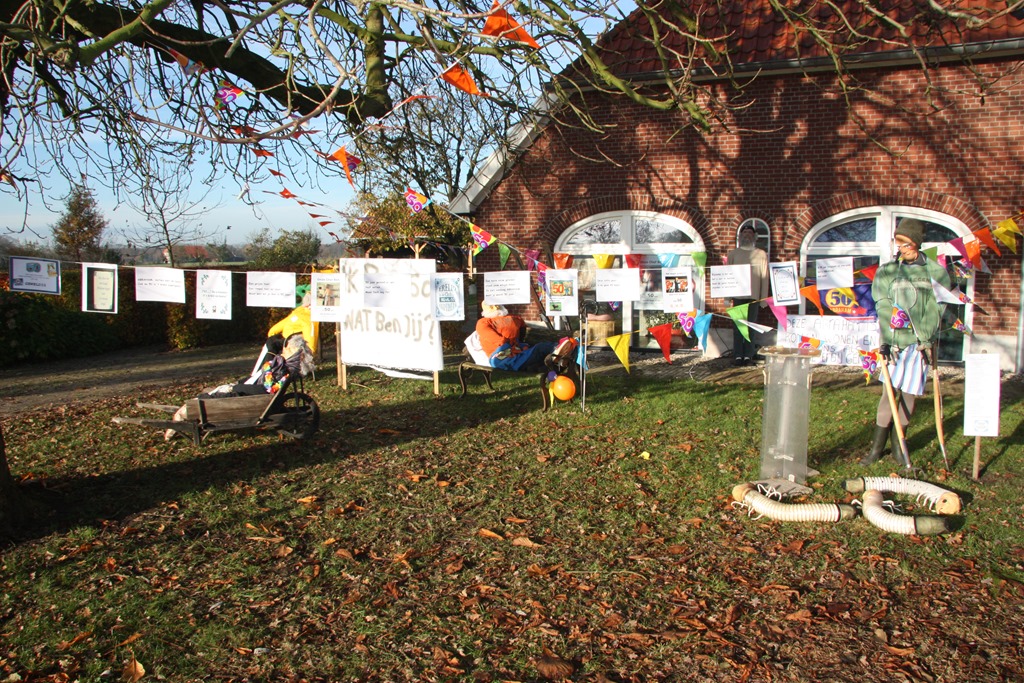
Here in the Netherlands, there’s a tradition that when someone reaches the age of 50, they are said to be an Abraham (if they’re a man) or a Sarah (if they’re a woman).
And in this part of the Netherlands, that is often marked by friends and neighbours installing an appropriately (or inappropriately) dressed mannequin outside the celebrant’s house.
Last Wednesday, one of our neighbours reached his 50th, so late on Tuesday night his garden was invaded by a series of groups each installing their own version of an Abraham and accompanying signs and decorations. This was the scene the following morning…
There’s a small village, Bredevoort, that lies about 7 kilometres distant from us. It’s a pretty little village of about 1,500 inhabitants, and it also has a disproportionate number of antiquarian bookshops in it. That’s because, since 1993, it has become known as a Boekenstad (book-town). Apart from the 20 or so bookshops, there are also regular antiquarian bookmarkets, with market stalls placed in and around the central market square.
I often go along to the bookmarkets, and when I do, one of the things I invariably see is a queue of people waiting to get cash from Bredevoort’s one and only cash machine.
Today, I read in the Volkskrant that the Rabobank, the bank responsible for the cash machine, intends to remove it from the village. According to Nicole Olde Meule, the person responsible for the bank’s consumer clients in this area, the number of transactions has fallen by 9% over the past year to 25,000 per year. And that, she thinks, is justification enough to remove the service.
One of the bloggers that I make a habit of reading is Norman Geras. That is, until last Friday, when I found an entry on his blog from Jenny Geras (his daughter) saying that Norm had died that day.
Another voice of reason stilled. Here’s his obituary. It’s worth reading to get a sense of the man, and of course you can still read his writings on his blog.
Stephen Fry has collaborated with film-maker Fergus O’Brien to make a two-part documentary Out There. In it, Fry reflects just how much, and how little, things have changed in his lifetime for gay people around the world.
Martin and I watched the first part last night. Yes, we know that we are incredibly lucky to be able to live where we do, but to see the reality of the extent of homophobia elsewhere, much of it State-sponsored, is very depressing. Uganda featured prominently in last-night’s programme. Fry was shown participating in a Ugandan radio phone-in programme with Pastor Solomon Male, who seems obsessed with homosexual sex to a quite unhealthy degree. Fry also had an interview with the Ugandan State Minister for Integrity and Ethics, who amply demonstrated a complete absence of both of these qualities. Fry found the latter interview in particular quite stressful, in part I suspect because the Minister at one point was shouting that he would arrest Fry.
As a homosexual man himself, it was entirely understandable that Fry took the poisonous opinions he encountered in Uganda and Los Angeles as personal attacks. Nonetheless, I was surprised at how quickly he allowed himself to be drawn into a slanging match, his gravitas deserting him minutes into a debate with Ugandan pastor Solomon Male. It was all much too shouty and felt like the opportunity for instructive discussion had been lost. Later, in an invective-filled session with the Ugandan State Minister for Integrity and Ethics, Fry resorted to childish taunts: “Homosexuality is fantastic. You should try it, it’s really good fun.” This, surely, was not the best way to counter deep-rooted prejudice.
Easy for you to say Mr. Hawksley, but then I doubt that you’ve been much at the receiving end of institutionalised homophobia. If I were in Fry’s place, I’d probably have lost my temper much sooner with the odious human being that is the Ugandan Minister. “Instructive discussion” with people such as Male and the minister is an oxymoron, as I know from experience.
The second part of the documentary will be shown tonight, in which Fry visits Russia, and gets to meet Deputy Milanov of St. Petersburg. Somehow, I think Mr. Hawksley will once again have to suffer a sense of disappointment that there is no “instructive discussion”. As Stephen Fry writes:
I have visited Russia, stood up to the political deputy who introduced the first of these laws, in his city of St Petersburg. I looked into the face of the man and, on camera, tried to reason with him, counter him, make him understand what he was doing. All I saw reflected back at me was what Hannah Arendt called, so memorably, “the banality of evil.” A stupid man, but like so many tyrants, one with an instinct of how to exploit a disaffected people by finding scapegoats. Putin may not be quite as oafish and stupid as Deputy Milonov but his instincts are the same.
Kenan Malik sums up the real consequences of the terrible conflict in Syria. It makes for depressing reading. The posturing of Putin in particular is pure politics. However, as Malik says, none of the players come out of this well. Meanwhile, the slaughter and the flood of refugees continue.
While I often shake my head at some of the religious bollocks that emanates from the US, I would do well to remember that here in the Netherlands we have many examples of our own.
School board chairman Johan van Puten is reported to have said:
‘The conviction of the parents that the symbol was unacceptable was so strong that I knew a rigorous approach was the only solution’
Someone should point out to him that strong convictions do not necessarily equate to them being correct. And in this instance, it’s clearly the parents who need education as much as, if not more than, their children.
The New Statesman’s Caroline Crampton lists 18 arguments voiced today in the UK’s House of Lords against same-sex marriage.
All the usual suspects are there, including the new Archbishop of Canterbury. I can’t say that I’m surprised by his stance. Religion poisons pretty much everything.
I suspect that very similar arguments were once made against the abolition of slavery.
Since 2004, May 17 has been marked as the International Day Against Homophobia. The Dutch Government is hosting a three day international conference in The Hague on the subject of homophobia at the moment.
Yesterday, the Netherlands Institute for Social Research published its own report on the situation of LGBT people in the Netherlands. It makes slightly more comfortable reading than the EU report, but we are also likely to be the target of homophobia from the usual suspects within Dutch society.
I see that my birthplace, the Isle of Man, is still home to some old and ugly prejudice. Kira Izzard and Laura Cull have been refused a tenancy application because they are a lesbian couple. Their landlord, Keith Price, who is a Methodist Minister, stated:
“We understood that they were not a family so we said we couldn’t proceed [with the rental agreement].
“We believe that God has a plan for our lives within the context of marriage, the scripture is quite clear in its teaching on this.”
In the UK, such a refusal would be illegal; unfortunately, the Isle of Man is a Crown Dependency, and not part of the UK, so it makes its own laws.
Ms Izzard has started a petition to ask the Manx Parliament to support the UK Equality Act 2010 in the Isle of Man. Naturally, I’ve signed it.
Well, bully for him. And a bully is what he is proposing to be, with his pernicious nonsense. I reject his argument that the “problem with euthanasia is not that it is a immoral way to die, but that it has its roots in a fearful way to live”.
But it’s not called “looking after each other” if what the person who is suffering is asking for is help to die. It’s called coercion, then — which has a very different resonance — and if someone is being coerced into being a burden, then Fraser has simply has missed the point about what looking after each other is all about. Moreover — and this, coming from a priest, is inexcusable — it simply papers over the cracks with regard to how people die. Sometimes the burden, if Fraser really wants to know, is borne by those who are dying, and if those who are watching someone die in misery doesn’t notice this, then they are simply not watching closely enough!
And this just shows that Fraser hasn’t the least understanding — but not the slightest understanding! – of what is meant by assisted dying. It’s not the last desperate act of a person who has no inkling of what is happening until the very last moment, when farewells are almost impossible; it is, rather, a conscious act of taking the decision to die upon oneself, instead of leaving it up to the vagaries of the dying process, or to the all but certain stages that the trajectories of some diseases will follow to carry one away either gasping for breath or crying out in pain. Fraser seems to have not the slightest idea of how people die, or, if he does, he deliberately hides it from his readers the less to worry them at the end of life. But it is just as well to know, beforehand, just how terrible death can be, not so that we can be afraid of it — which seems as far as Fraser’s puny imagination will take him — but so that we can be prepared for it, and take our leave before the worst overtakes us.
It’s been a momentous day here in the small country of The Netherlands. This morning, at 10:10, Queen Beatrix signed the document that confirmed that she has abdicated in favour of her eldest son, Willem-Alexander, who has now become King. The first Dutch King since the 19th Century.
This signing took place in the Dam Palace, which started out life as the Amsterdam City Hall in the Dutch Golden Age of the 17th Century.
Now, I’m no monarchist, but I was moved by the day’s events. Right from the moment that Queen Beatrix announced she welcomed everyone to the ceremony, and the roar of approval from the crowd outside in the Dam Square brought a smile to her face as she realised that the Dutch people were watching and supporting this move.
Not that Beatrix has been a bad Queen. Far from it. She has become beloved by us in a way that could only have been dreamed of when she became Queen in 1980. Then, there were protests and smoke bombs in the Dam.
Following the signing of the Abdication document, this afternoon was the inauguration of the new King. I found it almost astonishing.
I grew up in the United Kingdom, where the British Monarchy is seen as something established by God. There is a Coronation, where the crown is placed on the head of the new monarch by the Archbishop of Canterbury. Religion and Monarchy are completely intertwined.
In stark contrast, here in The Netherlands, the Monarch is not crowned. Instead, King Willem-Alexander was inaugurated in a ceremony that involved the State – not the Church.
The King pledged his allegiance to the democratic process, and affirmed his responsibilities to the citizens. He made a good, and thoughtful speech, honouring the service of his mother, and promising that he would do his best for the Dutch citizens and the State. In return, the State, in the form of the members of the Dutch parliament, signalled their assent to his assumption of the role of king. And they did that individually – each standing when their name was called, and either swearing by God, or a simple “I promise”. It was interesting to see how many members did not invoke God. Another indication of how secular the Netherlands is, and how the United Kingdom still is not.
King Willem-Alexander pledged his allegiance in front of symbols of the State – the books of the Law of the Land – as well as symbols of his own status, the crown, sceptre and orb. He also had five representatives of the Dutch people present to bear witness, and to bear symbols of the importance of the citizen to Dutch society. They were his “Koningwapenen”, or Kings of Arms. One of them was André Kuipers, Dutch physician and astronaut.
As I say, I was moved. The importance of ritual to humans is unmissable, and touches something deep within us.
I wish Willem-Alexander, and his very impressive wife, Máxima, all the best in their new roles as King and Queen of the Netherlands. I think that they will both do well.
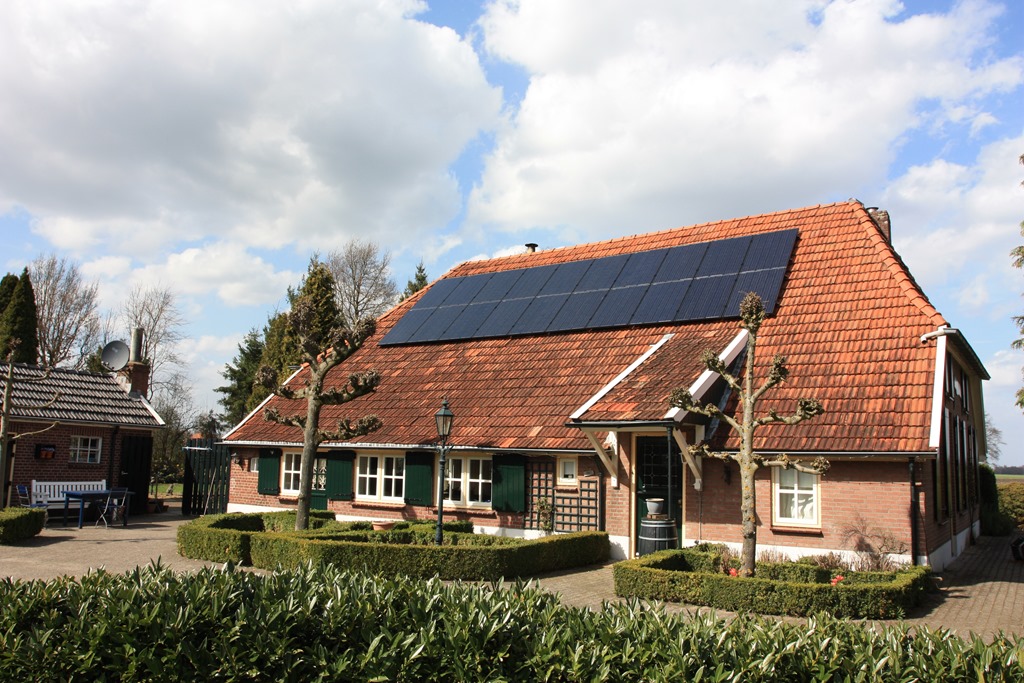
We’ve just had twenty solar panels installed on the roof.
Apparently, we’ve joined a growing trend in the Netherlands. In 2012, there was 260 MW of energy produced via solar panels – a doubling of what was produced in 2011.
I must admit I get a kick out of watching our electricity meter run backwards – indicating that we are supplying electricity to the national grid (and getting paid for it by the Power Company!), rather than consuming from it.
This is a long term investment – it will probably take ten years to break even, but I’m glad that we’ve done it.
Ah, Theo Hobson. It’s been a while since I felt moved to document how much I disagree with his writings – well, I have to say that once I was astonished to find that I actually agreed with him. It was, truly, a miracle.
So, she’s dead. She certainly changed our world, but, personally speaking, I’m not convinced she improved it. For me, Elvis Costello’s song: Shipbuilding is the perfect summary of that time.
…she was a terrible, terrible disaster to this country. The utter devastation of heavy industry, the writing off of countless billions worth of tooling and equipment, the near total loss of the world’s greatest concentrated manufacturing skills base, the horrible political division of society and tearing of the bonds within our community. She was a complete, utter disaster.
The Guardian’seditorial, while praising her, also damns her:
She was an exceptionally consequential leader, in many ways a very great woman. There should be no dancing on her grave but it is right there is no state funeral either. Her legacy is of public division, private selfishness and a cult of greed, which together shackle far more of the human spirit than they ever set free.