Reflections on life at “De Witte Wand”…

Category: Society

  • Racism: The Crack Cocaine of Politics

    The bogeyman of English politics of the late 1960s was Enoch Powell, and Hanif Kureishi has written a masterful article on the effect of Powell: Knock, knock, it’s Enoch. It’s well worth reading.

    Like Kureishi, I was a teenager in 1968 when Powell gave his Rivers of Blood speech. Like Kureishi, I was born in Britain, although unlike Kureishi, I was white. So even though I was appalled at what Powell unleashed, I was never the target of white racism. Ironically, I am a child with immigrant blood – my mother’s side of the family has maternal roots in 19th Century India. As I’ve written before, my great-aunts and great-uncle were clearly Indian (as can be seen in the photograph below), and my mother remembered the casual racism directed at her father when she was a young girl.

    G Aunts Corra & Annie, G uncle George Johnson circa 1915

    Perhaps because of what my mother remembered, I was brought up without being conscious of the fact that racism existed. I also grew up on the Isle of Man, and I only recall ever seeing one black person in real life as a child; he worked at one of the hotels during one summer season. I was more struck by the fact that his bicycle had a real radio on it, than by the fact that he was black. Nonetheless, racist attitudes existed in the wider society, and I must have subconsciously been aware of them. I recall one incident that happened when I must have been 11 or 12, and visiting my aunt and uncle who lived in Tottenham. I was walking along a London street and saw a very expensive car – it was either a Rolls or a Bentley – and being rather impressed by its beauty. Then, the owner and his family appeared and got into the car. They were black, and from seemingly nowhere, the thought popped into my head: “how have the likes of them got a car like that?” I stopped in shock, absolutely appalled at what I had just thought, and horrified that I could think such a thing. Despite my parents care and attention, racism had snuck in and lodged itself in my brain.

    It’s an insidious thing. Look again at that photo of my great-uncle George above. The uncle that I was visiting in Tottenham looked just like a whiter version of George. By his, and my mother’s, generation, their Indian origins had faded enough so that they could pass for white. He lived in the same terrace house where he had grown up. Tottenham became a multicultural melting pot, and during the 1960s contained a large population of African-Caribbean people. I became very aware during that time that my uncle and aunt had racist attitudes towards their neighbours. I would often bite my tongue in their presence. Lovely people, but with that side to them that I found very difficult to deal with.

    As Kureishi writes:

    Appealing to the worst in people – their hate – is a guaranteed way to get attention, but it is also fatal. Powell talked in whole sentences and was forever translating Herodotus, so was known for his cleverness. But he wasn’t smart enough to resist the temptation of instant populism for which he traded in his reputation. Racism is the fool’s gold, or, rather, the crack cocaine of politics.

    Forty-five years on, and it’s still happening. We have Nigel Farage and UKIP in the UK, and Geert Wilders and the PVV here in the Netherlands.

    Kureishi again:

    Britain survived Powell and became something he couldn’t possibly have envisioned. He was a pessimist and lacked faith in the ability of people to cooperate with one another, to collaborate and make alliances. The cultural collisions he was afraid of are the affirmative side of globalisation. People do not love one another because they are “the same”, and they don’t always kill one another because they are different. Where, indeed, does difference begin? Why would it begin with race or colour?

    Racism is the lowest form of snobbery. Its language mutates: not long ago the word “immigrant” became an insult, a stand-in for “paki” or “nigger”. We remain an obstruction to “unity”, and people like Powell, men of ressentiment, with their omens and desire to humiliate, will return repeatedly to divide and create difference. The neoliberal experiment that began in the 80s uses racism as a vicious entertainment, as a sideshow, while the wealthy continue to accumulate. But we are all migrants from somewhere, and if we remember that, we could all go somewhere – together.

    I hope we can survive Farage and Wilders as well.

  • A Piece of Wet String

    One of the less attractive things about living in the Dutch countryside is that the internet is usually delivered via the old copper cables used by the telephone companies. In the far distant days of using dialup modems (that is, 25 years ago), this was perfectly adequate. When ADSL technology was first introduced, using the same cabling, it seemed blazingly fast by comparison. And providing that you live close to the telephone exchange, it is still perfectly acceptable. However, the further away from the exchange that you are, the lower the internet speed becomes.

    So for those of us out in the countryside, using the internet is usually akin to dealing with a piece of wet string. I’ve just surveyed the addresses around us that make up our postal area. It’s about 6 km by 3 km with two small villages in it surrounded by outlying farms and houses. There are, in total, 436 addresses. It’s possible to do an online check of what internet speed is available at each address, and this is the rather depressing result:

    image 

    There are only 54 households that have internet (download) speeds of 8 Mbps or more, whilst the great majority (391) have 4 Mbps or less, with 101 households stuck with only 1 Mbps available via ADSL internet.

    These days, such speeds are considered low, bordering on completely unacceptable, for the services that are being delivered via the internet. For example, there are changes in the Dutch Healthcare services coming that will require broadband speeds beyond what is currently available for most of us round here. The government and local authorities would like to see more of the elderly being able to live at home in their own houses for as long as possible, while being supported by healthcare professionals, carers, and volunteers. Their services will increasingly be delivered virtually by the internet. The district nurse and the doctor will no longer be carrying out housecalls by driving round, but using video conferencing to see their patients (or “clients” in the new Healthcare-speak).

    At the other end of the age-range, today’s schoolchildren are using education services delivered via the internet, and this will only broaden and demand more bandwidth in the future. I know that the Director of our local schools is already concerned for the pupils at our village school. They are being disadvantaged in comparison with her pupils at the town school, which has broadband internet delivered via fibre optic cables.

    The laying of fiber optic cables began ten years ago in the Netherlands, and now there are almost 2 million Dutch households connected to the network, mostly in large towns and cities. The issue has always been that it is more financially attractive for the cable provider to lay cable in built-up areas than in the open countryside. The Province of Gelderland tried to get an initiative off the ground earlier this year: a public-private partnership with a cable provider, but the deal fell through. Now they have just announced an initiative, in cooperation with ten of the Province’s local councils (including ours!), to lay fibre optic cables in countryside areas. The Province is making 32 million euros available for investment, with the ten local councils adding a further 25 to 30 million.

    I expect that this investment will take the form of loans, with low or zero interest, made to individual householders who wish to pay for a connection to the fibre optic network. The challenge will be to get sufficient people willing to pay, so that the price per connection comes down to an attractive price for the majority of people. Our village community council is asking people how satisfied they are with the current situation for both internet and mobile telephone coverage. We’ll be using the results of that in our discussions with the Council. I’m hoping that we can get enough people around here to be interested in replacing the current pieces of wet string with pieces of glass – a fibre optics network.

  • Celebrating Hetty

    One of the pleasant things about living in the Dutch countryside is that we get to participate in traditions that are non-existent or being eclipsed in cities. One such tradition is Noaberschap (neighbourliness). Martin and I are the Noaste Noabers (closest neighbours) of Herman and José. This means that we are responsible for organising the rest of Herman and José’s neighbourhood (Buurt) in times of celebration or need.

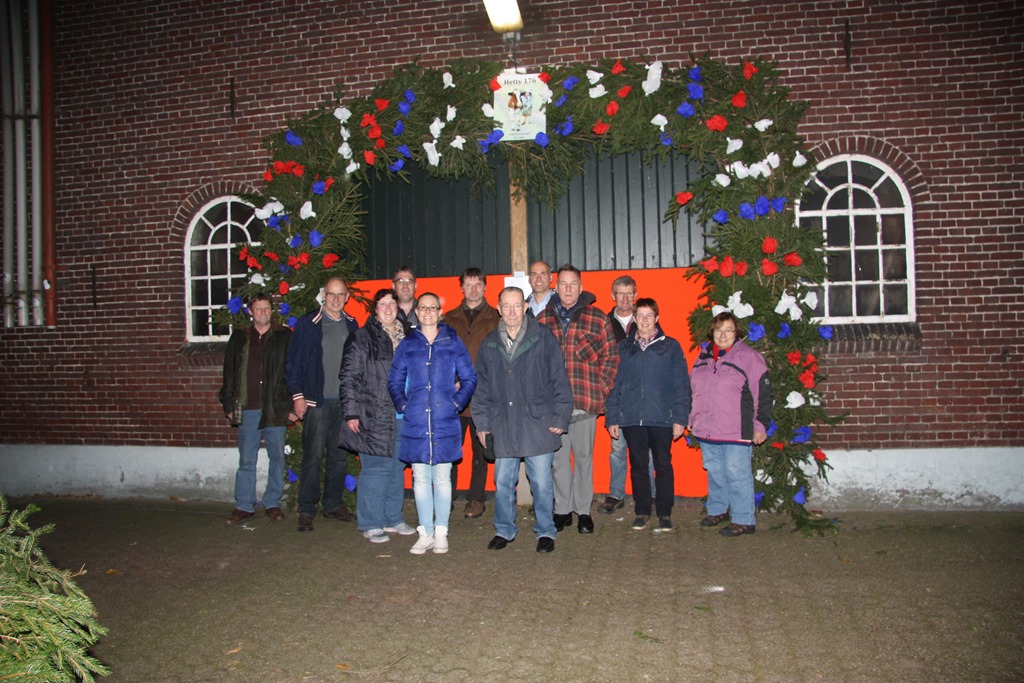
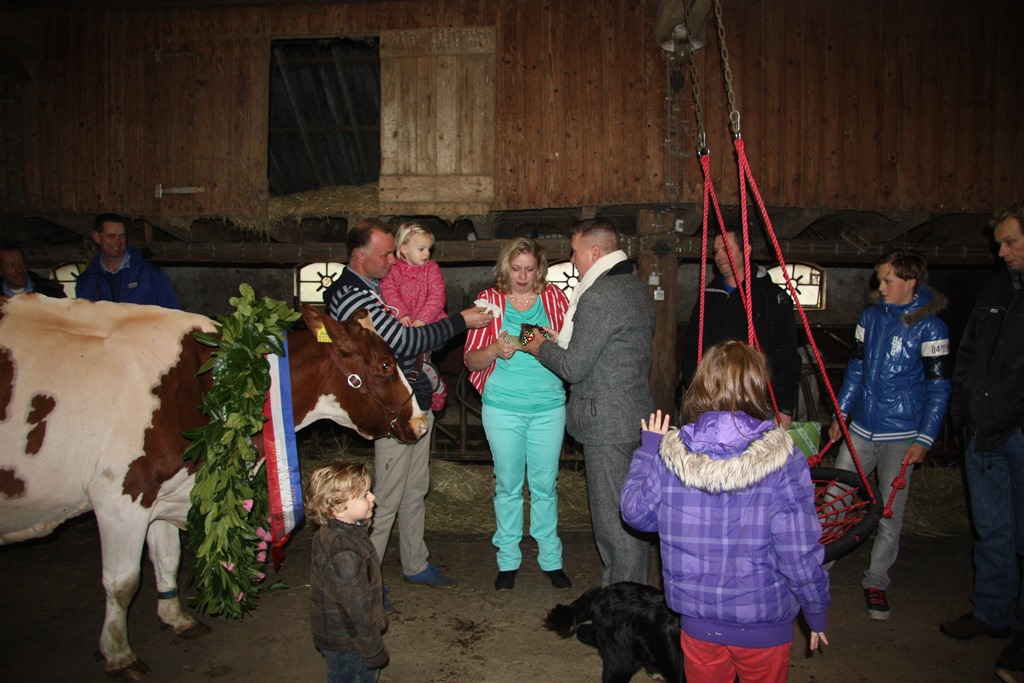
    Herman is a dairy farmer, and last month one of his cows, Hetty 176, reached a milestone. In her 14 years of life, she has produced 132,000 litres of milk and 10,000 Kg of fat and protein. That, coupled with the fact that the farm has been in existence for 101 years, meant that it was clearly time for a celebration. So last Friday evening, the Buurt gathered in a neighbour’s barn, and we decorated an arch with greenery and paper flowers (red, white, and blue, the colours of the Dutch flag). Late in the evening we took the arch round to Herman and José’s and erected it in front of the entrance to their barn.

    20141114-2340-37

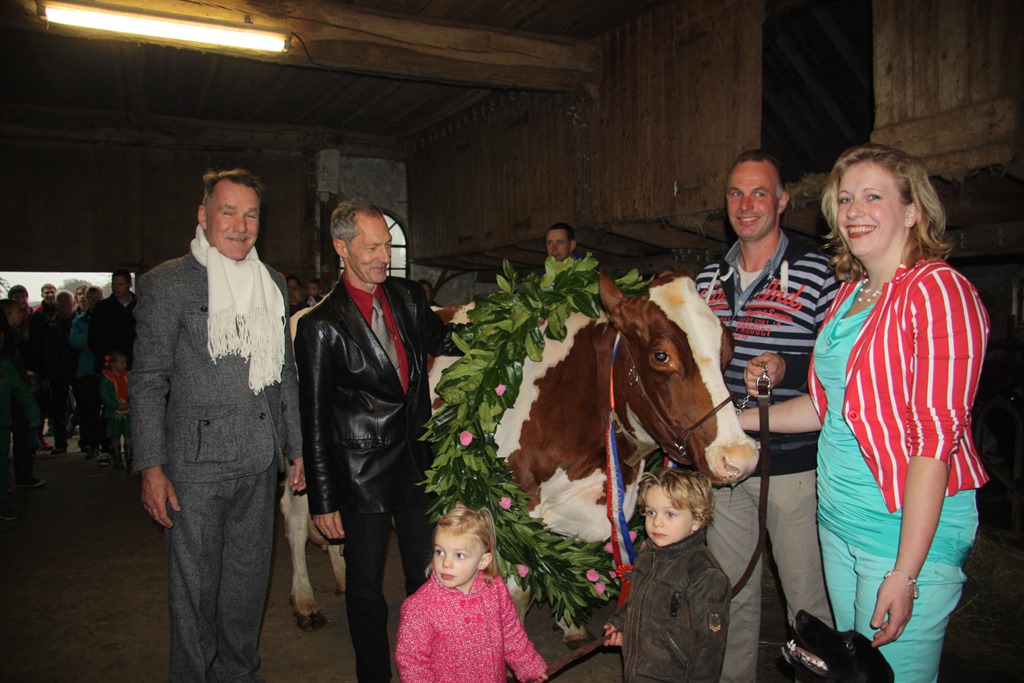
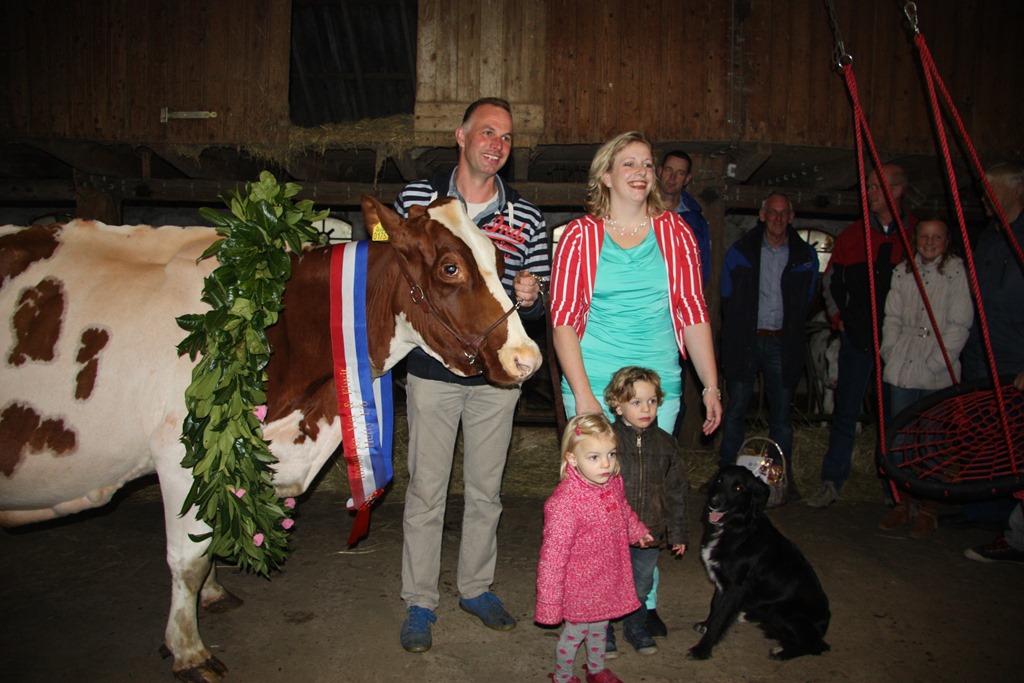
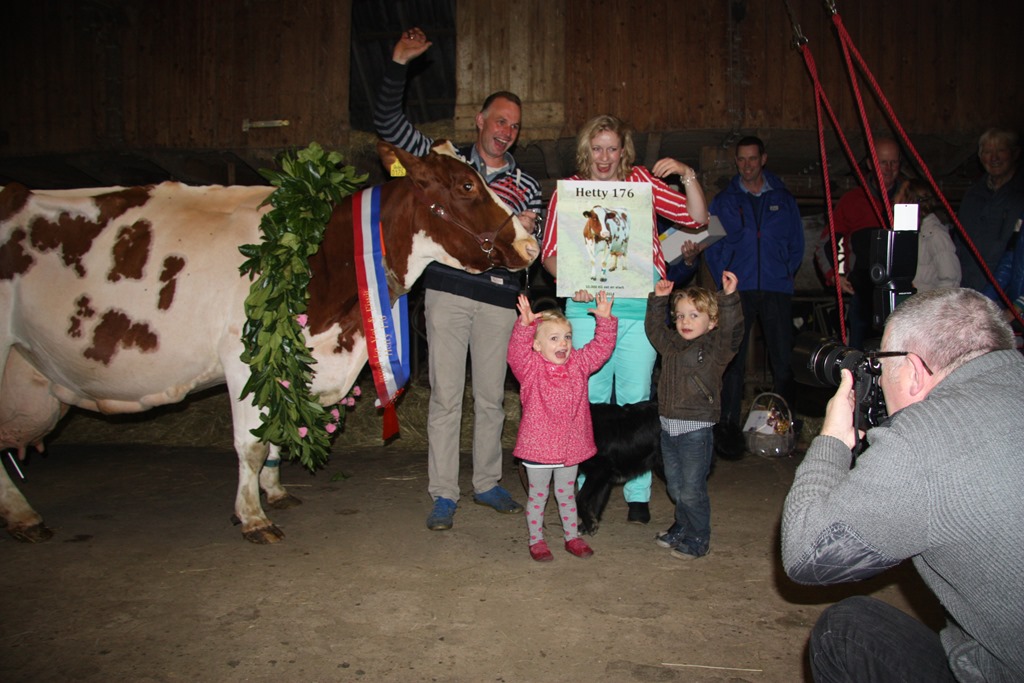
    Yesterday, the Buurt, together with Herman and José’s family, friends and farming colleagues, met in the barn to celebrate Hetty’s achievement. There were representatives from CRV (a Dutch cattle herd improvement company) to present a ribbon to Hetty and a certificate to Herman. Martin and I, on behalf of the Buurt, put a laurel wreath on Hetty, and presented gifts from the Buurt to Herman and José. More speeches followed, including an emotional one from José, who reminded us that farmers do not have an easy life, and that good farmers care about their animals above and beyond the call of duty. José is very proud of Herman, and rightly so.

    20141115-1459-09

    20141115-1508-17

    20141115-1508-49

    20141115-1510-38

    20141115-1519-07

    The afternoon was rounded off by a meal at a nearby restaurant hosted by Herman and José. A very good day.

  • What Did The Diva Say To The UN Secretary-General?

    I know, it sounds almost like an old joke, but I thought something quite interesting happened a few days ago.

    Scene: The UN International Centre in Vienna

    Dramatis personæ: The Secretary-General of the United Nations: Ban Ki-Moon, and the Diva: Conchita Wurst.

    Watch it and wonder. I really think the UN gets what human equality and respect for diversity means – unlike the Catholic Church.

  • The Rise of the Machines

    Yesterday, I blogged about the Microsoft Band – the new wearable device from Microsoft that is aimed at people who do sports. Reading the press, I get the impression that relatively few commentators have understood what’s really going on here. Most of them are focusing on the device itself, and missing the real story. The device is a first generation attempt. It is limited, clunky, and will only used by early adopters. Better devices will inevitably follow, but that’s almost not the point.

    The real point, and the real innovation, is Microsoft Health – the service in the Cloud where all the data collected by the Band can, and usually will, be held. Microsoft themselves talk about Microsoft Health being “the beginning of a journey”. It’s clear that the plan is that the data collected will be mined to provide value, and not just to you, but to Microsoft and its partners. I notice that Microsoft already has a connection not just between the Microsoft Health service and multiple (non-Microsoft) devices, but between Microsoft Health and Microsoft’s HealthVault:

    MS Health 01

    And just what is HealthVault? Well, it’s where you can store your health information and make it available to others: such as your health providers, and no doubt in the future, your insurers.

    This is the inevitable rise of big data in the Healthcare industry. I think where Microsoft, and others, certainly Google, but maybe even Nintendo, are going is to aim for the point where their intelligent agents (Cortana, in Microsoft’s case) take on the role of your personal physician. It may seem farfetched today, but it is an inevitable endpoint of the changes that are happening all around us. There’s a McKinsey report that says that Big Data is the next frontier for innovation and competition, which may well be the case, but I can’t help feel that McKinsey hasn’t seen the writing on the wall when they state that:

    There will be a shortage of talent necessary for organizations to take advantage of big data. By 2018, the United States alone could face a shortage of 140,000 to 190,000 people with deep analytical skills as well as 1.5 million managers and analysts with the know-how to use the analysis of big data to make effective decisions.

    Um, sorry, but coming rapidly up on the inside are intelligent bots that have those deep analytical skills. Already, we have the fact that arguably the best oncologist in the world is not a human but an intelligent bot: Watson. We are rapidly approaching the position where for many jobs – not just assembly line workers, but white-collar workers and even the professional classes such as lawyers, doctors, and analysts – humans need not apply:

    Last week, I attended a presentation in Silvolde, a small town nearby, which was given by Peter van der Wel – a Futurologist and Economist. He covered much the same ground as in the video above. While van der Wel was a self-confessed optimist about the technological changes that are heading our way, I’m not so sure. I agree that they will happen, but the resulting upheavals in society as we move from the pre-robot age to a post-robot one will not be easily managed. Today, most of us work to earn money in order to live. When it becomes difficult to find a job – any job – what will the impact be on society? I have no answer, but I think we “live in interesting times”, as the old Chinese curse would have it.

  • Pride

    There’s a new film coming out (if you’ll pardon the pun): Pride. It tells the true story of a group of lesbians and gay men from London who went deep into the Welsh valleys to support the miners during the dark days of the miners’ strike in the mid-1980s.

    It looks as though it’s wonderful, and will take me back to remembering those times. There’s a good interview with actor Bill Nighy and writer Stephen Beresford here.

    Addendum: Mark Simpson has a terrific post about the film and his recollections of being involved with the LGSM group. Shake that bucket!

  • Step Away, Professor Dawkins, Step Away…

    One of the reasons why I refuse to use Twitter is because it is impossible to have nuanced conversation and argument in a straitjacket of 140 characters. However, as the saying goes, fools rush in, where angels fear to tread

    And so it is with Richard Dawkins, who in response to someone who tweeted:

    I honestly don’t know what I would do if I were pregnant with a kid with Down Syndrome. Real ethical dilemma.

    responded with

    Abort it and try again. It would be immoral to bring it into the world if you have the choice.

    Oh god; *facepalm*. Talk about a hostage to fortune. Ophelia references a discussion between Michael Bérubé (whose son, Jamie, has Down Syndrome) and the moral philosopher Peter Singer. It’s worth reading.  Dawkins, it should be noted is a scientist, not an ethicist or moral philosopher.

    Professor Dawkins has a history of opening his mouth to change feet when he uses Twitter. Personally, I think he should stop using it. It’s an embarrassment to all concerned.

  • This Land is Mine Redux

    A couple of years back, I blogged about Nina Paley’s short animation: This Land is Mine. Two years on, and nothing seems to have changed in that part of the world. The only winner, as Nina pointed out, is the Angel of Death.

  • On the Wrong Side of the Track – Both Sides!

    We live in the so-called Achterhoek region of the Netherlands – the name literally means “back corner”. It’s predominantly farmland and countryside, and tourism is, after farming, the major industry. Many Dutch people living in the densely populated Randstad come here on holiday seeking a bit of peace and quiet, and some, like us, retire here.

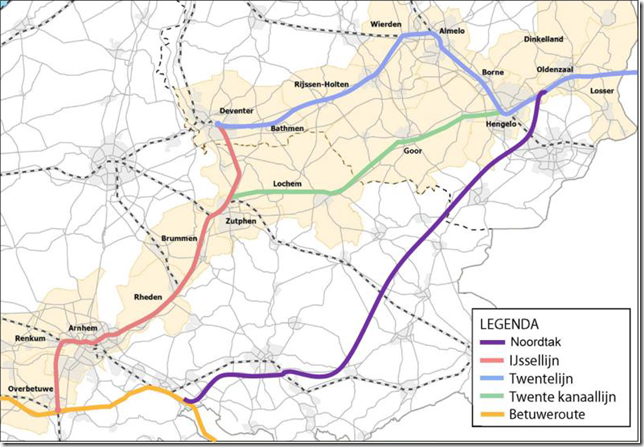
    As the years go by, the pressure increases on what remains of the countryside. The latest turn of the screw is the Noordtak Betuweroute. This is a proposal to lay a new railway line (the Noordtak – literally, the “North branch”) through the Achterhoek, connecting the current goods train line (the Betuweroute) at Zevenaar in the west through to the Dutch/German border in the east. At present, the Betuweroute currently goes south of Zevenaar to cross the border and connects with Emmerich and thence to Duisburg. This is the Zuidtak (the “South branch”).

    The Noordtak proposal was originally the brainchild of the Port of Rotterdam Authority, who were looking to increase the flow of goods from ships unloading in Rotterdam through to German industries in the Ruhr. There was a study into the Noordtak carried out in 2012 by the engineering firm Movares on behalf of the Dutch Ministry of Infrastructure and Environment. It looked at three alternative routes through the Achterhoek. When word got out about the two favoured alternatives, it galvanised protests from communities through which the routes passed.

    As a result, two of the three alternatives have effectively been killed, leaving just one. The Port of Rotterdam Authority then joined forces with the two provincial governments in the Achterhoek and commissioned a “Quick Study” of this third alternative route. The outcome, surprise, surprise, was what the PRA wanted. According to a press release issued jointly by the PRA and the Provinces, the proposed route would be “faster, safer, and less nuisance” than the rejected routes.

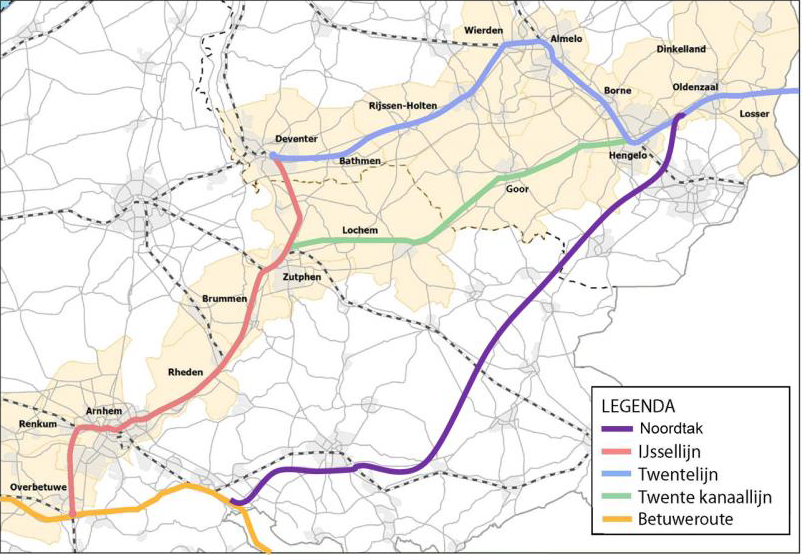
    But, guess what, it would pass quite close to us (it’s the route in purple in this map):
    Trace Noordtak 02

    We live near to the village of Heelweg, and it will be a lot worse for them. Heelweg actually consists of two hamlets, Heelweg-Oost and Heelweg-West (Heelweg-East and Heelweg-West). The Noordtak line would go straight through between them, a metaphorical stake through the heart of the community. As you might imagine, the inhabitants are not best pleased with the proposal, and we are joining forces with other action groups, such as the Gelderland’s Nature and Environment Federation, that are now springing up along the proposed route.

    Now you might think that this is simply a NIMBY reaction, and to some extent you would be right; whichever route such a railway takes, it is bound to affect someone. However, we feel that some of the bigger questions need satisfactory answers. What will the overall effect on the economy of the Achterhoek be? Even the press release mentioned above is cautious about this, admitting that:

    “The effect on the regional economy is difficult to estimate. Perhaps the maximum number of trains on the track (36 per 24 hours) is too small to make investment in a new goods train terminal cost-effective”.

    The press release also quotes a member of the regional government as saying:

    “There may well be indirect effects, such as an increase in industrial activity alongside, and in the area of the railway. This is, at this moment, not quantifiable in monetary terms.”

    Frankly, I find this ridiculous. Since the goods trains won’t be stopping anywhere in the Achterhoek, why should that be attractive for firms to build facilities alongside the railway? And if they do build, they simply cause more damage to the tourist economy by destroying the very asset that makes people want to come here and spend their tourist euros.

    A further question that needs to be answered is whether the Germans are wanting this new line. They have dragged their heels over connecting up with the Zuidtak, and all the signs are that they have little or no enthusiasm for connecting up with the Noordtak.

    The Dutch Minister for the Environment is due to give her decision on whether she supports the Noordtak proposal in the next few days. Even if she does support it, there will have to be a further, more detailed study done on the environmental impact of such a line. I would hope that an equally long hard look would also be taken at the economic justification for such a line. Many people are far from convinced that the figures would add up.

    We live in interesting times.

    Addendum 18 June 2014: The Minister has spoken, and she’s not convinced that the case for the Noordtak has been sufficiently proven, or that the figures in the “Quick Study” add up. She (or her successor) will take another look in 2020 to see if anything has changed that would require starting up a detailed study… So we can chalk that one up to a Minister showing commonsense. Nice to see.

    Addendum 25 January 2022: Well, here we are again. The Rotterdam and Amsterdam Harbour Authorities have been doing some hard lobbying over the past year, and the Noordtak is back on the agenda. There was a vote last November in the Second Chamber of the Dutch parliament on looking again at the route. 148 members voted for the motion, and one against. The sole vote against belonged to the only member of parliament who actually lives in the Achterhoek.

    The politicians in the local and provincial authorities have finally woken up and are now fighting back. They are demanding proper involvement in the ongoing research over the possible route, but perhaps more importantly are demanding research into whether there is a good business case for the Noordtak in the first place. The Germans are still lukewarm about connecting with the existing goods train line (the Betuwelijn), and it’s highly unlikely that they would want to connect with the Noordtak. They are looking to improve rail routes to their own harbours of Hamburg and Bremen.

  • Welcome, England and Wales…

    …you finally made it. At midnight on Saturday 29 March 2014, same-sex couples in England and Wales will be able to legally tie the knot. It’s been a long, hard battle for them to get equality, but the day has finally come. England and Wales join the other fifteen countries that recognise same-sex marriage.

    It’s also refreshing to see that the Church of England has thrown in the towel, and that the current Archbishop of Canterbury has publicly signalled the end of the Church of England’s resistance to same-sex marriage. Mind you, the global Anglican Church still has plenty of spleen and venom to vent on the issue, so now the fight moves elsewhere.

    In the meantime, congratulations to those who are preparing to get married. Sandi Toksvig has an excellent article on what it means to her.

  • Geert and Gedogen

    Gedogen is one of those (many?) Dutch words that is somewhat difficult to translate. On the face of it, it means to tolerate, permit, suffer and allow. However, there is something lurking behind those straightforward definitions; an additional layer of meaning that indicates that the tolerance, the permission and so forth are granted, well, perhaps not grudgingly per se, but perhaps almost in spite of the thing that is being tolerated. There’s a sense of turning a blind eye to behaviour that, strictly speaking, is illegal, or should not be condoned, but which one tolerates out of a sense of liberalism and of a sense of “live and let live”.

    Someone who has been the beneficiary of much gedogen is the Dutch populist politician Geert Wilders. He, on the other hand, exhibits near zero gedogen for his targets: immigrants, Muslims and Moroccans.

    We’ve just had elections here in the Netherlands for the town councils (the Gemeenten), and Wilders’ party fielded candidates in just two places: The Hague and Almere. During the campaign, Wilders went on record as saying that voters in The Hague should vote for a city with lower taxes and, if possible, fewer Moroccans. As a result, one Labour candidate (Fouad Sidhali) tweeted a comparison of Wilders to Hitler, a statement he later withdrew after criticism from senior Labour officials, saying the comparison had been unjustified.

    I found it fascinating to observe the media and politicians exhibiting gedogen towards Wilders by focusing on Sidhali’s tweet, rather than the initial remark by Wilders. It was as though Wilders was the injured party, rather than Sidhali, who had probably responded with understandable exasperation over yet more of Wilders’ xenophobic rhetoric.

    Wilders then (oh so predictably) responded by saying Fouad Sidali’s rethink was sensible but that ‘it would have been more sensible to leave for Morocco’.

    And so it goes. Geert grins under the grace of gedogen.

    But perhaps a line has now been crossed. During last night’s after-election celebrations in the Hague, Wilder asked his supporters ‘and do you want more or fewer Moroccans in your city and in the Netherlands?’ To which the crowd chanted ‘fewer, fewer, fewer’. ‘ We’ll arrange that,’ Wilders said with a faint smile (or was it a smirk?) when the chanting died down.

    I would like to think that people are beginning to think that enough is enough, and that the emperor has no clothes, other than rags of xenophobia and racism. We will see what happens during the European elections in May.

  • Presidential? – I Think Not

    Reading President Museveni’s speech at his signing of Uganda’s Anti-homosexuality bill is depressing. Not so much because of his clear bigotry, ignorance, and politicking – that’s only to be expected – but because of my realisation of what this means for gay people – and people who have gay brothers, sisters, parents, relations and friends – in Uganda. They have just been thrown to the wolves. And it hasn’t taken long for the wolves to start howling. A Ugandan newspaper has published a list of what it called “the country’s 200 top homosexuals”, outing some who previously had not identified themselves as gay.

    I was heartened, but not surprised, by Desmond Tutu’s condemnation of the new law. I fear, however, that his voice will be drowned by a new wave of witchhunts in Uganda.

  • The Streisand Effect in Action

    In 2009, Wendy Doniger’s book The Hindus: An Alternative History was published by Penguin. It seems to have attracted the wrath of Hindu (male) chauvinists; to the extent that a lawsuit from the Hindu group Shiksha Bachao Andolan accusing Doniger (a University of Chicago professor) of “hurt[ing] the religious feelings of millions of Hindus”  was instigated in India. As a result, Penguin have withdrawn the book from sale in India and intend to pulp the copies.

    Quite rightly, this decision has resulted in a storm of protest, and propelled the book up the bestseller list. I’ve ordered my own copies (paperback and Kindle) out of interest, in support of Doniger, and against the tiresome president of Shiksha Bachao Andolan, Dinanath Batra. As Ophelia says, Batra is an experienced religious bully.

  • RIP Stuart

    Stuart Hall died today. As the Guardian obituary says:

    Hall was always among the first to identify key questions of the age, and routinely sceptical about easy answers. A spellbinding orator and a teacher of enormous influence, he never indulged in academic point-scoring. Hall’s political imagination combined vitality and subtlety; in the field of ideas he was tough, ready to combat positions he believed to be politically dangerous. Yet he was unfailingly courteous, generous towards students, activists, artists and visitors from across the globe, many of whom came to love him. Hall won accolades from universities worldwide, despite never thinking of himself as a scholar. Universities offered him a base from which he could teach – a source of great pleasure for him – and collaborate with others in public debate.

    It’s a great loss. It was only a couple of months ago that I was walking through the woods listening to a podcast of a discussion between him and Laurie Taylor and being impressed anew at his insight.

    For an overview of his work and thought, this article, also in today’s Guardian, is a good start.

  • Nasty, Brutish, and Wrong

    The Guardian published an opinion piece by Kevin McKenna last Saturday: Scotland’s assisted suicide bill is an offence to our human dignity. Frankly, if anything was an offence to human dignity, it was this piece of invective. But then again, McKenna is an executive editor of the Daily Mail in Scotland. Says it all, really. The Guardian should be ashamed at publishing such tripe. I see that the comments pretty much call out the piece for the bullshit it is.

    I am thankful that I live in a country where I can ask for a peaceful death, should it prove necessary, and where safeguards exist to protect the vulnerable.

  • “I Am Officially Illegal”

    That was the tweet from Dr. Frank Mugisha today at the news that the Ugandan Parliament has passed the Anti-Homosexuality Bill. The bill apparently:

    • bans the ‘promotion of homosexuality’ with a maximum of 7 years imprisonment.
    • punishes same-sex marriage with life imprisonment

    It’s not clear what the final wording and provisions of the bill are, the original bill contained some wide-ranging powers to drive the LGBT community underground, both literally and figuratively, as well as have consequences for human rights defenders active in the LGBT field.

    I cannot imagine what it must be like for LGBT people in Uganda at the moment.  One thing is for certain, if Martin and I were living in Uganda instead of here, we would both be looking at life imprisonment.

  • Abraham And Sarah

    Here in the Netherlands, there’s a tradition that when someone reaches the age of 50, they are said to be an Abraham (if they’re a man) or a Sarah (if they’re a woman).

    And in this part of the Netherlands, that is often marked by friends and neighbours installing an appropriately (or inappropriately) dressed mannequin outside the celebrant’s house.

    Last Wednesday, one of our neighbours reached his 50th, so late on Tuesday night his garden was invaded by a series of groups each installing their own version of an Abraham and accompanying signs and decorations. This was the scene the following morning…

    20131120-1018-24

  • The Bankers Do It Again

    There’s a small village, Bredevoort, that lies about 7 kilometres distant from us. It’s a pretty little village of about 1,500 inhabitants, and it also has a disproportionate number of antiquarian bookshops in it. That’s because, since 1993, it has become known as a Boekenstad (book-town). Apart from the 20 or so bookshops, there are also regular antiquarian bookmarkets, with market stalls placed in and around the central market square.

    I often go along to the bookmarkets, and when I do, one of the things I invariably see is a queue of people waiting to get cash from Bredevoort’s one and only cash machine.

    Today, I read in the Volkskrant that the Rabobank, the bank responsible for the cash machine, intends to remove it from the village. According to Nicole Olde Meule, the person responsible for the bank’s consumer clients in this area, the number of transactions has fallen by 9% over the past year to 25,000 per year. And that, she thinks, is justification enough to remove the service.

    She clearly needs her head examined. At a time when the Rabobank has had its image severely dented by being fined €774m for its part in the Libor scandal, she thinks its OK to heap further hardship on the village, tourists and booklovers.

    She knows the cost of everything and the value of nothing.

  • RIP, Norm

    One of the bloggers that I make a habit of reading is Norman Geras. That is, until last Friday, when I found an entry on his blog from Jenny Geras (his daughter) saying that Norm had died that day.

    Another voice of reason stilled. Here’s his obituary. It’s worth reading to get a sense of the man, and of course you can still read his writings on his blog.

  • Out There

    Stephen Fry has collaborated with film-maker Fergus O’Brien to make a two-part documentary Out There. In it, Fry reflects just how much, and how little, things have changed in his lifetime for gay people around the world.

    Martin and I watched the first part last night. Yes, we know that we are incredibly lucky to be able to live where we do, but to see the reality of the extent of homophobia elsewhere, much of it State-sponsored, is very depressing. Uganda featured prominently in last-night’s programme. Fry was shown participating in a Ugandan radio phone-in programme with Pastor Solomon Male, who seems obsessed with homosexual sex to a quite unhealthy degree. Fry also had an interview with the Ugandan State Minister for Integrity and Ethics, who amply demonstrated a complete absence of both of these qualities. Fry found the latter interview in particular quite stressful, in part I suspect because the Minister at one point was shouting that he would arrest Fry.

    But never underestimate the smugness of TV reviewers. Rupert Hawksley, in the Telegraph, wrote that:

    As a homosexual man himself, it was entirely understandable that Fry took the poisonous opinions he encountered in Uganda and Los Angeles as personal attacks. Nonetheless, I was surprised at how quickly he allowed himself to be drawn into a slanging match, his gravitas deserting him minutes into a debate with Ugandan pastor Solomon Male. It was all much too shouty and felt like the opportunity for instructive discussion had been lost. Later, in an invective-filled session with the Ugandan State Minister for Integrity and Ethics, Fry resorted to childish taunts: “Homosexuality is fantastic. You should try it, it’s really good fun.” This, surely, was not the best way to counter deep-rooted prejudice.

    Easy for you to say Mr. Hawksley, but then I doubt that you’ve been much at the receiving end of institutionalised homophobia. If I were in Fry’s place, I’d probably have lost my temper much sooner with the odious human being that is the Ugandan Minister. “Instructive discussion” with people such as Male and the minister is an oxymoron, as I know from experience.

    The second part of the documentary will be shown tonight, in which Fry visits Russia, and gets to meet Deputy Milanov of St. Petersburg. Somehow, I think Mr. Hawksley will once again have to suffer a sense of disappointment that there is no “instructive discussion”. As Stephen Fry writes:

    I have visited Russia, stood up to the political deputy who introduced the first of these laws, in his city of St Petersburg. I looked into the face of the man and, on camera, tried to reason with him, counter him, make him understand what he was doing. All I saw reflected back at me was what Hannah Arendt called, so memorably, “the banality of evil.” A stupid man, but like so many tyrants, one with an instinct of how to exploit a disaffected people by finding scapegoats. Putin may not be quite as oafish and stupid as Deputy Milonov but his instincts are the same.

    The struggle continues.