
The BBC News service carries a report today about the situation for gay people in Iraq that makes for sobering reading. The detailed report, from Human Rights Watch, is even more unsettling. Man’s inhumanity to man, writ large, and in blood.
-
Only In The Netherlands…
I probably should have a series of posts like this. There are times when I look at things in my adopted country, and think to myself (often with a smattering of pride or alternatively, complete incomprehension): “Only in the Netherlands…”
Here’s a case in point, It’s an advert designed to get gay people (because it was on the back cover of the most recent issue of the Gay Krant – the Dutch magazine for gay folks) to apply to become members of the Dutch police force. Translated, it says: “Police, captivating work! – also for you?”. I should perhaps point out that this advert is one of those that I feel proud of.

The gentleman in the picture is Hans Klok, a Dutch magician.
Leave a comment
-
A Narrow Escape
I was mowing the lawns today, when suddenly I noticed something in front of the mower. First of all I thought it was a bundle of grass, and was about to carry on. Then I looked more closely and paused…


I think it’s a green chaffinch fledgling. It does seem a bit late in the season to have fledglings, but what do I know?
Leave a comment
-
Airborne Viruses, Airborne Rabbis
This has to be a joke, doesn’t it? They cannot be serious, surely?One response to “Airborne Viruses, Airborne Rabbis”
-
LOL love it!!!! Well, lets face it – they don’t eat pig so I guess they need to take every precaution against catching the swine flu as well ha ha ha 😉
Leave a comment
-
-
Varsseveld’s Carnival
The nearest small town to us, Varsseveld, is currently holding its annual four-day carnival. I went along to see the carnival parade last night. Nice atmosphere, with some good floats on show. A tradition in The Netherlands is to decorate the floats with thousands of flowers. There were some good examples last night. The most bizarre, however, was a float that represented a huge dung beetle, rolling an even larger ball of dung – the entire thing being covered in flowers and waste. Only in The Netherlands…
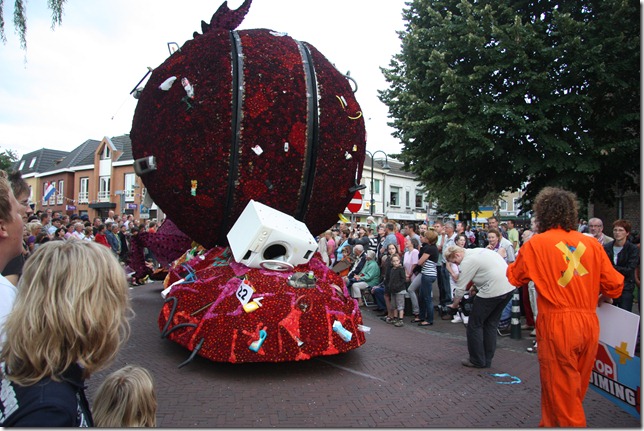
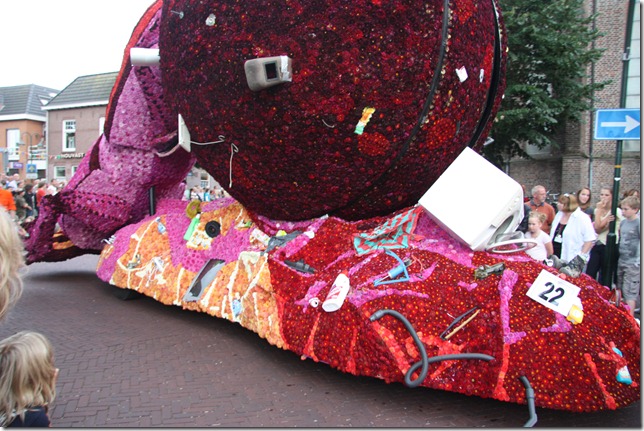
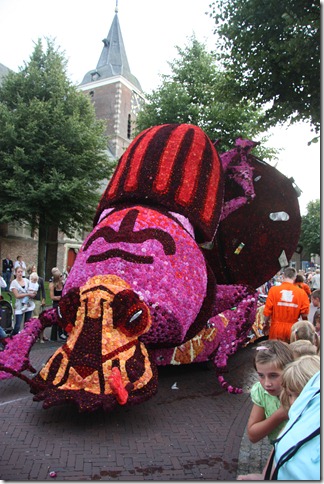
2 responses to “Varsseveld’s Carnival”
-
Wow! what a beautiful sight and with such imagination too. Have you ever seen the carnival in Jersey CI?, they use flowers too. Do they have the same insurance problems we encounter over here? … or are they more relaxed about it? Our ‘no win – no fee’ culture is tapping into everything these days, including our enjoyment! Bah, humbug!
-
No, I’ve never been to Jersey. The first Flower Parade I saw was the Bloemencorso in Lichtenvoorde a couple of years ago. See photos here: http://www.flickr.com/photos/gcoupe/sets/72157594277873262/ That’s a big parade. Whole fields in the surrounding area are given over to growing all the flowers needed. As for insurance, I don’t know what they do…
Leave a comment
-
-
Families In Straitjackets
There’s a bit of a stir going on in Amsterdam and the Hague at the moment. The reason is that the fifth World Family Congress has just opened at the RAI in Amsterdam for its three-day conference. The Dutch Minister for Youth and the Family, André Rouvoet, gave the opening address at the conference. And that was the reason for the stir: many, including fellow politicians in the Parliament in The Hague, felt that he was giving a stamp of approval to a conference that appears to have a very narrow view of what a family is.
Last night’s television news journal had an item on the conference, which included a snippet from Rouvoet’s video address. In part he said:
I’m aware of the outspoken views on the family that many of your organisations have. That’s why I want to challenge you to build bridges.
This was immediately followed by a spokesman from one of the participating organisations (Tradition, Family and Property – the name says it all, really) saying:
I don’t want to build a bridge to nowhere, I’m willing to cross bridges that go somewhere.
In response to a question from the interviewer, he then helpfully clarified that a bridge to gay parenting and gay marriage was a bridge to nowhere. What a surprise. And what really pisses me off is the Orwellian newspeak of it all. For example, the Howard Center is the think-tank behind the World Congress of Families, and which believes that the “natural human family is founded by the Creator, and is essential for a good society”. The director of the Howard Center, Larry Jacobs, is quoted as saying:
"It is clear that the left is shocked by the family congress because it brings a pro-family message to a city which they claim as their own territory."
There it is: pro-family – a positive-sounding term that actually means a rigid definition of what a family is and that is against any other meaning. It’s a great pity that Mr. Jacobs and others like the spokesman quoted above will never understand that families come in all shapes and sizes. Meanwhile he and his ilk will continue to spout their self-righteous bigotry. I also think it hypocritical. If you read the definition of the family given on the World Congress of Families V own web site, it goes to some pains to widen the narrow definition (man, woman and children) to include “alternatives”, which, it concedes:
If these alternatives have the same quality of love, upbringing and intergenerational transfer as the natural family, then they also belong to the category which we call ‘the family’.
However, the difference between these words and the deeds of the majority of the participants at this congress seem wide indeed, judging by the attitudes that I have seen and read.
But perhaps it’s hardly surprising really, because if you refer back to the Howard Center’s web site, you’ll find a much more hardline approach as to what the family is. Nary a whisper there of “alternatives”; indeed, I see that I’m headed for damnation:
Marriage between a man and a woman forms the sole moral context for natural sexual union. Whether through pornography, promiscuity, incest or homosexuality, deviations from these created sexual norms cannot truly satisfy the human spirit. They lead to obsession, remorse, alienation, and disease.
Here I think we see the true guiding spirit behind this conference: anti-abortion, anti-gay, and anti-secular. Now that sounds like a bridge to nowhere to me.
Leave a comment
-
New Arrivals
Our neighbour, Herman, is a milk farmer. A week ago, one of his cows gave birth to triplets. This only happens 5 times out of 10,000 births in cattle. What made it even more special is that all three of the calves are strong and healthy, and one of the calves has the father’s red and white colouring, while the other two have the mother’s black and white colouring.
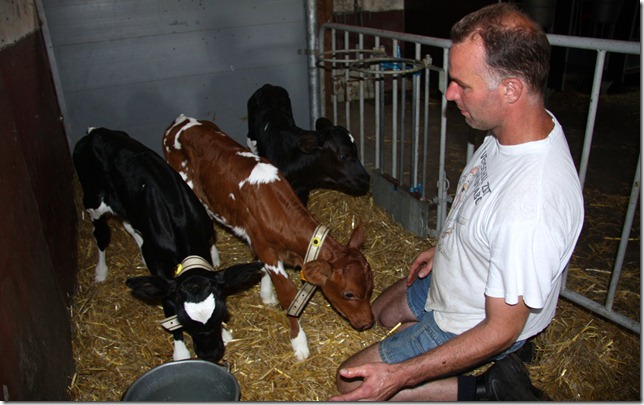
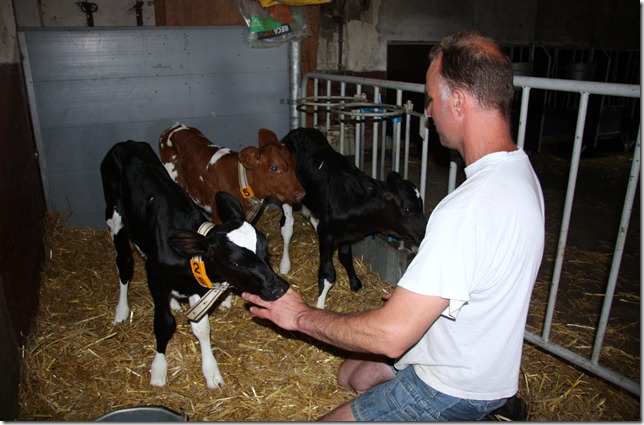

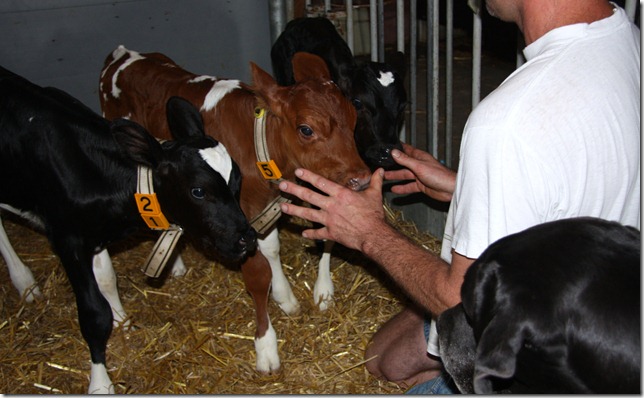
You’ll notice that Herman’s dog, Rico, is also curious about these new arrivals. Being a Great Dane, he’s a good deal bigger than they are at the moment…
Leave a comment
-
Biking With The Buurt
Each year, a couple of volunteers in our local neighbourhood (the buurt) organises a route for a bicycle ride through the local area. This year about thirty of us had an enjoyable day out, with a few stops for food and refreshment along the way. This is an opportunity to rediscover what a very pleasant part of the Netherlands this is, filled with cycle tracks that wind through the countryside.
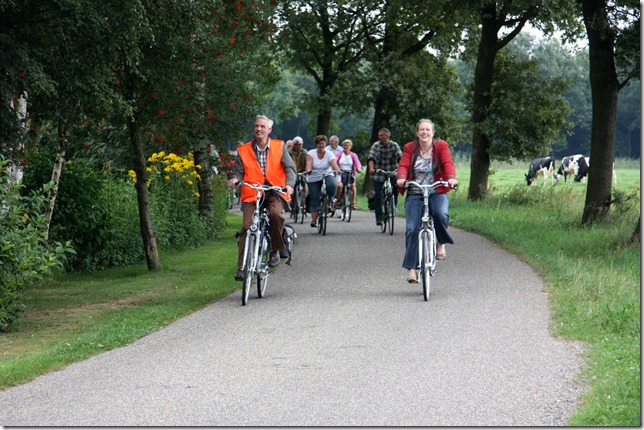
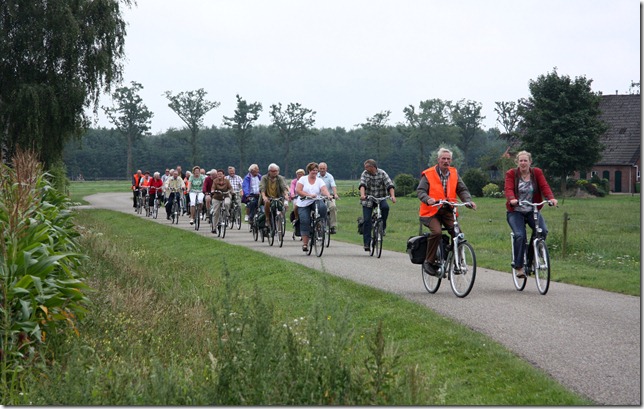
More pictures here.
2 responses to “Biking With The Buurt”
-
I’m jealous! – not only of the peaceful winding countryside (how did you decide on that part of Holland, anyway?), but of the fact that many of the riders are in jackets and long sleeves – it’s still abysmally hot here and will be for some time to come.
-
Mike – we’ve been having warm weather, but yesterday it was a reasonable 22C. We’ve had over 30C on a few days this year. As to why we chose this part of the Netherlands, quite simple really. Part of it was because of the countryside, but also it was in part because of the fact that it’s 19 meters above sea-level. In Gouda, we were almost 6 meters below, and I can’t dismiss the feeling that global warming is not to be dismissed…
Leave a comment
-
-
Down At The Waterhole
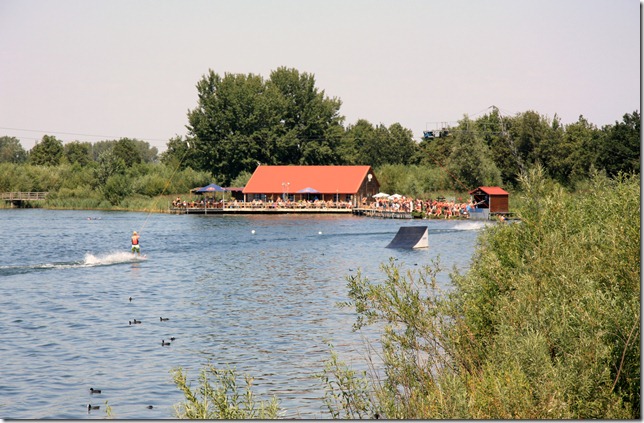
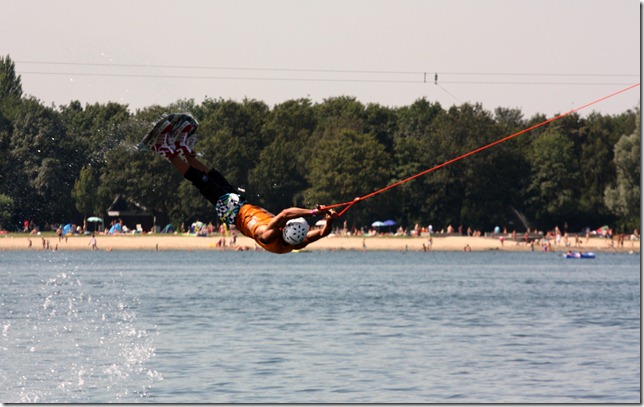
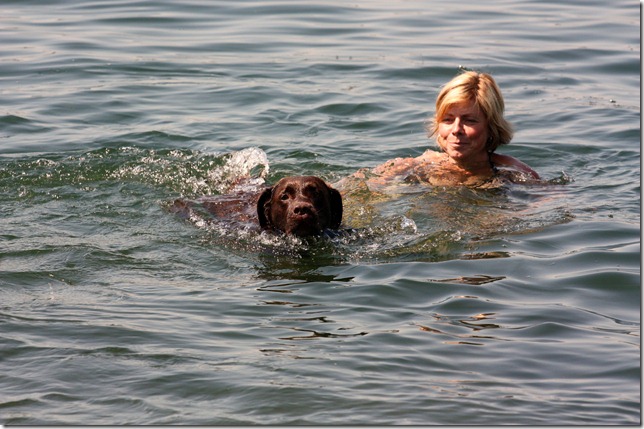
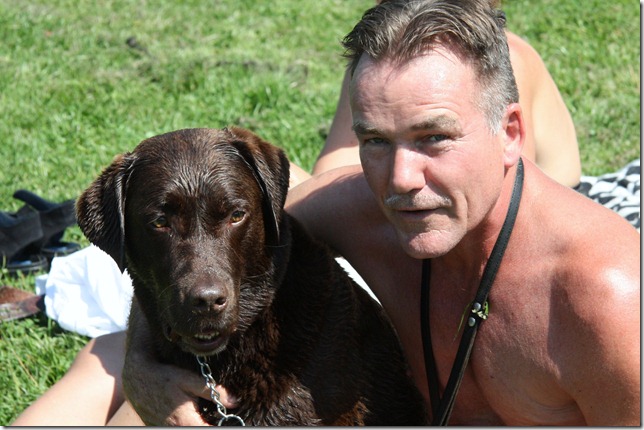
Thursday was really warm. We went, with a friend, to have lunch by a local lake, and (for a couple of us) to cool off. Watching the local water-ski enthusiasts was pretty interesting too. They were of all ages. Unlike me, however, they (mostly) managed to remain upright on their skis. I think I’ll stick to just taking photos.




Leave a comment
-
Fish In A Barrel
I know it’s like shooting fish in a barrel, but how could I resist pointing towards this pretentious twaddle spotlighted by David Thompson? There’s nothing better designed to evince howls of frustrated derision from me than a good dose of PoMo, particularly if it’s crossed with Queer Studies. Mind you, some of the sessions from the conference do sound intriguing. How about the one from Kira O’Reilly: Falling asleep with a pig? Or the one from Erika Cudworth & Maria Tamboukou: The cat and her woman: gendered interpolations of species relations? I just wonder if everybody’s favourite parasite Toxoplasma gondii got a mention in that one?Still, in future I shall remember the comment by David Thompson on this sort of PoMo pontification:It helps if you imagine a tiny creature inflating its gas bladder to intimidate passers-by.Quite.Leave a comment
-
Women of Iron
Hilary Mantel has a terrific article in today’s Guardian that evokes to a tee the monstrous regiment of women that I remember from my childhood. They were epitomised by the granny in the cartoons by Giles, and Mantel’s marvellous words bring the memories flooding back. Sample:When I was a child – in Glossop and district – no one supposed that women over 50 were invisible. On the contrary, they blacked out the sky. They stood shoulder-to-shoulder like penalty walls, solid inside corsets that encased them from neck to thigh, so there was no getting past them: if you’d rushed them and butted them with your head, you’d have careened off, sobbing. They stood in bus queues muttering dark threats against the driver. They stood in line in the butcher’s shop, bloodied sawdust clogging their bootees, and amid the loops of sausages and the tripes they talked about My Operation – they boasted of their surgical crises, as Coriolanus boasted about the wounds he got for his mother country. Almost every one of these women was called Nellie, and the others were called Cissie. Why these names are synonymous with effeminate weakness I cannot imagine.Now go and read the rest…Leave a comment
-
Bibliophiles ‘R Us
This last week, I’ve been making a couple of pilgrimages to bookshops and bookmarkets. First up was a day trip down to Maastricht, to the Dominicanen bookshop. This is notable for being in a converted church, and is probably the most beautiful bookshop in the Netherlands.


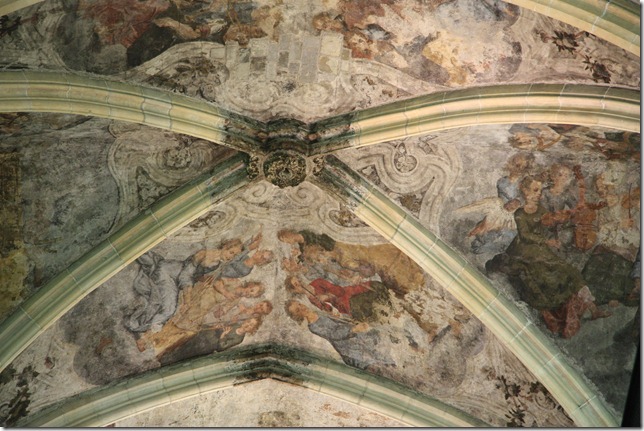
I confess that I didn’t actually buy anything there this time around, but it was worth it for the sightseeing, and the opportunity on the train journey to get stuck into Carlos Ruiz Zafon’s “The Angel’s Game”.
Next up was the trip last Sunday to the Hanseatic city of Deventer for the annual Bookmarket – the biggest one in Europe with 6 kilometers of bookstalls. Despite the pouring rain, I came away with some success: an armful of books including a first edition hardcover of Spider Robinson’s “Callahan’s Lady” and Anton Radevsky’s pop-up book on Spacecraft.
I have a small collection of pop-up books – I’m fascinated by paper engineering. But it’s nothing when compared to the collection of someone like Kees Keijzer. He was mentioned in the Volkskrant’s report on the bookmarket. Apparently, he has a collection of 2,500 pop-up books. That’s more than my complete library, for heaven’s sake.
Leave a comment
-
A Hit And A Miss
Somewhere (I can’t remember where), I came across a review of Jedediah Berry’s "A Manual of Detection". The review sounded interesting, so I got the book. There were other positive reviews as well, so I started the book with high hopes. Alas, my hopes have been dashed. I found the novel trying too hard, and eventually, simply trying. I’ve given up about halfway through, with a sour expression on my face. It just didn’t work for me.So I turned to the latest from Malcolm Pryce: "From Aberystwyth with Love". From the very first page, a smile was back on my face, and I can’t wait to immerse myself in this book.Both books are ostensibly about detectives and are detective novels set in bizarre fantastical worlds. But the difference, as far as I am concerned is like day and night. Give me Pryce over Berry any day.Leave a comment
-
Bang Goes The Theory
That’s the title of the BBC’s new science show. Tomorrow’s World, it ain’t, but I have to admit to liking it more than I thought I would. It’s clearly aimed at a young audience. not an old fogey like me. And on that level it probably succeeds quite well; hopefully it will get children interested in science.
The interview with Craig Venter came across well, despite the rather idiotic questions, and the "King of the World" visual reference the director obviously couldn’t resist throwing in.
Leave a comment
-
Beware The Spinal Trap
Simon Singh wrote an article on Chiropractic therapy for the Guardian a couple of months back, with the result that the British Chiropractic Association sued for libel in the British courts. In response, the Sense About Science organisation has started a campaign to keep libel laws out of the subject of science. As part of that campaign, Sense About Science has asked for bloggers around the world to repost the article. So here’s where I do my bit. By the way, do also check out my comment at the end of the reposted article.You might be surprised to know that the founder of chiropractic therapy, Daniel David Palmer, wrote that ‘99% of all diseases are caused by displaced vertebrae’. In the 1860s, Palmer began to develop his theory that the spine was involved in almost every illness because the spinal cord connects the brain to the rest of the body. Therefore any misalignment could cause a problem in distant parts of the body.In fact, Palmer’s first chiropractic intervention supposedly cured a man who had been profoundly deaf for 17 years. His second treatment was equally strange, because he claimed that he treated a patient with heart trouble by correcting a displaced vertebra.You might think that modern chiropractors restrict themselves to treating back problems, but in fact some still possess quite wacky ideas. The fundamentalists argue that they can cure anything, including helping treat children with colic, sleeping and feeding problems, frequent ear infections, asthma and prolonged crying – even though there is not a jot of evidence.I can confidently label these assertions as utter nonsense because I have co-authored a book about alternative medicine with the world’s first professor of complementary medicine, Edzard Ernst. He learned chiropractic techniques himself and used them as a doctor. This is when he began to see the need for some critical evaluation. Among other projects, he examined the evidence from 70 trials exploring the benefits of chiropractic therapy in conditions unrelated to the back. He found no evidence to suggest that chiropractors could treat any such conditions.But what about chiropractic in the context of treating back problems? Manipulating the spine can cure some problems, but results are mixed. To be fair, conventional approaches, such as physiotherapy, also struggle to treat back problems with any consistency. Nevertheless, conventional therapy is still preferable because of the serious dangers associated with chiropractic.In 2001, a systematic review of five studies revealed that roughly half of all chiropractic patients experience temporary adverse effects, such as pain, numbness, stiffness, dizziness and headaches. These are relatively minor effects, but the frequency is very high, and this has to be weighed against the limited benefit offered by chiropractors.More worryingly, the hallmark technique of the chiropractor, known as high-velocity, low-amplitude thrust, carries much more significant risks. This involves pushing joints beyond their natural range of motion by applying a short, sharp force. Although this is a safe procedure for most patients, others can suffer dislocations and fractures.Worse still, manipulation of the neck can damage the vertebral arteries, which supply blood to the brain. So-called vertebral dissection can ultimately cut off the blood supply, which in turn can lead to a stroke and even death. Because there is usually a delay between the vertebral dissection and the blockage of blood to the brain, the link between chiropractic and strokes went unnoticed for many years. Recently, however, it has been possible to identify cases where spinal manipulation has certainly been the cause of vertebral dissection.Laurie Mathiason was a 20-year-old Canadian waitress who visited a chiropractor 21 times between 1997 and 1998 to relieve her low-back pain. On her penultimate visit she complained of stiffness in her neck. That evening she began dropping plates at the restaurant, so she returned to the chiropractor. As the chiropractor manipulated her neck, Mathiason began to cry, her eyes started to roll, she foamed at the mouth and her body began to convulse. She was rushed to hospital, slipped into a coma and died three days later. At the inquest, the coroner declared: ‘Laurie died of a ruptured vertebral artery, which occurred in association with a chiropractic manipulation of the neck.’This case is not unique. In Canada alone there have been several other women who have died after receiving chiropractic therapy, and Edzard Ernst has identified about 700 cases of serious complications among the medical literature. This should be a major concern for health officials, particularly as under-reporting will mean that the actual number of cases is much higher.If spinal manipulation were a drug with such serious adverse effects and so little demonstrable benefit, then it would almost certainly have been taken off the market.Simon Singh is a science writer in London and the co-author, with Edzard Ernst, of Trick or Treatment? Alternative Medicine on Trial. This is an edited version of an article published in The Guardian for which Singh is being personally sued for libel by the British Chiropractic Association.
Now, you will note the words: "edited version" in the sentence above. Head on over to Jack of Kent’s blog to read the two sentences that have been excised from the article above, and which are the ones that all the fuss is about…3 responses to “Beware The Spinal Trap”
-
If I didn’t receive chiropractic treatment which release trapped nerves in my neck causing severe dizzziness and misalignments in my lower back sending off sciatic nerve sensations down my right leg (which was numb below the knee!) I would probably be paralysed by now and lord knows a total invalid!!!! My chiropractor Graham uses a McTimoney Method which involved gentle flicks in appropriate places to momentarily suspend the bone, thus releasing any entrapment and realigning the area along with other techniques which he has practiced and studied over an 8 year training period. I can only speak very highly of this man and no physiotherapist, x-ray or scan could help me or alleviate the pain I endured for 6 months trying tirelessly to get my GP to take me seriously about my ailments. I was told "you have had an enormous trauma to your body and it will take time to sort itself out" and yet when I went to Graham, he saw me on 7 occasions and put me back to normal having stated that it would take 5-7 sessions to achieve a result. I still go to him now when I have a fall off my horse and in fact I have chosen annual Mot to ensure my skeletal system is aligned. Interestingly, before I saw Graham for many years I had to change the toilet seat every 6 months or so because it would eventually break. Unknown to me my hips were misaligned and I was jigging my buttocks on these toilet seats and causing them to break. Since my treatment 5 years ago I have not needed to replace a toilet seat once! So you tell me, eh? This guy obviously has an amazing techynique which I totally trust that assists me without any undue pain that you normally experience with a physio as they push your boundaries!!!! Anyway, I wanted to share that with anyone that feels interested about this wonderful treatment. Oh, finally I have referred several people to Graham, all of whom have made wonderful recovery and the most recent person was my son’s girlfriend that was in excruciating pain from a trapped sciatic nerve – her GP gave her diplofenics and signed her off work for a week – following a visit to Graham in two days she stopped needing the painkillers and gained total mobility!!! Now, if she accepted the course of treatment recommended i.e. take pain killers and lay in bed all week, this whole episode would repeat itself over several months and indiscriminently, until her sciatic nerve was sufficiently weakened and Sarah would face a major op to remove this nerve costing the NHS thousands of pounds and possibly her job as a nursery nurse. So you tell me????????
-
Bal Maiden, I don’t doubt that your experience has been good. Singh’s article acknowledges that chiropractic technique can cure some physical problems. But the crux of the article is two-fold: first, the assertions by some chiropractors that the technique will cure illnesses has "not a jot of evidence", and secondly, that some of the chiropractic techniques carry dangers in themselves.
-
Ahhhh lightbulb moment! Well, yes I do agree that there is no concrete evidence to suggest that any chiropractic techniques will cure illnesses (imagine???? we’d all go to them with swine flu instead of taking tamiflu this winter if that were the case lol!). As for your second point, I’m afraid that all techniques including physiotherapy, anesthetic, lumbar punchtures, open heart surgery and most procedures of medicine carry dangers with no guarantee, just a guided percentage of success – including medication – so it all comes down to individual belief and choice at the end of the day based on what advice is given and what one decides to do for the best. The overall therory of chiropractic treatment makes total sense to me and I am shocked that the NHS do not adopt some forms of chiropractic treatment, as a patient is at just as much risk with them as they are with other proceedures – afterall we all sign disclaimers prior to treatment at the pre-op stage and that is something you do not do when visiting a chriopractor! Thanks for explaining things to me Geoff xxx
Leave a comment
-
-
Photograph of Jesus
Here’s a terrific little film about the impossible requests that the Hulton Photo Archive receives. Jeroen, this one’s for you…Leave a comment
-
Cheeta Makes The Booker
A couple of weeks back, I mentioned how much I had enjoyed reading James Lever’s cod autobiography Me Cheeta – supposedly the autobiography of the chimp who starred in the Tarzan films. I’m pleased to see, therefore, that Me Cheeta has been put on the longlist of this year’s Booker Prize. I’ll be cheering it on.Leave a comment
-
Moving In Mysterious Ways
Last week, I ordered a new monitor from Dell. Yesterday, I received an email from Dell telling me that the monitor had been despatched from the warehouse, and was on its way via UPS. The email also gave a link to a UPS web page that tracks the progress of the package.I confess I am confused. So far, the package seems to have come into the Netherlands at Eindhoven airport yesterday, from where it was promptly despatched to Brussels in Belgium. Hello? This seems to be a case of one step forward, two steps back. Brussels is twice as far away from here than Eindhoven is, and it’s in another country. UPS seem convinced that the package will be delivered today. We’ll see.This is not the first time that I’ve had experience of UPS moving stuff around in mysterious ways. A few years back, a Dell system was despatched to me from Ireland. It first travelled to Rotterdam, then was sent to France, where it languished for a few days, and eventually was returned to Rotterdam for delivery to me a few kilometers away in Gouda.Update: …Their wonders to perform… Well, it arrived shortly before 1PM today. I still think that sending it further away to Brussels seems a bit bizarre, but there you go…One response to “Moving In Mysterious Ways”
-
So much for carbon footprints, eh? Well presumably the monitor is in charcoal grey colour anyway? That’s about as carbon friendly as this is going to get! 😉
Leave a comment
-
-
The Game Cookbook
Apparently, the appalling Norman Tebbit has written a cookery book. I don’t think I’ll bother buying it – I don’t wish to put even a few coppers in his purse. I suspect John Crace’s digested read of the contents is not a million miles from the impression that I would have, were I to crack open its covers.Leave a comment
-
A New Word
I learnt a new word today: Lithopedion. It’s both horrifying and amazing at the same time.Leave a comment

 Geoff Coupe's Blog
Leave a comment