Reflections on life at “De Witte Wand”…

Category: Photography

  • Photo Metadata – Software for Rights Test

    The standards organisation IPTC has just published the results of a test of commonly available software to find out how effective different tools are in writing, editing and reading rights data in an image.

    I’m pleased to see that Photo Supreme, the software I use for managing my photos, has come out well.

  • Horse Driving Trials

    The local horse and carriage club held its annual horse driving trials (samengestelde menwenstrijd in Dutch) last weekend. On the Sunday, the Marathon was held, and I went along to take photographs at one of the sets of obstacles near our house. The full set of my photos is up on Flickr, but here’s a taster:

    20140713-1135-13

    20140713-1304-12(001)

    20140713-1513-27

    20140713-1353-39(001)

    20140713-1205-30

  • Taking The Kids For A Spin

    I’m not sure whether it’s the same duck, but a mallard attempts to nest in the shrubs by our pond every year. It’s mostly unsuccessful – last year the nest was abandoned, and earlier this year, something (a marauding crow?) took the eggs. However, this year, the mallard had a second attempt and has hatched six ducklings. The first we were aware of this was a couple of days ago, when she took them out for a spin on the pond.  Until then, we hadn’t realised that she had returned to the nest and had been brooding a second batch of eggs. She and the ducklings now seem to spend most of the time in the nest hidden in the shrub. Just as well, otherwise our dog Watson would be disturbing them.

    20140703-1106-35

    20140703-1106-09(001)

    20140703-1106-12

    20140703-1106-53

  • Noctilucent Clouds

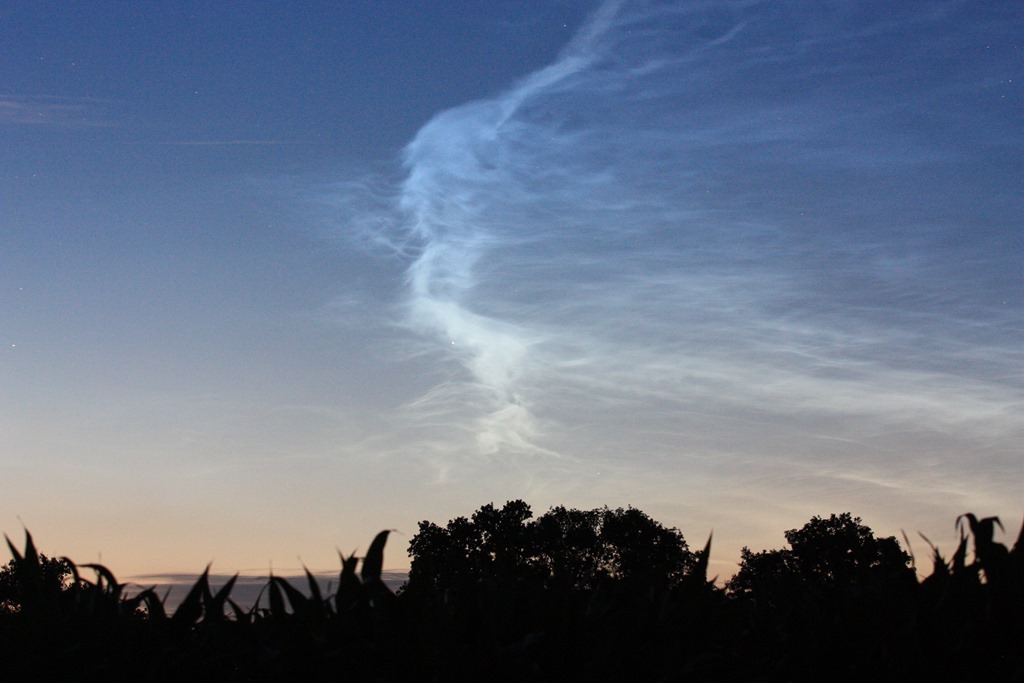
    When I took the dogs out last night at 11pm, I noticed that there were noctilucent clouds showing up above the Northern horizon. I dashed back and grabbed the camera for a couple of shots before they faded from view:

    20140703-2340-24

    20140703-2341-12

    20140703-2340-57 Stitch

    These are time exposures of ten seconds, so the sky appears brighter than in fact it was (you can also see some stars). This is the first time that I’ve ever been aware that I was looking at this particular meteorological phenomenon. 

  • More Visitors

    Following on from the shots of a Coal Tit taken the other day, here’s a couple of a Tree Sparrow…

    20140610-1146-53(001) 

    20140610-1146-47(001)

  • Bird Feeder

    Seated, as I frequently am, in front of the computer; I also have a view through the window to the garden, and to the bird feeders strategically positioned in direct view. That’s so I can catch views of the locals…

    20140529-1138-45

    20140531-0708-34

  • OneDrive – Still No Proper Support For Tags

    Update 23 January 2015: OneDrive now searches Tags – at last! So please treat what follows as a historical post illustrating the situation as it was up until January 2015…

    Update 8 October 2015: And now Tags added to photos via OneDrive online will get added to the photos’ metadata, and thus also be synced back down to the photos held in OneDrive on your PCs.

    Update 5 October 2024: And now Microsoft has removed the ability to search tags in photos stored in OneDrive. They have rendered OneDrive useless for managing photos.

    Microsoft has recently added some new features to OneDrive, listed in the OneDrive Blog: Updating OneDrive: Five New Features You Asked For.

    Unfortunately, the five do not include one that I (and others) have been requesting for the past three years: proper support for tags in photo metadata.

    Interestingly, one thing has changed, there is now a “Tags” heading displayed along with the “People tags” heading in the information pane for a photo. This returns a feature that was removed in June 2011. However, this does not yet seem to be fully working. Let me try and illustrate this.

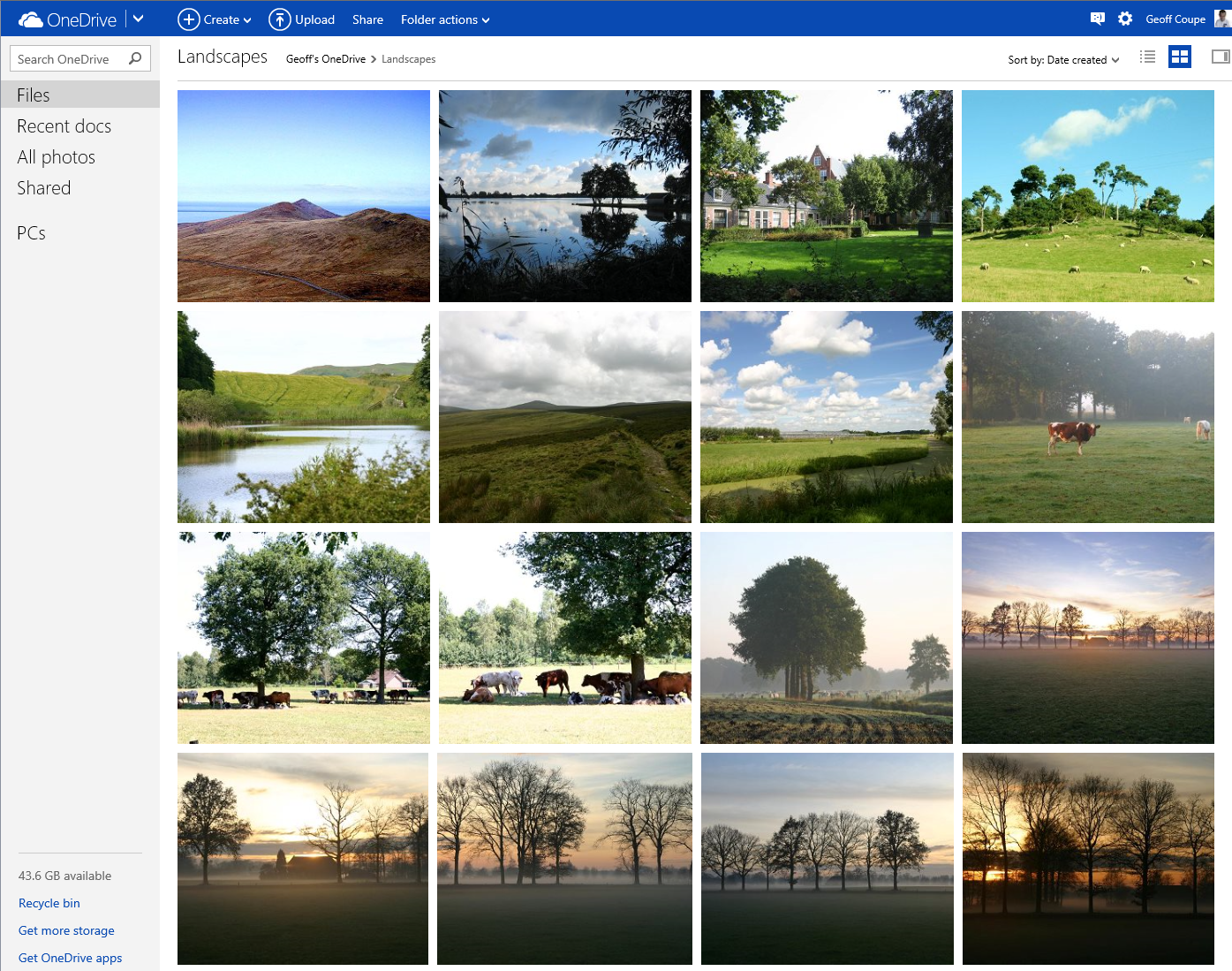
    First, here’s the new view of a folder of photos on OneDrive; it has larger thumbnails than the previous version:

    Onedrive 01

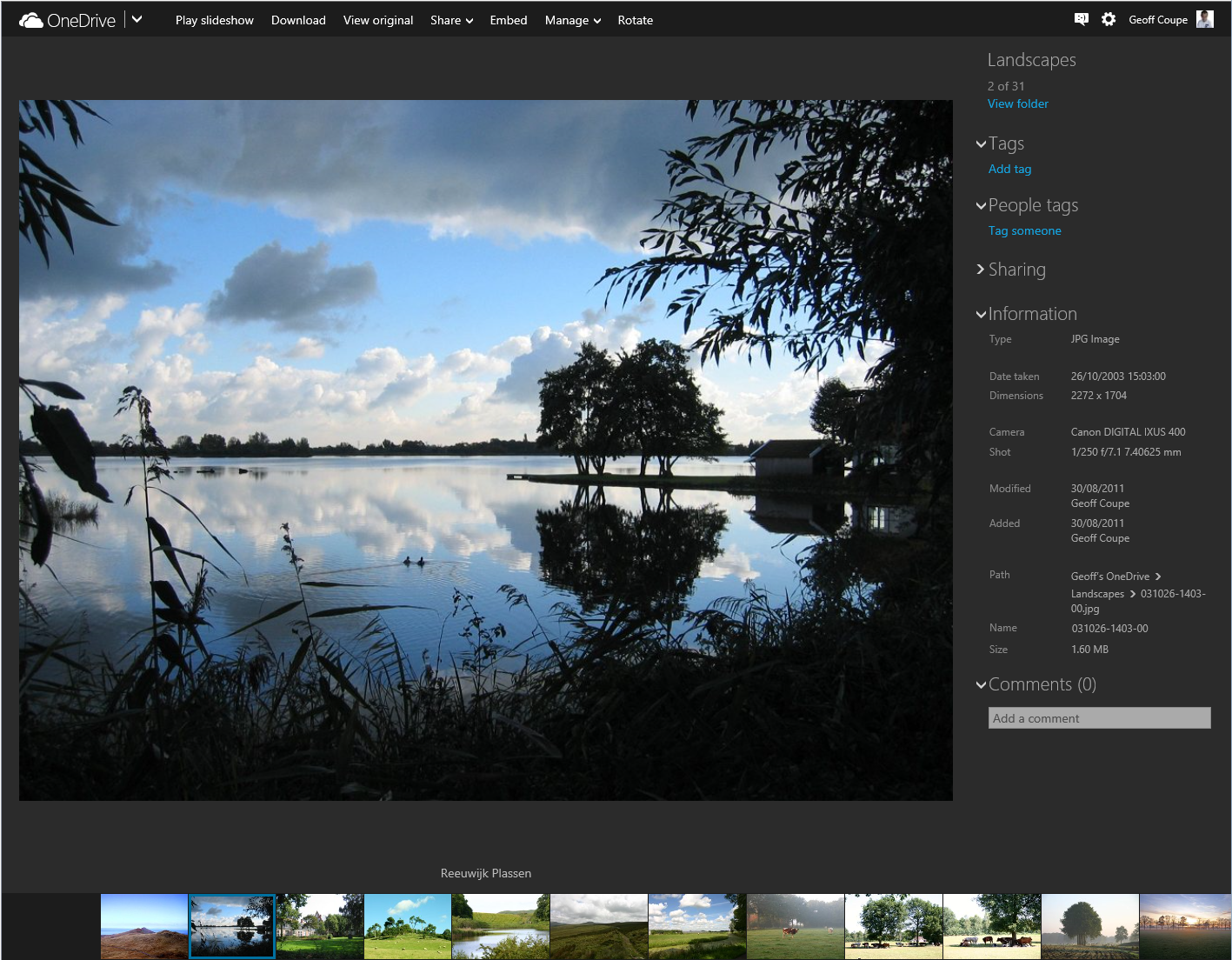
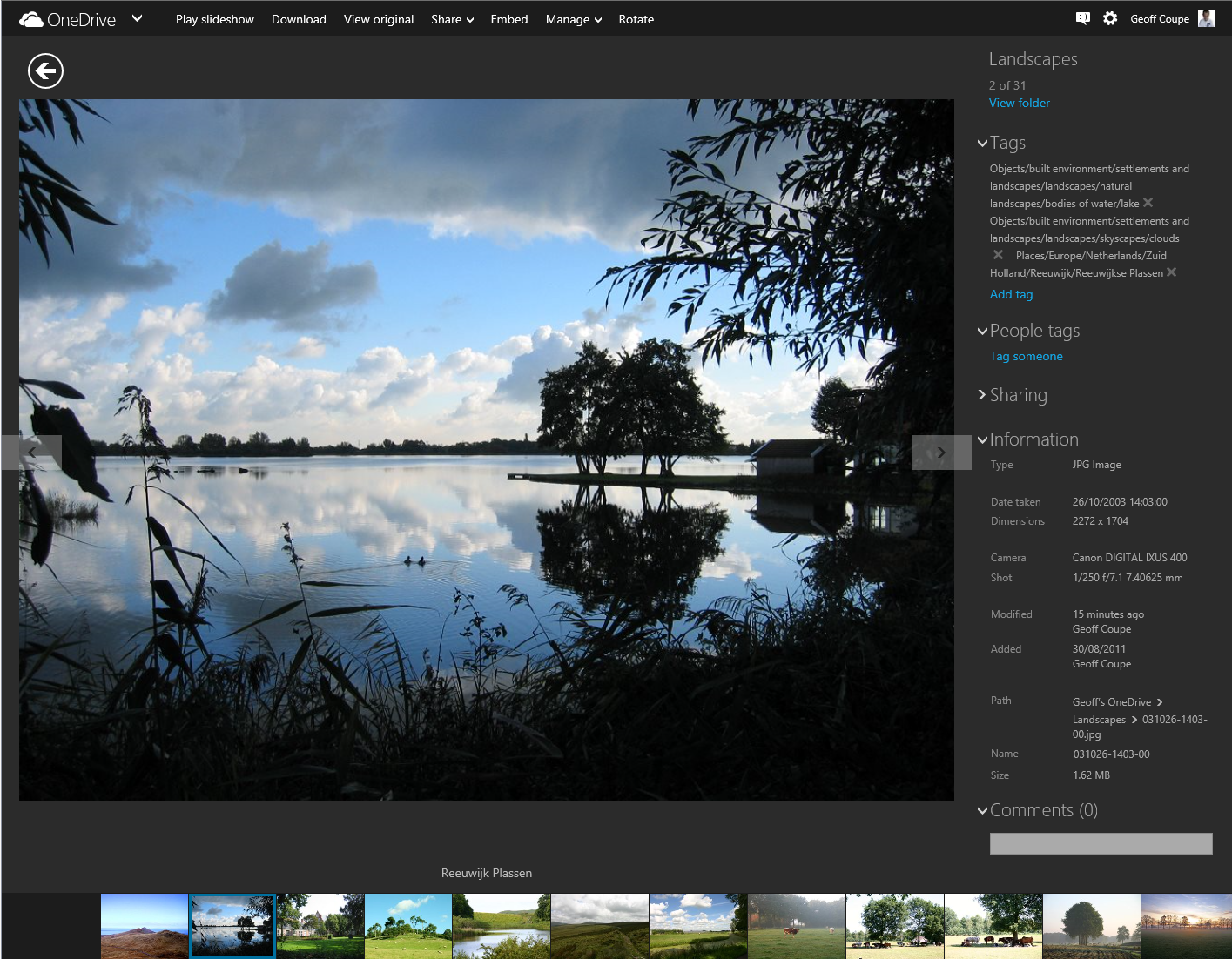
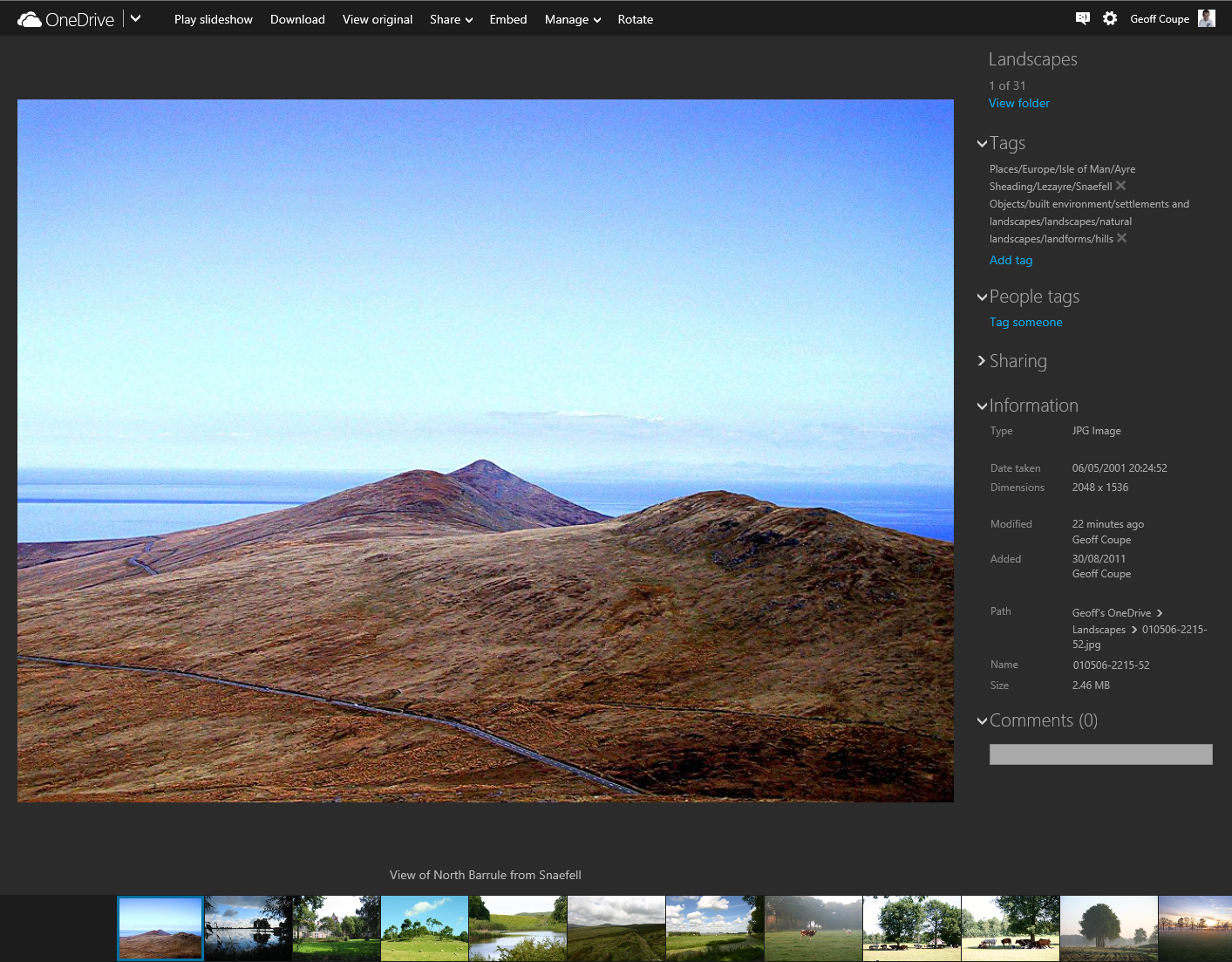
    Now let’s look at an individual photo using OneDrive, and show the metadata stored in the photo displayed in the information panel on the right:

    Onedrive 02

    Notice how OneDrive claims there are no descriptive tags in this photo, by the fact that under the “Tags” heading, there is only the link to add a tag.

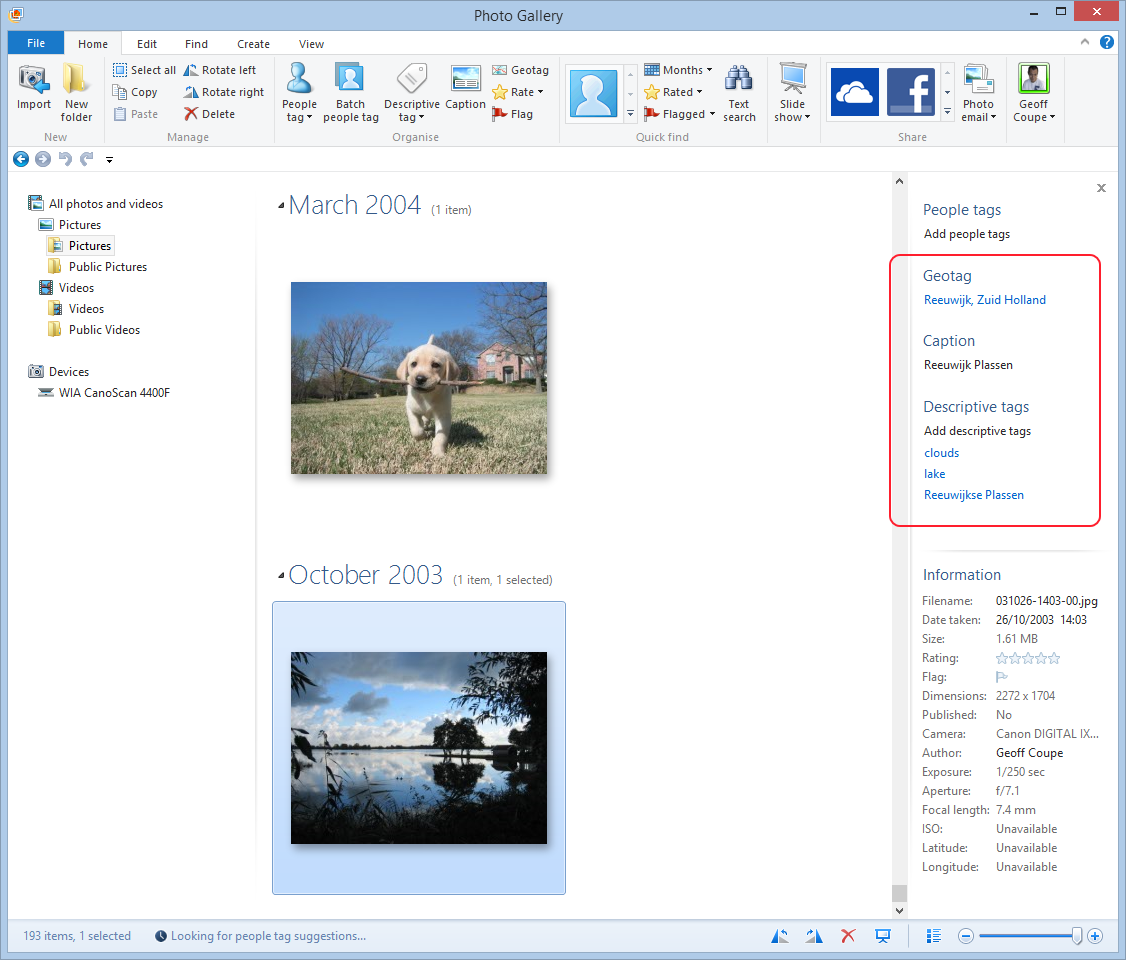
    However, this photo (like all the photos I have on OneDrive) has been tagged. I can show this by downloading a copy of this photo to my PC (by clicking on the “Download” link shown at the top of the OneDrive window), and then using Microsoft’s Photo Gallery to display the metadata in its information panel:

    Onedrive 03

    You can see that there are both Descriptive tags (clouds, lake, Reeuwijkse Plassen) and Location metadata (Reeuwijk, Zuid Holland – what Microsoft wrongly calls geotags; they are in fact more properly called geocodes) in this photo, and they were not being displayed in OneDrive.

    And then I discovered something really interesting. When I went back to displaying this photo in OneDrive, suddenly the Descriptive tags were showing up:

    Onedrive 05

    I can only conclude that the act of downloading the file has triggered a process in OneDrive to start displaying the tags in this file. All the other photos in the folder did not have any tags being displayed. As a further test, I downloaded another photo in the folder, and then went back to look at the photo in OneDrive. Lo and behold, that photo now had its descriptive tags displayed:

    Onedrive 06

    This is clearly a step forward, but it’s still a broken experience. We should not have to download every file in order to get the descriptive tags to display.

    And descriptive tags are still not being searched in OneDrive. That first sample photo has a descriptive tag “clouds” in it (to be strictly correct, it has a hierarchical tag Objects/built environment/settlements and landscapes/skyscapes/clouds), but doing a search for it in OneDrive produces no results:

    Onedrive 04

    According to Microsoft’s Omar Shahine: “this work just ranks lower on the priority list than some other things we are doing right now”.

    I just hope that the work remains on the list of things to do, and that this broken experience doesn’t last for too long.

    Addendum: A word of warning. Do not use the “Add tag” feature in OneDrive, if you want your photo metadata to remain consistent. Any tags added to photos using OneDrive do not get added to the metadata of the photos. You end up with a tag list displayed by OneDrive that does not reflect the tag list contained in the photo metadata.

    As of October 2015, this has now seems to have been fixed. Tags added in OneDrive will now get synced back to your photo metadata.

  • A Camera With A Phone Attached

    I dabble in photography, but I’d hesitate to call myself a photographer. Nevertheless, I invested in a Canon EOS 300D back in 2005, and replaced it with a Canon EOS 450D in 2008. Along with the cameras came investment in four lenses to cover a range of situations. I’ve been very satisfied with the equipment, despite having to spend 145 euros on a repair to the electronics in one of the lenses that failed during a shoot.

    However, having to lug the camera bag with a selection of lenses around means that I have to make a deliberate decision whether to take the camera with me if I’m going somewhere. That’s the advantage of point-and-shoot cameras; they are portable enough to slip into a pocket and be available at all times. Of course, the quality is not comparable with a DSLR. Martin has a Canon IXUS 300 HS, and I sometimes find that I borrow that rather than have the hassle of lugging around the Canon EOS and lenses.

    Meanwhile, smartphones have been in a race to improve the quality of the photos they made. I entered the race two years ago when I bought a Nokia Lumia 800. The quality and resolution of the Lumia was not quite up to that of the IXUS, but at least I had it with me at all times. Then, last July, Nokia introduced the Lumia 1020, which has a staggering 41 Megapixel image sensor.  To be fair, Nokia had also introduced the Nokia PureView 808 smartphone 18 months previously, which had a similar specification. However that smartphone runs the Symbian operating system, and represents an ecosystem that I have no interest in. The imaging technology that had been introduced in the PureView 808 was further tweaked for the Lumia 1020 to produce image quality that far outstrips any other smartphone. So the Lumia 1020 was the flagship phone at the time of introduction, and it commanded a flagship price – too rich for me. But six months is a long time in the smartphone market, the prices started to fall to the point where I became tempted. In the dying days of 2013, I purchased my own Lumia 1020.

    The Nokia Lumia 1020, like the Lumia 800 before it, is a Windows Phone, so I was able to move all my information and applications across without issue. The prime differentiator for me is the camera. It’s clearly not at DSLR quality, but it’s good enough for me for most occasions. If you want a comparison, then this article: Smartphones versus DSLRs versus film: A look at how far we’ve come, is highly recommended. A few choice quotes:

    When I first saw the images from the Nokia Lumia 1020, I did a double take. Clear and crisp, lots of detail and super strong colors that you’ll either love or wince at. I loved them. And did I mention the detail? After years of seeing bigger cameras perform better, I couldn’t believe that a tiny plastic and glass Zeiss lens could resolve so much from the center to the edge of the image. It was close to the Nikon D800. I was stunned. I’ll list the shortcomings of the Nokia below, but first, some more stand-out results.

    How many years are smartphones behind the best $2,000 DSLRs? Comparing detail resolved, I’ll say the iPhone 5S currently sits 8-9 years behind the DLSRs in bright light, while the Nokia trails by less than 6 years — probably nearer to 3. This is even when you allow the DSLRs the luxury of a $1,700 lens, and shooting in raw. In bright light, the Nokia came close to competing with the detail from the best DLSR yet made.

    The Nokia 1020 has redefined what I thought possible from a phone. I used to think of smartphones as a separate branch of ‘wannabe’ cameras, doomed to forever play catch-up with real cameras. I used to think like Takafumi Hongo, a Canon spokesperson who told the Wall Street Journal “Taking photos with smartphones and editing them with apps is like cooking with cheap ingredients and a lot of artificial flavoring. Using interchangeable [lens] cameras is like slow food cooked with natural, genuine ingredients.” He has a point. With a smartphone you’ll miss a lot of the joy of learning to cook traditionally. But in photography, the important ingredients come from you. Smartphones are now good enough not to need artificial flavoring from apps.

    I look forward to wielding my new camera that happens to have a phone attached to it. It will always be in my pocket, ready to hand.

  • Manx Wallpapers

    The background of the Desktop screen on my Windows PCs is generally set to display landscape themes. There’s a whole range of them, and other themes, available to download and use.

    Today, I noticed from a Microsoft blog, that there is now a landscape theme devoted to pictures from my birthplace, the Isle of Man. Taken by Mark Wallace, there are some suitably moody shots of Peel Castle, the ruins of St. Trinian’s church, the Calf of Man and more.

    They’ve been installed and serve as a reminder of my original home.

  • Photo Metadata Tools – The Saga Continues

    A couple of weeks ago, I blogged about the tools I use to manage my collection of photos and the metadata contained in them.

    In it, I noted that interoperability issues between metadata editing tools was a problem. Never was a truer word spoken (or written).

    One of the complaints I have had for a long while about Microsoft’s Windows Photo Gallery (WPG) is that, in my experience, it corrupts the Makernotes metadata in images produced by my Canon cameras. That led to an interesting discussion in the comments of that blog post with Mike Lee. He said that he wasn’t seeing the metadata corruption when he used WPG. We established that we were both using the same version of WPG (build 16.4.3508.205), so then we had a mystery: why was I seeing metadata corruption, and he wasn’t? A further surprise was when he said that a sample file that I had uploaded to SkyDrive to share with him contained metadata errors, whereas I was positive that it was error-free.

    So I set out to investigate. I took a photo using my Canon EOS 450D camera, and copied it onto my Desktop PC. This original file has the name IMG_7383.jpg:

    IMG_7383

    Using Mike’s MetadataMirror tool (which uses Phil Harvey’s most excellent ExifTool under the covers), I obtained a listing of all the metadata present in this original file. As expected, the only metadata present in the file (other than the Windows metadata) is the Exif data inserted by the camera itself. This is in three groups: standard Exif, Canon Makernotes and Canon Composite tags. Here’s a link to the file (IMG_7383.txt) containing the metadata listing:

    http://sdrv.ms/1aVOMkn

    The next step was to use Photo Supreme (PSU) on a copy of the image (IMG_7383 – PSU.jpg) to stamp in my usual boilerplate of metadata: e.g. my name and copyright information. The  file (IMG_7383 – PSU.txt) listing the metadata resulting from using PSU on this image file is here:

    http://sdrv.ms/1a16hx6

    PSU has preserved the original metadata, while adding some new items. This new metadata is both XMP-based and IPTC-IIM (for backwards compatibility). PSU also writes XMP equivalents for many of the original Exif items. So for example, if you look in the file, you will see items such as:

    [EXIF] Make: Canon
    [EXIF] Model: Canon EOS 450D
    [EXIF] Orientation: Horizontal (normal)
    [EXIF] XResolution: 72
    [EXIF] YResolution: 72
    [EXIF] ResolutionUnit: inches
    [EXIF] ModifyDate: 2013:10:04 21:06:31
    [EXIF] YCbCrPositioning: Co-sited

    PSU creates XMP equivalents:

    [XMP] Make: Canon
    [XMP] Model: Canon EOS 450D
    [XMP] Orientation: Horizontal (normal)
    [XMP] XResolution: 72
    [XMP] YResolution: 72
    [XMP] ResolutionUnit: inches
    [XMP] DateTime: 2013:10:04 21:06:31.300+02:00
    [XMP] YCbCrPositioning: Co-sited

    PSU also adds in the boilerplate that I use in XMP, e.g.:

    [XMP] Title: IMG_7383 – PSU
    [XMP] Rights: 2013 Geoff Coupe, Creative Commons
    [XMP] Creator: Geoff Coupe
    [XMP] CreatorWorkURL: https://gcoupe.wordpress.com
    [XMP] UsageTerms: Creative Commons Attribution Non-commercial Share-alike

    It also includes a notification that it has been used to edit the file, together with a timestamp. This is all as it should be, according to metadata standards.

    [XMP] CreatorTool: IDimagerSU (1.9.5.170)
    [XMP] MetadataDate: 2013:10:05 10:03:31.353+02:00

    In summary, there is absolutely nothing untoward about the resulting image file, as far as I can see. The structure of the Exif metadata is preserved, and XMP-based metadata has been added correctly.

    The next step was to take a copy of this file and add one item of metadata using WPG. This file is IMG_7383 – PSU+WPG.jpg and the corresponding file listing the metadata is IMG_7383 – PSU+WPG.txt:

    http://sdrv.ms/16pxkoF

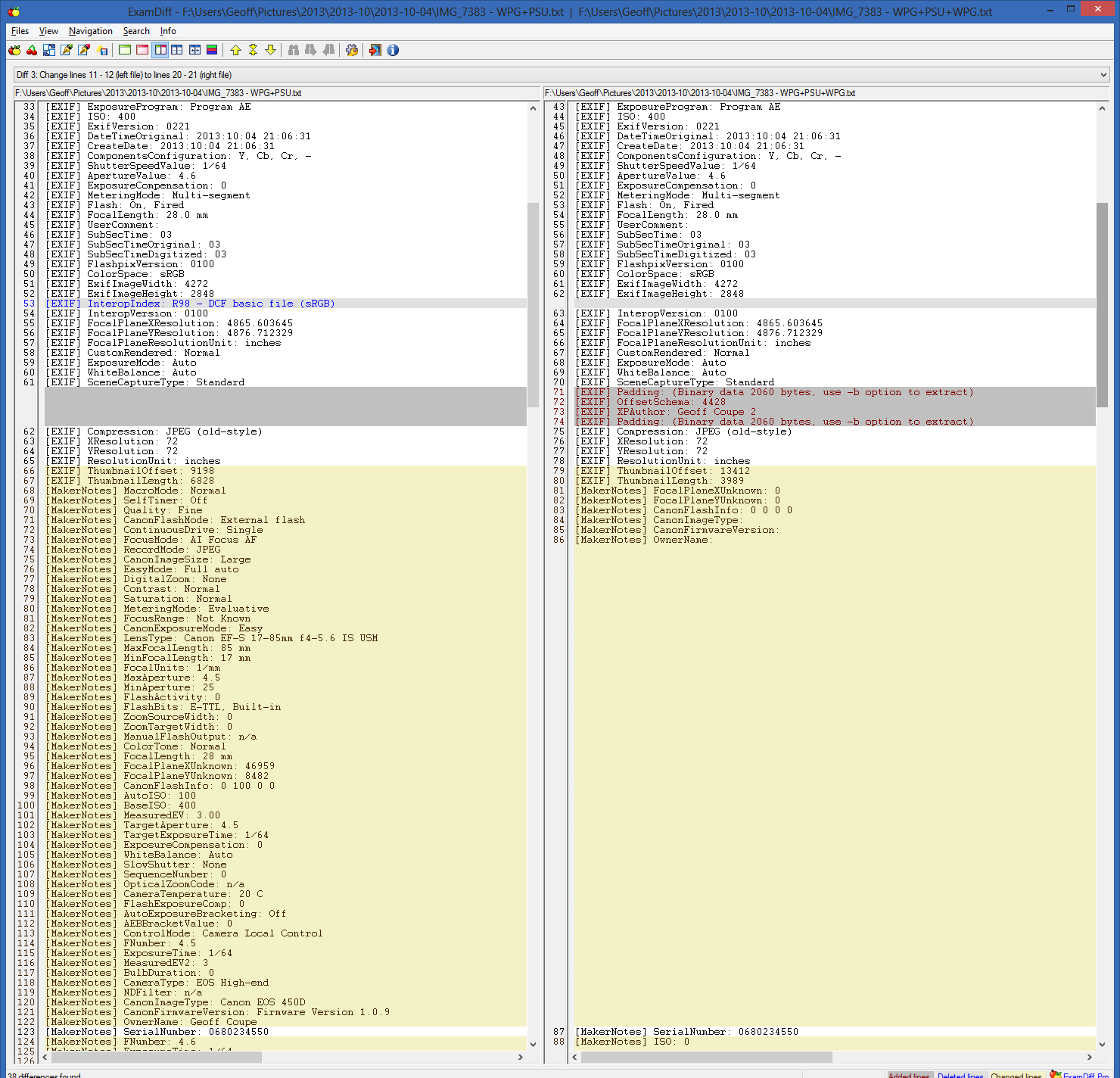
    Immediately, you can see there’s a problem – errors are being reported:

    [ExifTool] Warning: [minor] Possibly incorrect maker notes offsets (fix by 4476?)
    [ExifTool] Warning: Invalid CanonCameraSettings data
    [ExifTool] Warning: Invalid CanonShotInfo data
    [ExifTool] Warning: Invalid CanonFileInfo data
    [ExifTool] Warning: [minor] Suspicious MakerNotes offset for DustRemovalData
    [ExifTool] Warning: Invalid CustomFunctions2 data
    [ExifTool] Warning: Invalid ProcessingInfo data
    [ExifTool] Warning: Invalid MeasuredColor data
    [ExifTool] Warning: Invalid SensorInfo data

    And indeed, whole chunks of the Canon Makernotes are missing from the image file (left is the metadata in IMG-7383 – PSU.jpg and right is that in IMG_7383 – PSU+WPG.jpg):

    Metadata test 05

    There are also two other possibly significant things about this image file, captured in the metadata. The first is that when WPG writes back to the image file, it reverses the byte order of the Exif data structure. Originally, the Exif is in Little-endian order as shown in this line from both the original IMG_7383.txt and the IMG_7383 – PSU.txt files:

    [File] ExifByteOrder: Little-endian (Intel, II)

    However, once WPG has changed the file, the byte order is now Big-endian:

    [File] ExifByteOrder: Big-endian (Motorola, MM)

    Now, this may, or may not, be a problem, but it is definitely contrary to the advice given by the Metadata Working Group, which states that byte order should be preserved by tools that operate on image files.

    Secondly, WPG introduces an offset in the Exif data structure when adding the changed metadata:

    EXIF] Padding: (Binary data 2060 bytes, use -b option to extract)
    [EXIF] OffsetSchema: 4476
    [EXIF] XPAuthor: Geoff Coupe 2
    [EXIF] Padding: (Binary data 2060 bytes, use -b option to extract)

    So, at this point in the saga, I believe that I’ve established that for any given image that contains Canon Makernotes data, using PSU followed by WPG to edit metadata will result in the corruption of the Makernotes data. This is repeatable for all such image files that I’ve tested.

    What happens if I use WPG followed by PSU to edit metadata? Let’s find out. 

    I used WPG to add myself as author to a copy of the original image: IMG_7383 WPG.jpg. The metadata listing (IMG_7383 WPG.txt) is here:

    http://sdrv.ms/1e16G6W

    You’ll notice immediately that ExifTool gives a warning about the Makernotes structure:

    [ExifTool] Warning: [minor] Adjusted MakerNotes base by 4176

    Also, the byte order has been changed, and padding introduced:

    [File] ExifByteOrder: Big-endian (Motorola, MM)

    [EXIF] Padding: (Binary data 2060 bytes, use -b option to extract)
    [EXIF] OffsetSchema: 4176
    [EXIF] XPAuthor: Geoff Coupe
    [EXIF] Padding: (Binary data 2060 bytes, use -b option to extract)

    However, there is no Makernotes corruption.

    Now let us use PSU to edit the metadata in this file (I changed the Title to read IMG_7383 – WPG+PSU). The resulting image file is IMG_7383 – WPG+PSU.jpg and the corresponding listing of the metadata is IMG_7383 – WPG+PSU.txt, and can be found here:

    http://sdrv.ms/GEzvu1

    The interesting thing here is that the byte order has been switched back to Little-endian, and the padding removed:

    Metadata test 06

    Other than that, the metadata looks fine; no Makernotes are missing, and ExifTool reports no errors.

    So far, so good, but now if I go back and use WPG once more, I get Makernotes corruption again. The image file is IMG_7383 – WPG+PSU+WPG.jpg and the metadata listing is IMG_7383 – WPG+PSU+WPG.txt:

    http://sdrv.ms/192O5V7

    The byte order has been switched again, padding introduced, and ExifTool reports:

    [ExifTool] Warning: [minor] Possibly incorrect maker notes offsets (fix by 4428?)
    [ExifTool] Warning: Invalid CanonCameraSettings data
    [ExifTool] Warning: Invalid CanonShotInfo data
    [ExifTool] Warning: Invalid CanonFileInfo data
    [ExifTool] Warning: [minor] Suspicious MakerNotes offset for DustRemovalData
    [ExifTool] Warning: Invalid CustomFunctions2 data
    [ExifTool] Warning: Invalid ProcessingInfo data
    [ExifTool] Warning: Invalid MeasuredColor data
    [ExifTool] Warning: Invalid SensorInfo data

    And once again, chunks of Makernotes have gone:

    Metadata test 07

    So it seems that using PSU first, followed by WPG, will trigger a corruption of Canon Makernotes; however, using WPG followed by PSU does not.

    But there is one more twist to this saga.

    Remember that Mike had said that a sample file that I had uploaded to SkyDrive to share with him contained metadata errors, whereas I was positive that it was error-free?

    I know that the image files IMG_7383 – PSU.jpg and IMG_7383 – WPG+PSU.jpg do not contain errors. I have the metadata listings to prove it. And yet, if you download these files from SkyDrive, you will find that the Makernotes have also been corrupted. By comparison, if you download the same files from this set on Flickr, you’ll find that they are error-free.

    What’s going on here? I can only surmise that SkyDrive is doing some metadata processing on the images stored on the service, and that a similar, or the same, code library has the processing fault that triggers the Makernotes corruption on images that have already been processed by PSU.

    The SkyDrive folder containing these test images and their metadata files is here.

    The Flickr set containing the same test images is here.

    I like both PSU and WPG, but using them together can be dangerous.

    Addendum 7 October 2013

    I’ve been doing some further investigation and established the following

    • WPG definitely doesn’t like something about the metadata structures that PSU creates
    • None of my other metadata tools complain about PSU
    • ExifTool shows nothing amiss with the metadata that PSU creates.

    I can have an image file that has had metadata edited by a whole series of tools, but if at any point I have used PSU followed at some point further down the chain by WPG, then WPG will corrupt my Makernotes metadata.

    For example, I created two examples of chained metadata operations on files. The first was the sequence: Geosetter, XnViewMP, Lightroom 5, and WPG. At each stage I added a keyword identifying which tool I was using. The final result is given in the metadata listing: IMG_7383 – G+X+LR+WPG.txt, and there’s no corruption; here’s the start of the listing (but note the final offset, and the reversed byte order):

    [ExifTool] ExifToolVersion: 9.35
    [ExifTool] Warning: [minor] Adjusted MakerNotes base by 4236
    [File] FileName: IMG_7383 – G+X+LR+WPG.JPG
    [File] Directory: F:/Users/Geoff/Pictures/2013/2013-10/2013-10-07
    [File] FileSize: 3.9 MB
    [File] FileModifyDate: 2013:10:07 18:10:04+02:00
    [File] FileAccessDate: 2013:10:07 18:10:03+02:00
    [File] FileCreateDate: 2013:10:07 18:09:27+02:00
    [File] FilePermissions: rw-rw-rw-
    [File] FileType: JPEG
    [File] MIMEType: image/jpeg
    [File] ExifByteOrder: Big-endian (Motorola, MM)
    [File] CurrentIPTCDigest: f042c8560b6fafea9c47a1c0249baec1
    [File] ImageWidth: 4272

    The second was the sequence: PSU, Geosetter, XnViewMP, Lightroom 5, and WPG. Again, at each stage I added a keyword identifying which tool I was using. At each step, the metadata was as expected. Then in the last step, WPG is used to add another keyword, and bang – corruption occurs . The final result is given in the metadata listing: IMG_7383 – PSU+G+X+LR+WPG.txt. Here, WPG will corrupt the Makernotes metadata; here’s the start of the listing:

    [ExifTool] ExifToolVersion: 9.35
    [ExifTool] Warning: [minor] Possibly incorrect maker notes offsets (fix by 4526?)
    [ExifTool] Warning: Invalid CanonCameraSettings data
    [ExifTool] Warning: Invalid CanonShotInfo data
    [ExifTool] Warning: Invalid CanonFileInfo data
    [ExifTool] Warning: [minor] Suspicious MakerNotes offset for DustRemovalData
    [ExifTool] Warning: Invalid CustomFunctions2 data
    [ExifTool] Warning: Invalid ProcessingInfo data
    [ExifTool] Warning: Invalid MeasuredColor data
    [ExifTool] Warning: Invalid SensorInfo data
    [File] FileName: IMG_7383 – PSU+G+X+LR+WPG.JPG
    [File] Directory: F:/Users/Geoff/Pictures/2013/2013-10/2013-10-07
    [File] FileSize: 3.9 MB
    [File] FileModifyDate: 2013:10:07 18:25:07+02:00
    [File] FileAccessDate: 2013:10:07 18:25:07+02:00
    [File] FileCreateDate: 2013:10:07 18:24:37+02:00
    [File] FilePermissions: rw-rw-rw-
    [File] FileType: JPEG
    [File] MIMEType: image/jpeg
    [File] ExifByteOrder: Big-endian (Motorola, MM)

    WPG is sniffing out something that PSU puts in a file, and throws a fit… I’ve asked the developer of PSU for help, but he can’t guess what WPG chokes on. Right now, without input from Microsoft, it’s all guesswork and that could take forever.

    Microsoft were informed about this a couple of years ago, but since acknowledging that there was an issue, there’s been complete silence. 

  • Sharing Photos

    Long-time readers of the blog know that one of the topics I return to every now and then is that of photography.

    A couple of days ago, one of my posts had the following comment and question from michaelfanous:

    I recently started trying to organize my photo albums, which are stored across several external devices. (Trying to organize over 50,000 photos). I am not a professional photographer by any means. However, I am the “family/event” historian so to speak, so I love documenting and taking pictures of everything. I wanted to know your thoughts are current software out there? Lightroom 5, Photo Gallery (Windows), ACDSee, Picasa 3.9.

    My main concern is that all these files will eventually be stored in 1 central location, and the family can access them at their own over the network. However, I want to make sure that all the tagging is accessible across platforms. i.e. No matter which hardware device, or which software, when a user looks at the picture, they can see the tags.

    I remember in the earlier years (which is what caused me to stop for a bit) I would tag something in Windows Photo Gallery or in Picasa, but the tags wouldn’t transfer over appropriately. I am not so much concerned with actually editing the individual pictures (I am sure that will come later once I am organized)

    The other requirement is that the metadata is stored in the actual file, and not in some random database. The last thing I need is for that external database to get corrupted and lose out all the information.

    Suggestions?

    That sounds like a good opportunity to try and sum up what I might propose given the current state of things.

    First, a recap of my groundrule for managing photo collections (which echoes what Michael has stated as a requirement):

    I insist that any software used in the digital workflow (transfer from camera to computer, image selection, digital processing, cataloguing, publishing and asset management) will respect any Exif, IPTC and XMP metadata that may be stored in the image file itself.

    I am not interested in asset management software that stores image metadata away in a proprietary format in the software itself. That way lies painting oneself into a corner down the road… However, I will accept asset management software that copies metadata from image files into its own database for performance reasons, so long as the database and the image files metadata content are kept in sync transparently (i.e. it takes little or no effort on my part).

    The challenge is that different software treats image metadata in different ways, and interoperability can seem more of a goal than actuality. Not all image management applications will work together, and often, only a subset of all possible image metadata can be successfully exchanged between applications. Add to that the fact that many of the new photo editor applications for smartphones and tablets ignore image metadata altogether, or, even worse, strip it out. The same goes for many online social networks.

    Over the last seven years, I’ve used a number of image management applications to organise and tag my photos. These include versions of:

    I’ve also used tools that are no longer available. These include:

    • Microsoft’s Expression Media and Digital Image Suite
    • IDimager 5
    • Picajet
    • PixVue

    My primary image management tool at the moment is Photo Supreme. That’s because (for me) it has the best support for handling metadata and for image management of all the tools that I’ve used. I use GeoSetter in conjunction with Photo Supreme for handling geotagging.

    [Addendum: Version 2 of Photo Supreme now supports geotagging directly, and does it very well, so I no longer need to use GeoSetter in conjunction with Photo Supreme]

    Adobe’s Lightroom would rate high with me if I used Raw format in my images, because it has better digital darkroom features for processing Raw images than those of Photo Supreme. However, as I don’t often use Raw format, I prefer Photo Supreme’s metadata handling, which I consider to be much superior to Lightroom’s. Photo Supreme’s features for image acquisition and selection/culling are also, for my purposes, as good as anything that Lightroom has to offer.

    Since I use the ecosystem of Windows, I also have Windows Photo Gallery installed on our PCs. It’s an easy to use tool for browsing our photo collection, but I don’t use it as my primary tool for editing metadata or images. First, because while the metadata tools are usable, they are basic. However, more importantly for me, Windows Photo Gallery has a nasty habit of corrupting the Makernotes that our Canon cameras insert in the Exif section of images. This is a long standing issue that Microsoft has acknowledged and known about for some years, but clearly something that they won’t devote resources to for fixing. Microsoft seems to be using the same code in the Photos App of Windows 8, because it too will corrupt Canon Makernotes in any image that it edits. Now, I acknowledge that the majority of people either don’t know about the issue or wouldn’t bother themselves about it if they did. However, I would suggest that to a serious photographer, preservation of the original file is of paramount importance. This bug of Microsoft means that even adding a single piece of metadata to an image file will corrupt your Makernotes. That’s why I only ever use Windows Photo Gallery in a read-only mode. Anything else and it’s goodbye to your precious image data.

    And don’t think that Picasa is any better in this respect. Picasa will strip out Makernotes from your image files entirely.

    The bottom line: if you’re serious about photography, avoid using either Windows Photo Gallery or Picasa to do metadata work on your images. You can certainly use them to edit the images of copies of your original files, just don’t ever let them get near to your originals.

    The other tools in my first list above also offer metadata handling features, but they are pretty basic, and only cover the bare minimum of the Exif and IPTC metadata standards.

    One area where Photo Supreme (and Lightroom for that matter) is lagging is that of being able to handle automatic face recognition used to add metadata relating to people. Both Picasa and Windows Photo Gallery now offer this. Unfortunately, they do not use the same standard for storing people tags, so they do not interoperate. Photo Gallery uses a standard defined by Microsoft itself, whilst Picasa (in the latest version) uses a standard defined by a cross-industry consortium – the Metadata Working Group. Ironically, both Microsoft and Adobe are founder members of this consortium, yet Windows Photo Gallery and Lightroom do not yet use the consortium’s metadata standard for people tags.

    The Microsoft and MWG standards allow for metadata to be applied to specific regions in the image, that is, individual faces can be marked up with the names of the people depicted in the image. There is a third competing standard used for people tags, and that is contained in the IPTC Extension standard, which contains an element used to define persons shown in an image. However, this metadata element refers to the image as a whole, so for a group photograph, for example, you can list the names of all the people shown in the photo, but not explicitly identify who is who in the image. I am aware of just one application that implements this IPTC standard for people tags: Daminion, but there may be others. Correction: I completely forgot that since Photo Supreme implements all the IPTC standards fully (Core, Extension and Plus), then it too also implements the IPTC people tag. Photo Supreme also has its own proprietary standard for manually tagging regions in images for face tags, but I don’t use it. Photo Supreme now supports the MWG Region metadata, which means that it can identify face regions that have been tagged in Picasa. It also recognises the Microsoft People Tag, but any face regions that are defined in Photo Supreme will be written out using the MWG standard, rather than the proprietary Microsoft standard.

    So, to sum up at this stage: it’s possible to use a small number of different tools that will interoperate using a minimum subset of metadata standards – a basic set of Exif and IPTC Core metadata standards. That will give you a starter set of metadata elements. See this blog post for the list of IPTC elements that I use. The Exif elements are the technical data provided by the cameras I use (e.g. camera model, shutter speed, ISO, lens, date taken) plus optional GPS latitude/longitude/altitude data.

    Anything beyond this, e.g. People Tags, and you are likely to run into interoperability issues.

    Even with this subset, there can be bumps in the road. For example, Picasa uses the “Description” metadata field from the IPTC Core standard to display the caption for a photo, while Windows Photo Gallery uses the “Title” metadata field from the IPTC Core standard to display the caption. Even more bizarre, Windows itself (in Windows Explorer)uses “Title” according to the IPTC Core definition, and uses “Subject” to align with the IPTC Core definition of “Description”. So Windows is better aligned with the IPTC standard for photo metadata than Windows Photo Gallery…

    And the icing on the cake is that both Windows Photo Gallery and Picasa will damage your files if you use either of them to edit images. Bottom line: if you use either of these tools use them in read-only mode, or use copies of your original files.

    Right, you’ve now got your tools to hand, and you’ve used them to add your metadata to your images. You’ve also used your tools to tweak the original images and produced copies that have all your improvements applied: cropping, colour balance and so on. Now you want to share them with other people. What are your options?

    Assuming that at least some of the people you want to share with are physically located outside of your home, then you are looking at either using one of the online Social Networks or exposing your photo collection held on your home network to (selected) people via the internet.

    Let’s look at the Social Networks route first. As I’ve already said, Social Networks are not the best at preserving the metadata that you’ve spent blood, sweat and tears adding to your photos. There are also quirks involved. I use both Flickr and Microsoft’s SkyDrive, so I’ll use those to illustrate some of the oddities.

    Flickr has the advantage that when you upload your photos from your local storage, the metadata in your photos gets read by Flickr. So you can search your (and other people’s) collection of photos using keywords held in metadata. Even better, if you download the original size of a photo held on Flickr, then the metadata contained within it is preserved. However, if you select to download a different-sized copy of the original photo, then Flickr will strip out the metadata. It used to be the case that even different-sized copies of the original would have the metadata of the original preserved within them. But somewhere along the line, Flickr changed the rules of their playground and made their service the poorer as a result.

    Microsoft’s SkyDrive also has its faults. It does preserve metadata in downloaded copies of the originals held on its service. However, the metadata is neither exposed in the user interface, nor searchable with one exception – that of Microsoft’s proprietary People Tags. Frankly, this is abysmal. It makes sharing of photo collections with other people needlessly difficult.

    There are many other Social Networks available, e.g. FaceBook, Google+, but I don’t use them, so I can’t document the inevitable issues that they will have. I leave that as an exercise for the reader.

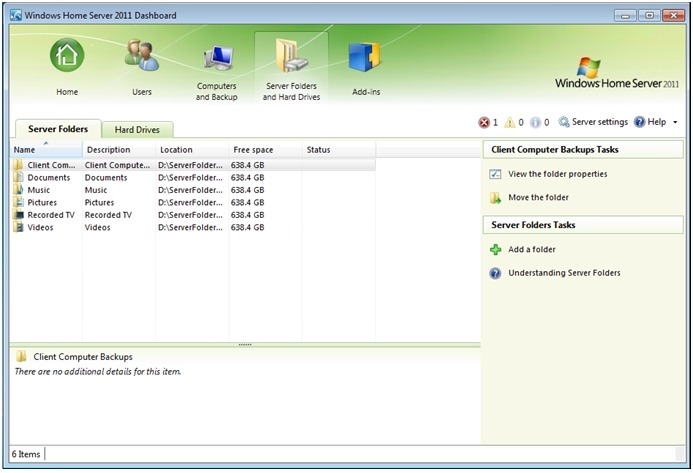
    There is also the route of exposing your photo collection held on your home network to (selected) people via the internet. I use Microsoft’s Windows Home Server 2011 on our home network to store all our media for sharing to a variety of networked devices, and to back up our attached PCs. It is very good at that. It is also possible to use WHS 2011 to allow selected people to access its media collection via the internet. At least, that’s the theory. In practice, the software is riddled with problems. I cannot use it, and Microsoft has no intention of fixing it.

    I see that Michael has a Synology device that he will use as a centralised nework attached storage device. It also has the feature of being able to give access to selected people over the internet. It runs a media application called Photo Station. I have no working knowledge of Synology devices or Photo Station, but I’ll just add a couple of comments. First, I noticed from the Synology documentation that Photo Station claims to:

    • Search photos with keywords, time slots, or tags
    • Supports people tags from Windows Live Photo Gallery
    • Supports IPTC tags of photos

    Nice to see IPTC tags explicitly mentioned, but I hope that these are at least the XMP-based IPTC Core set of tags, and not the legacy IPTC-IIM tags. If it is only the latter, then interoperability issues will arise sooner or later.

    As I’ve already written, the People tags in Windows (Live) Photo Gallery are Microsoft-proprietary. Also, if you make a conscious decision to use them, be aware that you can kiss goodbye to your Makernotes if you use Canon cameras (and possibly other makes of cameras as well).

    Secondly, Microsoft has also set a snake in the grass for Networked Attached Storage devices. The Windows indexing service is designed to collate results from network-attached Windows devices. It won’t collate results from NAS devices that don’t run a Windows operating system.

    The new generation of Microsoft Apps for Windows 8 (e.g. Xbox Music, Photos, Videos) cannot access media stored on non-Windows NAS devices, even if the media locations are stored in your Windows Libraries on the accessing PC.

    This is just something to be aware of going forward. The current generation of Desktop Applications (both Microsoft and third party) are generally OK. However, the new generation of Windows 8 Metro Apps, especially those from Microsoft itself, may present problems. Check them out before buying.

    I’ve already said that I have been unimpressed by the first wave of photo editors designed for Metro. The situation is not improving. In the process of writing this blog entry, I thought I’d check the Windows Store to see if there were Metro Apps available for editing photo metadata. I tried two that I found:

    Now, admittedly I have over 50,000 photos in my photo library collection. However, neither of them could open the collection without crashing. I sent an email to Photo TagEd’s support. Their response:

    Sorry, we didn’t test for thousands photos by our environment.

    And we can’t recommend to this App to your problem.

    We have no plans to continue support for this App, because technical difficulties by Windows 8 App SDK.

    Once again, We’re sorry. You can find out other apps for your Tablet PC in Windows Store.

    From IV Type Team.

    Sigh.

    Addendum: Prompted by a discussion in the comments on this post, I’ve put up a new post that documents the corruption of Makernotes by Windows Photo Gallery:

    Photo Metadata Tools – The Saga Continues

  • SkyDrive – Still No Proper Support For Tags

    Yesterday, Microsoft added some functions to SkyDrive – its online storage service. The additions are described in this blog post by Omar Shahine, a Group Program Manager at  SkyDrive.

    Now, some of the additions are worthwhile, but I am still missing something that Microsoft removed back in June 2011: the display and searching of Descriptive Tags (aka Keywords) in photos. Up until that time, you could show the Descriptive Tags that were contained in the metadata of photos uploaded to SkyDrive. Then, Microsoft did a major revamp of the user interface of SkyDrive, and started using HTML5 to drive the interface. In that revamp, something odd happened. Photos that I knew contained Descriptive Tags were suddenly shown as having no Tags, and I was being invited to re-enter Tags into the photos on SkyDrive.

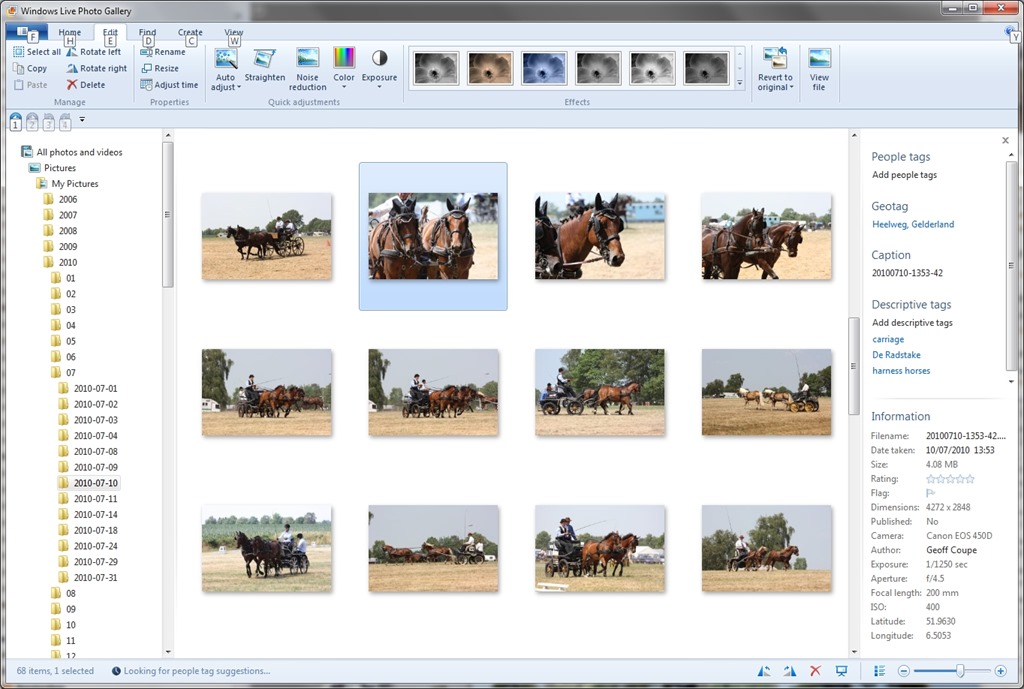
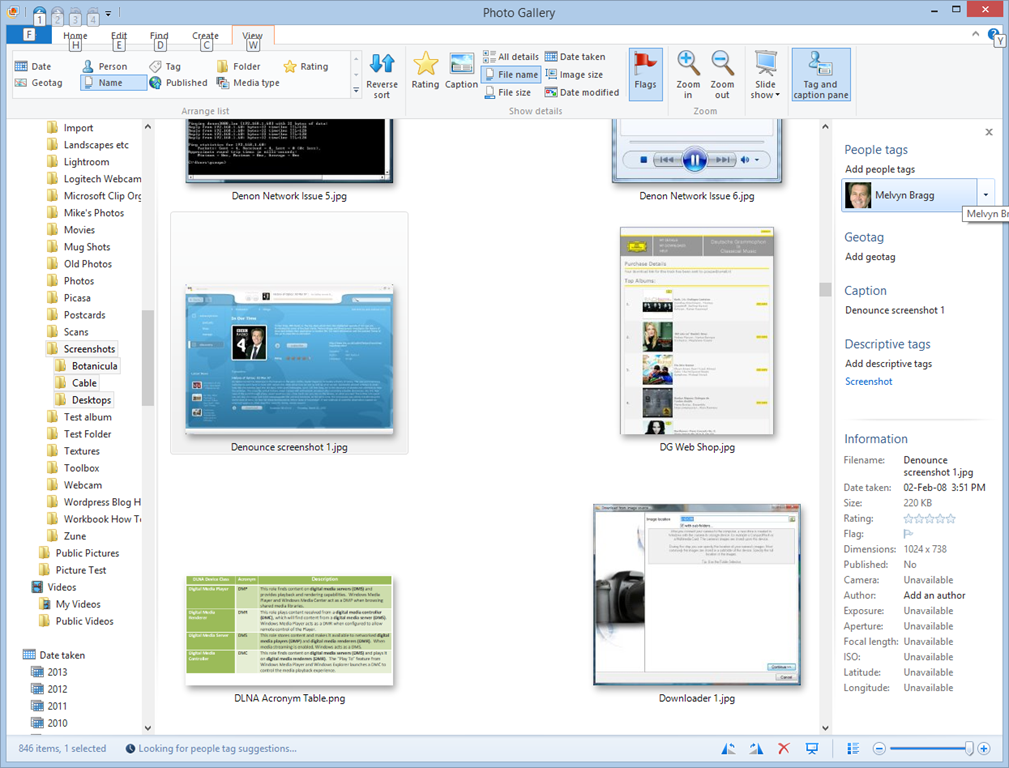
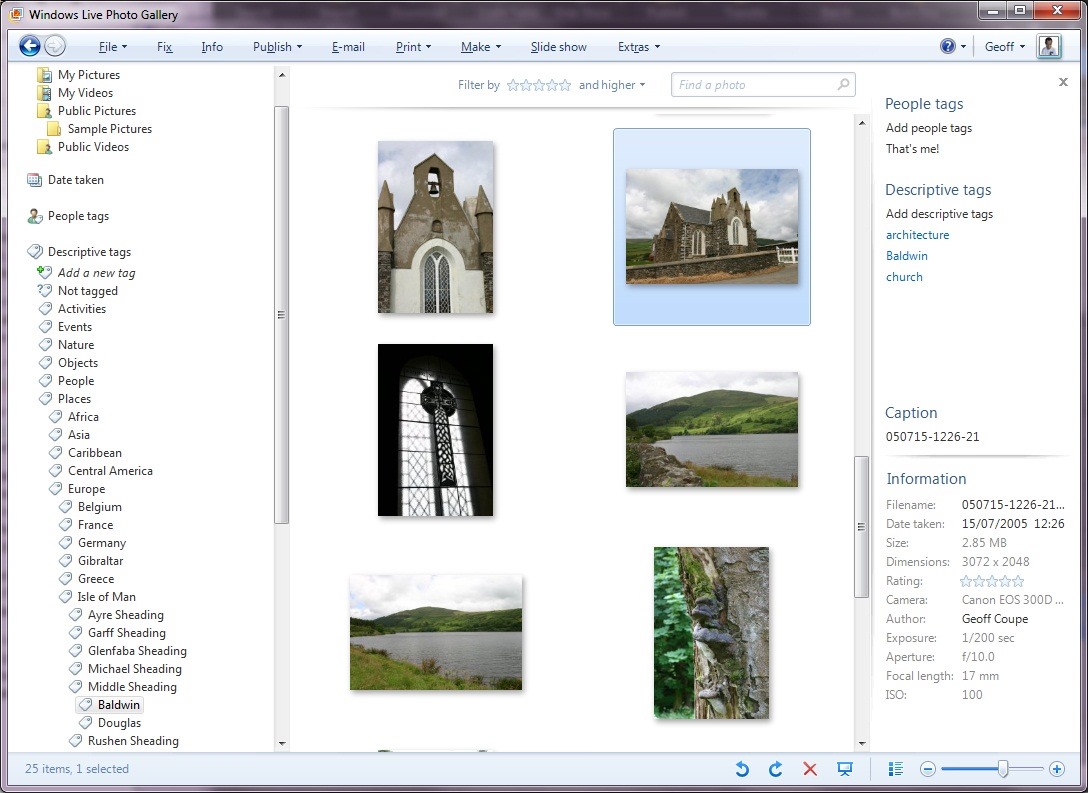
    Here’s an example of what I started seeing at the time; this is a screenshot of photos on my PC being displayed in Microsoft’s Windows Live Photo Gallery (now renamed to Photo Gallery), an application running on my PC. One thumbnail has been selected, and you can see the metadata embedded in the photo being displayed in the information panel on the right hand side of Windows Live Photo Gallery (click on the image to see the full-size screenshot):

    SkyDrive 1

    You can see that the metadata contains both descriptive tags (e.g. carriage and harness horses) as well as technical and copyright information (e.g. date taken, location, camera details, etc.).

    This picture was uploaded to a SkyDrive photo album here. When I looked at the picture in SkyDrive, while I saw some (but not all) of the technical information, none of the descriptive tags had been transferred. Indeed, I was invited to add the tags again!

    SkyDrive 2

    I blogged about this backwards step in November 2011, and had responses from Omar Shahine, and others, to my post. It turned out that the “Tags” label in SkyDrive no longer referred to Descriptive Tags, but People Tags.

    I notice that since then, Microsoft has renamed the “Tags” label to “People Tags” – here’s the photo being displayed in SkyDrive today:

    SkyDrive Tags 05

    However, there is still no sign of any Descriptive Tags being displayed by SkyDrive, even though my photos are all tagged. Yesterday, Omar Shahine and Mona Akmal of the SkyDrive team held an “Ask Me Anything” session on Reddit. Someone asked about support of tagging on SkyDrive, to which Shahine replied:

    Something we’ve talked a lot about on the team, but have nothing to share about this now.

    So it’s something that has probably been talked about for the past two years, and we are still apparently no further forward? I have to say that I’m not impressed. If the team are serious about making SkyDrive relevant to photographers, then proper support of tags should be high on their to-do list.

    And by “proper support”, I mean that SkyDrive should not just display Descriptive Tags as well as People Tags, but support searching of both types. Currently, they do neither.

    I have a test image with a “People Tag” defined. Here it is being displayed in Windows Photo Gallery:

    SkyDrive Tags 06

    You can see that I have identified the face in the screenshot as being that of British broadcaster Melvyn Bragg, and that the image has a Descriptive Tag of “Screenshot”.

    Now here’s the same image being displayed in SkyDrive:

    SkyDrive Tags 02

    It has lost all evidence of having a Descriptive Tag contained within the image, but at least it is displaying the fact that it has a People Tag, with the content “Melvyn Bragg”. Unfortunately, People Tags, just like Descriptive Tags, are not searchable on SkyDrive. If I search within my SkyDrive files for “Melvyn”, I get the message that nothing is found:

    SkyDrive Tags 03

    Both People Tags and Descriptive Tags are searchable on my PC – Windows supports searching within photo metadata, so here, the image is found:

    SkyDrive Tags 04

    But this won’t help someone trying to find something that has been tagged within my public SkyDrive folders, or friends and family looking for something within my shared folders.

    So, to summarise:

    • Microsoft removed the display of Descriptive Tags in photo metadata from SkyDrive in June 2011.
    • They replaced it with the display of People Tags in photo metadata.
    • Neither Descriptive Tags nor People Tags are searchable in SkyDrive
    • Two years on, and nothing has changed.

    Serious photographers need to look elsewhere.

    Update 19th February 2014: Well, today Microsoft has changed the name of SkyDrive to OneDrive, but nothing else has changed. Tag support is still woeful, and searching of tags is still not supported.

    Update 10th May 2014: Microsoft has introduced some new features into OneDrive, but unfortunately, the support for Tags is still very much broken.

    Update 23rd January 2015: OneDrive has finally introduced support for searching on Tags!

  • Microsoft’s SkyDrive – Room for Improvement

    OneDrive (previously SkyDrive, Windows Live SkyDrive and Windows Live Folders) is the online storage service offered by Microsoft. It’s been around since 2007, and has been through a number of iterations. It really started to come into its own with the introduction of Windows 8, where it started to assume a much more prominent role. Now with the imminent introduction of Windows 8.1, it is becoming more tightly integrated with the Windows operating system than ever, and the distinction between local and online (cloud) storage is becoming even more blurred.

    I’ve changed all references to SkyDrive to OneDrive in this post since it was first written, to reflect the change of name given to the service by Microsoft. Some screenshots and external references still refer to the old SkyDrive name…

    There’s a good post (Inside SkyDrive) over at the Windows blog that describes some of this integration. However, it seems to me that there is still room for further improvement.

    For example, the author of the post (Mona Akmal, Group Program Manager, SkyDrive apps) writes:

    Many people use search to quickly access their files. So we’ve made search work just as you’d expect – SkyDrive files show up in search results just like your local files.

    Er, no, that’s not true. The way that the search function works is to index the information held in the small placeholder files held locally on your PC. These placeholder files represent the real files held up on the OneDrive service itself. At the moment, it seems that very little metadata is held in the placeholder files; only things such as the filename, and image thumbnails. So if I search for Descriptive Tags (aka Keywords) that are held in photo metadata, I get no results.

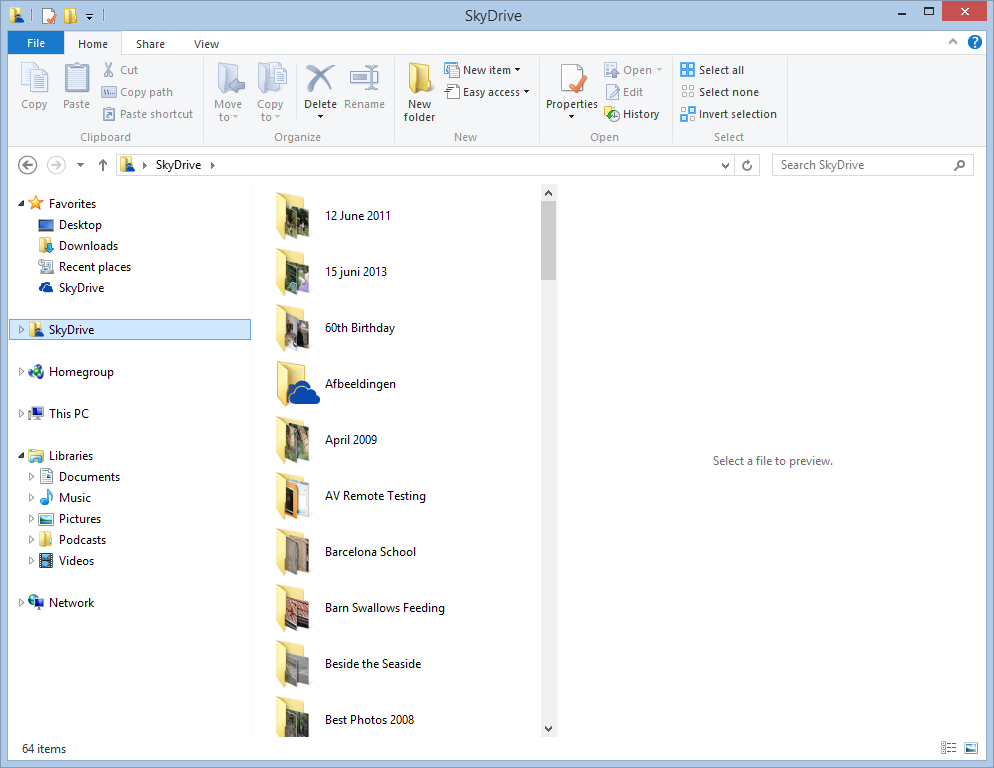
    Let me illustrate this. In Windows 8, it is possible to have a local copy of your SkyDrive folders and files. Here’s a screenshot showing some of the OneDrive folders that are held locally on my Desktop PC:

    SkyDrive 01

    These folders and the files within them are full local copies of the contents of my OneDrive storage. They are also included in the scope of the Windows Search engine running on the PC, and because they contain all the metadata, they are also searchable. So, for example, If I search for pictures of our dog, Kai, I get 16 hits of OneDrive photos that contain the Descriptive Tag: Kai:

    SkyDrive 02

    My ThinkPad Tablet, on the other hand, is running the Windows 8.1 Preview. In Windows 8.1, the contents of my OneDrive storage is represented by placeholder files:

    SkyDrive 03

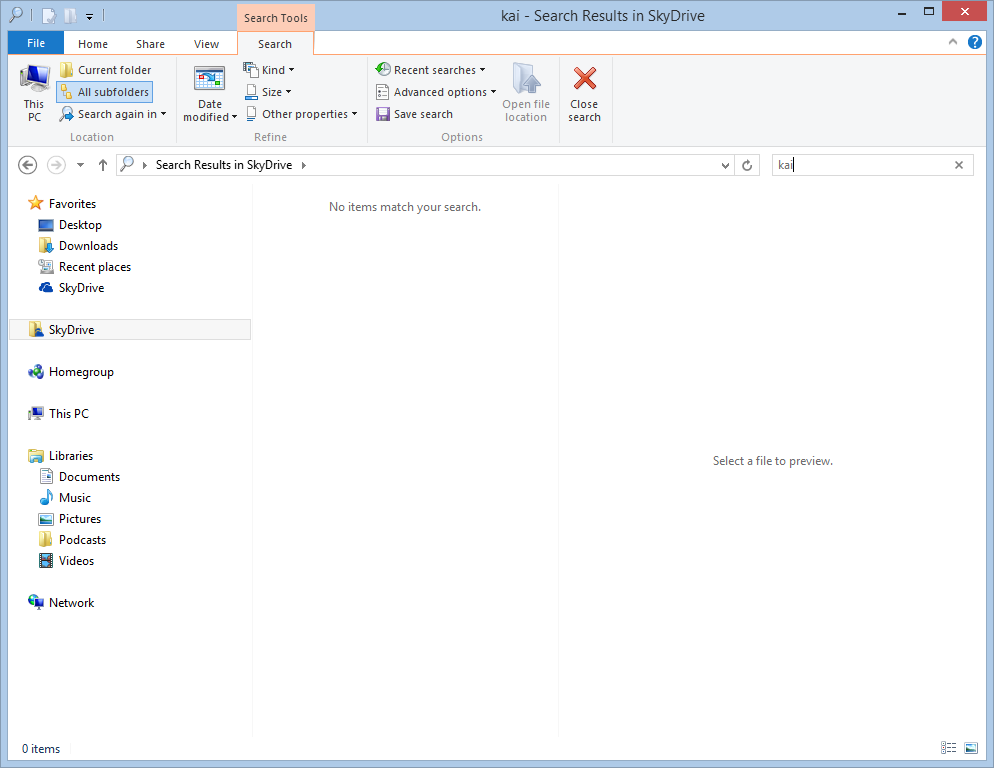
    To all intents and purposes, they look like the original Folders and Files held in my OneDrive , but they are not; merely placeholders. A full local copy of a file is not present on the Tablet, unless I have edited the file. So now, if I search for photos of Kai, I get a sad little “No items match your search” message:

    Skydrive 04

    That’s because the placeholder files do not contain any photo metadata. This seems to me like a real limitation, particularly since there is no way of searching Descriptive Tags in photos in OneDrive itself – even though the files themselves have the metadata.

    Here, for example, is the OneDrive App in Windows 8.1. Note how the Search Charm is not able to search OneDrive , but only the web or local files:

    SkyDrive 05

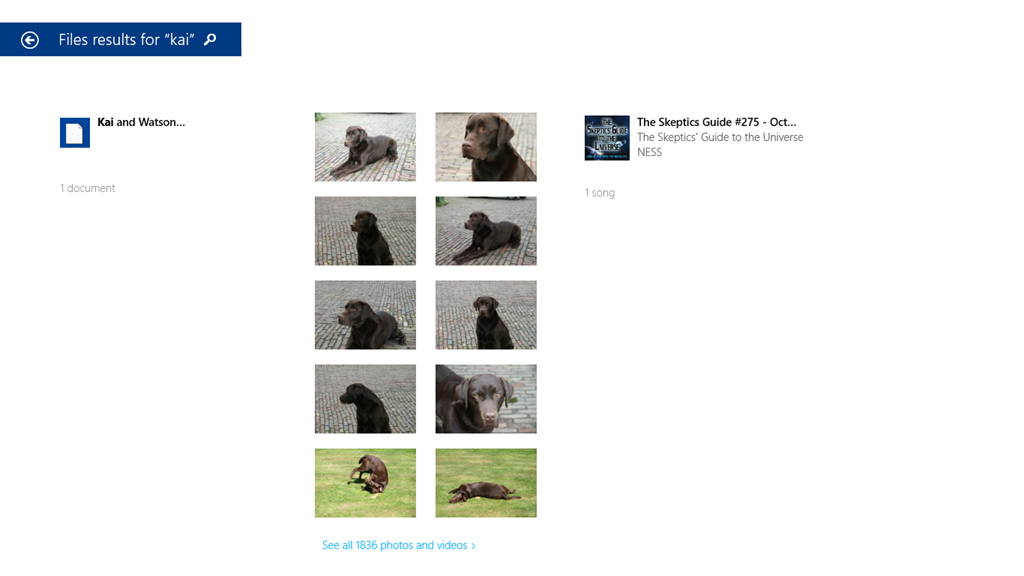
    Searching for “Kai” produces only the results from my local libraries, not from OneDrive :

    SkyDrive 06

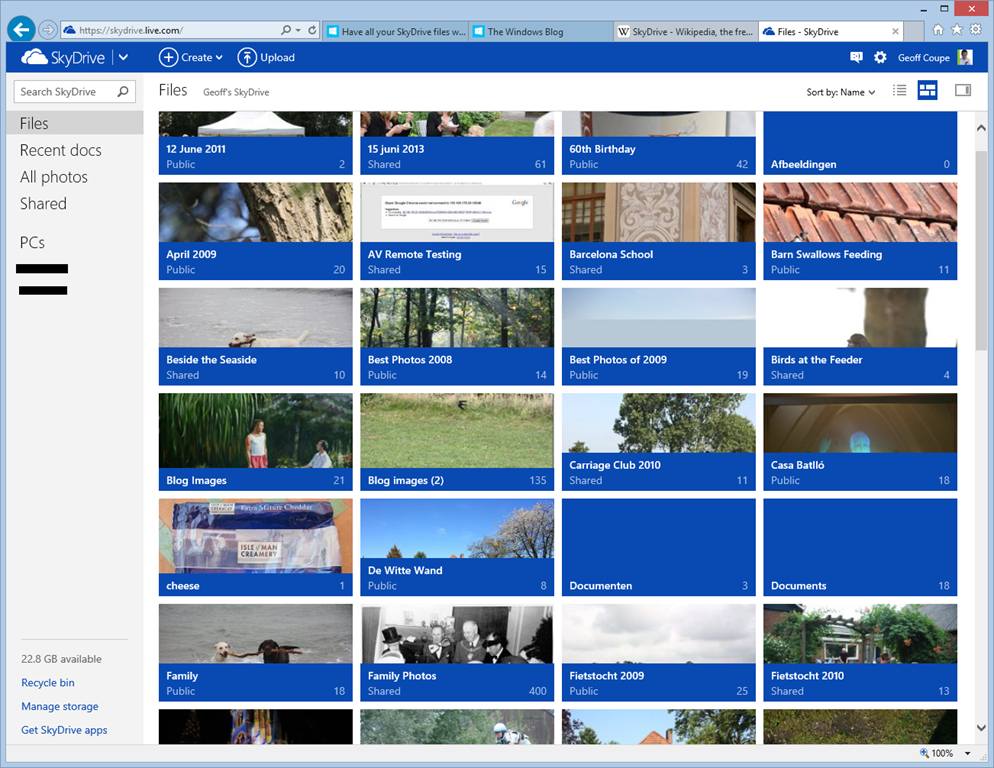
    If I use Internet Explorer to browse OneDrive directly, then I still can’t search on Descriptive Tags. Here’s the initial view of my OneDrive :

    SkyDrive 07

    If I use the “Search OneDrive” function at the top left, and search for “Kai”, then nothing is found:

    SkyDrive 08

    So the SkyDrive service is not indexing metadata such as the Descriptive Tags. This, by the way, is a long standing issue with the SkyDrive service. I’ve raised it on a number of occasions with the OneDrive team, and nothing has changed.

    In addition, the Windows 8.1 integration of OneDrive is also not indexing metadata, so perhaps the Microsoft statement should be rewritten as:

    Many people use search to quickly access their files. So we’ve made search work just not as you’d expect – SkyDrive files won’t always show up in search results unlike your local files.

    Sigh.

    Update 4 October 2013: If you read the comments below this post, you’ll see that members of the OneDrive team have replied. The good news is that they are working to address the shortcomings of the current search experience – photo metadata is now being included in the placeholder files. That’s good to hear.

    Update 7 May 2014: I’ve just done a test of uploading some files, containing IPTC Core keywords (tags) in their metadata, to OneDrive. You still can’t search for the tags using the browser accessing the online service – they don’t show up in the search results.

    However, it does appear as though the tags are now being included in the metadata contained in the placeholder files. So a search of the OneDrive folders on your local PC will find the tags. So, one step forward.

    Update 10 May 2014: The support for tags in the OneDrive service itself is still pretty much broken. Microsoft seem to have forgotten their one-time goal that “the truth is in the file“.

  • Photo Metadata

    The BBC’s News web site has a video report on photo metadata. It’s a fairly good introduction to the topic, and worth five minutes of your time.

    The reporter, Ian Hardy, makes the point that your grandfather’s photos often had some explanatory text written on the back of them – and that’s the metadata. In today’s digital world, the vast majority of images are being created with technical metadata (camera type, shutter speed, etc.) but often without any information on who is in the picture. The situation is not being helped by the new generation of social media web sites or mobile Apps for smartphones, Tablets or iPads that do not support management of metadata, or even worse, strip it out.

    I’m a firm believer in the value of metadata. Unfortunately, at the moment, it’s a minefield, with competing and conflicting standards and poor, faulty, or non-existent support in applications and online services. Things can only get better, but there’s no guarantee that they will.

  • Photo Editor Apps

    My needs are fairly simple when it comes to a tool to edit digital photos. I don’t need all the bells and whistles of an Adobe Photoshop, just something that I can use to crop, resize, or adjust the contrast or colour balance of an image. Very occasionally, I need to to be able to make a cut-out mask of part of an image and paste it into another. For example, in this blog’s header image (which changes with the seasons), you can see our two dogs sitting in front of the house. They are always there, whatever the season, and that’s because their image has been pasted in to each of the seasons’ images.

    The features of Microsoft’s Windows Photo Gallery are the sort of thing that I have in mind (although it doesn’t handle masks), but I found out a long time ago that it corrupts image metadata. In particular, it destroys Canon’s Makernotes, which are stored in the Exif metadata of images made using my Canon cameras. Despite reporting this to Microsoft over two years ago, and Microsoft acknowledging that there is a bug, this still hasn’t been fixed. In fact, the same bug is present in Microsoft’s Photos App, built for Windows 8.

    For this reason, I only use Windows Photo Gallery to stitch together panoramas – it is very good at that – and don’t use any other of its editing tools. I also don’t use it to modify image metadata, because whenever Photo Gallery writes back metadata into the image file, it will corrupt the Makernotes. For editing and metadata work, I use Photo Supreme. It is excellent for metadata, and the image editor is good enough for my simple tasks. When I need to use masking, then I fire up the ancient, and long since withdrawn, Microsoft Digital Image Pro 10. As an aside, I often wonder why on earth Microsoft dropped this product. It certainly outshines any of their current digital imaging products…

    Anyway, I was curious to see whether there was an easy to use photo editor available for the Windows 8 environment. At the moment, there are over 700 Apps listed in the Windows Store under the Photo category.

    Photo Apps 02

    Admittedly, some of those listed are Desktop Apps, designed to run in the Windows 7 Desktop environment, but the vast majority are built as Modern UI Apps for Windows 8.

    Last month, there was a post on Microsoft’s Windows Experience Blog that listed, and recommended, four Modern UI photo editor Apps. These were:

    I took a quick look at three of the suggestions (Fotor, Fhotoroom and Perfect365), and they all seem to strip out all metadata from a saved image, Exif and XMP. This is not useful, and completely contrary to the guidance from the Metadata Working Group, of which Microsoft is one of the founding members. As far as I’m concerned, that rules out any of these applications for me.

    Today, I saw that Adobe has made their Photoshop Express available as a Modern UI App for Windows 8, so I’ve taken a quick look.

    Photo Apps 01

    Well, on the positive side, it preserves metadata, and doesn’t corrupt it, so that’s a step forward from Microsoft’s efforts. However, it is still very limited in what it can do, and it has at least one irritating quirk all of its own. In this list of capabilities, unless otherwise stated, you can take it that Windows Photo Gallery (WPG) and Photo Supreme (PSU) can match the features listed.

    • It can crop and resize the image, with or without ratio guides.
    • It can rotate the image in fixed 90 degree increments (PSU can also handle free rotation, with or without cropping).
    • It can flip the image (WPG cannot).
    • It cannot resize the image resolution (WPG and PSU both can).
    • It can adjust (both manually and auto-fix) contrast, exposure and white balance, and apply preset filters.
    • It can remove Red Eye (PSU cannot).
    • It can heal images (WPG cannot).
    • It cannot handle masks and image layers (neither can WPG or PSU).
    • It cannot handle RAW images (PSU can, while WPG can only display them)

    Interestingly, it looks as though the App is extensible. You can add paid-for filters. So it’s possible that some of the limitations may be overcome in the future.

    And what of the irritation?

    Well, I don’t know whether the App is saving images at full quality, or whether it is applying compression. As a test, I took an original JPEG image that was 6.82 MB in size, and used the App to save a copy (no changes were made). The resulting copy was 4.08 MB in size. I suspect that some compression has been applied, but I have no way of telling how much, or more importantly, be able to save with no compression. That I do not like in an application.

    I also get slightly irritated by the fact that I can only save to one online Cloud storage service: Adobe’s own Revel. Fine, but I want to use my existing (and free) SkyDrive storage, rather than have yet another service to deal with.

    So in summary, all I can say is that Adobe’s Photoshop Express has promise, but it is not yet at a stage where I will drop my other digital image editor tools in its favour. Ask me again in a year.

    Addendum: I asked on an Adobe forum whether I could stop Photoshop Express from compressing my images. The answer is no, and that’s apparently by design.

    Also, I raised the issue of metadata being stripped out by Fotor with their support people. I had a response in which their programmer confirmed that Fotor does not save all of the Exif metadata in edited images. Unfortunately, he also seemed to be completely unaware that there are other types of image metadata besides Exif – and these are equally important to photographers.

    This link http://www.photometadata.org/META-101-metadata-types has an easy to understand introduction to image metadata.

    As it stands, Fotor is not a suitable tool for any photographer who cares about preservation of image metadata. The same seems to be true for many of the photo Apps currently available.

  • RIP – IDimager

    One of my hobbies is photography, and my main tool for managing my digital photos is IDimager. I’ve been using it since January 2007. It’s now up to version 5, and I’ve been very happy with it. I occasionally visit the IDimager support forums, just to see if there are any announcements, or tips and tricks being posted. Yesterday I read a message from the developer that said:

    IDimager V5 is discontinued as of today. Photo Supreme is a different product when compared to IDimager V5. They don’t offer an identical feature set so I recommend all IDimager V5 users to first try Supreme to see if it fits their need before they decide to make the switch.

    My immediate reaction was WTF? Whilst I had been aware of the Photo Supreme product, last time I looked, a few months ago, it was for the Mac, and there was no whisper of a Windows version being made available. Fast forward a couple of months, and now it has killed off IDimager. Needless to say, I’m not very happy about this, and neither are a lot of other IDimager customers. IDimager is a serious Digital Asset Management (DAM) tool, and Photo Supreme, at first glance, has far less functionality; so for many people, Photo Supreme is nowhere near an acceptable replacement. A typical reaction:

    Well that’s a real shame because you have killed off one of the best DAM systems a working professional could ask for and replaced it with a toy. I wish you luck with Photo Supreme, but regrettably it’s not a professional standard product IMO.

    Because I tend to work mostly with JPG images, I’ll probably be able to carry on using IDimager for some time to come. However, for professional photographers who work with RAW format images, then IDimager will soon not be able to handle images produced by new camera models. These people have been thrown into a pit. I can only echo what someone else posted:

    I have always had a lot of respect for Hert [the chief developer] and his responsiveness to bugs and feature requests. It made IDI stand out in a market dominated by big software giants who bought, crippled then abandoned software. Sadly yesterday’s announcement felt all too familiar and not what I have come to expect.

    Since I have never used all of IDimager’s power (similar to most people only ever using a fraction of the capabilities of Microsoft Word), I’m taking a look at Photo Supreme to see it is a possible replacement for my usage patterns. But I’m doing so with a rather sour taste in my mouth at the moment.

    Addendum 18th September 2014: I thought it was worthwhile adding that since writing this post, I switched (a while ago now) across to Photo Supreme, and have not regretted doing so. PSU has continued to evolve (version 3 is about to be released), and it has matured into a very good DAM.

    Photo Supreme V3 is worth looking at.

  • Microsoft’s Photo Gallery – Yet Another Missed Opportunity?

    As I wrote in my last post, Microsoft has recently released a new version of Windows Live Photo Gallery, now simply known as “Photo Gallery”. That last post documented an issue that Photo Gallery has over its handling of geotags. In this post I want to look at what I would consider to be missed opportunities by Microsoft to set the lead in the field of software aimed at organising digital photos.

    Microsoft is a founding member of the Metadata Working Group, a consortium of leading companies in the digital media industry, focused on the following goals:

    • Preservation and seamless interoperability of digital image metadata
    • Interoperability and availability to all applications, devices, and services

    Almost two years ago, in November 2010, the group published version 2 of its Guidelines for Handling Image Metadata. As I wrote at the time, it’s “a major new version of the Guidelines”. The document states:

    This expanded specification builds on existing metadata standards to describe several emerging consumer properties that:

    • Use regions to record faces, focus points, barcodes, or other data in an image
    • Provide hierarchical keywords to richly describe and classify images
    • Flexibly identify an image as part of a greater media collection

    While software applications are supporting features such as people tags and hierarchical keywords, they use differing implementations, so that interoperability between applications is difficult, if not often impossible.

    Version 2 of the Guidelines was an attempt to define a common specification in these areas, to drive interoperability forward.

    What I find disappointing is that, nearly two years later, the new version of Photo Gallery has not implemented any of these proposed specifications, and continues with the old Microsoft-proprietary ways of doing things, despite the fact that Microsoft is a founding member of the Metadata Working Group.

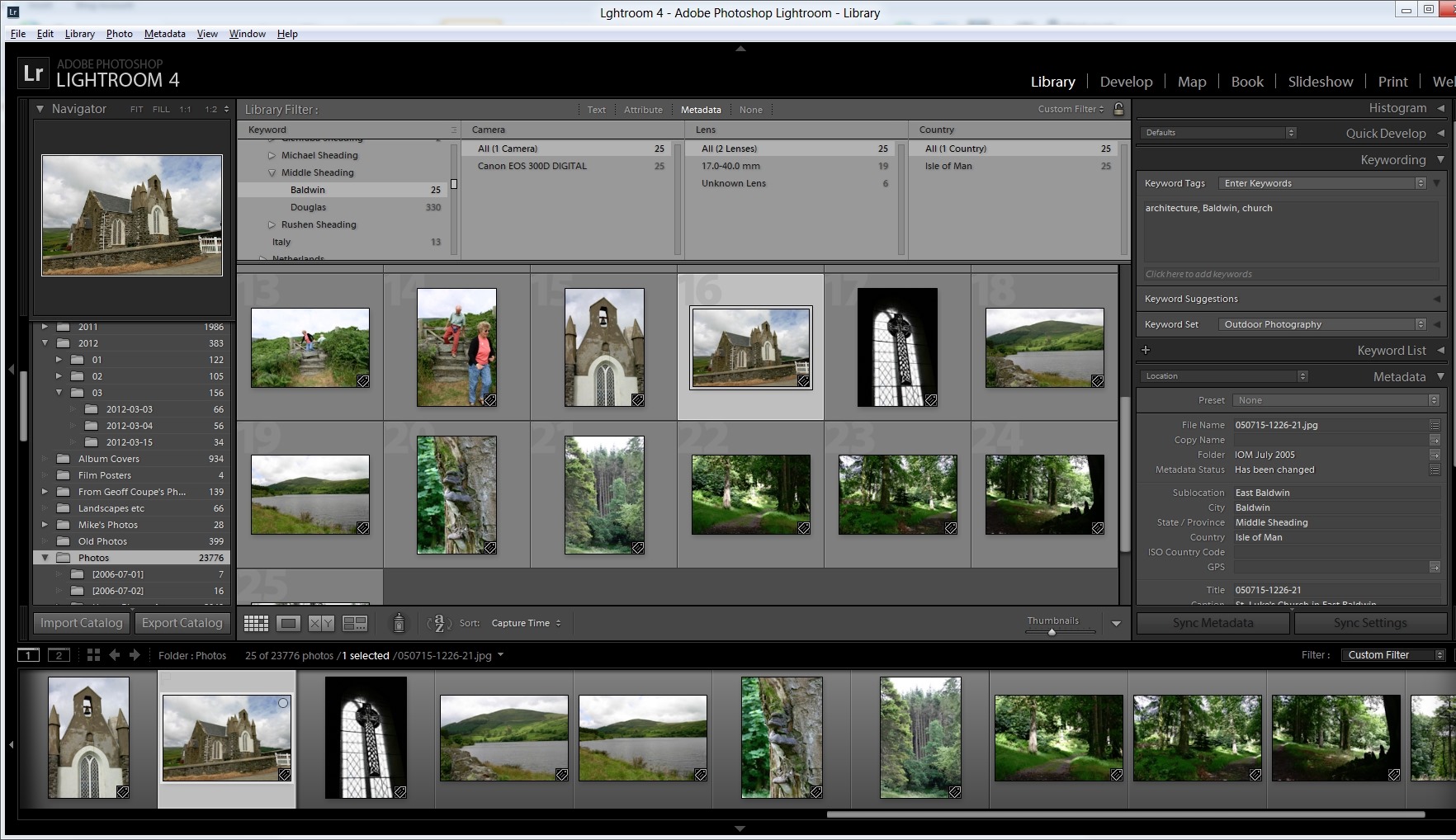
    Still, the same charge can also be levelled at Adobe, another founding member. Their latest version of Lightroom, Lightroom 4, also continues with the Adobe-proprietary ways of doing things. The result? You can forget about any real interoperability between Photo Gallery and Lightroom when it comes to People Tags and Hierarchical Keywords.

    One last, rather ironic, point. Despite the fact that Google is not a member of the Metadata Working Group, I’m heartened to see that Google has actually implemented the version 2 Guidelines proposed standard for People Tags in version 3.9 of Picasa. So it can be done. C’mon Microsoft and Adobe, get with the programme, give us tools that actually talk to each other…

  • Windows Photo Gallery, Geotags and Other Issues
    Microsoft has recently released a new version of Windows Live Photo Gallery. In keeping with Microsoft’s plan to kill off the “Live” branding, it is now simply known as “Photo Gallery”, and the suite of software utilities is now known as Windows Essentials, rather than the old name of Windows Live Essentials.

    Since this is a step change in the software (it’s now at version 16.4.3503.728, while the last version of Windows Live Photo Gallery was 15.4.3538.513), I thought I’d take another look at it.

    Apart from the name change, not much seems to have been done with the product. Yes, Microsoft has added in the possibility to publish videos to the Vimeo service and Photo Gallery now includes an Auto-Collage feature by default (this was a downloadable plug-in for the previous version), but that’s about it.

    However, while playing around with it, I discovered there was an issue with the way in which Photo Gallery was handling geotags.

    Some of you may recall that, when it was first released in 2010, Windows Live Photo Gallery had a major problem with geotags.  It was writing out GPS coordinate data into photos that was often completely wrong. Microsoft got this fixed in December 2010.

    And there the matter rested, or so I thought.

    However, I have discovered another issue related to geotags in Photo Gallery. For a long time now, Microsoft has said that it holds to the principle that “the truth is in the file”. That means that metadata you apply to your photos is part of the photo, and available to any application that knows how to read it. But I’ve found that this does not apply to geotags in all cases. Photo Gallery looks to see if the image contains metadata, and if so, the following operations occur:

    • If the photo contains Keywords in its metadata, these are added to PG’s list of Descriptive Tags, which it holds in its database and displayed alongside the photo in PG’s information pane. 
    • If the photo contains technical data in Exif (e.g. date taken, shutter and ISO speeds, etc.), these will be copied to PG’s database and displayed in PG’s information pane.
    • If the photo contains GPS coordinates in its metadata when it’s examined by PG, reverse geocoding will be triggered and the location is displayed as text addresses in the information pane.

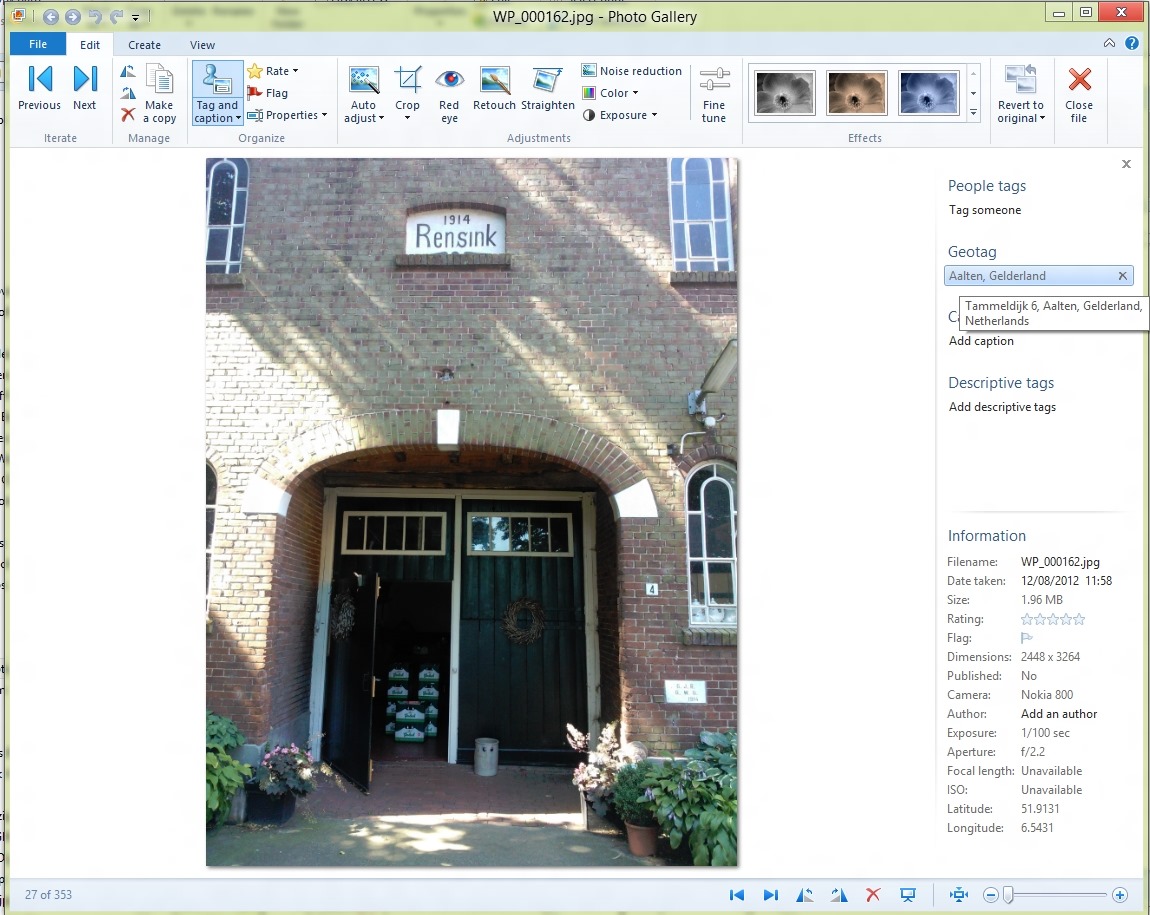
    The screenshot below shows a photo taken with my Nokia Lumia 800 Windows Phone being displayed in Photo Gallery (click for the full-sized image).

    WPG test 10

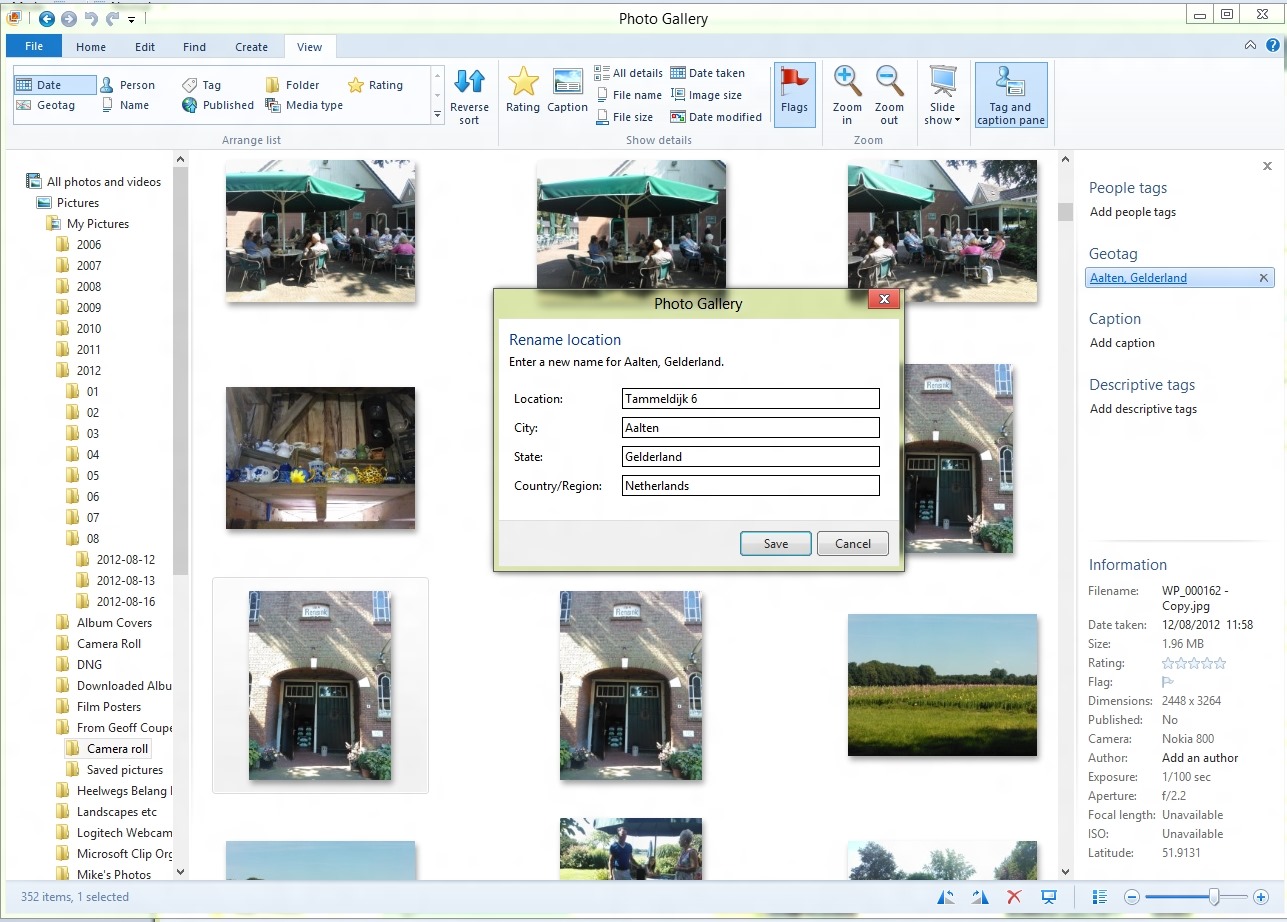
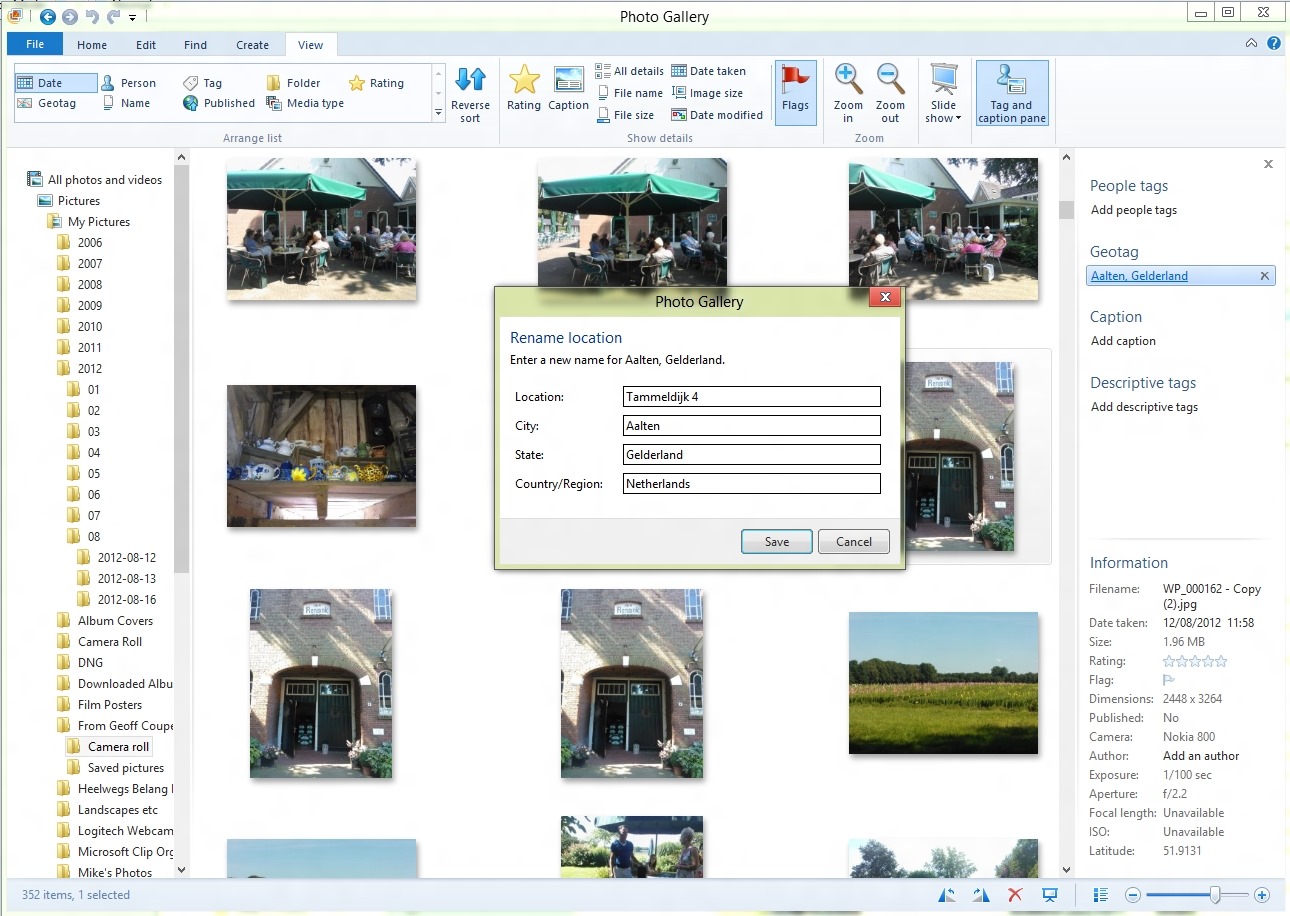
    In the information pane on the right, you can see some of the metadata present in the image being shown, including the GPS Latitude and Longitude (at the bottom right). Photo Gallery has used this GPS data to do reverse geocoding via a Bing service to resolve the coordinates to an address. That is being shown under the Geotag heading in the information pane. By default, only the City and Province/State data is shown (i.e. Aalten, Gelderland in this case). The full address is shown in a tooltip if the mouse cursor is placed over the Geotag – in this case, Bing has said that the GPS data is for the location: Tammeldijk 6, Aalten, Gelderland, Netherlands.

    As an aside, Bing has actually got the address wrong. It should be Tammeldijk 4, not 6. Google Maps will show the correct address, if fed these GPS coordinates…

    So, Photo Gallery has just generated some location data based on the GPS coordinates. Now the question is, how is it going to stay with the principle of “the truth is in the file”? It needs to write this generated data out into the image metadata in some fashion. How will it do this, and what standard will it use? I need to make a short digression here into the murky waters of industry standards…

    One very common industry standard for location (and other) metadata used in photos is that defined by the International Press and Telecommunications Council. Back in the early 1990s, the IPTC defined a standard for image metadata: IPTC-IIM. This became widely adopted and supported in many software tools and applications. However, it had design limitations, and the IPTC introduced a new version in 2005, based on the XMP standard, known as IPTC Core. Many software tools and applications handle both standards, and keep the metadata content synchronised between the legacy IIM and the new Core standards. Along with the Core standard, the IPTC also published a set of extensions, known, unsurprisingly, as Extension. The IPTC Core and Extension are published together as the IPTC Photo Metadata Standards.

    Both IPTC-IIM and IPTC Core contain fields for defining locations. Essentially, both define a hierarchy of (sub)location, city, state/province, country and country code. I, like many other photographers, use these fields for assigning locations to my photographs.

    However, somewhere along the line, photographers realised that the term “location” was ambiguous. Did it refer to where the photograph was taken, or did it refer to the location depicted in the photograph? These were not necessarily the same place. The standards did not specify a resolution to this conundrum. That is why, in the IPTC Extension standard, there are two sets of location fields: the location where the photograph was created, and the location depicted in the image.

    Clearly, the GPS coordinates reflect the location where the photograph was created, and Microsoft elected to use the IPTC Extension LocationCreated fields to store the results of the reverse geocoding lookup. The correct decision, in my opinion.

    Back in 2010 when I found that false GPS coordinates were being written out to my photos, what was happening was that Windows Live Photo Gallery was doing the following:

    • If a file contained IPTC-IIM or Core location metadata when it was brought into WLPG, then WLPG used the IPTC Location data to set the location strings in the geotag field of the info pane, and wrote them out into the image metadata as IPTC LocationCreated fields.
    • If the file did not contain GPS coordinates, WLPG would attempt to use the Location metadata with a Bing lookup to get the closest match for the GPS coordinates. In many cases, “the closest match” was miles away, or even in another country…
    • WLPG would then write out its idea of the “correct” GPS coordinates into the Exif metadata of the image.

    I, and other photographers, who had been using IPTC-IIM/Core location metadata, suddenly found our photo collections filled with false GPS coordinates. We complained, and Microsoft responded and changed the way in which WLPG worked. Microsoft told me the changes were:

    • GPS coordinates on a file are read-only inside of WLPG.  WLPG will never add, change or delete the GPS coordinates.
    • If a file contains GPS coordinates when it’s brought in to WLPG, reverse geocoding will be triggered and location strings are displayed in the info pane, users can rename or remove the strings but GPS coordinates won’t be touched. Users may Rename a location but it will then leave a mismatch between the coordinates and the string since the coordinates are read-only.
    • If a file does not contain GPS coordinates, users will be able to geotag by adding a string (that gets validated against Bing as it does today) but no GPS coordinates are added to the file.  The user can remove the string or rename it.
    • If the file contains a geo name only, there will be no GPS coordinates calculated for it.

    What I now see that I missed at the time is that WLPG, and now PG, no longer write out the result of a reverse geocode lookup into the IPTC Extension LocationCreated fields when the lookup is triggered by the presence of GPS coordinates in the image.

    The only time that LocationCreated metadata gets written out into the image is when the user makes an explicit change to the geotag information in PG. And it has to be a real change. I can open up the “rename location” panel, and click “Save”, but unless I’ve actually made a change in the data, nothing gets written out as metadata – the geotag information resides solely in Photo Gallery’s local database. In other words, the truth is no longer in the file.

    This screenshot shows the “rename location” panel. Clicking “save” does not make Photo Gallery write out the metadata, because I’ve left the contents unchanged.

    WPG test 2

    In this screenshot, I’ve changed “Tammeldijk 6” to “Tammeldijk 4”, and now when I clicked “Save”, the LocationCreated metadata was written out.

    WPG test 3

    This strikes me as a bit counter-intuitive. I would think that clicking “Save” in both cases should force a write of metadata. After all, if Microsoft is going to say that writing out of metadata should be under the explicit control of the user (which I tend to agree with), then even if I don’t change the result of the reverse lookup, I should be able to confirm my acceptance of it by the act of clicking “Save”. If I don’t want PG to write out the metadata, then I would click “Cancel” instead.

    So we currently have here a design where “the truth is in the file” is not fully in place, and where user confirmation is inconsistent.

    That’s poor design, and a poor user experience, in my book.

    I have to say that in one way, I’m rather thankful that the design is still broken. That’s because one of the other bugs in Photo Gallery is still present: it corrupts Canon Makernotes data when it writes out metadata to images. Just imagine: Photo Gallery would be finding location data or GPS coordinates in my photos and writing out LocationCreated metadata to those images. And in doing so, it would be merrily corrupting the Makernotes metadata in every single one of those images. Shudder.

  • Thoughts on the Windows 8 Release Preview

    I must admit, since Windows 8 is going to be released in October 2012, I was expecting Microsoft’s Metro Apps in the Windows 8 Release Preview to be more fully functional than they are. To my mind, they are still little better than toy demos. Yes, I know that they are still labelled “Previews”, but there’s precious little time left before October, and an enormous amount of functional ground left to cover.

    For example, the Mail App still doesn’t have IMAP or POP support. This is a staggering omission, since these protocols are the foundation on which internet email clients have been based for years. Then there’s all the extra stuff in the Windows Live Mail client that is missing from the Metro App, such as message rules or the ability to define extra storage folders. Since my email is hosted on an IMAP mail server by my internet service provider, I haven’t been able to use the Metro Mail App in earnest. There may well be other shortcomings that I haven’t discovered yet.

    The Music App only has four views of your music library: songs, albums, artists and playlists, as shown in this screenshot:

    W8RP 04

    Since you can’t define your own additional views, I miss the sorting by genre or composer that I have in Windows Media Player or Windows Media Center. And where is “Play to” or Podcast support? Missing in action, it would seem.

    The Photos App is still only a viewer, not an organizer/editor/metadata tagger in the manner of Windows Live Photo Gallery or Picasa.

    And then there are the bugs.

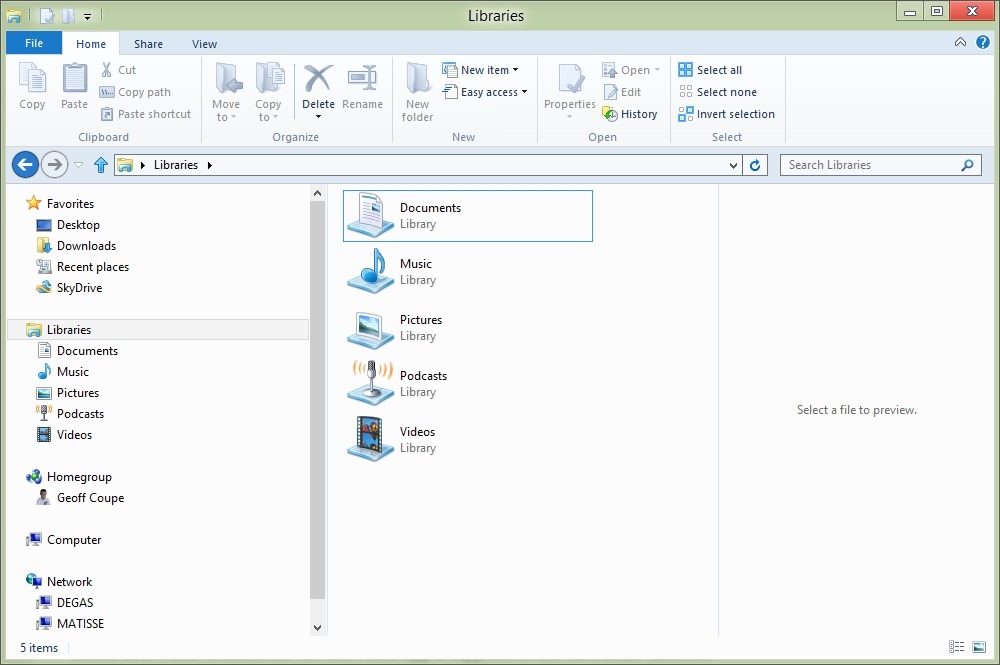
    For example, amazingly, it turns out that the Photos App cannot deal with photos that are stored on a Windows Home Server. The Photos App is supposed to use the Picture Libraries that you define in Windows 8. In both Windows 7 and Windows 8, you have a standard set of libraries defined for your media. See this screenshot:

    W8RP 01

    The Documents, Music, Pictures and Videos libraries are defined by default in installations of Windows 7 or Windows 8. If you install the Zune client (which is currently needed to support Windows Phones), then you get a Library defined for Podcasts as well.

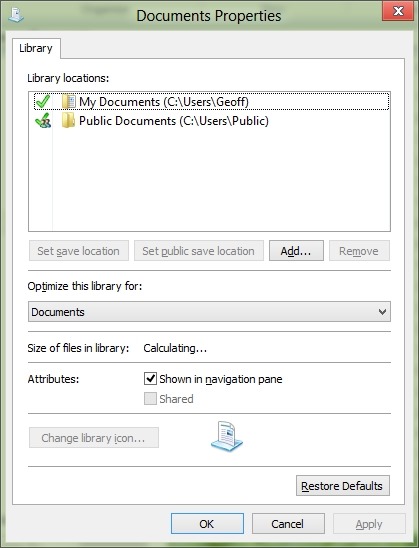
    By default, each of these libraries point to the corresponding folder in your Windows account on your PC, plus a pointer to the corresponding folder in the Public account on your PC. Here’s the pointers for the Documents library as an example:

    W8RP 02

    You can add additional pointers to folder hierarchies held locally on your PC, or network locations. If you have a Windows Home Server, then it will automatically add pointers to the corresponding Shared Folders on the server. Here’s a screenshot of the pointers to my music folders in the Music Library as an example:

    W8RP 03

    However, it turns out that the Photos App can only handle local folders, not network locations, such as the Shared Folder for pictures held on a Windows Home Server.

    This is even more curious when you realise that the Music App can handle music held in the Shared Folder for music on a Windows Home Server… That screenshot above of the Music App is showing music stored on my Windows Home Server.

    Now, the team responsible for the Photos App have admitted this is an issue. In this thread on the Microsoft Answers forum, Analy Otero, a member of the Photos App’s team states:

    The Photos team is aware of the concerns and issues that surround network locations, removable storage and Windows Home Servers. Unfortunately there are technical limitations to supporting them completely and correctly and as you have noted those locations are not supported in the Release Preview version either. 

    Rest assured that we are want to see these scenarios work and we aspire to support them just as all of you do so that you can use the Photos app as one place to see all of your photos regardless of where they are.

    If you have your photos in other PCs (Vista, Win7 or Win8 machines) you have the option to install the recently released SkyDrive client on them to be able to fetch files from them from anywhere. This includes being able to browse all your photos (and videos) from the Photos app as well. Definitely check it out if you have a chance.

    Thanks for the feedback, we’re definitely are listening and understand that support for WHS and other network locations is important for you.

    Notice that she mentions that the SkyDrive client can be used as a workaround to allow the Photos App to access files and folders held on other PCs in your network. It’s not clear whether the client is officially supported on the WHS operating system. This post on the SkyDrive forum does say that it will run on Windows Server 2008 R2, and that is the operating system that underlies WHS 2011. However, whether this also means that Microsoft will support the use of the client on WHS 2011 is another matter.  Update: Analy Otero has confirmed that Microsoft does not support the use of the SkyDrive client on WHS 2011, and it won’t install at all on WHS v1.

    I downloaded the SkyDrive client onto my Windows 8 system (which is 64bit), and then copied it across to my WHS 2011 (this is a 64bit operating system). I then did a Remote Desktop connection into my (headless) WHS, and successfully installed the client.

    Sure enough, the client then started synchronizing with my SkyDrive photos, but interestingly, something else also started happening… When I next opened the Metro Photo App, an additional pane had appeared on the opening screen – it was for “Degas” – the name of my WHS 2011 system.

    W8RP 05

    This view of the pictures folder on my Windows Home Server is not the default Pictures Shared Folder. Instead, it appears to be mapped to the Pictures folder of the Public user on WHS 2011. Now, while this is logical when the SkyDrive client is installed on a Vista, Windows 7, or Windows 8 PC, it makes no sense at all for a Windows Home Server. For one thing, no user account folders, including the Public user account folders, are ever exposed over the network in a standard Windows Home Server setup. A standard WHS 2011 system uses Shared Folders that are not tied to the Public user account.

    WHS2011 57a

    Also, I discovered that the Public Folders are only exposed so long as you are logged on to the Administrator’s Desktop (so that the SkyDrive Client runs). So if you want to use this workaround, you’re going to have to Remote Desktop in to your WHS, and populate the Pictures folder of the Public user account and keep logged on via Remote Desktop; photos in the standard Shared Folder for Pictures simply aren’t accessible by the Photos App. In my opinion, it’s a kludge. An unsupported kludge. Sigh.

    Update: I’ve gathered together in one place all the bugs, quirks and WTFs that I’ve found thus far with Windows 8. Check it out if you want to see the full list.

  • Lightroom 4 – A Mixed Blessing?

    Adobe has just released the latest version of their Swiss Army knife for digital photography: Lightroom 4.

    Since there’s a free trial available (which lasts for 30 days), I thought I’d download it and give it a go.

    Lightroom is a Digital Asset Management (DAM) tool for digital photographs. That is to say, it covers all aspects of dealing with digital photos, such as acquisition of the photos from the camera, selecting the ones to keep, editing for the final versions, organisation of photo collections, and publishing.

    At the moment, I use IDimager as my DAM tool, so I was interested to see how this latest version of Lightroom would compare. In some respects, the two tools are fairly similar, but there are also some substantial differences. (Note: IDimager is no longer available. Its successor is Photo Supreme, which I am now using)

    One area that I found to be similar is the acquisition process – getting your photos off a camera’s memory card and into your PC environment. Both products allow flexible renaming of your files, and applying metadata templates to the resulting files as part of the acquisition process. So far, so good.

    Once the files are in the tools’ workspaces then the main work of selecting the photos you want to keep and adding metadata to help organise the collection can begin in earnest. Again, both Lightroom and IDimager have similar features. For example, you can rapidly compare photos side-by-side in a virtual “light table” to aid in selection of those images that you want to keep.

    However, I quickly ran into a couple of issues with Lightroom’s handling of photo metadata that, for me, are quite serious.

    First, some background. Both Lightroom and IDimager use the concept of a Catalogue to hold a list of keywords that are used to organise your photo collection (or collections). While this list of keywords can be just a simple list, both products support, and encourage, the use of a keyword hierarchy for ease of use and flexibility.

    As I described a while back, the keyword hierarchy I use has been built up from a number of sources:

    I’ve ended up with a structure that has the following items at the top level of the hierarchy:

    • Activities
    • Events
    • Nature
    • Objects
    • People
    • Places
    • Science
    • Styles

    Each of these splits down into further categories as necessary as you go down the levels. For example, Activities splits into

    • Disciplines
    • Hobbies
    • Physical and mental activities
    • Processes and techniques

    So then a photo of a tennis match would have the structured keyword string of Activities/physical and mental activities/games/sports/ball game/tennisassigned to it.

    You’ll notice that I’m using the “/” character to separate the various levels contained in a keyword. The choice of the separation character is arbitrary, some applications use the period (“.”) or the pipe (“|”) character , since there is no industry standard at the moment. A standard for handling keyword hierarchies in image metadata has been proposed (by the Metadata Working Group), but as far as I am aware, there is no product on the market that implements it as yet.

    I chose the “/” character because Microsoft’s Windows Live Photo Galleryuses it as the separator to structure the keyword hierarchy (Microsoft calls keywords “Tags” in Windows Live Photo Gallery).

    For example, here’s a screenshot of Windows Live Photo Gallery with a thumbnail photo of a church in the Isle of Man shown being selected (the light blue frame around the image).

    Church2

    You can see, on the right of the screenshot, that the photo has three keywords (tags) associated with it: architecture, Baldwin, church. These are actually all structured keywords stored in the photo’s metadata as:

    • Styles/design/architecture
    • Places/Europe/Isle of Man/Middle Sheading/Baldwin
    • Objects/built environment/buildings/ceremonial buildings/religious buildings/church

    You can see part of the “Places” hierarchy being shown on the left of the screenshot, with the “Baldwin” tag being highlighted.

    Because Windows Live Photo Gallery is easy to use for other family members, I’ve adopted this method of implementing a keyword hierarchy, i.e. using the “/” separator, in my main DAM tool: IDimager. Here’s a screenshot of IDimager showing the same photo:

    Church1

    You can see on the left that IDimager uses the same keyword hierarchy. And on the right of the screenshot, you see the keyword strings that are being stored in the photo’s metadata.

    Now, the reason that both IDimager and Windows Live Photo Gallery have the same keyword hierarchy is that both tools are constructing it from the keywords stored in the photo metadata. And because they understand that the “/” is the separator character, they build up the same keyword structure on the fly as they read the photos in my collection. IDimager is the more flexible of the two applications, since you can define different separator characters if necessary. WLPG is fixed, and only understands the “/” character.

    So, what happens with Lightroom 4?

    Well, at first I thought everything was going to play nicely together. Just as with IDimager, Lightroom 4 has an option to choose the separator character that you want to use when reading the keywords in your photo metadata:

    LR4 002

    I’ve chosen “/” as the separator character – the same as for IDimager and WLPG.

    Sure enough, when I imported my photo collection into Lightroom 4, the keyword hierarchy got reconstructed to match the ones in IDimager and WLPG (click on the screenshot to see it full-size in a new window):

    Church3

    But then things started to go wrong.

    First, I discovered that although this process of recognising the separator works when importing photos into the Lightroom 4 Catalogue, it doesn’t work when reading metadata from individual photos – even though Lightroom claims it does (see the text in the “Preferences” screenshot above).

    I added the keyword “Christmas” to a photo using IDimager. This is a structured keyword, so the keyword string that was written to the photo’s metadata was actually: Events/holidays/Christmas. Lightroom 4 correctly saw that the photo had had its metadata altered, but when I used Lightroom to read in the photo metadata, instead of adding the photo to the “Christmas” keyword in the existing hierarchy in its Catalogue, it created a brand-new single-level keyword string: Events/holidays/Christmas – it did not treat the “/” character as a level separator.

    Now, this, I think is a simple bug, and has been reported as such. However, much to my dismay, I discovered I was not out of the woods yet.

    Up to now, I use IDimager to do all my keyword work. When a keyword in the IDimager Catalogue is assigned to a photo, IDimager will write out the structured keyword string into the photo, and WLPG will then pick up the change and modify its own Catalogue of tags automatically.

    As a test, let’s use that photo of the church in Baldwin in the Isle of Man. Here you can see the current keywords assigned to it: architecture, Baldwin, church, as seen in Lightroom 4.

    LR4 003

    Remember, these are all structured keywords with a hierarchy. Lightroom, like WLPG, is just showing the lowest level of each keyword. Using IDimager, I can look at both the actual photo metadata (showing the full keyword strings), highlighted in red, as well as the Catalogue keywords/labels, highlighted in green:

    Church4

    Now, let’s use Lightroom 4 to add a keyword to the photo, and then get Lightroom 4 to write out the changed metadata into the photo. Here, I’ve added the keyword wall:

    LR4 004

    Looking at the photo in IDimager, what do I see:

    Church5

    Disaster! Lightroom has not written out a structured keyword string, but a series of individual keywords separated by commas. While IDimager has been able to sort the wheat from the chaff (the labels, highlighted in green, show that it knows that the structured keyword wall has been added), Windows Live Photo Gallery is not so clever.

    Church6

    It is now showing all the individual keywords assigned to the image, and worse, it has created new, false, levels in the keyword hierarchy shown on the left in the screenshot. For example, wall is now shown as a top-level keyword.

    So Lightroom 4 will read structured keyword strings using the “/” character as a separator from photo metadata, but, unlike IDimager, it will not write out structured keyword strings to photo metadata. Instead it writes single level keywords and additional, Adobe-proprietary, metadata to describe the hierarchy. This is, apparently, expected behaviour.

    Well, it may be expected, but it’s pretty much useless to me if I want to keep WLPG as the easy to use browser for others in the family. If I use Lightroom 4 to do any metadata work, it will destroy the keyword structure that I use as far as other programs are concerned.

    So where does this leave me, as far as the trial of Lightroom 4 is concerned?

    I have to say that the Lightroom tools for editing and developing photos (especially those in RAW format) are far in advance of anything that IDimager or WLPG possess. So while I could continue to use IDimager for metadata work, I could supplement that with the image adjustment tools of Lightroom 4. Frankly, the other modules of Lightroom (Map, Book, Print and Web) are of little use to me; my other tools give me all that I require in those areas. So, are the image adjustment tools of Lightroom alone worth an investment of 130 Euros to me? If I were heavily into manipulating my images using the RAW format, then, yes, very probably. But at the moment? To be honest, I’m not sure.