
Donald Tusk hits the nail on the head. The Nigel Farages, Jacob Rees-Moggs and Boris Johnsons of this world deserve nothing less. It is they who have betrayed the British people, not the EU.
Category: Society
-
“A Terrible Failure of Common Sense”
In recent years, the UK Home Office has increasingly seemed to be driven by checklists, rather than any understanding of the people they are dealing with.
Here’s just the latest example in a very long list: a man, 90 years old, is being told to fly to the US to get a visa so that he can stay in the UK with his wife.
Apparently, a Home Office spokesperson has said:
“All UK visa applications are considered on their individual merits, on the basis of the evidence available and in line with UK immigration rules.”
As a good friend of mine has said on many an occasion: “Just what is wrong with these people?”.
-
Half and Half
Someone asked me last night how long I had been living here in the Netherlands, and I replied: “35 years”.
“So, for half your life?” he asked. And up until that moment I had not thought about it, but he’s right: for the first 35 years of my life, I lived in the UK (even though, technically speaking, the country of my birth, the Isle of Man is a Crown Dependency and not part of the UK) and now I’ve been living for 35 years in the Netherlands.
It gave me pause.
-
Nine Lessons of Brexit
Ivan Rogers, the former UK ambassador to the EU, delivered a speech this week on the nine lessons of Brexit. The full 10,000+ words transcript is here, but if you prefer a précis, then this will do nicely.
The basic message is that the choice for Brexit and, in particular, the process of Brexit have both been fucking disasters, although Ivan Rogers is too much of a gentleman to use such words. The blame for this trainwreck, he argues, cannot rest on the shoulders of the Brexiters or the Remainers alone – both sides have contributed to the dishonesty and the confusion that today reigns supreme.
One might almost say “A plague on both their houses…”
-
Selfie Deaths
Selfie deaths – a report. But I disagree strongly with the conclusion. It would only serve to affect the number of Darwin Award winners in a negative fashion.
-
Here was a Plague
That’s the title of an excellent article by Tom Crewe in the London Review of Books about the history of the Aids crisis.
It seems so long ago now, and I count myself amongst the lucky survivors, but we lost so many friends and lovers in that dark period. It should not be forgotten.
-
Typically Dutch
The Dutch have a reputation for being straightforward, bordering on rude, in their interactions with other people. I had a prime example of this in an encounter yesterday.
My Lenovo wireless keyboard and mouse has been giving trouble over the past month or two. The keyboard and mouse become unresponsive at random intervals – and no, it’s not because the batteries are dead. When this happens, the only thing that will cure it is a reboot of the PC. The fault definitely seems to lie in the Lenovo devices, since plugging in a spare mouse and keyboard will immediately work without the need of a reboot. My spare keyboard has one non-working key, and was the reason why I swapped it for the Lenovo keyboard in the first place.
At any rate, when the Lenovo keyboard and mouse froze again yesterday, I thought enough was enough, and resolved to get a replacement keyboard (I already had a spare mouse). I jumped in the car and sped off to the local computer shop in town. Unfortunately, this being a Saturday, the shop closes at 16:00 – as I saw, with a sinking feeling, on the door as I opened it at 15:59.
“Am I too late to buy something?” I asked. “I’ve just cashed up – what do you want?” came the reply. “I need a new keyboard, because my old one has just died”, I said. “I can’t help, I’ve cashed up”, came the rejoinder. No “Sorry”, no sympathy for my plight, just “I can’t help, I’ve cashed up”. I knew that he wouldn’t help, but could he not have softened the blow with a simple “sorry”? That’s so typically Dutch…
Oh well, his loss – I ordered a new keyboard from CoolBlue, and it will be delivered today (on a Sunday!)…
-
Pride Badges
The LGBTQ+ Pride season is upon us. Today was the London Pride march, with 30,000 marchers. The Guardian also had a story about a treasure trove of LGBTQ+ badges being found in an attic.
That reminded me that I must still have a box containing a small collection of my own. Sure enough, a rummage in a cupboard produced:
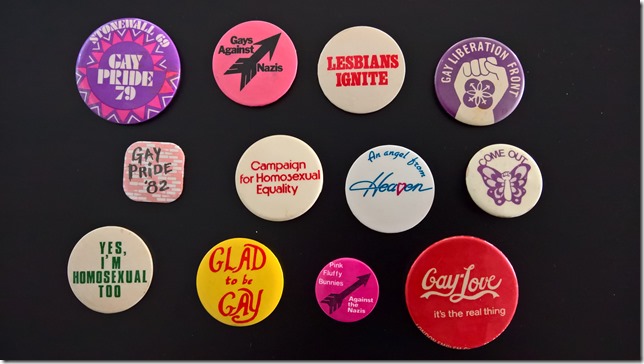
A few of these come from the 1970’s. The Campaign for Homosexual Equality badge may well date from 1974, when I helped organise the second annual CHE conference, which was held in Malvern, Worcestershire. I suspect the GLF badge will date from the mid 1970’s, whilst the Heaven badge was produced to celebrate the opening of the Heaven nightclub in 1979.
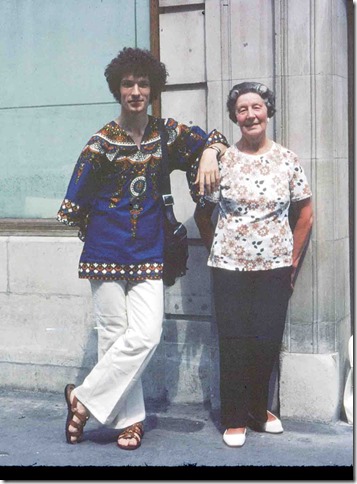
I attended a number of marches in those days. The early Pride marches, of course, but also anti-Fascist marches and Women’s Rights marches. This photo of me and my mother was taken in June 1975, shortly after I had finished marching (along with 20,000 others) in the demonstration organised by the National Abortion Campaign.
Heady days…
-
Jaron Lanier and Social Media
An interview of Jaron Lanier, and why he thinks that Facebook and its ilk are bad for us both as individuals and as society.
He’s absolutely right, of course, but the damage has probably already been done. The one false note in this interview comes right at the end with a truly insulting observation from the interviewer, Krisnan Guru Murphy. Fortunately, Lanier is too much of a gentleman to rise to the bait.
-
The Sermon
So, today there was a wedding, a Royal Wedding. And while I wish Harry and Meghan to live happily ever after; I remain a republican. This Royal Wedding was unlike any I have previously seen. Today, I witnessed the sermon from the Rev. Michael Curry. And “witnessed” is the apt term.
Yes, I’m an atheist, but I loved this. Probably shook up the congregation a bit, but quite right.
-
The Internet Apologizes…
… that’s the title of a sobering article on what has gone wrong with the internet. Well worth reading.
The apology is necessary, but it’s too damn late – the damage is done. I’m not sure how it will ever be possible to undo the damage that platforms such as Facebook and Twitter have caused. To many people, Facebook is the internet, and it is a global monopoly. And it has connected people for both good and ill. The recent Buddhist violence against Muslims in Sri Lanka is but the latest example.
-
You Are the Product
That’s the title of an article about Facebook by John Lanchester. Published back in August 2017, it is eerily prescient about the shit that has now hit Facebook’s fan.
It’s a long article, but definitely worth a read. As Lanchester writes:
I am scared of Facebook. The company’s ambition, its ruthlessness, and its lack of a moral compass scare me.
His conclusion is sobering:
Automation and artificial intelligence are going to have a big impact in all kinds of worlds. These technologies are new and real and they are coming soon. Facebook is deeply interested in these trends. We don’t know where this is going, we don’t know what the social costs and consequences will be, we don’t know what will be the next area of life to be hollowed out, the next business model to be destroyed, the next company to go the way of Polaroid or the next business to go the way of journalism or the next set of tools and techniques to become available to the people who used Facebook to manipulate the elections of 2016. We just don’t know what’s next, but we know it’s likely to be consequential, and that a big part will be played by the world’s biggest social network. On the evidence of Facebook’s actions so far, it’s impossible to face this prospect without unease.
I deleted my Facebook account yesterday. I hope that I can remain outside its walled garden.
-
A Stranger in a Strange Land
Joris Luyendijk is a Dutchman who has been living in Britain for the last six years, writing articles for the Guardian. He is a writer, journalist and anthropologist, specialising in Arab and Islamic countries.
He’s recently written an article in the Prospect magazine, provocatively titled: “How I learnt to loathe England”. It’s a good article (i.e. I mostly agree with his analysis). One thing that at first surprised me was that he supports Brexit (I don’t), but as he says:
…by the time the referendum came, I had become very much in favour of the UK leaving the EU. The worrying conditions that gave rise to the result—the class divide and the class fixation, as well as an unhinged press, combine to produce a national psychology that makes Britain a country you simply don’t want in your club.
And that was a novel perspective; the reaction that the EU might well be better off without Britain: good riddance, and don’t let the door hit you on the way out… There may well be something to be said for that stance.
As I head on into my twilight years, the possibility that I will end up living here alone in the depths of the Dutch countryside becomes real, if I outlive Martin. In such circumstances, I may well end up as a “stranger in a strange land”, but quite honestly, I think I would prefer that to a return to what England seems to be becoming.
-
Public Service
Some officials know what public service means and fulfil their duties to the best of their abilities, serving the public good. And the people react accordingly.
Eberhard van der Laan, you’ve set an example to us all.
-
Floating and Voting
Tomorrow, the 15th March, we in the Netherlands go to the polls to vote for our political candidate of choice. Note that I didn’t say “to vote for our next government” – with 27 political parties to choose from on the ballot paper, it is inevitable that we’ll end up with yet another coalition government.
As well as the mainstream parties (8 or 11, depending on your definition of “mainstream”), the parties also include the “Non-Voters” party (12 candidates), the “Pirate Party” (with 37 candidates) and the “Jesus Lives” party (6 candidates). Somehow, I don’t think Jesus stands much of a chance. Perhaps he needs to hitch his wagon to the “Political Calvinist Party” – the evangelical Christian party, with their 30 candidates – not one of them a woman, because a woman’s place is of course in the home, and certainly not in politics. Yes, it’s the 21st century, but clearly not for some people.
And as usual, Geert Wilders has been generating more heat than light. His manifesto – actually a list of 11 bullet points covering less than one side of an A4 page – lays bare his anti-Muslim and anti-EU soul. He must be fully aware that he hasn’t got a hope of forming a government – few other parties will touch him with a bargepole in a coalition – and one suspects that he only does it to provoke. What is worrying is that his probable strategy – to pull the other parties to the right – appears to be working, at least in the case of the VVD, led by the current prime minister, Mark Rutte. Wilders appears to have goaded Rutte successfully into matching his rhetoric. Rutte is increasingly trying to appeal to Wilders’ PVV voters, and that’s a very dangerous, and populist, game.
Then we have Erdoğan butting in, and inflaming the passions of the Dutch citizens who have dual Dutch and Turkish nationalities. His “Nazi” rhetoric hasn’t exactly helped Dutch-Turkish relations of late, but then, one suspects, it wasn’t intended to.
And on top of all this, our newspaper, de Volkskrant, has been full of vox-pop pieces on floating voters, there seems to be a veritable flood of them. I confess that I am bewildered by the number of people who seem incapable of making up their minds. The choices are clear, at least to me. Tomorrow I’ll be following in my father’s footsteps and voting left-wing. He was a lifelong socialist, as am I, and believed in a caring society. My vote will be going to the Dutch Labour Party (PvdA), and to a woman. Sorry about that, Calvinists.
-
“A cruel, stupid and bigoted act”
…and I’m sure we’re only at the beginning of Trump’s nightmare presidency. The Guardian editorial on Trump’s anti-Muslim orders nails it.
The words in the Statue of Liberty’s pedestal famously read:
“Give me your tired, your poor,
Your huddled masses yearning to breathe free,
The wretched refuse of your teeming shore.
Send these, the homeless, tempest-tost to me,
I lift my lamp beside the golden door!”Sorry, lady, but as far as Muslim refugees from countries where Trump does not have business interests are concerned, your lamp has just been doused.
-
Even the Heavens Wept…
I see Trump has begun as he means to go on. His first speech as President was, as Gary Younge says:
as crude and unapologetic an appeal to nationalism as one might expect from a man incapable of rising to an occasion without first refracting it through his ego.
This is not the triumph of democracy, but a tragedy.
-
Responsible Leadership
A sobering article on responsible leadership in the age of populism. Worth reading. An extract:
The way today’s leaders increasingly rely on referenda, petitions and social media to legitimize their action suggests the emergence of a worrying trend of delegation of leadership and therefore responsibility.
In Britain, the Brexit referendum is a case in point, where those who put this issue to a vote and campaigned for the UK to leave the EU did not take responsibility for the consequences. The illusion that politics can simply collect people’s preferences and mechanically turn them into a reality threatens to override the idea behind political representation.
In a representative democracy, the mission of leaders should be to temper citizens’ input and emotional responses rather than to foster the violence of the majority. In other words, the relationship between representatives and represented must be ongoing and should entail judgement on both sides.
The article lists 10 personal qualities that should be present in a responsible leader. The person who will assume the role of the next President of the US in a few days time would appear to lack all of them.
-
HyperNormalisation
As I’ve written before, Adam Curtis makes amazing documentaries. Tomorrow sees the release of his latest work: HyperNormalisation. Unfortunately, it only seems to be available on the BBC iPlayer – which is geofenced to viewers in the UK. I hope that it will become more widely available…
 Geoff Coupe's Blog