Reflections on life at “De Witte Wand”…

Category: Society

  • IDAHo

    Since 2004, May 17 has been marked as the International Day Against Homophobia. The Dutch Government is hosting a three day international conference in The Hague on the subject of homophobia at the moment.

    Today, the EU Fundamental Rights Agency published a report on the experience of LGBT people across the EU and in Croatia. It doesn’t make for very comfortable reading. The survey (of 93,000 people) found:

    • Some 26% of respondents (and 35% of transgender respondents) said they had been attacked or threatened with violence in the past five years
    • Most of the hate attacks reported took place in public and were perpetrated by more than one person, with the attackers predominantly being male
    • More than half of those who said they had been attacked did not report the incident to the authorities, believing no action would be taken
    • Half of respondents said they had felt personally discriminated against in the year before the survey, although 90% did not report the discrimination
    • Some 20% of gay or bisexual respondents and 29% of transgender respondents said they had suffered discrimination at work or when looking for a job
    • Two-thirds of respondents said they had tried to hide or disguise their sexuality at school.

    Full details of the report and its findings are here.

    Yesterday, the Netherlands Institute for Social Research published its own report on the situation of LGBT people in the Netherlands. It makes slightly more comfortable reading than the EU report, but we are also likely to be the target of homophobia from the usual suspects within Dutch society.

  • “They Were Not A Family”

    I see that my birthplace, the Isle of Man, is still home to some old and ugly prejudice. Kira Izzard and Laura Cull have been refused a tenancy application because they are a lesbian couple. Their landlord, Keith Price, who is a Methodist Minister, stated:

    “We understood that they were not a family so we said we couldn’t proceed [with the rental agreement].

    “We believe that God has a plan for our lives within the context of marriage, the scripture is quite clear in its teaching on this.”

    In the UK, such a refusal would be illegal; unfortunately, the Isle of Man is a Crown Dependency, and not part of the UK, so it makes its own laws.

    Ms Izzard has started a petition to ask the Manx Parliament to support the UK Equality Act 2010 in the Isle of Man. Naturally, I’ve signed it.

  • Romanticising Pain And Suffering

    Giles Fraser has an article in the Guardian, in which he claims “I want to be a burden on my family as I die, and for them to be a burden on me”.

    Well, bully for him. And a bully is what he is proposing to be, with his pernicious nonsense. I reject his argument that the “problem with euthanasia is not that it is a immoral way to die, but that it has its roots in a fearful way to live”.

    Eric MacDonald also demolishes Fraser’s argument completely, and I refer you to him for chapter and verse. A couple of key quotes:

    But it’s not called “looking after each other” if what the person who is suffering is asking for is help to die. It’s called coercion, then — which has a very different resonance — and if someone is being coerced into being a burden, then Fraser has simply has missed the point about what looking after each other is all about. Moreover — and this, coming from a priest, is inexcusable — it simply papers over the cracks with regard to how people die. Sometimes the burden, if Fraser really wants to know, is borne by those who are dying, and if those who are watching someone die in misery doesn’t notice this, then they are simply not watching closely enough!

    And this just shows that Fraser hasn’t the least understanding — but not the slightest understanding! – of what is meant by assisted dying. It’s not the last desperate act of a person who has no inkling of what is happening until the very last moment, when farewells are almost impossible; it is, rather, a conscious act of taking the decision to die upon oneself, instead of leaving it up to the vagaries of the dying process, or to the all but certain stages that the trajectories of some diseases will follow to carry one away either gasping for breath or crying out in pain. Fraser seems to have not the slightest idea of how people die, or, if he does, he deliberately hides it from his readers the less to worry them at the end of life. But it is just as well to know, beforehand, just how terrible death can be, not so that we can be afraid of it — which seems as far as Fraser’s puny imagination will take him — but so that we can be prepared for it, and take our leave before the worst overtakes us.

  • It’s NOT a Coronation!

    It’s been a momentous day here in the small country of The Netherlands. This morning, at 10:10, Queen Beatrix signed the document that confirmed that she has abdicated in favour of her eldest son, Willem-Alexander, who has now become King. The first Dutch King since the 19th Century.

    This signing took place in the Dam Palace, which started out life as the Amsterdam City Hall in the Dutch Golden Age of the 17th Century.

    Now, I’m no monarchist, but I was moved by the day’s events. Right from the moment that Queen Beatrix announced she welcomed everyone to the ceremony, and the roar of approval from the crowd outside in the Dam Square brought a smile to her face as she realised that the Dutch people were watching and supporting this move.

    Not that Beatrix has been a bad Queen. Far from it. She has become beloved by us in a way that could only have been dreamed of when she became Queen in 1980. Then, there were protests and smoke bombs in the Dam.

    Following the signing of the Abdication document, this afternoon was the inauguration of the new King. I found it almost astonishing.

    I grew up in the United Kingdom, where the British Monarchy is seen as something established by God. There is a Coronation, where the crown is placed on the head of the new monarch by the Archbishop of Canterbury. Religion and Monarchy are completely intertwined.

    In stark contrast, here in The Netherlands, the Monarch is not crowned. Instead, King Willem-Alexander was inaugurated in a ceremony that involved the State – not the Church.

    The King pledged his allegiance to the democratic process, and affirmed his responsibilities to the citizens. He made a good, and thoughtful speech, honouring the service of his mother, and promising that he would do his best for the Dutch citizens and the State. In return, the State, in the form of the members of the Dutch parliament, signalled their assent to his assumption of the role of king. And they did that individually – each standing when their name was called, and either swearing by God, or a simple “I promise”. It was interesting to see how many members did not invoke God. Another indication of how secular the Netherlands is, and how the United Kingdom still is not.

    King Willem-Alexander pledged his allegiance in front of symbols of the State – the books of the Law of the Land – as well as symbols of his own status, the crown, sceptre and orb. He also had five representatives of the Dutch people present to bear witness, and to bear symbols of the importance of the citizen to Dutch society. They were his “Koningwapenen”, or Kings of Arms. One of them was André Kuipers, Dutch physician and astronaut.

    As I say, I was moved. The importance of ritual to humans is unmissable, and touches something deep within us.

    I wish Willem-Alexander, and his very impressive wife, Máxima, all the best in their new roles as King and Queen of the Netherlands. I think that they will both do well.

  • The Ghost in the House of Wonks

    Adam Curtis makes amazing documentaries. Here’s one he did earlier – The Attic. A cautionary tale.

  • A New Dawn

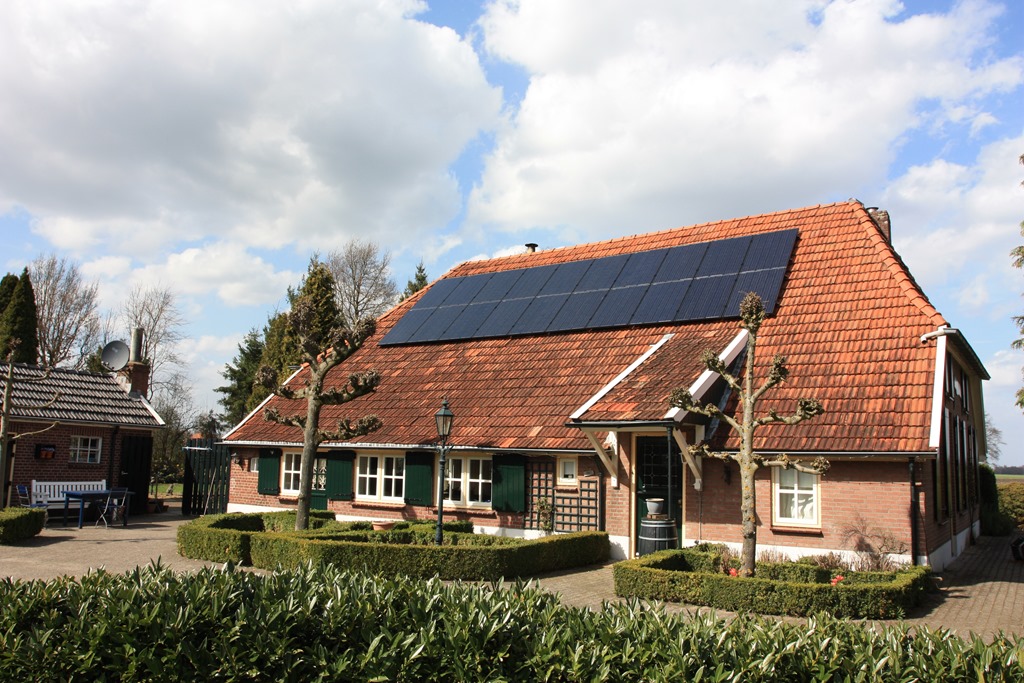
    We’ve just had twenty solar panels installed on the roof.

    20130418-1549-33

    Apparently, we’ve joined a growing trend in the Netherlands. In 2012, there was 260 MW of energy produced via solar panels – a doubling of what was produced in 2011.

    I must admit I get a kick out of watching our electricity meter run backwards – indicating that we are supplying electricity to the national grid (and getting paid for it by the Power Company!), rather than consuming from it.

    This is a long term investment – it will probably take ten years to break even, but I’m glad that we’ve done it.

  • Stop Digging, Theo…

    Ah, Theo Hobson. It’s been a while since I felt moved to document how much I disagree with his writings – well, I have to say that once I was astonished to find that I actually agreed with him. It was, truly, a miracle.

    However, he’s back and offers up an article in The Spectator in which he decrees that Richard Dawkins has lost. Sorry, Theo, you’re writing twaddle again. Eric MacDonald hands you your arse on a platter, and Jerry Coyne does likewise. Stop digging.

  • The End

    So, she’s dead. She certainly changed our world, but, personally speaking, I’m not convinced she improved it. For me, Elvis Costello’s song: Shipbuilding is the perfect summary of that time.

    Craig Murray, while he personally found her quite likeable, sums her up rather well:

    …she was a terrible, terrible disaster to this country. The utter devastation of heavy industry, the writing off of countless billions worth of tooling and equipment, the near total loss of the world’s greatest concentrated manufacturing skills base, the horrible political division of society and tearing of the bonds within our community. She was a complete, utter disaster.

    The Guardian’s editorial, while praising her, also damns her:

    She was an exceptionally consequential leader, in many ways a very great woman. There should be no dancing on her grave but it is right there is no state funeral either. Her legacy is of public division, private selfishness and a cult of greed, which together shackle far more of the human spirit than they ever set free.

    Her legacy lives on.

    Addendum. Norman Geras makes my feelings succint,

  • A Fool, A Liar, or a Thief?

    Lucy Mangan poses the question about Ian Duncan Smith. It’s a valid question.

    I propose the answer is that he is at least two out of the three, and that he isn’t a fool. Unfortunately, he’s far from the only person in power who thinks that way.

  • More Bad News

    Following on from the news that Iain Banks is not long for this world, comes the news that Roger Ebert has now departed it.

    I admit that I was only an occasional reader of Ebert’s film reviews, but I always found them worthwhile and thought-provoking. I refer you to The Mumpsimus for a deeper appreciation of Ebert and his writing. From that piece is a quote from Ebert himself. It’s probably Ebert’s best memorial and something to live up to:

    “‘Kindness’ covers all of my political beliefs,” he wrote, at the end of his memoirs. “No need to spell them out. I believe that if, at the end, according to our abilities, we have done something to make others a little happier, and something to make ourselves a little happier, that is about the best we can do. To make others less happy is a crime. To make ourselves unhappy is where all crime starts. We must try to contribute joy to the world. That is true no matter what our problems, our health, our circumstances. We must try. I didn’t always know this and am happy I lived long enough to find it out.”

    Amen.

  • The Grand Reopening

    I’ve always enjoyed visiting the Rijksmuseum, the grand old lady of Amsterdam’s many museums. However, she’s been closed since 2003 for a refurbishment that was supposed to have been completed in 2006.

    Here we are in 2013, and she’s about to throw open her doors once more to the world. I’ll be paying her a visit later this year, to marvel at her many wonders.

  • Best Laid Down – And Avoided

    In recent years, there’s been a fashion for “historical drama documentaries” on TV. You know the sort of thing – get a historian to front a programme on say, the Wars of the Roses, and fill most of the airtime with badly-paid and badly-acting extras re-enacting the battles. What could have been an opportunity for a knowledgeable expert to analyse a historical event gets pushed aside in favour of amateur dramatics and, shudder, “spectacle”.

    Tonight, for example, on BBC One, there will be a programme on Pompeii, fronted by Dr. Margaret Mountford. Now, Dr. Mountford recently completed her studies with her thesis on Papyrology, so she may well have the chops to be able to talk knowledgeably about the lives of Pompeiians in 79 AD, but I fear the worst. The programme is called Pompeii: The Mystery of the People Frozen in Time, and is billed as “a one-off landmark drama documentary”. The programme web site contains plenty of stills of costumed extras pretending to be citizens of Pompeii.

    Oh dear, this does not look promising. Particularly when I recall a documentary on the same subject that the BBC first broadcast in 2010: Pompeii: Life and Death in a Roman Town. No pointless dramatical reconstructions there – just an acknowledged expert on Roman life, Professor Mary Beard, talking about her beloved subject. And because of her knowledge and enthusiasm, she was able to bring the citizens of Pompeii to life for me far better than hordes of the toga-clad extras that I suspect will be paraded before us this evening.

    Just last year, the BBC broadcast a series of programmes made by Professor Beard on the Romans, and once again she brought them all to life without any need for “dramatical reconstructions”. Give me that sort of approach to history, and I’m happy. I think I’ll be giving Dr. Mountford’s drama documentary a miss this evening. I see that on BBC Two at the same time we have Sir Terry Pratchett contemplating the role of mankind in the eradication of the planet’s species, and considering his own inevitable extinction, hastened as it is likely to be by his Alzheimer’s disease. That sounds much more interesting and thought-provoking to me.

  • The Death of a Teacher

    Lucy Meadows is dead, most probably she committed suicide. What drove her to take her life was quite possibly the toxic combination of The Daily Mail and Richard Littlejohn.

    A petition has been set up to ask for a formal apology from the Mail, and for Littlejohn to be dropped from his job at the Mail.

  • There Is No God

    Just a reminder of what some people are going through because they say that: There is no god except Allah; Mohammed is his messenger.

  • Keeping Tradition Alive

    In this part of the Netherlands (the Achterhoek), there’s a tradition that when a new building is constructed, and the highest point is reached, then the neighbours will erect a Meiboom (a Maypole) alongside the building. Here’s a translation of the relevant section of the entry in the Dutch Wikipedia:

    In addition, it is customary in some parts of the Netherlands (including the Achterhoek and Limburg), that when a newly built House has reached the highest point of the building, a Maypole is placed by it. The maypole also stands for in this case as a symbol for fertility and prosperity. The tree is fetched by local residents from, for example, a neighbouring forest and after the placement, a glass is drunk and a toast raised together. The maypole is sometimes placed on the building, in other cases next to or nearby. In some cases, a permit must be applied for if one wants to plant a maypole.

    This is traditionally done when it’s dark, so that the building’s owner doesn’t know what’s going on until it’s too late. The maypole also has to be taller than the highest point of the building. I’ve been told that traditionally, the building’s owner would subsequently use the maypole to make a ladder to reach the roof for putting on the roof tiles, but I suspect that might be apocryphal.

    Our nearest neighbour is a dairy farmer, and he’s having a new cattle stall built. Last week, the building frame was complete, and so the highest point was reached.

    20130223-1501-27

    Martin and I are his noaste noabers, so we are responsible for organising the rest of the neighbours in his buurt (neighbourhood) to celebrate occasions such as this.

    Last Friday afternoon, while it was still daylight, four of us, including myself, met up at a local forester’s, and selected a fir tree that was tall enough to use as a meiboom. It was felled by the forester, and the lower branches were trimmed off. Some were kept for the later making of a wreath that is suspended around the trunk on the meiboom. One of the neighbours had borrowed a large tractor and trailer to haul it back to the neighbourhood.

    That evening, the neighbours gathered at our house to prepare the meiboom. It’s the tradition to decorate the meiboom with crêpe paper flowers, so we made dozens of the things. It’s also the tradition that it’s the women who do this, while the men prepare the tree. Martin and I naturally wanted to break down this separation on roles, so Martin and one of the men also set to work on making the flowers. It was noticeable though that the older men refused to break with tradition here!

    Later we prepared the tree, by making the wreath, putting it around the tree, and attaching the flowers. A spot was selected next to the cattle stall, and a hole was dug for the tree to be rooted in. When all was ready, we went back to the house for a toast.

    Then we brought the tree to the selected spot and erected it in position. Traditionally, this would be done by manpower alone (and I’ve been involved a couple of times where this was done). The tree is gradually raised by pushing ladders under it to make it upright. It requires a lot of men and brute force. We didn’t have a lot of (young) men this time, but what we had was someone who had thought it through. He said that in place of blood pressure, we should use hydraulic pressure. So he fetched a tractor with a fork raise attachment on it, and he used that to raise the tree. It worked wonderfully, and the tree was raised and in position in a couple of minutes.

    20130304-1314-58

    Martin then pinned the traditional poem from the buurt onto the tree, and we went back to the house to raise a few more toasts to celebrate. A job well done, and a tradition upheld. We all felt very pleased with ourselves, and the farmer and his wife like the meiboom as well.

  • The Joy of Schadenfreude

    I’m sorry, but I cannot refrain from giving in to some feelings of schadenfreude at the news that Cardinal Keith O’Brien has resigned following accusations of acts of inappropriate behaviour.

    This is the man who has consistently demonised us.

    Good riddance.

    Update 3 March 2013: O’Brien has now admitted, and apologised for, sexual misconduct. However, even in his statement it seems as though he wishes to offer his disingenuous version of the facts. His statement reads, in part:

    In recent days certain allegations which have been made against me have become public. Initially, their anonymous and non-specific nature led me to contest them.

    However, the facts of the matter are that the allegations, by an ex-priest and four serving priests, were not anonymous and non-specific:

    A narrative has begun to be embroidered on the cardinal’s magic mitre. A fairytale. He is named but his accusers are not, and therefore the accusations are invalid. Let us be clear about one thing: the three priests, and one former priest, who have made complaints are not anonymous. They have given sworn, signed statements to the papal nuncio.

    The four complainants made their statements to the papal nuncio, Archbishop Mennini, around 8 or 9 February.

    The Cardinal is either being utterly disingenuous, or he’s telling porkies.

    Once again, with feeling: good riddance.

  • Why Don’t You Govern The Bloody Country?

    …instead of making asinine comments on media storms in teacups?

    Honestly, I despair about David Cameron’s ability to discern what is important and what is not.

    Hilary Mantel’s piece about Royal Bodies was a forensic analysis, flensing the media spin from the actuality. It’s a pity that Cameron could not comprehend this, and does not bode well for his governance.

    Hadley Freeman has a better eye than David Cameron for what is going on.

  • Parenthood Is No Place For Perfectionists

    While still shaking my head over the idiocy of David Jones, who claims that two same-sex partners cannot provide a warm and safe environment for their children, I came across a new book written by Andrew Solomon: Far From the Tree: A Dozen Kinds of Love. In it he:

    tells the stories of parents who learn to deal with their exceptional children and find profound meaning in doing so.

    He introduces us to families coping with deafness, dwarfism, Down syndrome, autism, schizophrenia, disability, with children who are prodigies, who are conceived in rape, who become criminals, who are transgender. While each of these characteristics is potentially isolating, Solomon documents repeated triumphs of human love and compassion to show that the shared experience of difference is what unites us.

    Solomon is himself the gay child of straight parents, and is now, in turn, a parent himself. Here he talks movingly and lucidly about the nature of vertical identities (those that we inherit from our parents) and horizontal identities (those that we do not share with our parents, and which we develop through our peer groups). This short video is worth watching.

    The Guardian’s Carole Cadwalladr also has an interesting interview with him.

    His book is now on my list to get. Perhaps David Jones should also read it. He might learn a thing or two.

  • “Clearly”

    It’s a word that I use a lot in my blog posts: “Clearly”.

    I use it where others might deploy “Obviously” or “Without a shadow of a doubt” or “It must be patently obvious to all people with more than one brain cell to rub together that…

    And today I read that Tory MP David Jones, the Welsh Secretary, no less, has used the same word in an interview. He said:

    “I regard marriage as an institution that has developed over many centuries, essentially for the provision of a warm and safe environment for the upbringing of children, which is clearly something that two same-sex partners can’t do”.

    Clearly, David Jones is a fuckwit. Clearly, some people voted for him to represent them. Clearly, they should be regretting that they ever thought that he had any ability to think things through. Clearly, if ever I happened to find myself in his constituency, I would not be voting for either him or his idiotic ideas.

    Clearly.

  • A Sad Day For Hedgehogs Everywhere

    Ronald Dworkin has died. By coincidence, I listened last week to the podcast of Thinking Allowed, originally broadcast on 26 January 2011. In it, Dworkin discussed his book Justice for Hedgehogs with the philosopher A. C. Grayling and the sociologist Laurie Taylor. I thought at the time that I should get hold of the book, and now I definitely will.