
Johann Hari addresses an appeal to British Catholics in the run up to the Pope’s visit. I suspect that most will be blinded by hero worship and not see the feet of clay in the red Prada shoes.
-
What’s The Point – Part II
Here we go again, more bilge to wade through. This time it’s Jonathan Jones, whom I understand to be an art critic, claiming that in the area of writing about Natural selection: “Give me Darwin over Dawkins any day.“
Well, he’s every right to claim that of course, but his reasons don’t stand up to much scrutiny:
“Darwin is the finest fruit of English empiricism. His modest presentation of evidence contrasts, I am sorry to say, with the rhetorical stridency of Richard Dawkins. Visit the famous atheist’s website and you will see two causes being pushed. Dawkins is campaigning with other secular stars against the pope’s visit to Britain. Meanwhile he is touring the paperback of his book The Greatest Show On Earth: The Evidence for Evolution. The trouble with this book is that it lacks Darwin’s empirical style. Where the Victorian writer presented masses of evidence, and let his astonishing, earth-shattering theory emerge from common-sense observations of nature, Dawkins lacks the patience, at this point in his career, to let natural history speak for itself. He has become the mirror image of the theological dogmatists he despises.
He just can’t separate science from the debate he has got into with religious people.”
Jones seems to have read a different version of The Greatest Show on Earth from the one that I did. Mine has Dawkins present and review the evidence, both that which Darwin saw and that which has become available in the 150 years since Darwin first published. As Jerry Coyne says, it’s “chapter after chapter of solid biology, natural history, genetics, evo-devo, and the like”.
And if Dawkins can’t resist slipping in the occasional jab at the idiocy of creationists in the face of the mountains of evidence, then I, for one, cannot blame him. If it were me, I’d be screaming in their faces to get in the fecking sack, yer fecking eejits.
It’s all I can do to refrain from saying the same to a certain Mr. Jonathan Jones, erstwhile art critic of the Guardian and jury member for the 2009 Turner Prize. As Jerry Coyne says:
“Jones is clearly out of his element here, which is writing about pictures of dogs playing poker. In his haste to defend faith against the depredations of Dawkins, he makes a complete fool of himself.”
Oh, bugger it; Get in the fecking sack, Mr. Jones…
Leave a comment
-
What’s the Point?
I know I shouldn’t get irritated by it. I know that it is pointless to feel exasperated by twaddle. But when Lord (yup, Lord) Sacks starts heaping up strawmen, I really do feel like saying enough is enough, fer gawd’s sake.
Let’s just examine what he is reported to have said:
“There is a difference between science and religion. Science is about explanation. Religion is about interpretation. The Bible simply isn’t interested in how the universe came into being.”
Erm, hello? The Bible simply isn’t interested, because it states how it happened. The fact that it’s nonsense seems to have passed by its readers who think they know how to interpret its fantasies. Its mind was made up by the original writers.
And Religion is about interpretation, eh? Tell that to those who think that the Bible is God’s inerrant law.
And of course, there’s a warning:
Sacks also said the mutual hostility between religion and science was one of “the curses of our age” and warned it would be equally damaging to both.
Enquiry is not a curse. The fact that your folklore feels under threat is not equally damaging to both..
And Lord Sacks rounds off with:
“But there is more to wisdom than science. It cannot tell us why we are here or how we should live. Science masquerading as religion is as unseemly as religion masquerading as science.”
Science is not masquerading as a religion, except in your worldview, Lord Sacks. And that is simply because the results of scientific enquiry are undermining the strawmen set up by your interpretation of sacred texts. Texts that were written by human beings trying to do the best (or the worst) that they could in less enlightened ages.
And of course, Moses speaks for Lord Sacks.
Leave a comment
-
Chopped
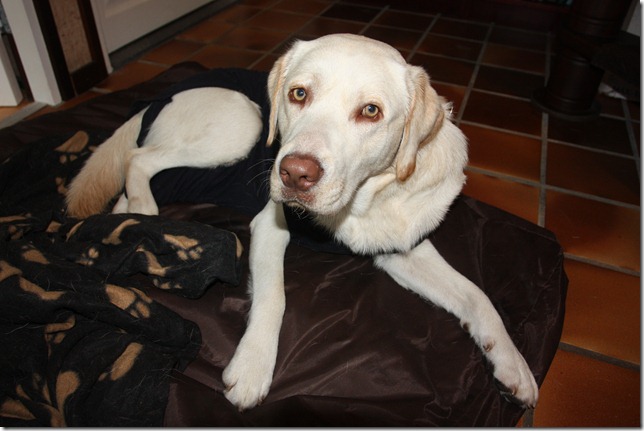
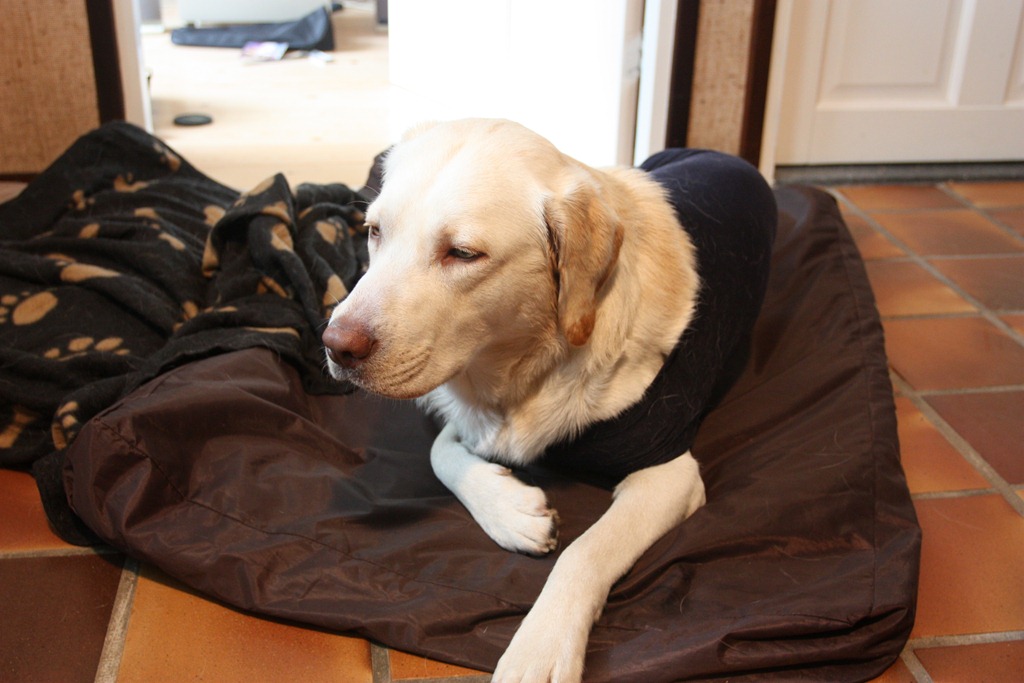
We have two Labradors: Kai, who is now over seven years old, and Watson, who is now 13 months, and heavily into puberty.
We became the owners of Kai when he was three, and he was already neutered when we got him. He has a gentle nature, and wins the hearts of everyone that meets him. Watson, on the other hand is a typical teenager, pushing the boundaries at every opportunity. He also pushes Kai around, while Kai just wants a quiet life.
So we decided to level the playing field by neutering Watson.
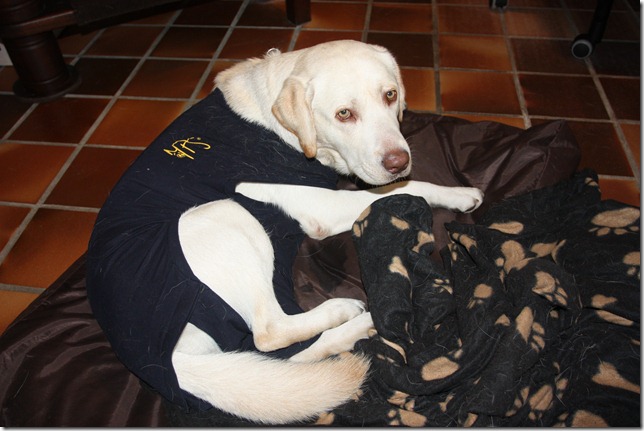
This morning he went for the chop. That was done without problem. Now he is coming to terms with the fact that something has changed. He’s feeling a bit sorry for himself, but I’m sure that will pass. He’s also being subjected to the indignity of wearing a one-piece garment at the moment in an attempt to stop him licking his wounds.

Leave a comment
-
Feeling Slightly Dirty
That’s how I’m feeling at the moment, having read, and had a shudder of revulsion at the content of, this piece by Pankaj Mishra in the Guardian. As Ophelia says, it’s ugly stuff.
A good rebuttal of Mishra’s tripe is this comment:
Ayaan Hirsi Ali was mutilated as a child because of the patriachal religion of her homeland.
Ayaan Hirsi Ali received death threats after publishing her first book, detailing the treatment of women in Islamic society
Ayaan Hirsi Ali’s colleague Theo Van Gogh was murdered. A letter threatening Ayaan Hirsi Ali was pinned to his dead body with a knife. As a result, she had to go into hiding.
Ayaan Hirsi Ali still regularly receives death threats.
And yet, according to you, a few criticisms of a planning application represent a tide of hatred, while Ayaan Hirsi Ali is the one to be vilified. It is people like you, Pankaj, the apologists and appeasers, that allow islamists operating in the west to think they can murder and threaten with impunity.
Now are you going to come down below the line and answer our points, or do you think you’ve done enough damage with your witless blathering?
For a longer and more in-depth background on why Mishra is talking shite, then I would point you to this piece by Clive James, penned in September 2009.
Leave a comment
-
The Illusion of Free Will
Over at Why Evolution Is True, Jerry Coyne muses on the concept of Free Will. His musings were prompted by reading Dan Dennett’s book: Freedom Evolves.
His post is followed by a discussion by commenters batting the ideas back and forth. I’m no philosopher, and reading some of this stuff makes my brain hurt, but it’s enjoyable all the same to explore the ideas.
When it comes down to it, I think I’m pretty much in the camp that believes that free will is an illusion, albeit an exceedingly strong one. I think Ophelia pretty much sums it up for me:
This subject doesn’t fret me the way it does some people, and I suspect that’s because I’m lazy about it. I’m lazy about a lot of things. It doesn’t fret me because I always end up thinking “but it feels as if I choose and in a way that feeling amounts to the same thing as really choosing.” That’s probably lazy because of the “in a way” or the “amounts to” or both. It’s woolly. And yet –
And yet if we all do live that way, feeling all the time as if we choose various things, then for the purposes of living that way, it does amount to the same thing. Or at least it seems to. It’s like the self, and other such illusions. We can agree that they’re illusions, and yet in everyday life, we go on living and thinking as if they’re not, and we can’t really do anything else.
It’s like vision, too – we don’t really see what we see; what we see is a confabulation – we fill in all kinds of missing bits with our brains to make a seamless whole that our eyes don’t in fact see. I’m aware of that, but I certainly can’t refrain from doing it.
Perhaps I should go back and re-read Freedom Evolves again. Now, is that a decision taken of my own free will?
Leave a comment
-
Afghan Images
Future Perfect is a blog written by Jan Chipchase, who used to work for Nokia, and who now works for a design and innovation company. He specialises in in taking teams of concept/industrial designers, psychologists, usability experts, sociologists, and ethnographers into the field and, after a fair bit of work, getting them home safely.
He’s currently working in Afghanistan. His blog entries are fascinating, and worth reading. Start here, and then explore some of the other entries.
Leave a comment
-
The Pope and Gorgeous Georg
Colm Tóibín has a very good article in the London Review of Books looking at the issue of homosexuality and the Catholic Church. It’s long and it’s worth reading.
Leave a comment
-
“I Believe in Wallace Stevens”
I didn’t know who Wallace Stevens was until I listened to A. S. Byatt. In this interview, her thoughts and ideas are simply scintillating. Well worth watching. What I want to know is, what is the significance of the roll of sellotape?
Leave a comment
-
Augmented City 3D
Keiichi Matsuda has created a short film to illustrate the idea of the real world augmented by fully 3D computer interfaces. Think of Minority Report, and you’ll get some idea.
http://player.vimeo.com/video/14294054
Augmented City 3D from Keiichi Matsuda on Vimeo.
The thing that struck me the most was the idea of wading through a mass of adverts clustered around your feet. I think it’s going to be much, much worse – we’re going to be swimming through them, and they’re all going to be saying, in tinny little voices, “Pick me! Pick me!”
Get out your old red and green 3D specs, and watch the video…
Leave a comment
-
The Acid Tanks Await
I’ve always had this inkling feeling that the Transhumanist singularity is nothing much more than a rather daft idea peddled by the likes of Ray Kurzweil.
It’s a topic that comes up for regular chewing over in the science blogosphere, particularly around the time when the proponents of transhumanism hold a shindig.
I came across something today that triggered a faint memory. Over at Pharyngula, there’s a post today that contains a comment by Ye Olde Blacksmith that nails the flaw for me.
To summarise the idea of the singularity, it is that at some point in the not-too-distant future, it will be possible to copy the consciousness of a human person into another, perhaps non-biological, substrate, such that the consciousness lives on in the new vessel.
In a way, it’s what lies at the heart of the Star Trek transporter, but the idea was explored even earlier in Science Fiction in the 1964 book by Clifford D. Simak: Way Station. The central idea of the book is that what appears to be a remote rural farmstead in Earth is in fact a galactic way station that travellers are passing through. As Simak envisages it, travellers arrive at the way station by having their bodies and their consciousness replicated from the blueprints taken at the previous station. When they leave, the process begins with their complete blueprint, body, consciousness and all being transmitted to the next station. It is completed when the traveller on earth is killed and its body flushed into the underground tanks of acid that lie beneath the way station. That image has stayed with me.
The comment on the Pharyngula thread rather brought the memory of that book back to me:
Dr. Nick: Good evening, Mr. Anderson. Are you ready for the procedure?
MeatbagMe: Hi. Um, yeah, I guess. Are you sure this will work? I’m really going to be in the machine?
Dr. Nick: Yes, you will be in the machine and will no longer be biologically mortal.
MeatbagMe: Oh, OK, let’s get this party started.
*Dr. Nick admininstering sedative via I.V.*
Dr. Nick: Ok, start counting backwards from 100.
MeatbagMe: 99…98…97…9…..
Dr. Nick: Are you there? Can you hear me, Mr. Anderson?
DigiMe: Hey, yeah, I’m here! SWEET! I’m in a computer. The interfaces are awesome! I can’t even tell I’m not still in my body. So what happens now?
Dr. Nick: Well, now that we have established that the procedure was successful, we will dispose of the body.
DigiMe: Wait, what? So my original body is dead?
Dr. Nick: No, it isn’t dead, but you have no use for it anymore. Now that you are digital, that is, you have not need for a biological carrier.
*MeatbagMe comes to*
MeatbagMe: Hey, what happened? Did it work? I don’t feel any different.
Dr. Nick: Nurse, please begin the body disposal procudures.
*Nurse begins administering something via I.V.*
MeatbagMe: What? Hey, I’m still alive here! You can’t do this!
Nurse: The body is prepping now, Dr.
MeatbagMe: Hey! HEY! Stop this! I’m still here! I’m still here goddamm……………..
Nurse: I will arrange for the transport of the remains.
Dr. Nick: Thank you. Mr. Anderson, will you be requiring anything else?
DigiMe: Nope, I’m good.
Or, in devastating summary (comment #46):
“As you can see, this new duplicate of you is an exact replica in every way, down to every last memory, down to every last arm hair. Now please step into the disintegration chamber.”
This seems to me to be the fatal flaw. If I am a non-dualist, then I have to believe that “I” will cease to exist once I step into the disintegration chamber. The fact that a replica of me, carrying a perfect copy of my consciousness will carry on is of little comfort to the me that existed up until that point…
The acid tanks await…
Leave a comment
-
"This"
I never fail to admire the barmaid’s ability to cut through nonsense to the heart of the matter.
Leave a comment
-
Geotagging in Windows Live Photo Gallery–Part 2
Last month, I wrote about my findings on the experience in using the Beta of Windows Live Photo Gallery to geotag my photos. I wasn’t too impressed with the experience.
This week, a second beta of WLPG was released by Microsoft so I’ve been revisiting the experience of geotagging.
And today, it’s been borne in upon me just what a disaster geotagging in WLPG has proved to be.
You see, I made an assumption. That was that WLPG would not alter any metadata in a photo without my explicit permission and knowledge. Wrong…
I was naive enough to think that WLPG would only write out GPS coordinates to the Exif metadata in a photo when I explicitly added a Geotag using WLPG. Wrong…
I realised that WLPG was reading in IPTC Core Location metadata from my photos and using that to create a geotag in WLPG’s internal database. I also realised that it was copying the metadata into the “Location Created” section of the newly specified IPTC Extension metadata. Since these are a set of text fields that reflect what already existed in the original IPTC Core Location fields, that didn’t bother me unduly.
What I hadn’t also appreciated is that WLPG not only constructs a geotag in its internal database and creates Location Created metadata in the IPTC Extension section, but that it then proceeds to write out a set of GPS coordinates into the photo’s Exif metadata of where it thinks that the photo was taken.
This is an unmitigated disaster!
As I said last month, WLPG makes false assumptions about what the GPS coordinates are. If it doesn’t recognise the contents of the Sublocation field, it uses a GPS position derived from the contents of the City field. If it doesn’t recognise the contents of the City field, it uses a GPS position derived from the contents of the State field, and if it doesn’t recognise the contents of the State field, it uses a GPS position derived from the Country field.
I have a collection of over 40,000 photos. The majority of these have IPTC Core Location metadata that I have catalogued over time. Only a very small percentage of these had GPS coordinates that I had carefully added myself.
Now, WLPG has gone through my collection reading the Location metadata and has written out GPS coordinates to all of the photos containing Location metadata. And, of course, in a lot of cases, it doesn’t recognise the terms I’ve used for a particular location field, so it’s plucked a GPS value out that bears no relation to where the photo was taken.
Worse still, I now have lost the needles of those photos which have accurate GPS positions in a haystack of huge proportions, which consists of photos with false GPS positions.
Aargghh!
Update 23 August 2010
- I’ve now looked at a backup of my photo collection taken on the 1st June 2010 (i.e. before the WLPG beta was installed). No photos had false GPS values inserted in the Exif at that time. Therefore I conclude that WLPG is the culprit.
- Contrary to what I first thought, not all photos with IPTC Location metadata get GPS values inserted into them by WLPG – there may be a pattern, but it’s not obvious to me why some files are hit, but not others.
- However, even though all files are not affected, I have still found over 7,000 photos with GPS values, and of these, only 2,359 of these photos have genuine GPS values that I have explicitly inserted. The rest have GPS values inserted by WLPG itself and which are also inaccurate (false).
- Some false values come from WLPG ignoring a sublocation, and inserting a central GPS value for the City.
- Some false values come from WLPG misinterpreting a sublocation and inserting a completely wrong GPS value for another location altogether; e.g. Sublocation: Voortman Bos, City: Heelweg gets interpreted as Voortmanweg in Deventer, 37 kilometres away…
- Some false values make no sense whatever; e.g. some photos I have of St. Pancras station in London have a GPS value assigned to them of Cuxham, a very small village in Oxfordshire…
All together now: Aaaarrrggghhh!!!
Update 8 September 2010
I posted about this issue on the WLPG Help Forum. Now, Analy Otero, who works in the WLPG team, has posted a response to confirm that WLPG does indeed write out what it thinks are correct GPS coordinates to image files based on the content of the IPTC Location fields. As she says:
“The behavior you’re experiencing is the design of the feature and we’re working to improve both reliability of the process (to ensure all photos get proper geotags) and to improve the accuracy of the places.”
Unfortunately, I don’t believe that Microsoft can ever sufficiently improve both the reliability of the process and improve the accuracy of the places to the extent where I can trust that accurate GPS information will be included in my images. My experience thus far has been an eye-opener of just how bad it currently is. I see that in the current release notes, Microsoft themselves say:
“Landmarks (such as the Eiffel Tower) are not supported in the current implementation of geotagging”.
The problem is that the textual IPTC sub-location field, in particular, will always be down to what the user decides, e.g. “the stern of HMS Ark Royal in dry dock”. I’d like to see Microsoft be able to give an accurate GPS for that. Of course, they can’t, and so the chances that rubbish GPS coordinates will be introduced by WLPG into an image remain very high.
A further twist is that, apparently, once WLPG has introduced a GPS value (false or accurate) into a file, it can’t ever be subsequently changed by WLPG. Elsewhere in the release notes it states:
If a photo or video contains no GPS data, coordinates will be added when the item is geotagged. However, updating or deleting a geotag string won’t modify the GPS coordinates. Any additional updates to the geotag field don’t change the original coordinates written to the file. (my emphasis)
It seems to me that the way to cut this Gordian knot is for Microsoft to give us a proper mapping interface in WLPG itself (such as Picasa, IDimager, or Geosetter do) so that we can check locations prior to allowing GPS coordinates being written, and to use the map to modify or delete GPS coordinates. That is, writing of GPS coordinates is under the explicit control of the user, instead of something that WLPG does by itself in the background as a write-only operation.
The current implementation of WLPG writing out what it thinks the GPS coordinates should be is dreadful and appalling. I simply cannot afford to have WLPG installed on my PCs as it is. It has already introduced garbage information into thousands of my images.
Update 30 September 2010: Well, the final version of WLPG 2011 is now released, and as far as I can see it is still screwing up my GPS metadata.
I’ve just found some photos taken this month in the Netherlands which now have GPS info for Wimereux in France inserted into them by the final release of WLPG.
I am definitely not impressed.
Update 2 December 2010
There’s an update to WLPG 2011 that addresses the geotagging issue. See here for more information.
3 responses to “Geotagging in Windows Live Photo Gallery–Part 2”
-
[…] photographer who uses IPTC metadata to record information about where your photos were taken, then WLPG 2011 will write false GPS data into your photos without telling you that it is doing […]
-
[…] members to edit photos, since the original files get preserved. It’s a major step forwards from the geotag disaster that hit me back in August. My thanks to the WLPG team for their work in addressing the […]
-
[…] of you may recall that, when it was first released in 2010, Windows Live Photo Gallery had a major problem with geotags. It was writing out GPS coordinate data into photos that was often completely wrong. […]
Leave a comment
-
Carpe Diem
We had a telephone call last night that underlined the importance of carpe diem – seizing the day and living life while you can. The daughter of a friend of ours rang to give us the news that Maaike had died of a heart attack while on holiday visiting relatives in Portugal. She was only 52. She and her family visited us just over five weeks ago. She was full of life then, and now she’s gone. She is missed.
Leave a comment
-
A Message That’s Missing A Word
Someone with more time on his hands than sense decided to use a GPS logger to spell out the message “Read Ayn Rand” in letters that cover the whole of the USA. As someone else comments on the story, we just need someone with more sense to spell out the word “Don’t” in Canada.
My favourite quote about Rand is the one coined by John Rogers:
“There are two novels that can change a bookish fourteen-year old’s life: The Lord of the Rings and Atlas Shrugged. One is a childish fantasy that often engenders a lifelong obsession with its unbelievable heroes, leading to an emotionally stunted, socially crippled adulthood, unable to deal with the real world. The other, of course, involves orcs.”
Leave a comment
-
Murphy’s Law
Last Thursday night was the peak of the annual Perseid meteor shower. The sky was reasonably clear, so I stayed out for about ninety minutes at around midnight. I saw a number of Perseids, but nowhere near the 60 per hour that had been forecast. I did see an Iridium flare, which was rather satisfying.
I was also trying to photograph the meteors. This involved having the camera on a tripod, pointing the camera at the sky and taking a succession of 30 second exposures. By Murphy’s Law, the camera was never pointing at a part of the sky where a meteor happened to appear during an exposure…
Not everyone was as unlucky. Here’s a great shot from reway2007:

Leave a comment
-
A Day Out
Yesterday I left Martin in charge of the dogs while I travelled to Rotterdam for a day out with a couple of old colleagues. I arrived at midday, and the original plan was to stroll from Central Station down to the Veerhaven, catch a water taxi there and cross the Maas river to the Hotel New York for lunch.
Alas, we had hardly started walking when the heavens opened, and what can only be described as a tropical downpour commenced. As a result, we abandoned that plan, and took shelter in the museum Boijmans van Beuningen instead. We had intended visiting it after lunch anyway, so we thought that we would switch to having lunch in the museum. It has a roomy restaurant overlooking a park, thus plan B was looking good.
We should have been alerted to the fact that yesterday was Friday the thirteenth by the downpour…
We bought our museum tickets, and announced to the cashier that we would go straight to the restaurant first for lunch before strolling around the exhibits. “Ah”, she said, “sorry, but the restaurant is closed for renovation; only the coffee bar is open”. She pointed to the coffee bar next to the museum entrance and our hearts sank. The coffee bar was small, crowded, and with very little in the way of choice of food. Still, we decided to have coffee while we ruminated on the date.
We enjoyed the Notion Motion installation by Olafur Eliasson. A very effective visual experience using very simple means. I was personally less impressed by the work of Thomas Demand, although I can appreciate the work that went into constructing it.
One thing that we all wanted to see was the exhibition of the work of Han van Meegeren, who became (in)famous in the 1940s as the man who faked Vermeers. It’s definitely an exhibition worth seeing. It captures the scandal that rocked the art world very well. The museum itself was at the centre of the storm, since, in 1937, the ambitious director of the museum, Dirk Hannema, wanted to purchase The Supper at Emmaus by Vermeer which had just been discovered. Of course, this was actually a forgery by van Meegeren. Hannema managed to raise 520,000 guilders – a huge amount for the time – and purchased the painting. Ironically, one of the first things that the museum did was to have the painting restored. Ironic, since it wasn’t a 17th Century painting, but something that had been painted the year before on a 17th Century canvas.
The thing that struck me, looking at these paintings, was how bad they are. I know I’m no expert, but I would never have said that these were genuine Vermeers in a million years. And yet, the art historians at the time, notably one Dr. Abraham Bredius, fell over themselves in praise. There’s a book in the exhibition, a compendium of great works of art with texts by prominent art critics. It is open at the page depicting The Supper at Emmaus, and the text is by Bredius. It is no exaggeration to say that Bredius is fulsome in his praise, embarrassingly so. It is hard to read it today without bursting into laughter mixed with pity at poor Bredius’ total misjudgement.
Was this a case of the Emperor’s New Clothes syndrome or mass hysteria? Clearly, someone must have planted the idea that these were genuine Vermeers at the start. Was he mistaken, or was he in on the game? Whoever it was, I don’t think it was Bredius, as he seems to have been a target of van Meegeren. But Bredius certainly fell for the forgeries; hook, line, and sinker.
The video of the story on the museum’s page is worth watching, and the English Wikipedia entry is definitely worth reading for the full sordid story of greed on all sides. Strangely, the Dutch Wikipedia entry is less revealing… Perhaps the Dutch are still embarrassed by the affair, or they don’t want to view van Meegeren as anything other than a hero, when in fact he was a criminal and a Nazi sympathiser.
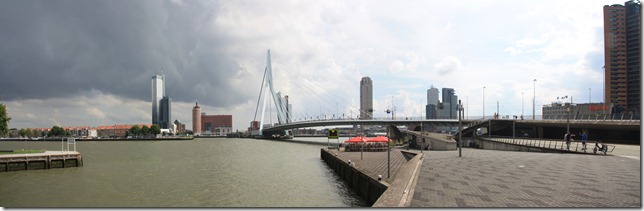
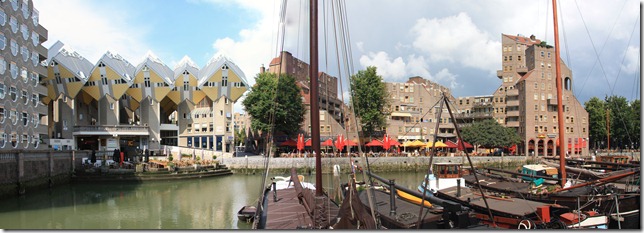
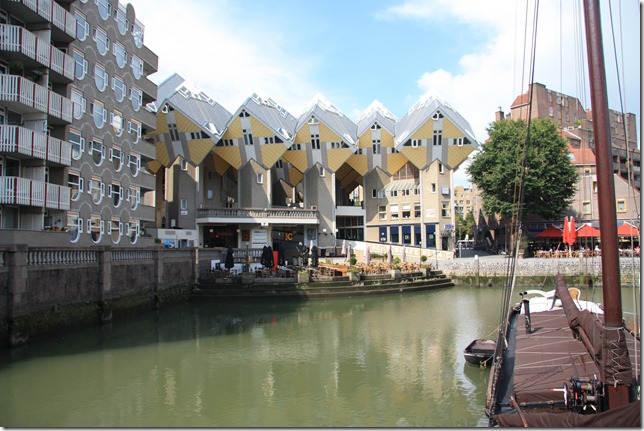
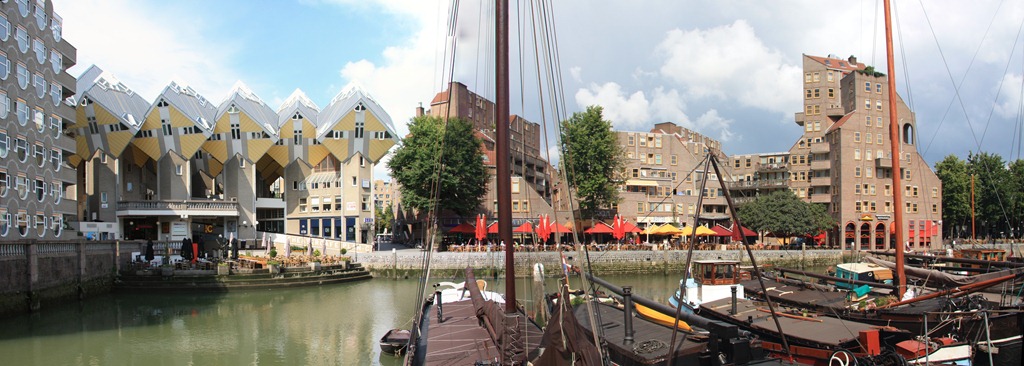
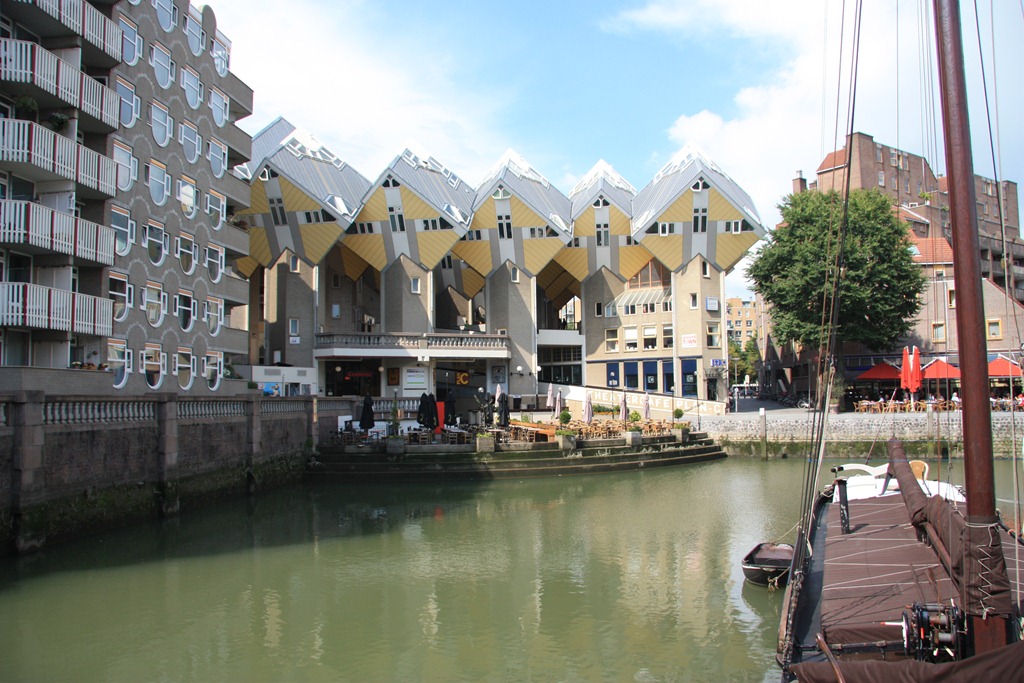
After the museum, we strolled down to the Oude Haven, passing the Erasmus Bridge, and there, in the shadow of the Kubuswoningen, finished off our jaunt with a few beers and bitterballen.

Leave a comment
-
An Unmitigated Disaster?
Apparently, there may be a further beta of Wave 4 of the Windows Live Essentials suite released next week. I’m beginning not to care any more, since Microsoft appear to have damaged the brand with what has already been released.
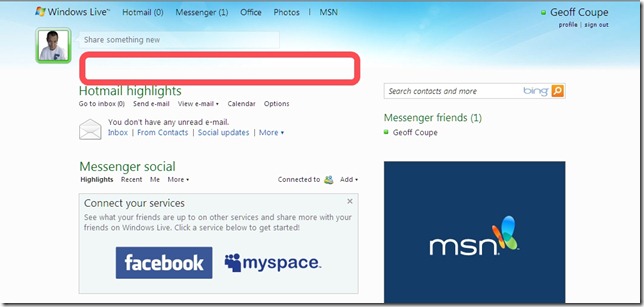
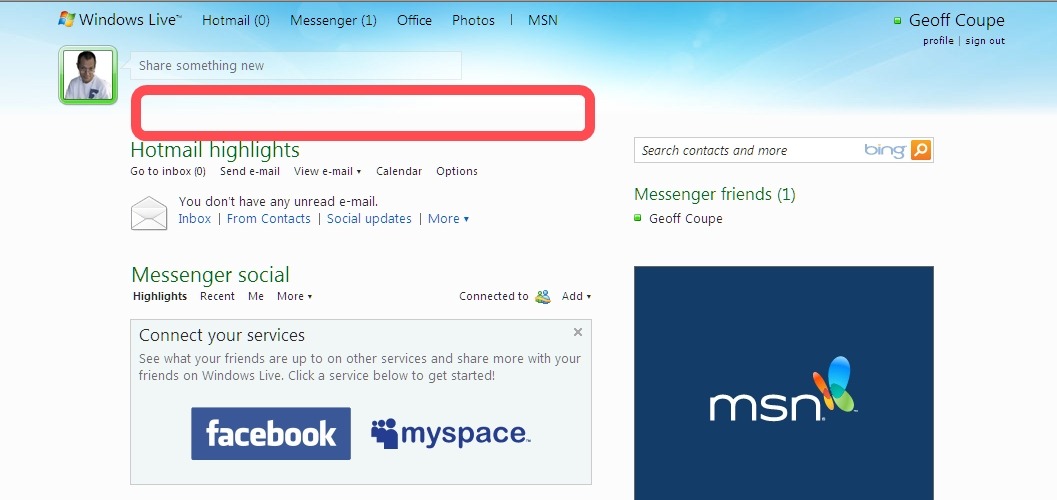
Today, for example, I went to my Windows Live Home page (if you have a Windows Live ID, you’ll find yours at http://home.live.com ). Since I last visited it, Microsoft have done a redesign, and in keeping with what they’ve done with the rest of Wave 4, functions have been mysteriously airbrushed out of the picture.
I used to be able to see upcoming events in my Calendar, my local weather, and if I had private message in my Windows Live messaging inbox. That has all gone. The red outline in the following screenshot shows where they used to be…
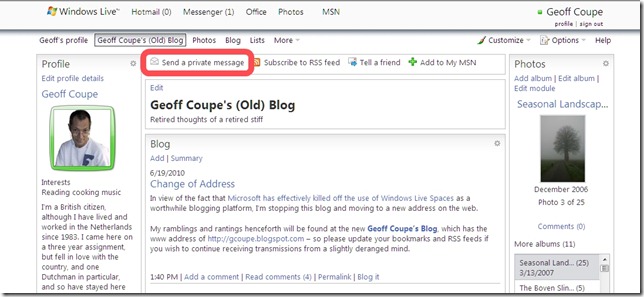
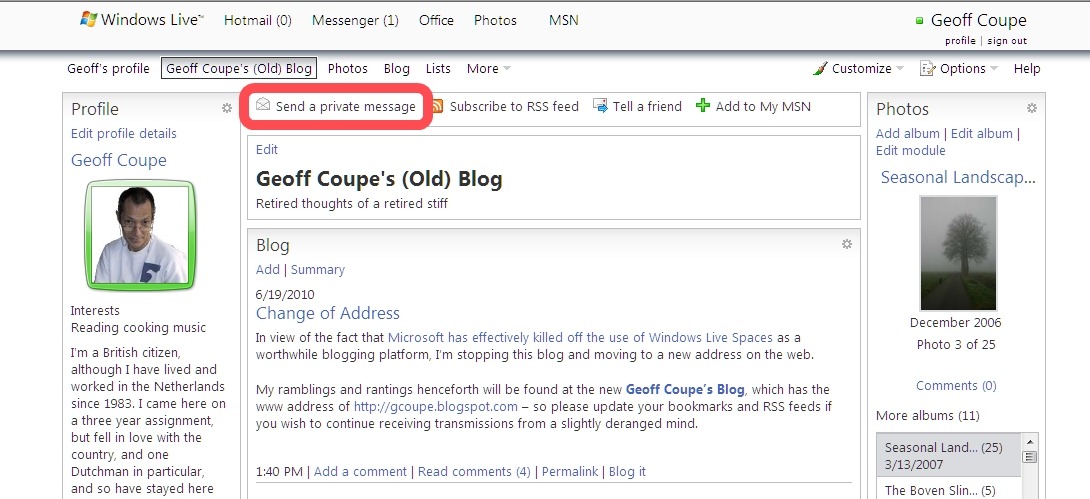
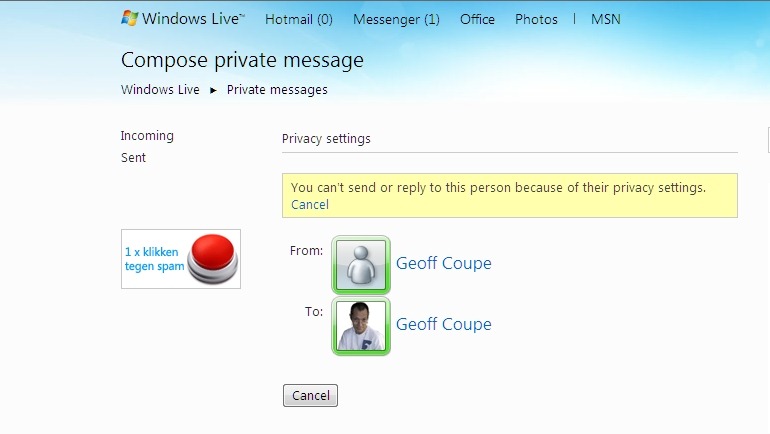
I spent a long while trying to find out where my Windows Live Message inbox and sent messages have gone. I eventually discovered that the only way to access the system was to fake a message by clicking on the “Send a private message” button in my Windows Live Space (see below).
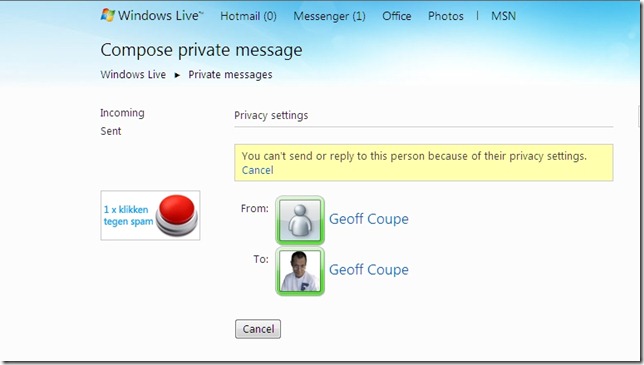
This then gave me a error (since I was trying to send a message to myself), but it also gave me links to my inbox and my sent messages folder.
This is appalling user interface design, and a real step backwards. Microsoft should be ashamed of this crap.
Update: since posting this, Microsoft have announced that they are pulling the plug on Windows Live Spaces, so I can’t now use the workaround shown above to get to my messages. The only way I’ve found to get there is to type in the URL into my browser directly. Hardly intuitive, and error-prone to boot.
Leave a comment
-
Sherlock – A Triumph
After last week’s dog’s dinner, last night’s final episode of Sherlock was a triumph in every way. Razor-sharp writing from Mark Gatiss and terrific performances from the cast. And typical of Gatiss’ audacity to leave us with a cliffhanger ending in the form of a standoff between Holmes and Moriarty.
As written by Gatiss and Moffat, Moriarty is the evil twin of Holmes – anti-matter and matter, with the very real danger of an annihilating explosion in the final moments of the episode when they meet face to face.
In a nice touch, Gatiss sprinkled references to the original Conan Doyle stories throughout the episode. And yes, the plot required suspension of disbelief a number of times – for example, I know the night sky over London is not deep black and filled with stars, more a yellow sodium glare with occasional appearances by the moon – but it didn’t matter. The energy of the production propelled the whole thing along with great verve and excitement. I can’t wait for the next series – and to see how Gatiss resolves the final standoff.
Leave a comment
-
A Monstrous Carbuncle
I see that BBC Four have set aside two hours tonight to transmit a two–part televisual biography of Bruce Chatwin, done by Nicholas Shakespeare. This should be worth watching. Shakespeare wrote what must surely be the definitive biography of Bruce Chatwin, who, it must be said, was something of a monster.
I thought Shakespeare’s biography of Chatwin was masterful and said so:
I recently purchased this biography of Bruce Chatwin written by Nicholas Shakespeare. I probably did it to confirm my own prejudices (the sneaking suspicion that Chatwin was ‘not a nice man’) and on that level it delivered in spades. Shakespeare gives a magnificent warts-and-all portrait. Chatwin’s friends and his apparently long-suffering wife could obviously see beyond the warts – all I saw was a monstrous egotistical carbuncle called Bruce Chatwin. I am pleased to have made his acquaintance via this biography; I would never have wanted to meet him in real life. I would have viewed him as a black hole – always taking, never giving.
I am very much looking forward to seeing Shakespeare’s TV program tonight – all the more so because some of the real people that Chatwin interacted with are going to be featured. I am curious to hear what they have to say.
Leave a comment




 Geoff Coupe's Blog
Leave a comment