
Ronald Dworkin has died. By coincidence, I listened last week to the podcast of Thinking Allowed, originally broadcast on 26 January 2011. In it, Dworkin discussed his book Justice for Hedgehogs with the philosopher A. C. Grayling and the sociologist Laurie Taylor. I thought at the time that I should get hold of the book, and now I definitely will.
Category: Society
-
What’s Sauce for the Goose…
…is sauce for the gander.
Not being a Catholic, I have little skin in the game. However, given that Pope Benedict has little time for us homosexual secularists, and has made it plain enough, I just thought that I would muse on the fact that:
a) He seems keen on pointing out that contraception is a thwarting of God’s will, whilst at the same time being happy to…
b) …have a pacemaker fitted to extend his allotted time in this vale of tears. God might well feel cheated at the presumption.
I gain no joy and I shed no tears at his relinquishing of the Papal crown, knowing full well that the next wearer will be stamped from the same ultra-conservative, human-hating mould.
As a bit of light relief, here’s Crispian Jago’s version of the Situation Vacant ad:

-
What’s Changed?
And so the British Parliament finally decided to see sense. Not without the usual grumblings from the bigots and homophobes. Even Jesus and Mo seem surprised at the lack of divine retribution. Welcome to the 21st century. Meanwhile, we’re heading towards our 15th wedding anniversary.
-
Queen Abdicates
Stop Press: the Queen is abdicating in favour of her middle-aged son.
Nope, this is not Betty handing over the reins of the monarchy to Charlie (god forbid); it’s Queen Beatrix of The Netherlands handing the reins over to Prince Willem-Alexander.
A well-timed and sensible choice.
The Prince and Princess Maxima are well-equipped to pick up the reins and carry on. They are, like Beatrix herself, not unintelligent, understand both business and society and are well-liked by their subjects. I’m no monarchist, but I have a lot of respect for them.
-
A Fine Balance
I see that the European Court of Human Rights has delivered its judgments in the cases of four Christians who claimed that their religious rights were being infringed by their employers.
And I think that the ECHR got it right. They supported the claim of Nadia Eweida, and dismissed the other three claimant’s cases.
Frankly, I didn’t think British Airways had a leg to stand on when (1) they refused to allow Eweida to wear a crucifix visibly while (2) they allowed the wearing of turbans and hijabs, and (3) they subsequently changed the rules so that the wearing of crucifixes was permissible.
In the other three cases, the ECHR quite rightly pointed out that Christian rights do not trump human rights. However, Andrea Williams of the Christian Legal Centre wants to reframe these as cases where gay rights is apparently winning over human rights:
In the cases of Ladele and McFarlane, she added, sexual rights had been given priority over religious liberty: “[The judges said] that if an employer has an equalities policy and says there should be no discrimination in any way on the grounds of sexual orientation no matter what your Christian belief is that the sexual orientation rights win.”
Nonsense. As Joshua Rozenberg writes:
Take the case of Lilian Ladele, the registrar of births, deaths and marriages who lost her job when she refused to conduct civil partnership ceremonies. By a majority of five votes to two, the Strasbourg judges dismissed her claim that she had suffered discrimination in comparison to a registrar with no religious objection to same-sex unions.
That was because the local authority for which she worked also had a legitimate duty to protect the rights of same-sex couples. The human rights court generally allows member states a wide discretion — what it calls a “margin of appreciation” — when it comes to striking a balance between competing rights. According to the five judges in the majority, the decision to sack her was within that discretion.
But what am I to make of the language used by the two dissenting judges (out of the seven on the panel)?
In a dissenting judgment, two ECHR judges, Nebojsa Vucinic and Vincent de Gaetano, said Ladele’s right to freedom of conscience had been infringed. They explained: “We are of the view that once a genuine and serious case of conscientious objection is established, the state is obliged to respect the individual’s freedom of conscience.”
They also launched a fierce verbal attack on the culture prevalent in her local authority: “In the third applicant’s case, however, a combination of backstabbing by her colleagues and the blinkered political correctness of the borough of Islington (which clearly favoured ‘gay rights’ over fundamental human rights) eventually led to her dismissal.”
That is quite extraordinary language from judges who sit on the ECHR. However, as Rozenberg points out:
Minority judgments are written by the judges themselves, unlike the majority ruling which is compiled by officials. The court itself would never have said that gay rights were not human rights.
I note that the two judges hail from Montenegro and Malta. Clearly, based on these two individuals, who, one would assume, represent the highest flowering of moral and judicial sensibility, the moral zeitgeist has not moved forward in those countries at the same rate as elsewhere.
-
My Precious…
Lawrence Krauss, articulating both the wonder and the insignificance of humanity. I agree.
No gods required.
-
I Beg Your Pardon?
I apologise about returning to the subject of same-sex marriage so soon, but I came across an example of an argument against same-sex marriage today that is just so, well, bizarre.
It is contained in an opinion piece in the Guardian, penned by one Timothy Radcliffe, who turns out to be, as I subsequently learned, a Roman Catholic priest and a Dominican friar. So I suppose I shouldn’t have been surprised.
Father Radcliffe starts out well:
It is heartening to see the wave of support for gay marriages. It shows a society that aspires to an open tolerance of all sorts of people, a desire for us to live together in mutual acceptance. It seems obviously fair and right that if straight people can get married, why not gay people?
But then comes:
But we must resist the easy seduction of the obvious. It once seemed obvious that the sun revolved around the Earth, and that women were inferior to men. Society only evolves when we have the mental liberty to challenge what seems to be common sense.
Followed by something that struck me as being simply mind-boggling:
Many Christians oppose gay marriage not because we are homophobic or reject the equal dignity of gay people, but because “gay marriage” ultimately, we believe, demeans gay people by forcing them to conform to the straight world.
As one of the commenters on the piece said, this is rather like saying:
Many Christians oppose the liberation of the slaves not because we are racist or reject the equal dignity of black people but because “freedom” ultimately, we believe, demeans black people by forcing them to conform to the white world.
Many Christians oppose equal rights for Jews not because we are antisemitic or reject the equal dignity of Jewish people but because “equality” ultimately, we believe, demeans Jewish people by forcing them to conform to the gentile world.
I felt neither demeaned nor forced to marry Martin. We got married because it seemed to us a positive step to take, and we didn’t take it lightly.
Here in the Netherlands, every couple who gets married does so in a civil ceremony. The option is then open to them, if they are religious, and if their religion supports it, to follow that up with a religious marriage ceremony. It’s very common here to see a newly-wedded couple emerge from the Town Hall, walk across the market square, and go into the church for their church wedding.
-
Marie Antoinette and the Anglican Church
I confess to a fondness for schadenfreude. Never more so when an organisation, which expects power and recognition in the society in which it exists, resolutely opens its mouth only to change feet.
And so it is with the Anglican Church and same-sex marriage.
Having earnestly entreated the UK government to forbid the possibility of same-sex marriage, for a number of dubious reasons, it is now horrified when the UK government has responded by effectively saying: OK, you don’t want to have same-sex marriage, then we’ll bring in a law to make it forbidden for you to conduct same-sex marriage ceremonies within your premises.
Look, gentlemen (and, of course, it is men) you can’t have your cake and eat it. If you don’t want to conduct same-sex marriages, then don’t bleat when you are told that you can’t conduct same-sex marriages.
The Anglican Church: a cross between Marie Antoinette and Stan Laurel.
-
Terry Pratchett
The New Statesman has an excellent interview with Sir Terry Pratchett. It is well worth reading. He’s not going gently into that Good Night; but instead with his head held up high and fearlessly facing the final curtain. I wonder if I could do the same.
Here’s Terry Pratchett’s award-winning documentary “Choosing to Die”
Please watch it.
-
Irrelevant
Yes, it’s been fifty years since I believed in Christianity, but even so, I had hoped that the Anglican Church would see sense and vote for women bishops.
Er, nope, they are still stuck in the dark ages, and want to treat 50% of the human race as lesser creatures.
Still swirling around in a cesspit of their own making. Bless.
-
A Barbaric Practice
I find it difficult not to get both depressed and angry when reading about some of the things inflicted on the group that comprises 50% of the human race. Last week it was reading about the case of Savita Halappanavar. Today it is reading about the barbaric practice of female genital mutilation in Indonesia, a supposedly modern Muslim country.
It is well established that female genital mutilation (FGM) is not required in Muslim law. It is an ancient cultural practice that existed before Islam, Christianity and Judaism. It is also agreed across large swathes of the world that it is barbaric. At the mass ceremony, I ask the foundation’s social welfare secretary, Lukman Hakim, why they do it. His answer not only predates the dawn of religion, it predates human evolution: “It is necessary to control women’s sexual urges,” says Hakim, a stern, bespectacled man in a fez. “They must be chaste to preserve their beauty.”
Oh God, ah Allah, what evil we do in thy names…
-
A Well-deserved Award
I see that Cardinal Keith O’Brien has been awarded the “Bigot of the Year” award by Stonewall. Naturally, he and other members of the Catholic hierarchy aren’t best pleased. On the other hand, if the cap fits…
To quote from the article:
Colin Macfarlane, the director of Stonewall Scotland, said: “We’ve never called anyone a bigot just because they don’t agree with us. But in just the past 12 months, the cardinal has gone well beyond what any normal person would call a decent level of public discourse.”
Speaking on BBC Radio Scotland, Macfarlane added: “The people that were nominated for bigot of the year have this year called gay people Nazis, they have compared them to bestialists and to paedophiles, and one of the nominees suggested that gay people should be put in front of a firing squad and shot dead.
“So I think what we are doing is highlighting the very cruel, very nasty, very pernicious language that is being used by some people – and in particular by the cardinal, who won.
The opposing view was expressed by Ruth Davidson:
Stonewall’s decision was criticised, however, by the Scottish Tory leader Ruth Davidson as she picked up her own award as politician of the year at the prize ceremony at the Victoria and Albert museum in London on Thursday evening.
Davidson, the first openly gay leader of a major political party in the UK, was booed when she said it was “simply wrong” to call people names like bigot. “The case for equality is far better made by demonstrating the sort of generosity, tolerance and love we would wish to see more of in this world,” she said.
“There are many voices in this debate and just as I respectfully express my sincerely held belief that we should extend marriage to same-sex couples, I will also respect those who hold a different view.”
To my way of thinking, respect is something that is earned, not automatically given. And holding different views is one thing, but to hear powerful religious figures such as the Cardinal, and the former Archbishop of Canterbury, George Carey, spout the cruel, nasty, pernicious language that they regularly use about us is something that I will not countenance.
I have no hesitation whatsoever in calling the Cardinal a bigot, because that is what he is. He has earned himself a well-deserved award.
Update: and now, of course, he has shown himself to be a hypocrite. Hoist by his own petard. Just desserts.
-
Carey Invokes Godwin’s Law
I admit, when I first read of Lord Carey’s performance at the Coalition for Marriage rally at the recent Conservative Party Conference in the UK, I rolled my eyes, sighed deeply, and thought I should just ignore it. While it was yet more evidence that he, and his fellow travellers, such as Anne Widdicombe, are simply bigots, it gets tiresome pointing this out every time.
But then I read Martin Robbins’ response, and I thought, yes, if Lord Carey wants to play the victim card by likening himself and his supporters to the Jews in Nazi Germany, then he fully deserves the fury of Martin Robbins’ response.
So I call your attention to what Martin Robbins wrote. In particular, I echo the sentiments he expressed in two paragraphs in the piece:
I have no words powerful enough to describe the disgrace, the ignorance, the self-absorbed vileness of a man who believes that being called a bigot by Nick Clegg is even remotely comparable to the experiences of men like Pierre Seel, or thousands of others who were slaughtered by the Nazi regime…
But perhaps Carey’s most disturbing remark was that eerily familiar question he posed: “Why does it feel to us that our cultural homeland and identity is being plundered?” The answer, Lord Carey, is that it is not your homeland, it is our homeland; and homosexuals are just as much a part of our identity as anyone else. The day we allow bigots to deny that, or to suggest that the emotions felt by certain people are somehow not on the ‘same level’ as other human beings, is the day we start heading back down a dark and dangerous path.
-
Forget Burglars, Shoot a Banker…
That’s Craig Murray’s modest proposal. Truth to tell, looking at the behaviour of the banking industry over the past few years, it has a certain ring to it…
-
The Book Mountain
After that last post, I needed something to give me hope. Perhaps the news of the opening of the Book Mountain and Library quarter in Spijkenisse, here in the Netherlands, is something to restore my spirits.
-
Religion Poisons Everything
That quote, from the late Christopher Hitchens, seems apposite in the wake of the news that a 14 year-old girl has been shot in the head because, according to the Taliban spokesman (it is always, of course, a spokesman), her activities in highlighting Taliban atrocities needed to be stopped.
He said the teenager’s work had been an “obscenity” that needed to be stopped: “This was a new chapter of obscenity, and we have to finish this chapter.”
It is at times like this when I come close to despair for humanity’s future.
-
This Land is Mine
I’m currently reading (very slowly) Steven Pinker’s magisterial The Better Angels of Our Nature. It’s a history of violence in human societies, and his thesis is that violence has actually declined over the centuries. It seems difficult to believe, but Pinker marshals his facts and presents a convincing case.
And on the theme of the distressing fact that violence and humanity are inextricably locked together, here’s Nina Paley’s offering on that theme.
More about the film, Seder Masochism, together with a handy guide to who’s killing who, can be found on Nina’s Blog.
-
Polling Day
It’s polling day here in the Netherlands. It’s our chance to exercise our democratic right to choose the members of the Tweede Kamer (Second Chamber), and, indirectly, the makeup of the next Dutch Government. With twenty political parties to choose from, the next government will almost certainly be a coalition, as usual.
There’s a chance that we might see a swing to the left, but it seems that it will be a close run thing.
At least I should get some respite from the last few weeks of a constant barrage of web ads urging me to vote for the VVD. Their crude slogans – Meer straf en minder begrijp voor criminelen (more punishment and less understanding for criminals) – have merely confirmed me in my belief that I am doing the right thing by voting for the PVdA.
-
A New Arrival
Our nearest neighbours, Herman and José are currently celebrating (and having sleepless nights) because José gave birth to their second child last Tuesday. Her name is Linde.
Yesterday, as is traditional around these parts, we, the neighbours, assembled to erect a stork in the garden to proclaim the arrival of a baby.
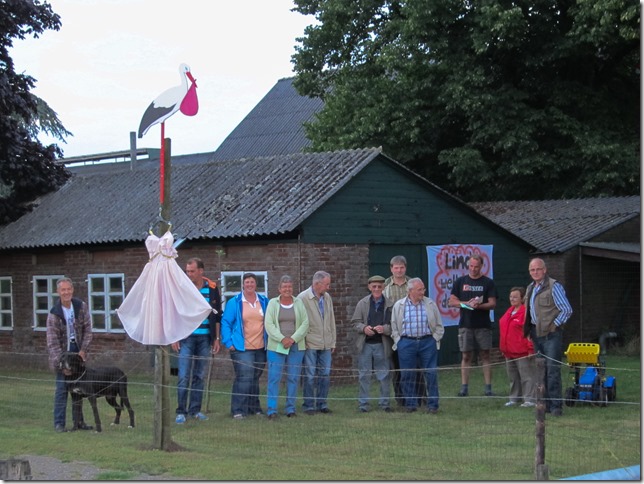
Because Linde is a girl, Martin added the princess dress to indicate the fact. He also decorated the entrance to the cattle barn…
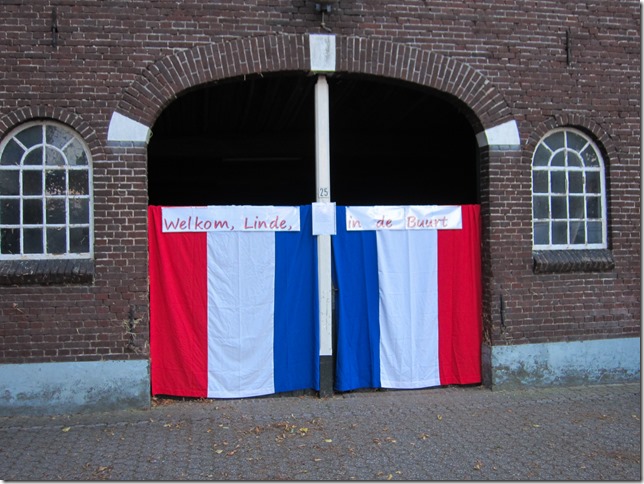
The text reads Welkom, Linde, in de Buurt (Welcome, Linde, into the Neighbourhood).
-
The Right To Die
I am profoundly thankful that I live in a country where I can choose if I wish to die.
Tony Nicklinson has been denied that choice, and is condemned to serve more time in a living hell.
Update #1: Polly Toynbee has a good article on this issue. As she says:
The verdict was morally abominable – but inevitable. However bad a law may be, it is not for the courts to make fundamental change but for parliament – even when parliament sentences thousands a year to brutal and pointless suffering.
However, as she points out, it will be difficult to persuade the UK Parliament to right this wrong. The religious lobby is extremely powerful.
In opinion polls, for years, more than 80% have supported this change in the law, but every attempt at a right-to-die reform has been sabotaged by the large religious lobby, galvanised by Care Not Killing. The red benches, heavily stacked with the religious, including 26 bishops, saw off the last bills.
Rowan Williams’s pretence is that their opposition springs from a fear this will lead to mass extermination of the inconvenient old. But why should the religious worry more about that than everyone else? The law would provide safeguards. The real religious reason is theological, as voiced in the Lords by the bishop of Oxford when he proclaimed “We are not autonomous beings” – we must all wait for God’s release. Presumably avoidable suffering is part of God’s mysterious purpose.
As I said, I am thankful that I live in the Netherlands. Contrary to what the bishop of Oxford may choose to believe, I am an autonomous being.
Update #2: Sarah Wollaston has an atrocious article on this issue. It appears that not only is she a physician, but she is also the Member of Parliament for Totnes. My heart goes out to the people of Totnes for being saddled with her to represent them in the democratic process, and I would hate to end up as one of her patients. She would quite cheerfully condemn me to continued suffering rather than respect my wishes to end my life.
The trouble with people like Sarah Wollaston is that they do not seem to understand what a human life is. They think, for some reason, that human life is simply a biological reality, the fact that a body is breathing. The human life that we value is very different. A life is a continuum of sorts, with a unity of conception. I do not want to enter into the philosophical problem of identity, but the important thing about a well-lived life is that it has a sense of overall consistency and coherence. That is why we respect people’s autonomy, the right to make their own decisions about life: what to do with their lives, who to marry, whether to have children, which vocation to pursue, and many other decisions that go to make up a life rich in experience and held together, so far as is possible, by a single, or at least a unified sense of what is appropriate for a life so conceived.
A life conceived in this way includes some of the most important decisions that must be made, and includes, as an essential part, how that person understands the part that death plays in life. Most of us do not think much about death, especially when we are in the midst of life, but the time will come when the issue of dying will loom very large indeed. To be unable to make decisions about dying is to put outside the scope of a person’s conception of life all those things that may befall them at the end of life.
Update #3: Tony Nicklinson has died. RIP. He fought well for the right to die with dignity.
 Geoff Coupe's Blog