For the past three weeks, I’ve been trying to nail what my next Windows Tablet will be. And I still can’t decide between the Lenovo ThinkPad 10 (TP10) or the Microsoft Surface Pro 3 (the Core i3 model). I keep going back and forth trying to look at the pros and cons of both tablets in an effort to choose. To be honest, it’s a bit of a Luxury Problem, because my current tablet – a Lenovo ThinkPad Tablet 2 (TPT2) – is still serving me well after 18 months of use. Overall, I’ve been very pleased with the TPT2, but the siren call of new technology is singing to me, and I’m finding it difficult to resist. So I thought I’d use this post to compare all three tablets with each other, and see if that helps sharpen up the pros and cons as I see them.
Dimensions
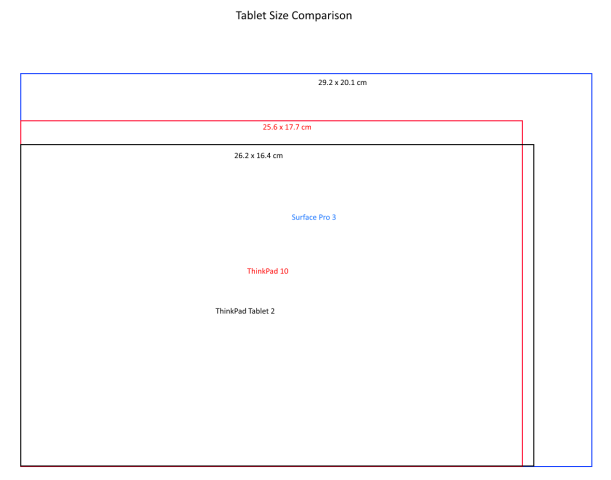 The Surface Pro 3 (SP3) is the biggest and heaviest (at 800 gm.) tablet of the three. The TP10 is roughly the same size and weight (610 – 600 gm., depending on whether it has WWAN or not) as my TPT2 (610 gm.), but has a slightly different aspect ratio. Whilst I haven’t had an opportunity to compare all three side by side in real life (and won’t until September, here in the Netherlands); reading the forums where these are discussed, I worry a little that the SP3 may be just a little too big and unwieldy as a tablet. The TP10, particularly with that changed aspect ratio, may be, as Goldilocks found, “just right”.
Screen Resolution and Aspect Ratio
The changed physical aspect ratio of the TP10 reflects the fact that the display screen ratio has also been changed: from 16:9 of the TPT2 to 16:10 of the TP10. It’s not just the ratio that has been changed, but also the resolution. The TPT2 has a screen resolution of just 1366 x 768 pixels, whereas the TP10 has 1920 x 1200. Now, I say “just”for the TPT2, but quite honestly, for the size of the device, the resolution is perfectly adequate. Nonetheless, the higher resolution of the TP10 is clearly an improvement, and the 16:10 aspect ratio even more so, as far as I’m concerned. So how does this compare with the SP3? It has to be said that the SP3 has the upper hand. Not only does it have a resolution of 2160 x 1440, this also gives it the best aspect ratio of 3:2. For reading books and documents in portrait mode, this is pretty close to what I want. The 16:10 ratio of the TP10 is in second place (with my trusty TPT2 coming in at third place with 16:9). However, if one compares reading quality, as expressed by pixel density, then in fact the TP10 comes first: it has a pixel density of 224.17 pixels per inch, while the SP3 has 216.33 pixels per inch. Obviously, the TPT2 comes third with 155.16 ppi. In summary, for me, the SP3 display is the front runner, but the TP10 is close behind.
Performance
On paper, there is no contest; the Core i3-based SP3 wipes the floor with both of the Atom-based ThinkPad tablets. Looking at the CPU Passmark benchmarks, then we have:
- SP3: 2,278
- TP10: 1,970
- TPT2: 679
The SP3 is over three times as fast as my TPT2. However, for my usage (Word, Excel, OneNote, Mail, Windows Live Writer, web browsing, playing media, Metro Apps), the TPT2 has proved perfectly adequate. Yes, extra power would be welcome on occasion; but essential? Not for what I use my tablet for. I understand that, for many people, more power is what they need. That’s not the case for me – at least not with my current usage patterns and scenarios. In summary then, the TP10 would give me a boost in power over the TPT2. The SP3 would give me a further boost in power over the TP10, but whether I really need it is a moot point. More likely, this would be gilding the lily.
Fan Or No Fan?
The biggest stumbling block for me is the fact that because the SP3 has more performance than the TP10, it requires a cooling fan. The TP10, like the TPT2 before it, is fanless. Personally, having experienced a tablet that is fanless (my TPT2), I really do not want to replace it with a tablet that has a fan. That would seem to be a huge step backwards as far as I’m concerned. Now I know that Microsoft claim that the fan in the SP3 is silent; but reading the forums, it’s clear that it is not. It’s true that at the moment all the real world experience is coming from people who have SP3 models that are fitted with the more powerful Core i5 processor. The Core i3 models (which should run cooler) won’t be available until next month. Nevertheless, it’s a concern. An additional point is that the SP3 is one of the first examples of an Intel Core-based tablet that uses InstantGo (formerly known as Connected Standby). Reading the forums, it is apparent that the bugs have not been fully ironed out. There are examples of people finding that their SP3 has turned itself on in their shoulder bags, with subsequent overheating. As a result, some people are posting ways to turn off InstantGo, which seems to me a pretty drastic course of action. My TPT2 has InstantGo, and, after some initial teething issues, solved by software updates, it now performs faultlessly, and I would not want to lose it. A fanless tablet, even if it did turn itself on in your shoulder bag, would only run the risk of unwanted battery drain, not meltdown. In summary, therefore, the fanless TP10 easily wins this round over the SP3.
Pen Support
All three devices (the TPT2, TP10 and the SP3) support active pens for accuracy and pressure sensitivity. The ThinkPads use Wacom technology, whereas the SP3 now uses N-Trig technology (earlier Surface Pro models also used Wacom). There are many heated discussions over which technology is superior, particularly amongst artists. However, since my purpose for wanting to have a pen is for simple notetaking and scribbled drawings, I will be happy with either. Both are far superior to the capacitive pens sold as accessories for iPads. The TPT2 came with a very thin pen that can be stored in the tablet itself. However, I tend to use a normal-sized Wacom pen when writing long screeds. The pens supplied with the TP10 and SP3 are of normal dimensions, which unfortunately means that they are too big to be stored in the thinner tablets. In this category, therefore there is nothing to choose between the TP10 and the SP3, as far as I am concerned.
Cameras
I was very surprised to discover recently that the rear camera in the SP3 was a fixed-focus device, rather than auto-focus. A fixed-focus camera is very limited in what it can do. Photographing documents, and similar close-up work, will be difficult, if not impossible. When this was raised in forums, lots of people jumped in to say that they would never use their tablet for making photos anyway, but always rely on their smartphones. While this is true (and my Nokia Lumia 1020 will knock the socks off any tablet camera), it does rather seem to miss a fundamental point. Microsoft are presenting the SP3 as a premium device for professionals. If Microsoft want the SP3 to be bought in large numbers by organisations, then it has to be a serious platform for Line-of-Business applications. Many such applications, these days, will want to include photos captured by the platform. For example, when the contractors arrived at our house to install and commission the solar panels and electric inverter, the team leader had an iPad with a LoB application. It contained the work order details. Once the installation was commissioned, he used the iPad camera to photograph the serial number barcode of the inverter, and the serial number was used to activate the monitoring system in the cloud. He also photographed my paper copy of the work order, now complete with my signature, and the electronic copy was added into the business process application. The iPad has an auto-focus camera, and can be used in these sorts of applications. The SP3’s fixed focus camera can’t. Here’s an example (taken from a post on the Microsoft Surface forum) of the same document photographed by an iPad (auto-focus) and the SP3 (fixed-focus) cameras: 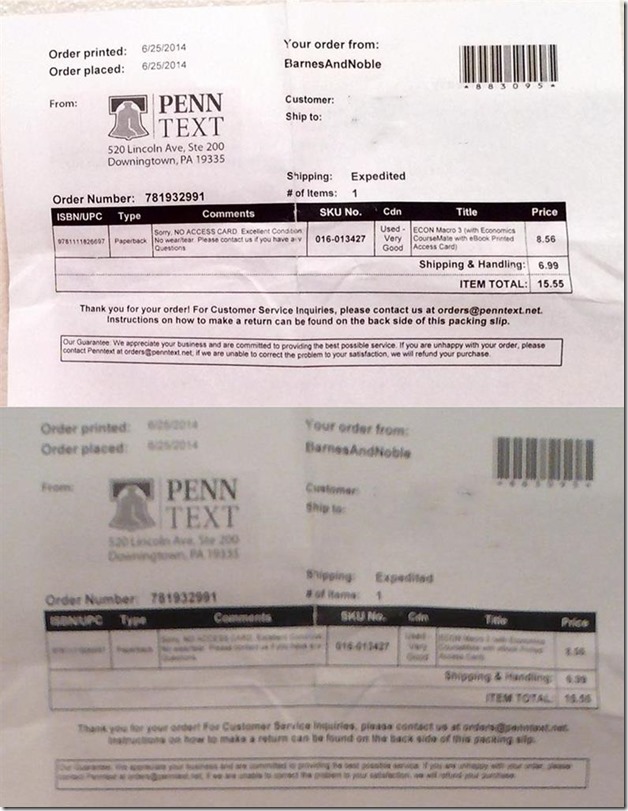 I’m sorry, but Microsoft should be ashamed of this. A common use of tablets in the field is with insurance adjusters. They will inspect a loss, taking a number of photographs along the way, notate the damage on them with a pen by circling the damage and email the pictures to the claims handler with their recommendations. The Adjusters need to take long shots and close ups (hat-tip to Bronsky for this example). The SP3 cannot be used in this scenario. My old TPT2, and the TP10, can. They both have auto-focus lenses capable of taking close-ups and wide-angle shots. Once again, Microsoft snatches defeat from the jaws of victory. As I said, most of the time I will use my Nokia 1020 for taking photos, but in practice, both my TPT2 and the TP10 cameras will far surpass the toy camera that Microsoft has put in the SP3. So, while I could live with the camera that the SP3 has, it certainly tarnishes the “premium” moniker that Microsoft would have us believe that the SP3 carries.
Sensors
Smartphones and tablets are equipped with a range of sensors these days, whilst laptops are not. The TPT2, TP10 and the SP3 all have a gyroscope, accelerometer, magnetometer and an ambient light sensor. In addition, however, the TPT2 has a GNSS sensor, which can provide GPS positioning data to the Windows 8.1 Location Service. At this point, it’s not clear whether the TP10 includes the same sensor. Lenovo’s documentation implies that all models of the TP10 have it, yet Lisa Gade found in her review of the TP10 that the model under test did not include GNSS capability. I’ve asked Lenovo if they can clarify the issue. One thing is clear, though, the SP3 does not have a GNSS sensor. And again, I find this strange, given that the SP3 is supposed to be a premium device for professionals. Microsoft state in the SP3 specifications that it has a “digital compass” for its Location Service. Do they take us for fools? A compass is not sufficient to provide accurate position data. In this category, therefore, the TPT2 is currently out in front, but if it is confirmed that the TP10 also has a GNSS sensor, then it will join the TPT2, and the SP3 will be in third place. [Addendum: Lenovo has confirmed to me that all models of the TP10 have a Broadcom 4752 GPS chip in them to provide GNSS data] Is a GNSS sensor essential for me? Honestly, no, but it is very nice to have. A number of the apps that I use require accurate position data (e.g. mapping, navigation and astronomy apps), and while I could provide this via a bluetooth GPS device to the SP3 (and the TP10, if necessary), it’s very convenient to have this built into the tablet directly.
Networking
All three devices support WiFi and Bluetooth 4.0 networks. The SP3 also supports the newest, fastest variant of WiFi: 802.11 ac in addition to the 802.11 a/b/g/n specifications. This puts the SP3 in front of the TPT2 and the TP10 in this respect. However, there are currently no models of the SP3 that are equipped with WWAN capability, whereas both the TPT2 and the TP10 have models equipped for mobile networking. Once again, just as for the camera quality, this could be an important differentiator for Business users. Is this a showstopper for me? No, it isn’t. Although my current TPT2 is equipped with WWAN, I very rarely use it, and on the occasions that I do, I could just as easily pair it with my Nokia 1020 to provide internet access to my tablet. The SP3 also does not have NFC, whilst some models of both the TPT2 and the TP10 do. This feature is more commonly found in Smartphones, but it could just take off in tablets as well. This is another “nice-to-have” feature as far as I’m concerned. Its absence is not a showstopper. Overall, therefore, given that I could live without WWAN capability, NFC, and do not need 802.11 ac speeds (or indeed have them in our home network), then there is nothing to choose between the SP3 or TP10 in this category.
Summing Up
I’ve tried to sum up using the table shown below. I haven’t assigned weightings to the categories, but if I did, then the dimensions/weight, display and noise categories would be the most important to me. You’ll notice that I have not got a battery life category. I’m assuming that both the SP3 and the TP10 would be sufficient for me.
| Category |
Front-runner |
| Dimensions/Weight |
TP10 |
| Display |
SP3 |
| Performance |
TP10 (sufficient) |
| Noise (fan) |
TP10 (fanless) |
| Pen Support |
SP3 = TP10 |
| Cameras |
TP10 |
| Sensors |
SP3 = TP10 |
| Networking |
SP3 = TP10 |
The one area where the SP3 clearly comes out on top is in the display category, because of its superior resolution and 3:2 aspect ratio. Whilst, on paper, the SP3 clearly wins in the performance category, the TP10 has sufficient performance for me, so I’ve put that first. The SP3’s superior performance also comes at a cost for me: that damn fan. In fact, I’m beginning to think that the whole case one way or another, balances around the question of the fan. If the Core i3 model of the SP3 can really minimise the use of the fan, and the problems with InstantGo resolved, then it becomes more attractive. Then the attention shifts to the dimensions and weight category. So it looks as though, at this point in the technology cycle, while the TP10 is a better fit with what I am looking for in a tablet, I must resist the temptation to pull the trigger until after some reports of the Core i3 model of the SP3 have been published, and I’ve had a chance to see, and heft, both the TP10 and SP3 in the flesh…
Addendum
I reached a decision (of sorts) on the 6th September 2014, and wrote a post on it. The bottom line:
Now that a wider range of TP10 models are available here in the Netherlands, I could get a TP10 (faster, with a better display, and twice the RAM) to replace my existing TPT2 for €620. I definitely won’t be going for the SP3 (at €819) – too many compromises and issues for me. I could also equally continue using my TPT2 quite happily and wait to see what an SP4 has to offer. There’s no rush.
































Leave a Reply